What's inside
- Key Takeaways
- Quick Picks: The Best Absorbing Beach Towels at a Glance
- How Did We Choose These Beach Towels?
- How Do the Six Beach Towels Compare Side by Side?
- Cotton, Microfiber, or Flat Weave: Which Beach Towel Family Fits Your Day?
- How Should You Care for Beach Towels Through a Season of Salt, Sun, and Sunscreen?
- What Mistakes Do Buyers Make When Choosing a Beach Towel?
- What Do Children Need From a Beach Towel That Adults Do Not?
- Pool or Sea: Does the Water Change the Towel You Should Buy?
- How Should You Set Up a Beach Camp So the Towels Stay Useful All Day?
- How Can You Tell in the First Week Whether a Beach Towel Is a Keeper?
- When Should a Beach Towel Be Retired, and What Happens to It Next?
- Final Recommendation
- Frequently Asked Questions
- Related Guides
As an Amazon Associate I earn from qualifying purchases. This post may contain affiliate links at no extra cost to you.
cottageverdict.com is reader-supported. When you buy through links on our site, we may earn an affiliate commission.
Where to buy: Every towel below is sold on Amazon, and each linked name opens its listing so you can check price on Amazon and confirm the size and pack count before ordering. If you are picking the best absorbing beach towels in a hurry, start with the White Classic Stripe Cabana Beach Towels for classic plush cotton absorbency, the Widdonen Microfiber Beach Towel Blue for a compact towel that dries between swims, and the LANE LINEN Beach Towels XL 2 Pack for oversized coverage in a pre-washed cotton that packs smaller than it looks.
A beach towel leads a double life, and most buying mistakes come from judging only one of them. For half its day it is furniture: a groundsheet, a lounger cover, a boundary marker that says this patch of sand is ours. For the other half it is equipment — the thing that has to take the sea off a swimmer, repeatedly, in wind and heat, and be ready to do it again twenty minutes later. A towel that performs the furniture role beautifully and the equipment role badly is the familiar disappointment of the category: huge, bright, photogenic, and somehow always damp, slick, and useless when a cold child climbs out of the water wanting to be dry. This guide is about the second job. Every pick here was chosen first for how it absorbs, and only then for how it looks doing it.
The distinction that matters is between towels that drink and towels that smear. A thin printed beach towel — the kind sold folded in a beach-shop bin, polyester-smooth, vivid with a sunset or a cartoon — mostly pushes water around the skin. It feels wet immediately, stays wet, and by the third swim it is a cold, sandy sheet that nobody wants against their back. A genuinely absorbent beach towel, whether plush cotton terry or well-made microfiber, takes water in. You can feel the difference in a single pass down a wet arm: one leaves the skin dry enough for sunscreen to go on evenly, the other leaves it gleaming. The six picks below sit on the drinking side of that line, in two families — cotton terry and velour for the classicists, microfiber and flat-weave Turkish cotton for the minimalists — and the reviews explain which family’s compromises suit which kind of beach day.
Size is the second honest specification. A beach towel must first cover a lounger or a lying adult, which in practice means at least 68 inches of length for anyone tall, and enough width that your arms are on towel rather than sand when you roll over. All six picks are oversized by bathroom standards, ranging from 32 to 39 inches wide and up to 71 inches long. Weight is the shadow side of size: a big plush cotton towel is a serious object when dry and a heavier one when wet, while a microfiber sheet of the same dimensions can weigh less than a paperback. Families carrying four towels, a parasol, and a cool box down a cliff path will feel that difference in their shoulders, and this guide weighs it openly rather than pretending absorbency is the only variable.
A towel also has to survive being looked at all day, which is not vanity but morale: the beach camp is a small temporary home, and its textiles set the tone of the place. Stripes, tiles, deep teal, herringbone-adjacent weaves — the picks below were chosen to look settled and intentional on the sand, because a camp that looks cared for tends to be cared for, down to the drying line and the reserve towel.
Sand, finally, is the third character in the story. Sand sticks to wet terry loops and travels home in them; it shakes off flat weaves and microfiber far more willingly. No towel is truly sand-proof while it is wet — physics is not negotiable — but construction decides whether the sand leaves at the beach with a shake or leaves in your car, your hallway, and your washing machine over the following week. Each review notes its pick’s sand behaviour, because a towel that absorbs beautifully and imports half the beach is solving one problem by creating another.
Key Takeaways
- Judge a beach towel by its second job — drying a swimmer repeatedly — not by its size or print alone.
- Plush cotton terry absorbs the most per pass; microfiber and flat-weave Turkish cotton dry fastest between swims and shed sand best.
- Oversized is functional, not luxurious: 68 inches or more of length covers a lounger and a tall adult properly.
- A towel that still feels wet at the third swim has failed, whatever its dimensions — drying speed between dips is the hidden specification.
- Sunscreen, salt, and chlorine are the real enemies of beach towels; the care routine matters as much as the purchase.
- Run the third-swim test before you commit to a set: a keeper dries you willingly on its third use of the day, because it dried itself in between.
- Keep one towel in dry reserve for the last swim of the day — the coldest emergence deserves the household’s driest towel.
Quick Picks: The Best Absorbing Beach Towels at a Glance
| Pick | Badge | Why it earns its place |
|---|---|---|
| Widdonen Microfiber Beach Towel Blue | Best compact absorber | A 71-inch microfiber sheet that rolls to almost nothing, dries between swims, and shrugs sand off. |
| COTTON CRAFT Oversized XL Beach Towels 2 Pack | Best plush cotton pair | Jacquard terry velour cotton at 450 GSM with the soft, thirsty feel traditionalists expect. |
| White Classic Stripe Cabana Beach Towels | Best classic cabana | 500 GSM cotton with navy cabana stripes — the resort towel, done properly, in a two-pack. |
| LANE LINEN Beach Towels XL 2 Pack | Best oversized value pair | Pre-washed 39-by-71 cotton that arrives soft, covers everything, and washes without fuss. |
| Utopia Towels Thin Microfiber Beach Towel 2 Pack | Best travel two-pack | Two big microfiber towels with a travel bag, built for packing light and drying fast. |
| Antfuny Turkish Beach Towels | Best flat-weave all-rounder | Turkish-style flat cotton that doubles as a blanket and refuses to carry sand home. |
How Did We Choose These Beach Towels?
We began by excluding the category’s decorative fringe: towels whose listings lead with a print and mention absorbency as an afterthought, towels too small to cover a lounger, and towels whose fabric content is a mystery. What remained had to pass three tests. First, genuine absorbency — terry loops, velour pile, quality microfiber, or dense flat-weave cotton, each a construction with a real mechanism for taking water off skin. Second, honest dimensions, stated in inches and large enough for adults. Third, a plausible life after the beach: machine washability, colours and weaves that tolerate sun, salt, and sunscreen, and pack counts that make sense for how people actually go to the beach, which is rarely alone and never with quite enough towels.
We paid attention, too, to the small print of beach life that listings rarely mention and owners always meet: whether the towel’s colour will survive a chlorinated pool season, whether its hems are built to be shaken hard with a load of wet sand in them, whether a two-pack is truly two full towels rather than one towel and a gesture. Beach towels are bought in spring optimism and judged in August reality, and the gap between those two moments is exactly where careful reading of dimensions, materials, and construction earns its keep.
We also insisted on representing both families of the category fairly. Cotton loyalists distrust microfiber’s feel; microfiber converts distrust cotton’s wet weight; flat-weave enthusiasts think both are overengineered. Each position has evidence behind it, and the reviews below argue each pick on its own family’s terms while naming the cost of choosing it. Where a towel’s listing claims sand-free or quick-dry performance, we treat those as the maker’s framing and judge the construction instead — because construction, not adjectives, is what you will be lying on in August.

Widdonen Microfiber Beach Towel Blue — Best compact absorber
The Widdonen is the towel for people who travel to the water rather than living beside it. At 71 by 32 inches it is a full adult beach towel, yet the microfiber rolls or folds into a package smaller than a water bottle, which changes the packing mathematics of any trip: two towels take the space of one cotton one, and a towel can live permanently in a swim bag, a car boot, or a carry-on without justifying itself weekly. In use, microfiber’s absorbency works by surface area — it does not feel like cotton, it feels efficient, pulling water off skin in a couple of passes and then, spread over a bag or a railing, drying in the sun and breeze faster than any cotton pick in this guide. Between-swim drying is where this towel earns its keep: by the third dip, when the plush towels are still carrying the first, the Widdonen is ready again.
The listing’s suggested range — camping, hiking, swimming, pool, picnic, gym, cruise — is broad but believable for a towel of this format, and cruisers and campers in particular will understand the appeal of a towel that rinses in a sink and dries overnight on a balcony. Sand behaviour is excellent once the towel is dry: a shake clears it, because microfiber gives sand nothing to grip. The trade-offs are the family’s usual ones. Microfiber has a slightly grabby feel on dry skin that some swimmers dislike, it offers no cushion between you and hard poolside concrete or pebbly ground, and it must be washed without fabric softener to keep its thirst. None of those will trouble the traveller it was made for.
- Material: microfiber
- Size: 71 x 32 inches
- Colour: blue
- Character: thin, compact, quick-drying, sand-shedding
- Uses listed: beach, camping, hiking, swim, pool, picnic, gym, cruise
Strengths
- Full adult length that packs down smaller than any cotton towel here.
- Dries between swims, staying useful through a whole day of dips.
- Sand shakes off cleanly once dry — nothing for grit to cling to.
Trade-offs
- Microfiber’s grabby hand-feel is not every swimmer’s favourite.
- No padding on hard or pebbly ground; it is a sheet, not a mattress.
- Fabric softener will quietly destroy its absorbency if used in the wash.
Best for: travellers, swimmers, and anyone carrying their beach on their back. Not suited for: sunbathers who want plush cushioning between themselves and the ground.

COTTON CRAFT Oversized XL Beach Towels 2 Pack — Best plush cotton pair
For the traditionalist, this is what a beach towel is supposed to be: 39 by 68 inches of cotton terry velour at 450 GSM, jacquard-woven in a blue tile pattern, sold as a pair. Terry velour is the classic beach construction for a reason — one face carries the loops that drink, the other is sheared smooth into velour that prints and drapes beautifully — and in the hand this towel has the soft, dense, slightly springy feel that microfiber never imitates. Its absorbency per pass is the best in this guide: a swimmer can be dried properly, once, with one towel, and wrapped in something that feels like comfort rather than equipment. As furniture it is equally convincing, covering a lounger end to end with enough weight to stay put in a sea breeze.
The pair format suits couples and parents-and-child beach days, and the jacquard pattern is woven rather than printed, so it will not crack or peel across seasons of sun. Now the honest costs, which are cotton’s eternal ones. Wet, this towel is heavy — carrying two of them back up from the shore at the end of the day is a noticeable job — and it dries slowly, so a morning swim’s towel may still be damp for the afternoon unless it gets full sun and wind. Sand embeds in the terry face and needs a vigorous shake and a proper wash to fully leave. None of this is a defect; it is the price of plush, stated plainly so that buyers who value the plush can pay it gladly and buyers who do not can choose otherwise.
- Material: 100% cotton terry velour, jacquard woven
- Weight: 450 GSM
- Size: 39 x 68 inches each
- Pack: 2 towels, blue tiles pattern
- Character: plush, soft, highly absorbent
Strengths
- Best absorbency per pass in this guide, with a genuinely plush feel.
- Jacquard pattern is woven in, so it survives seasons of sun and washing.
- Weight and size make it stay put on a lounger in a sea breeze.
Trade-offs
- Heavy when wet, and slow to dry between swims on a still day.
- Terry face holds sand and brings some of it home despite shaking.
- Two plush towels occupy serious bag and shelf space.
Best for: beach traditionalists and lounger-based days near home or a parked car. Not suited for: long carries, backpacking, or multi-swim days without sun to dry in.

White Classic Stripe Cabana Beach Towels — Best classic cabana
The cabana stripe is the uniform of every good resort pool, and this two-pack — 35 by 70 inches, 500 GSM cotton, navy stripes on white — is that uniform made honestly. At 500 GSM it is the densest cotton here, denser even than the COTTON CRAFT pair, and the absorbency shows it: this is the towel to hand a swimmer who wants to be dry, warm, and done. The stripe does practical work too. It marks the towel’s orientation at a glance, distinguishes yours from the identical whites around a shared pool, and reads as crisp and deliberate in photographs and in person — the rare beach purchase that improves how the whole setup looks.
White cotton at the beach is a commitment, and the review should say what kind. It tolerates hot washing and brightens back up in a way colours cannot, which suits towels that meet sunscreen, salt, and the occasional ice-cream incident weekly. But it will record every one of those incidents until wash day, and households that prefer their gear to hide its history should choose a colour instead. The size, at 35 inches wide, is slightly narrower than the widest picks while keeping the full 70-inch length — a proportion that suits loungers particularly well, since lounger width is the dimension that actually constrains. As a matched pair for a couple, or as the house set for a pool, this is the most classic option in the guide and proud of it.
- Material: 100% cotton
- Weight: 500 GSM
- Size: 35 x 70 inches each
- Pack: 2 towels, navy blue cabana stripe
- Character: thick, plush, quick to absorb
Strengths
- Densest cotton here — dries a swimmer thoroughly in a single pass.
- Cabana stripe looks resort-crisp and identifies your towel poolside.
- White base tolerates hot washes that restore it after sunscreen and salt.
Trade-offs
- White records stains faithfully until laundry day arrives.
- At 500 GSM it is a heavy carry when wet, like all plush cotton.
- Slightly narrower than the widest picks, though the length is full.
Best for: pool owners, resort-style beach days, and couples wanting a matched classic pair. Not suited for: buyers who want stains hidden or weight kept low.

LANE LINEN Beach Towels XL 2 Pack — Best oversized value pair
The LANE LINEN pair attacks the two complaints people bring home from the beach — the towel was too small, and the towel was stiff — in one product. The dimensions are the largest in this guide alongside the flat weave: 39 by 71 inches, enough to wrap a tall adult completely or to give a child a small principality of towel to rule. And the cotton is pre-washed, which means the softness that ordinary cotton towels take a dozen washes to reach is present on the first day, along with absorbency that does not need breaking in. Pre-washing also pre-shrinks, so the size on the listing is the size that survives the laundry — a quiet honesty that buyers only appreciate after owning towels that shrank into placemats.
The Old Glory teal colourway is deep enough to hide the ordinary evidence of beach life between washes while still looking intentional, and the maker’s sand-free framing should be read the way we read all such claims: the relatively smooth cotton surface sheds dry sand well with a shake, better than deep terry, though no wet towel of any construction releases sand completely. Machine washability is emphasised in the listing and matters here, because a 39-by-71 towel that needed special handling would quickly become a burden. Its compromises are cotton’s standard ones — wet weight and drying time sit between the plush pair and the microfibers — but as a balanced, generously sized, ready-from-day-one pair, it is the easiest recommendation in this guide for a family buying its first proper beach towels.
- Material: cotton, pre-washed
- Size: 39 x 71 inches each
- Pack: 2 towels, Old Glory teal
- Character: oversized, soft from first use, machine washable
- Note: smooth surface sheds dry sand with a shake
Strengths
- Largest dimensions here, with pre-washed softness and absorbency from day one.
- Pre-shrunk, so the generous size survives the wash honestly.
- Deep teal hides beach-day evidence between washes gracefully.
Trade-offs
- Cotton’s wet weight and drying time remain, if milder than the plush pair.
- Sand-free is a direction, not a fact — wet sand still needs a rinse at home.
- Two towels this size need real storage room in a small linen cupboard.
Best for: families and tall swimmers buying a first serious pair of beach towels. Not suited for: ultralight packing or anyone counting grams on a long carry.

Utopia Towels Thin Microfiber Beach Towel 2 Pack — Best travel two-pack
Utopia’s entry takes the Widdonen’s compact logic and doubles it: two microfiber beach towels, each 32 by 71 inches, supplied with a travel bag. The bag is not a trivial accessory. It gives the pair a home in a suitcase or a car boot, keeps damp towels corralled away from dry clothes on the journey back, and turns “did we pack the beach towels” into a single glance. For couples who travel, families splitting towels between two bags, or anyone who keeps a permanent swim kit ready to grab, that organisation is worth as much as the fabric. The fabric itself is the familiar microfiber proposition: thin, light, quick to absorb across its surface, and quicker still to dry, with the listing aiming it at beach, pool, camping, picnic, and travel use — a range this format genuinely covers.
Two towels also solve microfiber’s one structural limit at the beach, which is capacity per session. A single microfiber towel used by one swimmer all day performs beautifully because it dries between dips; shared among a family’s worth of swimmers in rotation, any towel struggles. A pair restores the rhythm — one in use, one drying on the line or the parasol — and the household stops rationing. The compromises echo the Widdonen’s: the grabby microfiber feel, no ground cushioning, and the softener prohibition in the wash. Buyers deciding between the two microfiber picks should choose on logistics: the Widdonen for the solo traveller’s single towel, this pair for anyone whose beach headcount is two or more.
- Material: microfiber
- Size: 32 x 71 inches each
- Pack: 2 towels with travel bag
- Character: thin, lightweight, compact, quick-drying
- Uses listed: beach, pool, camping, picnic, travel, outdoors
Strengths
- Travel bag keeps the pair organised and damp towels away from dry kit.
- Two towels restore the use-one, dry-one rhythm for couples and families.
- Full 71-inch length in a package that disappears into luggage.
Trade-offs
- Same microfiber hand-feel and softener rules as every microfiber pick.
- Thin sheet offers no padding on shingle or hard pool surrounds.
- At 32 inches wide it is the narrowest full-length option here.
Best for: travelling couples and families who pack light and swim often. Not suited for: lounger traditionalists who equate a beach towel with cushioning.
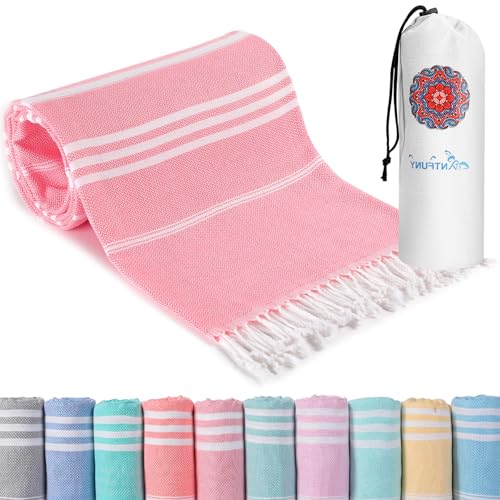
Antfuny Turkish Beach Towels — Best flat-weave all-rounder
The Antfuny represents the third way between terry and microfiber: the Turkish flat weave, a large thin cotton sheet in the peshtemal tradition, marketed with a blizzard of adjectives — quick dry, sand free, soft, absorbent, lightweight, packable — that in this case rest on a real foundation. Flat-weave cotton absorbs by fibre, dries by exposure, and sheds sand by having no loops for sand to lodge in; all three properties are structural, not chemical, and they survive washing indefinitely. Spread on the sand, the Antfuny behaves almost like a light blanket, and the listing leans into that, calling it a blanket and pool towel as much as a drying towel. That dual identity is honest: flat weaves are the towels people end up using as wraps, sarongs, picnic cloths, and evening shoulders-cover when the breeze turns.
As a drying tool it asks for a small technique adjustment. Flat cotton does not blot like terry; it wipes and presses, and it works best slightly warmed by the sun, which at a beach it usually is. In exchange, it will be dry again in a fraction of a plush towel’s time and it folds into a tote bag corner. The compromises: no cushion, no plushness, and a first-use absorbency that improves after washing, as with all flat-weave cotton. Buyers who want one textile that does the whole beach — lie on it, dry with it, wrap up in it, picnic on it — will find this the most versatile single purchase in the guide, and the one most likely to be borrowed by everyone else in the party.
- Material: Turkish-style flat-weave cotton
- Format: extra-large single towel/blanket
- Character: thin, lightweight, fast-drying, packable
- Sand behaviour: flat surface releases sand readily
- Uses: beach, pool, picnic, wrap, travel
Strengths
- Most versatile textile here — towel, blanket, wrap, and picnic cloth in one.
- Flat weave sheds sand better than any looped construction can.
- Dries fast and folds into a corner of any beach bag.
Trade-offs
- Wiping technique replaces blotting; terry loyalists need a day to adjust.
- No cushioning and no plush feel at any point in its life.
- Absorbency peaks after the first few washes rather than on day one.
Best for: minimalists and multi-purpose packers who want one textile for the whole beach. Not suited for: anyone whose beach day centres on a lounger and a thick, soft wrap.
How Do the Six Beach Towels Compare Side by Side?
| Towel | Material | Size | Standout trait |
|---|---|---|---|
| Widdonen Microfiber Beach Towel Blue | Microfiber | 71 x 32 in | Packs smallest, dries between swims |
| COTTON CRAFT Oversized XL Beach Towels 2 Pack | Cotton terry velour, 450 GSM | 39 x 68 in, 2 pack | Plushest absorbency per pass |
| White Classic Stripe Cabana Beach Towels | Cotton, 500 GSM | 35 x 70 in, 2 pack | Classic cabana density |
| LANE LINEN Beach Towels XL 2 Pack | Cotton, pre-washed | 39 x 71 in, 2 pack | Largest, soft from day one |
| Utopia Towels Thin Microfiber Beach Towel 2 Pack | Microfiber | 32 x 71 in, 2 pack + bag | Travel pair with its own bag |
| Antfuny Turkish Beach Towels | Flat-weave cotton | Extra large, single | Towel-blanket versatility |
Cotton, Microfiber, or Flat Weave: Which Beach Towel Family Fits Your Day?
The families divide by itinerary more than by quality. If your beach is a lounger, a parasol, and a car parked fifty metres away, cotton terry is the right answer and its weight is irrelevant: the COTTON CRAFT and White Classic pairs will dry you best, feel best, and look the part. If your beach involves a train, a hike, a boat, or a suitcase, microfiber’s arithmetic wins before the day starts, because the towels you can carry are the towels you have. Flat weave sits between the stools and slightly outside the argument — it is the choice of people who want the towel to be several things and who read a beach day as an afternoon lived on a textile rather than a series of dips.
Swimming frequency is the second divider. An occasional dipper needs absorbency per pass, which is cotton’s crown. A serial swimmer — the person in and out of the water all day, the parent supervising children who are never out of it — needs a towel that recovers between uses, which is microfiber and flat weave’s crown. Many households end up owning both families and deploying them by day: plush cotton for the pool at home, compact towels for the travelling beach. That is not indecision; it is the correct answer to two different questions, and the packs in this guide are priced and sized to make the mixed strategy painless.
How Should You Care for Beach Towels Through a Season of Salt, Sun, and Sunscreen?
Beach towels endure the harshest laundry life of any household textile. Salt stiffens fibres, chlorine fades and weakens cotton, sunscreen leaves greasy marks that set if they are baked in a hot car, and sand works into weaves like grit into a bearing. The countermeasures are simple and mostly about timing. Shake sand out at the beach, while it is still dry enough to leave. Rinse or wash towels promptly after a beach day rather than letting them ferment in a bag — a damp, salty, sunscreened towel left for three days will smell of all three permanently. Wash in warm water with ordinary detergent, skip fabric softener (it coats fibres and kills absorbency, microfiber most of all), and dry fully before storing.
Sunscreen stains deserve their own word, because they are the marks owners most often misread as towel failure. Many sunscreens react with wash water and leave rusty-orange patches on light fabrics; treating the marks promptly, before washing, gives the best outcome, and white cotton — the White Classic pair — at least permits the strongest wash treatments without colour loss. Colours and microfiber ask for gentler handling. Finally, store beach towels dry, aired, and out of direct sun when they are not in use; ultraviolet that fades a towel on the beach will keep fading it on a sunny shelf all winter, and a towel put away fully dry in autumn will greet the next summer fresh instead of musty.
What Mistakes Do Buyers Make When Choosing a Beach Towel?
The first mistake is buying the print. A beach towel is used hard, wet, and in public for years; the sunset scene that charmed in the shop will be a faded joke by the second season, while the absorbency you did not check will still be failing daily. Construction first, dimensions second, decoration third — the order this guide is written in. The second mistake is buying bathroom size. A standard bath towel at the beach covers neither a lounger nor an adult, and the saving is repaid in sand on skin all day. The third mistake is buying exactly as many towels as people, with no allowance for one being wet, sandy, or commandeered as a picnic blanket; beach arithmetic always wants one more towel than the headcount.
The fourth mistake is packing a wet towel into a closed bag and forgetting it, the single fastest route to a towel that must be thrown away. The fifth is expecting one towel family to be best at everything — demanding plush comfort from microfiber, or luggage-friendly weight from 500 GSM cotton, and then blaming the towel. Every pick in this guide is excellent at its own job. The buyer’s only real task is deciding, honestly, which job their beach actually involves.
What Do Children Need From a Beach Towel That Adults Do Not?
A child’s beach towel works harder than any adult’s. It dries a small swimmer who is in and out of the water a dozen times a day, it wraps for warmth the moment that swimmer emerges shivering, it becomes a changing tent, a nap blanket, a superhero cape, and a repository for shells, sandwiches, and sand in quantities that defy physics. Absorbency matters doubly because children feel cold faster and complain about it more honestly: a towel that smears water around will be rejected by its owner within the hour, loudly. The plush cotton pairs in this guide, the COTTON CRAFT and the White Classic, are the natural children’s choices for a home beach — maximum drying per pass, enough weight to wrap and stay wrapped, and a size a child can grow into rather than out of by next summer.
For travelling families the calculus flips, because the children’s towels travel in the parents’ bags. A microfiber pair like the Utopia set lets each child carry a personal towel in a daypack, which distributes the load and ends the damp-towel-in-the-shared-bag problem that sours car journeys. Colour-coding helps more than any feature: when each child’s towel is recognisably theirs, towels stop being lost, swapped, and fought over. Whatever the family chooses, buy the children’s towels to the same absorbency standard as the adults’. The cheap printed towel aimed at children is the worst product in the category precisely because its user is the person least able to dry themselves with a substandard tool.
One practical note on warmth: a wet child wrapped in a dry towel warms up; a wet child wrapped in a wet towel does not, whatever the towel cost. This is the real argument for the family spare and for fast-drying towels in rotation — by mid-afternoon, the household needs at least one genuinely dry towel in reserve for the last, coldest emergence from the water. Plan the towel count around that moment and the whole day runs more kindly.
Pool or Sea: Does the Water Change the Towel You Should Buy?
It changes the towel’s enemies. Sea water brings salt and sand: salt stiffens cotton fibres and makes a towel feel boardy if it is not rinsed, and sand infiltrates every loop a terry towel offers. Seaside households therefore benefit from the constructions that release both — flat weaves and microfiber that rinse clean in seconds — or from a rinsing discipline applied to their plush towels: a freshwater rinse at the beach shower, a proper wash at home, and no towel left salty in a bag. Pool water brings chlorine instead, which fades colours and, over a season, weakens cotton; the white cabana pair turns this into an advantage, since white has no colour to lose and tolerates the strong washes that strip chlorine and sunscreen.
The setting changes the furniture role too. Poolside is hard surfaces — concrete, tile, lounger slats — where a plush towel’s cushioning is a genuine comfort and its weight keeps it in place. Sand is already soft, which quietly removes cotton’s cushioning advantage and rewards the towels that spread wide and shake clean. Lake and river swimmers split the difference and add mud to the equation, which argues for darker colours and easy washing — the LANE LINEN teal was practically specified for a lake house. Read your water honestly and the family choice often makes itself: the towels are all absorbent, but they are absorbent in different landscapes.
There is also the question of the journey home. A seaside towel travels wet and sandy; a pool towel travels wet and chlorinated; both punish a closed bag. The travel bag supplied with the Utopia pair, or any breathable bag used with discipline — towel aired at the first opportunity, washed the same evening — is the difference between a towel that lasts five summers and one that is retired, smelling of mildew, before the second. The water chooses the towel; the journey home decides how long it lives.
How Should You Set Up a Beach Camp So the Towels Stay Useful All Day?
A little camp discipline multiplies what any towel can do. Establish a drying line from the start — a parasol rib, a line between two chairs, the roof bars of the car — and put each towel on it the moment its swimmer is dry, rather than leaving towels in a communal damp pile where they keep each other wet. The pile is the enemy: it is where absorbency goes to die by noon. Rotate deliberately, so the driest towel is always the one handed to the next swimmer, and keep one towel in reserve, folded in the bag, untouched, against the end of the day when everyone is cold and the sun is lower. That reserve towel is the mark of a well-run beach camp, and children who have once been wrapped in a genuinely dry towel at six in the evening will demand the system be maintained forever.
Keep a sand boundary as well. Towels that live on the sand collect it; towels that live on a blanket, a mat, or a lounger stay cleaner and keep their absorbency for swimmers instead of spending it on the ground. This is the flat-weave blanket logic of the Antfuny used deliberately: one textile assigned to ground duty, the drying towels kept off the sand until they are needed. Shake everything at the shoreline before packing — dry sand leaves willingly at the beach and reluctantly forever after — and the car, the hallway, and the washing machine will all testify that the system works.
How Can You Tell in the First Week Whether a Beach Towel Is a Keeper?
Give it the third-swim test, which is the examination every beach towel actually sits. Use it for a full day: dry off after a first swim, let it air while you swim again, and judge it at the third emergence, when novelty has worn off and the towel has done real work. A keeper takes water off your skin on that third use almost as willingly as it did on the first, because it dried in between. A failure feels cold, slick, and saturated — it has spent the day storing your swims rather than shedding them. No specification sheet reports this number, which is why this guide keeps returning to it: drying between uses, in the conditions of your beach, is the performance that decides whether a towel is loved in August or abandoned in the boot.
The home tests matter too. Wash the towel as you will actually wash it — your machine, your detergent, your line or dryer — and see whether the colours hold, the hems stay flat, and the fabric keeps its hand. Cotton towels that curl at the edges after two washes will annoy for years; microfiber that emerges from a softener-free wash still thirsty has passed its real examination. And check the towel against your lounger and your bag, the two pieces of furniture it must fit. A towel that is perfect in the abstract and wrong for your actual lounger width or your actual carry is the wrong towel, and the first week is when that is cheapest to learn.
Finally, watch who reaches for it. In any household or holiday group, one towel becomes the favourite — fought over, hidden, claimed — and that towel is telling you the household’s true preference among plush, flat, and microfiber, whatever was said during the shopping. Buy the second set in the favourite’s image, and let the others serve as the rotation and the spares. Beach equipment, like everything else in a family, is ultimately chosen by use rather than by committee.
When Should a Beach Towel Be Retired, and What Happens to It Next?
A beach towel’s absorbency rarely dies in a single event; it fades as fibres clog with sunscreen, detergent residue, and the mineral memory of a hundred swims. The first intervention is a strip wash — a hot wash without softener, with a vinegar rinse — which revives most fading towels by clearing what coats the fibres. If a cotton towel still pushes water around after that, its loops are worn or permanently coated, and its drying career is over. Microfiber that has gone slick from softener sometimes recovers with the same treatment; microfiber that has been repeatedly overheated does not, because the fibres themselves have fused at their tips.
Retirement from the beach is not retirement from the house. A faded, less thirsty towel remains excellent as a ground cloth, a car-seat protector after swims, a dog towel, a picnic layer, or the towel kept by the door for wet feet and wetter weather. Flat weaves in particular seem to live forever in second careers, since their usefulness never depended on pile. Demote in stages, and the household’s towel economy runs itself: new towels to the beach, veterans to the car and the garden, and only the truly exhausted to the rag bag. It is the same lifecycle the peshtemal has followed for centuries, and it is available to any household willing to buy quality once and demote it slowly.
Final Recommendation
Match the towel to the journey and the swimmer. For a home pool or a drive-to beach, the White Classic cabana pair is the classic done right, with the COTTON CRAFT pair close behind for lovers of pattern and plush. For travel, festivals, boats, and swim-heavy days, the Utopia two-pack and the Widdonen single bring absorbency that survives being packed in a bag the size of a shoebox. The LANE LINEN pair is the family default — biggest, softest from day one, least fuss — and the Antfuny is the free spirit’s single textile for everything. Buy one more towel than the headcount, shake the sand off at the shoreline, wash the day away the same evening, and the towel you spread next summer will still be drinking like it did on its first morning by the sea. That is the whole secret of the category, in the end: not a miracle fibre or a record-breaking specification, but a well-made towel, honestly sized, matched to the way your household actually reaches the water, and cared for with the same unglamorous promptness that keeps every good textile alive season after season.
Frequently Asked Questions
Why does my beach towel just push water around instead of drying me?
Because it was made to be looked at. Thin printed towels, often polyester or a very light cotton, have no loops, pockets, or fibre density to take water in, so the water moves across the skin instead of into the towel. A terry, velour, quality microfiber, or dense flat-weave towel absorbs by construction. If your current towel smears, replacing it with any pick in this guide will feel like a different product category, because it is.
What size should a beach towel be for a tall adult?
Look for at least 70 inches of length so the towel covers a lounger fully and wraps without a gap, and 35 inches or more of width if you like your arms on the towel while sunbathing. The LANE LINEN pair at 39 by 71 inches and the White Classic at 35 by 70 are the comfortable benchmarks here; the microfiber picks keep the length while trading a little width for packability.
Are microfiber beach towels really as absorbent as cotton?
They absorb differently. Cotton terry holds more water in total and feels drier against the skin in a single pass, while microfiber takes water quickly across its surface and then dries so fast that across a whole day of swimming it often delivers more total drying. For one long swim and a slow afternoon, cotton wins; for repeated dips, microfiber’s recovery makes it the more useful towel.
How do I stop beach towels smelling musty by mid-season?
Break the damp chain. Shake out sand at the beach, never seal a wet towel in a bag overnight, wash promptly after beach days without fabric softener, and dry fully — sun and moving air are ideal — before folding away. A vinegar rinse in an occasional wash strips the build-up that traps odor in the fibres. Mustiness is a schedule problem wearing a smell’s clothing; fix the schedule and the smell does not recur.
Can I use a beach towel as a bath towel at home?
Yes, and many people do — the oversized cotton pairs in this guide work beautifully as bath sheets for tall adults. The reverse journey is less happy: a standard bath towel is too small for lounger duty and often too precious in pile for sand. Flat-weave and microfiber beach towels also double as travel bath towels, which is part of their appeal for small bathrooms and guest rooms.
How many beach towels does a family need?
One per person, plus one spare for the household — the spare covers the towel that is still damp, the one that became a picnic blanket, and the guest nobody counted. In pack terms, two of the two-packs in this guide outfit a family of three or four with the spare included. Owning the spare is what turns beach packing from a negotiation into a routine.
Do darker or patterned towels hide beach wear better?
Yes, and for working towels it is a legitimate strategy. Sunscreen marks, salt tide-lines, and the general greying of a hard season all show least on deep colours and woven patterns — the LANE LINEN teal and the COTTON CRAFT jacquard both exploit this. White’s counter-argument is restorability: it can be washed hotter and brighter than any colour, so it returns to new-looking in a way colours cannot. Choose hiding or restoring, but choose deliberately, because a pale patterned towel gets neither benefit.
Should I rinse a beach towel with fresh water at the beach?
If a beach shower is available, a quick rinse pays for itself: it removes salt before the drive home, keeps cotton from drying board-stiff, and means the evening wash starts from a better place. Wring the towel well afterwards and air it at the first opportunity rather than sealing it wet into a bag. Households without a beach shower can achieve most of the same effect by washing promptly the same evening — the enemy is never the salt itself, but the days a salty, damp towel spends forgotten.
Related Guides
A well-run beach house draws on several of our towel guides at once. The small textiles that greet guests are covered in Best Affordable Decorative Hand Towels, for the holiday rental or the house full of visitors, while Best Antimicrobial Towels looks at the towels built to stay fresher between washes during a long, damp season. Back at the house, Best Bar Towels covers the unglamorous cloths that handle drinks and spills all summer. And for the beach itself, our companion guide to Best Sand-Free Beach Blankets picks up where the towels leave off, with ground cover designed to keep the sand where it belongs — on the beach, under the camp, and out of the car, the hallway, and next week’s laundry.



[…] towels sit in a family of fast-drying textiles worth exploring together. Our guide to Best Absorbing Beach Towels applies the same surface-area logic to the shore, while Best American-Made Bath Towels looks at […]