What's inside
- Key Takeaways
- Quick Picks
- How did we judge machines that make ice as a craft product?
- How do the best countertop clear ice makers compare side by side?
- Why is clear ice clear — and why does it melt so slowly?
- Cube or sphere: which shape belongs in your glass?
- How do you build a clear ice routine that actually works?
- What does the water have to do with clarity?
- How do you serve clear ice without spoiling the effect?
- What does clear ice cost to run, in time and electricity?
- Who should skip clear ice and buy the bullet machine instead?
- How do you clean and descale a clear ice maker properly?
- What glasses and drinks show clear ice at its best?
- How does a home bar grow around a clear ice machine?
- Which clear ice mistakes waste good machines and good whisky?
- Final Recommendation
- Frequently Asked Questions
- Related Guides
As an Amazon Associate I earn from qualifying purchases. This post may contain affiliate links at no extra cost to you.
cottageverdict.com is reader-supported. When you buy through links on our site, we may earn an affiliate commission.
Where to buy: each machine below is sold through Amazon, and the names in the Quick Picks table and the detailed reviews link straight to its listing, where you can check price on Amazon and confirm the ice size and included accessories before ordering. The best countertop clear ice makers exist because of a disappointment every home drinker eventually meets: ordinary ice melts into the drink it was meant to chill, watering a good whisky into a sad one within twenty minutes. Clear ice — dense, transparent, frozen slowly in one direction — melts at a stately pace, looks like glass sculpture in the glass, and has until recently required either a specialist bar or a cooler, a bread knife, and a free afternoon.
These countertop machines automate that trick. They freeze water directionally, pushing air and impurities out of the ice as it forms, and they produce either large clear cubes or clear spheres — the two shapes that matter, because a two-inch cube or ball presents the least surface area to the drink for its volume, which is the whole physics of slow dilution. The trade is time and quantity: where a bullet-ice machine drops cubes every six minutes, a clear ball maker may take forty minutes to an hour over a handful of spheres. You are buying quality per piece, not volume per hour.
The six picks divide by shape and tempo. One EUHOMY makes clear cubes at a comparatively brisk 34 pounds a day; two EUHOMY ball makers and two ecozy ball makers cover the sphere market at different sizes and speeds; and a final EUHOMY makes two-inch cubes under app control for the planner who wants ice ready on a schedule. This guide matches them to drinking habits, then explains the freezing science, the water question, and the storage rhythm that clear ice rewards.
Key Takeaways
- Clear ice melts slowly because it is dense and air-free, and because large cubes and spheres minimise surface area against the drink.
- The EUHOMY clear cube maker is the volume pick: 34 lbs a day of clear cubes, fast enough to supply a gathering as well as a nightcap.
- Ball makers trade speed for spectacle: expect 32 to 144 spheres a day depending on size, with the 2.4-inch balls the slowest and most dramatic.
- Two-inch spheres and cubes are sized for whisky and cocktails; smaller, faster output suits highballs and everyday drinks.
- Every machine here benefits from filtered water — clarity begins with what goes into the reservoir, not only with the freezing method.
- Clear ice keeps beautifully in the freezer, so the winning routine is to make it ahead and bank it, rather than freezing to order.
Quick Picks
| Pick | Badge | What earns it a place at the bar |
|---|---|---|
| EUHOMY Clear Ice Cube Maker 34 Lbs/Day | Best Overall | Clear cubes at 34 lbs a day from a 1.5L top tank, with two ways to add water, self-cleaning, and a scoop and basket — the volume end of clear ice. |
| EUHOMY Clear Ice Ball Maker 2.4 Inch | Best Large Sphere | Two 2.4-inch crystal-clear spheres in about 60 minutes, 48 a day, with timer and self-cleaning — the statement ice for serious whisky glasses. |
| ecozy Clear Ice Ball Maker | Best Compact Sphere Maker | A minimal-footprint 2.4-inch sphere maker using CrystalFlux technology, one piece in about 40 minutes, 32 a day, with an 8-hour timer and self-cleaning. |
| ecozy 2 Inch Ice Ball Maker 144 Pcs/Day | Best High-Volume Spheres | Four 2-inch clear spheres in about 40 minutes and 144 a day, with CrystalFlux freezing, enhanced insulation, auto water supply, and self-cleaning. |
| EUHOMY 2 Inch Clear Ice Ball Maker 144 Pcs/Day | Best Sphere Value at Volume | Four clear 2-inch spheres in about 40 minutes, 144 a day, self-cleaning — EUHOMY’s high-output answer for whiskey and bourbon drinkers who entertain. |
| EUHOMY 2 Inch Clear Ice Cube Maker with App | Best Smart Cube Maker | Two 2-inch clear cubes in about 27 minutes and 110 a day, with app control, a 24-hour timer, self-cleaning, and tongs included for whisky service. |
How did we judge machines that make ice as a craft product?
Clarity came first, and we mean the word literally: a finished cube should read as glass, transparent through its centre, not merely pale at the edges with a white heart. True clarity is the visible evidence of directional freezing done properly — air and minerals expelled rather than trapped — and it predicts the dense, slow-melting behaviour the buyer is paying for. Machines whose method or pace left a cloudy core were marked down regardless of their other charms.
Second, we weighed tempo against honesty. Clear ice is slow by physics, and the makers here quote their output in pieces per day rather than pounds for a reason: a 2.4-inch sphere every half hour or so is a production line for one drinker’s evening, not for a wedding. We favoured machines whose stated yields — 32, 48, 110, 144 pieces — matched a plausible household rhythm, and we note in each review the drinking pattern that yield actually serves.
Third came the ownership details that decide whether a craft appliance becomes a ritual or a regret: self-cleaning programmes, timers that let the machine work while you are out, the tongs and storage the maker includes, and how the finished ice releases. Clear ice asks more of its owner than bullet ice does; the machines that repay that attention with reliability and small courtesies earned their places here.
We also asked a ruder question of every candidate: what happens in month six, when the novelty has faded and the machine must survive on usefulness alone? The survivors are the ones whose output a household can organise a small ritual around — a banking rhythm, a cleaning cycle that runs itself, a size of ice that fits the glasses actually owned. Novelty is a launch feature; ritual is the retention feature, and this category lives or dies on the second.

EUHOMY Clear Ice Cube Maker 34 Lbs/Day — Best Overall
Most clear ice machines ask you to accept scarcity as the price of beauty; this EUHOMY argues you can have a working supply. Its clear cubes emerge at a rate the maker frames as sixteen pieces in about seven minutes, building toward 34 pounds a day — figures that belong to a different league from the stately ball makers below, and that change the machine’s role from nightcap accessory to household ice supply with unusually good manners in the glass.
The design supports that role. A 1.5 litre top tank and two ways to add water — pour in, or let the machine draw — keep the reservoir question painless across a long day’s production, and the self-cleaning programme handles the hygiene that any water appliance eventually demands. The cubes themselves are the clear, dense kind that chill a highball or a whisky with noticeably less dilution than freezer-tray ice, and their square shape stacks in the glass and in the freezer bag with a tidiness spheres never manage.
Honesty requires a calibration: high-tempo clear cubes will not match the jewel-like perfection of the slowest sphere makers at their best, and a purist examining a cube against the light may find more character in it than a one-hour freeze produces. But for the household that wants clear ice as a daily utility rather than a ceremony — drinks for four, on a Friday, without a week’s planning — this is the machine that makes the category practical.
It is also the natural upgrade path for owners of bullet machines who discovered their drinks deserved better ice. The rhythm is familiar — fill, run, collect — and only the output has changed character. Keep a freezer bag as its overflow bank and the machine quietly becomes the house’s ice department, clear division.
- Output: 34 lbs of clear cubes per day
- Cycle: 16 cubes in about 7 minutes
- Tank: 1.5L top tank, two ways to add water
- Cleaning: self-cleaning programme
- Includes: scoop and basket
- Suited to: home, office, and bar supply
Strengths
- Clear ice at a genuinely useful daily volume
- Flexible water filling suits long production days
- Self-cleaning keeps the routine sustainable
Trade-offs
- Clarity a notch below the slowest sphere makers
- Cubes, not spheres, for those set on the round form
- Output assumes steady running through the day
Best for: households wanting clear ice as an everyday supply, not a ceremony.
Not suited for: single-malt purists chasing flawless, jewel-grade spheres.
When the freezer bank runs low, Check price on Amazon for the EUHOMY clear cube maker.
EUHOMY Clear Ice Ball Maker 2.4 Inch — Best Large Sphere
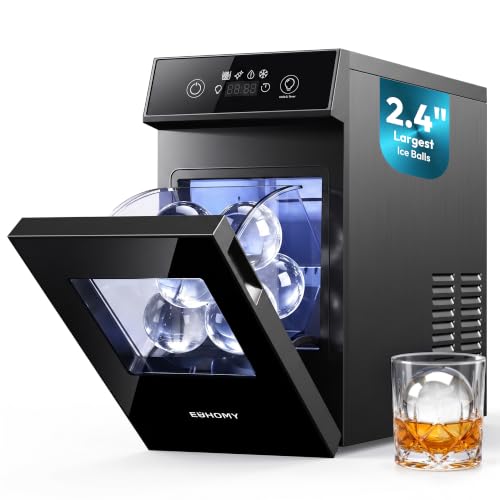
A 2.4-inch sphere is the largest single piece of ice most glasses can host, and this EUHOMY is built around that drama. It produces two crystal-clear balls per cycle of roughly an hour, accumulating to about 48 pieces a day, and each one is a small event in the glass: a flawless orb that chills a generous pour of whisky or a large cocktail while melting so slowly that the last sip tastes like the first’s sibling rather than its ghost.
The pace is the philosophy. An hour per pair means this machine is a producer to be run ahead — an afternoon’s quiet work banking spheres in the freezer for the week’s evenings — and its timer exists precisely for that rhythm, letting a cycle finish on schedule rather than on your attention. Self-cleaning closes the ownership loop, because a machine that runs unattended for hours should also maintain itself with minimal ceremony.
Who should not buy it is equally clear: anyone whose ice demand is measured in parties. Forty-eight spheres a day is abundance for a household of whisky drinkers and a rounding error at a wedding. Buy it as what it is — the connoisseur’s instrument, sized for the wide glasses and slow drinks where a single perfect sphere is not decoration but temperature engineering.
Presentation deserves its due, too. A clear sphere in an amber drink catches light in a way no cube does, and guests notice before they taste. If your home bar is partly theatre — and most good ones are — this machine supplies the prop that also happens to be the best-performing ice in the building.
- Ice: 2.4 inch clear spheres
- Cycle: 2 pieces in about 60 minutes
- Output: 48 pieces per day
- Functions: timer, self-cleaning
- Ice character: crystal clear, slow melting
- Suited to: whisky and bourbon glasses
Strengths
- Largest, most dramatic spheres in this guide
- True clarity for slow, even chilling
- Timer suits make-ahead production
Trade-offs
- An hour per pair demands planning
- Daily count serves drinkers, not parties
- Spheres need freezer banking to build a stock
Best for: whisky households that plan an evening’s ice with pleasure.
Not suited for: hosts needing ice for crowds on short notice.
When the freezer bank runs low, Check price on Amazon for the EUHOMY 2.4 inch ball maker.

ecozy Clear Ice Ball Maker — Best Compact Sphere Maker
The ecozy ball maker is the minimalist’s answer to clear ice: a compact machine with a small counter footprint that produces 2.4-inch clear spheres one at a time, in about forty minutes each, up to 32 a day. Its maker names its freezing method CrystalFlux, and whatever the branding, the output is the point — dense, transparent spheres of the size serious whisky glasses are built around, from a machine that does not demand a bar’s worth of counter to exist.
The one-at-a-time rhythm defines its household: this is the nightcap machine, the two-glasses-on-a-Friday producer, the appliance whose freezer drawer slowly fills with perfect orbs across a week of evenings. The 8-hour timer lets a sphere be ready when you are — set it in the morning, come home to ice — and self-cleaning keeps the small machine’s internals as clear as its product.
Output is the honest limitation, the lowest daily count in this guide, and buyers should look at the number without flinching: 32 spheres a day is a feast for a couple and a famine for a function. The ecozy does not pretend otherwise. It is a precision instrument for a narrow, pleasurable job, and its compactness means it can live where bigger machines cannot — a drinks trolley’s shelf, a study’s sideboard, the small bar corner of a flat that takes its pleasures seriously.
It also suits the beginner in clear ice better than its low count suggests, because its demands are small: little space, little water, little cleaning, and a production pace that teaches the make-ahead habit gently. Many owners of grander machines started with exactly this scale of commitment and discovered the ritual suited them.
- Ice: 2.4 inch clear spheres
- Cycle: 1 piece in about 40 minutes
- Output: 32 pieces per day
- Technology: CrystalFlux freezing method
- Functions: 8-hour timer, self-cleaning
- Design: minimal countertop footprint
Strengths
- Full-size spheres from the smallest footprint here
- Timer delivers a sphere to your schedule
- Gentle demands on space, water, and cleaning
Trade-offs
- Lowest daily output in the guide
- One-at-a-time production cannot serve gatherings
- Sphere-only menu, no cube option
Best for: couples and solo drinkers wanting perfect spheres without the bulk.
Not suited for: entertainers who need ice in party quantities.
When the freezer bank runs low, Check price on Amazon for the ecozy ball maker.

ecozy 2 Inch Ice Ball Maker 144 Pcs/Day — Best High-Volume Spheres
If the 2.4-inch makers are soloists, this ecozy is the ensemble: four 2-inch clear spheres per cycle of about forty minutes, building to 144 pieces a day — output that moves clear ice from the nightcap category into the dinner-party category. The two-inch sphere is the versatile size, fitting standard rocks glasses and highball glasses alike, and at this production rate a host can bank a weekend’s worth of beautiful ice across a single day’s running.
The specification supports the tempo like a machine designed by someone who has hosted. Enhanced insulation keeps finished spheres in better condition while the next batch forms; an auto water supply option removes the reservoir-refill interruptions that break a production rhythm; self-cleaning handles the aftermath. The CrystalFlux freezing method carries over from its smaller sibling, so the clarity that justifies the whole enterprise survives the scaling-up.
Size is the trade, in both senses: the machine is a more substantial counter presence than the compact ecozy, and its spheres, at two inches, carry slightly less theatre than the 2.4-inch orbs. What it returns is freedom — the freedom to serve clear ice to eight people without a spreadsheet. For households whose drinking is social, that freedom is the feature, and this is the sphere machine we would buy with entertaining in mind.
It also changes the economics of the home bar in a way worth noticing: a host no longer rations the good ice to the first round. Every drink of the evening gets a clear sphere, including the ones poured after dinner, and that consistency is what guests actually remember about a well-run bar, at home or anywhere else.
- Ice: 2 inch clear spheres
- Cycle: 4 pieces in about 40 minutes
- Output: 144 pieces per day
- Technology: CrystalFlux, enhanced insulation
- Water: auto supply option
- Cleaning: self-cleaning
Strengths
- Party-capable sphere production
- Auto water supply sustains long runs
- Insulation protects finished spheres between cycles
Trade-offs
- Larger counter presence than the compact model
- Two-inch spheres are slightly less dramatic
- Output still rewards a make-ahead habit
Best for: hosts who want clear spheres for a tableful of guests.
Not suited for: minimalists with a single shelf of bar space.
When the freezer bank runs low, Check price on Amazon for the ecozy 2 inch ball maker.

EUHOMY 2 Inch Clear Ice Ball Maker 144 Pcs/Day — Best Sphere Value at Volume
EUHOMY fields its own entry in the high-output sphere class, and it mirrors the ecozy’s headline — four 2-inch spheres in about forty minutes, 144 pieces a day, self-cleaning — which tells you the format has settled into a shape the market agrees on. The differentiation is in the living: this machine is aimed squarely at whiskey and bourbon households that entertain, and its production rhythm is tuned to bank spheres steadily through a day so the evening’s glasses are never the ones that got the cloudy freezer ice.
Two inches is the diplomat’s size. It fits the standard rocks glass without a struggle, chills a highball without swamping it, and melts at the slow, even pace that makes clear ice worth the effort. A host running this machine from breakfast can face a dozen guests with the good ice and still have the freezer bank growing — a sentence that no other category of home ice maker can honestly complete.
As with its ecozy counterpart, the machine asks for counter room and a make-ahead mindset, and it returns those investments in social confidence. Between the two high-output sphere makers, the choice will come down to the details of a given day’s listing and a household’s brand experience; on capability, they stand shoulder to shoulder, and this guide scores the contest a respectful draw.
One habit maximises either machine: dedicate a freezer container to the sphere bank, lined and lidded, so finished pieces are stored as deliberately as they were made. Spheres stored loose among the frozen peas emerge tasting faintly of the freezer’s biography, which is a poor reward for forty minutes of directional freezing.
- Ice: 2 inch clear spheres
- Cycle: 4 pieces in about 40 minutes
- Output: 144 pieces per day
- Cleaning: self-cleaning
- Ice character: crystal clear, round cubes for slow melting
- Suited to: whiskey and bourbon service at volume
Strengths
- High daily sphere count for entertaining
- Versatile two-inch size fits most glasses
- Self-cleaning keeps production hygienic
Trade-offs
- Needs a make-ahead routine for big events
- Counter footprint matches its ambition
- Sphere shape stores less compactly than cubes
Best for: bourbon and whiskey hosts who serve clear ice to company.
Not suited for: households whose ice needs are a single nightly drink.
When the freezer bank runs low, Check price on Amazon for the EUHOMY 2 inch ball maker.

EUHOMY 2 Inch Clear Ice Cube Maker with App — Best Smart Cube Maker
The final EUHOMY closes the list with the planner’s machine: two-inch clear cubes, two at a time in about 27 minutes — the briskest cycle among the slow-freeze picks here — accumulating to roughly 110 cubes a day, and all of it schedulable through an app with a 24-hour timer. The cube format will suit drinkers who find spheres beautiful but impractical in a favourite glass, and the two-inch size delivers the same slow-dilution physics in a shape that stacks, stores, and portions neatly.
App control in an ice maker earns its keep in one specific way: timing. Clear ice is a make-ahead product, and a machine that can be started from the sofa the night before, or set to have cubes ready at the hour guests arrive, removes the last friction from the ritual. The included tongs are a small, telling courtesy — clear ice handled by fingers melts at the surface and clouds at the touch, and the maker that ships the right tool understands its own product.
Between this and the high-output sphere makers, the decision is shape and rhythm: cubes in pairs on a faster cycle, versus spheres in fours on a slightly slower one, with daily totals in the same neighbourhood. Whisky traditionalists lean cube; presentation romantics lean sphere. Both camps are well served, and neither needs to envy the other.
Its self-cleaning and timer complete a specification aimed at owners who run their homes by schedule — the household that preheats the oven from the train will feel entirely at home telling an ice maker to have two perfect cubes ready by seven. Technology in the kitchen is justified exactly when it disappears into a routine, and that is this machine’s design brief, executed faithfully.
- Ice: 2 inch clear cubes
- Cycle: 2 cubes in about 27 minutes
- Output: 110 cubes per day
- Control: app control, 24-hour timer
- Cleaning: self-cleaning
- Includes: ice tongs
Strengths
- Fastest cycle among the slow-freeze picks
- App scheduling fits make-ahead routines
- Cubes store and stack more neatly than spheres
Trade-offs
- Pairs per cycle trail the four-piece sphere makers
- App features are surplus for hands-on households
- Cube clarity rewards filtered water and patience
Best for: planners who want scheduled, stackable clear cubes for whisky.
Not suited for: romantics committed to the sphere as the only proper form.
When the freezer bank runs low, Check price on Amazon for the EUHOMY app cube maker.
How do the best countertop clear ice makers compare side by side?
| Pick | Shape | Cycle | Daily output | Standout trait |
|---|---|---|---|---|
| EUHOMY Clear Ice Cube Maker 34 Lbs/Day | Cubes | 16 in ~7 min | 34 lbs | Volume clear cube supply |
| EUHOMY Clear Ice Ball Maker 2.4 Inch | 2.4 in spheres | 2 in ~60 min | 48 pieces | Largest statement spheres |
| ecozy Clear Ice Ball Maker | 2.4 in spheres | 1 in ~40 min | 32 pieces | Compact minimal footprint |
| ecozy 2 Inch Ice Ball Maker 144 Pcs/Day | 2 in spheres | 4 in ~40 min | 144 pieces | Auto water supply, insulation |
| EUHOMY 2 Inch Clear Ice Ball Maker 144 Pcs/Day | 2 in spheres | 4 in ~40 min | 144 pieces | High-output EUHOMY spheres |
| EUHOMY 2 Inch Clear Ice Cube Maker with App | 2 in cubes | 2 in ~27 min | 110 cubes | App control and timer |
Why is clear ice clear — and why does it melt so slowly?
Ordinary ice is cloudy because water freezes from the outside in, trapping air bubbles and dissolved minerals in the last part to freeze: the centre. The white heart of a freezer cube is a crowd of microscopic bubbles scattering light, and those same voids give meltwater a head start, which is why cloudy ice disappears quickly and unevenly. Clear ice is made by reversing the geometry — freezing in one direction, from one face, so the air and impurities are pushed ahead of the freezing front and out of the finished piece, or into a final layer that is discarded.
Density follows from that purity. A clear cube or sphere is solid water ice all the way through, with no internal scaffolding of bubbles, so heat must melt it honestly from the surface inward. Shape completes the advantage: for a given volume, a sphere has the least possible surface area, and a large cube is close behind, so the drink touches less ice per ounce than it would with a handful of small cubes. Less contact, slower melt, longer drink — the entire category is that sentence, engineered.
This is also why clear ice is slow to make. Directional freezing cannot be hurried past a certain pace without trapping the very impurities it exists to expel, and the machines in this guide spend their forty-to-sixty-minute cycles doing patiently what a bar does with an insulated cooler overnight. The wait is not a flaw in the design; it is the design, and the freezer bank is how households reconcile it with thirsty evenings.
Cube or sphere: which shape belongs in your glass?
The physics slightly favours the sphere — least surface area, most even melt — but glasses are not physics problems, and the honest answer begins with your glassware. Wide, heavy rocks glasses welcome a 2.4-inch sphere like it was designed for them, because it was. Narrower tumblers and highball glasses suit cubes, which also stack two to a tall drink for a longer chill. Measure your favourite glass before choosing a machine; an orb that must be forced is an orb that will crack glasses and tempers.
Storage argues for cubes, which pack into a freezer container with little wasted space and portion out predictably. Presentation argues for spheres, which catch light, roll gently as they melt, and make a home drink feel like an occasion without any other effort. Many serious households end up bilingual — a cube machine’s output for the week, spheres banked for guests — but a first purchase should follow the glass you actually drink from on an ordinary Tuesday.
There is also the question of the drink itself. A single large piece, either shape, suits spirit-forward drinks that should change slowly. Long drinks built over more ice — a julep’s crushed mountain aside — sometimes prefer two cubes to one sphere for coverage. The machines here cover both philosophies; choose the one whose output matches the drinks you pour most, not the drinks you photograph best.
How do you build a clear ice routine that actually works?
Bank, do not chase. The owners who love these machines treat them as small factories with a warehouse: the freezer holds a lidded container of finished pieces, the machine tops it up on a rhythm — a morning run, an evening run, a long run before a known gathering — and drinks are served from the bank, never from the machine’s current cycle. This single habit converts the category’s slowness from a limitation into an irrelevance, because the ice is always already made.
Handle the bank properly and it keeps for weeks. Move finished pieces to the freezer promptly, since the machines’ baskets are holding areas rather than freezers; store them in a sealed container so they do not absorb the freezer’s ambient flavours; and let a piece sit in the glass for half a minute before pouring if it has come straight from a deep freeze, because ice far below zero can crack dramatically when a room-temperature drink hits it — a small tempering pause that bars observe and homes should steal.
Before a gathering, count backwards. A machine making four spheres every forty minutes needs an afternoon, not an hour, to bank two dozen; the cube makers are faster but still reward a morning start. Put the ice on the same planning list as the chilling of wine and the buying of lemons, and clear ice becomes the most reliable part of the evening rather than its last-minute anxiety.
What does the water have to do with clarity?
Directional freezing does the heavy lifting, but it starts from the water it is given, and heavily mineralised or strongly chlorinated water makes the machine’s job harder and the ice’s flavour worse. A standard jug filter is the sweet spot for most households: it strips the chlorine that perfumes a drink and reduces the mineral load that the freezing front must expel, so cycles finish cleaner and the machine’s internals scale more slowly. Distilled water is unnecessary and, in the view of many drinkers, produces ice that tastes oddly empty as it melts.
Reservoir discipline matters as much as filtration. Water that stands in the machine for a week between gatherings will make ice that tastes of the week, however clear it looks, so the self-cleaning cycles these machines offer should be run after idle stretches, and the first pieces of a new session are well spent chilling the sink rather than a good whisky. Fresh water, a clean machine, and a banked supply: the whole flavour doctrine of this category in one sentence.
Hard-water households should also adopt the descale rhythm from the start. Scale insulates freezing surfaces and slows cycles, and in a machine whose entire value is the quality of its freeze, a furred cold plate is a quiet catastrophe. The makers’ cleaning programmes handle the routine work; a proper descale on schedule handles the rest, and both together keep the ice as clear in year two as in week one.
How do you serve clear ice without spoiling the effect?
Clear ice rewards a small amount of stagecraft, most of it borrowed from bars. Use tongs or a scoop, never fingers: skin warmth melts the surface on contact and leaves the piece cloudy at the touchpoints, undoing forty minutes of patience in four seconds. The app-controlled cube maker in this guide ships with tongs for exactly this reason, and owners of the other machines should acquire a pair with the same seriousness as the machine itself.
Temper before you pour. A piece straight from a deep freezer is far below the temperature of the drink, and the thermal shock can crack it — prettily, sometimes, but unpredictably. Half a minute on the counter, or a breath under the tap, brings the surface to a state where it accepts the pour gracefully. Bars call the tap rinse a wash, and it has the side benefit of removing any frost or freezer flavour the surface collected in storage.
Pour the drink over the ice, not the ice into the drink, and pour gently down the side of the glass or over the back of a spoon for the first seconds. A clear sphere or cube is the centrepiece of the glass; treating its arrival as a small ceremony costs ten seconds and returns a drink that looks composed rather than assembled. Guests may not know why the drink seems better. You will.
What does clear ice cost to run, in time and electricity?
The honest currency of this category is time, and the ledger is simple: roughly forty minutes to an hour of machine attention per small batch, most of it unattended. Electricity is the smaller bill — these are small refrigeration appliances working at a modest load, and a day’s sphere production draws less than a household casually assumes, certainly less than the freezer space the ice bank occupies would suggest. The real expense owners report is not power but planning, and planning, once habitual, stops feeling like a cost at all.
Compare the alternative honestly. Bar-quality clear ice bought in bags, where it can be found at all, is a speciality purchase priced like one, and the cooler-and-knife home method consumes a freezer shelf, a day, and a quantity of patience with sharp tools that most households ration carefully. Against those, a countertop machine that banks a week’s spheres across a few unattended afternoons is not the extravagant option; it is the economical one wearing a luxury’s clothes.
The machines also repay their keep in drinks not diluted. A bottle of good whisky stretched across evenings of slow-melting ice is, in the only accounting that matters to its owner, a bottle that goes further — every glass finishing at the strength it started. Owners rarely describe the purchase as saving money. They describe it as the drinks tasting right, which is the same ledger kept in a different hand.
Who should skip clear ice and buy the bullet machine instead?
Candour requires the list. Households whose ice disappears into blenders, coolers, and children’s drinks by the litre will find clear production a beautiful irrelevance — the bullet machines in the companion guide serve that life at six minutes a batch, and no sphere survives a smoothie anyway. Hosts of large, spontaneous gatherings should likewise count honestly: a machine banking four spheres per forty minutes cannot improvise for twenty guests, and pretending otherwise ends with a petrol-station ice run at the worst hour.
There is also the question of temperament. Clear ice is a ritual product, and rituals divide households into those who find them soothing and those who find them fussy. If the make-ahead rhythm, the sealed container, and the thirty-second tempering pause read as pleasures, this category was designed for you. If they read as chores stacked between you and a drink, the honest purchase is the fast machine, enjoyed without guilt.
And some drinks simply do not ask for it. A gin and tonic built long and cold, a spritz, a jug of iced tea — these are volume drinks, well served by ordinary ice in generous quantity. Clear ice earns its patience in the short, strong, slow glass. Buy the machine for that glass, if that glass is a regular citizen of your evenings, and let the long drinks fend for themselves.
How do you clean and descale a clear ice maker properly?
The routine mirrors the bullet machines’ but matters more, because a clear machine’s value is optical and anything growing in its lines eventually shows in the glass. The self-cleaning programmes fitted across this list handle the regular flush: run one every week or two of production, and always after the machine has stood idle with water in it. Follow with a plain-water cycle whose output is discarded, because the first pieces after any cleaning carry the cleaning with them.
Descaling follows your water rather than the calendar. Hard-water households will see cycles lengthen and clarity soften as scale insulates the freezing surfaces — the machine’s way of asking — and a descale with the maker’s specified solution restores both. Soft-water households may go a season between descales and should still not skip the self-cleaning rhythm, because biofilm does not care how soft the water is.
Storage is the third act. A machine put away for a month should be drained, cleaned, and dried with its lid open before it is closed up, exactly as the companion guide advises for bullet machines — with the addition that clear makers often have more intricate freezing moulds, which deserve a soft cloth’s attention while they are accessible. Stored dry, the machine returns to service with one cleaning cycle; stored wet, it returns with a project.
What glasses and drinks show clear ice at its best?
The spirit-forward family is the showcase: an old fashioned, a neat whisky with a single sphere, a Manhattan served down over one large cube. In each, the drink is mostly spirit, the ice is mostly visible, and dilution is the variable the drinker is managing across half an hour — precisely the variable clear ice holds steadiest. A Negroni on a two-inch cube is the gateway drink for sceptics, because its bitterness exposes watering immediately and clear ice passes the test audibly, glass after glass.
Longer drinks use clear ice differently. A highball over two stacked clear cubes keeps its sparkle and its strength to the bottom of the glass, where ordinary ice would have surrendered both by the halfway mark. Iced coffee over clear cubes stays coffee-flavoured rather than becoming cold brown water in the sun. Even a simple glass of water becomes a small pleasure, which sounds like a joke until a household has lived with a sphere bank for a summer.
The drinks that waste it are the loud ones: blended, crushed, or drowned in juice, where ice is texture or bulk rather than a presence. Knowing the boundary is part of owning the machine well. Clear ice is a soloist, and the household that casts it in solo roles will never feel its production pace as a limitation.
How does a home bar grow around a clear ice machine?
Appliances reorganise the rooms they serve, and a clear ice maker quietly promotes a drinks corner into a bar. Once the ice is serious, the glassware follows — a pair of proper rocks glasses appears, because the sphere deserves them — then a jigger, then a mixing glass, each purchase justified by the one before. None of this is required, but owners should know the machine is often the first step of a pleasant staircase, and budget their counter space for the possibility that the ritual expands.
The social geometry changes too. A host who can offer a guest a clear sphere in a whisky is performing a small act of care that guests register even if they cannot name it, and the machine’s freezer bank becomes part of the household’s hospitality infrastructure, like the chilled glasses some hosts keep. Entertaining households consistently report that the ice, of all their bar investments, draws the most comment per unit of effort — because it is the one guests can see working in the glass.
Our advice is to let the growth be deliberate. Start with the machine and the glasses you own; add the container, the tongs, and the one bottle the ritual calls for; and stop whenever the corner serves your evenings completely. A home bar is finished not when it resembles a professional one, but when nothing in it is waiting to be used — the same standard this guide has applied to every machine in it.
Which clear ice mistakes waste good machines and good whisky?
Freezing to order is the founding error. A guest arrives, the machine starts, and forty minutes later the drink that needed ice is a memory. Clear ice is a stored product; the households that thrive with these machines bank pieces in the freezer as a standing habit, the way other households keep a bottle chilled. Judge any machine in this guide by whether its rhythm fits your banking patience, not by whether it can rescue an unplanned evening — none of them can, and none claims to.
Serving a piece straight from a deep freezer into a delicate glass is the second error, and it occasionally ends in a crack. Ice at freezer temperature is under thermal stress, and a sudden pour of liquid can split it — sometimes theatrically, in the glass. Thirty seconds of tempering on the counter, or a brief rinse under the tap that also washes away any freezer taste, prevents the drama entirely.
Storing finished ice loose and uncovered in the freezer undoes the machine’s careful work within days. Ice absorbs odours greedily — it is, after all, frozen water with an enormous effective surface for its size — and a sphere banked beside garlic bread emerges with a biography. A sealed, dedicated container is not an accessory; it is the second half of the machine.
Neglecting the cleaning cycle because the ice still looks clear is the quiet fourth. Clarity is an optical property; the lines and reservoir can be developing the usual water-appliance film while the cubes sparkle. Run the self-cleaning on schedule, descale for your water, and refresh the reservoir after idle weeks, so that the ice tastes as clean as it appears.
Judging a clear machine by its first cycle deserves the last word. The inaugural run of any ice maker is a flushing exercise — the pieces may carry the taste of new plastic and factory dust, and their clarity reflects a machine still settling. Discard the first batch or two without forming an opinion, run the cleaning cycle the manual asks for, and let the third cycle introduce you to the machine you actually bought. Many a good appliance has been returned on the evidence of its first hour, which is rather like reviewing a restaurant on its building site.
And a gentle word about impatience with the freezer bank: raiding tomorrow’s spheres for tonight’s second round is how households wake to an empty container on the one evening guests arrive. Treat the bank the way a careful cook treats a sourdough starter, always leaving enough behind to rebuild from, and the supply will quietly take care of every evening you actually care about, including the unplanned ones.
Final Recommendation
If your household wants clear ice as a working supply rather than a special effect, EUHOMY Clear Ice Cube Maker 34 Lbs/Day is the place to start: it produces clear cubes at a pace no other pick approaches, and it will quietly supply a social household all summer. For the whisky ritual in its purest form, EUHOMY Clear Ice Ball Maker 2.4 Inch makes the grand sphere, while ecozy Clear Ice Ball Maker delivers the same size of sphere from the smallest footprint here, for the bar corner that measures its space in centimetres.
The high-output sphere makers and the app-scheduled cube maker divide the entertainers and the planners between them, and both camps are served at a level that would have required a professional bar’s equipment not long ago. Choose by shape, by glass, and by the rhythm your household will actually keep — those, and not any headline number, are the decisions that determine whether the machine becomes a ritual.
Clear ice is a small luxury with an unusually honest bargain: patience and a freezer drawer, exchanged for drinks that hold their character to the last sip. Make the ice ahead, keep it sealed, temper it briefly, and pour something worthy of it — because once a household has tasted a slow drink that finishes the way it started, ordinary ice stops being an ingredient and becomes an apology.
Frequently Asked Questions
Is clear ice really different, or is it just prettier?
Both, and the prettiness is evidence of the difference. The clarity shows that air and impurities were expelled during freezing, which means the piece is denser — and density, plus the large size, is what slows the melt. In a side-by-side glass, a drink over clear ice stays stronger and colder-tasting measurably longer than the same drink over cloudy cubes. The look is the receipt for the physics.
How long do the spheres and cubes keep in the freezer?
Weeks, stored properly. Move finished pieces into a sealed, dedicated container promptly, and they will keep their clarity and neutrality for a month comfortably. Over longer stretches they slowly sublime — shrinking at the edges — and absorb whatever the freezer offers, so a monthly rhythm of making and using suits most households better than a vast permanent bank.
Can these machines replace my regular ice maker?
For drinks, many households find they do — but the roles differ. A bullet machine supplies volume for coolers, blenders, and children’s drinks all day; a clear machine supplies quality for glasses. Homes that entertain in both registers often keep the bullet machine for the crowd and the clear machine for the top shelf, while whisky-focused households happily let the clear maker be their only one.
Why do the cycles take so long compared with bullet ice?
Because clarity is a slow freeze by definition. Directional freezing must advance gradually so air and minerals are pushed out of the ice rather than trapped inside it; rush the front and the piece clouds. Bullet ice, by contrast, freezes thin shells around chilled rods in minutes precisely because nobody asks it to be clear. The cycle times in this guide are the honest cost of the result in the glass.
Do I need filtered water, or is tap water fine?
Tap water works, and the machines will still produce clear ice from it, because the freezing method does most of the work. Filtered water improves the flavour neutrality of the melt, reduces scale inside the machine, and gives the freezing process less mineral load to expel, so the results are cleaner in every sense. In hard-water or strong-chlorine areas, a jug filter is close to essential for best results.
What size ice should I choose for whisky?
The classic answer is the largest piece your glass comfortably holds: a 2.4-inch sphere for wide rocks glasses, a 2-inch cube or sphere for standard tumblers. The principle is minimum surface area against the drink, so one large piece beats several small ones. If your glassware is varied, the 2-inch formats in this guide are the versatile middle — large enough to melt slowly, small enough to fit almost everything.
Related Guides
To see the faster, everyday side of the ice story — or the grills that pair with a well-made drink — read on: Best Apartment Balcony Grills, Best Electric Indoor Grills, Best Camping Grills.


[…] ice is only the beginning of the drinks project, these guides cover the neighbouring territory: Best Countertop Clear Ice Makers, Best Patio Grills, Best Kamado […]