What's inside
- Key Takeaways
- Quick Picks
- Which test-kitchen criteria did we apply to these dehydrators?
- How do the best food dehydrators compare on the test-kitchen criteria?
- What does even drying actually require, in practice?
- Which temperatures do common foods actually need?
- How do you run a dehydrator like a test kitchen would?
- What about noise, energy, and living with a machine that runs all day?
- Which foods repay dehydrating most, and which disappoint?
- How should dried food be stored so the work is not wasted?
- What separates a good first batch from a discouraging one?
- How do you choose between more trays and a second machine?
- What should beginners know about marinades, cures, and jerky flavour?
- How does humidity in your kitchen change the plan?
- Which dehydrating mistakes do test kitchens see again and again?
- Final Recommendation
- Frequently Asked Questions
- Related Guides
As an Amazon Associate I earn from qualifying purchases. This post may contain affiliate links at no extra cost to you.
cottageverdict.com is reader-supported. When you buy through links on our site, we may earn an affiliate commission.
Where to buy: each dehydrator below is sold through Amazon, and the names in the Quick Picks table and the detailed reviews link straight to its listing, where you can check price on Amazon and confirm the tray count and included accessories before ordering. A note on method before anything else: this guide judges the best food dehydrators the way a professional test kitchen would — by repeatability, evenness, temperature honesty, and cleaning effort — but it is our own independent assessment, built from specifications, design analysis, and accumulated owner experience, not the verdict of any outside organisation. No laboratory scores are invented here; where a judgement is qualitative, it is labelled as one.
Those test-kitchen criteria turn out to be exactly the right lens for this category, because dehydrating is a process of patience measured in hours, and small flaws compound over a long run. A machine whose rear corner dries two hours faster than its front will burn one tray of apple slices while another stays leathery. A thermostat that overshoots its setting by fifteen degrees will case-harden jerky — dry outside, damp inside — which is not a texture flaw but a safety one. Evenness and temperature accuracy are not connoisseur details in this category; they are the whole game.
The field below splits into serious stainless-tray machines with rear fans and horizontal airflow, led by two Cosori models and two sizes of Magic Mill Pro, and two gentler stackable or compact designs from Elite Gourmet and Konfintos that serve smaller batches at smaller prices. Between them they cover the jerky maker, the garden glutted with tomatoes, the dog-treat baker, and the flat-dweller who wants dried mango without dedicating a cupboard to the cause.
A word about what this guide is not: it does not borrow any famous test kitchen’s name for authority it has not earned, and it does not present laboratory measurements it does not have. What it offers instead is the framework those kitchens use — clear criteria, applied consistently, with the trade-offs stated out loud — turned on six machines you can actually buy. That framework, honestly applied, is worth more than a borrowed badge.
Key Takeaways
- Horizontal airflow from a rear fan dries more evenly than a bottom fan in a stackable tower, and it is the single design feature that matters most.
- The Cosori 6-tray is the test-kitchen-style benchmark here: 600W, 6.5 square feet of stainless drying space, and a 95–165°F range with a 48-hour timer.
- Judge temperature ranges against your foods: jerky wants a machine that reaches at least 160°F territory, while delicate herbs prefer gentle lows.
- Stainless trays clean up after sticky, sugary fruit far more gracefully than plastic, and they tolerate years of scrubbing.
- Buy capacity by your biggest real batch — a whole garden harvest or a jerky session — not by your average Tuesday.
- Case hardening is the key failure to avoid: steady, accurate heat matters more than raw wattage or headline tray counts.
Quick Picks
| Pick | Badge | How it passes the criteria |
|---|---|---|
| Cosori Food Dehydrator 6 Stainless Trays | Best Overall | Six stainless trays, 6.5 ft² of drying space, 600W of rear-fan power, precise 95–165°F control, and a 48-hour timer — the complete package. |
| Magic Mill Pro Dehydrator 7 Stainless Trays | Best for Jerky Makers | A 600W rear-fan machine with seven full-size stainless trays, 95–176°F control, a 48-hour timer, keep-warm, and auto shutoff. |
| Magic Mill Pro Dehydrator 10 Stainless Trays | Best Large Capacity | Ten stainless trays with digital timer and temperature control and a keep-warm function, for harvest-scale batches and dog-treat production lines. |
| Cosori Food Dehydrator 5 Stainless Trays | Best Compact Stainless | Five stainless trays and 3.1 ft² of space with horizontal airflow, control up to 176°F, four presets, and a 48-hour timer in a compact body. |
| Elite Gourmet 5-Tray Food Dehydrator | Best Budget Starter | A simple five-tray stackable with BPA-free 11.4-inch trays and adjustable temperature, for jerky, fruit, herbs, and vegetables at an entry price. |
| Konfintos Small Food Dehydrator 250W | Best for Pet Treats and Small Batches | A small 250W machine with five stackable BPA-free trays, 95–158°F control, and up to 72 hours of continuous operation for treats and small batches. |
Which test-kitchen criteria did we apply to these dehydrators?
Repeatability came first, because it is the criterion professional kitchens use to separate equipment from gadgets. A dehydrator earns trust when the same load, loaded the same way, finishes in the same condition run after run — which demands a thermostat that holds its setting, a fan that moves air consistently, and a timer you can set for the long cycles that thick foods need. Machines with vague dials, narrow temperature ranges, or short maximum timers were marked down before any other quality was considered.
Evenness came second, and it is largely a question of architecture. Rear-fan designs blow air horizontally across every tray at once, so each shelf lives in roughly the same climate. Bottom-fan stackable designs push warm air upward through the tower, so the lowest tray cooks in a different world from the top one and the owner becomes a tray-rotating attendant. Rotation is not a disaster — generations of gardeners have managed it — but a test kitchen counts labour as a cost, and so do we.
Third, we weighed the unglamorous evidence: tray material and cleaning, the honesty of the stated temperature range against the foods it must serve, noise across a run that may last overnight, and whether the controls can be set precisely and left alone. A dehydrator is a machine you live alongside for twelve hours at a stretch; its manners across those hours are part of its performance.

Cosori Food Dehydrator 6 Stainless Trays — Best Overall
By test-kitchen criteria, the Cosori 6-tray is the machine against which this list is measured, because it makes no structural compromise. The rear fan drives air horizontally across six stainless steel trays totalling about 6.5 square feet, so a full load of jerky strips or apple rings experiences one climate rather than six. Power is a substantial 600 watts, which matters less for speed records than for recovery: load it with wet, heavy produce and the temperature holds its line instead of sagging for the first hour.
Control is the other half of its case. The range runs from 95 to 165 degrees Fahrenheit with precise digital adjustment, covering delicate herbs at the bottom and the jerky-safe highs at the top, and the timer stretches to 48 hours, which means a thick batch started on Friday evening never needs a midnight restart. Operation is quoted as quiet — under 48 decibels — and in a category where machines run overnight in lived-in houses, that restraint is a genuine specification rather than a courtesy.
The stainless trays deserve their own sentence, because they decide how the machine ages. They scrub clean after sugary fruit, they do not stain or hold odours the way plastic can, and they will outlast several generations of mesh liners. If your dehydrating ambitions are regular and varied — jerky in autumn, herbs in summer, fruit leather whenever the orchard provides — this is the machine we would install and stop thinking about.
Living with it asks only for counter depth and a cupboard shelf for the trays when they are washed. The footprint is that of a small microwave, the door closes with a proper seal, and the whole unit wipes down without crevices that trap dried tomato skins. It is not the cheapest route into dehydrating, but by the standards this guide applies — repeatability, evenness, honesty of control — it is the most complete one here.
- Trays: 6 stainless steel, about 6.5 ft² drying space
- Power: 600W, rear fan, horizontal airflow
- Temperature: 95–165°F precision control
- Timer: up to 48 hours
- Noise: quiet operation, under 48 dB
- Food contact: stainless trays, no plastic against food
Strengths
- Most even drying architecture in this guide
- Wide, precise temperature range with a long timer
- Stainless trays clean easily and age well
Trade-offs
- Counter footprint matches a small microwave
- Premium position within this list
- Six trays may exceed a small household’s real batches
Best for: regular dehydrators making jerky, fruit, and herbs across the year.
Not suited for: occasional users who dry one tray of herbs each summer.
When you are ready to compare, Check price on Amazon for the Cosori 6-tray.

Magic Mill Pro Dehydrator 7 Stainless Trays — Best for Jerky Makers
The Magic Mill Pro 7-tray is built around the jerky maker’s checklist. Its rear fan pushes air evenly across seven full-size stainless trays, its 600 watts hold temperature under a full load of wet meat, and its range tops out at 176 degrees Fahrenheit — headroom that matters when a recipe calls for bringing jerky up to a safe heat before settling into the long dry. A keep-warm function and automatic shutoff finish the specification with the two features long, unattended runs genuinely need.
That temperature ceiling is its distinguishing argument. Several machines in this category stop in the mid-160s, which is adequate for most drying but leaves jerky protocols tight; the Magic Mill’s extra degrees give the cook room to follow food-safety guidance properly rather than approximately. The 48-hour timer matches the Cosori’s, and the digital controls set temperature in the small increments that experienced dehydrators actually use when they move between meat, fruit, and vegetables in the same week.
As a piece of kitchen equipment it is unpretentious: a working box with a door, trays that slide like oven shelves, and a fan note that is present without being punishing. The seven-tray capacity sits in a sweet spot — a serious jerky batch fits without the tower becoming a piece of furniture — and the stainless construction keeps the post-jerky cleanup to a wash rather than an archaeological dig.
If your dehydrating begins and ends with jerky, with fruit as a supporting act, this is arguably the first name on the list rather than the second. We placed the Cosori ahead on the breadth of its all-round polish, but a household whose autumn is measured in pounds of venison or beef jerky may reasonably reverse that order, and this guide would not argue with them.
- Trays: 7 full-size stainless steel
- Power: 600W rear fan, even-drying system
- Temperature: 95–176°F
- Timer: 48 hours, keep warm, auto shutoff
- Certification: ETL listed
- Focus: jerky and mixed family batches
Strengths
- Highest temperature ceiling in this guide
- Seven trays suit serious jerky sessions
- Keep-warm and shutoff suit unattended runs
Trade-offs
- Larger box to store between seasons
- Fan is audible across a quiet room
- More capacity than herb-only users need
Best for: jerky makers who want temperature headroom and tray space.
Not suited for: small flats drying the occasional bunch of herbs.
When you are ready to compare, Check price on Amazon for the Magic Mill Pro 7-tray.

Magic Mill Pro Dehydrator 10 Stainless Trays — Best Large Capacity
Ten trays changes the nature of the appliance. The largest Magic Mill Pro is less a kitchen gadget than a small preserving station, sized for the household that cans, freezes, and dries in earnest: the orchard glut, the hunting season, the market stall’s end-of-day bargain crate of tomatoes. Loaded fully, it processes quantities that would take the mid-size machines two or three sequential runs, and in dehydrating — where a run is half a day — that difference decides whether a harvest gets saved or quietly composted.
The specification supports the scale honestly. Digital timer and temperature control keep long runs precise, the keep-warm function holds finished food safely until you are ready to unload, and the stainless trays tolerate the scrubbing that ten trays of sugared fruit will eventually demand. The maker lists it for the full repertoire — jerky, dog treats, herbs, meat, beef, fruit — and the capacity is what makes the dog-treat line in that list realistic: pet treats are a volume business even in a one-dog household.
The costs of scale are the obvious ones, and a test kitchen would list them without flinching: counter space during runs, storage space between them, and the discipline to load the machine fully enough to justify its existence. A ten-tray machine run with two trays of apple rings is not inefficient in energy so much as in the owner’s life. Buy it for the batches you genuinely face in September, not the ones you photograph in January.
Households that sell at farmers’ markets, preserve for large families, or split a machine between neighbours will find this the only pick here sized to their reality. Everyone else should read its capacity as a warning label as much as an invitation — in this category, the right size is a feature, and oversize is a storage problem wearing a specification’s clothes.
- Trays: 10 stainless steel
- Controls: digital timer and temperature
- Functions: keep warm, auto shutoff features
- Certification: ETL approved
- Suited to: jerky, dog treats, herbs, fruit at volume
- Format: large countertop preserving station
Strengths
- Largest capacity in this guide by a wide margin
- Handles harvest-scale and pet-treat batches in one run
- Stainless trays suit heavy, repeated use
Trade-offs
- Demands serious counter and storage space
- Overkill for small or occasional batches
- Loading and washing ten trays is real work
Best for: preservers, large families, and market gardeners with real harvests.
Not suited for: apartment kitchens and once-a-season dabblers.
When you are ready to compare, Check price on Amazon for the Magic Mill Pro 10-tray.
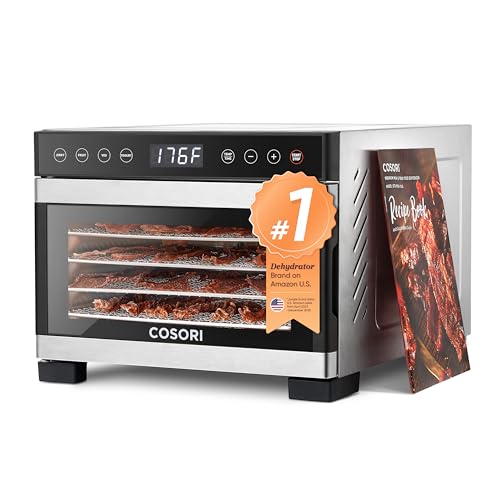
Cosori Food Dehydrator 5 Stainless Trays — Best Compact Stainless
The smaller Cosori keeps the family architecture — rear fan, horizontal airflow, stainless trays, no plastic in contact with the food — and trims the capacity to 3.1 square feet across five trays, in a body that suits kitchens where the six-tray would colonise the counter. For a household of two that dries herbs from the garden, makes a modest jerky batch, and works through summer fruit in sane quantities, this is not the compromise model; it is the correctly sized one.
Its control range reaches 176 degrees Fahrenheit, higher than its bigger sibling, which gives it the same jerky-protocol headroom as the Magic Mill machines, and four presets cover the common foods for owners who would rather press a programme than consult a chart. The 48-hour timer completes a specification that reads, in test-kitchen terms, like a machine designed by people who understood the assignment and then shrank it carefully rather than cheaply.
The honest trade is throughput. Five trays fill quickly when a whole punnet harvest arrives, and the household that discovers a serious preserving habit will outgrow it within a couple of seasons. But outgrowing a well-chosen smaller machine is a happier story than storing an oversized one, and the compact Cosori’s evenness and temperature honesty mean its results will match the big machines tray for tray — there will simply be fewer trays.
It is also the easiest of the stainless machines to live with week to week: lighter to move, quicker to wash, and small enough to earn a permanent counter corner in many kitchens. Permanence matters in this category more than most, because a dehydrator that lives out gets used for the small batches — the half-bunch of parsley, the three ageing bananas — that a stored machine never sees.
- Trays: 5 stainless steel, 3.1 ft² drying space
- Airflow: horizontal, rear fan
- Temperature: up to 176°F control
- Presets: 4, plus 48-hour timer
- Food contact: no plastic against food
- Format: compact countertop body
Strengths
- Full stainless, horizontal-airflow design in a compact size
- High temperature ceiling for jerky protocols
- Presets simplify routine batches
Trade-offs
- Capacity fills fast at harvest time
- Fewer trays than keen preservers want
- Still a countertop commitment, not a cupboard toy
Best for: couples and small households wanting serious design at a sane size.
Not suited for: gardeners facing crate-scale harvests.
When you are ready to compare, Check price on Amazon for the Cosori 5-tray.
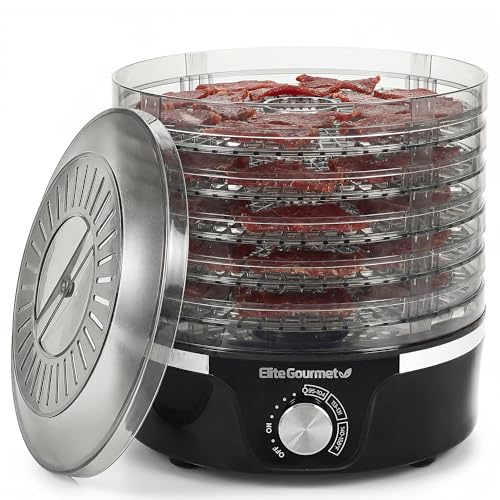
Elite Gourmet 5-Tray Food Dehydrator — Best Budget Starter
The Elite Gourmet represents the other school of dehydrator design: a stackable tower of five BPA-free trays, 11.4 inches across, with the heat and fan working from the base and an adjustable temperature control rather than a digital panel. It costs a fraction of the stainless machines, assembles in a minute, and stores in a fraction of their space. For a household deciding whether dehydrating is a hobby or a passing enthusiasm, it is the rational first instrument.
Test-kitchen honesty requires naming the architecture’s known behaviour: in a bottom-up tower, the lower trays dry faster than the upper ones, so even results ask for tray rotation partway through long runs. Owners who treat that rotation as part of the ritual — a check, a shuffle, a taste of the nearly-done pieces — produce perfectly good jerky, fruit, and herbs with this machine, and have done for years. Owners who want to load, leave, and return to uniformity should buy the horizontal-airflow design instead.
Within its brief, the machine is likeable. The trays are light and wash easily, the footprint suits a small kitchen, and the adjustable temperature covers the standard repertoire from herbs to jerky, if without the top-end headroom or the fine digital precision of the pricier picks. It is the dehydrator equivalent of a good first guitar: honest, limited, and exactly right for finding out whether you play.
It also travels between homes gracefully — a holiday cabin, a borrowed kitchen during harvest week, a student’s first flat. Machines that cost little and store small get lent, shared, and used in places the big stainless boxes never reach, and there is a real argument that the most-used dehydrator in many families is precisely this kind of unpretentious tower.
- Trays: 5 stackable, BPA-free, 11.4 inch diameter
- Temperature: adjustable control
- Airflow: base fan, vertical stack design
- Foods: jerky, fruit, herbs, vegetables
- Model: EFD319, black
- Format: light, compact, easy storage
Strengths
- Lowest commitment way into dehydrating here
- Stores in far less space than the box machines
- Simple controls with nothing to programme
Trade-offs
- Bottom-up airflow needs tray rotation for evenness
- No digital timer precision or high-end range
- Plastic trays ask for gentler cleaning than steel
Best for: beginners testing whether dehydrating suits their kitchen life.
Not suited for: hands-off cooks who will not rotate trays on long runs.
When you are ready to compare, Check price on Amazon for the Elite Gourmet dehydrator.

Konfintos Small Food Dehydrator 250W — Best for Pet Treats and Small Batches
The Konfintos is the specialist small-batch machine: 250 watts, five stackable BPA-free trays, and a temperature range from 95 to 158 degrees Fahrenheit tuned for the gentle, long drying that pet treats, herbs, and fruit pieces actually need. Its headline virtue is endurance rather than power — it is rated for up to 72 hours of continuous operation, which suits the low-and-slow philosophy of treat-making, where a batch of sweet potato chews or chicken strips for the dog dries gradually over a day and a night.
Energy frugality is the second half of its case. A 250 watt machine running a small batch uses a fraction of the electricity of a 600 watt box doing the same work, and for households whose dehydrating is measured in handfuls — herbs from two pots, treats for one dog, the occasional mango — the big machines are overpowered in the literal sense. The Konfintos matches its appetite to its loads.
The limits follow from the same numbers. The 158 degree ceiling rules out jerky protocols that call for higher heat, so meat for human consumption belongs in the other machines here; thick or very wet loads will take their time; and the stackable format shares the rotation caveat of the Elite Gourmet. Within its declared territory — pet treats, herbs, fruit, small and slow — it is a coherent, economical tool rather than a cut-down version of a bigger one.
There is a charm to its scale that the specifications miss: it can live on a utility-room shelf or beside the dog’s food bin, running its quiet, day-long cycles where a full-size dehydrator would never be allowed to settle. Appliances that find a permanent home get used, and this one’s home is simply easier to find.
- Power: 250W, energy-efficient heating
- Trays: 5 BPA-free stackable
- Temperature: 95–158°F
- Endurance: up to 72 hours continuous operation
- Foods: jerky-style treats, fruit, herbs, pet treats
- Format: small countertop footprint
Strengths
- Frugal power draw for small, long batches
- Long continuous runtime suits pet treats
- Compact enough for a permanent small home
Trade-offs
- Temperature ceiling excludes high-heat jerky protocols
- Stackable airflow benefits from tray rotation
- Small trays limit batch size quickly
Best for: pet-treat makers and herb growers with small, steady batches.
Not suited for: jerky makers needing high temperatures and large loads.
When you are ready to compare, Check price on Amazon for the Konfintos dehydrator.
How do the best food dehydrators compare on the test-kitchen criteria?
| Pick | Trays | Airflow | Temperature | Best at |
|---|---|---|---|---|
| Cosori Food Dehydrator 6 Stainless Trays | 6 stainless | Horizontal, rear fan | 95–165°F | All-round even drying |
| Magic Mill Pro Dehydrator 7 Stainless Trays | 7 stainless | Horizontal, rear fan | 95–176°F | Jerky with headroom |
| Magic Mill Pro Dehydrator 10 Stainless Trays | 10 stainless | Horizontal, rear fan | Digital control | Harvest-scale batches |
| Cosori Food Dehydrator 5 Stainless Trays | 5 stainless | Horizontal, rear fan | Up to 176°F | Compact serious drying |
| Elite Gourmet 5-Tray Food Dehydrator | 5 stackable plastic | Vertical, base fan | Adjustable | Budget starting point |
| Konfintos Small Food Dehydrator 250W | 5 stackable plastic | Vertical, base fan | 95–158°F | Pet treats, small batches |
What does even drying actually require, in practice?
Evenness is the product of three things: airflow that reaches every tray in a similar state, food cut to a similar thickness, and a load arranged so air can move. The machine supplies only the first. A rear-fan dehydrator delivers air of similar temperature and speed to each shelf, which removes the largest variable, but the cook still owns the other two. Slices that vary between three and eight millimetres will finish hours apart in any machine ever built, and trays packed edge-to-edge with overlapping pieces will dry in patches no fan can rescue.
The practical disciplines are simple and worth stating plainly. Cut with a mandoline or a patient knife to a uniform thickness; leave a finger’s width between pieces so air can pass; and resist loading trays beyond a single layer, however tempting the harvest makes it. In stackable machines, add the rotation ritual — move top trays to the bottom halfway through — and accept it as the price of the design’s compactness and cost.
Judged this way, the gap between the best and the rest narrows but does not close. Good technique makes the budget towers genuinely serviceable, while the horizontal machines forgive technique that is merely decent. A test kitchen would call that difference robustness, and it is why the rear-fan designs lead this list: they produce even results across the widest range of real-world loading habits.
Which temperatures do common foods actually need?
Herbs are the gentle end of the craft, happiest at the lowest settings — roughly the 95 to 110 degree region — where their volatile oils stay in the leaves instead of evaporating into the kitchen. This is why a low minimum temperature is a real specification rather than a footnote: machines that start too hot cook herbs instead of drying them, and the result tastes of hay. Both Cosori models and the Magic Mill range begin at 95 degrees, which is part of their all-round credibility.
Fruit and vegetables occupy the middle band, commonly dried somewhere in the 125 to 145 degree region, where moisture leaves steadily without the surface hardening that traps dampness inside. Fruit leather and tomatoes are the classic victims of excessive heat — leathery outside, fermenting within — and they reward the precise digital control the stainless machines offer over a vague dial’s best guess.
Jerky stands apart because it is a safety question as much as a drying one. Guidance for home jerky generally calls for heating meat to 160 degrees Fahrenheit — 165 for poultry — at some point in the process, whether in the dehydrator itself or in an oven step before or after drying. Machines whose range reaches the mid-170s, like the Magic Mill Pros and the compact Cosori, let you run that protocol inside one appliance; machines that top out lower ask for an oven assist, which is workable but must not be skipped.
How do you run a dehydrator like a test kitchen would?
Start with a log. Professional kitchens write down the load, the thickness, the temperature, and the finishing time for every batch, because memory edits ruthlessly and the notebook does not. Three batches into a new machine, your log tells you its true personality — whether its 135 setting behaves like 135, which tray runs fastest, how your climate’s humidity stretches the timings in every recipe you read. That knowledge is worth more than any single feature on a specification sheet.
Weigh the endpoint rather than trusting the clock. Dried food is judged by condition: fruit should be pliable with no visible moisture when squeezed, herbs should crumble, jerky should bend and crack without snapping or feeling damp. Recipes give hours because they must give something, but a humid August kitchen and a heated January one are different countries. Condition is the only destination; time is merely the usual route.
Finally, cool before you judge and before you store. Warm food feels drier than it is, and sealing genuinely warm produce into a jar invites condensation and mould. Let batches rest on their trays until they reach room temperature, test the thickest piece you can find, and only then pack them away — ideally with a conditioning week in a sealed jar, shaken daily, so any remaining moisture equalises and reveals itself before the food goes into long storage.
What about noise, energy, and living with a machine that runs all day?
A dehydrator is a background appliance, and its background qualities decide whether it gets used. Fan noise in the stainless box machines is a steady, low wash — noticeable in a silent kitchen, ignorable in a lived-in one, and the Cosori 6-tray’s sub-48-decibel operation is the quietest claim here. Stackable towers concentrate their smaller fans into a slightly higher note. None will disturb a household through a closed door, but a studio flat running jerky overnight is a real scenario, and light sleepers should place the machine accordingly.
Energy arithmetic reassures most people who run it. A 600 watt machine cycling its heater across a ten-hour run consumes roughly what an oven consumes in a fraction of that time, and the 250 watt Konfintos sips by comparison. Dehydrating is one of the gentler energy profiles in food preservation — far below canning’s boiling water or a freezer’s lifetime of continuous draw — which is part of its quiet appeal to households preserving a garden’s output.
Smell is the unlisted specification. A dehydrator perfumes its surroundings with whatever it is drying: onions and garlic will colonise a house for a day, jerky announces itself pleasantly or intrusively depending on the audience, and fruit is welcome almost everywhere. Site the machine with the load in mind — a utility room or a spot near an extractor for the allium family, the kitchen counter for apples and cinnamon — and the household will remain your ally.
Which foods repay dehydrating most, and which disappoint?
The great dehydrating foods share a trait: their dried form is a distinct pleasure rather than a diminished copy of the fresh one. Tomatoes concentrate into something intensely savoury; apples and pears turn chewy and sweet; mango becomes confectionery; herbs keep a garden’s summer available to a winter’s cooking. Jerky belongs on the list because drying is its definition, and banana chips, fruit leathers, and dog treats round out a repertoire that justifies a machine’s counter space across the whole calendar.
The disappointments are equally predictable. High-fat foods dry badly because fat does not evaporate — it lingers, turns rancid, and shortens the shelf life of everything stored beside it, which is why fatty meats and cheese are specialist projects rather than beginner ones. Very watery produce with little sugar or structure, such as cucumber or lettuce, dries into a curiosity rather than an ingredient. Avocado, famously, becomes a lesson.
A test kitchen would add a third category: foods that dry well but only earn their effort in quantity. Herbs for a household that uses a teaspoon a week are cheaper bought; herbs for a cook who makes pesto, rubs, and teas are a garden’s fortune preserved. The machine does not change across those cases — the household’s appetite does — which is why this guide keeps returning to batch size as the honest sizing question.
How should dried food be stored so the work is not wasted?
Drying removes water; storage defends that achievement against a humid world trying to give the water back. The enemies are air, light, heat, and time, and the defences are unglamorous: airtight jars or sealed bags with the air pressed out, a cool dark cupboard, and portions sized so a jar is opened a handful of times rather than daily across a season. Every opening admits a breath of damp kitchen air, which is why preservers store in small containers and keep a working jar separate from the archive.
Conditioning, described earlier in this guide, is the gateway step: a week in a sealed jar, shaken daily, equalises moisture between pieces and reveals any under-dried stragglers while they can still go back into the machine. Skipping it is how a batch with one damp piece becomes a jar with one mouldy piece and then a jar in the bin. The week costs nothing but patience, which dehydrating households are presumably already cultivating.
Shelf life follows the food. Herbs hold their best flavour for months, fruit for the better part of a year when truly dry, jerky for weeks at room temperature and months in the freezer. Label every container with the food and the date — not because you will forget what it is, but because you will forget when it was, and dried food keeps its counsel about its age right up until it disappoints you.
What separates a good first batch from a discouraging one?
Ambition management, mostly. The successful first batch is small, uniform, and chosen from the forgiving end of the repertoire — apple rings, banana slices, a tray of herbs — because it teaches the machine’s pace and the cook’s judgement in a single afternoon-to-evening run. The discouraging first batch is usually a full load of something demanding: thick jerky from an untested marinade, or a harvest’s worth of tomatoes committed before a single slice has been timed. The machine gets blamed for a curriculum problem.
Thickness discipline is the technical half of the lesson. New dehydrators should slice thinner than instinct suggests — thin pieces dry evenly, finish together, and forgive timing errors — and graduate to thicker cuts once the log book holds a few entries. A mandoline, used with its guard and full attention, pays for itself in uniformity within two batches.
Finally, taste as you go. Pull a piece at the earliest plausible finish, cool it completely, and eat it with attention: that cooled piece is the only honest report on the batch’s progress. Cooks who sample this way calibrate themselves to their machine within a few runs, and calibration — not wattage, not tray count — is what test kitchens actually mean by skill in this craft.
How do you choose between more trays and a second machine?
Serious preservers eventually face a fork: one large machine, or two mid-size ones. The large machine wins on simplicity and counter footprint per tray, and it suits households whose batches are homogeneous — ten trays of the same apple, dried the same way, in the same run. Two machines win on flexibility: herbs at a gentle temperature in one while jerky rides high in the other, a small batch run economically without heating a ten-tray box, and a harvest split by food rather than forced into one climate.
The deciding evidence is your own log book. If your batches are usually one food at a time and as large as your machine allows, capacity is your constraint and the ten-tray class is your answer. If your diary shows mixed loads, staggered starts, and foods queuing for different temperatures, a second mid-size machine — the compact Cosori beside an existing box, say — will serve the real pattern of your preserving life better than a single giant.
Budget the unglamorous accessories into either path: spare mesh liners, a mandoline that makes uniform slicing effortless, jars and labels enough for a season. Preserving fails at the edges — the unlined tray, the unlabelled jar — far more often than at the machine, and a modest accessories budget protects a much larger investment of food and time.
What should beginners know about marinades, cures, and jerky flavour?
Jerky flavour is built before the machine is switched on. A marinade does three jobs — seasoning, tenderising through salt and acid, and contributing the sugars that colour the finished strips — and it needs time to do them: most cuts want an overnight rest in the marinade, drained and patted dry before loading, because surface liquid adds hours to the run and steams the meat’s exterior before drying begins. Slices cut partially frozen, against the grain for tenderness or with it for chew, come off the knife at the uniform thickness this guide keeps preaching.
Curing salt is the ingredient beginners meet with suspicion and should meet with respect instead. In recipes designed for it, a small measured quantity protects colour and adds a layer of safety during the long, warm drying hours; it is not interchangeable with table salt by volume in every formulation, so follow a tested recipe’s quantities exactly rather than improvising. Jerky is the one dehydrating project where precision is a safety practice, not a personality trait.
Sweetness needs restraint. Sugars in a marinade caramelise pleasantly at drying temperatures, but heavy, sticky glazes keep surfaces tacky and can mask the feel of a properly dried strip, making doneness harder to judge. Glaze late if you glaze at all, test doneness by the cooled bend-and-crack method, and let your first batches run plainer than your ambitions — the notebook, again, will tell you what to add next time.
How does humidity in your kitchen change the plan?
Every timing ever printed for a dehydrator assumes a moderately dry room, and real kitchens conspire against the assumption. A humid summer day can stretch a batch’s finish by hours, because the machine is pushing moisture into air that is already carrying its share; a heated winter kitchen, by contrast, dries with an efficiency that surprises owners who learned their timings in August. This is the deepest reason this guide insists on judging by condition rather than by clock: the clock cannot see the weather, and the food can.
Placement helps more than settings. A dehydrator exhausts warm, damp air for its entire run, so a machine sealed into a small, closed utility room gradually humidifies its own workplace and slows itself down. A spot with ordinary room ventilation — near an extractor, in a kitchen with a window ajar in summer — keeps the exhaust moving away and the timings honest. Garages and sheds tempt in summer and punish in winter, when cold ambient air forces the heater to work against the season.
Storage inherits the same logic. In humid climates, dried food earns extra defences: smaller jars, a freezer berth for jerky and anything borderline, and the discipline of checking stored batches monthly rather than discovering them in spring. None of this is difficult; it is simply the part of dehydrating that happens after the machine switches off, and it decides whether the craft’s promise — food kept well — is actually kept.
Which dehydrating mistakes do test kitchens see again and again?
Cutting pieces to wildly different thicknesses is the original sin of the craft, because no machine can finish a three-millimetre apple slice and an eight-millimetre one at the same hour. The thick piece dictates the run, the thin pieces over-dry into crisps while they wait, and the owner concludes the machine is uneven when the knife was. Uniform cuts are the cheapest upgrade in all of dehydrating.
Running the temperature too high to save time comes next, and it backfires mechanically: the surface dries and seals before the interior moisture can escape, a fault called case hardening that leaves food damp inside a dry shell. It is a quality disaster in fruit and a safety hazard in jerky. The correct temperature for the full, patient duration beats a hotter, shorter guess every single time.
Packing food into storage while it is still warm, or without a conditioning rest, quietly undoes a successful run. Residual moisture redistributes in the jar, mould finds the dampest piece, and a batch that took twelve hours spoils in a week. Cool completely, condition in a sealed jar with daily shaking, and re-dry anything that shows condensation before it goes to the pantry.
Skipping the pre-treatment that certain foods expect — lemon or ascorbic acid for pale fruit, a proper marinade and heat step for jerky, blanching for some vegetables — produces results that look tired and keep poorly, and the machine takes the blame for a recipe’s omission. Dehydrators do one thing: they remove water. Everything that makes dried food delicious and safe around that single talent is still the cook’s department.
Buying by tray count alone is the shopper’s version of the same error. Ten trays of uneven, underpowered drying lose to five trays of even, accurate drying on every batch that matters, and the household ends up using the top half of a big machine and ignoring the rest. Count the trays last, always, after airflow design, temperature range, and control precision have had their say — the order this guide applied, and the order your future batches will quietly thank you for.
One more habit separates careful preservers from hopeful ones: label the tray, not just the jar. A sticky note on the machine door with the load, the setting, and the hour it went in saves the mid-run guessing that leads to doors opened, heat lost, and pieces handled before their time. The note takes twenty seconds to write and returns those seconds with interest on every long batch you run from that day forward.
Final Recommendation
Judged by the criteria this guide set out — repeatability, evenness, temperature honesty, and the labour a machine asks of its owner — Cosori Food Dehydrator 6 Stainless Trays is the dehydrator we would install in a test kitchen and in most homes. It dries evenly, controls precisely, cleans easily, and asks almost nothing across a twelve-hour run. Jerky specialists should look hard at Magic Mill Pro Dehydrator 7 Stainless Trays for its temperature headroom, harvest-scale preservers at Magic Mill Pro Dehydrator 10 Stainless Trays, and smaller kitchens at the compact Cosori five-tray, which proves the same design virtues fit a tighter counter.
The budget towers and the little Konfintos are not failed versions of those machines; they are honest tools for smaller commitments, and a household that rotates trays happily will eat very well from them. What none of these machines can do is rescue uneven slicing, impatient temperatures, or food stored warm — the cook remains part of the process, as any test kitchen would insist.
Choose the size that matches your real harvest, respect the temperatures your foods ask for, and keep a notebook for the first few batches. Do that, and a dehydrator stops being an appliance you experiment with and becomes the quiet reason your pantry holds summer fruit in February, your dog thinks you are a genius, and nothing the garden produced ever truly goes to waste.
Frequently Asked Questions
Is a dehydrator with a fan at the back really better than a stackable one?
For evenness and for hands-off running, yes — horizontal airflow treats every tray alike, while a bottom-fan tower dries its lower trays faster and asks the owner to rotate them. That said, stackable machines cost less, store smaller, and produce perfectly good results in the hands of someone willing to rotate trays and accept a little variation. The better machine is the one whose working style matches yours.
How long does dehydrating actually take?
It depends on the food, its thickness, and your kitchen’s humidity, which is why honest answers come in ranges. Herbs may finish in a few hours, apple slices typically take most of a day, fruit leather runs long, and jerky usually needs several hours after its heat step. Judge doneness by condition — pliable, dry to the squeeze, no visible moisture — rather than by any recipe’s clock, and let your first batches teach you your own machine’s pace.
Can I dry meat for jerky safely at home?
Yes, with the safety steps treated as non-negotiable: use lean meat, keep it cold until it enters the machine, and include a heating step that brings it to 160 degrees Fahrenheit — 165 for poultry — either in a dehydrator whose range reaches that high or in an oven before or after drying. Machines in this guide that reach the mid-170s simplify that protocol. Cool the jerky, store it airtight, and refrigerate or freeze it for longer keeping.
Do I need mesh screens or fruit leather sheets?
They solve specific problems. Fine mesh keeps small items — peas, herb leaves, berries — from falling through or sticking to tray bars, and solid sheets are essential for fruit leather and other purees, which would otherwise drip through any tray. Most owners acquire them after their first batch of something small or liquid rather than before, and the stainless-tray machines here accept standard liners readily.
Why did my dried fruit go mouldy in the jar?
Almost always because it went in with moisture still inside — either it was packed warm, the thickest pieces were under-dried, or the batch skipped conditioning. The fix for next time is procedural: cool fully, check the thickest piece by tearing it and looking for moisture, and condition the batch in a sealed jar for a week, shaking daily, returning it to the dehydrator if condensation appears. Mould already present means the batch is lost; do not try to rescue it.
How much electricity does a long run use?
Less than most people fear. The heater in a dehydrator cycles on and off to hold temperature, so a 600 watt machine does not draw its full rating for ten straight hours, and smaller machines draw proportionally less. A typical long run costs roughly what a few hours of oven use would, and preserving a glut of produce that would otherwise be wasted is, by any accounting, the economical side of the comparison.
Related Guides
If the preserving bug has bitten, these companion guides cover the machines and the outdoor cooking that surround it: Best Countertop Ice Makers, Best Pellet Grills, Best Built-In Gas Grills.



[…] out the drinks station or planning what to cook alongside it? These guides continue the tour: Best Food Dehydrators, Judged by Test-Kitchen Standards, Best Barrel Charcoal Grills, Best BTU for Gas Grills: How Much Heat Is […]