What's inside
- Key Takeaways
- Quick Picks
- How We Chose These Picks
- The Best Built-In Gas Grills, Reviewed in Detail
- How Do the Six Grill Heads Compare on Paper?
- What Must You Decide Before Choosing a Built-In Grill Head?
- Natural Gas or Propane for an Outdoor Kitchen?
- Why Does 304 Stainless Steel Matter So Much Outdoors?
- How Should the Island Around the Grill Be Planned?
- What Does Installation Actually Involve, Step by Step?
- What Does a Built-In Project Really Cost Beyond the Head?
- How Do You Maintain a Grill That Lives in Stone?
- What Do Rear Burners, Rotisseries and Lighting Actually Add?
- How Do You Choose Between 30, 32, 36 and 40 Inches?
- How Should You Think About Safety Around an Island?
- What Does Life With a Built-In Grill Actually Change?
- What Are the Most Common Mistakes in Built-In Grill Projects?
- Final Recommendation
- Frequently Asked Questions
- Related Guides
As an Amazon Associate I earn from qualifying purchases. This post may contain affiliate links at no extra cost to you.
cottageverdict.com is reader-supported. When you buy through links on our site, we may earn an affiliate commission.
Where to buy: each grill head below is sold through Amazon, and the names in the Quick Picks table and the detailed reviews link straight to its listing so you can check price on Amazon before ordering. This guide to the best built-in gas grills starts with the decision that defines the category: a built-in grill is not an appliance you buy, it is a component you build around. The best built-in gas grills therefore have to be judged as architecture as much as cooking — cutout dimensions, fuel supply, ventilation, materials that must survive a decade outdoors, and the island that will surround them for just as long.
The six heads below span the real choices a project faces: plumbed natural gas against flexible propane, 30 inches against 40, flagship 304 stainless against honest value construction. Read the project sections alongside the reviews, because in this category the installation questions are not fine print — they are the purchase. A head chosen well and installed correctly disappears into the garden’s life for years; a head chosen carelessly becomes the most expensive lesson in the landscape.
Key Takeaways
- Verify the cutout dimensions against the current specification before any island is built or cut.
- Choose fuel early: natural gas needs a professionally run line; propane needs a vented, accessible tank enclosure.
- 304 stainless steel is the material benchmark for heads that must live outdoors for a decade.
- Size the head to your real gatherings and leave counter space alive on both sides of it.
- Plan ventilation, access for servicing, and a cover from the start — they protect the whole investment.
Quick Picks
| Pick | Badge | Why it earns its place |
|---|---|---|
| Bull Lonestar Drop-In Grill Head Natural Gas | Best Natural Gas Head | A 60,000 BTU stainless drop-in head plumbed for natural gas — no tanks, ever |
| Bull Outlaw Drop-In Grill Head Propane | Best Propane Head | The 60,000 BTU Outlaw head in liquid propane form for islands without a gas line |
| SPIRE 36 Inch Built-In 6-Burner Grill | Best Large 304 Steel | A 36-inch, six-burner dual-fuel head in all-304 stainless with 73,000 BTU and 915 sq. in. |
| SPIRE 30 Inch Built-In 5-Burner Grill | Best Mid-Size 304 Steel | The 30-inch five-burner in all-304 stainless: 63,000 BTU, 904 sq. in. and dual fuel |
| Hygrill 32 Inch Built-In Grill | Best Value Built-In | A 32-inch, four-burner stainless built-in for liquid propane at a friendlier point in the range |
| Brand-Man 40 Inch Built-In Gas Grill Head | Largest Head Here | A 40-inch six-burner head with cast iron grates, a griddle and 60,000 BTU, natural gas convertible |
How We Chose These Picks
Built-in selection begins with survival. We weighted construction first — steel grade where stated, build solidity, and the maker’s history of supporting heads with parts across years — because a built-in that fails is not swapped like a cart; it is extracted from masonry. Fuel flexibility came next, since the wrong fixed fuel can strand a whole project, and dual-fuel or convertible designs earned real credit. Burner architecture and honest output followed, judged per inch and by zones rather than by headline totals.
We also insisted on range. An island project can be a plumbed showcase or a first masonry bench with a propane tank, and a useful guide must serve both without condescension. So the list pairs the established Bull heads and the all-304 SPIRE pair with a value 32-inch option and a 40-inch maximalist, each described with its installation demands attached. The reviews name the paperwork — cutouts, venting, access — because in this category the paperwork is the product.
The Best Built-In Gas Grills, Reviewed in Detail
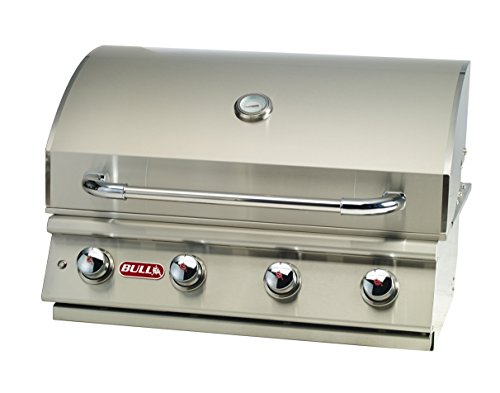
Bull Lonestar Drop-In Grill Head Natural Gas — Best Natural Gas Head
The Lonestar in natural gas form is the built-in argument at its most seductive: turn a valve and the grill is lit, today, tomorrow, in year ten, with no propane tank to empty at the exact moment guests arrive. Plumbed fuel changes behaviour as much as hardware — cooks grill more often when fuel is infinite and invisible — and Bull builds the head itself like it expects that frequency: a stainless body, a drop-in format that sits into the island cutout, and 60,000 BTU of total output sized for serious family and entertaining loads.
Choosing natural gas is a site decision before it is a grill decision. Your island needs a gas line run by a qualified installer, sized for the grill’s demand and any neighbours it will share with — heaters, fire features, a second burner — and that line’s route often shapes the whole island layout. Do that work once, properly, and the Lonestar repays it with the lowest-friction grilling that exists. Skip it, or discover your home has no practical gas route, and the propane sibling below is the same idea with a tank.
As a head, it assumes the island provides what carts carry: storage, work surface, and shelter from the worst weather. Buyers should budget the head as one component in a system — cutout dimensions verified against the island design, ventilation for the enclosure respected, and an access plan for servicing the connection beneath. Judged as that component, the Lonestar is a benchmark: proven maker, serious output, and the endless fuel that makes an outdoor kitchen feel like a kitchen rather than an expedition.
- Output: 60,000 BTU total
- Fuel: natural gas, plumbed connection
- Format: drop-in grill head for outdoor kitchens
- Construction: stainless steel body
- Installation: cutout mounting in an island
Strengths
- Plumbed natural gas ends tank management forever
- Serious output for entertaining loads
- Established maker with outdoor-kitchen depth
Trade-offs
- Requires a professionally run gas line
- Island and cutout costs dwarf the head alone
- Fuel type is fixed once installed
Best for: permanent outdoor kitchens with a practical natural gas route.
Not suited for: renters or anyone whose island plans may move house.

Bull Outlaw Drop-In Grill Head Propane — Best Propane Head
The Outlaw is the Lonestar’s twin in spirit — same Bull drop-in philosophy, same 60,000 BTU class of output — burning liquid propane instead, and that single difference reorganises the whole installation. No gas line needs trenching across the garden, so the island can stand wherever the view is best; in exchange, a tank lives in the cabinet below, and the island’s design must give it what propane safety demands: proper enclosure ventilation, an accessible door, and a hose route that respects the maker’s clearances.
Propane in a built-in surprises some planners, who assume plumbed gas is the only serious option. In practice, tank-fed islands are everywhere, because gardens are rarely plumbed and patios move house less often than their owners fear. The discipline is tank management: a spare tank stored correctly, a gauge checked before big cooks, and an exchange routine that never coincides with a party. Cooks who keep that rhythm find propane built-ins indistinguishable from plumbed ones at the grate — the burners do not know where their gas slept.
Build quality expectations should match the Lonestar’s: this is a long-service head from a specialist maker, meant to be serviced rather than replaced. Verify your cutout against the current specification before the island is cut — dimensions are the one specification in this category that cannot be fudged afterwards — and confirm the enclosure venting in your island plan with the same seriousness. Get those two paperwork moments right and the Outlaw delivers a decade of drop-in grilling with no trench ever dug.
- Output: 60,000 BTU total
- Fuel: liquid propane from a tank in the island
- Format: drop-in grill head, stainless steel
- Installation: cutout mounting with tank access below
- Ventilation: enclosure venting required for propane
Strengths
- No gas line needed — island can sit anywhere
- Same serious output class as its twin
- Propane flexibility suits most gardens
Trade-offs
- Tank changes become a household routine
- Propane enclosures demand proper venting
- Cutout dimensions must be verified exactly
Best for: island projects without a practical natural gas route.
Not suited for: anyone unwilling to manage tanks and spare fuel.

SPIRE 36 Inch Built-In 6-Burner Grill — Best Large 304 Steel
The SPIRE 36 is the maximalist’s answer, built around the material specification that matters most outdoors: 304 stainless steel throughout the body. In an appliance that will live outside for a decade, the grade of stainless is destiny — 304 resists the corrosion that clouds and pits lesser grades, particularly in coastal air — and SPIRE puts it in the headline where it belongs. Around that body sit six burners, 73,000 BTU of total output, 915 square inches of cooking space, a ceramic rear burner for rotisserie work, and interior lighting for the cooks that run past dusk.
Dual-fuel flexibility is the planner’s gift here: configure for propane now, convert if a gas line arrives later, and the island’s biggest component never needs replacing for fuel reasons. Six burners across 36 inches give genuine zone architecture — a searing end, a roasting middle, a resting edge — at a scale where a whole celebration cooks at once. The rear ceramic burner deserves its sentence: radiant, even and made for rotisserie, it turns the head from a grill into a small outdoor oven range.
Scale is the caution. A 36-inch head demands an island with the cutout, the counter run and the entertaining habit to justify it; in a modest garden it can dominate like a parked car. Measure the social reality as carefully as the cutout. For households whose summers are a procession of gatherings, though, this is the complete specification — the right steel, the flexible fuel, the burners to run a feast — executed as one head.
- Construction: all 304 stainless steel body
- Output: 73,000 BTU total across 6 burners
- Cooking space: 915 sq. in. total area
- Extras: ceramic rear burner, interior lighting, thermometer
- Fuel: dual fuel — propane or natural gas configuration
Strengths
- All-304 stainless body for outdoor longevity
- Huge area with six-burner zone control
- Dual fuel protects the investment
Trade-offs
- Dominates modest islands and gardens
- Premium scale demands premium island budget
- Many features to keep clean after parties
Best for: large outdoor kitchens and households that entertain at scale.
Not suited for: small patios where a 36-inch head would overwhelm the space.

SPIRE 30 Inch Built-In 5-Burner Grill — Best Mid-Size 304 Steel
The SPIRE 30 makes an argument that surprises shoppers until they see the numbers side by side: five inches narrower than its sibling, it keeps nearly all the cooking space — 904 square inches against 915 — because the design spends its width on grate rather than frame. The same all-304 stainless construction, the same dual-fuel flexibility, the same ceramic rear burner and interior lighting arrive in a head that fits the islands most gardens can actually host. It is the range’s sweet spot wearing a specification sheet.
Five burners across 30 inches is a genuinely useful architecture: enough zones for a mixed feast, enough output at 63,000 BTU to run the whole grate hot, and a scale that leaves counter room on both sides for the platters, boards and drinks that real entertaining generates. Built-in grills fail socially when the head eats the island; this one leaves the island alive around it. The rear burner keeps rotisserie in the repertoire, and the lighting keeps winter evenings in the calendar.
Choose it over the 36 when your gatherings are large but your island is honest, and over smaller heads when 304 steel and fuel flexibility top your list. As with every pick here, the cutout is a contract: verify dimensions against the current specification, plan the enclosure’s ventilation and access, and let the island be built around confirmed numbers rather than hopeful ones. Do that, and this head will outlast several generations of the furniture around it.
- Construction: all 304 stainless steel body
- Output: 63,000 BTU total across 5 burners
- Cooking space: 904 sq. in. total area
- Extras: ceramic rear burner, interior lighting, thermometer
- Fuel: dual fuel configuration
Strengths
- Nearly flagship space in a friendlier width
- All-304 steel and dual fuel retained
- Leaves counter room alive on the island
Trade-offs
- Still a substantial island commitment
- Rear burner adds cleaning surfaces
- Five burners is more than couples need nightly
Best for: serious entertainers whose islands are mid-size rather than vast.
Not suited for: minimalist projects wanting the smallest possible head.

Hygrill 32 Inch Built-In Grill — Best Value Built-In
Not every island project carries a flagship budget, and the Hygrill exists for the honest middle: a 32-inch built-in head with four burners and a stainless body, configured for liquid propane, that puts a real outdoor kitchen within reach of households the premium names price out. Four burners across 32 inches is a workable architecture for family-plus-friends cooking, and the size sits comfortably in the islands that typical gardens host.
Value engineering shows in the places you would predict: the feature list is shorter — no rear burner theatre, no lighting rig — and the specification sheet is quieter about steel grades, which is exactly the question a careful buyer should ask of any value built-in. Stainless is a family, not a material, and the grade decides whether the head polishes up in year five or freckles in year two. Ask, verify, and set expectations accordingly; a value head maintained under a cover can serve admirably, but it should be bought with its metallurgy understood.
As a propane head it shares the Outlaw’s installation logic: no trench, a tank below, venting respected, access planned. For a first island — the project that teaches a household how it actually uses an outdoor kitchen — the Hygrill’s proposition is sound: spend the saving on the island itself, the counter and the seating, and let the head be the component you upgrade in a later season if the habit outgrows it. Many never will.
- Size: 32-inch built-in format
- Burners: 4 burners
- Fuel: liquid propane
- Construction: stainless steel body
- Use: outdoor kitchens and barbecue islands
Strengths
- Real built-in format at a friendlier level
- Four burners suit family-plus cooking
- Leaves budget for the island itself
Trade-offs
- Steel grade needs verifying by the buyer
- Shorter feature list than premium heads
- Propane-only configuration
Best for: first island projects balancing head and build budgets.
Not suited for: coastal sites where only top-grade steel should be specified.

Brand-Man 40 Inch Built-In Gas Grill Head — Largest Head Here
Forty inches is not a grill size, it is a land claim, and the Brand-Man head claims it with six burners, cast iron grates and a griddle in the box. The proposition is a complete outdoor cooking station in one drop-in: searing zones at one end, gentle holding at the other, and a flat griddle surface for the breakfasts, smash burgers and teppanyaki evenings that a grate alone cannot host. At 60,000 BTU total, the output is arranged for breadth rather than ferocity — six burners sharing the load across a very wide floor.
Cast iron grates at this scale are a commitment as much as a feature: they sear superbly, hold heat through the largest loads, and demand their seasoning discipline across a lot of iron. The natural gas convertibility protects the installation — start on propane, convert if the line arrives — and the heavy-duty stainless body is built to be serviced in place, which matters when the component weighs what this one does and the island was built around it.
Be honest about the island this head requires: a 40-inch cutout, counters that can stage for a crowd, and gatherings that genuinely fill forty inches of grate more than twice a summer. Households that meet that description will find a single appliance replacing what others do with a grill, a griddle and a prayer. Households that do not will find a monument. The specification is admirably clear about which it is; the only remaining task is the buyer’s honesty.
- Size: 40-inch built-in grill head
- Burners: 6 burners, 60,000 BTU total
- Grates: cast iron grates plus a griddle included
- Fuel: propane, convertible to natural gas
- Construction: heavy-duty stainless steel
Strengths
- Enormous cooking floor with six zones
- Griddle included expands the repertoire
- Convertible fuel protects the installation
Trade-offs
- Demands a very large island and cutout
- Cast iron upkeep across a huge area
- Capacity wasted on small households
Best for: large properties whose gatherings fill forty inches of grate.
Not suited for: any island project of ordinary domestic scale.
How Do the Six Grill Heads Compare on Paper?
| Pick | Badge | Key specification | Detail |
|---|---|---|---|
| Bull Lonestar Drop-In Grill Head Natural Gas | Best Natural Gas Head | 60,000 BTU total | natural gas, plumbed connection |
| Bull Outlaw Drop-In Grill Head Propane | Best Propane Head | 60,000 BTU total | liquid propane from a tank in the island |
| SPIRE 36 Inch Built-In 6-Burner Grill | Best Large 304 Steel | all 304 stainless steel body | 73,000 BTU total across 6 burners |
| SPIRE 30 Inch Built-In 5-Burner Grill | Best Mid-Size 304 Steel | all 304 stainless steel body | 63,000 BTU total across 5 burners |
| Hygrill 32 Inch Built-In Grill | Best Value Built-In | 32-inch built-in format | 4 burners |
| Brand-Man 40 Inch Built-In Gas Grill Head | Largest Head Here | 40-inch built-in grill head | 6 burners, 60,000 BTU total |
Let the table sort by your project’s fixed facts first: fuel available, cutout the island can host, and the steel your climate demands. The surviving two or three heads can then be compared on cooking, which is the pleasant part of the decision and the part the detailed reviews cover.
What Must You Decide Before Choosing a Built-In Grill Head?
Four decisions precede the product decision, and projects that make them in order rarely stumble. First, the island itself: its size, position, and whether it is masonry, framed and clad, or a prefabricated system — because the island sets the cutout envelope every head must fit. Second, fuel: whether a natural gas line can reach the site at sane cost, or whether propane’s flexibility wins by default. Third, the electrical and lighting plan, since heads with interior lights and rotisserie motors need power at the island, and trenching electricity alongside gas is far cheaper than returning for it later.
Fourth, the service plan, the decision everyone skips: how will a technician reach the gas connection, the valves and the underside of the head in year six? Access panels sized generously, an island interior that a human arm can actually work in, and shutoff valves placed where they can be reached in a hurry are the unglamorous details that separate professional projects from expensive sculptures. Decide those four things on paper, and the head selection becomes almost easy — the specifications that remain are the ones this guide’s reviews discuss.
Natural Gas or Propane for an Outdoor Kitchen?
Natural gas is the convenience champion: unlimited supply, no tanks, no exchanges, and a per-cook cost that fades into the household bill. Its demands are front-loaded — a qualified installer, a line sized for total demand, permits where your area requires them, and a route from the house supply to the island that may cross paving, planting and foundations. Projects already trenching for power or water absorb that cost gracefully; projects that would trench for gas alone must weigh it honestly against decades of tank swaps.
Propane is the flexibility champion: the island goes where the garden wants it, the installation is simpler, and the fuel arrives in a bottle you control. Its demands are ongoing — tank management, a spare kept correctly, and enclosure design that takes ventilation seriously, because propane is heavier than air and must never be able to pool inside a sealed cabinet. Purpose-built island doors and vent panels exist precisely for this, and any propane design that treats venting as optional should be sent back to the drawing board.
Dual-fuel and convertible heads, like the SPIRE pair and the Brand-Man in this guide, insure the decision: install on whichever fuel is practical today, convert if circumstances change. Where the price difference is modest, that insurance is among the wisest money in the whole project, because fuel infrastructure is the hardest element of an outdoor kitchen to retrofit.
Why Does 304 Stainless Steel Matter So Much Outdoors?
Stainless steel is a family of alloys, and the family members age very differently in weather. Grade 304, with its higher nickel content, forms a stable protective surface that resists the pitting and tea-staining that coastal air, fertiliser drift and winter damp inflict on lesser grades. A head is the one component of an island that cannot be repainted, reclad or cheaply replaced, so its alloy is effectively a ten-year promise: 304 heads characteristically polish back to brightness each spring, while lower grades freckle, then pit, then perforate at seams and fasteners.
The buyer’s task is verification, because the word stainless alone guarantees nothing. Look for the grade stated plainly in the specification — the SPIRE heads in this guide state all-304 construction outright — and treat silence on grade as information in itself. In inland, sheltered gardens a lesser grade under a good cover can still serve respectably, which is the honest case for value heads like the Hygrill. In coastal or exposed sites, specifying 304 is not extravagance; it is the difference between a component and a consumable.
Care still matters on any grade: rinse salt air deposits, avoid leaving corrosive cleaners sitting on surfaces, and keep the head covered when idle. Good steel rewards minimal care with decades; poor steel punishes even devoted care eventually. Choose the alloy for your climate first, then keep the small promises that let it perform.
How Should the Island Around the Grill Be Planned?
Think of the island as three zones: the hot zone the head occupies, the working zones of counter on either side, and the storage and services below. The working zones are where projects most often under-build — a head flanked by a hand’s breadth of counter forces every platter onto laps and garden chairs. As a working rule, landing space for a full tray on at least one side, and staging space on the other, turns the island from a grill stand into a kitchen. Below, divide the interior deliberately: tank or gas service in its own ventilated section, dry storage sealed against weather, and access panels aligned with the head’s service points.
Ventilation deserves its own paragraph because it is safety, not comfort. Enclosed islands trap heat and, with propane, can trap gas; makers specify vent placement and area for their heads, and those specifications are conditions of safe installation, not suggestions. Cross-ventilation — openings on opposing sides — lets air move through the enclosure, and an insulating jacket is required when a head sits in a combustible island structure. These are the lines in the manual to read twice and build once.
Finally, plan the island’s life, not just its unveiling: a cover that fits the head, a lighting plan for evening cooking, water or a bar sink if the budget allows, and seating that keeps guests near the cook without crowding the hot zone. The best outdoor kitchens are social instruments, and the head, for all its specifications, is there to serve the gathering around it.
What Does Installation Actually Involve, Step by Step?
The sequence begins on paper: a dimensioned drawing of the island showing the cutout, the service routes and the vent positions, checked against the head’s current installation manual rather than a brochure. With the drawing approved, services come first — the gas line or the propane enclosure, electrical supply for lights and ignition, and any water or drainage the design includes — because services are trivial to place in an open structure and miserable to retrofit into a closed one. Qualified hands do the fuel work, pressure-test it, and leave it capped and safe while the island rises around it.
The island structure follows, built to the drawing with the cutout formed precisely and the interior kept accessible until the head is commissioned. Only when the surrounding counters are finished and cured does the head itself arrive and drop in — late delivery is deliberate, protecting the most expensive component from weeks of construction dust and weather. Connections are made through the access panels, the installation is leak-tested at every joint, and the burners are lit and observed one by one before any food is allowed near the project.
Commissioning ends with calibration and education: checking that flames burn even and blue, that ignition is instant at every burner, that the thermometer reads sanely against a probe, and that everyone who will cook knows where the shutoff lives. Keep the manuals, the installer’s details and the warranty registration together in one envelope in the island’s dry storage. Projects that follow this order describe installation as uneventful, which is the highest praise an installation can earn.
What Does a Built-In Project Really Cost Beyond the Head?
New planners are routinely surprised that the head is often not the largest line in the budget. The island structure — masonry or framing, cladding, stone or rendered finishes, countertops cut around the head — commonly exceeds it. Services follow: a gas line run can range from trivial to transformative depending on distance and ground, and electrical work for lighting and ignition rides along. Then come the companions that turn a grill station into a kitchen: storage doors and drawers rated for outdoor use, a sink if water is planned, refrigeration if the budget stretches, and the cover that protects it all.
None of this argues against building; it argues for budgeting the system rather than the centrepiece. A household that prices the whole island honestly can then choose where its money works hardest — and the pattern this guide recommends is consistent: protect the head’s quality and materials first, because it is the hardest component to upgrade later, and let finishes and companions be the elements that can arrive in a second phase. Islands are unusually forgiving of phased budgets provided the cutout, services and structure are right in phase one.
Running costs deserve a line too. Plumbed gas is the cheapest fuel per cook; propane exchanges are a visible, budgetable rhythm; and a head maintained under a cover with burners brushed seasonally will hold its performance for years without professional visits beyond the occasional service. The expensive built-in is the neglected one, whatever its badge — a truth that flattens much of the range’s price spread across a decade of ownership.
How Do You Maintain a Grill That Lives in Stone?
Maintenance divides into the cook’s rhythm and the season’s rhythm. The cook’s rhythm is unchanged from any gas grill: preheat, brush the grates while hot, empty the drip tray before it becomes a reservoir, and wipe the control panel while it is still a pleasure rather than an excavation. The season’s rhythm reaches deeper — burners lifted and brushed, ports checked, ignition contacts cleaned, the enclosure’s interior vacuumed of the leaves and visitors that find their way into every island, and vents confirmed unobstructed by the storage that migrates in front of them.
The island itself needs its share: seals and joints inspected where counter meets head, because water that enters the enclosure corrodes from inside where no cover protects; doors and hinges given the same attention as the head’s steel; and the cover aired on dry days so the protected space stays a dry one. In coastal gardens, a freshwater rinse of the head’s exterior is the cheapest anti-corrosion ritual available, and in cold climates the water features — never the gas head — are what need winterising.
Keep a small log in the island’s dry box: installation date, service visits, parts replaced, the cover’s condition. Built-ins outlast memories, and the household that inherits or buys your home one day will bless the envelope. More practically, the log turns troubleshooting from archaeology into arithmetic when a burner misbehaves in year seven.
What Do Rear Burners, Rotisseries and Lighting Actually Add?
The ceramic rear burner is the feature most often bought as a bullet point and loved as a practice. Radiant heat from behind cooks a rotisserie chicken, a rolled joint or a leg of lamb with a self-basting evenness that grate cooking cannot imitate, because the food turns through its own juices under a gentle, constant climate. Households that roast whole birds outdoors more than twice a summer will use it constantly; households that never do own an elegant warming shelf. Buy it for your actual repertoire, and it is either essential or honestly optional — there is no middle verdict.
Interior lighting sounds like theatre until the first November cook, when dusk arrives before the food does and the difference between medium and well-done hides in shadow. Lights built into the head solve the problem at its source; a head torch solves it nearly as well for a fraction of the commitment. Judge lighting as a winter feature: gardens that grill year-round in northern latitudes will bless it, while summer-only cooks can safely let it go.
The pattern generalises across built-in features, from side burners to sear zones to smart controls: each is a tool with a named job, and the project’s discipline is to name the job in your own cooking before paying for the tool. Features chosen that way never feel like clutter; features chosen from a brochure have a way of becoming the parts of the island nobody can remember ordering.
How Do You Choose Between 30, 32, 36 and 40 Inches?
Work from the gathering backwards. Count the largest group you feed more than twice a summer — not the once-a-decade celebration, which can be catered, borrowed or cooked in waves — and picture its food on a grate: burgers by the dozen, or a mixed load of joints, corn and vegetables. Thirty inches serves a family with guests in waves; 32 adds breathing room; 36 runs the whole feast at once with zones to spare; 40 belongs to households whose ordinary weekends look like other people’s parties. The honest count, not the aspirational one, picks the size.
Then subtract what the head takes from the island. Every inch of grill is an inch not available for counters, and cooks consistently report that landing space outranks grate space once a basic capacity is met. If your island’s total run is fixed, a 30-inch head with generous stone on both sides will out-cook a 36-inch head with nowhere to rest a tray — the food may be equal, but the evening will not be. Let the island’s total length arbitrate, and give the counters their due.
Finally, consider the cooks of the future: households grow into entertaining or out of it, and a head is a decade-long fixture. The dual-fuel, mid-size, top-steel specification exists precisely because it bends with those changes — which is why the SPIRE 30 anchors this guide’s recommendations for all but the smallest and largest projects.
How Should You Think About Safety Around an Island?
An island concentrates things that deserve separation: fuel, ignition, hot surfaces, and people holding drinks. The design rules that follow from that are simple and non-negotiable. Fuel shutoffs must be reachable without reaching across the grill. Enclosures must breathe through their specified vents, which must never be blocked by stored items — a rule to repeat every spring, because storage creeps. Clearances to combustible planting, furniture and overhead structures follow the head’s manual and local code, measured with the lid open and a cook standing in place, not from a drawing’s optimism.
Children and guests change the risk picture socially rather than technically: an island with the cook’s working side facing the garden and the guests’ side kept as counter and seating naturally separates the audience from the fire. Plan the social geometry when the island is drawn, not after it is built — where people will stand with plates is where they will stand, and the design can either welcome them at a safe remove or leave them drifting through the hot zone with nowhere better to be.
Finally, keep the unglamorous kit at hand: a fire extinguisher rated for grease within reach but not within the heat, a first-aid kit in the dry storage, and lighting on the path between house and island for the winter evenings when most trips and spills happen. None of this dims the pleasure of an outdoor kitchen; all of it is what makes the pleasure repeatable for a decade.
Insurance and permits deserve a closing word, because they are the paperwork half of safety. Many areas require permits for gas line work, and insurers like to know about plumbed outdoor appliances; a short call before the project beats a long conversation after an incident. Keep the permits with the manuals in the island envelope, where the next owner will find the project’s whole story in one place.
What Does Life With a Built-In Grill Actually Change?
Owners consistently report that the change is behavioural before it is culinary. A grill that is always installed, always fuelled and always two steps from the kitchen door gets used on whims — a single steak on a Wednesday, vegetables for tonight’s soup, bread toasted over real fire because it is there. Cart grills, however excellent, ask for a small ceremony of uncovering, positioning and fuelling; built-ins ask for a valve and a match’s worth of attention. Frequency follows friction, and the built-in’s deepest specification is how little friction it leaves in an ordinary evening.
The social geometry changes too. The cook stops commuting between kitchen and a distant grill and starts hosting from a fixed, well-equipped station, with guests gathered at the island rather than shouting across the garden. Meals stretch longer around an island; the cooking becomes part of the evening’s entertainment rather than an absence from it. Designers of outdoor kitchens trade on exactly this effect, and for once the brochure language undersells the reality.
There is a discipline the built-in demands in return: it cannot be wheeled away from its mistakes. A badly sited island is sited forever, a head that disappoints disappoints in stone, and the maintenance described earlier cannot be delegated to a future owner of a cart. That permanence is the category’s whole bargain — commitment in exchange for belonging — and it is why this guide spends so many words on paper decisions. Make them well, and the garden gains a room; make them hastily, and it gains a monument to haste.
Start, then, with the site and the drawing, choose the fuel with your eyes open, specify the steel your weather deserves, and let the head — Bull, SPIRE, or the honest value of the Hygrill — be the reward for decisions already made well. The cooking, afterwards, is the easy part, and it stays easy for years.
What Are the Most Common Mistakes in Built-In Grill Projects?
The cardinal mistake is building the island before confirming the head’s cutout — masonry is unforgiving, and a cutout an inch wrong converts a joyful project into a negotiation with a diamond saw. Confirm dimensions from the maker’s current specification, then confirm them again when the head arrives, before the island is closed. The second mistake is fuel improvisation: undersized gas lines that starve every burner at full demand, unvented propane enclosures, and flexible connectors asked to do a fixed installation’s job. Fuel work belongs to qualified installers, full stop.
Third comes the forgotten access panel, discovered in year four by a technician who cannot reach a valve. Fourth, specifying by headline output while ignoring steel grade — buying weather failure with impressive numbers. Fifth, starving the counters to enlarge the head, producing a magnificent grill with nowhere to put a plate. And sixth, skipping the cover because the head is steel, as if steel enjoyed weather. Every one of these is a paper mistake before it is a garden mistake, which is good news: paper is where they are cheapest to fix.
One more paper exercise repays its ten minutes before any order is placed: the full-size template. Makers publish cutout templates for their heads, and printing or drawing yours at true scale — then laying it on the planned island footprint with plates, boards and a pretend platter arranged around it — reveals space truths that no dimensioned drawing conveys. Counters that looked generous in numbers feel tight in cardboard; a 40-inch head that seemed merely large becomes honestly enormous. Projects that pass the cardboard test rarely disappoint in stone.
Do the same service for the fuel decision by walking the gas route physically, from the house supply to the island site, noting every surface the line must cross. A route that is simple on paper and brutal across a finished terrace changes the propane-versus-plumbed arithmetic on the spot. Gardens are three-dimensional and occasionally muddy; let the decision meet the real one before it hardens into a contract.
And photograph the site in the evening, when the island will mostly be used. Light, wind and the view from the cook’s position all declare themselves at dusk in a way they hide at noon, and a head placed for the noon photograph may face its cook into the sunset glare for a decade of dinners. Ten minutes at the right hour is the cheapest consultancy in the entire project.
Final Recommendation
For a plumbed showcase island, the Bull Lonestar Drop-In Grill Head Natural Gas remains the benchmark head, while its twin the Bull Outlaw Drop-In Grill Head Propane serves tank-fed projects with the same authority. Buyers who want the full modern specification — 304 steel, dual fuel, rear burner — should take the SPIRE 30 Inch Built-In 5-Burner Grill for all but the largest islands. Confirm the cutout, respect the venting, choose the steel for your climate — and the head you set into stone this year will still be the heart of the garden when everything around it has been repainted twice.
When the project is done and the first season is underway, resist the urge to judge it by its largest party. Judge it instead by an ordinary Thursday: how quickly dinner happened, how naturally guests gathered, how little the cook thought about the equipment at all. A built-in that disappears into the evening is a built-in that succeeded, and the specifications — steel, fuel, inches, output — will have done their work so quietly that nobody at the island mentions them, which is exactly as it should be.
Keep the cover on between those evenings, the vents clear, the log updated, and the spare tank or the gas line’s shutoff exactly where the drawing said they would be. Permanence rewards housekeeping, and the island that is kept like a kitchen will cook like one long after the neighbours’ carts have rusted into garden ornaments.
Budget a small contingency for the surprises every garden keeps: a root where the trench was drawn, a slab thicker than expected, a delivery that needs two extra hands. Projects with a contingency absorb these as anecdotes; projects budgeted to the last coin absorb them as crises. The island will be standing for a decade either way — let its first memory be a good one.
And involve the people who will cook on it before the design freezes. The second cook in the household notices the missing landing space, the left-handed door swing, the light that will shine in eyes rather than on food. A drawing reviewed by every cook is a drawing with its mistakes already half corrected, at the only stage when correction costs nothing.
Then build it once, build it to the drawing, and let the first cook be the celebration the project has been promising since it was a sketch — preferably something simple and excellent, cooked at dusk, with the island lights on and nowhere else to be.
Years from now, nobody will remember what the head cost or how long the trench took; they will remember the evenings. Build for the evenings, verify for the decade, and the island will pay its rent in the only currency gardens really deal in.
That is the standard to hold every drawing, every specification and every sales conversation against: not how impressive the island looks on delivery day, but how invisible its quality becomes across a hundred ordinary evenings of cooking well.
Choose accordingly, take your time over the drawing, and welcome to the part of grilling where the appliance quietly becomes a place of its own in the life of the house and in the evenings of everyone who gathers around it, season after season, year after good, long, well-fed, well-remembered year ahead of you.
Frequently Asked Questions
Can a built-in grill head be replaced later with a different brand?
Only if the new head matches the existing cutout or the island can be modified — masonry changes are possible but costly. This is why established makers with stable dimensions and long parts support are favoured for built-ins: the safest replacement strategy is a head that never needs replacing, serviced across its life instead.
Do I need an insulating jacket for my island?
If the island structure includes combustible materials near the head, yes — jackets isolate the head’s heat from the structure and are specified by makers for exactly that situation. Solid masonry islands may not require one. The head’s installation manual governs; follow it precisely rather than improvising.
How much ventilation does a propane island need?
Follow the head maker’s stated vent area and placement — typically vents at high and low points on opposing sides, since propane pools low. Ventilation is a safety specification, not a styling choice, and local codes may add requirements. When in doubt, have the design reviewed by the gas installer before building.
Is a bigger built-in grill always better for entertaining?
Only up to the size your gatherings actually fill. Beyond that, extra width eats counter space, lengthens preheats and heats empty grate. Most households entertain best on 30 to 36 inches with generous counters; the 40-inch class serves genuinely large, regular crowds.
Can a built-in head be converted between propane and natural gas?
Some can — dual-fuel and convertible models are designed for it, using the maker’s conversion kit and a qualified installer. Others are fuel-fixed for life. If flexibility matters, choose a convertible head at purchase, as with the SPIRE models here, rather than hoping a fixed head can be adapted later.
Related Guides
Complete the project reading with Best Kamado Grills for the charcoal alternative some islands make room for, Best Country Kitchen Faucets for the indoor kitchen’s finishing touches, and Best Countertop Clear Ice Makers for the drinks station every outdoor kitchen deserves.



[…] with Best Built-In Gas Grills for permanent outdoor kitchens, Best Contemporary Kitchen Faucets for the indoor half of the […]