What's inside
- Key Takeaways
- Quick Picks
- How Did We Choose These Balcony Grills?
- What Are the Best Apartment Balcony Grills for Your Space?
- How Do the Six Balcony Picks Compare Side by Side?
- Do Apartment Rules Really Ban Balcony Grills?
- Which Fuel Makes Sense When Flame Is Allowed?
- How Should You Set Up a Balcony Grill Safely?
- What Should You Cook First on a Small Balcony Grill?
- How Do You Measure a Balcony Before Choosing a Grill?
- What Mistakes Do Balcony Grill Owners Keep Making?
- Final Recommendation
- Frequently Asked Questions
- Related Guides
As an Amazon Associate I earn from qualifying purchases. This post may contain affiliate links at no extra cost to you.
cottageverdict.com is reader-supported. When you buy through links on our site, we may earn an affiliate commission.
Where to buy: every grill in this guide links to its Amazon listing, where you can check price on Amazon and read the manufacturer’s own dimensions, fuel requirements and clearance guidance before ordering. Measure your balcony door and railing width first, because a grill that cannot pass through the door or leaves no room to stand beside it is a return waiting to happen.
Finding the best apartment balcony grills starts with a document most shoppers never read: your lease, and the fire code your building falls under. Many apartment complexes and condos ban charcoal outright, a large share also prohibit gas grills on balconies, and some cities restrict any open-flame cooking within a set distance of combustible structures. Electric models slip past nearly all of those rules because there is no open flame and no stored fuel, which is why two of the six picks below plug into a wall outlet rather than a tank or a bag of briquettes.
That honesty shapes the whole list. The electric picks are the default recommendation for anyone whose paperwork is unclear, and they genuinely sear rather than merely warm food through. The portable gas and charcoal options appear here for readers whose buildings explicitly allow them, whose balconies sit on concrete high-rises with written permission, or who want one compact grill that serves a balcony where permitted and a campsite where rules differ. Nothing in this guide is a workaround for a ban: if your lease says no flame, believe it, because a singed railing is the least expensive way that argument ends.
One more filter quietly shaped this list: how a grill behaves at the end of the evening. Balcony cooking happens close to bedtime and close to other people’s windows, so models that cool down predictably, shut off completely, and clean without a hose or a cloud of ash scored ahead of cookers that stay hot and messy for hours. A grill you can put away before dessert is a grill you will use on a Wednesday, and Wednesday use is where these purchases justify themselves.
Size discipline matters as much as fuel. A balcony grill has to share a few square metres with chairs, planters and the person cooking, leave a safe gap from railings and siding, and store without dominating the space all winter. Every pick below cooks for one to four people, moves easily, and keeps its footprint closer to a side table than to a backyard barbecue. Within those limits there is real range, from a countertop electric griddle that lives in a kitchen cupboard to a small insulated kamado that smokes ribs on a generous, rule-compliant terrace.
Key Takeaways
- Read your lease and local fire rules before choosing a fuel type; many buildings ban charcoal and gas on balconies entirely.
- Electric grills are the near-universally permitted option, and the two here reach proper searing temperatures rather than steaming food.
- Compact footprints under roughly 420 square inches of cooking space suit one to four diners without crowding a small balcony.
- Portable gas and charcoal picks only belong on balconies where written rules explicitly allow open flame and stored fuel.
- A lid, a drip tray and easy ash or grease handling matter more in a small shared space than raw burner power.
- Store fuel, ash and grease away from the cooking spot, and let every grill cool fully before it comes back indoors.
Quick Picks
| Pick | Badge | Why it earned a place |
|---|---|---|
| Ninja Sizzle Indoor Grill and Griddle | Best Electric Pick | A 14-inch electric grill and griddle that reaches 500°F, so balcony cooks under a flame ban still get real char marks. |
| George Foreman 4-Serving Indoor Grill | Best Compact Electric | A small sloped-plate electric grill with removable plates that stores upright in a cupboard between balcony sessions. |
| Cuisinart 14 Inch Portable Charcoal Grill | Best Small Charcoal (Where Allowed) | A 196-square-inch kettle-style charcoal grill with locking lid, included only for balconies where charcoal is explicitly permitted. |
| Charbroil Grill2Go X200 Portable Gas Grill | Best Portable Gas (Where Allowed) | A rugged latching-lid gas grill on small canisters, suited to permitted balconies and ready to travel to the campsite. |
| Feasto 2-Burner Propane Gas Grill | Best Full-Size Feel on a Terrace | A 418-square-inch two-burner gas grill with warming rack for larger, gas-permitted terraces that can spare the floor space. |
| Char-Griller AKORN Jr Portable Kamado | Best Small Kamado (Where Allowed) | A 155-square-inch triple-wall insulated kamado that smokes and sears on little charcoal, for permitted larger balconies. |
How Did We Choose These Balcony Grills?
The first filter was permission, not performance. We started by sorting balcony-suitable grills by fuel and asking which ones a typical renter could actually use: electric models that plug into an outdoor outlet, then small gas and charcoal units whose listings and dimensions suit the minority of balconies where flame is allowed in writing. Anything too large to leave walking room on a modest balcony was cut, however good its barbecue credentials.
Cooking ability came second. Balcony meals skew towards weeknight speed: burgers, chicken thighs, salmon fillets, skewers and vegetables for one to four people. We favoured grills that preheat quickly, hold a steady temperature across the grate rather than only above the element, and give some way to manage flare-ups, because fat dripping in a confined space produces smoke that drifts straight into a neighbour’s open window.
Third came the unglamorous details that decide whether a balcony grill gets used weekly or abandoned by August. Grease trays that slide out for washing, lids that contain splatter, ash systems that do not require tipping a hot bowl over a railing, and handles that stay cool enough to move the unit once dinner is done all counted heavily. Storage footprint mattered too: several picks here live indoors between sessions, which keeps them cleaner and keeps the balcony clear.
Finally, we weighted build honesty. Thin painted steel is acceptable at the small charcoal end if the price of entry is low and expectations are set correctly, but anything presented as a long-term fixture needed sturdier grates, a lid that seals, and replacement parts that exist. Each pick below states plainly who should skip it, because on a balcony the wrong grill is not merely disappointing, it is unusable.
One more consideration ran through every decision: smoke behaviour at lighting and during fatty cooks, because a balcony grill performs in front of an audience of neighbours whether it wants to or not. Models that light cleanly, keep lids over dripping fat, and shut down quickly scored ahead of equally capable cookers that announce themselves to the whole building for half an hour. Courtesy is not a specification you will find on a product page, but on a balcony it behaves like one.
What Are the Best Apartment Balcony Grills for Your Space?
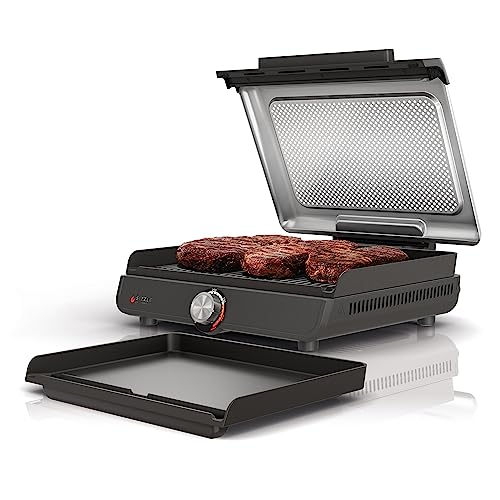
Ninja Sizzle Indoor Grill and Griddle — Best Electric Pick
The Ninja Sizzle solves the balcony problem by removing the flame from it entirely. It is a 14-inch countertop electric unit with interchangeable grill and griddle plates, edge-to-edge heating up to 500°F, and a hinged lid with a mesh splatter shield. Set it on a heat-safe outdoor table near an outlet and it behaves like a small, serious grill: steaks take on defined marks, chicken skin crisps, and the flat plate handles eggs, pancakes and smashed onions for a weekend brunch cooked outside.
Heat distribution is the pleasant surprise. Many electric grills scorch a ring above the element and leave the edges lukewarm, but the Sizzle’s plate heats evenly enough that a row of asparagus cooks at the same pace from end to end. The lid matters on a balcony, too, because it traps splatter that would otherwise freckle the railing and the floor, and the splatter shield keeps the worst of the smoke-generating grease off the hot surfaces.
Its limits are honest ones. There is no charcoal flavour, because there is no charcoal; a light hand with smoked paprika or a finishing drizzle of smoked oil is the workaround most owners settle on. Capacity suits two people generously and four at a squeeze, and the unit needs a nearby outlet plus a surface that tolerates heat underneath. As the default recommendation for renters whose rules forbid flame, though, nothing else in this guide is as easy to justify to a landlord.
Day to day, it asks little of its owner. Preheat is a matter of minutes, the temperature dial gives repeatable settings for regular dishes, and the plates pop out for washing instead of demanding a wire brush session on the balcony floor. Salmon fillets with crisped skin, prawns that stay snappy rather than rubbery, and halloumi that browns without melting through a grate all suit its even, enclosed heat. Because it also works on a kitchen counter, it earns its cupboard space in winter instead of hibernating until spring, which is more than any flame grill in this list can claim.
- Fuel: Electric, corded, standard household outlet
- Cooking surface: 14-inch interchangeable grill and griddle plates
- Maximum temperature: 500°F with edge-to-edge heating
- Lid: Hinged lid with mesh splatter shield
- Cleaning: Nonstick plates and lid are dishwasher safe
- Footprint: Countertop size, stores in a kitchen cupboard
Strengths
- Reaches a genuine 500°F, so searing is real rather than cosmetic
- No flame and no stored fuel, which satisfies most balcony rules
- Swappable griddle plate doubles it as an outdoor breakfast station
Trade-offs
- Corded power ties you to an outlet within reach of the balcony
- Cooking area feeds two comfortably and four only in batches
- No smoke flavour without help from seasonings or finishing oils
Best for: renters under a strict no-flame policy who still want proper grill marks and a fast weeknight cook. Not suited for: anyone chasing authentic charcoal smoke, or balconies with no outdoor power outlet. Check price on Amazon.
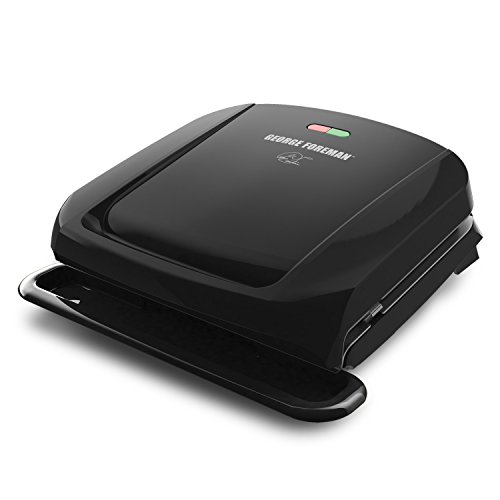
George Foreman 4-Serving Indoor Grill — Best Compact Electric
The George Foreman 4-Serving grill is the smallest commitment in this guide: a countertop electric press grill with removable nonstick plates, a sloped cooking surface that channels grease into a drip tray, and a footprint that stands upright in a kitchen cupboard when the balcony season pauses. For a studio or one-bedroom flat, that storage trick is not a minor perk; it is the difference between owning a grill and owning an obstacle.
Cooking is contact-style, with both plates heating the food at once, so burgers, chicken breasts and panini cook quickly and without flipping. The slope earns its keep with fattier cuts, drawing grease away from the cooking surface into the tray instead of letting it pool and smoke, which your upstairs neighbour will appreciate on a still evening. Removable plates that go in the dishwasher remove the scrubbing session that puts people off grilling on a Tuesday.
Set expectations by the name: four servings assumes modest portions, and two hungry adults is the realistic comfortable load. There is no temperature dial to finesse, no lid thermometer, and the closed-press format flattens delicate fish and thick bone-in cuts are a poor match. Treat it as a fast, tidy, rule-proof way to cook simple food outdoors or in, and it is excellent; ask it to be a barbecue and it will disappoint.
Its natural menu is the weekday canon: burgers on Thursday, chicken sandwiches, quesadillas, vegetable panini, and the kind of breakfast fry-up that feels like a small holiday when eaten outside. Because both plates cook at once, a round of food finishes in roughly half the time an open grill would take, and there is no preheat ritual beyond plugging in and waiting for the ready light. For a first grill in a first flat, that frictionless routine builds the cooking habit instead of testing it, and the modest investment means upgrading later carries no guilt about money left on the table.
- Fuel: Electric, corded
- Capacity: Marketed for 4 servings; realistically 2 adults
- Plates: Removable nonstick grill plates, dishwasher safe
- Grease handling: Sloped surface draining to a removable drip tray
- Controls: Simple on-off operation, no temperature dial
- Storage: Stands upright for cupboard storage
Strengths
- Smallest storage footprint of any pick in this guide
- Removable plates make cleanup a dishwasher cycle, not a project
- Grease drains away from food, reducing smoke and flare risk
Trade-offs
- Press format cannot handle thick or bone-in cuts well
- No adjustable temperature control for delicate items
- Cooking area is tight for more than two adults
Best for: solo renters and couples in small flats who want grilled weeknight staples with almost zero cleanup. Not suited for: hosts cooking for groups, or anyone who wants open-grate barbecue character. Check price on Amazon.

Cuisinart 14 Inch Portable Charcoal Grill — Best Small Charcoal (Where Allowed)
This little Cuisinart is the charcoal entry, and it carries the loudest condition in the guide: use it only where your building’s written rules and local fire code explicitly allow charcoal on a balcony, which is a minority of apartment buildings. Where it is legal, a 14-inch kettle format with 196 square inches of chrome-plated grate delivers the genuine article: real smoke, real char, and the particular flavour that electric plates imitate but never quite reach.
The design is sensibly portable. Three lid locks hold everything together for one-handed carrying, a dual vent system gives basic control over the fire, and an ash catcher underneath keeps the balcony floor cleaner than open designs do. It lights with a small chimney starter, cooks a pair of steaks or four burgers happily, and cools down to a size that tucks into a storage box rather than squatting on the balcony all year.
Charcoal discipline matters more in this setting than anywhere else. Ash must be stone cold, ideally left a full day, before it goes into a metal container and then out with the rubbish according to building rules; never tip it over a railing and never store a bag of briquettes beside the grill in summer heat. The grate is chrome-plated rather than cast iron, so sear marks are lighter and the surface rewards a brush and oil rather than neglect.
Cooking on it is a pleasantly old-fashioned ritual. A small chimney of briquettes lights in about fifteen minutes, the vents teach you fire control within a couple of sessions, and food for two comes off in unhurried rounds while the balcony catches the evening. It will not smoke a brisket or hold a casserole dish beside the coals, and it was never meant to. Bought cheaply, used legally and stored dry, it delivers the essential charcoal experience at kettle scale, which is exactly what a permitted small balcony asks for.
- Fuel: Charcoal briquettes or lump
- Cooking area: 196 sq in chrome-plated steel grate
- Vents: Dual air vent system, top and bottom
- Portability: Three lid locks for one-handed carrying
- Ash handling: Enamelled ash catcher beneath the fire bowl
- Assembly: Minimal; legs and handles attach out of the box
Strengths
- Authentic charcoal flavour in the smallest footprint here
- Lid locks make it genuinely carryable to permitted spots
- Ash catcher keeps a small balcony tidier than open braziers
Trade-offs
- Illegal on many apartment balconies; permission is essential
- Chrome grate gives softer sear marks than cast iron
- Ash disposal demands patience and a metal container
Best for: cooks in buildings that explicitly permit charcoal, who want true smoke flavour for two. Not suited for: anyone whose lease or fire code bans charcoal, which is most renters. Check price on Amazon.

Charbroil Grill2Go X200 Portable Gas Grill — Best Portable Gas (Where Allowed)
The Grill2Go X200 is a briefcase of a gas grill: a cast aluminium body, a lid that latches shut, legs that fold, and a burner fed by small disposable propane canisters rather than a full-size tank. That fuel choice is the balcony-relevant detail, since many buildings that tolerate gas at all still object to a large tank stored beside the railing, and the canister format keeps the whole setup small enough to bring indoors after dinner. As with every flame pick here, confirm your building allows gas grilling before it ever comes home.
Charbroil’s TRU-Infrared style cooking surface spreads heat through an emitter plate, which calms the flare-ups that plague small gas grills when chicken skin or burger fat drips onto an exposed burner. Push-button ignition lights it without matches, the grate gets properly hot for a single layer of steaks or skewers, and the whole unit shrugs off being carried down to a car for tailgating or camping weekends.
Capacity is its ceiling: the grate handles dinner for two or three, not a party. The emitter plate needs regular cleaning or its pores clog and hot spots creep back, and canister fuel costs more per cook than a refillable tank over a long season. Judge it as a permitted-balcony and travel grill rather than a household’s only barbecue, and its compromises line up neatly with its strengths.
Owners tend to develop a rhythm with it: canister screwed on, lid down for a short preheat, food cooked in one confident layer, then everything latched and carried back inside once cool. The cast body shrugs off the knocks that dent thin steel, and the whole package fits in a car boot without rearranging the luggage. For households splitting life between a flat and the outdoors, that double duty justifies the purchase in a way a fixed balcony grill never could, provided the home end of the arrangement sits within the building’s gas rules.
- Fuel: Propane, small disposable canisters
- Body: Cast aluminium with latching lid
- Cooking system: Infrared emitter plate over a single burner
- Ignition: Push-button piezo ignition
- Portability: Folding legs, carry handles, latches shut
- Best load: Single layer of food for two to three people
Strengths
- Canister fuel avoids storing a full-size propane tank
- Emitter plate tames flare-ups in a confined space
- Latches and folds into a genuinely portable package
Trade-offs
- Gas grilling is banned on many balconies; check first
- Emitter plate needs frequent cleaning to stay even
- Small grate cannot feed a crowd in one round
Best for: permitted balconies in gas-friendly buildings, plus campers and tailgaters sharing one grill. Not suited for: renters under a gas ban, or households cooking for five or more. Check price on Amazon.

Feasto 2-Burner Propane Gas Grill — Best Full-Size Feel on a Terrace
Some balconies are really terraces, and for those, with gas explicitly allowed, the Feasto two-burner is the closest thing here to a conventional backyard grill. It offers 418 square inches of grilling area, 26,500 BTU across two burners, a warming rack for buns and resting meat, and an all-porcelain-enamel build that wipes down easily and resists the weather a covered terrace still delivers.
Two burners change what dinner can be. One side runs hot for searing while the other idles low under vegetables or a pan of beans, and the warming rack keeps finished food hot without pushing it past done. Porcelain-enamel grates release food more kindly than bare steel and shrug off a brush after each cook, and the enclosed design keeps the grease tray out of sight and out of the wind.
The conditions are real: this is a fixed resident, not a cupboard guest, so the terrace needs the floor space, the clearance from walls and railings the manual specifies, and a building that permits a tank-fed grill in the first place. Assembly takes a proper afternoon session with a screwdriver. Given room and permission, it cooks like the family grill it resembles; squeezed onto a narrow balcony, it would crowd out the chairs it is meant to feed people sitting in.
What it returns for that space is a familiar, sociable style of cooking. There is room to keep a conversation going while turning skewers, a rack to park the garlic bread, and enough grate to plate everyone’s main at the same moment rather than in shifts. Weekend breakfasts on the griddle-less grate still work with a cast iron pan set over the burners, and the enclosed cabinet hides the tank and tools from view. On the right terrace it stops feeling like an appliance and starts feeling like the outdoor kitchen corner the space was missing.
- Fuel: Propane, standard refillable tank
- Output: 26,500 BTU across 2 burners
- Cooking area: 418 sq in plus warming rack
- Grates: Porcelain-enamel coated
- Body: All-porcelain-enamel design, black finish
- Placement: Freestanding; needs a larger terrace footprint
Strengths
- Two burners allow a hot zone and a gentle zone together
- Warming rack keeps batches and buns at serving temperature
- Porcelain enamel cleans easily and resists rust well
Trade-offs
- Far too large for narrow balconies or indoor storage
- Requires a building that allows tank-fed gas grills
- Assembly is a multi-step job, not a ten-minute setup
Best for: households with a spacious terrace and written permission for gas, cooking for three to five. Not suited for: small balconies, renters under any flame restriction, or minimalists. Check price on Amazon.

Char-Griller AKORN Jr Portable Kamado — Best Small Kamado (Where Allowed)
The AKORN Jr shrinks the kamado idea to balcony scale: 155 square inches of cast iron grate inside a triple-wall insulated steel body, with a locking lid and the egg shape that makes kamados so frugal with charcoal. Insulation is its party trick. The walls hold heat steady for low-and-slow ribs or a smoked chicken, then climb willingly to steak-searing temperatures, all on a modest pile of lump charcoal that lasts far longer than it would in a thin kettle.
On a permitted balcony, that efficiency has practical side benefits. A smaller fire means less smoke drifting to neighbours, less ash to dispose of once cold, and a body whose exterior stays cooler than single-wall steel, though cooler never means safe to touch mid-cook or casual about clearance from the railing. The locking lid and compact legs make it movable once cold, so it can live against a wall under a cover rather than centre stage.
Charcoal rules apply with full force: this pick is only for buildings that allow charcoal in writing, full stop. The 155 square inches also set a hard ceiling, roughly two steaks and some vegetables at once, and kamado cooking rewards patience while you learn its vent settings, since overshooting temperature is easy and coming back down is slow. For the permitted few, it is the most capable small charcoal cooker here; for everyone else, it is a photograph of a grill they cannot use.
The learning curve deserves one honest paragraph. Kamado vents work in small movements: open them and the temperature climbs eagerly, close them and the fire settles slowly, so cooks plan changes ten minutes ahead instead of chasing the thermometer. Two or three practice cooks with inexpensive chicken teach the settings better than any manual. After that apprenticeship, the little egg becomes the grill owners reach for when flavour matters most, turning out smoked wings, charred cabbage and thick steaks with a depth the electric plates admire from a distance.
- Fuel: Lump charcoal recommended
- Cooking area: 155 sq in cast iron grate
- Body: Triple-wall insulated steel, grey finish
- Lid: Locking lid for moving once cold
- Temperature style: Wide range from low smoking to high searing
- Ash handling: Removable ash pan under the fire chamber
Strengths
- Insulated walls hold low temperatures on very little fuel
- Cast iron grate lays down deep, even sear marks
- Compact body suits larger balconies without dominating them
Trade-offs
- Charcoal is prohibited in many apartment buildings
- Small grate limits meals to about two people
- Vent control has a learning curve for beginners
Best for: permitted charcoal cooks who want smoking ability in a balcony-friendly size. Not suited for: anyone under a charcoal ban, or families needing a big cooking surface. Check price on Amazon.
How Do the Six Balcony Picks Compare Side by Side?
Read the fuel column first and the size column second. Permission decides which rows of this table are even available to you, and only then does cooking area separate a solo weeknight grill from a terrace fixture.
Notice, too, how differently the six use their space. The press grill cooks two faces of the food at once and so punches above its area, the kamado’s single layer is small but its insulated fire stretches a meal across courses, and the two electric models trade raw area for the freedom to cook where flame models simply cannot go. Judge the table by fit for your balcony rather than by the biggest number in the size column. Every model here was chosen to leave standing room beside it, but the Feasto assumes a terrace while the George Foreman assumes a cupboard, and that difference matters more than any single feature.
| Pick | Fuel and heat source | Cooking space | Standout trait |
|---|---|---|---|
| Ninja Sizzle Indoor Grill and Griddle | Electric, corded | 14-inch plate | Highest electric heat here |
| George Foreman 4-Serving Indoor Grill | Electric, corded | 4-serving press plates | Stores upright in a cupboard |
| Cuisinart 14 Inch Portable Charcoal Grill | Charcoal | 196 sq in | Lid locks for carrying |
| Charbroil Grill2Go X200 Portable Gas Grill | Propane canisters | Compact single-burner grate | Infrared plate calms flare-ups |
| Feasto 2-Burner Propane Gas Grill | Propane tank, 2 burners | 418 sq in + rack | Two-zone cooking |
| Char-Griller AKORN Jr Portable Kamado | Charcoal, insulated kamado | 155 sq in | Sips fuel at low heat |
Do Apartment Rules Really Ban Balcony Grills?
Often, yes, and the restriction usually comes from two directions at once. Leases and condo bylaws commonly prohibit charcoal grills on balconies, and many extend the ban to gas, because a balcony fire sits close to siding, railings and the unit above. Separately, many local fire codes restrict open-flame cooking on combustible balconies or within a set distance of the building, with exceptions sometimes carved out for electric appliances and occasionally for small propane setups in sprinklered concrete buildings. The exact wording varies by city and building, which is precisely why a generic internet answer cannot clear you to cook.
The practical routine takes ten minutes. Search your lease for grill, barbecue, balcony and open flame; check the building’s posted rules or ask the management office in writing; then look at your city’s fire code summary if doubt remains. Keep the answer somewhere you can find it, because if a neighbour complains, the conversation goes better with the clause in hand. When the answer is no flame, it is final, and the electric picks in this guide exist so that the answer does not end balcony cooking altogether.
Insurance is the quiet third party in this discussion. A fire started by a prohibited grill can complicate or void coverage for the damage, quite apart from lease consequences and fines. Nobody buys a balcony grill expecting that sentence to matter, but it is the strongest argument for treating the rules as the first specification of the product, ahead of BTUs and grate material.
Renters should also think about the end of the tenancy. A grill that leaves rust rings on balcony tiles, grease shadows on render or a scorched patch on decking can cost more in deposit deductions than the grill itself cost to buy. Drip mats under flame models, prompt cleaning, and keeping the unit a sensible distance from walls protect both the building and your deposit, and they take almost no effort once they become habit.
Which Fuel Makes Sense When Flame Is Allowed?
Where a building permits more than electricity, the choice turns on smoke, storage and patience. Charcoal gives the deepest flavour and the simplest hardware, but it produces the most smoke at lighting time, demands a safe ash routine, and requires storing fuel somewhere dry. The two charcoal picks here answer differently: the little Cuisinart kettle is cheap, light and honest about being an occasional cooker, while the insulated AKORN Jr burns far less fuel per session and holds smoking temperatures the kettle cannot.
Gas trades flavour for manners. It lights instantly, makes little smoke beyond what the food itself generates, and shuts off the moment dinner ends, which neighbours notice and appreciate. The Grill2Go’s canister format suits buildings wary of stored tanks, while the Feasto’s tank-fed two burners suit a terrace where the grill is a permanent, permitted fixture. Neither produces charcoal smoke flavour, and both need their grease systems kept clean, because accumulated fat is the main source of the smoke people blame on the fuel.
Electric deserves a fair hearing even when flame is allowed. It is the only fuel you can also use indoors on a rainy evening, it never needs a fuel run, and modern plates reaching 500°F sear convincingly. What it cannot do is smoke food or forgive a forgotten drip tray. Many balcony cooks end up owning both worlds over time: an electric plate for Tuesday and a small permitted charcoal grill for the Saturday when flavour is the whole point.
Running costs differ quietly between fuels. Electricity is effectively free at this scale, canister propane is the priciest way to buy gas but comes in small commitments, a refillable tank is cheapest per cook, and charcoal sits in the middle with the added cost of your time at lighting and ash disposal. None of these numbers should override the permission question, yet they explain why two neighbours with identical balconies can rationally choose different fuels.
How Should You Set Up a Balcony Grill Safely?
Start with placement. The grill belongs on a stable, level, non-combustible surface, away from railings, siding, outdoor curtains and anything stored on the balcony, with the manufacturer’s stated clearances treated as minimums rather than suggestions. Never grill inside a screened enclosure or under a low combustible ceiling, keep a clear path back through the door, and position the cook so escaping a flare-up never means stepping around the grill itself.
During the cook, small habits prevent most incidents. Stay with the grill while it is hot, keep children and pets inside the door line, tie back loose sleeves, and manage fat by trimming excess and using the drip tray rather than letting grease accumulate across sessions. A spray bottle is not a fire tool; a lid closed over a flare-up starves it calmly, and a small fire extinguisher rated for grease, kept inside the door and checked yearly, is the adult answer to the worst case.
Afterwards, close the routine properly. Gas gets shut off at the source, charcoal gets left until the ash is completely cold before it meets a metal container, and electric plates get unplugged once wiped down. Bring portable units in only when fully cool, and give grates a brush while they are still warm enough to release residue but safe to handle with a gloved hand nearby. Balconies forgive careful cooks almost everything; they forgive rushed ones very little.
Wind deserves a mention of its own, because a balcony five floors up lives in different weather from the street below. Gusts steal heat from open grills, push flames sideways on gas burners, and carry embers and smoke in directions nobody chose. Cook with the lid down more than you would in a garden, weight down anything paper, and accept that the windiest evenings are the electric grill’s moment to shine, since its enclosed plates barely notice the weather at all.
What Should You Cook First on a Small Balcony Grill?
Begin with forgiving food while you learn your grill’s temperament. Chicken thighs, sausages, burgers, corn in its husk and thick zucchini planks all tolerate a temperature surprise and still arrive at the table good. Thin steaks and fish fillets cook fast enough to punish distraction, so they make better second-week projects once you know where your hot spots live and how your lid behaves in a breeze.
Batching is the small-grill skill nobody mentions. Rest cooked items on a warm plate under foil while the next round grills, lean on the warming rack if your model has one, and plan menus where a salad, bread and a room-temperature side carry part of the meal. A balcony dinner for four from a two-person grill is entirely possible; it just looks like courses rather than a single mountain of food.
Keep a tiny balcony kit beside the grill: long tongs, a stiff brush, heatproof gloves, a small metal bin for charcoal households, and a headlamp for winter evenings. Stored in one box, the kit turns cooking outside from a series of trips through the patio door into a settled routine, and settled routines are what make a small grill earn its space.
Vegetables deserve a deliberate strategy on a small grate, because they cook at different speeds and love to escape through the bars. A perforated grill pan or a simple skewer habit keeps asparagus, mushrooms and onion wedges in the meal instead of in the fire, and denser items like potatoes and carrots benefit from a head start in the kitchen microwave before they meet the heat. Finish soft vegetables over the hottest zone for char, and hold the cooked ones under foil while the protein takes its turn in the spotlight.
Seasoning is the small grill’s flavour equaliser. Because batches are small, a dry rub applied an hour ahead, a marinade that doubles as a finishing sauce, or a compound butter melting over resting meat all have outsized effects, and they cost no extra cooking space. Electric-grill owners lean on these tricks hardest, adding smoked salts and chipotle butters where charcoal households get complexity from the fire itself, and the honest truth is that a well-seasoned electric-grilled chicken thigh beats a careless charcoal one every time.
How Do You Measure a Balcony Before Choosing a Grill?
Start with the tape measure, not the product page. Note the balcony’s width and depth, the swing of the door, and where chairs and planters already live, then mark candidate footprints on the floor with painter’s tape. Stand inside the taped outline’s neighbourhood holding a plate and turning around; if you cannot pivot without brushing the outline, the grill is too big for the life that balcony actually lives, whatever its cooking area promises.
Clearances come next, and they are three-dimensional. Check the distance from the proposed spot to railings, walls, windows that open, and any ceiling or balcony floor above, and compare those gaps with the manufacturer’s guidance for your shortlisted models. Remember that heat rises in a column: the underside of the balcony above yours is part of your cooking environment, which is another reason enclosed electric plates behave so politely in stacked housing.
Do not forget the cook’s own working triangle while the tape is out. You need somewhere heatproof to land a platter, a separate spot for raw food that never touches the cooked pile, and a hook or rail for tongs so they are not balanced on the railing itself. On very small balconies a folding side table earns its floor space by holding all three zones, then folds flat against the wall when the grill goes away. Planning these landing spots on paper sounds fussy; discovering their absence with a hot tray in both hands feels considerably worse.
Finally, walk the route the grill will travel. Measure the door width, the hallway turn and any lift it must fit, because a terrace grill that cannot reach the terrace is a special kind of heartbreak. Portable picks forgive sloppy measuring since they store indoors, but fixed models deserve the full survey. Ten minutes of this unglamorous work prevents the most common balcony grill failure of all: a good product in a space that was never going to fit it.
What Mistakes Do Balcony Grill Owners Keep Making?
The costliest mistake is assuming a rule does not apply because a neighbour grills already. Buildings enforce unevenly until they do not, and the person caught after a complaint or a scorch mark rarely wins the argument that someone else did it first. Read your own paperwork, and if flame is banned, buy electric and cook happily inside the rules rather than nervously outside them.
Oversizing runs a close second. A grill that leaves no room to stand beside it, blocks the door swing, or forces guests to squeeze past a hot lid will be used twice and then resented. Measure the balcony, mark the footprint with tape, and stand in the remaining space holding a plate before you commit to anything larger than the compact picks here.
Grease neglect causes most balcony grill misery. Fat left in trays and emitter plates smokes, smells, attracts insects and eventually flares, and in a small shared space every one of those consequences has an audience. Empty and wash the tray after fatty cooks, brush grates while warm, and treat a five-minute cleanup as part of the recipe rather than an optional epilogue.
Finally, people store things badly: propane canisters baking in direct sun beside the grill, charcoal bags soaking up balcony rain, electric plates put away greasy in a cupboard. Fuel belongs in the conditions its label describes, ash belongs in metal until cold, and a clean, dry grill stored out of the weather will cook for years longer than the same model left to fend for itself.
Another quiet error is ignoring the neighbours until they stop being quiet. A brief word before a smoky first cook, reasonable hours, and keeping the loudest charcoal lighting for when windows are closed cost nothing and buy a great deal of goodwill. Apartment grilling is a shared-space hobby; the cooks who treat it that way are the ones still grilling happily three summers later, while the inconsiderate ones meet the building rules the hard way.
A subtler mistake is cooking only barbecue food. Small grills excel at things their owners forget to try: flatbreads that blister in minutes, fruit that caramelises into an instant dessert, breakfast cooked outside on a slow Sunday, and reheating pizza with a crisper base than any oven manages. The households that keep using a balcony grill for years are the ones that let it join ordinary cooking, not just summer occasions, and that shift usually happens once the grill is clean, close at hand and quick to start.
Final Recommendation
Start with the verdict your paperwork hands you. If your building bans flame, the Ninja Sizzle Indoor Grill and Griddle is the confident buy: it sears at 500°F, contains its splatter, and never asks you to have an awkward conversation with building management. The George Foreman 4-Serving Indoor Grill is the smaller, thriftier version of the same freedom, ideal when storage space is tighter than the cooking ambitions.
If your rules genuinely allow more, choose by appetite. The Charbroil Grill2Go X200 Portable Gas Grill keeps gas tidy and portable, the Feasto suits a big permitted terrace, and the two charcoal picks split between the Cuisinart’s simple kettle pleasures and the AKORN Jr’s insulated, smoky depth. None of them outrank the rules; each simply makes the most of the permission you actually have.
Balcony grilling rewards the cook who treats constraints as the design brief, so measure your space, confirm your fuel, and pick the grill that fits both.
Frequently Asked Questions
Are electric grills really allowed on apartment balconies?
In most buildings, yes, because the typical ban targets open flame and stored fuel, and an electric grill has neither. It is still worth a quick lease check, since a small number of properties restrict all balcony cooking appliances, but electric is the category least likely to collide with any rule. Keep the cord untangled, use a proper outdoor outlet, and never run the grill under a low combustible ceiling.
Can I use a charcoal grill if I am very careful?
Care does not override a ban. If your lease or fire code prohibits charcoal on balconies, no amount of attention makes it permitted, and the consequences range from lease violations to serious liability after an accident. Where charcoal is explicitly allowed, the small picks in this guide plus a patient ash routine make it manageable, but the permission has to come first and ideally in writing.
How much cooking space do I actually need?
For one or two people, 150 to 200 square inches handles a full meal in one round: two steaks, or four burgers, or chicken pieces with vegetables worked around them. Groups of four can still eat well from that size with simple batching and a resting plate. Only step up to something like the Feasto’s 418 square inches if your balcony is truly terrace-sized and the grill will not crowd out seating.
What do I do with ash and grease in an apartment?
Ash waits until it is completely cold, which can mean a full day, then goes into a metal container with a lid and out with the household rubbish according to building guidance; it never goes over the railing or into a plastic bin warm. Grease from trays and drip pans gets wiped or poured into a sealable container for the bin once cool, never down the kitchen sink, where it hardens in the pipes.
Will a balcony grill smoke out my neighbours?
Fuel choice and fat management decide that more than grill size. Electric models produce only the light smoke of food searing, gas stays modest when its grease system is clean, and charcoal smokes most heavily during lighting, which a chimney starter shortens considerably. Cooking leaner cuts, keeping the lid down, and avoiding windy evenings when smoke blows straight at open windows all help keep relations friendly.
What should I buy alongside a first balcony grill?
A short list covers nearly everything: long-handled tongs that keep hands away from the heat column, a stiff grill brush or scraper matched to your grate material, heatproof gloves for moving hot plates and chimneys, and a small lidded metal bin if charcoal is part of your life. Add a drip mat sized to your grill’s footprint if it will sit on decking or tiles you want to keep clean, plus a fitted cover for anything stored outdoors. None of it is glamorous, and all of it gets used weekly, which is more than can be said for most accessory bundles.
Can these grills stay outside all year?
The Feasto and the kamado can live on a covered balcony under a fitted cover, though both last longer with the worst weather kept off them. The portable and electric picks are happier stored indoors, which their sizes make easy, and indoor storage also sidesteps buildings that object to grills left on balconies permanently. Whatever stays out should be cleaned first; a greasy grill under a cover is a pest invitation.
Related Guides
Round out your outdoor cooking research with Best BBQ Grills That Last Long if a permanent grill is in your future, watch the seasonal deals in Best Black Friday Grills before you buy, and borrow prep power from Best Food Processors, Judged by Test-Kitchen Standards for marinades, slaws and sauces that make simple balcony food taste planned.



[…] everyday side of the ice story — or the grills that pair with a well-made drink — read on: Best Apartment Balcony Grills, Best Electric Indoor Grills, Best Camping […]