What's inside
- Key Takeaways
- Quick Picks
- What Test-Kitchen Standards Did We Apply to These Picks?
- How Do All Six Processors Compare Side by Side?
- Why Does Slice Evenness Matter More Than Motor Size?
- How Much Bowl Capacity Do You Really Need?
- How Do You Stop a Food Processor Leaking?
- What Is the Best Way to Clean Blades and Discs Safely?
- How Do You Choose Between a Processor and a Blender?
- What Should You Process First When a New Machine Arrives?
- How Long Should a Good Food Processor Last?
- Why Do Professional Kitchens Care About Repeatability?
- How Should You Store Discs, Blades and Bowls?
- What Accessories Are Worth Adding Later?
- How Do You Get the Most From the Pulse Button?
- What Mistakes Ruin Food Processor Results?
- Final Recommendation
- Frequently Asked Questions
- Related Guides
As an Amazon Associate I earn from qualifying purchases. This post may contain affiliate links at no extra cost to you.
cottageverdict.com is reader-supported. When you buy through links on our site, we may earn an affiliate commission.
Where to buy: Every model below links to its Amazon listing, where you can check price on Amazon and confirm which discs and blades are included before ordering. Included accessories vary more between processors than almost any other kitchen category, so that listing check genuinely matters.
Choosing the best food processors gets easier once you judge them the way a disciplined test kitchen would: not by the longest feature list, but by whether results repeat. This guide applies independent test-kitchen standards — even slicing, controlled chopping, leak discipline, dough composure and cleaning effort — to six machines at very different sizes and prices. No outside organisation has tested or ranked these picks for us; the criteria are ours, stated openly, so you can weigh them against your own cooking.
That framing changes the questions. Instead of asking which processor is most powerful, we ask which one slices a kilo of carrots without turning the last third to rubble, which one seals when soup season arrives, and which one you will still be washing cheerfully in year three. Read the detailed reviews with your own menu in mind, because the right answer for a sourdough household is rarely the right answer for a couple who mostly make salads and sauces.
Keep one question beside you while reading: what did you last process, and what annoyed you about it? Every review below answers to that annoyance, whether it was uneven slices, a leaking bowl, a cupboard full of loose discs or a machine too large for the job at hand.
Finally, a word about expectations. Even the finest processor will not dice like a patient chef with a sharp knife, and even the simplest will out-chop any human across a kilo of onions. Judge each machine against the work it will genuinely do in your kitchen, at your pace, for your people, and the differences in the reviews that follow will sort themselves into a decision surprisingly quickly.
Key Takeaways
- Judge processors by repeatability: even slices and controlled chopping beat raw wattage claims.
- Bowl size should match your usual batch, not the largest meal you cook once a year.
- Lids and centre spindles are where leaks live; sensible fill lines prevent most of them.
- Machines that assemble and wash easily get used on weeknights, not just weekends.
- A mini processor for daily small jobs complements a big bowl better than any accessory.
- Dough separates the field: weight, torque and patience matter more than speed settings.
Quick Picks
| Pick | Badge | Why it earns a place |
|---|---|---|
| Cuisinart 14-Cup Food Processor | Benchmark for Even Results | A 720-watt motor and a big 14-cup bowl set the standard for uniform slicing and serious dough work. |
| Ninja Professional Plus Food Processor BN601 | Most Power per Batch | A 1000-peak-watt motor and Auto-iQ presets take the guesswork out of chopping, slicing and dough. |
| Hamilton Beach 12-Cup Stack & Snap | Easiest Assembly | Stack-and-snap assembly removes the twist-and-lock struggle that puts people off using a processor at all. |
| KitchenAid 7-Cup Food Processor KFP0718 | Neatest Storage | Blades and discs store inside the bowl, so the whole kit lives in one tidy footprint on the counter. |
| BLACK+DECKER 8-Cup Food Processor 450W | Straightforward Value Pick | An 8-cup bowl and 450 watts cover shredding, slicing and pureeing without paying for unused extras. |
| Cuisinart Mini Prep 3-Cup | Best for Small Jobs | A reversible blade chops in one direction and grinds in the other, perfect for herbs, nuts and garlic. |
What Test-Kitchen Standards Did We Apply to These Picks?
Our criteria borrow the habits of a professional test kitchen without borrowing anyone’s name or results. First comes uniformity: a processor should slice, shred and chop to a consistent size, because even pieces cook evenly and uneven pieces burn at the edges while staying raw in the middle. Second comes control — the ability to stop at coarse crumbs or chunky salsa rather than sliding helplessly into puree. Third comes containment: bowls and lids must keep liquids inside at realistic fill levels.
We also weighed dough behaviour, since kneading exposes weak motors and light bases immediately, and cleaning effort, since a machine that needs twenty minutes of washing after a two-minute job will soon be avoided. Storage counted too, because loose discs vanish into drawers. Every model below appears in our verified pool with its official listing details, and the specifications quoted in each review come from those listings rather than from imagination.
A note on honesty: these are assessments against stated criteria, not laboratory scores. We do not publish invented timings or pretend a famous organisation endorsed the ranking. Where a machine is merely good rather than excellent, the review says so and explains which cooks will never notice the difference.
We also deliberately included machines at several sizes rather than six near-identical family bowls. Real kitchens differ: a studio flat, a farmhouse and a student house share almost no equipment logic. A guide judged by test-kitchen standards should respect that spread, because the correct answer to a standards question is always “for this cook, doing this work” — and the reviews below keep returning to exactly that qualification whenever a machine’s strengths come with conditions attached.

Cuisinart 14-Cup Food Processor — Benchmark for Even Results
Judged the way a careful test kitchen would judge it — by repeatability — this Cuisinart design has endured because its results look the same on the fiftieth onion as on the first. The bowl is wide enough that food circulates instead of riding in a lump above the blade, and the motor has the low, unhurried strength that keeps slices even instead of shredding the last piece into confetti. For gratins, coleslaw and pastry, that consistency is the whole argument.
Dough is the examination many processors fail, walking across the counter or stalling as gluten develops. Here the weight that annoys you during storage becomes an ally, anchoring the machine while a full batch of pizza dough kneads. Liquid capacity still demands respect: fill beyond the sensible line and soup will find the central spindle and escape, a lesson every owner learns once and remembers.
Cleaning separates honest tools from drawer ornaments. The bowl, blade and discs all need proper washing after oily or doughy work, and the blade demands the respect you would give a good knife. In return, parts are sturdy rather than delicate, and nothing about the machine feels like it will fatigue after a year of Sunday batch cooking.
Choose it when your cooking genuinely involves volume: double pie crusts, litres of soup base, kilos of cabbage. Smaller households should read the Mini Prep review further down with an open mind, because a benchmark machine used twice a year is not a bargain at any size. Used weekly, though, this is the processor against which the rest of this list was measured.
Pastry deserves its own paragraph because this machine changed home bakers’ habits. Flour, butter and a pulse of cold water come together before the butter softens, which is the entire secret of flaky crust. The wide bowl lets you watch the mixture turn to crumbs evenly rather than packing into a corner, and experienced bakers learn to stop one pulse earlier than instinct suggests, finishing by hand on the board.
Ownership over years is where the design earns loyalty. The silhouette has barely changed across decades, so bowls, blades and discs remain findable, and a machine bought for a wedding registry can still be repaired when the couple’s children start cooking. That continuity is rare among kitchen appliances and worth real money to anyone tired of replacing gadgets on a three-year cycle.
A final practical note concerns the feed tube and whole vegetables. Trim produce to sit snugly and the disc rewards you with slices of near-professional regularity; let a lone carrot rattle around and it will slice on a slant. Small preparation before the machine starts is the unglamorous secret behind every beautiful gratin this processor produces.
Coleslaw for a crowd is this machine’s home fixture: cabbage, carrots and onions emerge in minutes with a consistency that keeps dressing distribution even. Hand-cut slaw tastes fine and takes an hour; the Cuisinart version tastes the same and takes ten minutes, which is why it appears at every barbecue its owners host.
- Capacity listed in pool title: 14-cup work bowl
- Motor listed in pool title: 720 watts
- Jobs named in pool title: mincing, dicing, shredding, puree and kneading dough
- Finish: stainless steel
- Model reference in pool title: DFP-14BCNY
Strengths
- Wide bowl swallows family-size batches without a second run
- Power stays composed when dough thickens and resists the blade
- Disc work produces gratifyingly even slices for gratins
Trade-offs
- Heavy base claims permanent counter space in small kitchens
- Many parts make washing up a deliberate project
- Oversized for a single portion of pesto or crumbs
Best for: keen home cooks processing large batches and bread dough weekly
Not suited for: tiny kitchens or anyone who only ever chops one onion

Ninja Professional Plus Food Processor BN601 — Most Power per Batch
The Ninja answers a different test-kitchen question: not whether a skilled cook can get a good result, but whether a tired one can get it on a Tuesday. Auto-iQ programs pulse, pause and spin in patterns designed for each job, so salsa keeps some body and dough gathers without you hovering over the button. In repeated home use that automation is the difference between a processor that gets used and one that gets admired.
Power headlines deserve translation. The strong motor matters less for speed than for composure: hard cheese, dense squash and thick hummus slow lesser machines into a whine, while this one keeps the blade moving so pieces process evenly instead of half turning to paste. The feed chute handles a steady stream of vegetables for weeknight stir-fries without constant stopping to reload.
Evenness is very good rather than flawless. Soft tomatoes still prefer a knife, and the last slice of any vegetable tends to ride the disc and emerge thicker, as it does on nearly every machine here. What impresses is how rarely a batch needs rescuing by hand, and how the dishwasher-safe parts remove the usual excuse for leaving prep to the weekend.
Pick the Ninja when your kitchen runs on weeknight momentum: school lunches, freezer meals and sauces made between other jobs. Cooks who bake bread twice a week may still prefer the Cuisinart’s sheer bowl volume, but for mixed family prep this machine’s blend of strength and automation is hard to argue with.
Frozen fruit exposes weak processors instantly, and the Ninja’s composure with smoothie-bowl bases and frozen desserts is a party trick with substance. The preset logic pulses hard, rests, then pulses again, letting chunks fall back into the blade instead of spinning in a frozen arch above it. Families who batch breakfast smoothies for the freezer will use that talent weekly.
Noise is the honest cost of this much readily available power. It is not a machine for processing at midnight in a flat with thin walls, and the bowl’s height means some cabinets will not accept it assembled. Store it with the bowl separate if needed, keep the blade box in the same cupboard, and the routine stays painless. Power always asks for a small organisational tribute.
Meal-prep Sundays reveal the Ninja’s stamina. Batch after batch — onions, peppers, cheese, breadcrumbs, a sauce — move through without the motor begging for rest, provided you empty and reload sensibly. Clear the counter before starting, line the bowls up, and the machine becomes the engine of an hour that stocks the whole week’s cooking.
Parents find a particular use in the dough preset: pizza dough started after school, rested during homework, baked before evening activities. Anything that moves a homemade dinner from weekend project to weekday routine earns permanent counter space in a family kitchen, and this machine’s automation is aimed squarely at that promotion.
- Capacity listed in pool title: 9-cup bowl
- Power listed in pool title: 1000 peak watts
- Programs listed: Auto-iQ presets for chop, slice, puree and dough
- Hardware listed: 3 blades plus feed chute and pusher
- Care listed: dishwasher-safe parts
Strengths
- Presets stop automatically, protecting textures from over-processing
- Strong motor powers through frozen fruit and firm cheese
- Parts going in the dishwasher lowers the barrier to weekday use
Trade-offs
- Preset pulses may frustrate cooks who like total manual control
- Tall profile needs cabinet clearance when stored assembled
- Plastic bowl will cloud over years of heavy dishwasher use
Best for: busy families who want one-button help with weeknight prep
Not suited for: purists who judge every pulse by eye and hand alone

Hamilton Beach 12-Cup Stack & Snap — Easiest Assembly
Every test kitchen knows the dirtiest secret of food processors: the best machine is the one people actually assemble. Twist-lock bowls that demand a precise angle have ended more weeknight ambitions than dull blades ever did. The Stack and Snap design simply piles its parts in order, and that small mercy changes behaviour — the machine comes out for cabbage, carrots and onions instead of living in a cupboard behind the slow cooker.
Capacity is generous for the class. Twelve cups handles a family soup base or a party coleslaw in one run, and the two speeds plus pulse cover ordinary chopping honestly. Where the moderate motor shows its limits is stiffness: bread dough and very thick nut mixtures make it work audibly harder, and sensible owners will split heavy batches rather than demand heroics.
Leak discipline depends on the stacking being done properly, because the same easy fit that speeds assembly must also seat the lid correctly. Take two seconds to check the stack before pouring in stock for soup. Once that habit forms, the machine is reassuringly tidy, and the bowl’s simplicity makes hand washing quick when the dishwasher is full.
This is the processor for households whose cooking is generous but not technical: big salads, soups, crumbles and sauces. It will not win a dough contest against the Cuisinart, and it makes no claim to. It wins the Tuesday evening contest, which for most families is the only one that counts.
Think about who else uses your kitchen. A grandparent, a teenager or a partner who cooks twice a month all benefit from a processor that stacks obviously and refuses to run until parts sit correctly. That accessibility spreads the prep work around the household, which quietly improves everyone’s cooking. Machines that intimidate occasional users concentrate labour on one person, and resentment is a poor seasoning.
The bowl scraper question is worth settling: process, stop, scrape once with a spatula, process again. Thirty seconds of scraping transforms chunky mixtures, because ingredients clinging to the walls rejoin the batch instead of surviving as lumps. It is the simplest professional habit to copy at home, and this big, simply shaped bowl makes it easy to do well.
For holiday cooking the big bowl earns gratitude. A double batch of cranberry relish, stuffing vegetables and pie pastry components all pass through in sequence, with a rinse between jobs. Hosts who cook for twelve once a year but four weekly will find this capacity curve fits their real lives better than either extreme on the list.
Soup season tests the big bowl monthly. Mirepoix for a dozen portions processes in one loading, and the simple controls mean whoever is helping can run it without a lesson. In households where cooking is shared, that teachability is a feature as real as any motor figure printed on a box.
- Capacity listed in pool title: 12-cup bowl
- Motor listed in pool title: 450 watts, 2 speeds
- Assembly listed: easy stacking design with no twist locking
- Blades listed: stainless steel blades
- Note in pool title: BPA free bowl materials
Strengths
- Assembly takes seconds with no alignment ritual
- Large bowl suits soup and slaw batches for a family
- Simple controls leave almost nothing to learn
Trade-offs
- Moderate motor labours with stiff doughs and dense mixes
- Sealing relies on correct stacking every single time
- Slicing finesse trails the benchmark machines here
Best for: households wanting big capacity without assembly frustration
Not suited for: bread bakers needing a motor that shrugs off stiff dough
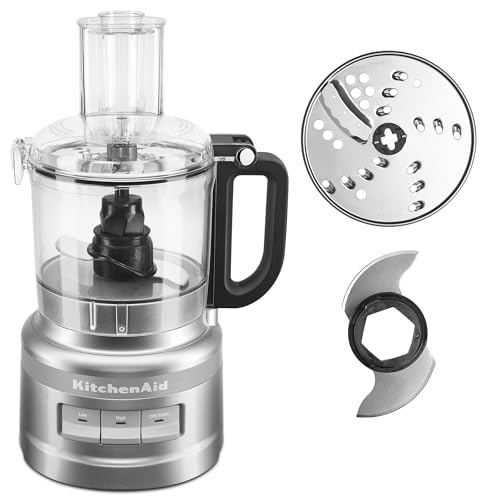
KitchenAid 7-Cup Food Processor KFP0718 — Neatest Storage
Storage is a test-kitchen criterion nobody photographs, yet it decides whether accessories survive. Loose discs in a drawer get chipped, lost or feared; KitchenAid’s answer is to nest everything inside the bowl itself, so the machine on your counter is the complete kit. Reaching for the slicing disc becomes a five-second decision instead of a rummage, and tools that are easy to find get used.
Seven cups sounds modest beside the giants here, but it maps neatly onto real cooking for two to four: a curry paste, a tart’s worth of pastry, vegetables for soup, a bowl of slaw. The three speeds give a gentle option for softer work and enough pace for firm vegetables, while the two-in-one feed tube accepts both a whole small tomato and a bundle of herbs without swapping parts.
Evenness sits a step behind the big Cuisinart on very large loads, simply because a fuller bowl circulates less freely; work in two batches for a party and results recover completely. The easy-clean bowl earns its name after pesto and pastry, where a smooth interior rinses free instead of trapping green paste in ridges.
Choose this model when your cooking is frequent, fresh and moderately scaled. It respects counter space, respects your drawers, and respects the reality that most dinners are not banquets. Households feeding six nightly should look up the list; everyone else should look closely here.
Colour and counter presence matter more than purists admit. A processor that lives visibly on the counter gets used; one banished to a high cupboard might as well not exist. This KitchenAid’s tidy footprint and in-bowl storage make permanent residence realistic even in flats, and that daily visibility is why owners describe it as their most-used appliance rather than their most powerful one.
Herb sauces show its judgment nicely. Basil for pesto processes quickly enough to stay bright, and the bowl’s smooth interior releases every green spoonful instead of trapping it in ridges. Pulse rather than run, add oil gradually, and stop while the texture still looks alive. Small machines reward cooks who watch the food, and this one makes watching easy.
The three speeds deserve a word of praise for restraint. Low speed keeps flour from erupting when pastry starts, and gentle settings protect soft cheese from smearing. Many rivals offer only fast and faster, which flatters specification sheets and frustrates cooks. Control, once again, is the luxury feature that actually matters at the counter.
Breakfast prep shows a gentler talent: grating potatoes for hash browns and slicing mushrooms for omelettes without turning the counter into a project. Small, frequent victories like these are how a processor becomes part of a household’s rhythm rather than a guest at its dinner parties.
- Capacity in pool title: 7-cup work bowl
- Controls listed: three speed settings
- Feed tube listed: 2-in-1 design for varied produce sizes
- Storage listed: all-in-one storage for blades and discs
- Bowl described in pool title as easy-clean design
Strengths
- Accessories stored in the bowl end drawer clutter completely
- Mid-size bowl matches real meals for two to four people
- Easy-clean bowl shape rinses without trapped corners
Trade-offs
- Seven cups fills quickly during holiday batch cooking
- Serious dough work is occasional rather than a speciality
- Extra discs beyond the included set cost more later
Best for: smaller households who cook fresh meals most nights
Not suited for: anyone regularly catering for crowds or freezing huge batches

BLACK+DECKER 8-Cup Food Processor 450W — Straightforward Value Pick
Not every kitchen needs a benchmark machine, and this BLACK+DECKER makes the honest case for enough. Eight cups, a straightforward blade and attachments for the jobs named in its listing — shredding cheese, slicing vegetables, mincing herbs, grinding crumbs and pureeing soups — describe what most households ask of a processor across an ordinary month. Nothing here pretends to be professional equipment, and that honesty is refreshing.
Test it by test-kitchen criteria and the compromises show in predictable places. Slice a kilo of carrots and thickness wanders more than on the Cuisinart; push a stiff dough and the motor asks for mercy. But chop onions for a stew, grate cheese for Friday pizza or puree a bean dip, and it simply does the job, which is precisely what its buyers need.
Cleaning is uncomplicated, with shapes that rinse without ceremony, and the controls could be operated by a helpful teenager without a briefing. Longevity expectations should be set sensibly: this is a machine for weekly use, not for a preserving marathon every autumn weekend, and owners who respect that boundary report few disappointments.
Buy it as a first processor or as a household’s second pair of hands. If you later graduate to sourdough weekends and dinner parties for ten, you will know exactly which upgrade you need — and this machine will have taught you, cheaply, how a processor fits your cooking.
Cheese grating is the weekday task where this machine quietly shines. A block of cheddar becomes pizza topping in moments, saving the cost and the odd waxy texture of pre-grated bags. Keep cheese cold, cut it to fit the tube, and let steady pressure do the work. For many households that single habit, repeated weekly, justifies the purchase within a season.
Expectations about noise and vibration should be set plainly: lighter machines move a little under hard loads, and a folded tea towel beneath the base settles both the movement and the sound. Work on a clear, dry counter, keep the cord away from the bowl, and the experience stays orderly. Simple machines reward simple discipline.
Students and first-flat cooks adopt this model often, and sensibly. It teaches the core skills — pulsing, batching, scraping down — on forgiving equipment, and its mistakes cost little. A generation of cooks has started on machines exactly like this one before deciding which serious tool their cooking eventually deserved.
Picnic cooking suits its scale as well. Potato salad vegetables, sandwich fillings and a quick slaw all process without hauling out a giant bowl, and the machine returns to its cupboard without ceremony. Modest tools that travel easily between tasks tend to out-serve grand ones in ordinary weeks.
- Capacity listed in pool title: 8-cup bowl
- Power listed in pool title: 450 watts
- Jobs listed: shred, slice, mince, grind and puree
- Blade listed: stainless steel blade
- Style: classic countertop processor layout
Strengths
- Covers the five everyday jobs most households need
- Familiar controls require no manual study at all
- Size suits couples and small families neatly
Trade-offs
- Firm vegetables reveal the limits of a modest motor
- Finish and plastics feel utilitarian beside premium rivals
- Fine slicing consistency varies more than on top picks
Best for: first-time processor buyers covering everyday prep
Not suited for: heavy users processing dense batches several times weekly

Cuisinart Mini Prep 3-Cup — Best for Small Jobs
The Mini Prep survives every test-kitchen cull because small jobs are the most frequent jobs. A handful of herbs, two garlic cloves, a scattering of nuts for a salad — washing a full-size processor for these tasks is absurd, so without a mini machine the knife board comes out and the big processor stays idle. This little bowl lives on the counter, rinses in seconds and earns its space daily.
The reversible blade is the clever part. Run it one way and the blunt edge chops herbs and onions without turning them to soup; reverse it and the sharp edge grinds spices, nuts and coffee-adjacent tasks with real intent. Results on a cup of parsley or a batch of breadcrumbs are genuinely even, because the small bowl keeps food in the blade’s path instead of letting it hide in corners.
Limits are obvious and should be embraced. There are no discs, so no slicing; capacity caps at small batches; and thin liquids behave best kept modest. None of that diminishes the machine, because it never claimed those jobs. Judged on the work it exists for — the daily two-minute tasks — it is arguably the most satisfying tool in this entire roundup.
Buy it alongside a big processor or instead of one if your cooking runs small and fresh. Many experienced cooks own both sizes and reach for this one five times as often. In a test kitchen, frequency of honest use is the metric that outlasts every specification, and by that metric the Mini Prep is a quiet champion.
Spice grinding changes home cooking in ways new owners underestimate. Whole cumin, coriander and dried chillies ground fresh in this little bowl carry a fragrance that pre-ground jars lose within months. Wipe the bowl between spices with a piece of bread, which picks up residue and becomes a cook’s snack, then grind the next batch. Curry nights improve noticeably from that one habit.
Coffee drinkers sometimes ask whether it grinds beans; it can in a pinch for coarse brewing, though a dedicated grinder does the job more evenly. Keep the Mini Prep for food and it will stay sweet-smelling and ready. Garlic, ginger and chilli for a stir-fry sauce, though — that is its home ground, and nothing at this size does it faster.
Dessert work gives the Mini Prep a final claim on your counter. A handful of biscuits becomes a cheesecake base, nuts chop evenly for brownies, and a small batch of flavoured butter for finishing cakes takes a minute. Tiny quantities defeat big bowls completely, so the smallest machine here ends up serving the sweetest course.
Single cooks may find this the only processor they ever need. Sauces for one, crumbs for a solo gratin, chopped nuts for porridge — the scale of one-person cooking matches the bowl exactly, and the washing up never outweighs the meal. Right-sizing is a form of wisdom the biggest machines cannot teach.
- Capacity listed in pool title: 3-cup, 24 oz bowl
- Blade listed: auto-reversing SmartPower blade
- Modes listed: chop in one direction, grind in reverse
- Finish listed: brushed chrome
- Role: mini chopper for small daily jobs
Strengths
- Perfect scale for garlic, herbs, nuts and dressings
- Reversible blade handles both soft chopping and hard grinding
- Tiny footprint lives on the counter permanently
Trade-offs
- No slicing or shredding discs at this size
- Batches beyond a cup or two need repeating
- Liquids can splash if the small bowl is overfilled
Best for: cooks who make small fresh quantities every single day
Not suited for: anyone expecting one machine to prep a whole dinner party
How Do All Six Processors Compare Side by Side?
| Pick | At a glance |
|---|---|
| Cuisinart 14-Cup Food Processor | 14-cup bowl, 720-watt motor, stainless steel finish, model DFP-14BCNY |
| Ninja Professional Plus Food Processor BN601 | 9-cup bowl, 1000 peak watts, Auto-iQ presets, 3 blades included |
| Hamilton Beach 12-Cup Stack & Snap | 12-cup bowl, 450-watt motor, 2 speeds, stack-and-snap assembly |
| KitchenAid 7-Cup Food Processor KFP0718 | 7-cup bowl, 3 speeds, 2-in-1 feed tube, in-bowl accessory storage |
| BLACK+DECKER 8-Cup Food Processor 450W | 8-cup bowl, 450 watts, attachments for shred, slice, mince, grind, puree |
| Cuisinart Mini Prep 3-Cup | 3-cup / 24 oz bowl, reversible auto-reversing blade, brushed chrome |
Why Does Slice Evenness Matter More Than Motor Size?
Slice a potato for a gratin and the answer is on your plate. Even slices soften together, brown together and stack into a dish that cooks as one; mixed thick and thin slices give you crunch and mush in the same forkful. Evenness comes from disc design, feed tube fit and steady motor speed under load, which is why a composed mid-power machine can out-slice a frantic powerful one.
Test any processor you buy with the food you cook most. If that is carrots for soup, judge the carrot slices. If it is cheese for pizza, judge whether shreds stay separate or clump warm against the disc. Your personal test food reveals more than any generic demonstration, and shops’ return windows exist precisely for this kind of honest trial.
How Much Bowl Capacity Do You Really Need?
Capacity ratings describe the bowl, not the sensible working load. As a rule, dry ingredients should fill no more than about two thirds of the bowl for free circulation, and liquids far less, because the centre spindle is a leak waiting for encouragement. A 14-cup bowl therefore shines for dough and dry batches, while its comfortable liquid load is much smaller than the headline suggests.
Match capacity to your household arithmetic. One to two people cooking fresh meals live happily at seven cups or below, especially with a mini chopper for tiny jobs. Families of four to six benefit from twelve to fourteen cups for slaw, soup bases and dough. Bigger is not automatically better: an oversized bowl chops a single onion badly, because the pieces spread beyond the blade’s reach and hide.
How Do You Stop a Food Processor Leaking?
Most leaks are user physics rather than machine failure. Liquid rises along the centre post as the blade spins, so respect the maximum liquid line if one is marked, and process soups in batches that leave headroom. Check that the bowl is fully seated and the lid locked before adding liquid through the feed tube, a mistake that has decorated many kitchen walls with tomato soup.
Thick mixtures leak less than thin ones, so puree vegetables with just enough liquid to move, then thin the finished soup in the pan. If a recipe matters, process the solids first. Finally, carry the bowl with a hand under its base rather than trusting the handle with a full load of hot soup — a handling habit every test kitchen drills into new cooks.
What Is the Best Way to Clean Blades and Discs Safely?
Rinse parts promptly and food releases willingly; leave them overnight and you will need soaking and patience. Wash blades by holding the central hub and brushing away from the edge, never by swishing a hand through soapy water where a blade hides. Discs deserve the same respect, since their teeth are simply a row of small knives.
Dishwashers are convenient but age plastics and can dull edges over time, so many careful cooks hand-wash blades and discs while letting bowls take the machine. Dry parts fully before storage, store discs where they cannot rattle against each other, and keep the sharpest pieces out of any drawer a child can reach. A processor kept clean and complete stays a pleasure; a neglected one becomes a hazard with a motor.
How Do You Choose Between a Processor and a Blender?
The two machines overlap less than their similar silhouettes suggest. A processor’s wide bowl and low blade excel at dry and thick work: pastry, dough, slicing, shredding and chunky mixtures that need texture. A blender’s tall jug and vortex excel at liquids: smoothies, silky soups and drinks. Ask a processor to make a thin smoothie and it sulks; ask a blender to make pastry and it fails completely.
Households that cook widely often own both, while households that mostly bake, prep vegetables and make sauces should buy the processor first. If your weekly cooking is soups and smoothies, reverse the order. The honest inventory of your last twenty meals decides this better than any showroom demonstration, so write the list before spending anything.
What Should You Process First When a New Machine Arrives?
Begin with a forgiving, revealing test: a batch of onions for a stew, or carrots for soup. You will learn the pulse rhythm, see how evenly the blade works, and discover whether the bowl seals and the parts wash easily, all on food destined for a forgiving pot. Follow with pastry or hummus once confidence forms, because both expose weaknesses honestly.
Keep the packaging until those first tests are done. If slices emerge wildly uneven, if the lid fights you, or if washing the blade feels dangerous rather than merely careful, return the machine and choose again. A processor is a ten-year relationship; a week of testing at the start is cheap insurance against a decade of mild annoyance.
How Long Should a Good Food Processor Last?
A well-made processor used weekly should serve for many years, with blades and discs as the consumable parts. Longevity comes from boring habits: never forcing the motor through a stalled load, washing and drying parts promptly, and storing discs where their edges cannot chip. Motors rarely die from honest work; they die from being asked to chew through frozen blocks without mercy.
Judge a purchase partly by the manufacturer’s support for older models. Designs that stay in production keep their parts available, which is one reason the long-running Cuisinart pattern inspires such loyalty. A slightly dearer machine with a decade of parts behind it usually costs less per year than a bargain replaced twice in the same period.
Why Do Professional Kitchens Care About Repeatability?
A restaurant lives or dies on the fiftieth plate tasting like the first, so test kitchens build their methods around repeatability: weigh, time, repeat, compare. Home cooks benefit from the same mindset in miniature. When your processor slices evenly every time, recipes behave predictably, cooking times in books start to make sense, and your own adjustments become meaningful rather than random.
Apply that mindset when judging any new machine. Make the same dish twice in the first week and compare honestly. If the second batch matches the first with less effort, the machine has passed the only examination that matters. If results wander, technique or tool needs attention while the return window is still open.
How Should You Store Discs, Blades and Bowls?
Storage is a safety system disguised as tidiness. Blades belong in a box, a magnetic strip rated for the weight, or the bowl itself — never loose in a drawer where a reaching hand finds the edge first. Discs stored upright in a rack keep their teeth from chipping against each other, and a quick inventory after washing prevents the slow loss of small pushers and parts.
Keep the manual, or a photograph of its parts diagram, on your phone. When a cousin washes up and cannot rebuild the machine, the diagram settles the argument in seconds. These small systems sound fussy until the first time they save a dinner, after which they simply become how your kitchen runs.
What Accessories Are Worth Adding Later?
Live with the included kit for a month before buying extras, because your cooking will tell you what is missing. Bakers often add a dough blade if one is not included, keen slicers add a finer or thicker disc, and cooks who juice citrus daily may add a press attachment. Each addition should answer a repeated frustration, not a hypothetical recipe you might attempt once.
Resist accessory bundles bought on speculation. Drawers across the country hold julienne discs used a single time, purchased in a flush of enthusiasm. The disciplined route — cook, notice, then buy the one piece that removes a real obstacle — keeps both drawers and budgets honest, and every accessory you own will carry a story of actual use.
How Do You Get the Most From the Pulse Button?
Pulsing is the processor skill that separates good results from great ones. Each short burst lets food fall back into the blade’s path, so the next burst cuts a fresh layer instead of re-cutting the same puree. Count your pulses for favourite recipes — eight for chunky salsa, twenty for fine crumbs — and write the number on the recipe card. That small record turns luck into method.
Pastry, pesto and nut butters all reward this patience. Watch through the bowl, stop early, and remember that you can always pulse twice more but can never un-process a mixture that has gone too far. Restraint is the master skill of processor cooking, and it costs nothing to learn.
What Mistakes Ruin Food Processor Results?
Overfilling tops the list, because a jammed bowl cannot circulate food and the blade simply purees the layer it touches. Work in batches and the total time often drops. Running the machine continuously instead of pulsing is the second classic error: salsa becomes soup and pastry becomes tough because the motor’s heat and friction keep working the ingredients past their ideal point.
Feeding the tube unevenly ruins slicing — a steady, gentle pressure gives even slices, while shoving produce through produces wedges. Finally, many owners use the processor for jobs a knife does better, like ripe tomatoes or herbs that bruise, then blame the machine. Choose the tool per ingredient and both knife and processor will seem to improve.
One more quiet error is storing the machine assembled with the blade inside and the lid locked in a damp cupboard. Trapped moisture dulls edges and encourages stale smells in plastic. Wash, dry, and store parts with air around them, and the processor will greet you fresh rather than faintly haunted by last month’s onions.
Another recurring mistake is processing warm ingredients that should be cold, or cold ingredients that should be at room temperature. Butter for pastry must be cold or it smears; cheese for grating firms up in the freezer for twenty minutes and shreds cleanly; nuts for butter release their oils best when warm. Temperature is an ingredient in processor work, and ignoring it produces results that get blamed on the machine.
Final Recommendation
Let your cooking volume cast the deciding vote. The Cuisinart 14-Cup remains our benchmark for households that bake, batch and entertain, while the Ninja BN601 serves busy families who want preset help on weeknights. The Hamilton Beach Stack and Snap removes the assembly excuse entirely, the KitchenAid 7-Cup keeps smaller kitchens tidy, the BLACK+DECKER covers everyday prep without fuss, and the Mini Prep handles the daily handfuls that make cooking feel fresh.
Whichever you choose, run your own first test with the food you cook most, inside the return window, and judge it by the standards in this guide rather than by first impressions. A processor that passes your kitchen’s examination will still be earning its counter space years from now, long after the box and the excitement have been forgotten.
If you are choosing between the two ends of this list, let batch size arbitrate. Cooks whose processor comes out for dough and dinner parties should start with the Cuisinart 14-Cup Food Processor, while cooks whose daily reality is herbs, garlic and small sauces will smile more often at the Cuisinart Mini Prep 3-Cup. Households in the busy middle, wanting presets to carry weeknight prep, should give the Ninja Professional Plus Food Processor BN601 a close look. None of these choices is a compromise if it matches the meals you actually cook, because a processor judged by honest test-kitchen standards is ultimately judged by your table, your recipes and your willingness to reach for it on an ordinary evening.
Trust the standards, trust your own test dishes, and let the machine that passes both examinations take its place on your counter with confidence for the years of ordinary, delicious work ahead of it in your kitchen.
Good prep, repeated calmly week after week, is where great home cooking quietly begins for most households everywhere, in kitchens large and small alike.
Frequently Asked Questions
Can a food processor really knead bread dough?
Yes, within the limits of bowl size and motor strength. The blade kneads quickly, often in under two minutes, because it works the dough continuously. Large, strong machines handle full batches calmly, while smaller models do better with half batches. Watch the dough rather than the clock: it should gather into a smooth ball that cleans the sides of the bowl.
Why does my processor turn vegetables into puree?
Usually the bowl was overfilled or the machine ran without pulsing. Food at the blade purees while food above waits its turn, so the bottom layer over-processes. Pulse in short bursts, scrape down once, and process smaller batches. For salsa and pesto, those pauses are the difference between texture and soup.
Is a mini processor worth owning beside a full-size one?
For most keen cooks, yes. The mini bowl handles garlic, herbs, nuts, breadcrumbs and dressings in seconds and rinses just as fast, so it gets used daily. Full-size machines excel at batches but are a nuisance for a handful of parsley. Owning both sizes means the right tool is always the easy tool.
How do I get even slices from the slicing disc?
Choose produce of similar size, trim a flat side so pieces sit steadily, and feed with slow, even pressure on the pusher. Fill the tube snugly so pieces cannot tip sideways, and let the disc’s speed do the work rather than forcing food through. The final slice often emerges thicker on any machine; many cooks save it for stock.
Are replacement blades and discs easy to find?
For long-running designs from major makers, generally yes, and that support is part of what you pay for. Check the listing for your model’s included parts and keep the model number noted somewhere safe. A machine whose blade can be replaced in five years is a better purchase than a cheaper one that becomes useless when its first blade dulls.
Can I process hot soup directly from the pan?
It is safer to let very hot liquids cool briefly and to process them in small batches with the lid firmly locked. Heat expands and can push liquid up the centre post. Many cooks prefer an immersion blender for large pots of soup and reserve the processor for thicker purees, where its power gives the smoothest results.
What is the difference between chopping and mincing in a processor?
Chopping leaves distinct, bite-size pieces, while mincing cuts food much finer, almost to a paste of tiny fragments. The difference is time and pulses: a few bursts chop an onion, while continued pulsing minces it for a sauce or meatball mixture. Stop early and check, because the journey from chopped to minced to pureed takes only seconds.
Should I buy a processor with a wide feed tube?
A wide tube saves pre-cutting and keeps pieces oriented for even slices, which matters if you process whole potatoes, large onions or blocks of cheese often. Narrow tubes force smaller pieces but can slice them more uniformly. Match the tube to your produce: market gardeners and batch cooks benefit most from width, while salad-for-two households rarely miss it.
Related Guides
Round out your kitchen research with our guides to Best Bottom Freezer Refrigerators with Ice Makers, Best Electric Milk Frothers, Best Barbecue Grills.



[…] planning your outdoor kitchen with our guides to Best Food Processors, Judged by Test-Kitchen Standards, Best Coffee Beans for Automatic Espresso Machines, Best BBQ Grills That Last […]