What's inside
- Key Takeaways
- Quick Picks
- How Did We Choose These Dehydrator Machines?
- How Do the Six Dehydrator Machines Compare at a Glance?
- What Can You Actually Dry in a Home Dehydrator?
- How Much Tray Area Do You Really Need?
- What Temperature Does Each Food Actually Want?
- How Long Do Common Foods Take to Dry?
- How Do You Prepare Fruit and Vegetables for Even Drying?
- What Is Fruit Leather and How Do You Get It Right?
- How Do You Dry Herbs Without Losing Their Flavour?
- Can a Dehydrator Make Good Dog Treats?
- How Should You Store Dried Foods for the Cupboard?
- How Do You Clean and Maintain a Dehydrator?
- What About Drying Flowers, Crafts and Other Non-Food Jobs?
- How Much Does It Cost to Run a Dehydrator All Day?
- Which Dehydrator Suits a Small Kitchen Best?
- How Do You Choose Between a Stackable and a Cabinet Model?
- What Mistakes Do New Dehydrator Owners Make With Produce?
- How Do You Dry Tomatoes and Peppers for Winter Cooking?
- What Is the Best Way to Dry Citrus and Berries?
- How Can a Dehydrator Help With Meal Preparation?
- What Should You Know About Drying Times in Humid Climates?
- How Do You Revive and Use Dried Foods in Cooking?
- How Do You Keep a Drying Kitchen Organised During Harvest?
- A Short Word on Drying for Lunchboxes and Snacks
- What Mistakes Should You Avoid When Drying at Home?
- Final Recommendation
- Frequently Asked Questions
- Related Guides
As an Amazon Associate I earn from qualifying purchases. This post may contain affiliate links at no extra cost to you.
cottageverdict.com is reader-supported. When you buy through links on our site, we may earn an affiliate commission.
Where to buy: the six best food dehydrator machines below are sold through Amazon, and their names in the Quick Picks table, the detailed reviews and the comparison table link to the matching listing, where you can check price on Amazon and confirm tray dimensions, temperature ranges and included screens before ordering. A dehydrator is the quietest preserving tool ever sold: no boiling jars, no freezer Tetris, just warm moving air turning a glut of apples, a garden’s last tomatoes or a tray of herbs into food that keeps in a cupboard and weighs almost nothing.
This guide takes the general view of the category. We judged these machines on the breadth of a household’s year: fruit in autumn, vegetables and herbs through summer, snacks and dog treats whenever the mood strikes, and the occasional batch of jerky handled with the care meat deserves. Tray area, temperature span from the gentlest herb setting to a properly hot finish, timer endurance and the small accessories that decide whether fruit leather is a pleasure or a wrestling match all counted more here than any single headline wattage figure.
Key Takeaways
- Total tray area, not tray count alone, tells you how much produce a loading really holds.
- A low setting near 95°F protects herbs and flowers, while a ceiling in the 160s handles heartier jobs.
- Steel trays suit sticky, savoury work; BPA-free plastic trays keep a starter machine light and simple.
- Mesh screens stop small pieces falling through, and a fruit roll tray turns purée into leather.
- Horizontal rear airflow dries mixed loads most evenly, sparing you mid-cycle tray rotation.
- Quiet operation matters because the best drying often happens overnight or across a long day.
Quick Picks
| Pick | Badge | Why it earns its place |
|---|---|---|
| Cosori 6-Tray Dehydrator | Best All-Round Family Machine | Six steel trays, 6.5 square feet of space and horizontal airflow make it the balanced centre of this guide. |
| FOHERE 5-Tray Dehydrator | Best Compact for Beginners | Five stackable BPA-free trays, a 48 hour timer and a gentle 95°F floor make it a welcoming first machine. |
| Magic Mill Pro Dehydrator (shared) | Best Temperature Range | The span from 95 to 176°F across seven steel trays covers everything from raw herbs to the hottest finishing jobs. |
| Elite Gourmet 5-Tray (shared) | Best Simple Dial Machine | A single adjustable dial and five light trays make drying feel like a kitchen habit rather than a project. |
| Magic Mill 5-Tray (shared) | Best Steel in a Small Footprint | Digital control and stainless trays in a five-tray stack give small kitchens a genuinely grown-up machine. |
| HOPERAN 16-Tray (shared) | Best for Harvest-Scale Preserving | Sixteen trays, twin fans and included mesh screens turn a harvest glut into a single day’s organised work. |
How Did We Choose These Dehydrator Machines?
Our yardstick was a year of ordinary preserving rather than a single hero task. We added up usable tray area, because six generous trays out-dry eight cramped ones, and we favoured machines whose temperature range reaches genuinely low for herbs as well as usefully high for finishing fruit and vegetables. Timers were read with real recipes in mind: a machine that stops after a short cycle is a poor partner for mango, tomatoes or thick fruit leather, so long timers and steady digital control scored well.
We also rewarded the unglamorous extras. Mesh screens keep peas, herbs and berries from raining through tray grids as they shrink; a roll sheet makes fruit leather a planned activity instead of an improvisation with parchment. Noise figures were noted where a maker states them, because a dehydrator often works in the same room where people talk, read and sleep. Finally we kept one light plastic-tray machine in the six, because not every household needs steel, and a simple stacker still dries a herb garden beautifully.

Cosori 6-Tray Dehydrator — Best All-Round Family Machine
The Cosori 6-Tray Dehydrator is what a modern family dehydrator looks like when the design brief says balance. Six stainless trays give 6.5 square feet of drying space, a figure the listing states outright, and that area swallows a market bag of apples or a tomato glut without the pieces touching. Horizontal airflow crosses the cabinet evenly, so a mixed loading of banana chips below and tomato halves above finishes in step instead of in shifts.
Control is the other half of its appeal: a span from 95 to 165°F covers delicate herbs at the bottom and confident fruit and vegetable work at the top, with the precision to hold a chosen setting across the full 48 hours its timer allows. The stated noise ceiling under 48 dB is a domestic blessing; this is a machine you can run through a film night or a night’s sleep without it becoming the loudest presence in the house. Six hundred watts keeps recovery brisk after you open the door to test a piece.
If one machine must serve a household’s whole preserving calendar, this is the one we would put on the counter. It is large without being industrial, quiet without being timid, and its steel trays move from savoury to sweet work with nothing more than a proper wash in between.
- Trays: 6 stainless steel trays, 6.5 ft² total drying space
- Temperature: 95 to 165°F with precision control
- Airflow: horizontal, from a 600W system
- Noise: stated under 48 dB, with a 48 hour timer
Strengths
- Stated 6.5 ft² area ends guesswork about capacity
- Horizontal airflow dries mixed loads evenly
- Quiet running suits overnight and living-room use
Trade-offs
- 165°F ceiling is ample for produce, modest for meat
- Six trays still fill fast at peak harvest
- Steel trays add weight when washing a full set
Best for: families preserving fruit, vegetables and snacks all year. Not suited for: production-scale makers who think in dozens of trays.

FOHERE 5-Tray Dehydrator — Best Compact for Beginners
The FOHERE 5-Tray Dehydrator understands the beginner’s kitchen: limited counter, limited storage and a preserving habit that is still finding its size. Its five stackable trays measure 11.42 inches across, the classic round format that tucks into a cupboard, and the trays are BPA-free, which keeps the machine light to lift and easy to wash. Four hundred watts is honestly matched to that scale, warming a modest load of fruit or herbs without the running appetite of the big cabinets.
Two figures lift it above the usual starter class. The timer runs to 48 hours, so a thick batch of fruit leather or a slow herb dry never outlasts the clock, and the temperature floor of 95°F is gentle enough for the delicate end of the repertoire, the herbs and edible flowers that scorch or blacken under hotter air. The ceiling of 158°F is the honest limit to note: fine for produce and snacks, while meat work deserves the extra care and the separate heating step described in our jerky guidance elsewhere on the site.
Choose the FOHERE if your preserving is real but modest: a herb garden, a child’s fruit snacks, dog treats in family quantities. It teaches the craft without demanding counter space as tuition, and its timer generosity means it will not embarrass you when a recipe runs long on a humid day.
- Trays: 5 BPA-free stackable trays of 11.42 inches
- Temperature: 95 to 158°F
- Timer: 48 hours, unusually generous at this size
- Power: 400W, sized for small to mid loads
Strengths
- 48 hour timer is rare generosity in a compact body
- Low 95°F setting treats herbs and flowers gently
- Light stackable trays store in a cupboard
Trade-offs
- 158°F ceiling is the lowest top end here
- Plastic trays need prompt washing after savoury loads
- Round trays hold less than rectangular cabinets
Best for: beginners drying herbs, fruit snacks and pet treats. Not suited for: large harvests or frequent high-heat finishing.

Magic Mill Pro Dehydrator (shared) — Best Temperature Range
Viewed as a general preserving machine rather than a meat specialist, the Magic Mill Pro Dehydrator (shared) distinguishes itself with range. A dial that travels from 95°F to 176°F lets one cabinet coddle basil at breakfast and finish a tray of tomato crisps firmly by evening, without the compromises that a narrow band imposes. Seven full-size stainless trays give that range room to work in, and the rear fan’s horizontal stream keeps a mixed loading honest from top shelf to bottom.
The keep warm mode, easy to overlook, suits the rhythm of preserving days: a finished batch can hold gently while the next tray of produce is sliced, instead of sitting in a cooling cabinet absorbing kitchen humidity. Auto shutoff at the end of the 48 hour timer adds peace of mind for overnight runs. Steel trays remain the practical choice for a machine that will meet garlic, onion and chilli as often as apple and pear, since they wash back to truly neutral.
Households that preserve widely, from garden herbs to school snacks to the occasional savoury batch, will feel the benefit of that temperature span weekly. It is the connoisseur’s pick in this line-up: not the largest, not the quietest on paper, but the one whose control range never tells you a job is outside its repertoire.
- Trays: 7 full-size stainless steel trays
- Temperature: 95 to 176°F, the widest span here
- Airflow: 600W rear fan even-drying system
- Extras: keep warm mode and auto shutoff, ETL listed
Strengths
- Widest temperature span in this guide
- Rear fan keeps seven trays drying in step
- Keep warm suits stop-and-start preserving days
Trade-offs
- Premium control costs more counter commitment
- Herb-only households will rarely use the top heat
- Seven steel trays are a full sink at wash time
Best for: wide-ranging preservers who use low and high heat weekly. Not suited for: occasional users drying a few herbs each summer.
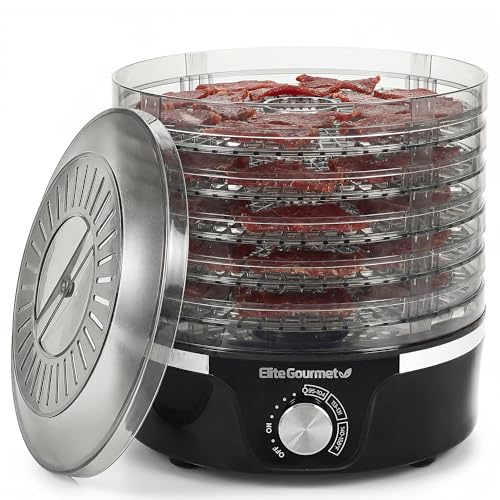
Elite Gourmet 5-Tray (shared) — Best Simple Dial Machine
There is a kind of cook who distrusts digital panels on simple machines, and the Elite Gourmet 5-Tray (shared) was made for them. One adjustable dial sets the heat, five light trays stack on, and the day’s drying begins without a manual in sight. For herbs, fruit and vegetables, which make up the great majority of home dehydrating, that simplicity is not a compromise at all; it is the reason the machine gets used on a Tuesday rather than saved for a planned preserving weekend.
The round 11.4 inch trays are BPA-free plastic, light in the hand and quick under the tap, and the stack can shrink or grow with the load in the way stackable designs allow. Airflow in this format rewards a tray rotation on long runs, a ten-second habit that experienced owners perform without thinking. The listing names jerky among its uses, and small occasional batches are within its talents, with the same note we give every modest machine: follow the recognised heating guidance for meat rather than improvising.
Keep this Elite Gourmet in mind if the dehydrator’s job in your house is the garden and the fruit bowl. It dries the weekly surplus quietly, stores in a corner, and asks almost nothing of its owner beyond a wiped tray and a turned stack. Bigger appetites have bigger options in this guide, but few are this easy to live with.
- Trays: 5 BPA-free trays of 11.4 inches
- Controls: adjustable temperature dial, no menus
- Listing focus: jerky, fruit, herbs and vegetables
- Format: black stackable round design
Strengths
- One-dial control anyone can use immediately
- Light trays wash and store without effort
- Stack shrinks or grows with the harvest
Trade-offs
- Dial gives less precision than digital rivals
- Plastic trays prefer gentle handling when hot
- Rotation helps evenness on the longest runs
Best for: gardeners and fruit lovers wanting dial-simple drying. Not suited for: precision cooks who log exact temperatures.
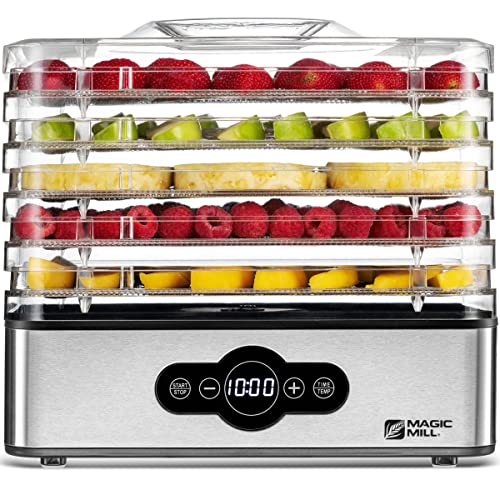
Magic Mill 5-Tray (shared) — Best Steel in a Small Footprint
Small kitchens usually face a shabby choice between a toy and a giant, and the Magic Mill 5-Tray (shared) refuses both. Its five trays are stainless steel, which in a compact machine is still uncommon enough to be the headline: savoury loads, sticky fruit and the dog treats the listing mentions all wash off steel without leaving their ghosts behind. Digital control of time and temperature, running to a full 48 hours, gives the little stack the manners of the big cabinets.
The ceiling of 167°F covers the whole produce repertoire with room to spare and handles snack work confidently. Because the trays stack, the machine’s footprint stays cupboard-friendly, and because they are steel, the stack keeps its shape and spacing year after year instead of warping into uneven gaps. A mid-run shuffle of trays remains a wise habit on the fullest loads, as with any vertical airflow design, and it takes less than a minute.
This is the pick for the cook who dries weekly in modest quantities and refuses to buy twice. It preserves the herb harvest, turns ageing fruit into lunchbox snacks, keeps the dog supplied with homemade treats, and still fits the cupboard it came from. In a small kitchen, that combination is not a compromise; it is the whole point.
- Trays: 5 stackable stainless steel trays
- Controls: digital timer and temperature, 48 hours
- Temperature: up to 167°F
- Listing uses: jerky, fruit, dog treats and more
Strengths
- Stainless trays in a compact stackable body
- Digital control with a full two-day timer
- Versatile across produce, snacks and pet treats
Trade-offs
- Five trays cap the biggest harvest days
- Stacked airflow likes an occasional tray shuffle
- Steel set is heavier than plastic equivalents
Best for: small kitchens drying weekly in modest quantities. Not suited for: harvest-scale preserving measured in crates.

HOPERAN 16-Tray (shared) — Best for Harvest-Scale Preserving
Some kitchens meet a harvest that laughs at five trays: the neighbour’s plum tree, the allotment’s September, a market stall closing with crates unsold. The HOPERAN 16-Tray (shared) is built for those weeks. Sixteen stainless trays in a twin-fan cabinet mean the whole glut can be prepared once, loaded once and dried in one orchestrated run, instead of a relay of small batches that monopolises the counter for days. The maker states noise under 48dB, a mercy when the machine works through the night at harvest pace.
The included accessories show the same production thinking: two mesh screens for the small and the crumbly, peas, sweetcorn, herb leaves and berries that would otherwise slip through tray grids as they shrink, plus a fruit roll tray for purées. Digital temperature and timer control keep a tall cabinet’s many shelves under one consistent regime, and the twin fans exist precisely so that shelf twelve dries like shelf two.
Buy it if preserving is a season in your house rather than a hobby afternoon. It asks for storage, for slicing help and for a household that will actually eat what sixteen trays produce. Given those, it turns the most overwhelming week of the garden year into the most satisfying one.
- Trays: 16 stainless steel trays
- Power: 800W across 2 fans, stated under 48dB
- Controls: digital temperature and timer
- Extras: 2 mesh screens and 1 fruit roll tray
Strengths
- Sixteen trays swallow a whole harvest glut
- Twin fans keep a tall stack drying evenly
- Mesh screens and roll tray included from the start
Trade-offs
- Storage for the cabinet and trays is a real commitment
- Tempts batches beyond a household’s appetite
- Washing sixteen trays is a genuine chore
Best for: allotment growers and harvest-scale preservers. Not suited for: flat-dwellers drying the odd bunch of herbs.
How Do the Six Dehydrator Machines Compare at a Glance?
| Pick | Badge | Distinguishing detail |
|---|---|---|
| Cosori 6-Tray Dehydrator | Best All-Round Family Machine | 6 steel trays, 6.5 ft², horizontal airflow, under 48 dB |
| FOHERE 5-Tray Dehydrator | Best Compact for Beginners | 5 BPA-free trays, 95 to 158°F, 48 hour timer, 400W |
| Magic Mill Pro Dehydrator (shared) | Best Temperature Range | 7 steel trays, 95 to 176°F, rear fan, keep warm mode |
| Elite Gourmet 5-Tray (shared) | Best Simple Dial Machine | 5 BPA-free trays, simple dial, stackable round body |
| Magic Mill 5-Tray (shared) | Best Steel in a Small Footprint | 5 steel trays, digital control, up to 167°F, 48 hours |
| HOPERAN 16-Tray (shared) | Best for Harvest-Scale Preserving | 16 steel trays, twin fans, 800W, screens included |
What Can You Actually Dry in a Home Dehydrator?
Almost anything that grew, within reason. Fruits lead the repertoire: apple rings, banana chips, mango strips, strawberries that concentrate into sweets, and citrus slices for cooking and garnish. Vegetables follow: tomato halves that keep a summer’s flavour for winter sauces, courgette crisps, peppers, onions and garlic for your own seasoning blends, and sweetcorn or peas for soups. Herbs dry at the gentle end, flowers for teas and decorations join them, and purées become fruit leather on a roll sheet.
Beyond produce, the same warm air makes yoghurt in suitable containers in some routines, proofs dough in a pinch in a warm cabinet, dries flowers and craft materials, and produces the pet treats several listings here mention. Meat belongs in its own careful category, with the heating guidance covered in our jerky guide. The honest way to think of a dehydrator is as a cupboard-maker: it turns perishable abundance into stable stores, and the six machines here differ mainly in how much abundance they can greet at once.
How Much Tray Area Do You Really Need?
Tray area is the capacity figure that matters, which is why the Cosori’s stated 6.5 square feet is such useful honesty. As a rough household guide, a few square feet handles a herb garden, a punnet habit and the occasional fruit glut for one or two people. Family preserving, school snacks and a productive garden push you toward the six-to-eight-tray cabinets. Sixteen trays belong to allotments, smallholders and anyone who has ever been given a crate of plums by a smiling neighbour.
Remember that loading style eats area. Pieces need air gaps; a tray crammed edge to edge dries slowly and unevenly, so your usable capacity is always less than the geometric total. Pieces also shrink dramatically, which tempts overloading, but resist: the batch you spread properly finishes together and tastes better. If you regularly dry for a dog as well as a family, count the pet’s production honestly in your area budget, because treat-making has a way of becoming a weekly production line.
What Temperature Does Each Food Actually Want?
Herbs and flowers ask for the cool end, around the 95 to 105°F neighbourhood, where their colour and aromatic oils survive; several machines here reach down to 95°F for exactly this work. Fruit generally dries happily in the middle band, warm enough to move steadily without cooking, while vegetables often take a touch more heat, especially dense ones like tomato and pepper that begin life full of water. Fruit leather sits in the middle too, and its centre is always the last place to finish.
The top of the dial belongs to finishing and to the savoury end of the repertoire: crisping vegetable snacks, drying onion and garlic thoroughly for grinding, and the meat work that follows its own guidance. A wide span like the Magic Mill Pro’s 95 to 176°F means one machine can walk the whole ladder without strain. Narrower spans are not failures; the FOHERE’s gentle range suits a herb-and-fruit household perfectly. Match the dial to your repertoire rather than buying heat you will never dial to.
How Long Do Common Foods Take to Dry?
Times vary with thickness, humidity and the machine, so treat every published figure as a neighbourhood rather than an appointment. Herbs can finish in a few hours; apple rings take most of a day; tomato halves and mango can run well past that, and thick fruit leather tests a timer’s generosity. This is why the 48 hour timers fitted across most of this guide matter more than they appear to in a showroom: real preserving does not consult office hours.
Learn the doneness tests instead of worshipping the clock. Fruit should feel leathery and pliable with no beads of moisture when a cooled piece is squeezed or cut. Vegetables for storage should be brittle or firmly leathery depending on the type, and herbs should crumble between fingers. Cool a test piece before judging, because warm food always feels softer and damper than it will in the jar. The clock proposes; the cooled piece disposes.
How Do You Prepare Fruit and Vegetables for Even Drying?
Uniform thickness is the whole secret, again. Slice fruit evenly, treat browning-prone pieces like apple and banana with a brief dip in lemon water if appearance matters to you, and lay everything in single layers with breathing room. Berries dry best halved or briefly blanched to crack their skins, grapes likewise, while stone fruit wants halving and the stone removed. Vegetables benefit from blanching in many cases, which sets colour and shortens drying, though peppers, onions and mushrooms go in raw happily.
Sweet, ripe produce dries into the best snacks, because drying concentrates whatever flavour was present and forgives nothing. The bargain bag of tired fruit becomes tired leather, while the glut of perfect fruit becomes the jar everyone raids. Herbs should be picked dry, ideally mid-morning after dew lifts, and dried on the stem where possible so leaves do not scatter through the trays. Small pieces of anything belong on the mesh screens several of these machines include.
What Is Fruit Leather and How Do You Get It Right?
Fruit leather is purée dried into a flexible sheet: the school-lunch treasure and the finest use ever found for a glut of plums, apricots or windfall apples. Blend ripe fruit to a smooth pourable purée, sweeten only if the fruit demands it, and spread it on a roll tray or lined sheet to an even thickness, slightly thicker at the edges because edges dry first. The HOPERAN includes a roll tray; with other machines, suitable sheets are an inexpensive addition that transforms their repertoire.
Dry it until the centre no longer feels tacky or cool-damp, then peel, roll in paper and slice into spirals. Under-dried leather moulds in storage; over-dried leather becomes fruit glass, which children will still eat but dentists may question. Mixed-fruit leathers, apple with blackberry or plum with a whisper of spice, are where home makers outshine shops entirely. Make double batches once you find a favourite, because the first roll rarely survives the weekend it was made.
How Do You Dry Herbs Without Losing Their Flavour?
Herbs are the dehydrator’s most delicate clients. Their value lives in volatile oils that heat and light destroy, so the method is low warmth, moving air and patience. The machines here that reach down to 95°F earn their keep in herb season. Dry whole sprigs where you can, strip the leaves after drying, and store them whole in dark jars, crushing only when cooking, because whole leaves keep their oils far longer than pre-ground herb ever will.
Judge doneness by crumble: a leaf that shatters cleanly between fingers is ready, while a leathery one needs another hour. Keep strong herbs like mint and oregano on their own trays away from delicate fruit unless you enjoy cross-flavoured apple rings. Label jars with the harvest month; herbs dried at their peak and stored whole will still embarrass a shop jar a year later, provided the jar stayed dark, cool and tightly closed.
Can a Dehydrator Make Good Dog Treats?
It can, and several listings here name dog treats directly, because the process suits them perfectly. Sweet potato slices dry into chewy, single-ingredient treats; thin strips of chicken or beef, dried thoroughly after the same careful heating you would use for your own jerky, become high-value training rewards. Liver treats are famously motivating and famously pungent, so choose a drying day when the windows can open and the household has been warned.
Keep pet batches honest: no onion, garlic, xylitol or seasoning blends anywhere near them, since ingredients harmless to people can harm dogs. Dry treats until properly hard or store softer ones in the fridge and use them promptly. Label pet jars as clearly as human ones, especially in a house where a beautiful sweet potato chew might otherwise end up in a child’s lunchbox. The steel trays on most picks here wash clean between species without carrying flavours across.
How Should You Store Dried Foods for the Cupboard?
Conditioning is the step beginners skip and veterans never do. After drying, let pieces cool, then rest them in a loosely filled jar for several days, shaking daily; moisture equalises between pieces, and any piece that was secretly damp reveals itself by softening its neighbours or fogging the glass. Send doubtful pieces back for another hour of drying. Only conditioned food goes into final airtight storage, somewhere cool, dark and dry, in jars you can see into so problems announce themselves early.
Label everything with contents and date, and store in the quantities you will open at once, since every opening admits humid air. Properly dried fruit keeps for many months, vegetables longer, herbs about a year at their best. If a jar smells musty or shows mould, let the whole jar go; dried food is inexpensive and your caution is worth more. These habits sound fussy in print and take seconds in practice, and they are the difference between a preserving hobby and a preserving system.
How Do You Clean and Maintain a Dehydrator?
Produce is kinder than meat, but sugar is its own adhesive. Wash trays promptly after fruit work, soaking steel trays if caramelised juices have set, and use mesh screens under sticky loads to save yourself the worst scrubbing. Wipe the cabinet and door with a hot cloth, check the fan intake for herb dust and floury debris, and dry the whole machine before closing it up, because a sealed damp cabinet develops the stale cupboard smell that haunts the next batch.
Store trays stacked neatly and screens flat so they do not warp or tear, and keep the roll tray with the machine rather than in the baking drawer where it will begin a second life under biscuits. Once a season, run the empty machine warm for a short spell after cleaning to dry its hidden corners. A dehydrator has no blades to sharpen and no seals to condition, which is part of its charm; give it cleanliness and dryness and it will repay you for years.
What About Drying Flowers, Crafts and Other Non-Food Jobs?
A dehydrator moonlights happily. Flowers for arrangements and wreaths dry with their colour largely intact at the gentlest settings, herbs for potpourri share the trays with culinary batches, and citrus slices become decorations as readily as garnishes. Crafters dry painted items, paper-making projects and clay pieces in the same warm airflow, though a machine used for non-food crafts should be honestly retired from food duty or cleaned with unusual thoroughness between lives.
Gardeners use the gentle heat to finish drying saved seeds, taking care to stay at the cool end so germination survives. Photographers and hikers dry damp kit. None of these uses requires a special model; they simply reward the wide, low temperature control that the better machines here provide. It is another reason a dehydrator earns its cupboard space across the calendar rather than only in harvest week.
How Much Does It Cost to Run a Dehydrator All Day?
Less than intuition suggests. These machines draw a few hundred watts, comparable to a handful of old light bulbs, and they run at that modest draw for hours rather than the kilowatts an oven cycles through. A long fruit batch typically costs a small fraction of the value of the produce it preserves, especially when the alternative was a glut rotting on the counter. The economics improve further against shop-bought dried fruit and pet treats, whose prices per kilo startle anyone who reads them after owning a machine.
You can trim running time with habits rather than money: load the machine fully but not crowded, dry on days when the room is already warm and dry, and avoid opening the door for idle checks. Use the timer so the machine stops at doneness instead of coasting warm for hours afterwards. None of the six picks here is extravagant to run; the real cost of dehydrating has always been the cook’s slicing time, and even that feels well spent at tasting.
Which Dehydrator Suits a Small Kitchen Best?
Measure the cupboard before the counter. A small kitchen that dries weekly will live happiest with the five-tray steel Magic Mill or the light FOHERE stacker, both of which store compactly and still behave like serious machines. The test is rhythm: if the machine is annoying to retrieve, it will not be retrieved, and the herb garden will dry on strings like it is 1890. Stackable formats win storage arguments because their working and stored shapes are both tidy.
Counter-dwellers with a permanent preserving corner can step up to the Cosori’s cabinet without regret. What a small kitchen should avoid is the production cabinet bought in a flush of harvest enthusiasm and stored somewhere so awkward that October’s plums meet it too late. The best dehydrator for a small space is the largest one you can store gracefully, a sentence that sounds like a riddle and behaves like a rule.
How Do You Choose Between a Stackable and a Cabinet Model?
Stackable machines, where trays pile over a base or under a lid, are light, storable and flexible in height; you add trays for a glut and remove them for a handful of herbs. Their airflow travels vertically, which can mean the trays nearest the heat finish first, answered by the simple ritual of rotating the stack. Cabinet machines with a door and a rear or side fan dry more evenly, hold rectangular trays that suit jerky strips and fruit leather sheets, and ask for permanent counter or shelf space in exchange.
Neither format is the correct one in the abstract. The stackers in this guide, the FOHERE, the Elite Gourmet and the small Magic Mill, serve cupboard kitchens and mixed small loads beautifully. The cabinets, the Cosori, the Magic Mill Pro and the HOPERAN, serve volume, evenness and rectangular work. Choose by where the machine will live and what shape your loads take, and you will have chosen well regardless of which badge is on the door.
What Mistakes Do New Dehydrator Owners Make With Produce?
Overloading leads the list, because a harvest feels urgent and trays look bigger empty than loaded; pieces laid touching dry into mats with damp seams. Mixed thicknesses run second, producing trays where the thin edges scorch while the thick centres stay leathery. New owners also dry at one temperature for everything, roasting herbs at fruit settings and wondering where the flavour went, or coddling tomatoes at herb settings until the batch takes two days.
Storage mistakes undo good drying: sealing warm pieces, skipping conditioning, or keeping jars somewhere sunny and warm where colours and flavours fade. The fixes are all habits rather than purchases. Slice evenly, load with gaps, match the temperature to the food, cool and condition before sealing, and write the date on the jar. A notebook helps here too, since the plum leather that worked in September deserves to be repeatable next September.
How Do You Dry Tomatoes and Peppers for Winter Cooking?
Tomatoes are the preserving triumph that converts sceptics. Halve cherry tomatoes or slice larger ones evenly, lay them cut-side up so their juices pool and evaporate rather than dripping, and dry them until leathery for sauce work or further, until firm, for storing in oil later. Their flavour concentrates into something that tastes like the memory of August, and a handful dropped into a February stew changes the whole pot. Peppers dry more simply: slice them into strips or dice, no blanching required, and dry until brittle for grinding into your own paprika-style powders or leathery for rehydrating in chillies.
Onions and garlic deserve a warning and a recommendation. They dry beautifully into flakes and powders that outclass shop versions, but their perfume colonises a house and any other food sharing the cabinet, so give them a solo run, ideally when the kitchen can be ventilated. Sweetcorn, peas and green beans blanch briefly first and then dry into soup vegetables that weigh nothing and keep for months. A summer garden’s surplus, handled this way, becomes the backbone of winter cooking rather than a compost tragedy.
What Is the Best Way to Dry Citrus and Berries?
Citrus slices are the decorators of the drying world: orange, lemon and lime cut into even wheels dry into garnishes for drinks, wreaths, baking and the top of a gift jar. Slice them uniformly, expect the membranes to dry translucent, and be patient, because their juice-heavy flesh takes longer than their slim profile suggests. Fully dried slices keep their colour best stored away from light, and a slightly leathery slice intended for cooking should be used sooner than a brittle decorative one.
Berries concentrate into intense little sweets but defend their moisture behind skins. Halve strawberries, and for blueberries, cranberries and grapes, a brief blanch or a pinprick to crack the skin transforms drying from a marathon into a schedule. Spread berries on mesh screens where your machine provides them, because they shrink through tray grids as they dry. Frozen berries can be dried straight from the bag, which makes winter a perfectly good season for stocking the snack jar.
How Can a Dehydrator Help With Meal Preparation?
Think of the machine as a quiet sous-chef for future meals. Dried mushrooms rehydrate into soups with a depth fresh ones envy; dried tomato, pepper and courgette become instant flavour for grains and eggs; herb blends mixed at the jar stage give you a house seasoning that no shop stocks. Backpackers and busy parents share a trick: assemble whole dried meals, pasta, vegetables, herbs and all, in jars or bags that need only hot water at the far end, whether that is a campsite or a late desk lunch.
Even ordinary weeknight cooking speeds up when the cupboard holds dried staples. Onions that never sprout, garlic that never turns blue in the fridge, peppers that never slump: each removes a small friction from dinner. The machines in this guide differ in how much of this preparation they can hold at once, but the habit itself scales from the smallest stacker upward. Start with one ingredient your household always wastes, dry it instead, and the meal-prep case makes itself.
What Should You Know About Drying Times in Humid Climates?
Humidity is the invisible ingredient in every batch. A dehydrator exchanges its moist interior air for your room’s air, so a steamy kitchen in a wet climate feeds the machine damp raw material and stretches every schedule. The practical answers are placement and timing: run the machine in the driest room you have, keep it away from kettles and dishwashers mid-cycle, and favour air-conditioned hours for the longest jobs like tomato and mango.
Expect to judge doneness by touch rather than by any printed chart, since charts assume average rooms. Pieces in humid climates also benefit from conditioning with extra vigilance, because a batch that felt finished can reveal residual moisture over the following days in the jar. None of this makes drying impractical in damp regions; generations of makers there manage it. It simply means your notebook, your timers set generously, and your cooled test piece are worth more than a timetable written in a desert.
How Do You Revive and Use Dried Foods in Cooking?
Rehydrating is a gentle art: cover dried vegetables or mushrooms with warm water, give them time to drink, and keep the soaking liquid, which now holds flavour that belongs in the pot. Fruit for baking often needs only the moisture of its batter, while fruit for snacking is eaten as it is. Dried herbs go straight into dishes, crushed between your palms at the last moment to wake their oils, and dried citrus grinds into a bright seasoning for fish, salads and baking.
Texture expectations keep cooks happy. A rehydrated tomato will flavour a sauce magnificently but will never be a salad tomato again, and that is fine, because drying is a transformation rather than a pause button. Build a small repertoire: mushroom soaking liquor for risotto, dried peppers for chilli, apple rings for pork, herb blends for everything. Within a season, the jars on the shelf stop being stored experiments and start being ingredients you reach for first.
How Do You Keep a Drying Kitchen Organised During Harvest?
Preserving days generate a particular clutter: bowls of prepared produce, trays in rotation, jars waiting for conditioning and a notebook that keeps migrating under a chopping board. A simple station cures most of it. Work in one direction, raw produce at one end, preparation in the middle, the machine at the far end, and a clear shelf for finished trays cooling before anyone touches them. Keep labels and a marker permanently at the station, because a jar labelled later is a jar labelled never.
Wash trays in rotation rather than in one heroic pile at the end, and keep mesh screens soaking while the next load runs if a sticky fruit batch has passed through. These small systems sound domestic because they are, and they are what separate a preserving season that feels abundant from one that feels like a siege. The machine does the drying; the station does the sanity.
A Short Word on Drying for Lunchboxes and Snacks
The snack jar is where a dehydrator quietly pays for itself in family life. Apple rings, pear slices, strawberry pieces and banana chips made at home carry no added anything unless you add it, travel without refrigeration, and survive a school bag’s worst treatment. A weekly habit forms easily: while dinner cooks, slice whatever fruit the bowl is tiring of, load two trays, and let the machine work through the evening. By morning the lunchboxes have a contribution that cost pennies and no packaging, and the fruit bowl has been rescued rather than composted.
What Mistakes Should You Avoid When Drying at Home?
The category-wide mistakes are slicing unevenly, crowding trays, and judging doneness while pieces are still warm, three habits that between them explain most disappointing batches. Warm food lies about its moisture; cool the test piece and it tells the truth. A fourth mistake is treating the timer as the recipe, setting an hour copied from a chart and never learning the look, bend and feel of properly dried food in your own kitchen’s air.
Finally, new owners often buy capacity for the harvest they imagine rather than the one they have, then store the giant machine somewhere so inconvenient that small everyday drying never happens. The households that love their dehydrators are the ones whose machine is reachable, whose trays are clean, and whose jars of last month’s work are visibly disappearing into lunches. Choose the size that fits your real rhythm and the preserving habit will build itself.
- Slicing fruit thick and thin together, then blaming the machine for uneven trays.
- Loading pieces until they touch, sealing in damp seams that dry last.
- Testing doneness on warm pieces that always feel softer than they are.
- Drying herbs at fruit temperatures and losing their colour and oils.
- Sealing unconditioned food in jars where hidden moisture spreads.
Final Recommendation
For the broadest household brief, the Cosori is the balanced champion, the Magic Mill Pro the range specialist, the HOPERAN the harvest machine, and the three smaller picks each own a sensible niche: FOHERE for gentle beginnings, the Elite Gourmet for dial-simple garden work and the small Magic Mill for steel in a compact stack. Any of them will turn abundance into stores; the differences lie in scale, control and how the machine fits your kitchen’s storage and habits.
Start with the load you dried last year in your imagination, be honest about the cupboard it must live in, and buy the machine that makes next week’s small batch easy, because a dehydrator used fifty times a year for modest loads preserves more food, and more joy, than a giant used twice.
Frequently Asked Questions
Do I need to rotate trays in these machines?
Cabinet models with horizontal airflow, like the Cosori and the Magic Mill Pro, dry evenly enough that rotation is optional for most loads. Stackable designs benefit from a mid-run rotation, moving lower trays upward, especially on long or crowded runs. It takes under a minute and is best done once, decisively, rather than through repeated door-opening checks that spill warm air and stretch the schedule.
Can I dry different foods at the same time?
Yes, with a little diplomacy. Foods with similar temperature needs and drying times share a cabinet happily, and a mixed fruit load is a preserving day classic. Keep strong characters apart from delicate ones: onion, garlic and chilli will perfume apple rings sharing their air, and herbs prefer to dry without fruit’s humidity around them. When in doubt, dry strong flavours as their own batch and wash steel trays before the next, milder load.
Why is my dried fruit still sticky?
Some fruits, especially mango, pineapple and sweetened berries, stay naturally tacky from their own sugars even when properly dried; the test is whether a cooled piece releases moisture when squeezed or cut, not whether it feels dry like a cracker. If pieces weep moisture, dry them longer. If they are merely sugary-tacky and pass the squeeze test, condition and store them, dusting with a whisper of cornflour only if they clump badly in the jar.
Is it safe to leave a dehydrator running overnight?
These machines are designed for long, unattended runs, and the timers and auto shutoff features across this guide exist for that pattern of use. Sensible precautions apply: run the machine on a clear, heat-safe surface with air space around it, keep the cord tidy, and choose settings so the load finishes near a time you can check it. Overnight drying is how many households fit preserving around work, and the quiet models here are built with exactly that life in mind.
How do I stop apple and banana turning brown?
A brief dip in water with lemon juice before loading slows browning and keeps pale fruit looking appetising, though the flavour cost is negligible and the step is optional for fruit destined for cooking. Browning is cosmetic rather than a safety issue, and many home makers skip the dip entirely for family snacks. Drying promptly after slicing helps as much as any treatment, since cut fruit left waiting on a board browns before the machine ever sees it.
Related Guides
A well-run drying shelf pairs naturally with the other preserving arts, so continue to Best Handheld Milk Frothers for the drinks that accompany a snack jar, browse the sticky, wonderful world of Best Rock and Salt Ice Cream Makers for the desserts your dried fruit will top, and keep the small appliances together with Best Small Countertop Microwave Ovens for reheating the meals your stores make possible.


