What's inside
- Key Takeaways
- Quick Picks
- How Did We Choose These Manual Meat Grinders?
- How Do the Six Manual Grinders Compare Side by Side?
- What Does the Grinder Size Number Actually Mean?
- Clamp Base or Suction Base: Which Mount Actually Holds?
- Cast Iron or Stainless Steel: How Should You Choose the Body?
- How Do You Grind Meat Well With a Hand Crank?
- How Do You Turn Ground Meat Into Sausages With These Tools?
- What Else Can a Manual Grinder Do Besides Beef?
- How Do You Clean and Store a Manual Grinder So It Lasts?
- How Much Meat Can a Hand Grinder Realistically Handle?
- Can You Grind Bones, Fat and Frozen Meat in a Manual Grinder?
- Which Manual Grinder Suits a First-Time Buyer?
- How Do You Keep Ground Meat Safe From Counter to Freezer?
- Should You Grind Once or Twice for the Texture You Want?
- What Crank and Handle Details Matter Over a Long Session?
- How Should You Set Up a Grinding Station Before You Start?
- When Does a Manual Grinder Stop Making Sense?
- How Do You Grind Meat Specifically for Better Burgers?
- How Do You Store Ground Meat and Sausages Once They Are Made?
- What Should You Check Before Ordering Plates or Parts?
- What Mistakes Do New Manual Grinders Make Most Often?
- Final Recommendation
- Frequently Asked Questions
- Related Guides
As an Amazon Associate I earn from qualifying purchases. This post may contain affiliate links at no extra cost to you.
cottageverdict.com is reader-supported. When you buy through links on our site, we may earn an affiliate commission.
Where to buy: each of the six best manual meat grinders below is sold through Amazon, and the names in the Quick Picks table, the detailed reviews and the comparison table link to the matching listing, where you can check price on Amazon and confirm the plate sizes, tube counts and clamp dimensions before ordering. A hand-crank grinder asks more of you than an electric model does, and it repays that effort in particular ways: silence at dawn when the house is asleep, no cord hunting for an outlet at a campsite table, and a pace of work slow enough that you can watch the grind change as the meat warms or the fat ratio shifts.
People return to manual grinding for control as much as for nostalgia. When you turn the crank yourself, you feel resistance change the moment a piece of sinew reaches the knife, and you learn within one batch how cold meat behaves differently from meat that sat out while you chopped onions. This guide separates the six picks by the decisions that actually matter at the counter: how the machine anchors itself, which plate size its throat and plates follow, and whether its body is cast iron that wants oiling or stainless steel that tolerates the dishwasher. Those three choices predict your experience far better than handle shape or box colour ever will.
Key Takeaways
- Mounting decides comfort: a screw clamp on a sturdy table edge barely moves, while a suction base needs a smooth, spotless surface to hold.
- Plate numbers describe throat size, so a #10 body swallows bigger cubes and pushes ground meat through faster than a #5.
- Cast iron bodies reward oiling and dry storage with decades of service, whereas stainless bodies forgive a rushed wash day.
- Nearly frozen meat, cut into strips, grinds cleaner than soft meat and smears far less fat across the plate holes.
- Every pick here stuffs sausage as well as grinding, though tube counts range from three to four depending on the model.
- Small plastic-bodied grinders suit occasional cookie dough and baby food batches better than a whole pork shoulder.
Quick Picks
| Pick | Badge | Why it earns its place |
|---|---|---|
| VEVOR Manual Grinder Cast Iron | Best Traditional Cast Iron Build | The heavy iron body and steel clamp give it the planted, old-butcher-shop feel that high-volume hand grinding rewards. |
| VEVOR Manual Grinder SS #5 | Best Stainless #5 for Easy Care | A true #5 throat in 304 stainless with four sausage tubes makes it the tidy, rust-proof choice for smaller batches. |
| Huanyu Manual Meat Grinder | Best Compact Dishwasher-Safe Pick | Its space-saving stainless body and dishwasher-safe parts suit small kitchens, pet food prep and outdoor tables alike. |
| Manual Grinder Sausage Stuffer generic | Best #10 Throughput on a Budget Class | The #10 plate format and steel clamp deliver the fastest hand throughput here without stepping up to electric power. |
| VEVOR Manual SS Grinder Clamp | Best Wide-Clamp Stainless Option | A stated 1.8 inch clamp opening and stainless body make it the pick for thick countertops and butcher-style use. |
| LHS Manual Meat Grinder | Best Lightweight for Small Jobs | The light 3-in-1 design with stainless blades handles meat, sausage and even cookie dough in small, easy-clean batches. |
How Did We Choose These Manual Meat Grinders?
Our first filter was honesty about mounting. A manual grinder lives or dies by whether it stays put while your shoulder works the crank, so we favoured machines whose listings state a real steel table clamp with a stated jaw opening, and we kept one suction-base design in the line-up deliberately, because renters with stone counters and no clampable edge deserve a working option too. We noted the clamp opening wherever a listing gives it, since a clamp that cannot open wide enough for your table helps nobody.
Next we sorted the field by grinder size, the old butcher numbering that ties throat diameter to plate diameter. A #5 machine is a modest, store-flat-friendly tool for a kilo or two at a time; a #10 moves noticeably more meat per crank and accepts fatter cubes. We also weighed body material as a care commitment rather than a spec to admire: cast iron asks for washing by hand, thorough drying and a whisper of oil, while stainless steel shrugs off the dishwasher and humid cupboards. Finally we counted what arrives in the box, because cutting plates and sausage tubes decide which jobs you can start on day one without a second order.

VEVOR Manual Grinder Cast Iron — Best Traditional Cast Iron Build
The VEVOR Manual Grinder Cast Iron is the grinder in this line-up that feels closest to the machines bolted to farmhouse tables a century ago. Its cast iron body carries real heft, and that weight works for you twice: the machine resists the rocking that cranking invites, and the mass of cold iron helps the throat stay cool while you work through a shoulder. The steel table clamp screws onto a counter edge and holds with the stubbornness you want when a tough piece of chuck reaches the auger.
Two cutting plates let you move from a coarse chili grind to a finer burger grind without ordering parts, and the three sausage tubes cover the common casing sizes a home sausage maker actually buys. The listing itself suggests beef, pepper and mushroom, which hints at the machine’s wider talent: firm vegetables and peppers pass through happily for relishes and salsa bases. Seasoning the iron and drying it properly after washing is the price of admission, covered later in this guide.
Choose this one when grinding is a recurring ritual rather than a twice-a-year event. The iron body will outlast lighter machines, the clamp suits wooden worktops and sturdy tables, and the whole tool stores in a deep drawer once the handle comes off. Households grinding several kilos at a sitting will appreciate how little drama the heavy body brings to the job.
- Body: heavy-duty cast iron with a steel table clamp
- Cutting set: 1 cutting blade and 2 cutting plates
- Sausage kit: 3 stuffing tubes included in the box
- Suggested foods from the listing: beef, pepper and mushroom
Strengths
- Cast iron mass keeps the machine steady and the throat cool
- Steel clamp grips a table edge far more firmly than suction
- Two plates plus three sausage tubes cover most home recipes
Trade-offs
- Iron must be dried and lightly oiled or it will rust
- Heaviest pick here, so it is no fun to haul to a picnic
- Hand washing only, which adds minutes after big batches
Best for: regular grinders who want a lifetime tool on a wooden table. Not suited for: anyone who hates hand-washing and oiling kitchen iron.
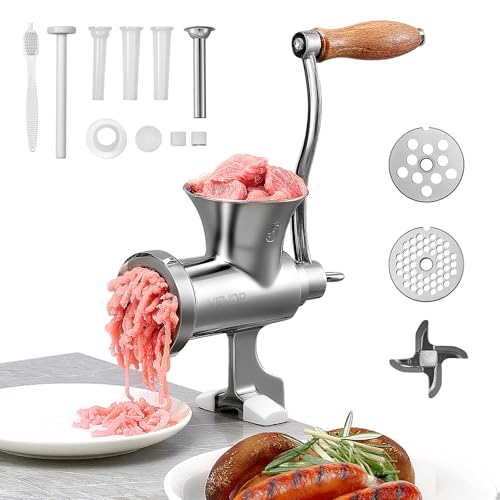
VEVOR Manual Grinder SS #5 — Best Stainless #5 for Easy Care
Where the cast iron VEVOR asks for devotion, the VEVOR Manual Grinder SS #5 asks only for a clampable edge. Its body is 304 stainless steel, the food-contact grade that shrugs off acidic marinades, salty sausage mixes and the occasional lazy evening when the parts sit in the sink longer than they should. The #5 designation matters: plates and knives follow the smaller standard, so cubes should be cut slimmer than for a #10, and throughput suits household batches rather than a whole deer.
Four sausage tubes is the generous detail here, one more than most rivals include, and it means snack sticks, breakfast links and plump bratwurst casings all find a matching tube without improvisation. The listing names beef chili and pork as home territory, and a coarse plate on well-chilled pork shoulder does indeed produce the loose, rustic grind that chili cooks argue about. Stainless parts also travel well: nothing to rust in a damp holiday-home cupboard between visits.
Pick this grinder when your batches run to a couple of kilos and your kitchen time is precious. It clamps on, grinds, rinses clean and goes back in the cupboard without the drying-and-oiling ceremony iron demands. Apartment cooks with one sturdy counter edge will find its footprint and appetite well matched to weekly meal preparation.
- Size class: #5 throat and plate format
- Body: 304 stainless steel with a steel table clamp
- Cutting set: 2 cutting plates included
- Sausage kit: 4 stuffing tubes, the widest spread here
Strengths
- 304 stainless body never needs seasoning or oiling
- Four sausage tubes cover more casing sizes than rivals
- #5 format stores easily in a standard kitchen drawer
Trade-offs
- Smaller throat means slimmer cubes and slower big batches
- Fine grinding of fatty meat needs extra chilling time
- Clamp still requires an accessible, sturdy table edge
Best for: smaller households wanting stainless care with full sausage kit. Not suited for: hunters or bulk grinders who need #10 throughput.

Huanyu Manual Meat Grinder — Best Compact Dishwasher-Safe Pick
The Huanyu Manual Meat Grinder was clearly drawn by someone who has stored a grinder in a small kitchen. The body is compact, the silhouette is simple, and the listing’s promise that the parts are dishwasher safe removes the single most annoying chore of hand grinding, which is picking meat fibres out of plate holes at the sink. Stainless steel throughout means no seasoning ritual and no rust freckles if a part hides damp in the drying rack overnight.
That compactness sets the working rhythm. Feed it steady, modest cubes and it rewards you with an even mince for beef patties, sausage mixes and the homemade pet food the listing mentions, where owners grind raw ingredients in small, frequent batches rather than marathon sessions. The maker pitches it at home kitchens, small restaurants and outdoor use, and that spread makes sense: it packs into a camp box without complaint and clamps or braces onto whatever table the day provides.
Consider the Huanyu your pick if counter space is the scarcest resource in your kitchen. It handles the weekly mince, the sausage experiment and the pet food routine, then breaks down small enough for a drawer. Only cooks planning to grind truly large quantities week after week should look toward the bigger throats elsewhere in this guide.
- Body: stainless steel hand crank machine
- Care: dishwasher safe according to the listing
- Design aim: space-saving footprint for small kitchens
- Suggested uses from the listing: beef, sausage and pet food
Strengths
- Dishwasher-safe parts simplify the worst chore in grinding
- Compact body fits drawers that reject bulkier machines
- Stainless build suits pet food and small restaurant prep
Trade-offs
- Compact throat rewards patience on larger batches
- Fewer included plates than the VEVOR models offer
- Small size means less flywheel heft on sinewy cuts
Best for: small kitchens, pet food makers and occasional sausage batches. Not suited for: bulk grinding sessions measured in many kilos.

Manual Grinder Sausage Stuffer generic — Best #10 Throughput on a Budget Class
Size is the whole story of the Manual Grinder Sausage Stuffer generic. The #10 in its name describes a throat and plate noticeably wider than a #5, and that width changes the feel of a grinding session: cubes can be cut chunkier, the auger grabs them with less coaxing, and the bowl fills at a pace that makes five kilos of pork shoulder a reasonable Saturday plan rather than an endurance event. A steel table clamp anchors the body while you lean into the crank.
Three sausage tubes ride along, so the same machine that minced the meat can stuff it, which matters more than it sounds. Transferring seasoned mince to a separate stuffer loses cold temperature and adds washing up; keeping one tool on the table keeps the mix chilled and the workflow simple. The listing aims the machine at home kitchens, small restaurants and outdoor use, and the straightforward construction suits all three, since there are few parts to lose and nothing electronic to protect from weather.
Reach for the #10 when volume is your recurring problem: hunting season trim, a pig share split with neighbours, or a family’s monthly burger grind. Its appetite forgives rough cubing, and its clamp keeps the pace brisk. Delicate small-batch cooks may find it more machine than they need, but nobody outgrows extra throat width.
- Size class: #10 throat and plate format
- Mount: steel table clamp
- Sausage kit: 3 stuffing tubes included
- Finish: silver, pitched at home, restaurant and outdoor use
Strengths
- #10 format accepts chunkier cubes and grinds fastest here
- Steel clamp holds firm through long, heavy sessions
- Grinds and stuffs with one tool, keeping meat colder
Trade-offs
- Larger body needs more storage room than #5 rivals
- Unbranded spares mean measuring plates before reordering
- Overkill for a single kilo of mince now and then
Best for: high-volume home grinders and sausage makers wanting #10 pace. Not suited for: tiny kitchens grinding only occasional small amounts.
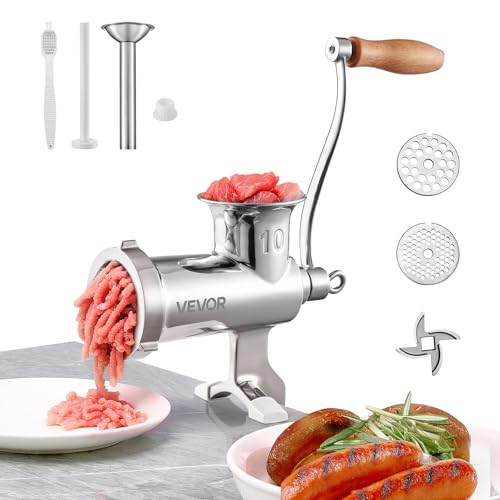
VEVOR Manual SS Grinder Clamp — Best Wide-Clamp Stainless Option
Most grinder listings leave you guessing about the clamp, so the stated jaw opening on the VEVOR Manual SS Grinder Clamp deserves applause: the clamp opens to 1.8 inches, which covers the thick butcher-block counters and chunky farmhouse tabletops that defeat narrower clamps. Measure your counter edge before ordering anything in this category, then compare it with that figure; a grinder that cannot mount is a sculpture, not a tool. The stainless body suits the butcher’s shop role the listing claims, tolerating constant washing without rust.
Two grinding plates handle the everyday split between coarse and fine work, and the sausage stuffer function folds stuffing into the same session, so a morning that starts with a pork shoulder can end with linked sausages and only one machine to scrub. The design language is plain and workmanlike, with smooth stainless surfaces that shed meat residue under a brush far faster than textured castings do.
Buy this VEVOR when your counter is thick, your batches are middling to large, and your patience for rust prevention is thin. It is pitched at homes, restaurants and small butcher’s shops, and that in-between scale is exactly where it sits: sturdier than novelty grinders, simpler than professional powered equipment, and washable without ceremony at the end of the day.
- Mount: table clamp with a stated 1.8 inch opening
- Body: stainless steel construction
- Cutting set: 2 grinding plates included
- Role: grinder plus sausage stuffer for home or shop use
Strengths
- Clamp opening is stated, so fit can be checked in advance
- Stainless body tolerates frequent washing in busy kitchens
- Two plates and stuffing cover the standard home repertoire
Trade-offs
- Thick-edge fit helps some kitchens and excludes none it fits
- Fewer sausage tubes than the four-tube #5 sibling
- Utilitarian finish prioritises function over counter looks
Best for: thick countertops and frequent grinders wanting stainless ease. Not suited for: shoppers needing the widest sausage tube selection.

LHS Manual Meat Grinder — Best Lightweight for Small Jobs
The LHS Manual Meat Grinder plays a different sport from the iron and steel machines above it. This is the light, friendly grinder that lives in a cupboard and comes out for a kilo of chicken mince, a small tray of sausage meat or, as the listing cheerfully notes, cookie dough pressed into shapes. Stainless steel blades do the cutting, while the white body keeps weight low enough that anyone in the household can set it up without a grunt. Its 3 in 1 billing simply means grinding, mincing and stuffing share one compact frame.
Easy cleaning is its headline promise, and for the jobs it is sized for, that matters more than raw throughput. Small batches mean small messes, and parts that rinse clean quickly encourage the habit of grinding fresh rather than buying a large pack of mince. Expect to feed it well-trimmed meat in modest pieces; sinew-heavy cuts and marathon sessions belong to the clamp-on metal machines, and asking this grinder to behave like one ends in frustration for both of you.
Choose the LHS when grinding is an occasional pleasure rather than a provisioning strategy: fresh chicken burgers on a weeknight, a child’s portion of mince you control completely, holiday cookie shapes through the same mechanism. It is the gentlest introduction to hand grinding in this guide, and for plenty of kitchens it is honestly all the grinder they will ever need.
- Format: 3 in 1 grinder, mincer and sausage stuffer
- Blades: stainless steel cutting blades
- Listing highlight: easy to clean after use
- Suggested extra use from the listing: cookie dough shapes
Strengths
- Light body is easy to set up, move and store
- Stainless blades handle meat and sausage mixtures
- Cookie use makes it a genuine multi-tasker for bakers
Trade-offs
- Not built for sinewy cuts or very large batches
- Lighter construction flexes more under hard cranking
- Serious sausage makers will want a metal clamp machine
Best for: occasional grinders, small batches and cookie dough work. Not suited for: bulk meat processing or tough, sinewy trim.
How Do the Six Manual Grinders Compare Side by Side?
| Pick | Badge | Distinguishing detail |
|---|---|---|
| VEVOR Manual Grinder Cast Iron | Best Traditional Cast Iron Build | Cast iron body, steel clamp, 2 plates and 3 sausage tubes |
| VEVOR Manual Grinder SS #5 | Best Stainless #5 for Easy Care | 304 stainless #5 body, clamp mount, 4 sausage tubes |
| Huanyu Manual Meat Grinder | Best Compact Dishwasher-Safe Pick | Compact stainless body, dishwasher-safe parts, pet food friendly |
| Manual Grinder Sausage Stuffer generic | Best #10 Throughput on a Budget Class | #10 throat, steel clamp, 3 sausage tubes, silver finish |
| VEVOR Manual SS Grinder Clamp | Best Wide-Clamp Stainless Option | Stainless body, 1.8 inch clamp, 2 plates, stuffer included |
| LHS Manual Meat Grinder | Best Lightweight for Small Jobs | Light 3 in 1 body, stainless blades, cookie-friendly design |
What Does the Grinder Size Number Actually Mean?
The numbers #5, #10 and #12 confuse shoppers because they look like quality grades, and they are not. They are an old trade sizing for the grinder’s throat and plate diameter: the bigger the number, the wider the plate, the larger the cubes the auger can swallow and the faster ground meat exits. A #5 plate is roughly two inches across, a #10 noticeably wider, and a #12 wider again, with knives and plates interchangeable only within the same size family. None of the six picks here is a #12, which is worth knowing before you order spare plates by guesswork.
In practice the size sets your working rhythm. On a #5 you cut meat into slim strips, feed steadily and produce excellent mince at a household pace. On a #10 the same meat can be cubed more roughly, the crank turns with a lazier bite, and a big batch shrinks surprisingly quickly. Neither is better in the abstract: the #5 stores in a drawer and suits weekly cooking, while the #10 earns its shelf space during hunting season or a whole-animal purchase. Match the number to your largest regular batch, not your largest imaginable one.
Clamp Base or Suction Base: Which Mount Actually Holds?
A clamp base screws the grinder to a table edge with a steel jaw, and once tightened it simply does not wander; your cranking force goes into the meat instead of into chasing the machine around the counter. The cost of that certainty is a suitable edge: you need an overhang thick enough to grip yet thin enough to fit the jaw, which is why the stated 1.8 inch opening on one pick above is genuinely useful information. Wooden worktops, farmhouse tables and sturdy workbenches are natural clamp territory.
A suction base presses a rubber cup onto a smooth surface and levers it tight, which suits stone, glass and laminate counters with no usable edge, and it leaves no marks. Its weakness is housekeeping: a smear of fat or a dusting of flour under the cup breaks the seal mid-session, and the machine begins to skate exactly when the meat gets tough. Wipe the surface, wet the cup lightly, and suction holds respectably for small batches. Choose by your counter first and your batch size second, because the finest grinder mounted badly is a miserable tool.
Cast Iron or Stainless Steel: How Should You Choose the Body?
Cast iron is the traditional grinder material for good reasons: it is heavy, rigid and cold to the touch, and a chilled iron throat helps fatty meat keep its definition instead of smearing. Iron also asks for a relationship. Wash it by hand, dry it on a warm hob or with a towel immediately, and wipe the thinnest film of neutral oil over the plates and knife before storage. Skip those steps in a humid kitchen and rust freckles appear, harmless to safety once cleaned off but annoying enough to teach you the routine.
Stainless steel trades a little of that mass and cold-soak for near-total forgiveness. It can drip-dry, most stainless parts here tolerate the dishwasher, and it shrugs off salty sausage mixes and tomato-heavy relish grinds that would test iron’s seasoning. For households that grind in short bursts and clean up in a hurry, stainless is the honest choice. For cooks who enjoy maintaining tools and grind often enough that the ritual stays familiar, iron repays the attention with a working life measured in decades rather than years.
How Do You Grind Meat Well With a Hand Crank?
Start colder than feels reasonable. Cube or strip the meat, spread it on a tray and give it time in the freezer until the edges firm and the pieces feel stiff but not rock hard; the bowl and, if they fit, the grinder parts can chill alongside. Cold meat cuts into distinct granules at the plate, while warm meat smears into paste and coats the knife, which is the single biggest quality difference a home grinder controls. Keep a second tray of meat waiting in the fridge rather than letting the whole batch warm on the counter.
Feed steadily and let the auger pull pieces in; the pusher is for guiding, not for ramming. Crank at a pace you could sustain for ten minutes, because surging and stalling tears meat instead of cutting it. Grind once for chunky chili texture, twice through a finer plate for smooth sausage or meatballs, and mix seasonings between passes when a recipe calls for it. If the output turns pale and pasty, stop, re-chill everything for a short spell, and check the knife is facing the right way against the plate, the classic beginner error.
How Do You Turn Ground Meat Into Sausages With These Tools?
Every pick in this guide stuffs as well as grinds, using the tubes listed with each model. The workflow is simple to describe and satisfying to learn: grind the meat, season and mix it until a small handful holds together tackily, chill it again, then remove the knife and plate, fit the stuffing plate if one is provided, slide a soaked casing onto the tube and crank slowly while a second pair of hands guides the filling casing off the tube. Steady cranking beats fast cranking; air pockets come from haste.
Casing choice pairs with tube size, which is why tube counts differ across these picks. Slim tubes suit breakfast links and snack sticks, mid tubes handle bratwurst and Italian sausage, and the widest manage large summer sausage styles. The four-tube #5 VEVOR gives the broadest casing wardrobe here, while three-tube kits still cover the sausages most households actually make. Keep the filled casings cold, twist links gently, and rest sausages uncovered in the fridge overnight before cooking or freezing; the flavour and texture both improve for the patience.
What Else Can a Manual Grinder Do Besides Beef?
The cast iron VEVOR’s own listing suggests pepper and mushroom, and that hints at the grinder’s second career as a relish and salsa machine. Firm vegetables, roasted peppers, onions and mushrooms pass through a coarse plate to make relishes, sandwich spreads and the base of a cooked salsa with a texture no food processor quite matches, because the grinder cuts rather than whips. Cooked potatoes for gnocchi-style doughs, soaked bread for meatball panade and nuts for baking all take a turn through the plates in older cookbooks.
Pet food is the other modern use, named directly in the Huanyu listing. Owners who prepare raw or cooked pet diets value grinding small batches fresh, controlling exactly which cuts and vegetables go in. Work in genuinely small quantities, chill everything as you would for your own burgers, and clean the machine with extra care afterwards, since pet batches often include ingredients that spoil quickly. A manual grinder’s willingness to work slowly and stop instantly makes it a calmer tool for these mixed jobs than a roaring electric unit.
How Do You Clean and Store a Manual Grinder So It Lasts?
Disassemble the machine while the residue is fresh, because dried meat in plate holes sets like mortar. Push a piece of plain bread through before you stop cranking and it will carry out much of the remaining meat, a trick butchers have used for generations. Wash plates, knife and auger in hot soapy water, attack the plate holes with a bottle brush or wooden skewer, and rinse well. Stainless parts can go through the dishwasher where the listing allows it; iron parts come straight out of the water and onto a towel.
Storage decides whether the machine greets you ready or rusty. Dry every part completely, warm iron briefly on the hob if your kitchen is damp, then film iron and carbon-steel knives with the faintest wipe of food-safe oil. Store plates and knife wrapped in a dry cloth so edges do not knock against each other and dull. Keep the whole kit together in one box or drawer; the fastest way to abandon home grinding is a missing plate on the day you planned to use it.
How Much Meat Can a Hand Grinder Realistically Handle?
Honest expectations keep manual grinding enjoyable. A fit cook working a #10 machine with well-chilled meat can process several kilos in a session without heroics, pausing to swap trays and re-chill. A #5 asks for a slower rhythm and rewards batches of one to three kilos. The limiting factor is rarely strength; it is temperature. As meat warms, quality falls, so sensible grinders work in waves, grinding what is cold, returning the rest to the fridge, and treating the pause as part of the craft rather than an interruption.
Plan the session like a small production line. Trim and cube everything first, season after the first pass, and keep bowls nested in larger bowls of ice if your kitchen runs warm. Two people transform the job: one cranks, one feeds and manages trays, and conversation replaces effort. If your household regularly faces a whole pig or a season of venison, a manual #10 still copes, provided you spread the work across a cool morning. If that sentence filled you with dread, your honest answer is an electric machine, and no brief can change it.
Can You Grind Bones, Fat and Frozen Meat in a Manual Grinder?
Soft fat is not the enemy; warm fat is. Firm, cold fat grinds into clean flecks that distribute through lean meat for juicy burgers and sausages, and a ratio around one part fat to four parts lean suits most home mixtures. Feed fat and lean alternately so the auger blends as it works. What manual grinders cannot do is bone: chicken bones, let alone beef or pork bones, will chip knives, crack plates and strain the clamp mount. Pet food recipes calling for ground bone belong to specialised heavy grinders, not these kitchen machines.
Fully frozen meat is nearly as unwise, because the auger cannot bite and the crank load spikes hard enough to rock even a clamped body. The sweet spot is the half-frozen state butchers call firm-chilled, where a knife still enters with effort and the surface feels stiff. Sinew deserves a word too: trim the silvery, rubbery sheets from roasts before cubing, since they wrap the knife and stall the grind. Small bits of gristle pass; long ribbons do not. Five minutes of trimming saves twenty minutes of unclogging.
Which Manual Grinder Suits a First-Time Buyer?
Begin with the batch you will actually make next month, not the feast you might host next year. If that batch is a kilo of chicken or pork mince for weeknight cooking, the compact stainless Huanyu or the light LHS removes every excuse: small storage, easy washing, modest price class and no mounting drama beyond a suitable surface or edge. Learning the chilling and feeding rhythm on forgiving little batches builds the skill that makes bigger machines sing later.
If your first batch is already ambitious, perhaps a family’s monthly burger supply or a first sausage project with friends, step straight to a clamp-mounted metal machine: the stainless #5 for tidy care, the #10 generic for pace, the cast iron VEVOR for the traditional feel. First-time buyers most often regret under-buying throat size rather than over-buying it, because grinding slowly is charming for one kilo and tedious for six. Whichever you choose, order a spare plate in your size once you know you enjoy the work; plates are the part every grinder eventually needs.
How Do You Keep Ground Meat Safe From Counter to Freezer?
Grinding spreads surface bacteria through the meat, which is simply a fact to manage with temperature and time rather than a reason to avoid the craft. Keep raw meat refrigerated until the moment of cubing, work in small cold waves, and get finished mince back into the cold within a sensible window; on warm days, bowls nested over ice earn their keep. Wash hands, boards and the grinder parts between species, especially between poultry and everything else, and treat the pusher and tray as food-contact surfaces, because they are.
Portion the finished grind before freezing and the whole habit becomes easier. Flatten mince in labelled bags so it thaws quickly and evenly, press out as much air as your hands allow, and freeze sausages on a tray before bagging so the links stay separate. Cook ground meats thoroughly at home, since the mixing that makes them delicious also means the middle of a burger must reach a safe temperature, not just the surface. None of this requires special equipment, only the same calm sequencing that good grinding already teaches.
Should You Grind Once or Twice for the Texture You Want?
A single pass through a coarse plate gives the loose, crumbly texture that chili and rustic ragù reward, where each granule stays distinct in the sauce. Burgers sit in the middle ground: many cooks grind once through a medium plate for a tender but structured patty, while meatballs and dumpling fillings often take a second pass through a finer plate so the mixture binds smoothly. Sausage mince usually gets ground, seasoned, mixed and then either ground again briefly or stuffed as it is, depending on how emulsified the style wants to be.
Each extra pass warms the meat slightly and breaks fat smaller, so grind twice only when the dish genuinely benefits. Work quickly between passes, keep the bowl over ice, and never send meat through a third time unless a recipe for a fine terrine demands it. Beginners often over-grind everything into baby food because the machine makes it easy; resist, taste the difference across one deliberate batch of each style, and you will quickly learn which of your regular dishes want one pass and which want two.
What Crank and Handle Details Matter Over a Long Session?
Grinding is a circular motion repeated hundreds of times, so the handle deserves more attention than it gets. A longer crank arm gives leverage that turns sinewy resistance into a manageable push, while a handle grip that spins freely on its shaft prevents the blisters a fixed grip carves into a palm. Wooden and smooth moulded grips both work; what matters is that your hand can relax between turns. Check that the handle removes easily, because a grinder that stores with its crank attached eats cupboard space and catches on everything.
Your body position matters just as much. The crank should sit at a height where your shoulder stays down and your elbow bends comfortably, which for most people means a table lower than a standard worktop or standing on a firm step at a high one. Alternate arms every few minutes on long batches; the meat does not care which hand turns, and your shoulders will thank you at kilo four. A steady rhythm with a relaxed grip will out-grind a heroic sprint every single session.
How Should You Set Up a Grinding Station Before You Start?
Lay the session out like a tiny factory and the work halves. From left to right: the tray of trimmed, cubed meat waiting in its cold state, the mounted grinder with a bowl beneath the plate, a second bowl for finished mince sitting in a larger bowl of ice, and a clear space for plates and tubes you will swap mid-job. Keep a roll of bags or a stack of containers at the end of the line for portioning, plus a marker for labelling, because unlabelled freezer bags become mystery meat within a month.
Small preparations pay off repeatedly. Soak casings early if sausages are planned, since they need their rinsing and soaking time regardless of your grinding speed. Put the kettle on for washing water before the last batch, not after it. Lay a damp cloth under bowls that slide. None of this is glamorous, and all of it is the difference between a session that feels like a pleasant craft and one that feels like a spill-prone scramble conducted with raw meat on your hands.
When Does a Manual Grinder Stop Making Sense?
Honesty requires a boundary. If your household processes a whole animal in a single weekend several times a year, or runs a small food business where mince is a daily product, hand cranking becomes the bottleneck that exhausts the cook and warms the meat. Electric machines exist for that world and nobody should feel disloyal for entering it. The manual grinder’s kingdom is the household batch: weekly mince, sausage Saturdays, hunting trim shared among friends, pet food in sensible quantities.
There is also the question of who is grinding. A manual machine asks for two able arms and a steady table; cooks with shoulder or wrist trouble may find even a kilo genuinely painful, and an electric model is the kinder tool for them. Everyone else tends to discover that the hand grinder’s slowness is partly the point: it keeps meat cold, keeps the kitchen quiet enough for conversation, and keeps a small, satisfying skill alive in a house that buys most things ready-made.
How Do You Grind Meat Specifically for Better Burgers?
Burger mince rewards a few deliberate choices. Blend cuts rather than relying on one: chuck brings flavour and fat, a little brisket adds depth, and a small share of short rib makes the mixture feel luxurious without any single cut dominating. Aim for a fat proportion that keeps patties juicy on a hot grill, and grind the blend once through a medium plate so the strands stay distinct; those loose strands, gently formed without pressing, are what give a home-ground burger its tender, steakhouse crumb.
Season after forming, on the outside, so salt does not draw moisture and tighten the meat during resting. Keep patties cold until the moment they meet the heat, and make the centre slightly thinner than the edges to allow for the puff that cooking causes. The difference between this and a bought mince patty is not subtle, and it is the batch that converts most households to grinding their own. Your manual machine, a cold tray of chuck and twenty calm minutes are all the upgrade requires.
How Do You Store Ground Meat and Sausages Once They Are Made?
Fresh mince keeps its quality for a short window in the fridge, so cook it promptly or freeze it the same day in flat, labelled portions that thaw evenly. Sausages benefit from an overnight rest uncovered on a rack, which dries their casings slightly and deepens flavour, before they are cooked or frozen on a tray and bagged once solid. Write the cut blend and the date on every package; future you, staring into the freezer in a month, will be grateful for the information rather than forced to guess.
Thaw ground meat in the fridge on a plate, never on the counter, and use it the day it softens. If a grinding session produced more than the week can use, consider cooking a large batch of seasoned mince and freezing that instead, since cooked crumbles reheat into tacos, sauces and shepherd’s pie bases with almost no effort. The grinder starts the chain, but these small storage habits are what turn one calm Saturday session into a month of easy dinners.
What Should You Check Before Ordering Plates or Parts?
Replacement plates and knives are sold by the grinder’s size number, so confirm whether your machine is a #5 or a #10 before ordering anything, and measure the plate diameter if the size is not stated anywhere on the body. Count the centre hole shape as well, because some knives use a square drive and others a round one, and the wrong profile will not seat against the plate. Buying a spare knife and plate pair when you first fall in love with the machine is cheap insurance against a dull set discovered mid-batch.
Tubes and clamps deserve the same care. Sausage tubes are described by their outlet diameter, and matching that to the casings you buy prevents a frustrating stuffing day. Clamp jaws and their screws are the parts most likely to be lost in a drawer move, so store them threaded loosely into the body rather than loose in a box. A complete, working kit is what keeps home grinding a pleasure instead of a treasure hunt.
What Mistakes Do New Manual Grinders Make Most Often?
Grinding warm meat tops the list, because it smears fat, coats the knife and produces the grey, pasty mince that convinces beginners the machine is at fault. The runner-up is mounting: a clamp half-tightened on a wobbly table, or a suction cup pressed onto a floury counter, guarantees a miserable session and sometimes a falling grinder. Third comes the reversed knife, installed with its flat cutting face away from the plate, which pushes meat rather than slicing it and mimics a dull machine perfectly.
Overfeeding causes its own trouble. Ramming the pusher bends the rhythm, tears meat and overloads the plate, while patient feeding lets the auger do the pulling it was designed for. Finally, many new owners store the machine damp or assembled with meat residue in the plate holes, then blame the material when rust or odours appear. Dry parts, a whisper of oil on iron, and a complete kit stored together prevent nearly every sad second session.
- Skipping the freezer spell, then blaming the grinder for smeared, pasty mince.
- Mounting on a wobbly table or a dusty counter and cranking anyway.
- Fitting the cutting knife backwards so it pushes meat instead of slicing.
- Forcing the pusher hard instead of letting the auger draw meat in.
- Putting the machine away damp, assembled, or missing a plate.
Final Recommendation
Match the mount to your counter, the size number to your typical batch and the body material to your tolerance for upkeep, and any of these six will grind happily. The cast iron VEVOR is the heirloom choice, the stainless #5 the tidy all-rounder, the Huanyu the small-kitchen diplomat, the #10 the volume worker, the wide-clamp VEVOR the thick-counter answer and the LHS the gentle starter. Most households will land happiest on a clamp-mounted stainless model and never look back.
If your cranking arm is willing and your freezer is ready, start with the pick whose care routine you will genuinely keep, because a grinder that gets washed, dried and stored properly is the one still mincing beautifully when the novelty has long worn off.
Frequently Asked Questions
How long does it take to grind a kilo of meat by hand?
On a #10 machine with firm-chilled meat, a practised cook finishes a kilo in a few unhurried minutes of cranking; a #5 takes a little longer because its throat accepts slimmer strips. The clock is dominated by preparation, not cranking: trimming, cubing and chilling the meat, then washing the parts afterwards. Plan the session as half an hour of calm work for a family batch and you will rarely be disappointed.
Do manual grinders work for chicken and turkey?
Yes, and poultry is where home grinding shines, because you choose the cuts and grind fresh for burgers, meatballs and sausage. Use thigh meat for juiciness, chill it until very firm since poultry softens faster than beef, and clean the machine thoroughly afterwards as you would any poultry surface. Skin can be included in small proportions for richness, though large amounts wrap the auger and slow the work.
Can I sharpen the knife and plate at home?
Light maintenance is possible: a plate can be lapped flat on fine wet-and-dry paper over glass, and a knife’s edge can be refreshed the same way, working slowly to keep the faces true. Deep nicks or a rocking plate belong to a sharpening service. The practical test is performance: if chilled meat starts smearing despite correct assembly, the knife-to-plate contact is usually the culprit, and replacing the pair in your grinder’s size is often simpler than repeated lapping.
What is the difference between a cutting plate and a stuffing plate?
A cutting plate has many small holes and works with the rotating knife to shear meat into mince of a chosen coarseness. A stuffing plate has a few large openings and no cutting role; it simply supports the stuffing tube while seasoned mince passes through into casings. Some kits use a spacer instead. Fitting the knife during stuffing is a common error, because it chops the mixture finer when you only want to move it.
How do I stop my grinder wobbling while I crank?
Fix the mount first: tighten a clamp onto the thickest, steadiest edge available, or clean and slightly dampen the surface under a suction base. Then look at your stance; cranking in line with your shoulder, with the machine at comfortable hip height, stops the sideways rocking that a high counter encourages. Finally, check the meat: oversized or half-frozen chunks make any grinder lurch, and slimmer strips calm the whole machine down.
Related Guides
If grinding your own mince has started a wider habit of making food from scratch at home, the natural companions are Best Food Dehydrators for Jerky for turning your grind into shelf-stable snacks, a detour through Best Small Microwave Convection Ovens for the small kitchen that hosts all this work, and the practical guidance in Best Gas Dryers With Steam for the laundry that follows a long preserving weekend.



[…] table that cooks together deserves a well-stocked kitchen behind it, so continue with our guides to Best Manual Meat Grinders Best Freestanding Induction Ranges Best Tiger Rice […]