What's inside
- Key Takeaways
- Quick Picks
- How We Chose These Picks
- How Do the Six Ovens Compare Side by Side?
- What Is the Difference Between Convection and Air Fry in These Ovens?
- How Should You Measure Your Counter Before Choosing?
- What Can a Convection Microwave Genuinely Replace?
- How Do You Get Good Baking Results From Such a Small Oven?
- What Mistakes Do Buyers of Combination Microwaves Make?
- How Do You Clean and Care for a Combination Cavity?
- Which Pick Suits an RV, a Studio or a Family Counter?
- What About Noise, Steam and Kitchen Heat?
- How Does Inverter Power Change Defrosting and Reheating?
- What Is the Right Way to Reheat Leftovers in a Combination Oven?
- Can You Cook a Proper Pizza in a Countertop Convection Microwave?
- Which Materials Are Safe in Each Mode?
- How Much Energy Does a Small Oven Save Over the Main Range?
- Should You Buy a Renewed Appliance Like the Panasonic Pick?
- What Does a Week of Cooking Look Like on One of These?
- How Do Sensor Menus Decide When Food Is Done?
- Why Does Turntable Size Matter More Than the Capacity Figure?
- How Does a Second Small Oven Change Holiday Cooking?
- What Should You Troubleshoot Before Blaming the Oven?
- How Should a Small Kitchen Vent and Place One of These Ovens?
- What Accessories Are Actually Worth Buying?
- How Long Should a Combination Microwave Serve?
- Final Recommendation
- Frequently Asked Questions
- Related Guides
As an Amazon Associate I earn from qualifying purchases. This post may contain affiliate links at no extra cost to you.
cottageverdict.com is reader-supported. When you buy through links on our site, we may earn an affiliate commission.
Where to buy: the six countertop ovens in this guide are sold through Amazon, and each model name in the Quick Picks table, the reviews and the comparison table links to its listing, where you can check price on Amazon and confirm the cavity size, wattage and included racks or trays for the exact unit on sale.
The best small microwave convection ovens exist for a particular kind of kitchen: one where the counter is precious, the household is one to three people, and the main oven feels like overkill for reheating pizza, roasting a small chicken or baking a tray of scones. A microwave alone reheats brilliantly and browns nothing. A convection microwave adds a heating element and fan, so the same box that softens butter can also crisp a pastry, and the newest generation folds in air fry and broil functions that would have seemed absurd in a microwave a decade ago.
Honesty about size comes first in this category. The true small class runs from 0.9 to 1.3 cubic feet, and five of our six picks live there. One pick, the Toshiba 4-in-1 at 1.5 cubic feet, is labelled a step-up wherever it appears, because it buys family-size capacity with countertop depth that small kitchens may not have to spare. We also separate genuine convection, where an element and fan bake like a small oven, from air fry combination modes, which use intense top heat and fast air for crisping; several picks offer both, and the reviews say which is which rather than letting the badge blur them.
Key Takeaways
- Small here means 0.9 to 1.3 cubic feet; the 1.5 cubic foot Toshiba is a deliberate step-up and is flagged as one throughout.
- True convection bakes with an element and fan, while air fry modes crisp with fierce top heat; the best picks here offer both tools.
- Turntable diameter decides what fits more honestly than cubic feet, so check your largest plate against the measurements given.
- Inverter models cook and defrost more evenly than cycling power, which matters most for fish, custards and reheated rice.
- One pick is a renewed listing, and it is labelled as such wherever it appears in this guide.
Quick Picks
| Pick | Badge | Why it earns its place |
|---|---|---|
| TOSHIBA 1.0 Air Fryer Combo Microwave | Best All-Round Small | An 8-in-1 brief with real convection, broil and air fry packed into a true 1.0 cubic foot footprint with a 12.4-inch turntable. |
| BLACK+DECKER 5-in-1 Microwave 0.9 | Best for Tiny Counters | The smallest box here at 0.9 cubic feet still manages convection bake and roast, making it the RV and studio flat candidate. |
| FRIGIDAIRE 1.2 Microwave Air Fryer Convection | Best Roomy Small | At 1.2 cubic feet with XL positioning, it swallows a family pizza or casserole that strains the sub-1.0 models. |
| TOSHIBA 4-in-1 1.5 Microwave Air Fryer | Best Step-Up Capacity | A step-up beyond the small class at 1.5 cubic feet, with sensor cooking, convection and a position memory turntable. |
| Panasonic HomeMADE Multi-Oven | Best Inverter Pick (Renewed) | Panasonic’s inverter cooking in a 1.3 cubic foot multi-oven, sold as a renewed unit and priced by the listing accordingly. |
| TOSHIBA OptiChef Convection Microwave | Best Inverter Convection | Inverter power plus convection, broil and air fry in a 1.0 cubic foot stainless box for cooks who reheat delicately. |
How We Chose These Picks
Every candidate had to be a countertop unit that microwaves and genuinely bakes. That second clause eliminated a long list of air fry microwaves whose only nod to an oven is a crisping element; useful machines, but not convection ovens, and this guide’s title makes a promise we intended to keep. Where a pick leans on air fry as its headline, its true convection credentials are stated in its review.
Capacity was judged by turntable and usable height rather than the cubic foot headline, because a tall narrow cavity that cannot accept your dinner plates is smaller than its brochure claims. We also weighed control clarity: combination cooking asks more of the user than reheating soup does, so presets that sequence microwave and convection stages sensibly counted for more than a long list of one-touch buttons nobody can memorise.
Finally, we kept the class honest. Five picks sit between 0.9 and 1.3 cubic feet, the sizes that genuinely fit small counters and under-cabinet gaps. The 1.5 cubic foot Toshiba stays because many shoppers searching this category actually cook for four, but it wears its step-up label openly so nobody mistakes its footprint for a compact one.
We also read the fine print on condition and claims, which is how the Panasonic’s renewed status and the difference between convection baking and air fry crisping made it into the reviews as plain statements rather than surprises after delivery.

TOSHIBA 1.0 Air Fryer Combo Microwave — Best All-Round Small
Toshiba’s black stainless 1.0 cubic foot combo is the shape of the modern category: eight functions in one box, with convection and broil listed alongside the air fry headline. That ordering matters. The convection mode here is a real baking arrangement with heated circulating air, suitable for a small batch of muffins or a tray of roast vegetables, while the air fry function takes the crisping jobs, wings and reheated fries, that convection alone does more slowly.
The 12.4-inch turntable accepts a full dinner plate or a modest pizza, which is the practical ceiling most small households need, and the Pro Defrost programming handles the microwave side with more nuance than a blunt timed thaw. In daily life this becomes the second oven of a small home: garlic bread crisping while pasta boils, a single chicken breast roasting without heating the main range, leftovers revived with their edges intact rather than steamed into surrender.
- Capacity: 1.0 cu. ft., true small class
- Turntable: 12.4 inches
- Functions: 8-in-1 including convection, broil and air fry
- Defrost: Pro Defrost programming
- Finish: black stainless steel
- Role: the default recommendation for most small kitchens
Strengths
- Genuine convection plus broil plus air fry covers nearly every small-oven task.
- The turntable fits real dinner plates, not just mugs and bowls.
- Black stainless finish hides fingerprints better than bright steel in daily use.
Trade-offs
- One cubic foot still means one tray at a time; batch bakers will queue.
- Combination modes reward reading the manual once, properly, before winging it.
- Air fry results trail a dedicated fryer for very large crisping loads.
Best for: small households wanting one countertop box that reheats, bakes, broils and crisps without drama.
Not suited for: families cooking multi-tray meals, who should look at the step-up pick or a full oven.
Check the dimensions on the TOSHIBA 1.0 Air Fryer Combo Microwave listing and check price on Amazon.

BLACK+DECKER 5-in-1 Microwave 0.9 — Best for Tiny Counters
At 0.9 cubic feet and 900 watts, this is the pick that treats counter space as the scarcest resource in the kitchen. BLACK+DECKER aims it openly at small kitchens and RVs, and the five-in-one brief still finds room for convection bake and roast beside the microwave and air fry functions. That is a remarkable amount of cooking for a box that can live where a toaster oven used to sulk.
Expectations should scale with the cavity. A 900W microwave heats a little more patiently than a 1000W unit, and the convection chamber roasts for one or two, not a crowd: think two chicken thighs, a small tray of scones, a personal pizza brought back to crispness. Ten power levels and a child lock round out a specification that understands its likely homes, which include caravans, dorm-adjacent studios and the narrowboats of the world where every watt and inch is negotiated.
- Capacity: 0.9 cu. ft., the smallest here
- Power: 900W microwave output
- Functions: 5-in-1 with convection bake and roast
- Controls: 10 power levels, child lock
- Audience: small kitchens, RVs, studios
- Role: maximum versatility per inch of counter
Strengths
- Genuine convection in a sub-1.0 footprint is rarer than marketing suggests.
- Modest power draw suits RV and older-building circuits kindly.
- Child lock and simple presets fit shared and family spaces well.
Trade-offs
- 900W reheats large portions noticeably slower than the 1000W picks.
- The cavity will not accept a standard large dinner plate in every case; measure yours.
- Air fry batches are snack-sized, so plan on two rounds for two hungry people.
Best for: RV owners, studio dwellers and anyone whose counter space argument is genuinely zero-sum.
Not suited for: households reheating family-size leftovers nightly or baking in batches.
Confirm the plate fit via the BLACK+DECKER 5-in-1 Microwave 0.9 listing and check price on Amazon.

FRIGIDAIRE 1.2 Microwave Air Fryer Convection — Best Roomy Small
Frigidaire pitches this 1.2 cubic foot model with the phrase XL Capacity, and inside the small class that is a fair claim. The extra fifth of a cubic foot over the 1.0 models shows up where it matters: a family-size frozen pizza sits flat, a casserole dish with handles clears the walls, and the air fry basket takes a double handful of wings without stacking them into a steamy pile.
The function set covers the expected trio of microwave, convection oven and air fry, with Frigidaire’s Combo-Fry naming for the hybrid crisping work. In practice this is the pick for the small kitchen that still cooks like a medium one: a household of three that reheats, roasts and bakes in the countertop unit daily and reserves the big oven for Sundays. The stainless finish keeps it visually at home beside full-size appliances, and the digital controls follow the brand’s familiar layout, which shortens the learning curve for anyone upgrading from a plain Frigidaire microwave.
- Capacity: 1.2 cu. ft., upper end of small
- Functions: microwave, convection, air fry with Combo-Fry
- Positioning: XL capacity within the compact class
- Finish: stainless steel
- Best dishes: whole pizzas, handled casseroles, bigger fry batches
- Role: the small-class pick for families of three
Strengths
- Noticeably more usable room than the 0.9 and 1.0 cubic foot picks.
- Convection and air fry both present, so baking and crisping are covered.
- Familiar brand controls ease the move from a basic microwave.
Trade-offs
- The larger footprint may crowd the very counters this category serves.
- No inverter, so low-power microwaving cycles rather than flowing steadily.
- Still a single-cavity compromise beside a true double-oven arrangement.
Best for: small families who found 1.0 cubic foot models just too tight for their dishes.
Not suited for: the tightest counters, where the BLACK+DECKER’s smaller box wins.
Review cavity measurements for the FRIGIDAIRE 1.2 Microwave Air Fryer Convection and check price on Amazon.
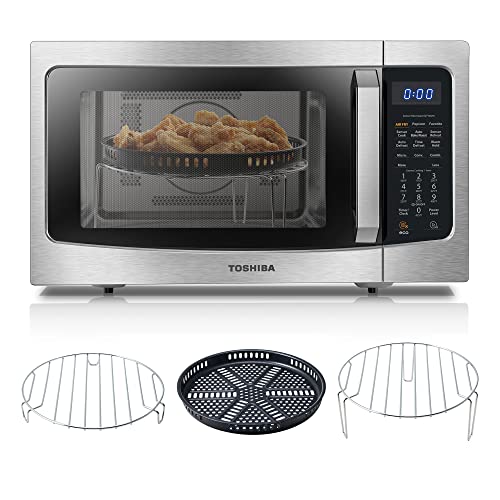
TOSHIBA 4-in-1 1.5 Microwave Air Fryer — Best Step-Up Capacity
Let the label do its work first: at 1.5 cubic feet this Toshiba is a step-up beyond the small class this guide is named for, included because a share of readers searching here actually feed four people and keep being disappointed by compact cavities. What the extra volume buys is a turntable and chamber that take a whole chicken’s worth of convection roasting or a genuinely family-size dish of leftovers, with 1000 watts behind the microwave side.
The thoughtful details are pure Toshiba. A smart sensor judges humidity and adjusts cooking so reheated rice and vegetables stop emerging half scorched, half cold. The position memory turntable returns the dish to the same orientation it started in, a small mercy when the handle of a hot jug needs to face you rather than the back wall. A mute function silences the beeps, which anyone reheating a midnight snack in a sleeping household will rank higher than several headline features. Convection and air fry complete the four-in-one brief.
- Capacity: 1.5 cu. ft., labelled step-up beyond small
- Power: 1000W microwave output
- Sensors: smart humidity sensor cooking
- Turntable: position memory returns dish to start angle
- Extras: mute function for quiet hours
- Functions: microwave, convection, air fry combo
Strengths
- Family-size cavity ends the decanting and batch-splitting of smaller picks.
- Sensor reheating is noticeably kinder to rice, pasta and vegetables.
- Mute and position memory show real attention to daily annoyances.
Trade-offs
- Its depth and width break the small-counter promise of this category.
- Heavier and harder to shift for cleaning behind than the compact picks.
- Shoppers who truly need compact should not let its talents talk them upward.
Best for: households of three or four whose cooking outgrew the 1.0 cubic foot class.
Not suited for: genuinely small counters, RVs, or anyone measuring success in inches saved.
Measure twice against the TOSHIBA 4-in-1 1.5 Microwave Air Fryer listing dimensions and check price on Amazon.

Panasonic HomeMADE Multi-Oven — Best Inverter Pick (Renewed)
Two disclosures frame this pick. First, the listing sells the Panasonic NN-CD66NS as a renewed unit, meaning a refurbished product sold under Amazon’s renewed programme rather than a factory-fresh box; the guide keeps it because the underlying machine is excellent and renewed stock is how many buyers access it, but you should read the listing’s renewed terms with clear eyes. Second, Panasonic’s inverter technology is the real story: instead of pulsing full power on and off to imitate low settings, an inverter delivers genuinely reduced, continuous power.
Continuous low power changes foods that microwaves traditionally ruin. Fish fillets cook through without rubbery edges, butter softens instead of exploding, custards and reheated sauces hold together, and defrosting stops producing cooked rims around a frozen core. At 1.3 cubic feet the HomeMADE multi-oven sits at the generous end of small, and Panasonic itself advertises the pizza case, which the cavity supports happily. As a multi-oven it bakes and browns beside its microwave duties, giving inverter households the convection half of this guide’s brief as well.
- Capacity: 1.3 cu. ft., generous end of small
- Technology: inverter continuous power delivery
- Condition: renewed listing, check terms on the page
- Series: Panasonic HomeMADE countertop line
- Best dishes: fish, custards, gentle reheats, pizza
- Role: the finesse pick for delicate microwave work
Strengths
- Inverter defrosting and low-power cooking are a class above cycling rivals.
- 1.3 cubic feet handles family plates while staying countertop-scaled.
- Renewed availability can make a premium machine attainable.
Trade-offs
- Renewed condition means stock, warranty terms and cosmetics vary; read carefully.
- No air fry headline, so crisping leans on its oven and broil style modes.
- Panasonic’s control logic takes an evening to learn for newcomers.
Best for: cooks who defrost and reheat delicate food often and accept a renewed unit gladly.
Not suited for: buyers who want a brand-new box with the standard new-product warranty story.
Read the renewed terms on the Panasonic HomeMADE Multi-Oven listing and check price on Amazon.

TOSHIBA OptiChef Convection Microwave — Best Inverter Convection
The OptiChef is Toshiba’s answer to a pointed question: what if the 1.0 cubic foot combo also cooked like an inverter? It pairs inverter power delivery with convection, broil and air fry in a stainless 1.0 cubic foot body at 1000 watts, which makes it the most technically complete small unit in this guide. The smart sensor handles reheating judgement calls, while the inverter keeps low-power work smooth in the way the Panasonic pick demonstrates.
For a cook who uses every mode weekly, that combination removes the usual compromise. Delicate defrosting in the morning, a convection-baked tart at lunch, air-fried snacks in the evening, all from a box the size of an ordinary microwave. The stainless finish and OptiChef branding aim it at buyers furnishing a kitchen properly rather than equipping a dorm, and the feature depth rewards the household that will actually read the cooking charts and use combination sequences, where microwave speed and convection browning work the same dish in turn.
- Capacity: 1.0 cu. ft., true small class
- Power: 1000W with inverter delivery
- Functions: convection, broil, air fry, smart sensor
- Finish: stainless steel
- Positioning: OptiChef series flagship compact
- Role: most complete technical package at 1.0 size
Strengths
- Inverter plus full convection set is unmatched at this footprint.
- Smart sensor reheating reduces the guesswork of mixed leftovers.
- Broil function gives cheese and gratins a proper finish.
Trade-offs
- Feature depth means a real learning curve for combination cooking.
- One cubic foot still caps the largest dishes, as with its sibling pick.
- Buyers wanting only reheat-and-go simplicity pay for unused talents.
Best for: keen cooks in small kitchens who will genuinely use inverter and convection together.
Not suited for: minimalists who want three buttons and no homework.
Explore the mode list on the TOSHIBA OptiChef Convection Microwave listing and check price on Amazon.
How Do the Six Ovens Compare Side by Side?
| Model | Capacity | Power | Signature trait |
|---|---|---|---|
| TOSHIBA 1.0 Air Fryer Combo Microwave | 1.0 cu. ft. | Countertop combo | 8-in-1 with broil and Pro Defrost |
| BLACK+DECKER 5-in-1 Microwave 0.9 | 0.9 cu. ft. | 900W | Smallest box, convection included |
| FRIGIDAIRE 1.2 Microwave Air Fryer Convection | 1.2 cu. ft. | Countertop combo | XL room inside the small class |
| TOSHIBA 4-in-1 1.5 Microwave Air Fryer | 1.5 cu. ft. step-up | 1000W | Sensor cooking, memory turntable |
| Panasonic HomeMADE Multi-Oven | 1.3 cu. ft. | Inverter | Gentle power, renewed listing |
| TOSHIBA OptiChef Convection Microwave | 1.0 cu. ft. | 1000W inverter | Fullest mode set at compact size |
Read capacity and cooking style together. The BLACK+DECKER wins the tape measure, the two 1.0 Toshibas split on inverter finesse versus all-round value, the Frigidaire and Panasonic stretch the definition of small in useful directions, and the 1.5 Toshiba stands apart as the step-up for households that have stopped pretending to be small.
What Is the Difference Between Convection and Air Fry in These Ovens?
Convection in this category means a heating element working with a fan to circulate hot air through the whole cavity, the same principle as a fan oven, shrunk. It bakes evenly, roasts properly and handles anything you would put in a small conventional oven, from a sponge cake to a tray of root vegetables. When a listing here says convection, that full baking ability is what is being promised, and our picks were screened for it.
Air fry is a specialised, more violent cousin: very hot air driven fast, usually from above, across food arranged in a single layer on a perforated tray. It crisps coatings beautifully and quickly, but it is a poor way to bake a cake and a crowded basket steams instead of frying. Machines offering both, like the Toshiba combos and the Frigidaire, let you choose the right violence for the dish. Machines leaning mainly on air fry were treated cautiously in this guide, because crisping chips is not the same skill as baking.
How Should You Measure Your Counter Before Choosing?
Measure three things: the footprint available, the height beneath any wall cabinets, and the breathing room behind and beside the unit, because convection ovens vent real heat and their listings specify clearances. Then measure your largest everyday plate and your favourite casserole across their widest points, handles included, and compare those numbers against turntable diameter and cavity width rather than the cubic foot headline.
Depth is the silent deal-breaker. A step-up model like the 1.5 Toshiba may fit the width of your counter run yet project past the front edge or crowd the backsplash, which is why its review keeps returning to the tape measure. Photograph your counter with the tape in frame; future you, comparing listings at midnight, will be grateful.
What Can a Convection Microwave Genuinely Replace?
For one or two people, nearly everything except volume. It reheats like a microwave, bakes like a small oven, crisps like a modest air fryer and broils cheese and gratins respectably. A small household can plausibly run weeknight cooking through one of these for months, lighting the main oven only for a turkey or a baking marathon, and the energy logic favours heating one cubic foot over five for a single portion.
What it cannot replace is simultaneity. One cavity means one temperature at a time, so the roast and the Yorkshire puddings and the reheated pudding must queue politely. Households that cook in parallel should treat these units as a brilliant second oven rather than a main-oven substitute, which is, in fairness, exactly how the happiest owners describe them.
How Do You Get Good Baking Results From Such a Small Oven?
Preheat properly, because a small cavity’s temperature swings more than a large oven’s when a cold dish lands inside. Use the rack supplied so air can circulate beneath trays, choose lighter-coloured bakeware to avoid over-browning in the close quarters near the element, and expect most recipes to finish a little sooner than their big-oven timings suggest. Check early, rotate once if your model lacks strong fan coverage, and let the smart sensor handle reheats rather than fighting it with manual minutes.
Combination cooking is the quiet superpower once learned: a brief microwave stage to bring a dense centre up to temperature, followed by convection to brown the outside, turns out baked potatoes and reheated lasagne portions that taste oven-made in microwave time. The manuals chart these sequences dish by dish, and an hour spent with yours in the first week pays for itself all year.
What Mistakes Do Buyers of Combination Microwaves Make?
The commonest is buying by cubic feet alone and discovering the turntable rejects their plates. The second is assuming air fry and convection are interchangeable words, then wondering why a cake baked under a crisping element has a scorched crown and a raw heart. Third is forgetting clearance: a convection oven squeezed into a cubby with no airflow will run hot, sulk and age early.
Fourth, and most human, is never opening the manual. Combination sequences, sensor menus and rack positions are where these machines earn their price, and the owner who treats theirs as a mere reheat box has bought a sports car for the school run. Spend one evening learning your model and the category makes sense forever after.
How Do You Clean and Care for a Combination Cavity?
Microwave splatter wipes away easiest while fresh, and a bowl of water microwaved until steaming loosens anything stubborn without chemicals. Convection and air fry modes add baked-on grease to the equation, so the crisper tray and rack want a soak after fry nights, and the cavity walls benefit from a degreasing wipe while still faintly warm. Keep metal scouring pads away from interior coatings, whatever the provocation.
The door seal and the area around the latch deserve a weekly once-over, since crumbs and grease there affect both hygiene and the door’s fit. Exterior vents should stay dust-free so the fan can breathe, especially in RV and small-flat settings where these units often live close to soft furnishings. None of this is arduous, but it is regular, and a combination oven rewards the household that treats cleaning as a two-minute habit rather than a monthly excavation.
Which Pick Suits an RV, a Studio or a Family Counter?
The RV answer is the BLACK+DECKER almost by definition: smallest footprint, gentle 900W appetite, convection for real meals when the campsite weather turns. Just confirm your inverter or hookup arrangements suit its draw, as with any heating appliance on wheels. Studio flats split between that same model, where the counter is truly tiny, and the Toshiba 1.0 combo where a few more inches exist and one box must do everything.
Families should start at the Frigidaire 1.2 and argue upward to the step-up Toshiba 1.5 if leftovers arrive in big dishes and four portions reheat at once. The Panasonic renewed pick suits the family that defrosts constantly and cooks fish often, while the OptiChef is the connoisseur’s compact: a small household of keen cooks who will use inverter nuance and combination sequences rather than admire them.
What About Noise, Steam and Kitchen Heat?
A convection microwave in baking mode is a small oven, with a fan’s working hum and real heat venting into the room; on a summer evening that is noticeable in a bedsit in a way a plain microwave is not. The microwave modes themselves are as quiet as their class gets, and the Toshiba step-up’s mute function removes the electronic beeping that travels through thin walls at midnight, though it cannot silence the fan.
Steam management is the other lived detail. Microwaved vegetables and reheated soups release moisture at the door when it opens, so a habit of standing back for two seconds saves steamed spectacles and mascara alike. Position the unit where that puff of steam rises into open air rather than into the underside of a low cabinet, and the whole category becomes pleasanter to live with.
How Does Inverter Power Change Defrosting and Reheating?
A conventional microwave imitates half power by blasting at full power for half the time, which is why defrosting mince traditionally yields cooked grey edges guarding a frozen heart. An inverter, as fitted to the Panasonic and the Toshiba OptiChef here, turns the power genuinely down, delivering a steady gentle stream that lets heat migrate through food at the pace conduction allows. The difference is not subtle: bread defrosts without leathery patches, chicken portions thaw evenly enough to cook immediately, and butter arrives soft rather than as a puddle with a solid iceberg.
Reheating gains the same way. Delicate sauces that split under pulsed full power hold their emulsion under a steady medium setting, and a plate of leftovers warms through without the volcanic rim and chilly centre that make people distrust microwaves generally. If your household reheats more than it cooks from raw, inverter behaviour is arguably the most valuable specification in this entire guide, worth more than an extra function or two.
The honest caveat is that inverter models reward using their programmed settings. The sensor and auto-defrost sequences are where the engineering lives; owners who only ever type in minutes manually will still benefit, but they leave the best of the machine unclaimed.
What Is the Right Way to Reheat Leftovers in a Combination Oven?
Match the method to the food’s original glory. Anything crisp, pizza, pastry, fried anything, belongs in convection or air fry mode, where dry circulating heat revives the crust that microwave energy would steam into leather. Anything saucy or steamed, curries, rice, pasta bakes, belongs in microwave mode, ideally with a cover and a stir halfway, where moisture is the medium rather than the enemy.
The combination sequence exists for the foods that are both: a lasagne portion wants its centre hot and its top re-crisped, so a microwave stage followed by a short convection finish produces the result a single mode cannot. Arrange food in a ring or an even layer where you can, let dishes stand for a minute after the cycle so temperatures equalise, and resist the urge to add a just-in-case extra minute, which is how good leftovers go to die.
Cold spots are a food-safety matter as well as a pleasure one, particularly with rice and poultry. Stirring, turning and standing time are the unglamorous trio that make reheating both delicious and responsible, and sensor-equipped models like the Toshibas automate much of that judgement for you.
Can You Cook a Proper Pizza in a Countertop Convection Microwave?
A fresh pizza is the test these ovens secretly audition for, and the Panasonic’s listing even campaigns on it. The method matters: preheat the convection mode thoroughly, use the rack or a perforated tray so the base meets hot air, and give the pizza a short microwave assist only if the toppings are dense and the centre lags. A thin base in a 1.2 or 1.3 cubic foot cavity emerges with a genuinely crisp underside, which is more than many full-size ovens manage on a tired heating element.
Frozen pizza is the friendlier brief, because its timings are written for home ovens and translate well to convection mode at a slightly reduced temperature. Watch the first attempt closely; small cavities brown enthusiastically near the element, and the difference between bronzed and burnt cheese can be ninety seconds. Once calibrated for your model, the result reliably embarrasses delivery on both speed and texture.
Size is the boundary. A compact cavity takes a personal or medium pizza whole; a large family pizza belongs to the step-up Toshiba or the main oven, and no amount of enthusiasm will fold it smaller.
Which Materials Are Safe in Each Mode?
Mode discipline prevents most countertop oven accidents. Microwave mode forbids metal, including the racks supplied for convection, unless the manual explicitly certifies a accessory for microwave use. Convection and broil modes reverse the rule: metal trays and racks are welcome, while plastics and many glass dishes that tolerate microwaving may not tolerate sustained oven heat, so check their oven-safe rating before the scones do it for you.
Combination sequences ask the most of cookware, since a dish may face microwaves and then oven heat in one programme. Oven-safe glass and ceramic with no metallic trim are the peacemakers that handle both stages, which is why a couple of good ceramic dishes in sizes matched to your cavity are the best accessory purchase this category offers.
When in doubt, the manual’s materials chart outranks internet folklore, including this paragraph. Manufacturers test their own cavities, and the listing’s included-accessory list tells you what the maker expected you to cook with from day one.
How Much Energy Does a Small Oven Save Over the Main Range?
Heating one cubic foot of air to baking temperature simply takes less energy than heating five, and the gap widens for small portions: a single jacket potato or two scones in a countertop convection oven avoids the main oven’s long preheat and large thermal mass entirely. For households cooking small meals daily, the cumulative saving across a year is meaningful without being miraculous, and the kitchen stays cooler as a side benefit.
The microwave modes are thriftier still for reheating, using a fraction of the energy an oven cycle would spend on the same plate. The step-up models narrow the advantage slightly with their larger cavities, which is one more reason the 1.5 Toshiba should be bought for capacity you need rather than capacity that merely sounds reassuring.
None of this argues for cooking a Sunday roast for six in relays. Energy wisdom in this category is portion honesty: match the oven to the meal and the savings follow automatically.
Should You Buy a Renewed Appliance Like the Panasonic Pick?
Renewed can be a sensible route to premium engineering, provided you buy it with your eyes open. Read what the listing promises about condition, testing and the returns window, and understand that cosmetic marks are part of the bargain while functional defects are not. Photograph the unit on arrival, test every mode in the first week, including a full convection bake and a defrost cycle, and raise any issue inside the stated window rather than living with it hopefully.
The Panasonic earns its place here because inverter multi-ovens of this quality rarely appear in the small class at all, and renewed stock is the realistic way to obtain one. Buyers who find the uncertainty stressful should take the OptiChef instead and enjoy a new unit with comparable inverter virtues; there is no virtue in a bargain that makes you anxious every time it beeps.
Keep the paperwork, note the serial number, and treat the first month as an audition. A renewed machine that passes a month of daily work has told you most of what a warranty would.
What Does a Week of Cooking Look Like on One of These?
Monday reheats Sunday’s curry in microwave mode while rice steams fresh beside it. Tuesday defrosts fish fillets gently in the inverter pick, then broils them with a crumb topping. Wednesday is pizza night, convection mode, with a salad doing nothing more technical than existing. Thursday bakes a small batch of muffins for Friday’s breakfasts, because a one-cubic-foot oven preheats while the kettle boils and nobody heats a full range for six muffins twice.
Friday crisps snacks in air fry mode for a film. Saturday attempts a small roast chicken in the Frigidaire or the step-up Toshiba, with the main oven either resting or handling a crumble at a different temperature, which is the two-oven luxury these machines quietly provide. Sunday reheats everything in sight.
That rhythm is the real product being sold here: not a gadget, but a kitchen that handles small-scale cooking at small-scale cost in space and energy. Choose the pick whose talents match your week’s actual menu, and the category delivers exactly that life.
Notice, too, what disappears from that week: the main oven’s long preheats for six muffins, the hob crowded with a defrosting bowl, the takeaway menus consulted because reheating pizza properly seemed impossible. Small combination ovens earn their counter not with one spectacular dish but by quietly removing a dozen small frictions, and a household that has lived with one for a season tends to plan its next kitchen around the space for it.
How Do Sensor Menus Decide When Food Is Done?
Sensor cooking listens to steam. As food heats, it releases moisture into the cavity air, and a humidity sensor tracks that rise to infer how much cooking has happened and how much remains. The Toshiba models in this guide lean on the technique for reheating and cooking staples, and when it works, as it usually does with rice, vegetables and covered dishes, it removes the two classic microwave errors: the timid underheat and the vengeful extra minute.
Sensors have honest limits. They judge best when food is covered loosely so steam builds predictably, and they can be fooled by very dry foods that release little moisture or by a cavity still steamy from the previous job. Wiping the interior and letting the unit breathe between sensor cycles keeps its judgement sharp, a detail buried in manuals that deserves daylight.
Treat the sensor as a skilled assistant rather than an oracle. Use it for the repetitive reheats that fill a week, supervise the unusual dishes yourself, and you will get the convenience without the occasional surprise that makes people abandon the feature entirely.
Why Does Turntable Size Matter More Than the Capacity Figure?
Cubic feet measure air; turntables measure dinner. A cavity can boast a generous volume arranged in a tall, narrow tower that rejects every plate you own, while a squarer smaller model swallows them whole. The turntable diameter, 12.4 inches on the lead Toshiba, tells you the largest round dish that can rotate freely, and rotation is not cosmetic: a dish that cannot turn cooks unevenly in microwave mode, with hot and cold stripes that no standing time fully repairs.
Rectangular dishes complicate the geometry further, since their corners sweep a wider circle than their width suggests. Measure your casserole diagonally, corner to corner, and compare that with the turntable before assuming it fits. Some cooks disable rotation for an oversized dish and accept manual turning halfway, a workable hack for an occasional bake but a poor foundation for a daily appliance.
This is why the reviews above keep returning to plates and pizzas rather than litres. Buy the cavity that fits your tableware, and the capacity figure becomes the footnote it deserves to be.
How Does a Second Small Oven Change Holiday Cooking?
Every festive meal eventually collides with the same wall: one oven, three temperatures, no mercy. A countertop convection microwave dissolves that collision for small households. The main oven holds the roast at its sacred temperature while the compact unit bakes the stuffing, warms the rolls or keeps a gratin at serving heat, and the microwave modes handle the gravy reheats and vegetable steaming that otherwise queue for hob space.
Timing becomes kinder as well. Desserts that want a gentle oven can bake in the small unit while the big oven is still radiating roast heat, and late guests’ portions reheat without restarting the entire kitchen. Hosts consistently report that the second oven’s greatest gift is not capacity but calm: one dish running late stops being a cascade.
The step-up Toshiba and the Frigidaire are the natural holiday picks here for their roomier cavities, while even the smallest BLACK+DECKER can hold a side dish at temperature. Plan the menu across both ovens on paper first, and the day itself feels almost choreographed.
What Should You Troubleshoot Before Blaming the Oven?
Uneven results usually trace back to arrangement, not engineering. Food piled in a mound microwaves unevenly whatever the badge, so spread, ring and layer thoughtfully. A turntable that is not seated on its ring, or a roller guide gritty with old spills, rotates in fits and starts and cooks accordingly; both take a minute to clean and reseat.
Browning disappointments in convection mode often mean the preheat was skipped or the wrong tray blocked the airflow. Use the supplied rack, let the cavity reach temperature, and keep foil away from walls and the fan housing. If air fry results turn soggy, the basket was crowded; single layers are the entire technology, and a second batch beats a steamed first one every time.
Persistent problems after those checks, error codes, arcing, a door that will not latch cleanly, are stop-and-call matters rather than experiments. Microwaves reward respect, and a unit under warranty or renewed terms should be handed to its maker while the paperwork is still warm.
How Should a Small Kitchen Vent and Place One of These Ovens?
Placement decides whether a combination oven feels like an appliance or an intruder. Convection modes exhaust warm air, usually from the rear or sides, so the clearances in the listing are functional requirements rather than legal decoration: choke them and the unit runs hotter, louder and shorter-lived. Keep the top clear too, however tempting the storage, because a stack of cookbooks above a vent is both a fire-risk habit and a guarantee of warped covers.
Steam argues for open air above the door, as noted earlier, while the power cord argues for a socket that does not require the cable to drape across the hob. In rented and RV settings, weigh the unit’s stability as well: a level, non-slip surface matters when a turntable is spinning a full casserole, and travelling households should plan how the oven is secured before the first corner, not after the first slide.
Finally, think about the cook’s triangle in miniature. The oven you open six times a day should not require moving a fruit bowl, a kettle and a chopping board to reach. Give the winner of this guide a permanent, ventilated home and it will repay the rent daily.
What Accessories Are Actually Worth Buying?
Start with what the box already includes and cook for a month before spending anything. Most owners discover the supplied rack and crisper tray cover their real habits, and the accessory industry is delighted to sell the rest of us specialised pans for dishes we make twice a year. The exceptions prove themselves quickly: a ceramic dish sized to the cavity for combination sequences, and a splatter cover for microwave mode, earn their cupboard space within a fortnight.
Add a roll of parchment cut to tray size if your household air-fries weekly, since it saves more scrubbing than any gadget on the market, and a slim instant-read thermometer if you reheat poultry often, because colour and steam are unreliable witnesses and a ten-second temperature check settles the question properly.
A small oven thermometer is the sceptic’s friend, verifying what convection temperatures your unit truly holds, and silicone mitts sized for reaching into a compact cavity prevent the wrist burns that full-size mitts invite by bunching at the door. Beyond that, let your actual menu write the shopping list, one proven gap at a time.
How Long Should a Combination Microwave Serve?
A countertop microwave in daily service is typically a many-year appliance, and the convection additions, a fan and an element, are mature, repairable technologies rather than fragile novelties. The parts that age first are the humble ones: door latches, turntable rollers, interior light and the control panel’s most-pressed buttons. Keeping the cavity clean and the door seal grit-free slows that ageing more than any careful unboxing ritual.
Brand support divides the field over that horizon. Toshiba, Panasonic, Frigidaire and BLACK+DECKER all maintain real parts and service ecosystems, which matters when a magnetron or a fan motor eventually tires. For the renewed Panasonic, note the listing’s own cover terms at purchase so expectations are set in writing from day one.
Retire a unit promptly if the door stops sealing flush, if arcing appears, or if it runs with the door ajar even once. Those are safety boundaries, not frugality tests, and no leftover is worth arguing with them.
Final Recommendation
Most small kitchens should start with the TOSHIBA 1.0 Air Fryer Combo Microwave, whose genuine convection, broil and sensible turntable make it the complete compact package. Keen cooks at the same footprint should stretch to the TOSHIBA OptiChef Convection Microwave for inverter finesse, while households that keep outgrowing compact cavities should admit it and take the TOSHIBA 4-in-1 1.5 Microwave Air Fryer as the honest step-up it declares itself to be. Whatever you choose, measure your biggest plate before the box arrives, because in this category the turntable, not the brochure, decides what dinner looks like.
Frequently Asked Questions
Can a convection microwave really bake a cake?
Yes, within its size. The convection mode is a true fan oven, so sponges, scones and traybakes bake properly; use light-coloured pans, preheat, and expect slightly shorter timings than a full-size oven.
Is air fry the same thing as convection?
No. Air fry uses faster, fiercer air for crisping single layers of food, while convection circulates heated air for even baking and roasting. Several picks here offer both, and the reviews distinguish them per model.
Why is one pick labelled a step-up?
The Toshiba 4-in-1 measures 1.5 cubic feet, beyond the 0.9 to 1.3 range that defines the small class. It is included for households that need family capacity, and it is flagged so nobody buys its footprint by mistake.
What does renewed mean for the Panasonic pick?
The Panasonic HomeMADE listing sells a refurbished unit under the renewed programme rather than a brand-new one. Read the listing for its condition and warranty terms before deciding it is the bargain it appears to be.
Will a 0.9 cubic foot model fit a dinner plate?
Often, but not always, and handles or wide rims can defeat it. Compare your plate’s diameter with the turntable and cavity measurements on the listing before ordering any compact model.
Do these ovens need special wiring?
They are countertop appliances that plug into ordinary kitchen outlets, unlike the 240V ranges elsewhere in this batch. Still, run them on a circuit that is not already carrying a kettle and a toaster at full tilt.
Related Guides
Small-oven cooking pairs naturally with the cooktops compared in Best 36 Inch Induction Cooktops for readers planning a full induction worktop. Laundry for the same compact homes is covered by Best Washer Dryer Combos With Steam, and long flights home to that small kitchen are made easier by the picks in Best Travel Pillows.


