What's inside
- Key Takeaways
- Quick Picks
- How Did We Choose These Retro Microwaves?
- How Do the Six Compare on Style, Size and Features?
- Does Retro Styling Change How the Microwave Cooks?
- How Do You Choose a Retro Colour That Ages Well?
- How Do Pull Handles and Curved Cases Behave Day to Day?
- What Should You Give as a Retro Microwave Gift?
- How Do You Care for a Retro Finish Over the Years?
- Which Retro Microwave Fits a Rented Kitchen You Cannot Change?
- How Does a Retro Microwave Anchor a Themed Kitchen?
- What Do Retro Owners Say After the First Year?
- How Do You Style the Counter Around a Retro Microwave?
- How Do You Cook Real Food in a Retro Compact, Beyond Reheating?
- When Is Retro the Wrong Choice Altogether?
- How Do You Verify a Retro Listing Before You Order?
- What Mistakes Do Retro Microwave Buyers Make Most Often?
- Final Recommendation
- Frequently Asked Questions
- Related Guides
As an Amazon Associate I earn from qualifying purchases. This post may contain affiliate links at no extra cost to you.
cottageverdict.com is reader-supported. When you buy through links on our site, we may earn an affiliate commission.
Where to buy: all six microwaves below are sold through Amazon, and their names in the Quick Picks table, the detailed sections and the comparison table link to their listings so you can check price on Amazon and confirm the colour and finish in the listing photographs before ordering. The best small retro microwaves ask to be judged by a double standard, and this guide will apply it openly. First, the style standard: these are appliances bought to be looked at, styled after the rounded, chrome-trimmed machines of the 1950s, in creams, aquas and reds that ordinary microwaves never offer. Second, the honesty standard: underneath the styling, five of these six are the same compact class as any small microwave — 0.7 cubic feet at 700 watts — and they cook at that class’s pace, neither faster for their beauty nor slower. Retro is a look laid over a perfectly ordinary, perfectly serviceable small microwave, and buyers who understand that are delighted; buyers who expect vintage styling to change the physics are not.
The line-up divides by maker. Frigidaire contributes a retro compact with eight auto cook menus and a glass turntable. Nostalgia — the brand that has built a business on yesterday’s shapes — offers two: a classic ivory model and an aqua easy-clean version with twelve pre-programmed settings. Galanz supplies the other three, all sharing the brand’s retro design language of a pull handle and rounded case: a 0.9 cubic foot red model that steps up in capacity, and two 0.7 models in lighter and darker finishes. Between them, most retro kitchen schemes — farmhouse cream, diner red, pastel aqua, modern black — find their machine.
Why buy retro at all, when a plain compact costs less effort to match? Because the microwave is the most visible small appliance in the kitchen, sitting at eye level on the counter through every meal, and in a kitchen designed around a period or a colour, a black plastic box is a daily small discord. The retro premium buys coherence: the appliance joins the room’s story instead of interrupting it. Owners of styled kitchens describe the purchase the way they describe a kettle or a toaster in the same finish — not as an indulgence but as the completion of a decision made when the room was designed.
The practical questions remain practical, and the sections after the picks treat them so. A pull handle on a light machine behaves differently from a push-button door. Curved cases clean differently from flat ones. Colour names on listings deserve a photograph check, because retro shades photograph variably and one maker’s beige is another’s blue-grey — read the listing images, not just the colour word, before committing a designed kitchen to a shade. And the cooking guidance is the compact class’s guidance: add time, stir halfway, let it stand.
One more framing note before the picks: a retro microwave is a gift-prone appliance, bought for new flats, weddings and kitchen makeovers, which means many buyers are choosing for someone else’s counter. The gift logic favours the true 0.7 class — it fits anywhere — and favours checking the recipient’s kitchen colours against the listing photographs rather than the colour name. The Galanz 0.9, delightful as it is, should be a gift only where the counter has been measured. With those cautions in place, here are six small machines with old souls and honest specifications.
Key Takeaways
- Retro styling is a finish, not a performance class: five of six picks cook at the compact standard of 700 watts in a 0.7 cubic foot cavity.
- The Galanz 0.9 cubic foot red model is the capacity step-up of the group and is labelled as such wherever it appears.
- Check the listing photographs for colour rather than trusting colour names, because retro shades are named and photographed inconsistently.
- Pull-handle doors, common on the Galanz retro design, can drag a light machine on smooth counters — a mat or a steadying hand solves it.
- All six offer modern basics such as auto cook menus, defrost and child locks behind their vintage faces.
- Buy retro for a kitchen with a deliberate style; buy plain compact if the machine will live unseen in an office or dorm.
Quick Picks
| Pick | Badge | Why it earns its place |
|---|---|---|
| Frigidaire Retro 0.7 Cream | Best Classic Cream | Frigidaire’s retro compact with eight auto cook menus, auto defrost and a glass turntable. |
| Nostalgia Retro 700W | Best Ivory Original | The retro specialist’s ivory machine, with eight auto-cook settings and a child safety lock. |
| Nostalgia Retro Easy Clean | Best Aqua Statement | Twelve pre-programmed settings and an easy-clean interior inside the group’s boldest colour. |
| Galanz Retro 0.9 Red | Step-Up: Diner Red, More Room | The capacity step-up at 0.9 cubic feet, in diner red with a pull handle and quick start. |
| Galanz Retro 0.7 Beige | Best Soft Neutral | The Galanz retro formula at 0.7 cubic feet in a soft light finish for calm kitchens. |
| Galanz Retro 0.7 Black | Best Retro in Black | Vintage curves in a black finish, for retro shape without retro colour. |
How Did We Choose These Retro Microwaves?
We began with the style test, applied strictly: a pick had to be a genuinely retro-styled machine — rounded case, period detailing, a colour or finish chosen for looks — rather than a standard compact with a coloured door. All six pass that test from their own listings’ presentation. We then applied the compact class’s honesty test, verifying cavity size and wattage for each, so the guide could state plainly that five picks are 0.7 cubic feet at 700 watts and one, the Galanz red, steps up to 0.9 cubic feet. Retro guides that hide the specification behind the styling do their readers a disservice we intend to avoid.
Colour coverage guided the final selection. A retro guide that offered six black boxes would have missed its subject, so the six span cream and ivory, aqua, diner red, a soft light neutral and black — the palettes that real retro kitchens are built in. Where a listing’s colour naming and its photography pull in different directions, our sections say so and direct you to the photographs, because the machine’s colour in your kitchen light is the fact that matters.
Feature checks were the compact class’s usual ones: auto cook menus, defrost behaviour, power levels, child locks and turntable provision, all verified against the listings. We also considered the retro-specific ergonomics — pull handles versus push-button doors on light bodies, curved cases and chrome trim for cleaning — because a styled machine still has to be used three times a day by people with wet hands and full plates.
Finally we weighed maker character. Nostalgia builds nothing but retro appliances, Galanz has made its retro line a signature, and Frigidaire lends a mainstream maker’s distribution to the style. That spread means parts, support and replacement turntables follow three different but all credible paths. The six below are the retro compacts that balanced genuine styling, honest specifications and daily usability most convincingly.

Frigidaire Retro 0.7 Cream — Best Classic Cream
Frigidaire’s retro compact is the mainstream maker’s take on the style: a 0.7 cubic foot, 700-watt machine with eight auto cook menus, auto defrost, five power levels, an LED display and a glass turntable, wrapped in a cream-toned retro case. The specification is a touch more restrained than some rivals — five power levels rather than ten — and in the compact class that restraint costs little, since most owners live at full power and at the gentle end for defrosting and softening, both of which the five levels cover. What the Frigidaire name adds is the comfort of a major appliance brand behind a fashion purchase, which gift buyers in particular tend to value.
The styling is the soft, rounded cream that anchors farmhouse and country kitchens — the shade that sits beside a cream range cooker and a wooden worktop as if it had always been there. One caution from the listing itself: Frigidaire’s colour naming on this model has appeared in more than one form, so treat the photographs as the authority and the colour word as a hint. In a designed kitchen, that check is the difference between a machine that completes the room and one that argues with it in the wrong shade of pale.
Cooking is the class standard: 700 watts, packet times extended, standing time respected, and the glass turntable keeping plates rotating evenly through it all. The LED display keeps the vintage face honest about being a modern machine, which most owners prefer to fake-analogue dials that sacrifice precision for costume. Check price on Amazon and study the listing photographs for the finish before ordering.
- Capacity: 0.7 cubic feet
- Power: 700 watts — the compact class pace
- Controls: 8 auto cook menus, auto defrost, 5 power levels, LED display
- Turntable: glass
- Finish: retro cream — verify shade in listing photos
Strengths
- Major-brand backing behind a style-led purchase.
- Cream retro case suits farmhouse and country kitchens perfectly.
- Auto defrost and menus cover the compact class’s real jobs.
Trade-offs
- Five power levels is a narrower range than rivals offer.
- Colour naming varies — the photos, not the words, decide.
- 700-watt pace, like every true retro compact here.
Best for: cream and farmhouse kitchens, and gift buyers who want a big brand’s reassurance. Not suited for: cooks who want ten power levels of fine control.

Nostalgia Retro 700W — Best Ivory Original
Nostalgia is the maker that treats yesterday as a product line, and its ivory retro microwave is the purist’s pick: 0.7 cubic feet, 700 watts, eight auto-cook settings and a child safety lock, in a case that commits fully to the 1950s silhouette. Where some retro appliances flirt with the style — a coloured door on a modern box — this machine’s rounded body and period detailing go the whole way, which is exactly what a themed kitchen, a diner-style diner corner or a vintage caravan asks for. Ivory is the right colour for the commitment: softer than white, warmer than cream, and the shade in which mid-century appliances actually lived.
The working specification is unpretentious and complete for the class. Eight auto-cook settings cover the snack-and-reheat repertoire, the child lock serves family kitchens, and the compact footprint takes the shelf or counter corner that retro kitchens — often in older houses with small worktops — can spare. Nothing here pretends to family duty, and that honesty is the brand’s charm: it sells a small, beautiful machine for small, beautiful jobs.
Buyers choosing between this and its aqua sibling should decide on colour and on the easy-clean interior the aqua model adds; the cooking hardware is the same class and pace. In an ivory-and-wood kitchen, or a room where every appliance has been curated, this is the microwave that looks like it was found in a farmhouse rather than bought in a sale. Check price on Amazon for the ivory listing.
- Capacity: 0.7 cubic feet
- Power: 700 watts
- Controls: 8 auto-cook settings
- Safety: child safety lock
- Finish: ivory, full retro silhouette
Strengths
- The most committed retro styling in this guide.
- Ivory shade suits period kitchens and vintage caravans.
- Specialist retro maker with the style in its DNA.
Trade-offs
- Shortest feature list of the six — style is the purchase.
- No easy-clean interior treatment like its aqua sibling.
- Compact class pace and capacity, without exception.
Best for: themed kitchens and retro purists who want the silhouette done properly. Not suited for: feature hunters, who should look at the aqua Nostalgia or the Galanz models.

Nostalgia Retro Easy Clean — Best Aqua Statement
The second Nostalgia is the extrovert: the same 0.7 cubic foot, 700-watt retro platform, but wearing aqua — the pastel blue-green that defined mid-century kitchenware — and carrying the richer specification of the pair, with twelve pre-programmed settings, an LED display, a child lock and an easy-clean interior. That interior is the quietly important feature. Retro machines live in kitchens where they are seen, and a cavity that wipes clean without a battle keeps the whole appliance looking cared for; soup eruptions happen in beautiful kitchens too, and this model forgives them fastest.
Twelve settings is the widest menu in the retro class here, and on a 700-watt machine the programmes do real conversion work, encoding the longer, gentler patterns that small power needs for the standard repertoire. The aqua finish is a commitment — it will be the colour accent of any kitchen it enters — and in the right room, a pastel scheme with matching small appliances, it is not a risk but the entire point. In the wrong room it shouts; retro buyers usually know which room they have.
Against its ivory sibling, this model trades purist restraint for features and colour confidence. Against the Galanz machines, it offers the specialist maker’s styling with a preset count they do not match. Check price on Amazon and view the aqua in the listing photographs under your kitchen’s lighting in mind.
- Capacity: 0.7 cubic feet
- Power: 700 watts
- Controls: 12 pre-programmed settings, LED display
- Interior: easy-clean treatment per the listing
- Finish: aqua
Strengths
- Widest preset range in the retro class.
- Easy-clean interior suits a machine bought to be looked at.
- Aqua is the definitive retro kitchen colour, done properly.
Trade-offs
- Aqua dominates a room — wrong kitchens need not apply.
- Same 700-watt pace beneath the features.
- Preset breadth exceeds what snack-only users will explore.
Best for: pastel and mid-century kitchens that want their microwave as a colour accent. Not suited for: neutral kitchens, where the ivory or beige picks behave better.

Galanz Retro 0.9 Red — Step-Up: Diner Red, More Room
The red Galanz is the guide’s step-up and its showpiece in one: a 0.9 cubic foot retro machine in diner red, with auto cook and reheat functions, defrost, quick start, an easy-clean interior, a glass turntable and the Galanz line’s signature pull handle. The capacity step matters more than the colour, delightful as the colour is — 0.9 cubic feet takes the larger plate and the taller bowl that the 0.7 class makes you negotiate with, so this is the retro for households whose reheating life is genuinely two-person. We label it a step-up because honesty about size is this guide’s rule, but within the retro brief it may be the most practical machine here.
The pull handle is the retro detail with real ergonomic consequences. It looks right — period machines had handles — and it gives a satisfying, positive door action; but on a light compact body, a firm pull can walk the machine forward on a glossy worktop. Owners solve it with a non-slip mat under the machine or a steadying hand on top, a tiny ritual that becomes automatic within a week. Quick start, meanwhile, is the modern convenience retro buyers use most: one touch and the machine is running at full power for a burst, no programme selection standing between a cold plate and its rescue.
Red is the diner colour and the boldest statement in the guide; it anchors retro kitchens built around it and overwhelms kitchens merely flirting with the style. Buy it as the room’s deliberate accent and it will be loved daily. Check price on Amazon for the red 0.9 listing and its dimensions.
- Capacity: 0.9 cubic feet — step-up within this guide
- Power: compact-class wattage per the listing
- Controls: auto cook and reheat, defrost, quick start
- Door: pull handle — use a mat on smooth counters
- Finish: red
Strengths
- Roomier cavity ends the plate-negotiation of the 0.7 class.
- Quick start matches how owners actually reheat.
- Diner red is the retro statement at its most confident.
Trade-offs
- Larger footprint — measure shelves the 0.7 class would fit.
- Pull handle can drag the light body without a mat.
- Red commits the kitchen’s palette around it.
Best for: two-person retro kitchens that need the bigger cavity and love the colour. Not suited for: the tightest counters, or kitchens where red has no supporting cast.
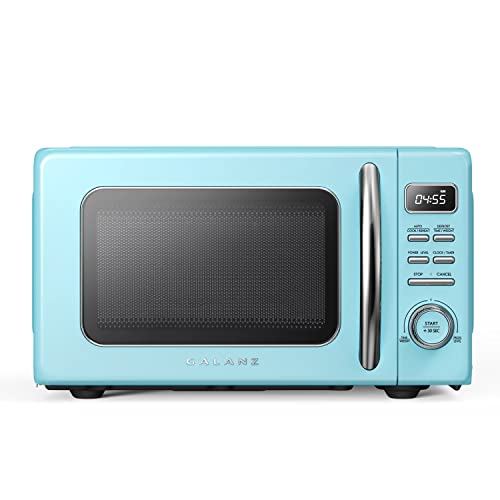
Galanz Retro 0.7 Beige — Best Soft Neutral
The light-finished Galanz brings the line’s retro formula — rounded case, pull handle, auto cook and reheat, defrost, quick start, easy-clean interior, glass turntable — down to the true 0.7 cubic foot size, in a soft neutral shade for kitchens that want the vintage silhouette without a colour shout. This is retro for the Scandinavian-adjacent kitchen, the pale rental, the room where the kettle is cream and the walls are white: the curves say 1950s while the colour stays in the room’s quiet register. It is the easiest of the six to place and the hardest to regret.
A word of listing literacy belongs in this section, because Galanz’s colour naming across its retro range is not perfectly consistent between name and description — this model’s own listing text has presented its shade in more than one way. The remedy is the one this guide keeps repeating: judge by the listing photographs, ideally on more than one screen, and if the exact shade is load-bearing for your kitchen’s scheme, hold the purchase until the photos convince you. The machine underneath the naming question is the same well-sorted Galanz compact whichever pale shade arrives.
Ergonomics repeat the family pattern: the pull handle wants a mat or a steadying hand on smooth counters, quick start handles the daily reheating, and the easy-clean interior keeps the pale machine looking pale. For gift buyers unsure of a recipient’s colours, this is the safest retro in the guide. Check price on Amazon and let the photographs settle the shade.
- Capacity: 0.7 cubic feet
- Power: compact-class wattage per the listing
- Controls: auto cook and reheat, defrost, quick start
- Door: pull handle, glass turntable, easy-clean interior
- Finish: soft light neutral — verify shade in listing photos
Strengths
- Retro curves in the most placeable, giftable colour of the six.
- Full Galanz feature set at the true compact size.
- Easy-clean interior protects the pale finish’s looks.
Trade-offs
- Colour naming is inconsistent — photos must arbitrate.
- Pull-handle caveat applies, as with all the Galanz retro models.
- Light finishes show kitchen splashes sooner than dark ones.
Best for: pale, calm kitchens and gift buyers who need a safe retro. Not suited for: buyers who want a colour statement — take the red or the aqua.

Galanz Retro 0.7 Black — Best Retro in Black
The black Galanz answers a question the other five raise: what if you love the retro silhouette but your kitchen’s palette is monochrome? Its answer keeps every curve, the pull handle, the chrome-era detailing and the full feature set — auto cook and reheat, defrost, quick start, easy-clean interior, glass turntable — and renders them in black, so the machine reads as a design object rather than a period costume. In a black-and-white kitchen, a loft with dark cabinetry or a modern room that wants one vintage gesture, this is the retro that belongs.
Black also has the practical virtues it has on ordinary compacts: it hides the daily evidence of kitchen life, from fingerprints to faint splashes, better than any pale finish, and it pairs with the black appliances most kitchens already own if the retro experiment is later abandoned. The shape still draws the eye — guests notice this machine — but it draws it as sculpture rather than as colour, which ages more gracefully in a room whose accents change.
The ownership notes are the Galanz family’s: mind the pull handle on smooth counters, enjoy the quick start, and expect compact-class cooking pace, because the black case changes the light in the room and nothing about the physics inside. Check price on Amazon for the black listing.
- Capacity: 0.7 cubic feet
- Power: compact-class wattage per the listing
- Controls: auto cook and reheat, defrost, quick start
- Door: pull handle, glass turntable, easy-clean interior
- Finish: black
Strengths
- Retro silhouette that survives a monochrome kitchen’s scrutiny.
- Black hides fingerprints and splashes best in the guide.
- Full Galanz features at the true compact size.
Trade-offs
- Buyers wanting the full colour retro experience should look elsewhere in this guide.
- Pull handle still wants a mat on glossy worktops.
- Dark case shows dust in sunlit kitchens.
Best for: monochrome and modern kitchens that want vintage shape without vintage colour. Not suited for: pastel or diner schemes, which the aqua and red picks serve directly.
How Do the Six Compare on Style, Size and Features?
| Pick | Cavity | Power class | Signature feature | Finish |
|---|---|---|---|---|
| Frigidaire Retro 0.7 Cream | 0.7 cu ft | 700W | 8 auto cook menus, auto defrost | Cream |
| Nostalgia Retro 700W | 0.7 cu ft | 700W | Full retro silhouette, child lock | Ivory |
| Nostalgia Retro Easy Clean | 0.7 cu ft | 700W | 12 settings, easy-clean interior | Aqua |
| Galanz Retro 0.9 Red | 0.9 cu ft | Compact class | Quick start, pull handle | Red |
| Galanz Retro 0.7 Beige | 0.7 cu ft | Compact class | Quick start, easy-clean interior | Soft neutral |
| Galanz Retro 0.7 Black | 0.7 cu ft | Compact class | Quick start, pull handle | Black |
Does Retro Styling Change How the Microwave Cooks?
No — and a guide that implied otherwise would be selling costume as engineering. The cavity, turntable and magnetron inside these machines are the compact class’s standard equipment, and a plate of leftovers reheats in the cream Frigidaire exactly as it does in any 700-watt compact: with time added to the packet’s assumption, a stir or turn in the middle, and a minute or two of standing while the heat settles. The retro buyer’s cooking education is therefore identical to the plain compact buyer’s, and the conversion guidance in our small microwave guide applies here word for word.
What styling does change is everything around the cooking. The door opens by a handle you pull rather than a button you press. The controls are arranged to suit a vintage face, sometimes trading a little of the plain machines’ sprawl for tidiness. The case’s curves meet the cloth differently when you wipe it. None of that touches the food, and all of it touches the day, three times a day, for years — which is the honest way to value it. You are not buying better reheating. You are buying a kitchen you enjoy standing in while the reheating happens, and that is a legitimate thing to buy.
How Do You Choose a Retro Colour That Ages Well?
Start from the room’s fixed elements, not its movable ones. Cabinet colour, worktop material and the range or fridge finish are the decade-long facts; cushions and curtains are seasonal. A retro microwave that harmonises with the fixed layer — cream beside a cream range, aqua against white cabinets and pale wood, black in a monochrome scheme — will look intentional for its whole life. One bought to match a tea towel will look stranded by spring. The red Galanz is the exception that tests the rule: it is strong enough to become a fixed element itself, the accent around which a diner-style room is then arranged, but that is a design commitment, not a purchase to drift into.
Then check the shade in the listing photographs on the screen you trust, remembering that retro colour names wander — the same Galanz light finish has been described in more than one way, and Frigidaire’s naming on its retro model varies too. Photographs under different lighting within a listing are worth more than the colour word in the title. If your scheme is exacting, order only when two or three listing images agree with each other and with your room. A microwave returns awkwardly and lives visibly; the five minutes of photographic diligence is the cheapest insurance in this guide.
A final expectation is worth setting for buyers new to the style: a retro microwave will be commented on. It is the rare appliance that guests name, that new visitors to the kitchen ask about, and that dates a room’s photographs in the best way — as a decision rather than a default. If that attention sounds like a burden, the black Galanz is your quietest route into the silhouette; if it sounds like the point, the aqua and the red are waiting. Either way, you are choosing how the room’s most-used small machine participates in the room, and that participation — not the wattage, which never changes — is the purchase.
One more placement story deserves telling, because it explains the style’s staying power: the holiday let and the short-stay flat, where a retro microwave does the work of a paragraph of listing copy. Guests photograph it, mention it in their messages home, and remember the kitchen as designed rather than equipped — and owners of such flats choose retro for exactly that memorability, accepting the compact specification as the fair price of being remembered. A plain box heats the same soup and vanishes from the guest’s account entirely; the aqua or cream machine becomes part of the story they tell, which in the letting world is worth more than wattage.
How Do Pull Handles and Curved Cases Behave Day to Day?
The pull handle is the retro feature with the most daily consequences, so let us be precise. A compact microwave is a light box; a handle invites a pull; on a polished stone or glossy laminate worktop, the box answers the pull by sliding toward you. Three cures exist, all cheap: a non-slip mat beneath the machine, a steadying hand on the case as you pull — the habit owners develop unconsciously within days — or placement against a wall or splashback that limits travel. None of the Galanz owners we imagine keep struggling after the first week, but the first week does teach the lesson, and a mat bought with the machine skips it entirely.
Curved cases clean differently rather than worse. The rounded top sheds dust less readily than a flat one in the sense that there is no sharp edge to flick a cloth along, but the smooth curves wipe without seams or vents on top to trap crumbs, and the chrome-era trim on retro models rewards a soft cloth rather than an abrasive one. The easy-clean interiors on the Nostalgia aqua and the Galanz models handle the inside story. Treat the exterior like the furniture it aspires to be — a damp microfibre cloth, no scouring pads — and the styling that sold the machine survives its decade.
What Should You Give as a Retro Microwave Gift?
Retro compacts are gifted constantly — new flats, weddings, a parent’s kitchen refresh — and the gift logic differs from the self-purchase logic in two ways. First, size safety: the true 0.7 class fits every counter the recipient might have, while the 0.9 Galanz should be gifted only into a kitchen you have measured or seen. A beautiful machine that does not fit its shelf is a return errand wearing a bow. Second, colour confidence: gift the shade you have seen in their kitchen — the cream that matches their range, the black that matches everything — rather than the shade you find charming in the abstract. Aqua and red are for recipients whose palettes you know embrace them.
The Frigidaire and the light Galanz are the guide’s safest gifts: one carries a household-name brand that reassures recipients, the other a neutral shade that offends no scheme, and both cook the compact repertoire without instruction. Include the mat for the pull-handle models if you gift a Galanz — it is the small, knowing touch that separates a thoughtful present from a product — and keep the receipt route simple, since a colour exchanged is a gift saved. A retro microwave given well becomes the appliance the recipient photographs; given carelessly, it becomes the appliance they apologise for.
How Do You Care for a Retro Finish Over the Years?
The enemies of a retro finish are abrasion and harsh chemistry, and both are avoidable with habits that cost nothing. Clean the case with a soft cloth and mild soapy water; keep scouring pads and gritty cleaners for the sink, where they belong. Wipe spills promptly on the pale finishes — turmeric and tomato are patient stainers of cream and ivory — and dry the chrome-effect trim rather than leaving it wet, so its shine survives. The cavity follows the usual compact routine: a bowl of water steamed until the splashes soften, then a wipe, with the easy-clean models making that wipe shorter.
Sunlight deserves a mention in bright kitchens: strong, direct sun across years can shift any coloured appliance finish subtly, and a retro machine bought for its shade deserves a counter position out of the fiercest window line where the room allows a choice. Beyond that, the care story is the compact class’s own — clear vents, a clean door seal, a turntable washed weekly — performed on a machine you happen to enjoy looking at while you do it. Owners consistently report that the looking is the point: a chore done to a beautiful object is a smaller chore.
Which Retro Microwave Fits a Rented Kitchen You Cannot Change?
Renters face a particular design problem: the kitchen’s fixed layer — landlord cabinets, landlord worktops — cannot be altered, so personality must arrive in objects that leave with you. A retro microwave is nearly the perfect rental appliance for that strategy, because it carries a whole style in one portable box and asks for nothing but a counter corner and an outlet. The cream and ivory picks soften a bland rental kitchen without committing to a palette the next flat may contradict, while the black Galanz survives any landlord’s colour scheme by matching none of them and clashing with none.
The rental lens also sharpens the practical choices. Stay with the 0.7 class, because rental counters and shelf heights are unknown quantities at signing time and the true compact fits the widest range of them. Prefer the model whose care is simplest — an easy-clean interior earns rent over a tenancy of quick meals — and keep the box if storage allows, because a styled appliance moves house better in its packaging and a retro machine is exactly the kind of purchase that follows its owner through three flats. When the tenancy ends, the kitchen returns to bland and your style leaves with you, which is the entire rental design philosophy in one appliance.
How Does a Retro Microwave Anchor a Themed Kitchen?
Every styled room has an anchor — the object the eye finds first and the others defer to — and in a retro kitchen the microwave is unusually qualified for the role. It sits at eye level, it is used in front of guests, and its silhouette is the most recognisably period shape among small appliances. Kitchens built around the aqua Nostalgia or the red Galanz typically repeat the anchor’s colour twice more in the room — a kettle, a set of canisters, a clock — and stop there, because a theme is a chord, not a catalogue. The microwave’s job is to strike the note clearly enough that two repetitions can harmonise with it.
That anchoring role argues for buying the microwave early in a kitchen’s styling, not last. Owners who choose the anchor first find the kettle and toaster decisions make themselves; owners who arrive at the microwave with every other appliance already bought in conflicting shades end up compromising the most visible object in the room. If a retro kitchen is forming in your plans rather than already standing in your home, let this guide’s six be the first decision, and let the room assemble around the one you choose — particularly if your heart is with the red or the aqua, whose rooms are built, not decorated.
What Do Retro Owners Say After the First Year?
The recurring report is that the novelty does not wear off the way novelty usually does, because the machine’s charm is encountered in use rather than in display. A plain microwave becomes invisible within a month; a retro one keeps being noticed — by its owner at breakfast, by guests at dinner — and that small repeated pleasure is the return on the styling premium, paid daily. The second report is more practical: owners adapt to the 700-watt pace so completely that they stop experiencing it as slowness, and instead describe packet times as the fiction and their machine’s times as the reality.
The regrets, where they exist, cluster exactly where this guide’s cautions point. A shade chosen from a colour name rather than photographs that never quite matched the cabinets. A 0.9 bought for a 0.7 shelf. A pull handle on polished granite without a mat, remembered as a week of comedy rather than a flaw. Notice that none of the regrets concern cooking: the machines did their ordinary, honest work throughout. Retro ownership succeeds or fails on placement, colour and expectation — the three things entirely within the buyer’s control before the order is placed.
How Do You Style the Counter Around a Retro Microwave?
Treat the machine as the room’s period spokesman and edit its neighbourhood accordingly. The counter immediately around it should stay clear — a retro silhouette needs air to read as a silhouette, and clutter reduces it to another box among boxes. Neighbouring objects earn their place by era or by neutrality: wooden boards, ceramic canisters, a kettle in a matching or deliberately quiet finish. Modern black plastic accessories crowding a cream retro machine undo in a glance what the purchase did, so the styling work is mostly subtraction.
Lighting finishes the composition. Warm light flatters every retro shade here and is the light kitchens should have anyway; the aqua and cream models in particular were designed in an era of warm bulbs and look their best under them. If the machine sits beneath cabinets, the under-cabinet strip that kitchens install for task light doubles as the retro’s display light. None of this costs more than attention, and it is the difference between owning a retro microwave and having a retro kitchen — the outcome the premium was always buying.
How Do You Cook Real Food in a Retro Compact, Beyond Reheating?
It is worth resisting the assumption that a small retro machine is only a reheating box, because the compact repertoire is wider than its reputation. Mug meals — eggs, oats, a single portion of macaroni cheese — cook genuinely well at 700 watts, where the gentle pace is an advantage rather than a limit, and the preset and power-level ranges on these machines exist partly for them. Vegetables steam beautifully in a covered bowl with a spoonful of water, retaining colour that boiling leaches. A baked potato takes longer than in a big machine and arrives exactly as good, given its resting time wrapped in a cloth.
The honest boundaries are volume and browning, not capability. Nothing in a microwave browns, at any price or in any era’s styling, and a 0.7 cavity will not cook for four. Within the one-to-two-person repertoire, though, a retro compact is a real cooker that happens to reheat superbly, and owners in small kitchens — where it may be the only cooking appliance besides a kettle and a hob ring — use it as one daily. The styling neither helps nor hinders that work; it simply makes the cook’s corner of the kitchen the pleasantest to stand in.
When Is Retro the Wrong Choice Altogether?
Three buyers should walk past this guide’s charms to the plain compact guide instead. The first never sees the machine: a microwave inside a closed utility cupboard or a rental’s appliance garage gains nothing from a silhouette nobody views, and the plain equivalent’s price or features will serve better. The second cooks at family scale, where the honest purchase is a family machine and retro styling at that size is a different guide’s subject. The third is furnishing a workplace, where a style statement by one employee becomes a target for everyone else’s opinions and the anonymous black box is a diplomatic asset.
There is also the buyer whose kitchen style is still undecided. Retro is a commitment device — it declares a direction — and a room whose direction is genuinely open may be better served by a neutral machine until the design settles, at which point the retro purchase can be made with the confidence this guide keeps recommending. Style bought prematurely is just clutter with curves. But for the kitchen that knows what it is — the farmhouse, the diner corner, the pastel scheme, the monochrome loft — delaying the retro purchase only prolongs the daily discord of the wrong-shaped box, and the six above are ready when the room is.
How Do You Verify a Retro Listing Before You Order?
Retro listings reward a particular kind of reading, because their persuasive energy goes into the photographs and the facts sit quietly underneath. Extract them in a fixed order. First, the cavity size and wattage, which tell you the machine’s true class — in this guide, 0.7 cubic feet at 700 watts for five picks, 0.9 for the red Galanz. Second, the external dimensions, checked against your shelf or counter with the door’s swing and the handle’s clearance included. Third, the feature list in words: menus, defrost, child lock, turntable — the items our sections verified pick by pick, which you should confirm have not changed since.
Fourth, and unique to this category, interrogate the colour. Open every listing photograph, including the lifestyle shots, and compare the shade across them; where a maker’s naming is loose — as we noted for the light Galanz and the Frigidaire — the photographs are the contract. Fifth, check what the purchase includes and what the machine needs: a mat is your own small addition for pull-handle models, and nothing else in this guide requires accessories. A listing read this way takes four minutes and converts a style purchase into an informed one, which is the only kind this guide endorses at any level of charm.
There is a small ritual that separates owners whose retro machines age gracefully from those whose do not: the weekly once-over. While the kettle boils, run a cloth over the case, glance at the trim, check the door seal for the crumb that will otherwise live there for a month, and confirm the mat under a pull-handle model has not crept. Ninety seconds, weekly, is the entire maintenance budget of the styling — a trivial sum that owners of beautiful objects tend to pay gladly, because the once-over is itself a moment of appreciating the thing they bought. Appliances that are looked at get looked after, and retro machines benefit from their own charm in this literal way.
What Mistakes Do Retro Microwave Buyers Make Most Often?
The first is expecting the styling to change the cooking — paying a retro premium and then feeling cheated that a 700-watt machine cooks at 700 watts. The specification was never hidden; read it before the colour seduces you, or let the colour seduce you with the specification already accepted. The second mistake is trusting a colour name over the listing photographs, in a category where naming is demonstrably loose, and receiving a shade that argues with the kitchen it was bought to complete.
Third, buyers forget the pull handle’s physics and spend a week sliding a Galanz across a polished counter before discovering the mat. Fourth, the 0.9 red’s admirers occasionally buy it for a shelf built for the 0.7 class; step-ups demand measuring, always. Fifth, gift buyers choose the boldest colour for the least-known kitchen, when the neutral picks exist precisely for uncertainty. And finally, some owners clean a retro case like a workhorse appliance — abrasives, scouring, neglect of the trim — and sand the charm off the purchase within a year. Buy the style with open eyes and keep it with a soft cloth, and a retro compact will charm its kitchen for a decade.
Final Recommendation
For most retro kitchens, the Nostalgia Retro Easy Clean is the sweet spot: the definitive aqua, the widest preset range in the class and an interior that forgives real cooking. Purists of the silhouette should take its ivory sibling, and mainstream-brand comfort points to the Frigidaire Retro 0.7 Cream. Households whose reheating life needs the bigger cavity should choose the step-up Galanz Retro 0.9 Red and give the room a colour to organise around. Whichever you pick, put a mat under it if it has a pull handle, check the shade in the photographs one last time — and enjoy owning the only appliance in the kitchen that makes people smile before it beeps.
Frequently Asked Questions
Do retro microwaves cook as well as normal small microwaves?
Yes — identically, because mechanically they are normal small microwaves. Five of the six here are 0.7 cubic feet at 700 watts, so the compact rules apply: add roughly a third to packet times, stir halfway, and let food stand. The styling changes the kitchen, not the cooking. Owners who accept that bargain on day one report no disappointment with it in year five, which is more than can be said for most style-led purchases in any category of household goods, large or small, cheap or dear, anywhere in the home at all.
Which retro colour is the safest choice?
The soft neutrals — the Frigidaire’s cream, the Nostalgia’s ivory and the light Galanz — suit the widest range of kitchens and make the safest gifts. Black is the safe choice in modern and monochrome rooms. Aqua and red are deliberate statements: wonderful in rooms designed for them, dominant in rooms that are not.
Is the Galanz 0.9 too big for a small kitchen?
It is a step up from the true compact class, so measure. Its cavity takes larger plates and bowls, which many two-person households need, but its footprint will not fit shelves and corners that a 0.7 model takes easily. The listing’s dimensions against your counter decide, not the word “retro” in its name.
Why do the colour names not always match the photos?
Retro shades sit between standard colour words, and makers name them loosely — a pale finish may be described in more than one way across a listing. Treat the photographs as the specification: view several, on a screen you trust, and judge the shade against your kitchen’s fixed colours before ordering.
Does a pull handle cause problems?
Only one, and it is trivially solved: a light machine can slide when its handle is pulled on a smooth worktop. A non-slip mat underneath, or a steadying hand on the case as you open it, ends the issue permanently. Most owners adapt within days and forget it was ever a consideration.
Are retro microwaves a good gift?
Among the best of kitchen gifts, with two disciplines: stay with the 0.7 class unless you have measured the recipient’s counter, and choose a shade you have actually seen in their kitchen. The Frigidaire and the light Galanz are the safest gifts in this guide; the aqua and red are for palettes you know well.
Related Guides
A styled kitchen deserves its laundry and utility choices to be equally deliberate, so continue with Best Stackable Front Load Washer and Dryer Sets With Steam for the laundry wall, add convivial cooking with Best Electric Hot Pots With Grill Plate, and handle the unglamorous essential with Best Inexpensive Garbage Disposals.



[…] kitchens reward coordinated choices, so pair this guide with Best Small Retro Microwaves if style is steering your shortlist, soften the room with Best Bedroom Runner Rugs, and complete […]