What's inside
- Key Takeaways
- Quick Picks
- How We Chose These Picks
- The Best 48 Inch Professional Gas Ranges Worth Your Money, Reviewed One by One
- How Do the Six Compare Side by Side?
- Why Does 48 Inches Exist?
- What Does the Double Oven Change in Practice?
- How Should You Read the Big BTU Totals?
- What Ventilation Does This Width Demand?
- How Do You Install Four Feet of Range?
- All-Gas or Dual Fuel at This Width?
- How Should You Maintain a Range of This Scale?
- Which Properties Suit a 48-Inch Range?
- How Do Two Cooks Share a 48-Inch Range?
- What Should the Paperwork File Contain?
- How Does a Statement Range Affect the Rest of the Budget?
- What Is the First Feast Rule for New Owners?
- How Do You Choose Among Six Flagships Without a Showroom?
- What Does a Holiday House Ask of This Width?
- How Should You Brief the Design Team Around the Range?
- What Is Ownership Like in Year Ten?
- How Do Griddles and Specialty Stations Earn Their Territory?
- What Should Happen in the Week Before Delivery?
- How Does the Range Change the Way a Household Entertains?
- What Are the Costliest Mistakes at 48 Inches?
- Final Recommendation
- Frequently Asked Questions
- Related Guides
As an Amazon Associate I earn from qualifying purchases. This post may contain affiliate links at no extra cost to you.
cottageverdict.com is reader-supported. When you buy through links on our site, we may earn an affiliate commission.
A 48-inch professional range is a kitchen’s founding decision: cabinets, ventilation, gas supply and the room’s whole social geometry organise themselves around it. The best 48 inch professional gas ranges reviewed here — five all-gas machines and one propane dual fuel interloper, clearly labelled — share the format’s promises: eight or so burners, double ovens, and cooking capacity at gathering scale. This guide argues about what separates them, and about the one fuel distinction in the set that could ruin a purchase if missed.
Where to buy: each range is sold through Amazon, and the names in the Quick Picks table and the detailed reviews link to the listings so you can check price on Amazon and — at this size, above all — confirm the exact fuel version before ordering. Read the KUCHT review twice if it tempts you: it is a dual fuel range running on propane, a virtue for the right property and a mistake for the wrong one.
Expect no false modesty from any of them: this is the flagship class, priced and sized accordingly, and the reviews judge the six as flagship purchases — on the honesty of their specifications, the intelligence of their layouts, and the systems of supply and ventilation each one demands from the house around it.
Key Takeaways
- The format’s real gift is the double oven: two cavities, two temperatures, feast cooking without a queue.
- Five of these six are all-gas ranges; the KUCHT B0DX8H4131 is DUAL FUEL on PROPANE (LP) with an electric oven — not natural gas.
- Combined BTU (the Forno’s 107,000) sizes your gas line and hood; it is not any single burner’s power.
- Oven totals run 6.58 to 6.7 cu. ft.; the KOSTCH states its split honestly at 4.6 plus 2.2 cu. ft.
- Ventilation at this width is architecture, not an accessory — budget a hood of matching ambition.
- Eight burners (ZLINE, THOR, Forno, Cosmo) versus six plus a griddle (KOSTCH) is a layout choice, not a ranking.
Quick Picks
| Pick | Badge | Why it earns its place |
|---|---|---|
| ZLINE Autograph 48 Inch Paramount Double Oven Gas Range | Best Overall Statement Range | A 6.7 cu. ft. double oven beneath eight burners, in Autograph Edition finish — the Paramount formula at full width. |
| Gordon Ramsay by THOR Kitchen 48 Inch Gas Range | Best Chef-Endorsed Workhorse | THOR’s professional double oven range in stainless steel and black, carrying a working chef’s name and standards. |
| KUCHT Professional 48 Inch Dual Fuel Range Propane | Best Dual Fuel on Propane — Read Carefully | A 6.7 cu. ft. DUAL FUEL range running on Propane (LP): gas burners and griddle above, electric oven below — not a natural-gas range. |
| Forno Galiano 48 Inch Gas Range | Best Total Output in Black | The Galiano in black: eight burners totalling 107,000 BTU, a griddle, and 6.58 cu. ft. of double ovens — a true all-gas range. |
| Cosmo Vista 48 Inch Double Oven Gas Range | Best Double Oven Value at Width | The Vista collection’s 6.6 cu. ft. double oven under eight burners, model COS-GRP486G, with an LED light panel. |
| KOSTCH 48 Inch Pro-Style Gas Range | Best Flexible Pro-Style at Width | Six burners plus a griddle cooktop, with double ovens of 4.6 and 2.2 cu. ft., in a natural gas pro-style body. |
How We Chose These Picks
We required genuine professional format: 48 inches, double ovens, a cooktop arranged for serious simultaneous cooking, and a maker with a real presence in the pro-style category. Within that frame we deliberately included the KUCHT dual fuel propane model — with its fuel and oven stated in the plainest terms we could write — because propane properties shop this category and deserve the electric oven’s precision at full width, honestly labelled.
Combined figures were handled with suspicion throughout. Where a maker quotes a total burner output, the review says what the number means; where oven capacity is split between cavities, both figures appear. At this size a range is a decade-long architectural commitment, and a guide’s first duty is to make sure the appliance in the reader’s head is the appliance on the listing.
We also weighed the support question at flagship scale, because a 48-inch range cannot be posted back. Every maker here has a real service presence, but the file-keeping advice in the sections below matters more than any badge: at this size, the owner’s own documentation is half the warranty, and the households that keep it are the ones whose repairs take days rather than sagas.
The Best 48 Inch Professional Gas Ranges Worth Your Money, Reviewed One by One
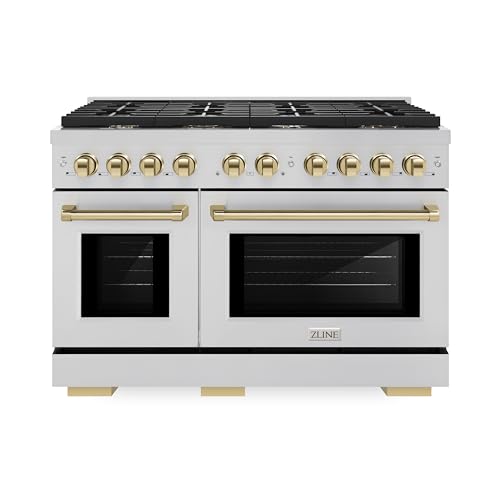
ZLINE Autograph 48 Inch Paramount Double Oven Gas Range — Best Overall Statement Range
At 48 inches, a range is no longer chosen; it is commissioned. ZLINE’s Autograph Paramount is the statement executed with the most polish in this guide: eight burners across the top, a double oven totalling 6.7 cu. ft. beneath, and the Autograph Edition’s design detailing over it all. The double oven is the functional heart of the format — a main cavity for the roast and a companion oven for the sides, the bread, or the dessert holding at its own temperature, each minding its own business.
Eight burners sounds like theatre until the first gathering, when it becomes logistics: two large pans searing, a stockpot rolling, sauces at their simmers, and positions still in reserve. The Paramount suits the kitchen built as a room for cooking in company — the island facing it, the guests orbiting it — and it carries that role with a finish that photographs like a magazine and cooks like a workstation.
The Paramount’s party trick, discovered at the first real gathering, is calm: with eight burners and two ovens, nothing queues, nothing waits, and the cook stops performing triage and starts hosting. That calm is the luxury the width actually sells. ZLINE’s Autograph finish holds the room’s eye while the logistics hold the evening together, and the combination explains why kitchens built around this range tend to be used the way their owners dreamed in the drawings. Its double oven also proofs dough in one cavity while the other roasts — the two-temperature trick no single oven can imitate.
- Width: 48 inches, gas range
- Cooktop: 8 burners across the full width
- Ovens: double oven, 6.7 cu. ft. combined
- Edition: Autograph, design-led finish
- Role: centrepiece of a cooking-centred kitchen
Strengths
- Double oven runs two temperatures at once
- Eight burners give genuine simultaneity
- Statement finish anchors a luxury kitchen
Trade-offs
- Demands a kitchen designed around it
- Ventilation must be equally monumental
- Largest commitment of space in this guide
Best for: Statement kitchens where cooking is the entertainment.
Not suited for: Any kitchen not being renovated around the range.
Given the scale of the commitment, open the ZLINE Autograph 48 Inch Paramount Double Oven Gas Range listing and check price on Amazon while confirming its exact fuel version in writing.

Gordon Ramsay by THOR Kitchen 48 Inch Gas Range — Best Chef-Endorsed Workhorse
A chef’s name on a range invites scepticism, and the correct response is to ignore the name and read the machine: THOR Kitchen’s professional platform at 48 inches, a double oven format, stainless steel with black accents, and the heavy, commercial grammar THOR has built its reputation on. The endorsement then reads as what it is — a chef associating his standards with equipment built for service — and the range underneath stands or falls on its burners and ovens, which are THOR’s proven professional stock.
The black-and-stainless presentation distinguishes it in a field of bright metal, giving the widest format a slightly moodier, more deliberate presence. For the household that cooks at restaurant intensity and entertains in the kitchen, the combination of THOR’s workhorse engineering and the double oven’s choreography is the argument. The name may open the conversation; the machine is what finishes it, nightly, for years.
THOR’s platform earns its endorsement in the unphotogenic hours: the third hour of a long cook, when grates are hot, pans are heavy and the second oven is carrying the meal’s second act. Equipment built for service does not dramatise those hours; it simply continues. Households that cook at that intensity will recognise the quality within a month and understand exactly what the chef’s name was certifying — stamina, more than shine. The black detailing photographs moody and wipes down kinder than bright steel under feast conditions.
- Width: 48 inches, professional gas range
- Ovens: double oven format
- Finish: stainless steel with black accents
- Line: Gordon Ramsay by THOR Kitchen
- Character: commercial-grade home workhorse
Strengths
- THOR’s proven professional platform
- Double oven for two-temperature cooking
- Black accents set it apart from bright rivals
Trade-offs
- Celebrity line will not suit every taste
- Professional appetite demands serious extraction
- Double oven format needs learning as a system
Best for: Restaurant-intensity home cooks who entertain in the kitchen.
Not suited for: Buyers who prefer their appliances anonymous.
Given the scale of the commitment, open the Gordon Ramsay by THOR Kitchen 48 Inch Gas Range listing and check price on Amazon while confirming its exact fuel version in writing.

KUCHT Professional 48 Inch Dual Fuel Range Propane — Best Dual Fuel on Propane — Read Carefully
Accuracy first, because this pick breaks the pattern of its own article: the KUCHT B0DX8H4131 is a dual fuel range that runs on propane — liquid petroleum gas — not a natural-gas range and not an all-gas one. Its burners and griddle burn LP, while its 6.7 cu. ft. oven is electric, giving the dual fuel division of labour: flame’s instant response on top, electricity’s steady precision below. For a propane household — a country property, an off-main estate kitchen — that combination at 48 inches is rare and valuable, provided it is bought with open eyes.
Why include it in a gas ranges guide at all? Because propane is a gas, its buyers shop this category, and hiding the distinction would serve nobody. What the KUCHT offers that the all-gas models cannot is the electric oven’s discipline at full width, plus a griddle/grill station in the top’s centre. What it demands is honesty about fuel: an LP supply, correctly fitted, and no assumption that a natural-gas line will serve it. Bought as what it is, it may be the most interesting range in this guide.
The KUCHT rewards the buyer who read carefully. Its electric oven bakes with a steadiness the all-gas ovens here admire from a distance, its propane top answers like any honest flame, and the griddle station becomes the household’s breakfast altar. Owners on rural properties describe the combination as the first range that did not ask them to choose between their fuel supply and their baking standards. That is a precise and hard-won compliment. Its sealed burners deserve emphasis at this size: eight burners of ambition, contained in wells a cloth can govern.
- Width: 48 inches, DUAL FUEL range
- Fuel: Propane (LP) for burners — not natural gas
- Oven: 6.7 cu. ft. ELECTRIC oven (dual fuel)
- Top: sealed burners with griddle/grill
- Note: confirm LP supply before ordering
Strengths
- Electric oven precision at full 48-inch width
- Propane fuel serves off-main properties
- Griddle/grill station built into the top
Trade-offs
- Not a natural-gas range — fuel mismatch is a real risk
- Needs both an LP supply and an electric feed
- Dual fuel complexity at professional scale
Best for: Propane properties wanting electric-oven precision at full width.
Not suited for: Natural-gas households — choose an all-gas pick instead.
Given the scale of the commitment, open the KUCHT Professional 48 Inch Dual Fuel Range Propane listing and check price on Amazon while confirming its exact fuel version in writing.

Forno Galiano 48 Inch Gas Range — Best Total Output in Black
The Forno Galiano is this guide’s maximalist all-gas answer: eight burners with a combined 107,000 BTU, a griddle in the layout, double ovens totalling 6.58 cu. ft., and a black finish that gives the widest format a tailored, almost formal presence. The combined BTU figure sizes your gas supply and your hood — it is the whole top drinking at once — while the double ovens do the daily choreography of mains and sides at separate temperatures.
Black at 48 inches is a design decision with consequences the review should honour: it shows splashes faithfully and therefore tends to be wiped faithfully, and it anchors dark or dramatic kitchens in a way bright stainless cannot. Forno’s proposition is abundance in a single specification — burners, griddle, ovens, output — for the household whose cooking genuinely peaks at gatherings and whose kitchen was drawn around exactly this object.
The Galiano’s black finish makes a wide range feel tailored rather than industrial, and its owners tend to plan kitchens in deeper colours around it — aubergine cabinets, dark stone, brass. The cooking underneath the tailoring is unapologetically maximal: burners for every ambition, a griddle for the weekend, ovens for the feast. It is the extrovert of this guide, and like most extroverts it is happiest in a room full of people. Its griddle, used for a crowd’s breakfast, converts sceptical guests to the format faster than any specification.
- Width: 48 inches, gas range (all-gas)
- Burners: eight, 107,000 BTU combined
- Top: griddle included in the layout
- Ovens: double ovens, 6.58 cu. ft. combined
- Finish: black
Strengths
- Highest combined output in this guide
- Griddle built into the eight-burner top
- Double ovens for feast choreography
Trade-offs
- 107,000 BTU demands monumental ventilation
- Black finish publishes every splash
- Combined figure is a supply number, not one burner
Best for: Feast-scale cooks in dramatic, dark-toned kitchens.
Not suited for: Modest kitchens or modest ventilation budgets.
Given the scale of the commitment, open the Forno Galiano 48 Inch Gas Range listing and check price on Amazon while confirming its exact fuel version in writing.

Cosmo Vista 48 Inch Double Oven Gas Range — Best Double Oven Value at Width
Cosmo’s Vista brings the double-oven 48-inch format to its most accessible expression in this guide without surrendering the essentials: eight burners, 6.6 cu. ft. of combined oven across two cavities, and the COS-GRP486G’s LED light panel keeping the cooking visible. Cosmo’s habit — professional silhouette, domestic conscience — scales up gracefully: the range looks like a restaurant’s and behaves like a family’s, which is the correct priority at any width.
The double oven is the feature that justifies the format for real households: the main cavity roasts while the companion proofs, bakes or holds, and holiday cooking stops being a single-file queue. For the buyer whose renovation budget has already been spent twice — on cabinets, on stone — the Vista’s accessibility is not a compromise but the reason the 48-inch dream survives contact with the spreadsheet.
The Vista’s LED panel sounds like a garnish until the first feast, when a glance across the kitchen confirms both ovens’ states without a crouch or a door opening. Small mercies compound at this scale. Cosmo’s value positioning shows in the finish under close inspection, and its owners, having spent the difference on the hood and the stone, generally consider the trade the smartest line in the renovation budget. First-time double-oven owners should label the cavities’ roles for the first season — main and companion — until the choreography is habit.
- Width: 48 inches, gas range
- Model: COS-GRP486G, Vista collection
- Burners: eight across the cooktop
- Ovens: double oven, 6.6 cu. ft. combined
- Detail: LED light panel for visibility
Strengths
- Double oven format at an accessible level
- Eight burners with real spacing
- LED panel keeps both ovens easy to monitor
Trade-offs
- Accessible tier shows in finish beside Autograph rivals
- Eight burners still demand a major hood
- Cosmo’s service network is the smallest here
Best for: Renovators protecting the 48-inch plan on a real budget.
Not suited for: Buyers for whom finish is the entire point of the width.
Given the scale of the commitment, open the Cosmo Vista 48 Inch Double Oven Gas Range listing and check price on Amazon while confirming its exact fuel version in writing.
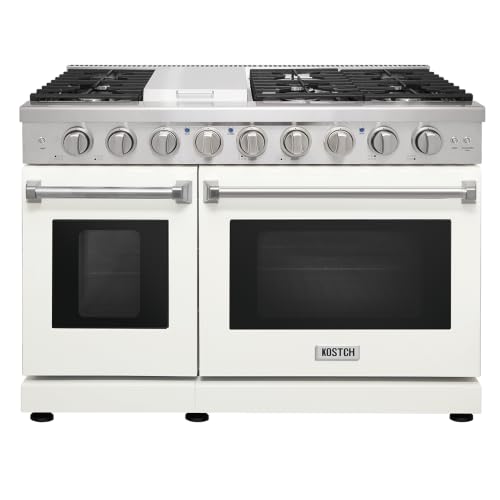
KOSTCH 48 Inch Pro-Style Gas Range — Best Flexible Pro-Style at Width
KOSTCH’s 48-inch entry arranges the width differently: six burners plus a dedicated griddle cooktop, over double ovens honestly specified at 4.6 and 2.2 cu. ft. That oven split is the format’s classic choreography — a main cavity for the roast, a smaller companion for the gratin, the bread or the dessert — and stating both figures plainly, rather than a combined total alone, is the kind of specification honesty this guide rewards. The fuel is natural gas, in a pro-style freestanding body.
The griddle earns its territory on this top: at 48 inches there is finally room for a permanent flat station without evicting the burners, and breakfast-for-a-crowd households will use it weekly. KOSTCH’s positioning is the accessible end of professional style, as in our 36-inch guide’s sibling — judge the finish by its tier, and the layout by its intelligence, and the range makes a confident case for the renovator who wants the width, the griddle and the double oven without the flagship invoice.
The KOSTCH’s griddle becomes, in household after household, the most-used square footage on the top — pancakes, eggs, burgers, grilled sandwiches for a crowd — while its honestly split ovens handle the roast-and-side choreography without a combined-figure bluff. It is the pragmatist’s 48: the width, the layout and the double oven, bought with the money left over for the rest of the kitchen still intact. Natural gas, plainly stated, keeps its installation conversation the simplest in this guide.
- Width: 48 inches, pro-style gas range
- Fuel: natural gas
- Top: six burners plus a griddle cooktop
- Ovens: double — 4.6 cu. ft. and 2.2 cu. ft.
- Format: freestanding professional style
Strengths
- Griddle has permanent room at this width
- Oven split stated honestly, cavity by cavity
- Natural gas pro style at an accessible level
Trade-offs
- Six burners, not eight, across the width
- Companion oven is small by design
- Finish a step below the flagship picks
Best for: Griddle households wanting double ovens at this width.
Not suited for: Eight-burner maximalists counting positions.
Given the scale of the commitment, open the KOSTCH 48 Inch Pro-Style Gas Range listing and check price on Amazon while confirming its exact fuel version in writing.
How Do the Six Compare Side by Side?
The essentials in one view: five all-gas double-oven ranges divided by design, endorsement, output, value and layout — and the KUCHT, this guide’s propane dual fuel exception, flagged in its row and its review so no reader can mistake what it burns.
| Pick | Badge | Standout trait |
|---|---|---|
| ZLINE Autograph 48 Inch Paramount Double Oven Gas Range | Best Overall Statement Range | A 6.7 cu. ft. double oven beneath eight burners, in Autograph Edition finish — the Paramount formula at full width. |
| Gordon Ramsay by THOR Kitchen 48 Inch Gas Range | Best Chef-Endorsed Workhorse | THOR’s professional double oven range in stainless steel and black, carrying a working chef’s name and standards. |
| KUCHT Professional 48 Inch Dual Fuel Range Propane | Best Dual Fuel on Propane — Read Carefully | A 6.7 cu. ft. DUAL FUEL range running on Propane (LP): gas burners and griddle above, electric oven below — not a natural-gas range. |
| Forno Galiano 48 Inch Gas Range | Best Total Output in Black | The Galiano in black: eight burners totalling 107,000 BTU, a griddle, and 6.58 cu. ft. of double ovens — a true all-gas range. |
| Cosmo Vista 48 Inch Double Oven Gas Range | Best Double Oven Value at Width | The Vista collection’s 6.6 cu. ft. double oven under eight burners, model COS-GRP486G, with an LED light panel. |
| KOSTCH 48 Inch Pro-Style Gas Range | Best Flexible Pro-Style at Width | Six burners plus a griddle cooktop, with double ovens of 4.6 and 2.2 cu. ft., in a natural gas pro-style body. |
Why Does 48 Inches Exist?
The 48-inch range descends from the professional kitchen’s range line, where width is throughput: more burners, more ovens, more dishes moving at once under one hood. At home it serves the household whose cooking is genuinely parallel — the feast kitchen, the multi-generational house, the serious entertainer, the property where twenty people at a table is a calendar event rather than a crisis. Its second oven is not a luxury; it is the difference between a menu and a queue.
It also exists, honestly, as architecture. A 48-inch range is a room’s hearth and altar, the object guests photograph and cooks organise their working lives around. That presence is a legitimate part of the purchase — provided the cooking justifies it often enough that the range is an instrument first and a monument second. This guide’s loyalty is to the instrument; the monument comes free with all six.
What Does the Double Oven Change in Practice?
Two cavities at two temperatures rewrites feast logistics. The joint roasts low and slow in the main oven while the companion crisps the potatoes at a fiercer heat; the bread proofs gently below while the top oven preheats for the mains; dessert holds at serving warmth through a long dinner without drying. Single-oven households achieve these evenings with sequencing and holding tricks — possible, admirable, and tiring. The double oven simply removes the queue.
The split sizes matter and are stated per model in this guide: the KOSTCH’s 4.6 plus 2.2 is the classic main-and-companion arrangement, while the near-equal totals elsewhere (6.58 to 6.7 cu. ft. combined) divide differently by maker. Match the split to your menus: the companion oven that fits your favourite gratin dish and a loaf side by side is worth more than a nominally larger one shaped wrong for your pans. Measure the dishes, not just the brochure.
How Should You Read the Big BTU Totals?
A figure like the Forno Galiano’s 107,000 BTU is the whole cooktop’s combined draw — every burner at full flame at once. Its proper uses are two: sizing the gas supply, which must feed that draw without starving the last burner lit, and sizing the hood, which must clear the heat and effluent of that worst case. It is not a promise that any single pan receives anything like that power, and menus planned on that misunderstanding end in disappointment and, occasionally, in scorched optimism.
What cooks dinner is the individual burner map: the hero burner’s searing ceiling, the middle burners’ daily honesty, the smallest burner’s simmering patience. At 48 inches every top here is powerful in aggregate; they differ in distribution and in the griddle question. Read the reviews for those distributions, and let the combined totals do their proper work in the conversations with your gas fitter and your hood supplier.
What Ventilation Does This Width Demand?
A 48-inch professional top at full song produces a plume that decorative extraction cannot govern. The hood must span the range, capture at its full width, and duct outside wherever the building permits, with makeup air considered in sealed modern construction — a powerful hood in an airtight house will hunt for air through every flue it can find. This is building-services territory, designed with the kitchen, not appended to it.
Budget accordingly and early. In many 48-inch projects the ventilation rivals the range’s own complexity, and discovering that after the cabinets are drawn is how projects stall. Run the hood whenever burners run, at the speed the cooking asks for, and the kitchen stays a room people gather in rather than a room the cooking smokes them out of. The range is the headline; the hood is what lets the headline be read comfortably.
How Do You Install Four Feet of Range?
Installation at this width is a small construction project with an appliance at the end of it. The slot must be a true 48 inches with the manual’s clearances to combustibles; the gas supply must be sized for the top’s combined draw and fitted by a licensed engineer; the floor must be level across a span where a small slope becomes a visible tilt; and the delivery route — doors, turns, stairs — must be measured for an object the size of a small car.
The dual fuel KUCHT adds an electric feed to the same slot, and propane models add their own supply conversation. Book every trade before the delivery date, photograph the empty slot’s services, and keep the old kitchen functioning until the new range is commissioned and cooking. Projects of this scale reward a written sequence and punish improvisation with a consistency that experienced renovators will recognise in their bones.
All-Gas or Dual Fuel at This Width?
Five of these six ranges heat their ovens with gas, in the professional tradition: fierce, moist heat that roasts magnificently and asks the cook to manage its geography. The KUCHT breaks ranks with an electric oven under propane burners — and the electric cavity’s even, dry precision is a genuine advantage for baking at scale, from wedding-cake rehearsals to a bakery-minded household’s weekend production. Neither tradition is wrong; they are optimised for different flagship dishes.
Decide by your oven’s greatest hits. Roasting households lose nothing to gas ovens and gain their traditional virtues. Baking households — bread in quantity, pastry, delicate work at two temperatures — should read the KUCHT’s specification with real interest, provided its propane fuel matches the property. And every household should decide with the fuel question settled first, because at 48 inches the wrong fuel is not a detail; it is the whole purchase, wrong.
How Should You Maintain a Range of This Scale?
Professional equipment assumes professional habits: grates and caps soaked and brushed, sealed wells wiped before spills carbonise, griddles seasoned and scraped as the flat-tops they are, oven cavities wiped while their soil is recent. The scale multiplies the minutes but not the difficulty, and a weekly rhythm keeps a 48-inch range looking like the brochure for years. Seasonal tasks — gasket checks, hood filter cleaning, igniter inspection before the feast season — belong on the household calendar, not in a panic.
Keep the paperwork architecture as carefully as the appliance: manuals, model plates, gas certificates, the fitter’s and electrician’s names. A range this size will outlast several of the tradespeople who installed it, and the next engineer to kneel before it deserves the file. Maintenance, at this width, is simply the rent paid on a magnificent tool — and the households that pay it cheerfully get the magnificent decades.
Which Properties Suit a 48-Inch Range?
The honest candidates: a kitchen being built or rebuilt around cooking, a household whose table regularly seats a crowd, a property with the gas supply — or, for the KUCHT, the propane and electric feeds — that the format demands, and cooks whose repertoire is parallel by nature. Holiday houses with feast-scale peaks qualify on the peak-load argument, provided the house is used enough to justify the standing commitment of space and servicing.
The honest exclusions matter as much: kitchens that would lose their only worktop to the width, households whose largest regular meal is for four, and any project whose ventilation cannot be made to match. For those, the 36-inch guide is the correct detour, and no shame attaches — a range sized to its household is the definition of a professional decision, whatever the width on the badge.
How Do Two Cooks Share a 48-Inch Range?
The width’s social dividend is a second cook. At 48 inches two people can work the top in genuine parallel — one on the sear, one on the sauces — with oven duties divided by cavity and a landing zone each. Households where cooking is a shared craft, a teaching relationship or a weekend ritual will use this dividend more than any single feature in the guide; it converts the kitchen’s main event from a solo performance into a duet.
Design for the duet if it describes your house: landing space on both sides of the range, knives and boards within each cook’s reach, and a hood quiet enough at working speed for conversation. The ranges here all support the arrangement mechanically; the kitchen around them decides whether it is a pleasure. A 48-inch range bought for two cooks is never overkill, whatever the calendar says.
What Should the Paperwork File Contain?
A range of this scale generates a dossier: the order confirmation naming the exact model and fuel version, the gas fitter’s certificate, the electrician’s sign-off where a dual fuel model is involved, the hood’s specification, warranty registrations and the manuals for every component. Keep it as a single file with the house documents. Insurers, future buyers, and the engineer kneeling before the range in year nine will all ask for pieces of it.
The fuel documentation deserves its own emphasis in this guide, because of the KUCHT: a propane dual fuel range in a house file that simply says ‘gas range’ invites a future owner’s expensive misunderstanding. Label fuels precisely, keep conversion records if any conversion was ever performed by a fitter, and let the paperwork be as honest as this guide has tried to be.
How Does a Statement Range Affect the Rest of the Budget?
A 48-inch range consumes budget in orbit as well as at the till: the hood of matching ambition, the gas work, the cabinetry built to its measure, sometimes the floor’s reinforcement and the doorway’s dignity. Wise projects cost the orbit before admiring the centre. The Cosmo Vista and the KOSTCH exist precisely for projects where the orbit has already eaten well — they protect the format’s essentials while leaving money for the system around them.
The false economy at this scale is never the range; it is the under-bought surroundings. A flagship range under a weak hood, on an undersized gas line, in a slot measured hopefully, is a monument to inverted priorities. Spend on the system in the right order — supply, extraction, slot, then range — and even the accessible picks in this guide will perform like flagships for a decade.
What Is the First Feast Rule for New Owners?
Rehearse before you premiere. The first month with a 48-inch range should include one full-dress practice cook — a roast with all its retinue, both ovens working, the top at something like feast load — for an audience of family rather than guests. You will learn the ovens’ personalities, the burners’ map, the hood’s voice and the kitchen’s traffic flow, at stakes low enough to laugh about.
Write down what the rehearsal teaches: which oven takes the bird, which burner owns the gravy, where the second cook stands. Pin the notes inside a cupboard door. Every great kitchen runs on such marginalia, and a range of this scale deserves its notes taken seriously — it will be cooking the family’s defining meals for fifteen years, and it should start, as all performers should, with a rehearsal rather than an opening night.
How Do You Choose Among Six Flagships Without a Showroom?
Reduce the decision to the order this guide has used throughout. Fuel first: natural gas for five of these six, propane-plus-electric for the KUCHT, and no purchase proceeds until the property’s supply and the range’s appetite are confirmed to match. Layout second: eight burners for the parallel maximalist, six plus a permanent griddle for the breakfast-centred household. Ovens third: combined totals for the headline, cavity splits for the truth, measured against your own largest dishes.
Only then let the soft factors speak — ZLINE’s polish, THOR’s endorsement, Forno’s black drama, Cosmo’s value, KOSTCH’s pragmatism — because at flagship scale the soft factors are the daily texture of a fifteen-year object. A decision made in that order survives ownership; a decision made by photograph alone survives until the first feast, which is precisely when it is too late to remake.
What Does a Holiday House Ask of This Width?
A holiday property concentrates a year’s cooking into a few intense weeks, and the 48-inch format suits that rhythm provided the house is used enough to keep the appliance exercised and serviced. Idle professional equipment deteriorates in its own way — seals dry, igniters sulk — so the little-used palace is often better served by the 36-inch class and a good caterer on call. Used monthly or more, though, the big range becomes the house’s reason for gathering, and its cost per feast falls with every season.
For such properties the accessible picks argue strongly: the Cosmo or the KOSTCH deliver the format’s choreography while leaving budget for the house’s other appetites, and their relative simplicity suits kitchens cooked in by rotating guests. Whatever the badge, appoint one person as the range’s keeper — the human who knows its file, its fitter and its moods — because shared houses dilute maintenance exactly as they multiply cooks.
How Should You Brief the Design Team Around the Range?
Give the range’s manual, not its photograph, to everyone drawing the kitchen. The clearances, the gas and electric points, the hood’s duct route and the landing zones all live in those pages, and a kitchen drawn from the manual fits the appliance the first time. Insist the ventilation is designed as part of the same conversation, with makeup air addressed in writing for a sealed modern build — the sentence that prevents a year of mysterious hood underperformance.
Decide the range before the stone is templated and the cabinets are ordered, and hold a site meeting at the empty slot with the fitter before anything ships. Flagship projects fail at interfaces — between trades, between drawings and buildings — far more often than at appliances. The range is the kitchen’s sun; the brief exists so that everything else is in a correct orbit before it arrives to shine.
What Is Ownership Like in Year Ten?
A decade in, a well-kept 48-inch range has usually needed the ordinary mercies: an igniter or two, a thermostat, perhaps a seal, each fitted from the file you kept by an engineer who could read the model plate in your photograph. The finish carries the honest patina of equipment in service, the ovens’ personalities are household folklore, and the range’s presence has long since stopped being a statement and become simply where cooking lives.
That ordinariness is the flagship’s final argument. The purchase that seemed theatrical in the showroom becomes, by year ten, the most familiar object in the house — which is what kitchens are for. Buy the range whose decade you can picture in detail: its fuel certain, its system sound, its layout matched to your menus. The picture that survives that scrutiny is the right range, and it will still be cooking when the kitchen around it is renovated again.
How Do Griddles and Specialty Stations Earn Their Territory?
At 48 inches the cooktop finally has territory to allocate, and the allocations in this guide are instructive: the KOSTCH gives its centre to a permanent griddle, the KUCHT builds a griddle/grill into its propane top, and the Forno includes a griddle among its eight burners. A griddle that lives on the range gets used; a griddle that lives in a cupboard gets used twice. Breakfast households, burger households and teppan enthusiasts should weight that permanence heavily.
The counter-argument is flexibility: eight open burners, as on the ZLINE, THOR and Cosmo, can host a removable griddle plate when wanted and two extra pans when not. Neither philosophy wins in the abstract — the permanent station wins on habit, the open top wins on adaptability — and your household’s actual breakfast-to-dinner ratio is the honest referee. Count a month of meals before letting a feature this territorial sign the cheque.
What Should Happen in the Week Before Delivery?
The final week has its own checklist. The slot stands empty, measured and photographed, with its services capped and certified. The route is walked with a tape and, where a turn is doubtful, with a cardboard outline of the range’s footprint. The old kitchen’s last meals are planned around the swap, the new range’s manual has been read by the household’s cooks — not skimmed, read — and the trades are confirmed for their hours, in writing, with the fitter last in the sequence and first in importance.
Keep one day of slack in the plan that nobody is allowed to spend in advance. Deliveries slip, fitters find history inside walls, and a 48-inch project with no slack converts every surprise into a crisis. The households that cook on schedule are not the lucky ones; they are the ones whose calendar had a spare day in it, quietly waiting to absorb the ordinary entropy of building work.
How Does the Range Change the Way a Household Entertains?
The deepest change is theatrical in the best sense: cooking moves from a hidden chore to the evening’s centre, because the range can hold an audience’s worth of food in motion at once. Guests gather where the fire is; courses arrive without the host vanishing into a back room of triage; the second oven holds dessert at warmth while the table lingers. Hosts consistently report that the format’s true product is their own presence at their own parties.
That dividend has a discipline attached: a range this visible must be kept presentable, and its cooking must be calm enough to converse over — which loops back to ventilation quiet enough for talk and a layout the cook has rehearsed. Bought and installed as a system, the 48-inch range does not just cook for the household’s gatherings; over fifteen years, it quietly becomes the reason the gatherings happen at this house.
What Are the Costliest Mistakes at 48 Inches?
- Missing the KUCHT’s fuel: it is a dual fuel range on propane (LP) with an electric oven — not a natural-gas range.
- Reading a combined BTU total as a single burner’s power and sizing nothing else accordingly.
- Designing the kitchen first and the ventilation second, at a width where the hood is half the system.
- Ordering before measuring the delivery route for an appliance the size of a small car.
- Assuming both ovens in a double format are the same size — check each cavity against your dishes.
- Letting feast-day ambition buy a width that Tuesday’s cooking and the room’s counters cannot support.
Final Recommendation
For the kitchen being built as a cook’s room, the ZLINE Paramount is the complete statement: eight burners, a 6.7 cu. ft. double oven, and a finish equal to the architecture. The THOR, carrying its chef’s name over proven professional bones, is the workhorse alternative for households that cook at service intensity and entertain where they cook.
Take the Forno Galiano for maximum all-gas abundance in black, the Cosmo Vista to protect the format on a renovation budget, and the KOSTCH for the griddle-centred layout with honestly stated ovens. And take the KUCHT only as what it is — a propane dual fuel range with an electric oven — in which role, for the right property, it is not the exception in this guide but its most distinctive answer. A 48-inch range is a decade of dinners written in steel; choose the one whose specification you have read most carefully, and it will repay the reading at every feast.
Final discipline, and it is the same at every width in this batch of guides, only louder here: confirm the fuel in writing, measure the route with a tape rather than an opinion, and book the trades before the range ships. At 48 inches, preparation is not caution — it is the difference between a landmark and a logistics problem with burners.
Three names settle most flagship debates — ZLINE Autograph 48 Inch Paramount Double Oven Gas Range, Gordon Ramsay by THOR Kitchen 48 Inch Gas Range, KUCHT Professional 48 Inch Dual Fuel Range Propane — statement, workhorse and the propane dual fuel exception, each answering a different property.
Frequently Asked Questions
Is a 48-inch range overkill for a home kitchen?
For most home kitchens, honestly, yes — and for the feast-scale, parallel-cooking household it is built for, it is simply correct. Judge by your largest regular cooking, not your largest imaginable: if eight burners and two ovens describe your real calendar several times a year, the width earns its space. If they describe one hypothetical Christmas, rent the capacity and keep the counters. Presence honestly enjoyed is a fine secondary reason — you will look at it daily for fifteen years.
What is the difference between the two ovens in a double oven range?
Usually size and role: a main cavity for roasts and large trays, and a companion for sides, baking or holding — the KOSTCH states its split as 4.6 and 2.2 cu. ft., while others quote combined totals from 6.58 to 6.7. Each cavity has its own temperature, which is the entire point: two dishes, two heats, one service time. Bring your largest pan to the measurements, not to the imagination; the cavity either takes it with air around it or it does not.
Is the KUCHT in this guide really a gas range?
It is a dual fuel range: its burners and griddle burn propane (LP) gas, and its oven is electric. It is included because propane households shop this category and the model offers electric-oven precision at full width — but it must never be ordered for a natural-gas supply, and its review and spec state the fuel in the plainest terms we can write. If a listing ever blurs that distinction, treat the blur itself as the answer and walk away.
How much gas supply does a 48-inch range need?
Enough for the top’s combined draw — the Forno’s 107,000 BTU is the guide’s largest example — without starving the last burner lit. Sizing belongs to a licensed gas fitter working from the chosen model’s manual, ideally before cabinets are finalised. Undersized supply is invisible until the first full-song feast, which is the worst possible discovery date. Propane models have their own supply arithmetic — the same fitter conversation, with the property’s tank and lines in the picture.
Can a 48-inch range be installed without renovating?
Only if the kitchen already offers a true 48-inch slot, a gas supply of adequate size, ventilation to match and a delivery route that admits it. In a standard kitchen the answer is no — the width is a renovation decision, and treating it as one from the first drawing is what separates the triumphs from the cautionary tales. The route deserves a rehearsal with a taped outline if any turn looks tight; cardboard is cheaper than plaster repairs.
How long should a professional 48-inch range last?
Fifteen years and well beyond, with ordinary professional maintenance: the wear items are igniters, thermostats, seals and fan motors where fitted, all replaceable without replacing the range. These are heirloom-scale appliances whose longevity is limited mostly by their owners’ wiping — keep the wells clean and the paperwork filed, and the range outlasts the kitchen’s fashion twice. Ventilation ages too — a hood serviced with the range keeps the whole system’s fifteenth year as strong as its first.
Related Guides
A range of this scale reorganises a whole kitchen project — these guides cover the decisions that share its drawings and its budget. Best Barista Machines Best Bean to Cup Coffee Machines for Home Best 700 Watt Microwave Ovens


