What's inside
- Key Takeaways
- Quick Picks
- How We Chose These Picks
- How Do the Six Compare at a Glance?
- Which Material Keeps Tea Hot the Longest?
- Does the Material Change How the Tea Tastes?
- Which Teapots Can Actually Sit on the Stove?
- How Should You Brew Differently in Each Material?
- How Do You Clean and Store Each Material Without Ruining It?
- What Size Pot Do You Actually Need?
- What Actually Is Borosilicate, and Why Does It Matter?
- Why Does the Enamel Inside a Tetsubin Change Everything?
- How Much Do Lids, Handles, and Spouts Really Matter?
- Western Brewing or Gongfu: Does the Pot Choice Change?
- Which Material Suits Each Tea on Your Shelf?
- How Does Hard Water Treat Each Material?
- Should You Buy a Vintage or Secondhand Teapot?
- What About Travel, Offices, and Second Pots?
- Which Mistakes Shorten a Teapot’s Life?
- Final Recommendation
- Frequently Asked Questions
- Related Guides
As an Amazon Associate I earn from qualifying purchases. This post may contain affiliate links at no extra cost to you.
cottageverdict.com is reader-supported. When you buy through links on our site, we may earn an affiliate commission.
Where to buy: every teapot below is sold through Amazon, and the linked names in the Quick Picks table and the detailed sections take you to the matching listing, where you can check price on Amazon and confirm capacity, infuser style, and stovetop rating before you order. If you have come here wondering about the best materials for teapots, the honest short answer is that the vessel changes the tea far more than most drinkers expect, and this guide treats material as the main decision rather than a styling footnote.
Glass shows you the liquor colour and lets blooming teas perform, but it sheds heat quickly and asks for gentle handling. Cast iron holds warmth through a long second steep and feels indestructible, yet it is heavy, slow to dry, and wasted on delicate greens that scorch at boiling point. Porcelain sits in the civilised middle: neutral flavour, decent heat retention, easy washing, and a spout that usually pours cleanly. Stainless steel boils fast and shrugs off drops, though thin walls can lend a faint metallic edge to very light teas. None of these is best in the abstract. Each is best for a particular leaf, a particular stove, and a particular pair of hands.
The six picks below were chosen to represent those four material families with real, buyable examples rather than museum pieces. Two are borosilicate glass, two are enamelled cast iron in the Japanese tetsubin tradition, one is porcelain, and one is a food-grade steel whistling kettle that covers the steel family’s strengths honestly — it boils the water superbly, and we will be plain about where a kettle ends and a teapot begins. Read the material sections first if you are still deciding; read the pick sections first if you already know your family and want the strongest example of it.
One habit worth adopting before any of this matters: warm the pot. Whatever the material, a cold vessel steals the first ten degrees from your water, and the leaf notices even when you do not. The sections below return to that theme often, because material choice is really a choice about how heat moves — into the leaf, through the wall, and out into the room.
Key Takeaways
- Borosilicate glass is flavour-neutral and shows steep colour honestly, which makes it the natural home for blooming teas and pale oolongs you judge by eye.
- Enamelled cast iron keeps a pot drinkably warm far longer than glass or porcelain, at the cost of real weight in the hand and slower, fussier drying.
- Porcelain is the quiet all-rounder: no flavour of its own, moderate heat retention, dishwasher tolerance, and usually the cleanest pour of any family.
- Thin stainless steel heats water fastest and survives travel and clumsy kitchens, but very delicate white teas can pick up a faint metallic note from it.
- Match the pot to your stove before anything else, because a beautiful teapot that cannot sit on your burner is a vase with a spout.
- Capacity on the box is brim capacity; a 40 oz pot brews roughly 32 comfortable ounces once leaf and headroom take their share.
Quick Picks
| Pick | Badge | Why it earns its place |
|---|---|---|
| HIWARE 1000ml Glass Teapot with Infuser | Best Everyday Glass | A stovetop-safe litre of borosilicate with a removable infuser, sized for two generous mugs and honest about its glass manners. |
| Teabloom Stovetop Glass Teapot 40 oz | Best for Blooming Teas | The larger glass showcase, with a glass infuser that keeps the view unobstructed and two blooming teas in the box to start. |
| suyika Japanese Tetsubin Cast Iron Teapot | Best Small Tetsubin | A 22 oz enamelled iron pot for one devoted drinker, with a stainless infuser basket and heat that outlasts the conversation. |
| Sotya Cast Iron Teapot 40 oz Tetsubin | Best Large Cast Iron | The family-size iron option at 40 oz, cherry blossom cast into the body and an enamelled interior that keeps rust at bay. |
| Sweese Porcelain Teapot 27 oz | Best Porcelain | A clean white 27 oz pot with a stainless infuser, neutral with every leaf and calm in a way glass never quite manages. |
| SUSTEAS Whistling Steel Tea Kettle 2.7QT Black | Best Steel Kettle Partner | A 2.7 quart food-grade steel whistling kettle that boils for the whole table and pairs with any infuser pot you already own. |
How We Chose These Picks
We started from the material question rather than the brand question. A guide about teapot materials fails if it lists six glass pots, however lovely, so the shortlist had to cover borosilicate glass, enamelled cast iron, porcelain, and stainless steel with at least one strong, currently sold example of each. Within each family we favoured pots with a proper removable infuser, because loose leaf is the reason most people research materials at all, and we checked that the listing’s own description supported every claim we repeat here — stovetop safety, enamelled interiors, capacities — rather than borrowing specifications from similar-looking models.
We also weighed the unglamorous evidence: how a lid seats, whether a handle stays cool, whether the spout geometry suggests a clean cut-off or a dribbling one, and how owners describe the pot after a year rather than a week. Glass pots live or die by their handle joints. Iron pots live or die by their enamel. Porcelain lives or dies by its pour. Those are the failure points this guide keeps returning to, because a teapot is a daily object, and daily objects are judged in year two, not on delivery day.
Finally, we kept the set honest about roles. Five of the six are true infuser teapots. The sixth, the SUSTEAS, is a kettle, and it is labelled as one wherever it appears; it represents steel because steel’s real stronghold in tea making is the boil, and pretending otherwise would mislead you. If you want a steel vessel that steeps as well as boils, the practical route is this kettle feeding a glass or porcelain pot — a combination many tea drinkers quietly prefer to any single compromise vessel.
A note on sources and certainty: every capacity, material claim, and cooktop claim in the pick sections traces to the manufacturer’s own listing for that exact model, checked against the pool record for this guide. Where listings were silent — exact wall thickness, for instance, or a numeric heat-retention figure — we have written qualitatively rather than borrowing numbers from a different pot that merely looks similar. Teapot marketing borrows specifications the way teapots borrow heat, constantly and without asking, and a materials guide above all others should refuse the habit.
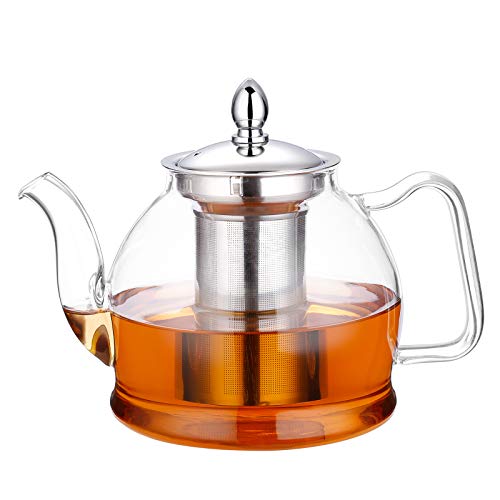
HIWARE 1000ml Glass Teapot with Infuser — Best Everyday Glass
The HIWARE is the pot we would hand to someone making their first serious loose-leaf purchase, because it removes excuses. One litre of borosilicate glass, a removable infuser with room for leaves to unfurl, and a body rated for the stovetop, so the same vessel that brews can also bring the water up — gently, over moderate heat, as glass always asks. Watching a green tea open in this pot teaches you more about steeping in a week than a month of timers, because you can see the liquor darken and pull the infuser at the colour you actually like.
Glass neutrality is this pot’s flavour argument. Borosilicate contributes nothing of its own, so a silver needle white tea tastes of hay and honey rather than of the vessel, and a smoky lapsang does not haunt the next morning’s sencha after a rinse. The trade is thermal: the thin wall gives heat back to the room quickly, so long steeps of black tea benefit from a tea cosy or a preheated pot, and the handle joint — the classic glass weak point — deserves a supporting hand on a full pour rather than a one-finger flourish.
- Material: borosilicate glass body
- Capacity: 1000 ml, roughly two large mugs
- Infuser: removable, sized for loose leaf expansion
- Heat: stovetop safe per the listing; moderate heat suits glass best
Strengths
- Completely neutral flavour, so delicate teas taste like themselves and nothing else.
- Visible steeping turns beginners into confident judges of colour within days.
- Stovetop rating removes the kettle-to-pot transfer for small households.
Trade-offs
- Heat escapes quickly, so slow black-tea steeps cool sooner than in iron.
- Handle and spout joints need two-handed respect when the pot is full.
- Glass shows every water stain, rewarding owners who dry it after washing.
Best for: new loose-leaf drinkers and anyone brewing pale teas judged by colour. Not suited for: households wanting a pot that stays hot through a long, distracted breakfast.

Teabloom Stovetop Glass Teapot 40 oz — Best for Blooming Teas
Teabloom built its name on the theatre of flowering teas, and this 40 oz pot is the stage. The infuser here is glass rather than steel mesh, which matters more than it sounds: a blooming tea ball opening behind a metal basket looks like a flower in a cage, while the glass infuser nearly disappears and leaves the blossom apparently floating. Two blooming teas come in the box, so the first performance happens the day the pot arrives, and guests who claim not to care about tea end up watching it like a fire.
Beyond the show, this is a practical large glass pot. Forty ounces covers a table of four small cups or a couple of big ones, the body is rated for both stovetop and microwave use per the listing, and the removable infuser lifts out so the pot can serve as a clear pitcher for iced tea in summer. The same glass caveats apply as with any borosilicate — heat retention is modest, and a pot this size, full, is a two-handed pour — but as a centrepiece that also brews properly, it has few rivals at any material.
- Material: glass body with glass infuser
- Capacity: 40 oz, the largest glass option here
- Included: two blooming teas to start with
- Heat: stovetop and microwave safe per the listing
Strengths
- Glass infuser keeps blooming teas visually unobstructed, which is the entire point.
- Generous capacity serves a table without a second brewing round.
- Doubles as an iced-tea pitcher once the infuser is lifted out.
Trade-offs
- A full 40 oz of glass is heavy enough to demand a deliberate pour.
- Large glass surface cools faster than a smaller pot of the same material.
- Blooming teas are a sometimes pleasure; daily drinkers may underuse the party trick.
Best for: hosts, gift buyers, and blooming-tea devotees who brew for a table. Not suited for: solo drinkers who mostly want one hot mug kept hot.

suyika Japanese Tetsubin Cast Iron Teapot — Best Small Tetsubin
At 22 oz, the suyika is a personal pot in the tetsubin tradition: cast iron outside, enamelled inside, with a stainless steel infuser basket sized for one drinker’s serious session. The case for iron is thermal patience. Once this little pot is warmed and filled, it holds steeping temperature through a slow breakfast, a chapter of a book, a phone call that runs long — the second cup pours nearly as hot as the first, which no glass pot in this guide can honestly claim. For black teas and roasted oolongs that like sustained heat, that steadiness is a flavour feature, not a comfort feature.
The enamelled interior is what makes a modern tetsubin practical. Bare iron would rust and would season like a wok, which traditionalists prize and everyone else regrets; the enamel keeps the water neutral and the maintenance to a rinse and a thorough dry. The pot is listed as stovetop safe, though iron this size asks for low heat and patience rather than a roaring burner. Respect the weight — even 22 oz of cast iron is a deliberate lift — and dry the rim and lid seat after washing, because those exposed edges are where enamelled iron always ages first.
- Material: cast iron with enamelled interior
- Capacity: 22 oz / 650 ml, a one-person session pot
- Infuser: stainless steel basket included
- Heat: stovetop safe per the listing; low heat suits it best
Strengths
- Heat retention no glass or porcelain pot here can approach.
- Enamelled interior keeps flavour neutral and rust a non-issue.
- Small size makes the famous iron weight manageable for daily use.
Trade-offs
- Twenty-two ounces is one drinker’s pot, not a sharing pot.
- Must be dried properly; a wet lid left seated invites rim rust.
- Enamel chips if knocked hard against a steel sink or another pot.
Best for: solitary black-tea and roasted-oolong drinkers who linger over the pot. Not suited for: anyone brewing for guests or wanting a featherweight travel pot.

Sotya Cast Iron Teapot 40 oz Tetsubin — Best Large Cast Iron
The Sotya answers the obvious objection to the little suyika: what if the iron drinker has company? At 40 oz — 1200 ml — this tetsubin brews for three or four, with a cherry blossom design cast into the body and the same enamelled interior logic protecting the water from the metal. A big iron pot is also a thermal flywheel: the more iron and water in play, the slower the temperature falls, so a pot this size, preheated, keeps a long afternoon session genuinely hot rather than merely warm by the last cup.
That mass is the bargain and the burden. Full, this is the heaviest pour in the guide by a wide margin, and anyone with wrist trouble should test the idea with a full saucepan before committing. The infuser handles loose leaf for the whole volume, the listing places it on the stovetop, and the enamel means a rinse-and-dry routine rather than seasoning rituals. Treat it as the hearth of a tea table — placed once, poured carefully, admired often — rather than a pot you wave around a kitchen, and it will outlast every other vessel here by decades.
- Material: cast iron, enamelled interior, cherry blossom design
- Capacity: 40 oz / 1200 ml, serves three to four
- Infuser: included for loose leaf at full volume
- Heat: listed for stovetop use; warm it gradually
Strengths
- Family-size iron capacity with the family’s best heat retention.
- Cast relief design makes it the most handsome object in this guide.
- Enamelled inside, so no seasoning and no rust-prone bare metal in the water path.
Trade-offs
- The heaviest full pour here; wrists and small hands should take note.
- Takes the longest to dry and the most cupboard presence to store.
- Oversized for a solo drinker, who will waste heat on empty volume.
Best for: households and hosts who brew black tea for a group and linger. Not suited for: anyone with limited grip strength or a one-mug routine.
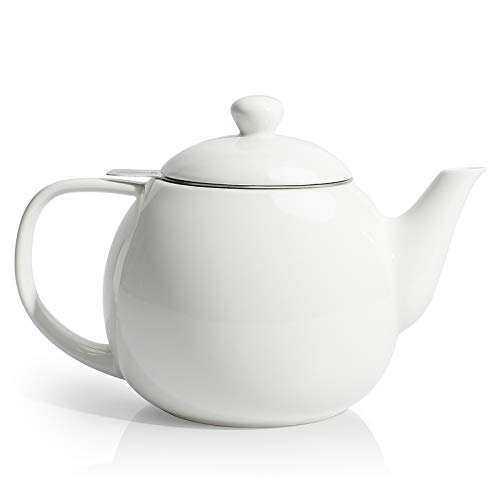
Sweese Porcelain Teapot 27 oz — Best Porcelain
Porcelain’s virtues are quiet ones, and the Sweese expresses all of them. The 27 oz white body is glazed inside and out, so it contributes no flavour, holds no memory of yesterday’s chai, and washes clean under a tap or in a dishwasher rack without argument. The removable infuser is stainless steel, fine enough for most loose leaf, and the size is the thoughtful middle of this guide: two proper mugs, or a solo drinker’s pot plus a warm-up, without the thermal waste of brewing small in a big vessel.
Where porcelain quietly beats glass is the pour and the temperature. A well-formed porcelain spout cuts off cleanly — Sweese’s does — and the thicker glazed wall holds heat noticeably better than borosilicate while never approaching iron’s marathon warmth. It is also the only family here that looks equally at home at a formal table and a weekday desk. The honest cautions are fragility against tile floors and a lid that, like most porcelain lids, wants a fingertip’s steadying on the final tilt. Neither flaw is hidden; both are simply the price of the material’s refinement.
- Material: glazed porcelain body
- Capacity: 27 oz, two-mug territory
- Infuser: removable stainless steel
- Care: the easiest wash in this guide, tap or dishwasher
Strengths
- Fully neutral, non-porous glaze keeps every tea tasting only of itself.
- Cleanest, dripless pour of the six picks here.
- Heat retention sits sensibly between glass and cast iron.
Trade-offs
- Porcelain chips and cracks where iron would merely dent the floor.
- No stovetop role; water must arrive from a separate kettle.
- White glaze shows tea staining until a soak persuades it otherwise.
Best for: daily drinkers who value a clean pour and easy washing above theatre. Not suited for: stovetop brewers or households with tile floors and toddlers.

SUSTEAS Whistling Steel Tea Kettle 2.7QT Black — Best Steel Kettle Partner
Steel earns its place in a materials guide at the boiling stage, and the SUSTEAS is steel doing that job at scale: 2.7 quarts of food-grade steel with a whistling spout, an ergonomic handle, a silicone pinch mitt in the box, and compatibility across induction, gas, electric, and radiant cooktops per the listing. That is enough water for the Sotya, the Teabloom, and a round of French press besides. If your household’s tea habit starts with a kettle that everyone also uses for noodles and cocoa, this is the steel representative that makes sense.
Honesty about roles matters here. The SUSTEAS is a kettle, not an infuser teapot: it boils superbly and steeps not at all, so loose leaf still needs an infuser pot or a basket in the cup. We include it because steel’s genuine material strengths — speed, toughness, induction friendliness, indifference to being knocked off a counter — live in kettles far more than in the thin steel teapots that dent and taint delicate teas. Pair it with the Sweese or the HIWARE and you have steel where steel is best, feeding a neutral vessel where neutrality matters.
- Material: food-grade stainless steel, black finish
- Capacity: 2.7 quarts, the largest vessel in this guide
- Heat: induction, gas, electric, and radiant cooktops per the listing
- Extras: whistling spout, ergonomic handle, silicone pinch mitt included
Strengths
- Boils family quantities fast on any cooktop type in a modern kitchen.
- Tough enough for travel, rentals, and kitchens where glass fears to go.
- Whistle announces the boil, saving forgotten kettles and scorched afternoons.
Trade-offs
- No infuser; it cannot steep loose leaf on its own.
- Thin steel walls hold no heat once off the burner.
- Black finish shows limescale dusting in hard-water homes.
Best for: high-volume households boiling for pots, presses, and cooking alike. Not suited for: anyone wanting a single vessel that boils and steeps together.
How Do the Six Compare at a Glance?
| Pick | Material | Capacity | Steeps? | Character in one line |
|---|---|---|---|---|
| HIWARE 1000ml Glass Teapot with Infuser | Borosilicate glass | 1000 ml | Yes, removable infuser | The transparent teacher for new loose-leaf drinkers. |
| Teabloom Stovetop Glass Teapot 40 oz | Glass, glass infuser | 40 oz | Yes, glass infuser | The blooming-tea stage with room for a table. |
| suyika Japanese Tetsubin Cast Iron Teapot | Enamelled cast iron | 22 oz | Yes, steel basket | One drinker’s heat-keeping iron companion. |
| Sotya Cast Iron Teapot 40 oz Tetsubin | Enamelled cast iron | 40 oz | Yes, infuser included | The family hearth pot, heavy and handsome. |
| Sweese Porcelain Teapot 27 oz | Glazed porcelain | 27 oz | Yes, steel infuser | The clean-pouring, easy-washing all-rounder. |
| SUSTEAS Whistling Steel Tea Kettle 2.7QT Black | Food-grade steel | 2.7 qt | No, kettle only | The fast, tough boiler feeding every other pot. |
Which Material Keeps Tea Hot the Longest?
Cast iron, and it is not close. Heat retention is mostly a story of mass: the more warm material surrounds the water, the slower the whole system cools, and an iron wall outweighs a glass one several times over at the same capacity. In practical terms, a preheated tetsubin like the suyika or the Sotya keeps a second and third cup at drinking temperature through a long sitting, while a glass pot of the same size drifts lukewarm unless a cosy or a warmer intervenes. Porcelain’s thicker glazed wall lands between the two, holding a two-mug session comfortably and then conceding.
Two habits matter as much as the material itself. Preheating — swirling hot water through the empty pot and discarding it — removes the initial temperature theft that hits glass hardest. And brewing the right volume matters: a small amount of tea in a large pot cools fastest of all, because the ratio of surface to liquid turns against you. Match pot size to session size and even glass behaves respectably; mismatch them and even iron feels disappointing by the final pour.
Does the Material Change How the Tea Tastes?
Yes, though mostly by subtraction. Glass and glazed porcelain add nothing, which is why tasters reach for them when judging a new tea: what you taste is the leaf and the water, full stop. Enamelled cast iron is likewise neutral while its coating is intact, one reason modern tetsubin use it. Bare metal is where flavour creeps in — thin stainless can lend a faint tang to very delicate white and green teas, and unlined iron or aluminium will season over time, carrying ghost notes from strong teas into gentle ones.
Temperature is the indirect flavour effect, and it is larger. A pot that holds heat keeps extracting steadily, so the last cup of an iron-brewed black tea tastes fuller than the last cup from a cooled glass pot of the same leaves. Conversely, heat-sensitive greens prefer a vessel that lets temperature fall gently rather than holding a near-boil against the leaf for ten punishing minutes. Material choice is therefore also a choice about which teas you drink most: sustained heat flatters the dark end of the shelf, neutrality flatters the pale end.
Which Teapots Can Actually Sit on the Stove?
Only the ones whose listings say so, and the distinction saves cracked pots. Among our six, the HIWARE and Teabloom glass bodies are rated stovetop safe, the two iron tetsubin are listed for stovetop use, and the SUSTEAS kettle is built for every common cooktop including induction. The Sweese porcelain pot is not a stovetop vessel at all — porcelain and direct flame are enemies, and its water must arrive from a kettle. Even for rated glass, stovetop use means moderate heat and a full pot; an empty glass vessel over a high burner is a crack rehearsing.
Induction deserves a specific word, because it decides many purchases now. Glass and porcelain do nothing on an induction hob without a diffuser plate, cast iron works beautifully, and steel works when its base is magnetic — the SUSTEAS listing claims induction compatibility outright. If your kitchen is induction-only and you want one vessel that boils, iron and steel are your families; if you happily keep a kettle, every material on this page remains open to you.
How Should You Brew Differently in Each Material?
In glass, brew by eye and pour promptly. Use the colour as your timer — pale gold for many greens, amber for oolongs, deep red-brown for blacks — and lift the infuser when the liquor looks right, because the thin wall will not hold a plateau for you. In iron, preheat thoroughly, use water a touch cooler than you think for the first steep, and let the pot’s stored heat do the steady work; iron rewards patience and punishes boiling water poured over delicate leaf, since the heat cannot escape.
In porcelain, brew by the book: standard times and temperatures behave predictably, which is why porcelain is the reference vessel in so many tea traditions. With a steel kettle feeding any of them, mind the whistle’s timing — water left roaring loses oxygen and tastes flat, so pour at the whistle rather than five minutes after it. Across all four families, one rule never changes: warm the pot first, and warm the cups too in winter, because cold ceramic steals heat as greedily as cold glass.
How Do You Clean and Store Each Material Without Ruining It?
Glass wants a rinse while warm, a soft brush for the infuser mesh, and an occasional soak with a denture tablet or baking soda solution when tea stain films the walls. Never plunge a hot glass pot under cold water; thermal shock is the one death borosilicate cannot argue with. Porcelain is the relaxed family — dishwasher, sponge, a paste of bicarbonate for stubborn rings — though gold-rimmed antiques, unlike our plain Sweese, should stay out of machines.
Iron asks for the driest routine: rinse with hot water only, no detergent inside the enamel, then dry on a warm burner for a few seconds or with a towel, and store with the lid ajar so the interior truly dries. Steel kettles in hard-water country need periodic descaling — a simmer of water with citric acid or vinegar, then a thorough rinse — because scale insulates the base and slows every boil. Store any pot with its infuser removed and dry; a basket left damp inside a closed pot is a mildew invitation in every material.
What Size Pot Do You Actually Need?
Work backwards from mugs, not from the box. A standard mug holds about 12 oz, a small teacup about 6, and a pot’s stated capacity is brim-full — the comfortable brewing volume is roughly four-fifths of it once leaf displacement and headroom are counted. So the suyika’s 22 oz is honestly one large mug plus a top-up; the Sweese’s 27 oz is two mugs; the Teabloom and Sotya at 40 oz serve three mugs or four to five small cups; and the HIWARE’s litre sits happily at two generous mugs with a little spare.
Err smaller when torn between two sizes. Tea brewed fresh in a right-sized pot beats a large pot’s second hour every time, and a small pot can always brew twice, while a large pot cannot brew small without thermal penalty. The exception is the household that drinks together at a set hour — there, the big iron or glass pot earns its keep daily, and its size stops being a compromise and becomes the ritual itself.
What Actually Is Borosilicate, and Why Does It Matter?
Borosilicate is glass formulated with boron oxide, which lowers its thermal expansion so dramatically that the material shrugs off temperature swings that would shatter an ordinary jam jar. That single property explains the whole glass teapot category: laboratory flasks, oven dishes, and stovetop-rated teapots all descend from the same chemistry. When you read that the HIWARE or the Teabloom can sit on a burner, it is this formulation doing the work, not thicker walls — indeed borosilicate pots are often thinner than decorative glass, because strength here comes from chemistry rather than bulk.
The same chemistry brings a subtler benefit: borosilicate is exceptionally non-reactive, so it neither absorbs flavours nor leaches anything into hot water across thousands of brews. A glass pot used for peppermint on Monday tastes of nothing but sencha on Tuesday after a plain rinse. Owners coming from plastic-bodied brewers, which hold odours tenaciously, notice this neutrality first and praise it longest. The honest counterweight remains mechanical rather than chemical — borosilicate still breaks when dropped on stone, and no formulation meeting a tile floor at speed has yet won that argument.
Why Does the Enamel Inside a Tetsubin Change Everything?
A traditional Japanese tetsubin began life as a kettle, cast bare and meant to boil water over a brazier, its interior slowly building a mineral patina that old hands insisted sweetened the water. The modern teapot version keeps the cast body but lines it with enamel, and that lining quietly redefines the object: the water now meets glass-like enamel instead of iron, so there is no rust in the brew, no metallic contribution, and no seasoning ritual to maintain. Both our iron picks, the suyika and the Sotya, follow this enamelled pattern, which is why they can steep delicate teas without apology.
Enamel also sets the care rules. It is hard but brittle, so the enemy is impact — a hard knock against a granite sink edge chips it where a steel pot would dent. Chips matter beyond looks because exposed iron beneath will rust in a damp pot, turning a cosmetic flaw into a maintenance chore. Chip prevention is mostly choreography: wash the iron pot by itself, set it down on a mat or wooden board, and never stack other cookware inside it. Observed casually, those habits cost nothing and keep the lining — and therefore the whole neutral-brewing promise — intact for decades.
How Much Do Lids, Handles, and Spouts Really Matter?
Enormously, and across every material, because these are the parts your hand and the physics of pouring actually meet. A lid should seat with a small, definite settle and stay put during a tilted pour without a fingertip escort; a loose lid is not a charm point but a scald rehearsal. Lids also vent — a tiny hole or notch lets air replace departing tea, and pots without one glug and surge. When you examine listing photographs, look for that vent and for a knob you could grip with oven-mitt clumsiness, because one day you will.
Handles divide into those that conduct and those that do not. Iron pots traditionally carry a bare or wrapped handle that warms with the pot, manageable at tetsubin sizes but worth respecting when full. Glass handles depend entirely on their joint, the stress point where every glass pot eventually tells its age. Porcelain handles, moulded as part of the body, stay coolest and feel most secure, one more quiet Sweese virtue. Spouts, finally, should rise from low on the body, narrow at the tip, and end in a slight downturn — geometry that starts the pour smoothly and, more importantly, stops it without the trailing dribble that stains tablecloths and tempers alike.
Western Brewing or Gongfu: Does the Pot Choice Change?
It changes the size answer more than the material answer. Western-style brewing — a spoonful of leaf per mug, one long steep — suits the larger pots in this guide, the Teabloom, the Sotya, and the litre HIWARE, because the method is built around volume served at once. Gongfu brewing inverts the logic: small vessel, generous leaf, many short steeps, each poured off completely so the leaves rest between infusions rather than stewing. For that practice the suyika’s 22 oz is still generous, and a porcelain pot like the Sweese earns special praise, because porcelain’s neutrality and easy rinsing suit rapid-fire comparison of successive steeps.
Material interacts with gongfu in one more way: heat. Short steeps poured in quick succession benefit from a vessel that stays hot between rounds, which flatters iron and thick porcelain, while glass drinkers compensate with a kettle kept near temperature and water refreshed for later steeps. None of this demands a second pot for most households. It asks only that you notice which ritual your kitchen actually performs on weekdays, and let the capacity follow the ritual instead of the other way round — the most common sizing regret we hear is a beautiful large pot bought for a gongfu habit it physically cannot serve well.
Which Material Suits Each Tea on Your Shelf?
Green and white teas, brewed cool and judged on delicacy, belong in glass or porcelain, where nothing intervenes and the liquor colour doubles as your thermometer’s second opinion. A glass pot also flatters scented teas — jasmine pearls unfurling in the HIWARE is a small ceremony — and lets you pull the infuser the moment the perfume peaks. Black teas are the least fussy family and the most heat-hungry, which is iron’s home ground: a preheated tetsubin keeps a malty Assam at full voice through the pot, and porcelain serves nearly as well for a two-mug morning.
Oolongs split by roast. Pale, floral high-mountain oolongs behave like greens and deserve neutrality; dark, roasted oolongs behave like black teas and repay iron’s sustained warmth across repeated steeps. Herbal infusions and rooibos stain enthusiastically and clog fine mesh, so give them the pot you mind cleaning least — usually porcelain or glass with the widest infuser opening — and keep a dedicated basket if peppermint features weekly, because mint’s oils outstay their welcome in any mesh. Pu-erh, finally, is traditionally clay’s territory, and while none of our six is unglazed clay, an enamelled iron pot is the respectable stand-in: neutral lining, serious heat, no cross-flavour drama.
How Does Hard Water Treat Each Material?
Limescale is water’s signature on every heated vessel, but each family wears it differently. Glass displays scale mercilessly — a filmy bloom on the walls that looks worse than it is and wipes away with a citric-acid soak. Steel kettles gather scale on the base where the heat lives, slowing the boil measurably over a season in hard-water postcodes; the SUSTEAS, like any kettle, wants a descale whenever the boil turns sluggish or the whistle’s note changes. Porcelain hides light scale politely under its glaze and releases it with the same acid soak as glass.
Iron is the family to protect from scale rather than clean of it, because aggressive descaling and enamel are poor companions. The practical defence is upstream: brew iron pots with filtered water if your tap runs hard, and never leave water standing in the pot between sessions. A tetsubin treated that way — the suyika or Sotya filled from a filter jug, emptied and dried after use — can go years without its interior needing anything beyond a hot rinse, which is precisely the low-intervention ownership that makes iron devotees so loyal.
Should You Buy a Vintage or Secondhand Teapot?
Sometimes, with eyes open. Vintage porcelain is the safest secondhand family: glaze is stable, chips are visible, and a thorough wash restores it fully, though crazed glaze — a network of fine cracks — harbours stain and should retire a pot to display. Vintage glass demands a hunt for hairline cracks around the handle joint and spout base, best found by filling the pot and watching for weeping. Secondhand cast iron is a wager on the previous owner’s drying habits; surface rust inside an unlined kettle can be scrubbed and re-seasoned by boiling, but a rusted-through or badly chipped enamelled interior is a display piece, not a brewer.
One firm exclusion: very old glazed ceramics of unknown origin can carry lead in decorative glazes, particularly pieces made for ornament rather than service. A teapot you drink from daily should be a food-service object from a maker who says so, which is another quiet argument for the new, listed, specification-backed pots in this guide over a charming unknown from a market stall. Charm belongs on the shelf; breakfast belongs in a pot whose materials you can name.
What About Travel, Offices, and Second Pots?
The material hierarchy rearranges itself away from home. At a desk, where a pot lives beside a keyboard and gets knocked by elbows and book stacks, porcelain’s manners still win but glass becomes a liability with a power cord nearby, and a small iron pot — heavy, stable, nearly unspillable by accident — develops an unexpected case. The suyika’s footprint suits a desk corner, and its heat retention suits a worker whose steep gets interrupted by meetings; tea poured an hour later from iron is a pleasure, while the same hour in glass is a microwave errand.
Travel inverts everything again: weight and fragility both argue for steel, which is why the travelling tea kit so often pairs a small steel kettle or thermos with a simple infuser basket rather than a true pot at all. Cabins, rentals, and dorm rooms follow the travel logic — the SUSTEAS pattern of boiling in steel and steeping in whatever neutral vessel the kitchen provides. And the second-pot question, which most tea households eventually face, usually resolves as a material complement rather than a duplicate: the glass drinker adds iron for winter blacks, the iron devotee adds porcelain for summer greens, and the collection starts to look less like accumulation and more like a toolkit.
There is also a hosting argument for owning across materials. Guests divide unpredictably — one wants the theatre of a blooming tea opening in glass, another wants a bottomless black-tea pot that never cools during a long story — and a household with the Teabloom and the Sotya in the cupboard answers both without compromise. You do not need six pots. Most settled tea kitchens we know converge on two, one neutral and light, one dark and heat-keeping, and the six picks in this guide are best read as three such pairs waiting to be chosen.
Which Mistakes Shorten a Teapot’s Life?
- Pouring boiling water into a cold glass pot straight from a winter cupboard, which invites the crack that ends the pot’s career in one sound.
- Leaving an iron tetsubin to air-dry with its lid sealed, trapping the moisture that starts rust freckles along the rim and lid seat.
- Scrubbing enamel or glaze with metal scourers, opening scratches that stain faster and, on enamel, eventually expose bare iron.
- Setting a porcelain pot on a burner or warming plate meant for metal, a category error that cracks bases and voids any sympathy.
- Brewing tiny volumes in the largest pot, then blaming the material for lukewarm tea the geometry caused.
- Storing the infuser basket inside the closed pot while still damp, in any material, and discovering the smell a fortnight later.
Final Recommendation
Decide your family first and your model second. If your shelf leans pale and delicate, start with glass: the HIWARE 1000ml Glass Teapot with Infuser for daily drinking, or the Teabloom Stovetop Glass Teapot 40 oz when the table is full and the tea is part of the entertainment. If your shelf leans dark and your sessions run long, iron is the honest answer, sized by company: solo drinkers to the suyika, households to the Sotya.
Porcelain remains the recommendation we make to anyone who refuses to specialise, because the Sweese Porcelain Teapot 27 oz never embarrasses any leaf and never complicates a morning. Add the SUSTEAS kettle when your boiling needs outgrow a small pot’s stovetop rating, and steel has done its proper job. Choose the material that matches the tea you actually drink on an ordinary Tuesday — not the tea you serve twice a year — and the pot you buy will still be earning its cupboard space a decade from now.
Frequently Asked Questions
Is borosilicate glass really safe on a stovetop?
When the listing rates it so, yes — borosilicate handles thermal change far better than ordinary soda-lime glass, which is why laboratory glassware uses it. The conditions are moderate heat, a pot that is not empty, and no sudden cold water on hot glass. Treat those as operating rules rather than fine print and a rated glass pot like the HIWARE or Teabloom will serve for years; ignore them and no glass at any price survives.
Will a cast iron teapot rust?
The enamelled interior of a modern tetsubin keeps water off the iron, so the brewing surface does not rust in normal use. The vulnerable spots are the rim, the lid seat, and any chip where enamel has been knocked away. Rinsing with hot water, drying deliberately, and storing the lid ajar keeps those edges clean for years; a pot left wet and sealed after every use will eventually freckle, whatever the brochure promised.
Does porcelain stain, and can the stains come out?
Yes and yes. Tea tannins film any glazed surface eventually, fastest where microscopic scratches give them grip. A soak in warm water with bicarbonate of soda, or a denture-cleaning tablet, lifts the film without abrasives; a melamine sponge handles the spout lip. Staining is cosmetic, not a flavour problem, though a stained pot used for both chai and silver needle is a good argument for the soak becoming a monthly habit.
Why does tea from my steel kettle taste slightly metallic?
Usually it is the water, not the steel: long-boiled water concentrates minerals and loses dissolved oxygen, tasting flat and hard. Very delicate teas also reveal faint notes that fuller teas mask. Fill the kettle fresh, pour at the whistle rather than after a rolling five minutes, and steep the palest teas in glass or porcelain — which is exactly the division of labour this guide recommends for the SUSTEAS and the neutral pots.
Can one teapot handle both green and black tea well?
A neutral vessel can: glass and glazed porcelain rinse clean between teas and impose no temperature agenda of their own. Iron can too, provided the water temperature is adjusted before pouring, since the pot will hold whatever heat you give it. The teas themselves need different water — greens cooler, blacks hotter — and no material excuses skipping that adjustment; the pot’s job is neutrality and heat behaviour, the kettle’s job is the right temperature.
How long should a good teapot last?
Cast iron leads by decades when dried properly; a tetsubin is effectively a lifetime object. Porcelain lasts as long as it is not dropped, which in careful kitchens is also decades. Glass is the mortal family — years of daily service is a fair expectation, with handles and thermal shocks the usual endings. Steel kettles sit near iron for longevity, losing only their whistles and gaskets along the way, both replaceable in spirit if not always in fact.
Are expensive teapots actually better, or just prettier?
Both effects exist and they separate cleanly. Money buys thinner, more even porcelain, better-balanced iron castings with cleaner enamel, and glass with properly annealed joints — all functional gains you feel in the pour and in year five. Beyond that threshold, money buys hand-painting, famous kilns, and silhouette, which are legitimate pleasures but do not change the liquor. The six pots here sit deliberately at the functional threshold: every one of them brews as well as its material allows, and anything pricier is a decision about beauty, not about better tea.
Should the infuser be glass, steel mesh, or a basket in the cup?
For the pot itself, a removable basket infuser beats a small ball or a spout strainer every time, because leaves need room to expand to several times their dry size and cramped leaves under-extract no matter how fine the mesh. Steel mesh, as in the Sweese and the iron pair, is durable and filters finely enough for most leaf; the Teabloom’s glass infuser trades a little filtration fineness for a clear view. Cup baskets are the fallback for kettle households — entirely respectable with the SUSTEAS doing the boiling — but a pot with its own basket keeps temperature and leaves together, which is the whole thermal point.
Related Guides
Material is only the first fork in the road. Readers comparing countertop appliances next often move to our companion research on Best Air Fryer Toaster Ovens, Judged by Lab-Test Standards, while anyone planning a summer kitchen refresh may also want Best 14,000 BTU Portable Air Conditioners and the renter-focused survey in Best Air Conditioners for Apartments.


