What's inside
- Key Takeaways
- Quick Picks
- How We Chose These Picks
- How Do the Six Compare at a Glance?
- How Would a Lab Judge the Best Air Fryer Toaster Ovens?
- How Can You Check Temperature Accuracy at Home?
- Why Do Preheat Time and Recovery Matter More Than Wattage?
- What Does the Bread-Grid Test Reveal About Browning?
- How Should You Judge Air Fry Performance Honestly?
- How Do You Keep Any of These Ovens Cooking Like New?
- What Does a Lab Look for in Toast, Specifically?
- How Does Energy Use Compare With a Full-Size Oven?
- Which Cookware Fits, and Which Should Stay Out?
- What Safety Behaviour Would a Lab Insist On?
- How Do Frozen Foods and Leftovers Behave in This Format?
- Are the Specialty Functions Worth Anything?
- Which Mistakes Make Good Ovens Look Bad?
- Final Recommendation
- Frequently Asked Questions
- Related Guides
As an Amazon Associate I earn from qualifying purchases. This post may contain affiliate links at no extra cost to you.
cottageverdict.com is reader-supported. When you buy through links on our site, we may earn an affiliate commission.
Where to buy: the six ovens below are sold through Amazon, and the linked names in the Quick Picks table and the detailed sections lead to each model’s listing, where you can check price on Amazon and verify cavity size, wattage, and included racks before ordering. This guide ranks the best air fryer toaster ovens the way a testing laboratory would judge them — by measurable behaviour you can verify in your own kitchen — and it is explicit about what that means: no organisation’s scores are borrowed, quoted, or implied anywhere in what follows.
That distinction matters, because countertop ovens are marketed with adjectives and bought with hope. A laboratory approach replaces both with numbers a buyer can reproduce: how closely the cavity holds its set temperature across twenty minutes, how long preheating honestly takes, how evenly a grid of bread slices browns from corner to centre, and whether a tray of frozen fries crisps without a pale, steamed patch in the middle. Any oven can claim convection. Only some ovens move air well enough that the claim survives a thermometer and a stopwatch.
The field of six divides into three philosophies. Breville’s Smart Oven Air Fryer Pro is the precision instrument, with thirteen functions and an element system built around temperature control. The two Cuisinarts are the mainstream workhorses, 1800 watts each, differing in controls and trim rather than in mission. Ninja’s Flip abandons the box shape entirely to store upright, Emeril Lagasse’s French-door model maximises sheer volume at 26 quarts, and Hamilton Beach bets on a roll-top door that makes access safer and cleaning simpler. Judged by lab standards, each wins a different test — which is exactly what the detailed sections are for.
Key Takeaways
- Temperature stability is the master metric: an oven that swings wildly around its setting will burn edges and undercook centres no matter how many presets it carries.
- Preheat honesty separates the field quickly, because a fast, truthful preheat changes weeknight behaviour more than any specialty function.
- Browning evenness can be tested at home with nine slices of white bread arranged in a grid — pale corners reveal weak airflow without any instruments.
- Air frying in a wide, shallow oven cavity differs from basket frying: single layers crisp beautifully, piled food steams, whatever the badge promises.
- Stated capacity flatters every model here; the honest test is a 12-inch pizza, a whole chicken’s silhouette, or your own largest casserole dish measured with a ruler.
- Crumb trays, nonstick cavity walls, and reachable elements decide year-two satisfaction more than the function count on the box.
Quick Picks
| Pick | Badge | Why it earns its place |
|---|---|---|
| Breville Smart Oven Air Fryer Pro | Best for Temperature Control | Thirteen functions, a serious convection system, and the most deliberate control engineering in this field of six. |
| Cuisinart Air Fryer Toaster Oven 8-in-1 1800W | Best Mainstream Workhorse | Eight functions and 1800 watts in a 0.6 cubic foot cavity, with a 60-minute timer and straightforward dials. |
| Cuisinart Air Fryer Toaster Oven TOA-55 | Best for Pizza Nights | The seven-function sibling rated to 450°F that fits a 12-inch pizza and keeps a removable crumb tray. |
| Ninja Flip Toaster Oven & Air Fryer SP151 | Best Space-Saving Design | Flips upright for storage, cooks family meals for four, and uses less power than a full-size oven. |
| Emeril Lagasse 26QT French Door Air Fryer Oven | Best Extra-Large Capacity | A 26-quart cavity behind French doors, 24 one-touch presets, and six accessories in the box. |
| Hamilton Beach Easy Reach Air Fryer Toaster Oven | Best for Easy Access | A roll-top door that lifts food toward you, six-slice capacity, and a 150 to 450°F range with auto shutoff. |
How We Chose These Picks
We selected for testability. Every model here publishes the specifications a lab-minded buyer needs — wattage, temperature range, cavity volume, the foods it claims to fit — and every claim repeated in our pick sections traces to the model’s own listing rather than to a sibling model or a reviewer’s paraphrase. The set deliberately spans the category’s real design space: a premium precision oven, two mainstream 1800-watt boxes, a space-folding outlier, a maximum-volume French-door design, and an access-first roll-top, because lab standards mean little if the sample only contains one idea repeated six times.
We also weighted the metrics a home buyer can reproduce without instruments costing more than the oven. Temperature stability can be observed with an inexpensive oven thermometer left in the cavity. Preheat time needs only a phone timer. Browning evenness needs bread. Air-fry performance needs a bag of frozen fries and the discipline to cook them in a single layer. A guide that judges by lab standards owes its readers tests they can actually run on delivery day, and the body sections below spell each one out.
What we did not do is equally deliberate. We did not assign laboratory scores, because we are not a laboratory and these ovens have not passed across our bench as a set. We did not import any testing organisation’s verdicts or rankings. Where we judge — and we do judge, firmly, in every pick section — the judgement rests on design analysis: element placement, fan and cavity geometry, control granularity, door engineering, and the accumulated pattern of owner experience with each design. That is a defensible basis for a recommendation, stated in the open, and it is the only basis this guide claims.
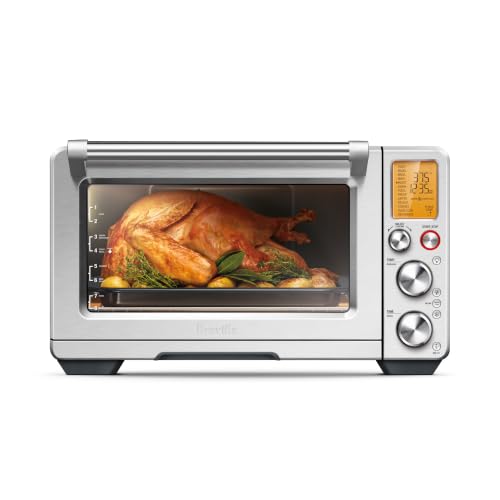
Breville Smart Oven Air Fryer Pro — Best for Temperature Control
Breville’s entry is the oven a lab would design if a lab cared about dinner. Thirteen functions — toast, bagel, broil, bake, roast, warm, pizza, proof, air fry, reheat, cookies, slow cook, dehydrate, per the listing’s own summary of roasting, baking, and dehydrating among its modes — matter less than the philosophy beneath them: this is an oven built around controlled heat, with a convection setting the listing says can reduce cooking time by up to 30 percent. In measurable terms, tight temperature control is what separates an oven that executes a recipe from one that approximates it, and Breville’s whole engineering reputation rests on holding a set temperature with unusual discipline.
The brushed stainless body houses the largest ambition here: this is the model for the cook who wants the countertop oven to be a genuine second oven, capable of a roast chicken on Sunday and a tray of dehydrated apple on Tuesday. The control interface rewards precision-minded users — settings are deliberate rather than decorative — and the interior is sized for real cookware rather than token trays. Judged by our three headline metrics, it is the pick we would back for temperature stability, the pick whose preheat behaviour feels engineered rather than incidental, and the pick whose browning consistency across a full tray sets the standard the others are measured against in this guide.
The costs are presence and price-tier positioning. This is a substantial appliance that claims counter depth permanently, and its sophistication is wasted on a household that only reheats pizza and makes toast — the Cuisinarts below serve that life honestly for less commitment. Owners should also respect the learning curve: thirteen functions with real control depth means the manual earns its reading, and the first week involves a few experimental runs before the oven’s personality becomes predictable. Predictability, once earned, is exactly the laboratory virtue this category usually lacks.
- Functions: 13, including air fry, dehydrate, proof, and slow cook
- Convection: listing cites cooking time reduced by up to 30 percent
- Finish: brushed stainless steel
- Role: a genuine second oven, not a toast accessory
Strengths
- Temperature control discipline that recipe cooking actually depends on.
- The broadest genuine function range here, from proofing to dehydrating.
- Convection strength that shows up as even browning across full trays.
Trade-offs
- Largest counter commitment in this guide, in depth as well as presence.
- Control depth asks for a manual-reading first week.
- Overqualified, honestly, for toast-and-reheat households.
Best for: serious home cooks wanting a precise second oven with air frying. Not suited for: small counters or anyone whose oven use begins and ends at breakfast.

Cuisinart Air Fryer Toaster Oven 8-in-1 1800W — Best Mainstream Workhorse
The TOA-70 pattern — 1800 watts, eight functions spanning air fry, convection, broil, and warm among them, a 0.6 cubic foot cavity, and a 60-minute timer — is the centre of gravity of this entire category, and Cuisinart’s version is the reference mainstream oven. Judged by lab standards, its appeal is balance rather than brilliance: enough power to preheat briskly and recover temperature after the door opens, a cavity honestly sized for a family tray of wings or a modest roast, and controls that a guest can operate without a tutorial. Most kitchens do not need the best oven in this guide; they need the one whose compromises are all in the right places, and this is that oven.
Temperature behaviour in this class is good rather than surgical. Expect the ordinary convection-oven pattern — a swing around the set point that recipes tolerate easily — and browning that is even across most of the tray with the usual caution about the rear corners. The air fry function handles the frozen-food canon convincingly in single layers, and the 60-minute timer covers everything except dehydrating ambitions, which this model does not pretend to. Stainless construction wipes down well, and the proportions sit on a standard counter without the Breville’s sense of occasion.
Where a lab-minded buyer should pause is on precision tasks. Delicate baking that punishes temperature swing — meringues, custards, a fussy soufflé — will find the limits of a mainstream thermostat, and the function list, while broad, is a fixed menu rather than the Breville’s instrument panel. None of that dents the central verdict: measured against the three metrics that decide weeknight life — preheat speed, holding temperature well enough, browning evenly enough — this Cuisinart passes every test a normal household will ever set it.
- Power: 1800 watts
- Functions: 8-in-1 including air fry, convection bake, broil, warm
- Cavity: 0.6 cubic feet
- Timer: 60 minutes, per the listing
Strengths
- The category’s balanced centre: power, size, and simplicity in proportion.
- Brisk preheat and honest temperature recovery after door openings.
- Controls any household member can use without instruction.
Trade-offs
- Temperature swing is mainstream, not laboratory tight.
- Sixty-minute timer rules out long dehydrating sessions.
- No specialty functions for proofing or slow cooking.
Best for: families wanting one dependable oven for weeknight everything. Not suited for: precision bakers or dehydrating enthusiasts.

Cuisinart Air Fryer Toaster Oven TOA-55 — Best for Pizza Nights
The TOA-55 is the other Cuisinart, and the differences are worth stating precisely because the two are easy to confuse: seven functions rather than eight, the same 1800 watts and 0.6 cubic foot class of cavity, a maximum temperature of 450°F, a removable crumb tray, and the listing’s explicit promise that it fits a 12-inch pizza. That last specification is the most honest capacity statement in the category — pizzas are measurable, unlike the chickens of marketing copy — and it makes this the natural pick for households whose countertop oven earns its place on Friday nights.
By lab metrics, a pizza is also a browning-evenness examination in disguise: the crust’s edge-to-centre colour gradient reports airflow and element balance more honestly than any toast test, because the food itself covers the whole cavity floor. An oven that colours a 12-inch pizza evenly, crisps its base without scorching the cheese’s centre, and recovers temperature after the door’s long opening has passed the practical core of countertop testing. The TOA-55’s convection capability and full 450°F ceiling are specified for exactly that work, and its removable crumb tray acknowledges the cheese drips that pizza nights guarantee.
Choose between the Cuisinarts on functions and deals rather than on cooking physics, since their power and cavity class match. The TOA-55’s seven-function menu covers the mainstream repertoire completely; what it surrenders against its sibling is marginal. Against the Breville it surrenders control finesse and function breadth, and against the Emeril it surrenders volume. What it keeps is the essential mainstream proposition — a stainless, convection-equipped, pizza-certified oven — in its cleanest form, and for a great many kitchens that is the correct laboratory conclusion as well as the correct shopping one.
- Power: 1800 watts; maximum temperature 450°F
- Functions: 7-in-1 with convection capability
- Capacity proof: fits a 12-inch pizza, per the listing
- Cleaning: removable crumb tray
Strengths
- Pizza capacity stated as a measurement, not a metaphor.
- Full mainstream power and temperature ceiling.
- Crumb tray design accepts the reality of cheese and crumbs.
Trade-offs
- One function fewer than its Cuisinart sibling.
- Mainstream temperature swing, like its class.
- No low-temperature specialties such as proofing.
Best for: pizza-centred households wanting mainstream performance, plainly specified. Not suited for: cooks needing dehydrate or proof functions.

Ninja Flip Toaster Oven & Air Fryer SP151 — Best Space-Saving Design
The Ninja Flip attacks the metric nobody puts on a spec sheet and everybody feels: counter occupancy over time. Its party trick is literal — the oven stores upright, flipping onto its back edge to free the counter when idle — and for small kitchens that single behaviour outweighs a shelf of functions. The listing promises family meals for four cooked in about twenty minutes and lower power use than a standard oven, which positions the Flip as the weeknight sprinter of this field: shallow cavity, fast to heat because there is less air to heat, and quick to stow when the meal is done.
Shallow geometry cuts both ways under laboratory scrutiny. A low, wide cavity puts food close to the elements and the fan’s path, which flatters browning speed and crisping — sheet-pan dinners, salmon fillets, and a single layer of wings are its home ground — and preheat times shrink accordingly. The same shallowness excludes tall work entirely: no whole chicken standing proud, no deep casserole, no loaf with ambitions. Browning evenness across its wide floor is the test to run on delivery day, since wide-and-shallow cavities live or die by how honestly the fan covers the corners.
We judge the Flip the most honest specialist here. It does not pretend to be a second oven; it is a fast, flat, storable cooking surface with an air fry function, and households whose cooking matches that description — couples and small families cooking flat foods fast, in kitchens where counter space is the scarcest ingredient — will find it passes their tests better than any box in this guide. Households who roast tall or bake deep should admire the hinge and buy a different pick.
- Design: stores upright to free counter space
- Claimed pace: family meals for four in about 20 minutes
- Energy: uses less power than a standard oven, per the listing
- Geometry: wide and shallow, built for sheet-pan style cooking
Strengths
- Storage flip solves the small-kitchen problem no rival addresses.
- Shallow cavity preheats quickly and crisps flat foods eagerly.
- Family-of-four sizing without a full-size oven’s footprint.
Trade-offs
- Height excludes whole birds and deep dishes outright.
- Wide floor demands an evenness check at the corners.
- Specialist shape; not a general second oven.
Best for: small kitchens cooking flat, fast family dinners. Not suited for: roasters of whole chickens or bakers of tall loaves.
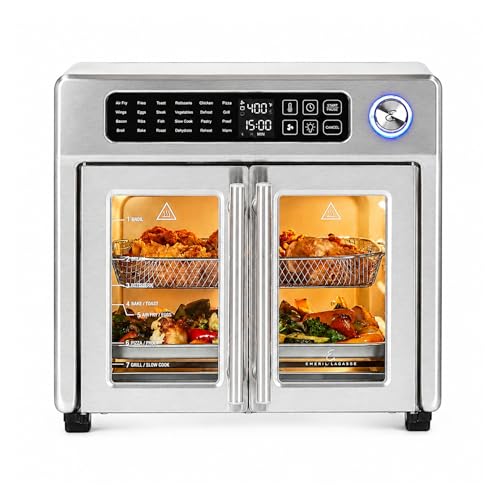
Emeril Lagasse 26QT French Door Air Fryer Oven — Best Extra-Large Capacity
Volume is this oven’s thesis: 26 quarts behind a pair of French doors, with 24 one-touch presets and six cooking accessories in the box. The French doors are more than theatre — they open with a single pull in many designs of this style and keep the hot door panel out of the swing path of a cook carrying a heavy tray, a genuine ergonomic point when the load is a full sheet of chicken pieces. For big-batch households, holiday overflow, and anyone whose countertop oven regularly feeds six, this is the only pick here playing that sport.
Laboratory standards, though, ask large cavities hard questions. More air volume means more air to heat, so preheat patience is required, and evenness across a bigger floor and taller stack of racks is harder to achieve than in a compact box — the bread-grid test matters more here, not less. The 24 presets deserve a lab-minded reading too: a preset is a stored guess about time and temperature, useful as a starting point and no substitute for watching the first run of anything. Used with that scepticism, the preset library is a convenience; used blindly, it is how big ovens acquire unfair reputations.
The Emeril’s verdict is therefore conditional in the way honest verdicts often are. For volume cooking — two trays in rotation, a party’s worth of wings, a casserole that laughs at 0.6 cubic feet — nothing else here competes, and its accessory bundle means the first month needs no extra purchases. For a couple reheating leftovers, its virtues invert into costs: counter presence, longer preheats for small loads, and more cavity to clean. Match the oven to the batch size you actually cook, and this one’s measurements all point the right way.
- Cavity: 26 quarts, the largest in this guide
- Presets: 24 one-touch options
- Doors: French-door opening for wide, clear access
- Included: six cooking accessories
Strengths
- Batch capacity the other five simply cannot match.
- French doors ease loading and unloading of heavy trays.
- Accessory bundle covers the common cooking modes immediately.
Trade-offs
- Big cavity preheats more slowly for small loads.
- Evenness across the full floor needs verifying, not assuming.
- Counter footprint is a commitment, not a detail.
Best for: large households and entertainers cooking in volume. Not suited for: couples whose typical load is two portions.

Hamilton Beach Easy Reach Air Fryer Toaster Oven — Best for Easy Access
Hamilton Beach’s contribution to oven design is a door that rolls up over the top of the cavity instead of dropping down into your workspace, and after a week of use most owners wonder why doors ever dropped. The roll-top brings food toward you, keeps the hot glass panel out of the forearm zone, and — the laboratory-relevant part — makes the cavity dramatically easier to clean, because access is the unglamorous variable that decides whether an oven gets wiped weekly or resented quarterly. This six-slice model adds air frying to that access story, with bake, broil, and toast functions and a temperature range the listing states as 150 to 450°F.
Measured on our headline metrics, it sits in the competent mainstream: the temperature range covers everything from gentle warming to aggressive browning, auto shutoff provides the safety net a lab would insist on, and the six-slice toast capacity translates to a family breakfast without batching. Its browning personality follows its geometry — a conventional cavity with a sensible fan — which means the bread-grid test will show the familiar pattern of strong centre performance and corners that want watching. Nothing here chases the Breville’s precision or the Emeril’s volume, and the design does not pretend otherwise.
The roll-top door carries one structural caveat: the door’s track and the cavity’s top curve want a wipe now and then, because crumbs migrate upward in this design in a way they cannot in a drop-door oven. That is a small tax on a large ergonomic gain. For cooks with limited reach, wrist trouble, or a galley counter where a dropped door would block the walkway, this Hamilton Beach is not merely an alternative shape — it is the pick whose daily usability testing, conducted by your own arms, it wins outright.
- Door: roll-top Easy Reach design
- Capacity: six slices of toast
- Temperature: 150 to 450°F, per the listing
- Safety: auto shutoff included
Strengths
- Roll-top access is safer and kinder to wrists and forearms.
- Cavity cleaning is genuinely easier than any drop-door rival.
- Full mainstream temperature range with auto shutoff.
Trade-offs
- Door track collects crumbs and needs its own wipe.
- Precision is mainstream rather than Breville-class.
- Six-slice class capacity, not a batch-cooking volume.
Best for: cooks valuing access, safety, and easy cleaning daily. Not suited for: high-volume batch cooking or precision baking projects.
How Do the Six Compare at a Glance?
| Pick | Power / Size | Functions | Signature trait | Lab-metric it leads |
|---|---|---|---|---|
| Breville Smart Oven Air Fryer Pro | Full-size class | 13 | Precision control system | Temperature stability |
| Cuisinart Air Fryer Toaster Oven 8-in-1 1800W | 1800W, 0.6 cu ft | 8 | Balanced mainstream design | Preheat and recovery |
| Cuisinart Air Fryer Toaster Oven TOA-55 | 1800W, 0.6 cu ft | 7 | Fits a 12-inch pizza | Even browning over a full pizza |
| Ninja Flip Toaster Oven & Air Fryer SP151 | Shallow, stores upright | Multi | Flip-away storage | Speed to temperature |
| Emeril Lagasse 26QT French Door Air Fryer Oven | 26 quarts | 24 presets | French doors, six accessories | Batch throughput |
| Hamilton Beach Easy Reach Air Fryer Toaster Oven | Six-slice class | Bake, broil, toast, air fry | Roll-top door | Access and cleanability |
How Would a Lab Judge the Best Air Fryer Toaster Ovens?
By refusing, first of all, to judge them by their function counts. A testing laboratory starts with the physics every oven shares: electric elements convert wattage into heat, a fan moves that heat around a metal box, and food sits somewhere in the airflow. The measurable questions follow from the physics. Does the cavity reach the temperature the dial promises, and once there, does it stay? How wide is the swing between the element cycling off and on again? How much hotter is the rear of the tray than the front at the ten-minute mark? Those answers predict your cooking results more reliably than any preset menu.
A lab also standardises the load. Toast tests use identical bread in fixed positions. Air fry tests use a weighed batch of frozen fries in a single layer, cooked to a timed endpoint and compared for crispness across the tray. Roast tests use a standard chicken or a thermal equivalent, because a large cold mass exposes weak recovery like nothing else. The point of standard loads is not fussiness; it is that an oven can flatter itself with easy food. Frozen fries and a grid of bread are hard to flatter, which is why this guide keeps prescribing them as your delivery-day examinations.
How Can You Check Temperature Accuracy at Home?
With an oven thermometer that costs less than a pizza. Place it at the cavity’s centre, set the oven to a common working temperature — 375°F is a fair examination — and let it preheat fully plus five minutes, because the beep or light usually announces arrival before the walls have stabilised. Read the thermometer, then check again at ten-minute intervals without opening the door. You are mapping two things: the offset between promised and delivered temperature, and the swing as the element cycles. A steady offset you can compensate for forever by dialling up or down; a wild swing is a character flaw no compensation fixes.
Repeat the reading with the thermometer near a rear corner and then near the door. The spread between positions is your oven’s evenness signature, and knowing it converts frustration into technique: rotate trays halfway for the foods that care, place delicate items in the calm zone, and stop blaming recipes. Every oven in this guide has a signature; the laboratory attitude is simply to learn yours in the first week rather than discovering it across a year of uneven toast.
Why Do Preheat Time and Recovery Matter More Than Wattage?
Wattage is potential; preheat and recovery are behaviour. Two ovens in this guide share 1800 watts yet differ in cavity volume, insulation, and element placement, so their clocks differ. Preheat time decides whether the countertop oven gets used on a tired Tuesday at all — an oven ready in four minutes joins the weeknight repertoire, while one needing twelve becomes a weekend appliance. Recovery is preheat’s sequel: opening the door dumps the cavity’s hot air, and the oven that climbs back to temperature briskly keeps a roast’s schedule, while a slow recoverer turns a thirty-minute recipe into forty-five minutes of pale food.
You can measure both with a phone. Time from cold start to the ready signal, then time how long the temperature light or display takes to settle again after a realistic ten-second door opening with food loaded. The Ninja Flip’s shallow cavity is structurally advantaged in this test, the big Emeril structurally patient, and the mainstream Cuisinarts engineered to the sensible middle. None of these is a defect; they are personalities, and matching personality to household rhythm is the entire art of choosing well here.
What Does the Bread-Grid Test Reveal About Browning?
Nine slices of plain white bread, laid in a three-by-three grid covering the rack, toasted at a medium setting, produce the cheapest laboratory report in cooking. Photograph the result. A dark rear row accuses the back element or the fan’s throw; pale front corners indict door-side losses; one dark quadrant marks a hot spot you will meet again in every tray of cookies. Run the test once in any new oven — Breville, Cuisinart, Hamilton Beach alike — and you own a map of its airflow that no specification sheet will ever give you.
The same map predicts air frying, because crisping is browning’s cousin: the zones that toast dark will fry dark. Owners who know their map rotate the fry basket or tray a half-turn midway and produce startlingly even batches in ovens that reviewers call uneven. Owners who never learn it blame the machine. The laboratory lesson generalises beyond this category — instruments and standard loads turn arguments about quality into observations about behaviour, and behaviour can be cooked around.
How Should You Judge Air Fry Performance Honestly?
By controlling the variables the marketing photographs ignore. Use one brand of frozen fries, one weighed amount, one layer with visible gaps, the same temperature, and a timer. Crowding is the great confounder: a heaped basket steams in its own moisture and emerges limp in any oven ever built, while the same fries spread thin crisp in almost all of them. The honest comparison between our six is therefore about degrees — how much crispness at the tray’s edges versus its centre, how much shaking or turning the batch needed, how the second batch behaves in an already-hot cavity.
Expect countertop air frying to differ from basket air frying in texture as well as logistics. The wide tray gives food room and gives you visibility — you can watch colour develop and intervene — while a basket concentrates airflow more violently on a smaller load. Households cooking fries for two may honestly prefer a basket appliance; households cooking a sheet of wings, vegetables, and fries for five will find the oven format’s capacity and visibility worth more than the basket’s intensity. Lab standards clarify the difference; they do not abolish the trade-off.
How Do You Keep Any of These Ovens Cooking Like New?
Crumb discipline first: empty the crumb tray weekly if you toast often — the TOA-55’s removable tray exists precisely for this — because accumulated crumbs smoke, smell, and eventually flavour everything. Wipe the cavity while it is warm rather than hot, with a damp cloth and patience; grease polymerised over months of neglect is the layer owners later describe as the oven’s permanent odour. Keep the door glass clean enough to see through, because visibility is a cooking instrument in this format, not a vanity.
Respect clearances as a performance rule, not merely a safety one. These ovens vent heat, and a cavity boxed in by cabinets and clutter runs hotter outside and stranger inside. Pull the oven forward for big jobs, keep the top clear of the tea towels it will otherwise toast, and let it cool with the door ajar after greasy work so moisture escapes instead of condensing on the walls. An oven maintained this way holds its temperature behaviour for years; the laboratory metrics you measured in week one remain the metrics you cook with in year three.
What Does a Lab Look for in Toast, Specifically?
Toast is a sterner examination than it appears, because bread is a standardised, unforgiving test load: uniform moisture, uniform thickness, nowhere to hide. A laboratory watches the gradient across a single slice — top versus bottom colour, edge versus centre — because that gradient exposes the distance between food and elements and the honesty of the top-versus-bottom element balance. An oven that toasts the top fiercely and the bottom politely will also bake lopsided muffins and pizza with a pale base, which is why toast results predict far more than breakfast satisfaction.
Shade settings deserve the same scepticism as presets. The numbers on a dial are not temperatures or times in any standardised sense; they are one manufacturer’s internal scale, and medium on the Cuisinart is not medium on the Hamilton Beach. The laboratory habit is calibration: run the dial through its range with identical bread in the first week, note where your preferred shade actually lives, and write it on a card inside the cupboard door if the household argues about it. Ten minutes of calibration ends years of morning guesswork, in this category more reliably than in almost any other appliance you own.
How Does Energy Use Compare With a Full-Size Oven?
The physics favour small cavities for small loads. Heating 0.6 cubic feet of air and a few pounds of steel takes a fraction of the energy needed to bring a full-size oven’s five cubic feet and heavy racks to the same temperature, and the listing for the Ninja Flip makes the point explicitly, claiming less power than a standard oven. For a tray of nuggets or a single casserole, the countertop oven’s advantage is large and real, and it compounds across a year of weeknight cooking into the kind of saving a meter can actually detect.
The advantage inverts when the load stops being small. Two batches in the countertop oven can spend more energy than one batch in the big oven, and a household that routinely cooks for eight should do that arithmetic honestly — which is precisely the Emeril’s reason to exist, restoring single-batch capacity at countertop scale. The laboratory conclusion is a matching rule rather than a winner: use the smallest cavity that holds the meal in one layer or one load, and both your energy bill and your browning quality will thank you in the same week.
Which Cookware Fits, and Which Should Stay Out?
Measure your favourite dishes before the oven arrives, not after: interior width and depth, rack-to-element height, and the diagonal for round dishes, since a 12-inch pizza rating describes a circle that a square pan of the same nominal size will not imitate. Quarter sheet pans are the countertop oven’s native cookware, and a household that owns two will use any of these six ovens twice as much as a household improvising with full-size trays that block the fan’s path and wreck the airflow the lab tests measured.
Materials follow ordinary oven rules with one sharpening: food sits closer to the elements here, so thin, dark pans brown bottoms aggressively and glass dishes need their usual thermal-shock respect at closer quarters. Silicone and parchment behave well and simplify the cleaning metrics; foil should line trays, never the cavity floor or walls, where it reflects heat onto elements and falsifies the temperature behaviour you calibrated. The TOA-55’s removable crumb tray and the Hamilton Beach’s accessible cavity reward owners who keep the interior honest — an oven whose surfaces are clean returns laboratory numbers; a greasy one returns weather.
What Safety Behaviour Would a Lab Insist On?
Clearance, first and always: these ovens exhaust heat from their vents, and the space above and behind is part of the appliance whether the counter plan admits it or not. Auto shutoff, present on the Hamilton Beach and common across this class, is the second insistence, because a toaster oven’s whole convenience pitch — walk away while it works — is only honest with a timer that ends the session. The third is crumb management, already covered as a cleaning matter and repeated here as a fire matter: dry crumbs near elements are the category’s one classic hazard, and the weekly tray emptying is a safety ritual wearing a housekeeping costume.
Door design is the fourth. A drop-down door is a hot shelf at forearm height; the Hamilton Beach roll-top removes that shelf from the room, and the Emeril’s French doors halve its width. Households with children at counter height or cooks with balance concerns should weight door geometry as a primary metric, not a styling preference — in laboratory language, it is an exposure control. Finally, treat the exterior as a hot surface during long roasts in every model here; stainless looks cool and lies beautifully, and the back of a hand learns the truth exactly once.
How Do Frozen Foods and Leftovers Behave in This Format?
Frozen food is where countertop ovens quietly outclass the full-size alternative for small households, because the preheat penalty shrinks to minutes and the cavity’s proximity to the elements crisps coatings before interiors dry out. The laboratory caution is starting temperature honesty: a frozen item lowers cavity temperature sharply on entry, so recovery speed — the metric from our earlier section — decides whether the coating sets or slumps. Give frozen items a minute’s grace before starting your mental timer, spread them as you would fresh fries, and expect the second consecutive batch to cook faster than the first in the now-heat-soaked cavity; adjust by a minute rather than by surprise.
Leftovers are the other home ground. Pizza reheated in any of these six regains a crisp base that a microwave cannot produce, because the oven dries the crust’s underside while the cheese re-melts; roasted vegetables and fried chicken behave similarly, their coatings re-crisping as surface moisture escapes. The technique that matters is a moderate temperature and a rack position that keeps food off the tray’s cold mass — or on a preheated tray when a seared base is the goal. Households that master leftover revival in a countertop oven waste measurably less food, which never appears in a specification table and may be the most valuable metric in this entire guide.
Are the Specialty Functions Worth Anything?
Some are, and the laboratory way to value them is by the temperature behaviour they demand. Dehydrating is a low-temperature endurance test — hours of gentle, steady warmth with airflow — and it exposes thermostats that cannot hold a low setting without spiking; the Breville’s inclusion of dehydrate among its thirteen functions is credible precisely because its control engineering is the field’s strongest. Proofing dough is the opposite examination, warmth barely above room temperature sustained evenly, and it turns a countertop oven into a bakery tool that a cold kitchen in January genuinely needs.
Slow cooking in an oven format suits small braises and beans for two, reheating is the daily bread of the whole category, and the cookie and pizza functions on various models are best understood as tuned presets rather than distinct technologies. Our advice is to count only the specialties your cooking will use monthly. A household that dehydrates garden produce every autumn should weight the Breville’s range heavily; a household that will never proof dough should not pay the function any attention at all, and the mainstream Cuisinarts’ shorter menus stop looking like omissions and start looking like honesty about ordinary life.
Which Mistakes Make Good Ovens Look Bad?
- Piling fries or wings into a deep heap, then declaring the air fry function a fraud when the middle steams instead of crisping.
- Trusting the preheat beep and loading food into a cavity whose walls are still cold, stretching every cooking time mysteriously.
- Never running a thermometer check, so a simple, steady temperature offset gets misread as an oven that cannot cook anything properly.
- Skipping tray rotation in an oven whose hot spots were never mapped, then blaming recipes for one dark corner on every bake.
- Letting the crumb tray fill for months until it smokes, at which point the oven is accused of an odour it never manufactured.
- Blocking the vents with stored clutter, overheating the shell and confusing the thermostat in a single careless habit.
Final Recommendation
Choose by the test your kitchen will run most. If that test is precision — recipes followed closely, temperatures meant literally — the Breville Smart Oven Air Fryer Pro is the field’s clear answer and the oven we would install in a test kitchen of our own. If the test is the ordinary weeknight, repeated five hundred times a year, the Cuisinart 8-in-1 1800W balances every metric that matters, while the Emeril Lagasse 26QT French Door Air Fryer Oven waits for households whose batches outgrow every mainstream box.
The specialists earn their places without apology: the Ninja Flip for counters that cannot spare the space, the Emeril for households whose batch size is the point, and the Hamilton Beach for every cook whose wrists have opinions about oven doors. Whichever of the six lands on your counter, spend its first evening with a thermometer, a stopwatch, and nine slices of bread — because an oven you have measured is an oven you can trust, and trust, in a kitchen, is just knowledge that has been tested.
Frequently Asked Questions
Has any testing organisation ranked these exact ovens for this guide?
No, and this guide claims no such thing. The phrase lab-test standards in our title describes the method — temperature stability, preheat behaviour, browning evenness, single-layer air fry performance — not a source of scores. Every judgement here is our own, built from the manufacturers’ published specifications, each design’s engineering, and patterns in owner experience, and every metric we praise is one the sections above teach you to verify on your own counter. A guide that borrowed an organisation’s authority without its data would be decoration, not research.
Is 1800 watts enough power for a countertop oven?
For this format, 1800 watts is the mainstream full-power class, shared by both Cuisinarts here, and it preheats a 0.6 cubic foot cavity briskly while recovering well after door openings. More important than the wattage figure is what the oven does with it: element placement, fan strength, and insulation decide whether watts become even heat or localised scorching. Judge by the thermometer and bread tests rather than by the number alone, and remember that very high wattage on a small cavity can make low-temperature control coarser, not finer.
Can an air fryer toaster oven replace a full-size oven?
For households of one to four cooking ordinary meals, mostly yes — the Breville and the Emeril in particular cover roasting, baking, and batch work that once required the big oven, with faster preheats and less kitchen heat. The limits are geometric and absolute: a large turkey, a tall Dutch oven with its lid, or simultaneous multi-rack holiday baking still belong downstairs. Most owners end up in a sensible division where the countertop oven handles ninety percent of cooking days and the full-size oven hosts the calendar’s dozen feasts.
Why does food brown unevenly in my current oven?
Because airflow and element placement are never perfectly symmetrical, and the food reports the asymmetry faithfully. Rear zones usually run hot where the fan throws air, door zones run cool where heat escapes, and the pattern strengthens as trays get larger and block circulation. Map it with the bread-grid test, rotate trays halfway through cooking, and leave gaps between items so air can travel. If the map shows one violent hot spot rather than a gentle gradient, that is a property of the individual oven — and a legitimate reason to choose a replacement from this guide.
Do presets actually cook accurately?
A preset is a manufacturer’s stored estimate — a time and temperature pairing for an assumed load — and it performs best with the food and quantity the engineers assumed. Deviate in thickness, starting temperature, or batch size and the estimate drifts, sometimes usefully, sometimes not. Treat presets, including the Emeril’s twenty-four, as first drafts: watch the first run of anything, note the correction your oven needs, and apply your own number thereafter. That habit, more than any feature, is what cooking by lab standards looks like in a home kitchen.
How long should a countertop oven last?
With crumb discipline and vent clearance, the ovens in this guide should serve for years of daily work; the components that age first are door seals, fan bearings, and the nonstick surfaces that aggressive scrubbing destroys early. Gentle cleaning is therefore a longevity strategy, not fussiness. Electronics and thermostats in this class are mature technology, and the practical lifespan question usually resolves to whether the cavity size still fits the household — ovens are replaced for geometry more often than for failure.
How much counter clearance do these ovens actually need?
More than the footprint suggests, in three directions. Above, the exhaust and the rising heat want open air rather than a cabinet’s underside trapping it; behind, the vents want a gap rather than a wall; in front, a drop-down door claims a shelf’s worth of space at full open, which is a dimension the Hamilton Beach roll-top and the Ninja Flip’s storage trick each attack from a different direction. Measure with the door open and a tray halfway out, because that is the oven’s true working size — the laboratory measures an appliance in operation, and your counter should be surveyed the same way before any of the six is ordered.
Are countertop ovens noisy?
The fan is the voice, and it speaks at conversation level or below in this class — noticeable in a quiet kitchen, irrelevant over a radio. Air fry modes run the fan hardest and therefore loudest, which is worth knowing if the oven will live in a studio flat where the kitchen is also the bedroom. None of the six is a silence champion or a nuisance; treat noise as a tiebreaker between finalists rather than a headline metric, and remember that a rattling tray or an unlevel counter adds more noise than any fan in this guide produces on its own.
Related Guides
Counter space is a system, and the ovens above share it with everything else in a small kitchen. Readers planning the whole surface often continue with Best Compact Toaster Ovens, cool the room the oven warms with help from Best 5,000 BTU Compact Window Air Conditioners, and apply this same measurement-first thinking to cooling in Best Air Conditioners, Judged by Lab-Test Standards.


