What's inside
- Key Takeaways
- Quick Picks
- How Did We Choose These Storage Picks?
- How Do the Six Picks Compare?
- What Are the 30 Storage Ideas, Zone by Zone?
- How Do You Measure a Bathroom for Storage Furniture?
- What Mistakes Make Bathroom Storage Fail?
- How Do You Turn These Ideas Into One Weekend of Work?
- Which Ideas Suit Which Households?
- How Do You Keep the System Working After Month One?
- What Does Good Bathroom Storage Do for Cleaning and Hygiene?
- Why Does the Under-Sink Cabinet Deserve Its Own Strategy?
- Why Do Walls Outperform Floors in Small Bathrooms?
- How Should Renters and Owners Split These Ideas?
- How Do Towels, Laundry and Cleaning Fit the System?
- What Is the Counter Tray Rule, and Why Does It Work?
- How Do You Store for Safety Around Children and Medicines?
- Which Idea Should a Complete Beginner Do First?
- Final Recommendation
- Frequently Asked Questions
- Related Guides
As an Amazon Associate I earn from qualifying purchases. This post may contain affiliate links at no extra cost to you.
cottageverdict.com is reader-supported. When you buy through links on our site, we may earn an affiliate commission.
Where to buy: every organiser reviewed below is sold through Amazon, and each linked name leads to its listing, where you can check price on Amazon and confirm dimensions against your own tape measurements before ordering. Storage is unforgiving about centimetres, so measure first and fall in love second.
These 30 bathroom storage ideas to save space begin from an unfashionable truth: most bathrooms are not small, they are badly zoned. The average family bathroom already contains a cabinet void under the sink, a blank wall above the toilet, the inside face of a door, and a dead wedge of air beside the tub. What it lacks is a system that assigns each of those zones a job. This guide is that system, thirty concrete moves grouped by zone, anchored by six products we would actually buy, each reviewed in the detail it deserves.
Read it as a renovation you perform with a screwdriver and a Saturday, not a builder. Some ideas cost nothing beyond honesty about what you own: the hotel shampoo collection, the fourth hair tool, the medicines that expired during another decade. Others ask for one well-chosen piece of furniture placed where the room has been wasting height for years. By the end, your counters should hold only what your hands touch daily, and everything else should live behind a door, inside a drawer, or on a wall that was previously decoration.
Key Takeaways
- Zone the room first: over-toilet, under-sink, walls, doors and counters each get one clear job.
- Clear stackable drawers end the archaeology of digging through deep bathroom cabinets.
- Pull-out organisers turn the under-sink cave into two reachable, visible shelves.
- Freestanding stands solve storage for renters without a single drilled hole.
- Wall cabinets reclaim the blankest square metre in most bathrooms, above the toilet.
- Counters should hold a daily handful of items, nothing more, on one tray.
Quick Picks
| Pick | Badge | Why it earns its place |
|---|---|---|
| Vtopmart Stackable Storage Drawers 4 Pack | Best Modular Drawer Tower | Four clear drawers that stack into a tower, making small items visible at a glance. |
| Vtopmart Pull-Out Under Sink Organizer | Best Under-Sink Access | Sliding drawers built for the plumbing zone, so bottles at the back finally come to you. |
| AOJEZOR Toilet Paper Holder Stand | Best Slim Renter Stand | A narrow stand that parks spare rolls beside the toilet where floor space seems nonexistent. |
| Spirich Wall Cabinet with Beadboard Doors | Best Cottage Wall Cabinet | Beadboard doors and an adjustable shelf, hiding the clutter behind cottage charm. |
| Yaheetech Over the Toilet Storage Cabinet | Best Over-Toilet Tower | A full tower over the toilet with doors, an open shelf and a safety anti-tip kit. |
| madesmart Two Tier Organizer | Best Tiered Pull-Out Basket | Two frosted tiers with dividers that corral bottles under sinks and inside cabinets. |
How Did We Choose These Storage Picks?
We chose for visibility first. Bathroom clutter persists because it hides: behind pipes, inside deep cabinets, at the bottom of baskets where last month’s purchase goes to be forgotten. Every pick here either is transparent, slides toward you, or opens fully, so the contents can be audited by eye in seconds. Storage you cannot see into is storage you will eventually stop trusting, and then the counter reclaims everything.
Second, we chose for the renter and the owner simultaneously. Some pieces assemble without tools and leave no trace; others mount to walls and repay the effort for years. A household should be able to start with the freestanding pieces, feel the system working, and graduate to the wall cabinet when ready. Third, we favoured honest materials and simple mechanisms: drawers that slide on their own geometry, shelves that adjust, doors that close flat. Bathroom humidity punishes clever mechanisms and rewards boring ones.

Vtopmart Stackable Storage Drawers 4 Pack — Best Modular Drawer Tower
A tower of clear drawers sounds like office equipment until you live with one in a bathroom, at which point it becomes difficult to remember how cotton buds, spare razors, nail tools and the household’s entire hair-tie economy were previously stored. The Vtopmart set stacks four roomy drawers into a vertical column, and vertical is the operative word: it grows upward into air the bathroom was wasting, while its footprint stays modest enough for a counter corner, a linen cupboard shelf or the floor of a deep vanity cabinet.
Clarity is the deeper virtue. Because the drawers are transparent, the morning search for tweezers becomes a glance rather than an excavation, and duplicates stop being purchased because the existing stock is visible. The drawers pull fully out and lift free for washing, which matters in a room where powder and lotion migrate. Assembly is a stack-and-click affair that asks for no tools and no patience worth mentioning.
Assign each drawer a category and defend the borders: faces in one, hair in another, first aid in a third, and the top drawer reserved for the small daily things that otherwise colonise the sink rim. Households that label the drawers, even with nothing fancier than tape, report that other family members actually return items to their homes, which is the closest thing to a storage miracle we have encountered.
- Format: four clear stackable drawers
- Assembly: tool-free stacking
- Visibility: transparent fronts and sides
- Placement: counter, cupboard or cabinet floor
- Care: drawers lift out for washing
Strengths
- Contents stay visible, ending duplicate buying
- Vertical growth saves precious floor area
- Drawers remove fully for easy cleaning
Trade-offs
- Clear plastic shows dust and fingerprints
- Tall stacks need a level, stable base
- Drawers are unlined, small items can rattle
Best for: households drowning in small items that vanish inside deep cabinets
Not suited for: renters who want a system that moves house with them
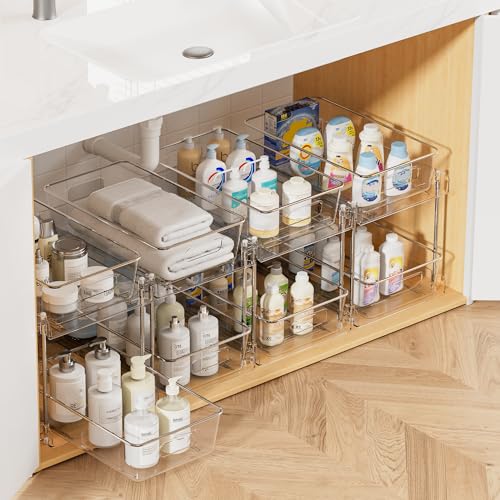
Vtopmart Pull-Out Under Sink Organizer — Best Under-Sink Access
The cabinet beneath a bathroom sink is where good intentions go to be stored behind a U-bend. This Vtopmart organiser attacks the problem with drawers that slide out toward you, converting the cave into two reachable layers. Bottles that once required kneeling, a torch and optimism now present themselves at the front of the cabinet, labels forward, like shop stock. The frame is shaped to negotiate the plumbing that makes this zone so hostile to ordinary shelves.
Sold as a multi-pack, the set lets a household standardise: one unit under the bathroom sink for cleaning sprays and spare toiletries, another in the kitchen for the identical chaos that gathers there. The clear construction continues the visibility theme of this guide, and the drawers lift out when a bottle inevitably leaks, so the cleanup is a rinse rather than a cabinet excavation.
Load it thoughtfully. Heavy bottles ride best in the lower drawer, lighter tubes and packets above, and anything used weekly should live at the front of its drawer rather than in the honoured back row. Measure the cabinet’s interior height and the pipe positions before ordering, because under-sink geometry is the most individual measurement in the entire house and no organiser, however clever, can negotiate a waste pipe that occupies its exact footprint.
- Format: pull-out drawers for under-sink use
- Design: shaped around household plumbing
- Visibility: clear drawer construction
- Quantity: multi-pack for several cabinets
- Care: drawers lift out after leaks
Strengths
- Back-of-cabinet items finally become reachable
- Pull-out motion suits stiff knees and bad light
- Standardises storage across several rooms
Trade-offs
- Cabinet measurements must be checked carefully
- Very tall bottles may exceed drawer height
- Plastic tracks prefer reasonable loads
Best for: anyone whose under-sink cabinet currently requires kneeling and faith
Not suited for: households standardising storage in bathroom and kitchen together

AOJEZOR Toilet Paper Holder Stand — Best Slim Renter Stand
Some bathrooms have a gap beside the toilet so narrow that visitors assume it is decorative. The AOJEZOR stand was designed for exactly that sliver: a freestanding holder that keeps the working roll at hand and stores spares in the same tiny footprint, without asking the wall for a single screw. For renters, that last clause is the entire review, because it converts a landlord’s no-drilling rule from a storage sentence into a mild preference.
The stand’s virtue is humility. It does not pretend to be furniture, it does not demand assembly heroics, and it can be lifted out with one hand when the floor needs mopping, which is more than wall-mounted holders ever permit. In small ensuites and cloakrooms it often becomes the difference between spare rolls living in another room entirely and spares existing where they are actually needed.
Treat it as a specialist rather than a system. It solves the toilet paper geography of a bathroom and nothing else, and its slim frame prefers a level floor. Households wanting it to also hold a phone, a book and a scented candle are asking a ballerina to do a porter’s job. Pair it with the wall and over-toilet pieces in this guide for the rest of the room’s needs.
- Format: freestanding toilet paper holder stand
- Storage: working roll plus spare rolls
- Installation: none, fully freestanding
- Footprint: slim, for narrow gaps
- Audience: renters and small bathrooms
Strengths
- Needs no drilling, drilling bans irrelevant
- Lifts away instantly for floor cleaning
- Uses a gap most bathrooms waste
Trade-offs
- Solves one job only, by design
- Slim frame wants a level floor
- Capacity suits spares, not bulk buying
Best for: renters and anyone with a narrow strip of floor beside the toilet
Not suited for: guest cloakrooms where spare rolls must live in the room
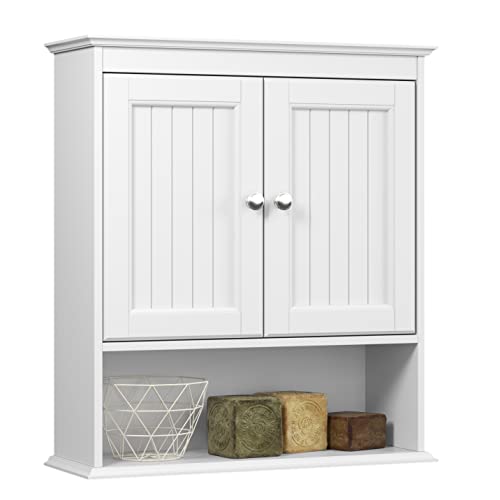
Spirich Wall Cabinet with Beadboard Doors — Best Cottage Wall Cabinet
A wall cabinet is the grown-up answer to bathroom clutter, and the Spirich makes the answer charming: beadboard doors in white, an adjustable shelf inside, and a combination of concealed and open storage that lets a household hide the chaos while displaying the one pretty bottle. Mounted above the toilet or over a sink, it claims the wall space that in most bathrooms holds nothing but a framed print and good intentions.
Inside, the adjustable shelf is the detail that earns its keep weekly. Tall mouthwash bottles and short cream jars stop competing for the same fixed altitude, and the shelf migrates as the household’s products change. The doors close on the visual noise that makes bathrooms feel smaller than they are, which is a psychological storage gain quite separate from the physical one: a calm room reads as a larger room.
Mounting deserves respect. This is a real cabinet with real weight once loaded, so it belongs on studs or proper wall anchors, levelled carefully, at a height that shorter adults can reach without tiptoe choreography. Households uneasy with that installation should hire it out without embarrassment; a cabinet installed crookedly or insecurely will be resented daily, while a well-hung one disappears into the architecture.
- Format: wall-mounted cabinet, beadboard doors
- Interior: adjustable shelf
- Storage: concealed plus open sections
- Placement: above toilet or sink
- Finish: white, cottage style
Strengths
- Reclaims blank wall as serious storage
- Doors hide visual clutter completely
- Adjustable shelf follows changing bottles
Trade-offs
- Installation needs studs or sound anchors
- White finish shows bathroom dust honestly
- Capacity is cabinet-scale, not cupboard-scale
Best for: owners ready to claim the wall above the toilet permanently
Not suited for: cottage and traditional bathrooms wanting storage with charm
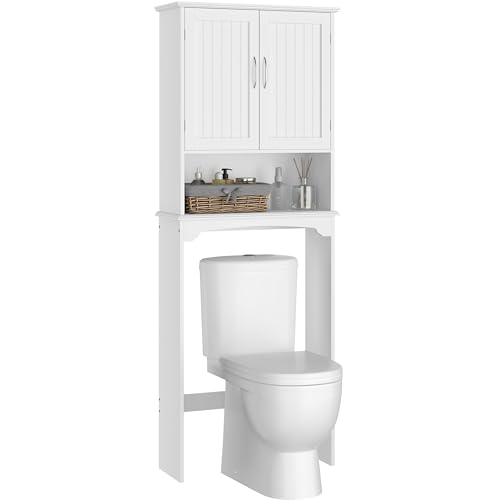
Yaheetech Over the Toilet Storage Cabinet — Best Over-Toilet Tower
Where the wall cabinet is a shelf with doors, the Yaheetech is a piece of furniture that happens to hang over a toilet. Two beadboard doors conceal the main compartment, an open section keeps daily items grabbable, and the whole tower turns the most wasted vertical run in the bathroom into the room’s storage headquarters. Towels, spare toiletries, cleaning supplies and the guest supplies all find floors in this building.
The included anti-tip kit matters and should actually be installed, because a tall loaded tower deserves the same respect as a bookcase in a child’s room. Assembly is a longer project than the other picks here, best approached with a second person, a clear floor and the instructions read before the first panel is unwrapped. The result justifies the afternoon: floor space stays free, the toilet remains fully usable, and the room gains the visual order of a fitted piece.
Before ordering, measure the height from floor to the top of your toilet cistern and confirm the tower’s lower opening clears it with room for the lid to lift during repairs. That single measurement decides success in this category more than any other. Households with unusually tall or wall-hung toilets should compare dimensions twice, because an over-toilet tower is a commitment piece, not a casual experiment.
- Format: over-toilet freestanding tower
- Storage: two doors plus open compartment
- Safety: anti-tip kit included
- Contents: towels, toiletries, supplies
- Assembly: two-person project
Strengths
- Largest storage gain in this guide
- Floor remains completely free
- Open shelf keeps daily items accessible
Trade-offs
- Assembly takes real time and care
- Cistern clearance must be measured
- Tower scale overwhelms tiny cloakrooms
Best for: bathrooms with no linen cupboard and a blank wall over the toilet
Not suited for: households needing towel storage inside the bathroom itself

madesmart Two Tier Organizer — Best Tiered Pull-Out Basket
The madesmart organiser is the diplomat of this line-up, a two-tier basket system with dividers that fits inside cabinets, under sinks and on deep shelves, quietly imposing order wherever it is posted. The frosted finish hides minor scuffs, the tiers slide so the back row can be inspected, and the dividers convert one wide basket, in which bottles topple like dominoes, into neighbourhoods where each category keeps to itself.
Its natural home is the under-sink cabinet beside the Vtopmart pull-outs, or inside a vanity drawer too deep for its own good. Cleaning supplies stand upright between dividers instead of leaning in a mildew-scented huddle, and the whole unit lifts out when the cabinet floor needs wiping. Because it is not bathroom-specific, households routinely reassign it to kitchens and offices as needs change, which is the hallmark of storage worth buying.
The trade-offs are scale and openness. Two tiers hold a curated collection, not a warehouse, and the open baskets display their contents, so this is order rather than concealment. Pair it with the doored pieces in this guide when visual calm is the goal. Used together, they demonstrate the system’s logic: baskets for working stock, doors for everything the eye should rest from.
- Format: two-tier organiser with dividers
- Finish: frosted, scuff-forgiving
- Motion: tiers pull out for access
- Placement: cabinets, under sinks, shelves
- Use: toiletries or cleaning supplies
Strengths
- Dividers stop bottles toppling over
- Fits inside existing cabinets and drawers
- Reassigns easily to other rooms
Trade-offs
- Open design displays rather than hides
- Tier capacity suits curated stock
- Tall spray bottles may not fit
Best for: deep cabinets and drawers needing internal order
Not suited for: households that like open, visible, grabbable storage
How Do the Six Picks Compare?
| Pick | Form | Standout trait | Watch out for |
|---|---|---|---|
| Vtopmart Stackable Storage Drawers 4 Pack | Stackable drawers | Small-item visibility | Tall stacks need level ground |
| Vtopmart Pull-Out Under Sink Organizer | Pull-out cabinet drawers | Under-sink reach | Measure pipe positions first |
| AOJEZOR Toilet Paper Holder Stand | Freestanding stand | Zero-install roll storage | One job, narrowly done |
| Spirich Wall Cabinet with Beadboard Doors | Wall cabinet | Concealed wall storage | Needs secure mounting |
| Yaheetech Over the Toilet Storage Cabinet | Over-toilet tower | Maximum capacity gain | Check cistern clearance |
| madesmart Two Tier Organizer | Two-tier basket | Internal cabinet order | Open, not concealing |
What Are the 30 Storage Ideas, Zone by Zone?
Thirty ideas can overwhelm if they arrive as a single list, so they are grouped by the zone they transform. Work through one zone per weekend and the bathroom changes without a single day of chaos. The numbering runs continuously so you can tick ideas off as they land.
Over-Toilet Zone
- Install an over-toilet tower and give towels a home inside the bathroom at last, ending the hallway linen expedition mid-shower.
- Hang a wall cabinet above the cistern for medicines and creams, high enough to stay dry and visible enough to audit.
- Add a slim shelf over the toilet for the guest set: spare roll, hand towel and one plant that tolerates steam.
- Use the top of the cistern itself only for a small tray, never a stack, so the lid still lifts for repairs.
- Mount a spare-roll holder on the wall beside the toilet where hands actually reach, not where symmetry suggests.
- Keep one basket on the tower’s open shelf for guest supplies, so visitors never need to open your cabinets.
Under-Sink Zone
- Fit pull-out drawers around the plumbing and retire the kneel-and-grope method of finding cleaning sprays forever.
- Stand bottles on a two-tier organiser so labels face forward and nothing hides behind the U-bend again.
- Decant the cleaning kit into one caddy that lifts out whole, leaving the cabinet floor empty and wipeable.
- Store spare toilet rolls in the dead corner beside the pipes, bagged against drips, where their bulk does no harm.
- Move everything that is not bathroom stock out of this cabinet; paint and tools have other homes to haunt.
- Line the cabinet floor with a washable mat, because the first leak is a matter of when, not if.
Walls and Doors
- Hang hooks behind the door for robes and towels in use, reclaiming the largest unused surface in the room.
- Fit an over-door rack for the hair dryer and straighteners, with their cords looped rather than counter-coiled.
- Add a magnetic strip inside a cabinet door for tweezers, scissors and nail clippers that otherwise wander.
- Mount a shallow shelf above the door frame for bulk spares bought on offer, visible but out of daily traffic.
- Use adhesive hooks inside the shower for razors and brushes, keeping the tub rim clear for actual bathing.
- Install a mirrored cabinet where a plain mirror hangs, and gain a shelf for every daily bottle in one swap.
Counters and Surfaces
- Corral the daily handful, toothbrushes, soap, one cream, onto a single tray that lifts for wiping in seconds.
- Give each person a small caddy that lives in a drawer or cabinet and commutes to the counter only during use.
- Banish the medicine collection to the wall cabinet, because counters are worktops, not pharmacies or archives.
- Keep one hand towel on a ring beside the sink and the spares in the tower, not draped across every surface.
- Choose a soap dispenser that refills from bulk and retire the parade of mismatched bottles along the sink edge.
- Leave one stretch of counter deliberately empty; an empty surface is what makes a small bathroom feel designed.
Inside Cabinets and Drawers
- Stack clear drawers inside a deep vanity cabinet and convert its dark volume into four auditable categories.
- Divide every drawer by job, faces, hair, first aid, cleaning, and defend the borders during the Sunday tidy.
- Decant cotton buds and pads into jars inside the cabinet, freeing their bulky retail packaging for the recycling.
- Keep a small donation bag on the cupboard door for products that disappoint, so they leave instead of lingering.
- Date medicines with a marker when they enter the cabinet, and audit the whole collection twice a year.
How Do You Measure a Bathroom for Storage Furniture?
Measure the room the way storage fails: in the awkward places. Record the width and height of the gap beside the toilet, the internal dimensions of the under-sink cabinet including where the pipes intrude, the wall run above the toilet from cistern top to ceiling, and the door swing, because a door that strikes a new tower will be resented every single day. Write the numbers in your phone and shop with them open.
Heights deserve special suspicion. Over-toilet furniture must clear the cistern with the lid future removal in mind, wall cabinets must hang low enough for the shortest adult yet high enough to clear taps and heads, and stackable drawers must fit the shelf they are destined for with the drawer fully extended. A tape measure used twice is cheaper than a return label used once, and in storage, fit is not a detail; fit is the product.
What Mistakes Make Bathroom Storage Fail?
The first mistake is buying containers before editing possessions. Storage purchased for clutter merely organises the clutter, at eye level, in matching colours. Edit first, count what survives, then buy for the survivors. The second mistake is choosing opaque baskets for small items, recreating the invisible-inventory problem in prettier materials. Third is filling every surface the new system frees, because storage that enables more accumulation has solved nothing.
Fourth, households ignore humidity, buying untreated baskets and paperboard boxes that swell and sag by spring. Fifth, they mount heavy cabinets on optimism rather than anchors. And sixth, they design for the household they wish they were, minimalists with four products, instead of the household that actually queues for this bathroom each morning. Storage designed for real people, in real quantities, is the only storage still working at Christmas.
How Do You Turn These Ideas Into One Weekend of Work?
Saturday morning belongs to the audit, and it should be ruthless enough to feel slightly uncomfortable. Empty one zone completely onto a towel on the floor, and sort what comes out into four honest piles: used weekly, used monthly, kept from guilt, and expired. The guilt pile is the one that built your clutter, housing nearly finished products you disliked, gifts you felt obliged to store, and bulk purchases whose savings evaporated the moment they began colonising a cabinet. Let that pile leave the house before any organiser is ordered.
Saturday afternoon is measuring and ordering, in that order and no other. Photograph each emptied zone with the tape measure visible in frame, because dimensions you can see are dimensions you will not misremember at midnight while shopping. Choose the anchor piece for the worst zone first, the tower or the drawers or the pull-outs, and let the smaller decisions wait until the anchor has proven itself in place. Storage systems built one proven piece at a time rarely collapse into regret.
Sunday is installation and arrangement, and arrangement is a skill of its own. Place items by frequency, not by category purity: the daily handful at hand height, the weekly stock one reach away, the monthly supplies highest and deepest. A system that files a daily cream behind a monthly one will be quietly sabotaged by its own users within a week, and they will be right to sabotage it. Convenience is not the enemy of order; convenience is the mechanism by which order survives contact with tired people.
The following weekend, resist buying anything. Live with the gaps. Notice which items migrate back to the counter, because those migrants are data: they are telling you their assigned home is too far, too high or too fiddly for the hour at which they are used. Move their home rather than scolding the household. Storage that adapts during its first month becomes permanent; storage defended rigidly becomes a museum people route around.
Which Ideas Suit Which Households?
A single person in a studio flat needs the fewest pieces and gains the most from each. One stackable drawer tower can hold the entire small-item economy of such a bathroom, and a slim stand beside the toilet replaces the linen cupboard that does not exist. The temptation in tiny homes is to buy many small organisers; the discipline is to buy two capacious ones and edit possessions to fit them, letting the furniture set the household’s honest capacity.
Couples sharing one bathroom should think in duplicates and territories. Two caddies rather than one shared jumble, a wall cabinet shelf each, and hooks in pairs prevent the low-grade friction that disorganised bathrooms manufacture daily. The over-toilet tower earns its place here by separating towel stocks, while clear drawers end the archaeological disputes about whether a replacement was ever bought. Peace is a storage feature, and in shared bathrooms it may be the main one.
Families with children need storage that survives being used by people who will not respect it. Low pull-out drawers children can operate themselves, open baskets for their bath toys and step-stool supplies, and medicines locked or lifted well beyond reach form the working pattern. Anything with a delicate mechanism will be tested to destruction by October. Choose the boring, sturdy pieces from this guide and place the pretty ones in the parents’ ensuite, where civilisation still holds.
Households with an older relative or anyone with limited mobility should read the pull-out sections twice. Kneeling to excavate a cabinet is not a minor inconvenience at seventy; it is a fall risk with a door. Pull-out drawers, eye-level wall cabinets and stands that keep essentials beside the toilet convert the bathroom from an obstacle course into a room that cooperates. Install grab-friendly handles, keep daily items between knee and shoulder height, and let the high shelves hold only the lightest, rarest things.
Guest bathrooms deserve their own logic: visible generosity, minimal personal stock. A stand with spare rolls in plain sight, a basket of guest supplies on an open shelf, and empty drawer space that silently invites visitors to unpack. Nothing makes a guest feel more welcome than storage they do not have to ask permission to use, and nothing makes them feel more like an intruder than cabinets crammed with the household’s overflow. Keep the guest room’s storage half empty on purpose.
How Do You Keep the System Working After Month One?
Systems decay at the borders, so defend the borders. When a new product enters the bathroom, something of similar size should leave, and the new arrival gets an assigned home before its first use, not after a week of counter residency. This one-in-one-out courtesy takes four seconds and prevents the slow re-cluttering that makes people believe storage products do not work. The products work; the borders were unguarded.
Labels are the second defence, unfashionable and undefeated. A label inside a drawer or on a shelf edge tells every household member, every babysitter and every future you exactly where things belong, removing the excuse of uncertainty under which clutter re-enters. Labels can be as plain as masking tape; their authority comes from existing, not from typography. Review them during the twice-yearly audit and rewrite any that life has outgrown.
The third defence is a five-minute weekly reset, ideally attached to an existing habit such as the bathroom clean. Return migrants to their homes, wipe the tray, check the stand’s spare rolls, and glance into the clear drawers to see what is running low. Five minutes weekly is the entire maintenance cost of the thirty ideas in this guide, which is a remarkable exchange rate for a room that stays findable, calm and easy to clean for years.
What Does Good Bathroom Storage Do for Cleaning and Hygiene?
An organised bathroom is faster to clean in ways that compound. Surfaces clear in one tray-lift rather than a dozen bottle relocations, cabinet floors wipe in a pass because organisers lift out whole, and the floor mops unobstructed when stands and towers respect the cleaning route. Households routinely report that the weekly clean shrinks by a third after a storage overhaul, which means the system pays rent in reclaimed time every single week.
Hygiene improves alongside speed. Products stored dry, upright and visible are products whose leaks are noticed the day they happen rather than the month they are discovered as a sticky archaeological layer. Medicines kept in a closed cabinet stay drier and are audited more honestly than medicines scattered across three rooms. Towels stored inside the bathroom in a tower with airflow stay fresher than towels stacked in a damp corner, provided the room ventilates as it should.
There is also the matter of what leaves. A storage system with a donation habit built into it, a bag on the cupboard door and an audit twice a year, keeps expired sunscreens, tired medicines and abandoned products flowing out of the house instead of aging in place. The bathroom becomes a room with a current inventory rather than a museum of past intentions, and that currency is felt every morning as simple, unglamorous ease.
Why Does the Under-Sink Cabinet Deserve Its Own Strategy?
No zone in the house wastes as much volume per litre as the cabinet under a bathroom sink. The plumbing arrives like an occupying army, the cabinet is deep enough to hide a small suitcase, and the door opens onto darkness at knee height. Conventional shelving fails here completely, which is why this guide attacks the zone with motion instead: drawers that slide, tiers that pull, caddies that lift. Once everything in the cabinet can travel to the light, the zone transforms from the worst storage in the home to some of the best.
Sort its contents into two nations before organising anything. The first nation is bathroom stock: spare toiletries, cleaning sprays for this room, guest supplies. The second nation is everything that drifted here because the cabinet had a door and the household had a deadline, and that nation should emigrate. Paint, tools, hallway overflow and mystery bottles belong elsewhere. An under-sink cabinet with a single citizenship is dramatically easier to keep, because every item inside it shares one room and one purpose.
Guard the zone against its natural enemy, the slow leak. Even a healthy trap weeps eventually, and the first sign is usually a warped cabinet floor discovered months late. The washable liner from the ideas list, plus organisers that lift out in seconds, turns that discovery into a five-minute inspection during the weekly reset. Run a fingertip along the trap joints whenever you are down there; your future self, spared a cabinet replacement, sends thanks.
Why Do Walls Outperform Floors in Small Bathrooms?
Floor space is the currency bathrooms are poorest in, while wall space is the currency they waste most freely. A wall cabinet and an over-toilet tower together can add the equivalent of a small cupboard without consuming a single step of floor, and they lift storage into the sightlines where adults actually look. Anything stored below knee height effectively requires a reason to visit; anything at eye height gets used, audited and kept honest automatically.
Height has limits worth respecting. The top shelf of any wall unit should hold only light, rarely used items, because retrieving a heavy bottle from above shoulder height, on tiptoe, in a room with hard floors, is an accident rehearsing itself. Reserve the altitude for spare towels, bulk tissue and the guest kit. Daily life belongs between waist and eye level, a band so important that designers call it the golden zone, and every idea in this guide quietly obeys it.
Doors are walls that move, and the back of a bathroom door is square footage with a hinge. Hooks and over-door racks there hold the bulky soft goods, robes, towels in use, hair tools, that otherwise drape across every horizontal surface. Just confirm the door still opens fully against its stop and that hanging weight has not begun to worry the hinges, particularly in older houses where doors have already lived several lives.
How Should Renters and Owners Split These Ideas?
Renters should build their system from the freestanding nation: stackable drawers, pull-out inserts that sit inside existing cabinets, the slim toilet stand, over-door racks and adhesive hooks. Every one of these leaves with the tenant, leaving the bathroom exactly as found and the deposit unargued. The over-toilet tower usually qualifies too, since it stands rather than mounts, though its anti-tip kit deserves a removable fixing agreed with the landlord rather than a hopeful screw.
Owners can add the permanent layer: the wall cabinet on proper anchors, a mirrored cabinet replacing a plain mirror, perhaps a shelf built into a stud bay during a future renovation. The permanent layer should be installed only after the freestanding system has proven the household’s real patterns for a season, because walls forgive repositioning far less readily than furniture does. Let the portable pieces conduct the experiment; let the drill merely confirm its results.
Both groups share the same final truth, which is that storage succeeds by editing before it succeeds by furniture. A renter with ruthless editing and two good organisers will out-store an owner with a fitted cupboard full of guilt and duplicates. The ideas in this guide are ranked by that philosophy throughout: visibility first, motion second, furniture third, and sentiment nowhere near the tape measure.
How Do Towels, Laundry and Cleaning Fit the System?
Towels are the bulkiest citizens of any bathroom and the worst planned. A household’s towel stock usually lives wherever history left it: an airing cupboard, a bedroom wardrobe, a chair. The over-toilet tower changes the geography by giving towels an address inside the room where they are used, rolled rather than folded to save volume and to make the stock countable at a glance. Keep the working set small, two per person in rotation, and let the tower hold the spares where a wet hand can reach them.
Laundry needs a planned exit, not a floor corner. A slim hamper that fits the same narrow gap family as the toilet stand, or a bag hanging on the door’s back, keeps worn clothes moving toward the wash instead of accumulating as bathroom topography. In family rooms, a divided hamper teaches children the lights-and-darks lesson at the point of undressing, which is the only place the lesson ever truly lands.
Cleaning supplies for the bathroom should live in the bathroom, in the lift-out caddy described earlier, because a kit that must be fetched from another floor is a kit that gets used late. Keep the kit small: one spray for surfaces, one for glass, a cloth, a brush. When the caddy is light enough to carry in one hand while opening doors with the other, the five-minute reset described above becomes genuinely five minutes, and the storage system starts maintaining the room instead of merely containing it.
What Is the Counter Tray Rule, and Why Does It Work?
Of all thirty ideas, the tray rule changes daily life the most per penny spent. Everything permitted to live on the counter must fit on one tray, and everything else needs an address elsewhere. The tray converts an argument about tidiness into a question of geometry, which households find far easier to settle at seven in the morning. When the tray overflows, the newest arrival is volunteering for relocation, and everyone can see it.
The rule works because counters fail by inches, not by feet. One bottle beside the tap is a choice; nine bottles are a landscape, and landscapes invite settlement. The tray also makes cleaning honest, since a single lift exposes the whole surface to the cloth, removing the ring-marked archaeology that forms around permanent bottle residents. Choose a tray with a raised edge, washable material and no sentimental value, because it will be handled daily and dropped eventually.
Expect a fortnight of negotiation while the household discovers what its true daily handful is. Toothbrushes and soap are uncontroversial; the third face cream and the rarely used styling product are where diplomacy is required. Let usage decide: anything untouched for two weeks on the tray earns a cabinet address. By the end of the month the counter will hold a small, calm still life, and visitors will ask whether the bathroom was recently renovated.
How Do You Store for Safety Around Children and Medicines?
Storage is also a safety system, and the bathroom concentrates a household’s sharpest and most chemical possessions in its smallest room. Medicines belong in the wall cabinet, high and closed, never on the counter where small hands patrol. Razors, scissors and nail tools belong on the magnetic strip inside a cabinet door or in the top drawer of a stack, beyond the reach of the under-five population while remaining findable for adults.
Cleaning chemicals deserve the same respect as medicines. The under-sink cabinet is their traditional home and also the first cabinet a toddler learns to open, so a simple latch on that door is among the cheapest safety devices a household can fit. Pull-out organisers help here too, oddly enough, because a cabinet whose contents are visible and ordered is a cabinet whose hazards are known rather than forgotten behind the pipes.
Finally, weigh the furniture itself. Towers get their anti-tip kits installed, wall cabinets get their anchors checked annually, and nothing heavy lives on a shelf above a bath where a sleeper soaks. These are thirty-second considerations during installation that convert storage from a convenience into part of the room’s safety architecture, which is exactly what good storage in a wet, hard-surfaced room should be.
Which Idea Should a Complete Beginner Do First?
If the whole programme feels like a renovation in disguise, shrink it to a single afternoon and a single zone. Clear the counter and install the tray rule today, because it costs almost nothing and its effect is visible before dinner. Tomorrow, empty the under-sink cabinet onto a towel, discard bravely, and measure the space for pull-outs. Those two moves alone typically recover more usable room than a new cabinet would, and they teach the editing habit on which everything else in this guide depends.
Then notice how the room feels for a week before buying anything larger. Storage purchased in the afterglow of a tidy counter is usually storage purchased wisely, because the household has learned what it actually owns. The tower, the wall cabinet and the drawer stacks will still be there next weekend, and by then you will know precisely which of them your bathroom has been asking for all along.
One habit ties the beginner moves to the full system: photograph each zone when it is finished and keep the picture on your phone. The photograph becomes the room’s constitution, the reference every household member can check when an item’s home is disputed and the standard the weekly reset restores. It sounds ceremonial; in practice it ends more storage arguments than any organiser ever sold, because nobody has to argue with a picture of their own bathroom looking calm.
Revisit that photograph after three months and take a second one from the same spot. The comparison will show you exactly where your system is holding and where life has negotiated amendments, and amendments are not failures. They are the system learning your household. Adjust the homes, rewrite a label or two, and the next photograph will hold for longer, until the room simply stays the way the picture shows it.
Keep the measuring habit alive after the system is built, too. Every future purchase, from a bulk tissue pack to a new hair tool, should be mentally placed in a measured home before money moves. If no home exists, the purchase is not a bargain at any discount; it is rent charged against your calm. Households that adopt this single question, where exactly will it live, stop needing storage overhauls altogether.
And when visitors compliment the room, as they will, resist crediting the furniture. The calm they are noticing is the editing, the zoning and the borders, maintained five unhurried minutes at a time, week after ordinary week, all year round. The six products in this guide are simply the sturdiest tools we know for holding those decisions in place through busy seasons, visiting relatives, growth spurts and every other force that tests a household system.
Final Recommendation
Start where your bathroom hurts most. If small items vanish, the stackable drawers will feel like a rescue; if the under-sink cave swallows bottles, begin with the pull-outs; if the room has no storage at all, the over-toilet tower changes the subject entirely. Add the wall cabinet when you are ready for permanence, the slim stand when the toilet gap mocks you, and the tiered basket wherever a cabinet needs internal government. Do one zone, live with it for a fortnight, and let the calm of that corner argue for the next, until the whole room holds only what earns its place and every object can be found in the dark, by any member of the household, without a shout down the stairs asking where anything lives anymore.
Frequently Asked Questions
How do I store things in a bathroom with no cabinets?
Build upward and use the walls. An over-toilet tower creates a cabinet where none existed, a wall cabinet adds concealed storage above head height, and freestanding stands exploit the floor gaps beside fixtures. Clear stackable drawers can stand on a counter corner or a small stool-height shelf unit. Renters can achieve nearly all of this without drilling, using freestanding pieces and adhesive hooks, then take the whole system when they move.
What is the best storage for a very small bathroom?
The highest-yield pieces are the ones using vertical and hidden space: over-toilet towers, pull-out under-sink drawers and slim stands for the toilet gap. Small bathrooms suffer less from lack of volume than from wasted height and unreachable corners. A single tray rule on the counter completes the effect, because visual clutter, not objects alone, is what makes a compact room feel cramped.
How do I keep bathroom storage from getting damp?
Choose plastic, coated metal or sealed engineered wood over untreated natural fibres, and leave air gaps rather than packing items tight against cold walls. Lift organisers out and dry the cabinet floor whenever a leak or condensation appears. Ventilation is the silent partner of all bathroom storage: run the extractor during showers and crack the door afterwards, so stored towels and paper goods stay fresh rather than faintly swampy.
Should bathroom storage be open or closed?
Both, assigned by job. Closed storage, wall cabinets and towers with doors, hides the visual noise of medicines and mixed bottles and keeps dust off towels. Open storage, tiered baskets and clear drawers, suits working stock you reach for daily and need to audit at a glance. Rooms with only open storage look busy; rooms with only closed storage hide duplicates. The six picks here deliberately mix the two.
How often should I reorganise bathroom storage?
A light audit twice a year keeps any system honest: remove everything from one zone, discard the expired and the abandoned, wipe the surfaces, and return only what is used. The zone-by-zone layout of this guide makes that a twenty-minute task per area rather than a dreaded weekend. Systems fail by slow accumulation, not by single events, so small regular corrections beat heroic annual purges.
Related Guides
Storage pairs naturally with the cabinet guide beside it, while the remaining companions cover the bedroom and the air that moves between both rooms: Best Bathroom Storage and Vanity Cabinets Best Alarm Clocks with Bedside Lamps Best Alarm Clocks for the Deaf and Hard of Hearing Best Air Purifiers for a 1-Bedroom Apartment.



[…] the other half is order and air, which is why these companions sit naturally beside this guide: 30 Bathroom Storage Ideas to Save Space Best Alarm Clocks for Heavy Sleepers and ADHD Best Alarm Clocks for College Students Best Air […]