What's inside
- Key Takeaways
- Quick Picks
- How Did We Choose the Best Alarm Clocks for the Deaf and Hard of Hearing?
- How Do the Six Picks Compare Side by Side?
- Where Exactly Should a Bed Shaker Be Placed?
- How Do Vibration, Light and Sound Work Together as Layers?
- What Should Travellers Who Are Deaf or Hard of Hearing Pack?
- How Can Households Keep a Vibrating Alarm Reliable for Years?
- How Should Parents Set Up a Vibrating Alarm for a Deaf Child or Teenager?
- What About Alarms for People Whose Hearing Changes Over Time?
- How Do These Clocks Fit Alongside Phones, Watches and Smart Home Alerts?
- How Strong Is Strong Enough, and How Can You Test It Fairly?
- What Should Guests, Hospitals and Care Settings Learn From These Clocks?
- How Does a Vibrating Alarm Change the Experience of Waking Itself?
- What Should You Check in the First Week of Ownership?
- How Should the Alarm Be Set for Shift Workers and Irregular Weeks?
- What Are the Most Common Mistakes When Choosing a Vibrating Alarm?
- Final Recommendation
- Frequently Asked Questions
- Related Guides
As an Amazon Associate I earn from qualifying purchases. This post may contain affiliate links at no extra cost to you.
cottageverdict.com is reader-supported. When you buy through links on our site, we may earn an affiliate commission.
Where to buy: each clock below links to its Amazon listing, where you can check price on Amazon and confirm the shaker type, power options and included accessories before ordering.
The best alarm clocks for the deaf and hard of hearing do not try to shout louder than hearing loss. They change the channel entirely. Instead of sound alone, they wake through the body: a puck under the mattress that shakes the bed frame, a pad beneath the pillow that pulses against the shoulder, a strobe that floods the room with light, or a wearable-style vibration that travels with the sleeper. For people who remove hearing aids or implants at night — which is to say, for most of the people these clocks serve — the night is silent by design, and the morning has to arrive by touch and by sight.
This guide treats that as an engineering brief, not a niche curiosity. How strong is the vibration, and can its strength be adjusted for a light sleeper who needs a nudge rather than an earthquake? Where exactly does the shaker sit, and how far does its cable reach? What happens when the power fails at three in the morning — does a battery backup hold the alarm, or does the whole system depend on the grid? Can the clock travel, because deaf travellers deserve hotel mornings as reliable as anyone’s? And can the sound be turned down or off entirely for a hearing partner, or a household where one sleeper needs vibration and the other needs quiet?
Six systems answered those questions well, and they divide by approach. Three are full bedside clocks with wired bed shakers, built for maximum force at home. One is a portable vibrating clock designed to slip under a pillow anywhere on earth. One pairs a wireless shaker with an app, for people who live by their phone’s calendar. One is a rechargeable under-pillow clock for lighter sleepers and travellers. All six also offer some combination of loud sound and flashing light, because many hard-of-hearing sleepers use residual hearing as one layer among several — and because a good accessibility tool offers redundancy, not a single point of failure.
A note on tone, because it matters: needing a vibrating alarm is an ordinary fact of life for millions of people, and this guide writes about these clocks the way it would write about any well-designed tool — concretely, respectfully, and with attention to the details that decide whether the thing works on a wet Tuesday in February. No medical claims appear here; these are wake-up devices, not treatments, and questions about hearing itself belong with an audiologist rather than a shopping guide.
Key Takeaways
- Vibration is the primary channel: judge these clocks by shaker strength, placement and adjustability first.
- The shaker puck belongs between mattress and base or under the pillow — placement changes everything.
- Battery backup is essential, because an alarm that dies with a power cut is a missed morning.
- Wireless and rechargeable options suit travel and beds where a cable cannot sensibly run.
- Sound and strobe work best as backup layers that can be dimmed, quietened or switched off.
- Buy for the sleeper’s actual depth of sleep; adjustable force beats maximum force for most people.
Quick Picks
| Pick | Badge | Why it made the list |
|---|---|---|
| Sonic Bomb Dual Alarm Clock with Bed Shaker | Strongest bedside system | A dual-alarm clock with a powerful bed shaker, flashing lights and battery backup for the deepest sleepers. |
| Serene Innovations Vibrating Alarm Clock | Best portable all-rounder | A compact vibrating clock with a bed shaker, flash alerts and travel-friendly multi-mode design. |
| iLuv SmartShaker 3 | Best app-connected shaker | A wireless rechargeable shaker with many alarms plus call and app alerts through a phone connection. |
| uscce Loud Dual Alarm Clock with Bed Shaker | Best adjustable home setup | A dual-alarm clock whose shaker strength adjusts, with a full-range dimmer and battery backup. |
| DreamSky Vibrating Alarm Clock | Best under-pillow traveller | A rechargeable vibrating clock made to live under a pillow at home or in a hotel anywhere. |
| ANJANK Extra Loud Alarm Clock with Wireless Bed Shaker | Best wireless home shaker | A dual-alarm clock with a cable-free shaker, light wake-up, nine-colour night light and USB charging. |
How Did We Choose the Best Alarm Clocks for the Deaf and Hard of Hearing?
Vibration quality came first, and it is more nuanced than raw power. A shaker must be strong enough to register through a mattress, yet controllable enough not to rattle the teeth of a lighter sleeper sharing the bed. We favoured systems with adjustable intensity or a choice of patterns, and we paid attention to where the vibration is delivered: a puck under the mattress shakes the whole sleeping surface, which suits deep sleepers, while a pad under the pillow delivers a more local, personal signal that disturbs a partner far less.
Reliability formed the second test. Battery backup was treated as close to mandatory for the bedside systems, because an accessibility alarm that fails silently during a night-time outage fails at its only job. We also looked at how the alarm behaves across a week: dual alarms for different days, snooze arrangements that a half-asleep hand can manage, and displays that confirm at a glance — visually, without needing to hear a beep — that the alarm is armed for the morning.
The third test was life beyond the bedside table. Cables were measured in practical terms: can the shaker reach from the clock’s likely position to the middle of the bed? Wireless systems were judged on charging discipline and connection simplicity. Portability mattered because travel is where deaf and hard-of-hearing people are worst served by ordinary hotel wake-up calls, which are, after all, just a telephone ringing in a silent room. A clock that packs flat and runs on its own battery solves a real and recurring problem, and the two travel-ready picks here earned their places on exactly that ground.

Sonic Bomb Dual Alarm Clock with Bed Shaker — Strongest bedside system
The Sonic Bomb is the reference point of this category, the clock other vibrating alarms are measured against. Its bed shaker is a puck on a cable, designed to slide between mattress and base where its vibration couples into the whole bed; when it fires, the bed itself becomes the alarm, and sleeping through it requires a talent most people simply do not possess. Around that shaker sits a dual-alarm clock with flashing light alerts and a very loud audible alarm for those who use sound as one layer among several — or for hearing partners who prefer to be woken and do the final rousing in person.
Battery backup keeps the promise through outages, which is not a luxury in this category but the core of the contract. The dual alarms suit a working week with two rhythms, and the display’s dimming keeps the room dark for anyone sharing it. Setup is a physical, uncomplicated affair: position the puck, route its cable where it will not be kicked loose, set the alarms, and test the whole system on a morning that does not matter before trusting it with one that does.
Who should temper the enthusiasm? Lighter sleepers may find the full-force shake more than they need, and partners in the same bed will feel a mattress-coupled puck almost as clearly as its owner. For a solo sleeper, a deep sleeper, or anyone who has already slept through lesser devices, that force is precisely the point. This is the heavy artillery of waking, deployed justly.
- Type: bedside dual-alarm clock with wired bed shaker
- Shaker: puck placed between mattress and bed base
- Alerts: vibration, flashing lights and a very loud audible alarm
- Power: mains with battery backup for outage protection
- Best setting: home bed of a deep sleeper, solo or agreed
Strengths
- The shake is strong enough to end arguments about waking.
- Battery backup protects the one morning that cannot be missed.
- Dual alarms handle workdays and weekends without resetting.
Trade-offs
- A partner in the same bed will feel the puck’s work clearly.
- The wired shaker ties the setup to one bed, arranged once.
- Maximum force is more than light sleepers will ever require.
Best for: profoundly deaf sleepers and very deep sleepers at home.
Not suited for: travellers, or couples wanting a purely personal signal.

Serene Innovations Vibrating Alarm Clock — Best portable all-rounder
Serene Innovations builds for this audience specifically, and it shows in the priorities. This compact clock pairs a bed shaker with a built-in flash alert and a loud audible option, then wraps the combination in a body small enough to earn its description as a travel companion. At home it sits modestly on the nightstand; packed, it turns any hotel bed into a bed that can wake its occupant — a transformation anyone who has stared at a silent hotel telephone will appreciate.
The multi-mode design lets the sleeper choose their channel: vibration alone for a shared room, flash added for a solo one, sound included where residual hearing or a partner makes it useful. That configurability is the difference between an accessibility product and a loud clock with a puck attached. The shaker itself delivers a firm, purposeful pulse rather than the Sonic Bomb’s full-bed commitment, which many sleepers will find the better-calibrated morning.
For people whose lives split between home and elsewhere — work trips, family visits, hospital stays where a reliable personal alarm matters enormously — this is the pick that follows them. Keep its cable coiled with the clock, test the flash in a dark room before relying on it, and it will perform in both lives without complaint.
- Type: compact vibrating clock with bed shaker and flash
- Alerts: vibration, visual flash and loud sound, selectable
- Design: small body intended to travel as well as sit
- Modes: multiple alert combinations for different rooms
- Best setting: home bedside plus regular overnight travel
Strengths
- Genuine portability solves the hotel wake-up problem properly.
- Selectable alert modes adapt to solo and shared rooms alike.
- Designed for this audience by a specialist maker.
Trade-offs
- The shake is firm rather than bed-moving at maximum depth.
- A compact display suits glance-checking, not reading across rooms.
- Travel use means remembering one more cable in the washbag.
Best for: deaf and hard-of-hearing people who travel regularly.
Not suited for: the deepest sleepers needing maximum bed-shaking force.

iLuv SmartShaker 3 — Best app-connected shaker
The SmartShaker 3 removes the clock from the nightstand entirely. What remains is a slim wireless shaker that lives under the pillow, paired by Bluetooth to a phone app where the alarms are set. The capacity is generous — up to twenty alarms — and the shaker also delivers call and app alerts, so the same vibration that announces morning can announce an incoming call at midnight. For people whose schedules live in their phone’s calendar, this collapses two systems into one familiar place.
Wireless life has its own disciplines. The shaker is rechargeable, so a charging habit must form — a weekly top-up at the desk, say — and the phone must stay within Bluetooth range overnight, which for most bedrooms means simply on the nightstand where it already lives. Automatic daylight-saving adjustment removes one classic failure mode, and compatibility spans both major phone platforms, sparing households the platform argument.
The vibration is a pillow-level signal: personal, precise and kind to partners, who will feel little of it through their own side of the bed. Deep sleepers who need the mattress itself shaken should look to the wired systems above; sleepers who want their phone’s intelligence delivered by touch, at home or in a travel bag where this puck takes almost no space, have found their device.
- Type: wireless pillow shaker controlled by phone app
- Alarms: up to twenty, plus call and app notifications
- Connection: Bluetooth to iOS or Android phones
- Power: rechargeable battery, charged on a weekly rhythm
- Convenience: automatic daylight-saving adjustment built in
Strengths
- Twenty alarms suit complex, phone-managed schedules perfectly.
- The under-pillow signal wakes its owner, not the whole bed.
- Call alerts extend its usefulness through the entire day.
Trade-offs
- A flat shaker battery means a silent morning — charge discipline matters.
- Depends on the phone staying nearby and connected overnight.
- Pillow-level force may not reach the very deepest sleepers.
Best for: phone-centric sleepers wanting one alert system day and night.
Not suited for: anyone who keeps their phone in another room overnight.
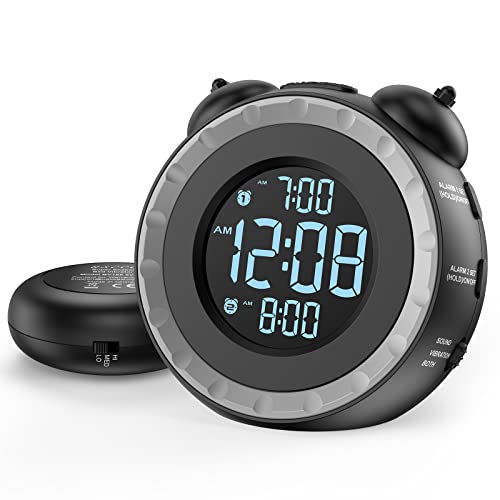
uscce Loud Dual Alarm Clock with Bed Shaker — Best adjustable home setup
Adjustability is this uscce’s whole argument, and in this category it is a persuasive one. The bed shaker’s strength can be set rather than merely endured, which lets a household calibrate the morning precisely: enough to wake the deaf sleeper, not so much that a hearing partner is launched out of the other side. Paired with a loud dual alarm and a display that dims across the full range to darkness, it is the most tunable of the wired home systems here.
Battery backup guards the arrangement against outages, and the dual alarms cover the standard two-rhythm week. The shaker follows the classic placement — slipped between mattress and base, cable routed to the clock — and the whole installation rewards ten unhurried minutes of setup: test strengths from the pillow, agree the sound level with anyone sharing the room, and confirm the display’s night brightness suits both sleepers. After that, it simply runs, which is the highest compliment available to a device whose job begins before its owner is conscious.
Compared with the Sonic Bomb, the uscce trades a little ultimate force for a lot of control. For couples in one bed — the situation where vibrating alarms most often succeed or fail as household diplomacy — that trade is usually the right one, and it is why this clock anchors the shared-bed recommendation in this guide.
- Type: dual-alarm clock with adjustable bed shaker
- Shaker: wired puck with selectable vibration strength
- Display: dims across the full range down to dark
- Power: mains operation with battery backup included
- Best setting: shared beds needing a calibrated wake signal
Strengths
- Adjustable shake strength respects a partner’s sleep too.
- Full-range dimmer keeps the room properly dark overnight.
- Dual alarms and backup cover the ordinary week’s risks.
Trade-offs
- Peak force sits a step below the category’s heaviest hitter.
- Calibration takes a deliberate setup session to get right.
- The wired puck fixes the arrangement to one bed at home.
Best for: couples sharing a bed with different hearing and schedules.
Not suited for: solo deep sleepers who simply want maximum power.
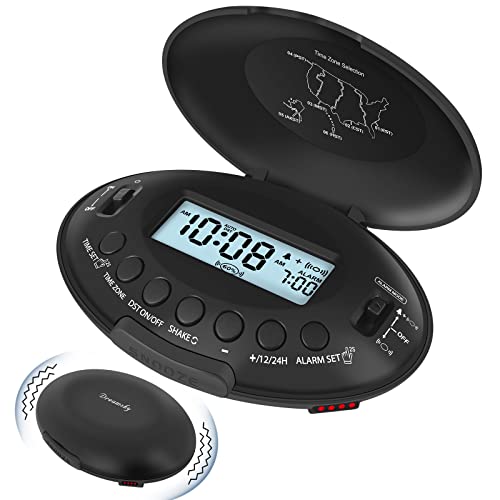
DreamSky Vibrating Alarm Clock — Best under-pillow traveller
DreamSky’s vibrating clock takes the opposite approach to the big bedside systems: instead of shaking the bed, it lives under the pillow and shakes the sleeper directly. The body is rechargeable and battery-run, with a backlight for night checks and automatic daylight-saving handling, and its whole design assumes movement — from bed to bag to a relative’s spare room — without cables, sockets or negotiation. For teenagers and students who are deaf or hard of hearing, that independence has a value beyond convenience: the morning becomes theirs, anywhere.
Under-pillow vibration is a distinct sensation from a mattress puck. It is local and unmistakable at the shoulder and neck, and it leaves the rest of the bed — siblings in a shared room, a partner at home — almost entirely undisturbed. The trade is depth: a sleeper who buries into heavy sleep may need the signal reinforced by routine, consistent placement and, on the biggest mornings, a household backup arrangement. Placement is the whole craft here: centred under the pillow, every night, not wherever it happened to land.
Charging is the standing obligation. A rechargeable clock that is flat is a decoration, so build the top-up into a weekly moment — while the bed is stripped, say — and the DreamSky will repay the habit with years of portable, personal mornings.
- Type: rechargeable vibrating clock for under the pillow
- Signal: direct pillow vibration, personal and localised
- Display: backlit face for night-time checking
- Convenience: automatic daylight-saving adjustment
- Best setting: travel, spare rooms and younger independent sleepers
Strengths
- Completely portable — no socket, cable or installation needed.
- The local signal barely registers elsewhere in the bed.
- Simple ownership suits teens managing their own mornings.
Trade-offs
- Recharging is a habit the owner must actually maintain.
- Very deep sleepers may need a stronger, bed-coupled system.
- It can migrate within the bed if placement gets careless.
Best for: travellers and young sleepers wanting an independent alarm.
Not suited for: anyone who routinely forgets to charge devices.

ANJANK Extra Loud Alarm Clock with Wireless Bed Shaker — Best wireless home shaker
The ANJANK removes the cable that defines most home shaker systems. Its bed shaker connects wirelessly to a dual-alarm clock that also offers a light wake-up, eight sound options, a nine-colour night light and a USB charging port — a combination aimed squarely at the modern bedroom, where the shaker’s traditional trailing wire is the one part of the setup everyone dislikes. Without the cable, the puck can sit exactly where it works best rather than where the wire reaches, and rearranging the bed stops being an installation project.
Layering is this clock’s philosophy. Vibration for the body, gradual light for the eyes, sound for whatever hearing the sleeper uses, each layer adjustable — the display dims across the full range — so the system can be tuned from a silent, tactile nudge to a full multi-sensory event. For households where hearing varies between partners, or where the same sleeper’s needs differ between workdays and rest days, that range is the product.
Wireless freedom carries the usual condition: the shaker needs its charge maintained, and the household must treat a low shaker battery with the same seriousness as a smoke alarm’s chirp. Build the check into the weekly routine and the ANJANK delivers the tidiest powerful setup in this guide.
- Type: dual-alarm clock with wireless bed shaker
- Alerts: vibration, light wake-up and eight sound options
- Display: full-range dimmer with nine-colour night light
- Extras: USB charging port for a phone at the bedside
- Best setting: home beds where a shaker cable cannot run
Strengths
- Cable-free shaker placement follows the bed, not the wiring.
- Three alert layers can be combined for almost any sleeper.
- Modern extras make it a complete bedside station.
Trade-offs
- The wireless shaker adds a second battery to keep charged.
- Feature richness means a longer first setup session.
- Light wake-up is wasted on sleepers who face away or mask up.
Best for: home users wanting strong vibration without any trailing cable.
Not suited for: minimalists who prefer one button and no menus.
How Do the Six Picks Compare Side by Side?
| Pick | Shaker style | Power | Travel ready |
|---|---|---|---|
| Sonic Bomb Dual Alarm Clock with Bed Shaker | Wired puck, maximum force | Mains with battery backup | No |
| Serene Innovations Vibrating Alarm Clock | Bed shaker with flash | Compact multi-mode unit | Yes |
| iLuv SmartShaker 3 | Wireless under-pillow puck | Rechargeable, phone paired | Yes |
| uscce Loud Dual Alarm Clock with Bed Shaker | Wired puck, adjustable strength | Mains with battery backup | No |
| DreamSky Vibrating Alarm Clock | Under-pillow vibrating body | Rechargeable battery | Yes |
| ANJANK Extra Loud Alarm Clock with Wireless Bed Shaker | Wireless puck, full bed | Clock mains, shaker rechargeable | Limited |
Where Exactly Should a Bed Shaker Be Placed?
Placement decides whether a powerful shaker feels like a revelation or a disappointment, and the rule differs by type. A wired puck like the Sonic Bomb’s or the uscce’s belongs between the mattress and the base, roughly beneath the sleeper’s shoulders or hips, where the bed’s structure carries the vibration into the whole sleeping surface. Too near the edge and energy leaks into the frame; too central in a wide shared bed and a partner receives a full share of a signal meant for one. Experiment on a lazy Sunday morning, lying in the actual sleeping position, because a shaker tested by hand on the mattress surface tells you almost nothing about how it feels through eight inches of foam at six in the morning.
Under-pillow devices — the SmartShaker, the DreamSky — obey a more personal geometry. Centred beneath the pillow, they deliver the pulse to the head, neck and shoulder, and most sleepers find a preferred spot within a few nights. The pillow’s thickness matters: a deep, soft pillow muffles what a slim one transmits, so anyone who sleeps on a cloud should test honestly before trusting the setup with a flight to catch. Thin pillowcase layers are fine; burying the device under a folded blanket is not.
Whichever system you run, secure the arrangement against the week’s entropy. Cables should be routed so a foot cannot kick them free at three in the morning, wireless pucks should return to the same spot as part of the bedtime routine, and the whole system deserves a monthly test at full strength — because the morning you discover a displaced shaker should be a morning you chose for the discovery.
How Do Vibration, Light and Sound Work Together as Layers?
Think of the three channels as a sequence rather than a pile. Light, where a clock offers it, begins the work gradually, shifting the sleeper towards the surface. Vibration delivers the unmistakable instruction. Sound, for those who use it, confirms and orients — many hard-of-hearing sleepers describe the audible layer as the part that tells them where and when they are, even when vibration did the actual waking. A system that lets each layer be set independently, like the ANJANK or the uscce, can be tuned to a person’s exact profile in a way no single-channel device can match.
Layering also buys resilience. A strobe bulb’s failure does not cancel the shaker; a shaker displaced in the night leaves the light and sound standing. For mornings with real consequences — examinations, flights, a new job’s first week — that redundancy is worth more than any single feature, and it argues for testing each layer separately during setup, so you know each one works before you ask them to work together.
Households should tune the layers socially as well as personally. A hearing partner may prefer the sequence to end before the loud layer fires, which the adjustable systems allow by giving vibration a head start. Children in the house, shift-working partners, thin walls — all are inputs to the same calibration, and a clock that accepts those inputs gracefully will serve the household for years rather than becoming a source of dawn friction.
What Should Travellers Who Are Deaf or Hard of Hearing Pack?
The honest answer is: their own alarm, always. Hotel wake-up services are telephone calls, and a telephone call is not an alarm for a sleeper who cannot hear it. Some hotels offer accessible rooms with visual alert systems, and booking one is worthwhile — but availability varies, systems vary, and the traveller who carries a Serene, a SmartShaker or a DreamSky is independent of all that uncertainty. Each of the three travel picks here packs nearly flat, runs without the destination’s socket geography mattering much, and turns an unfamiliar bed into a reliable one within a minute of arrival.
On arrival, run the same ritual as at home: place the shaker, set the alarm, test it while unpacking. Time-zone changes deserve the same respect as at home — shift the alarm in steps on longer trips — and a phone’s automatic time handling, which the SmartShaker inherits, removes one classic error from the list. Keep the device in hand luggage rather than checked baggage, because the first morning of a trip is usually the one with the meeting attached.
Travel also exposes the charging question in its sharpest form. A rechargeable shaker that crosses an ocean needs its cable in the same bag and a top-up on the first evening, whatever the gauge claimed at departure. Build the habit and these small devices deliver something disproportionately large: the confidence to sleep deeply in a strange place, knowing the morning is handled.
How Can Households Keep a Vibrating Alarm Reliable for Years?
Reliability in this category is a routine, not a specification. Monthly, fire the alarm at full strength on a morning that does not matter and confirm every layer performs. Quarterly, check cables for the fraying that bedside life inflicts, reseat the puck, and replace backup batteries on the manufacturer’s rhythm rather than your memory’s. When a rechargeable shaker’s stamina visibly shortens, treat that as information and plan its replacement before it fails on a morning with consequences.
Keep the manual — or a photograph of its key pages — because the settings that matter, like how to disable the audible layer or reset after an outage, are exactly the ones nobody remembers at midnight. Label the shaker’s correct position with a small marker on the bed base if other people change the sheets; helpful laundry help has displaced more shakers than any defect. And when the sleeper’s needs change — deeper sleep, a new partner, a move to a thicker mattress — recalibrate rather than replacing, because most of these systems have more range in them than their first setup ever used.
How Should Parents Set Up a Vibrating Alarm for a Deaf Child or Teenager?
The goal in a young person’s room is independence with a safety net. A teenager who manages their own mornings gains the same quiet confidence as any other teenager, and the equipment should be chosen to hand over control: the DreamSky’s simple rechargeable body or the SmartShaker’s phone-based alarms both let a young person set, test and own their wake-up without a parent’s nightly involvement. Start the handover on a weekend, agree what happens if the alarm is missed on a school day, and let natural consequences do the teaching while the stakes are still small.
Placement in a child’s bed follows the same geometry as an adult’s, with two additions. Cables, where a wired system is used, must be routed entirely out of the bed’s play zone, because a child’s bed is also a fort, a reading cave and occasionally a trampoline. And the strength should be set with the child awake and participating — a young sleeper who helped calibrate their alarm treats it as their tool, whereas one who was simply subjected to it treats it as weather. Revisit the setting as they grow; the force that suited an eight-year-old will not be the force a fourteen-year-old wants.
School adds one more consideration: the alarm’s reliability becomes part of the family’s relationship with the school itself. Keep a simple backup understanding — a parent who checks a light is on, a sibling who knocks — for the examination mornings and the first week of each term, then let the system carry ordinary days alone. Independence built gradually, on equipment that demonstrably works, is independence that lasts.
What About Alarms for People Whose Hearing Changes Over Time?
Hearing is not always a fixed quantity. It can decline gradually with age, fluctuate with conditions, or change suddenly — and a well-chosen clock accommodates the journey because its channels are independent. A sleeper who today wakes to a moderate tone plus light may in five years need the shaker as the primary channel, and a system bought with all three layers, like the ANJANK or the uscce, simply has its emphasis re-tuned rather than its hardware replaced. When shopping for an older relative especially, that headroom is worth more than any single specification.
The same logic applies in reverse after treatment. Someone fitted with new hearing technology may find their night-time situation transformed — devices come out at night, but residual hearing and confidence both change — and an adjustable system can be softened to match. The practical advice is to recalibrate after any significant change: rerun the test morning, reset the strengths, and confirm the backup layers still make sense. The clock is a system, and systems are maintained, not merely owned.
Families buying for a relative should also weigh the display and controls as accessibility features in their own right. Large, dimmable digits, settings that can be confirmed visually, and an alarm-armed indicator that can be checked at a glance all serve the same person the shaker serves. The kindest purchase is the one the user can operate entirely alone, at midnight, without instructions — because that is when it will actually be operated.
How Do These Clocks Fit Alongside Phones, Watches and Smart Home Alerts?
Many deaf and hard-of-hearing people already live inside a small ecosystem of alerts: phone notifications delivered by vibration, smartwatch taps, doorbell lights, smoke alarms with strobes. A bedside shaker system should join that ecosystem rather than compete with it. The SmartShaker is the explicit bridge, carrying call and app alerts into the bed itself. The standalone clocks play a different role — they are the layer that works when the phone is flat, the watch is charging, or the home network is down, and that independence is a feature, not a lack of sophistication.
Think in terms of coverage across a whole day. The phone handles the waking hours, the watch handles movement, and the bed system handles the eight hours when everything else is removed, charging or out of reach. Gaps appear at the joins — the nap on the sofa, the night spent at a partner’s or a parent’s house — and the portable picks in this guide exist precisely to close those gaps. A DreamSky in the travel bag means the bed layer travels with its owner, and the ecosystem becomes a property of the person rather than of one address.
Whatever combination a household runs, one principle governs: the morning alarm should never depend on a chain of devices all working perfectly. Phones update, watches die, networks drop. The clock that plugs into the wall, holds its backup battery and shakes the bed on its own authority is the foundation — everything smarter is a supplement built on top of it.
How Strong Is Strong Enough, and How Can You Test It Fairly?
Manufacturers describe vibration in adjectives, and adjectives cannot be compared across a shop page. The only honest test is empirical: place the shaker as it will actually be used, set it for five minutes hence, get into bed in the position you actually sleep in, and have a household member confirm you could not reasonably sleep through the result at the setting you intend to use. Repeat at the next setting down. Most people discover they need less force than they feared — the sleeping body is remarkably sensitive to a novel, rhythmic pulse delivered through a mattress — and the lower setting preserves both the partner’s peace and the alarm’s authority, since a morning that begins without shock is a morning a person can sustain for years.
Depth of sleep varies across the night and across the week, so test on an ordinary tired evening rather than after a celebration or a red-eye flight. If the alarm must also survive the deepest Friday-night sleep of the month, set for that reality and accept the stronger weekday mornings as the cost. Dual-setting households can split the difference: the uscce’s strength adjustment and the ANJANK’s layered build both allow a workday configuration and a weekend one, provided someone remembers which is armed — write it on a card by the bed if the household’s memory, like everyone’s, is unreliable before coffee.
Finally, retest after any change to the bed itself. A new mattress, a topper, a moved puck, a thicker winter duvet over an under-pillow device — each alters the physics enough to matter. The thirty seconds a retest costs is the cheapest insurance in this entire guide.
What Should Guests, Hospitals and Care Settings Learn From These Clocks?
The principles in this guide generalise anywhere a person must be woken without relying on their hearing. A spare-room host with a deaf guest does better to offer a portable vibrating clock than to promise a knock at the door that may come late or not at all; the guest gains privacy and the host gains a free morning. Care settings face the same logic at scale: a resident’s own familiar alarm, with its known settings and trusted strength, preserves dignity and routine far better than a corridor announcement, and the travel picks here were practically designed for the hospital bag and the respite stay.
What these settings teach in return is the value of the personal signal. Institutional waking treats everyone identically; a shaker under one pillow wakes exactly one person, on their schedule, without disturbing a ward or a household. As more people live alone for longer, that precision matters beyond the deaf community — to the shift worker sleeping through the day in a noisy house, to the parent of a newborn snatching sleep in fragments. The technology in this guide began as accessibility equipment. It is becoming, quietly, simply good design for anyone whose morning cannot be left to a sound they might not hear.
How Does a Vibrating Alarm Change the Experience of Waking Itself?
People who switch from sound to vibration often report something unexpected: the morning feels calmer. A tone arrives as information from outside — something is happening to you — while vibration arrives through the body, closer to being gently shaken awake by another person. There is no startle spike, no scramble to silence a noise that is also waking the house, and for light-sleeping partners the difference between a ringing room and a quietly pulsing mattress is the difference between one alarm and two. Several picks here, the uscce especially, are bought by hearing households for exactly this reason once they have experienced it in a guest room or a hospital stay.
The psychological shift matters too. An audible alarm can be slept through, argued with, incorporated into dreams; a physical signal is harder for the sleeping mind to negotiate away, which is why these clocks succeed with deep sleepers of every hearing profile. Waking becomes a bodily fact rather than a decision, and decisions are precisely what a half-asleep person makes badly. Set the strength kindly, place the puck carefully, and the morning starts as something that happens with you rather than to you.
None of this makes sound obsolete. It relocates it — from the blunt instrument of first resort to the confirming layer that orients a woken sleeper. The systems in this guide that layer all three channels are, in effect, offering their owners a choice of mornings, and choice is the thread that runs through every good accessibility purchase: the right to arrange your own life with the same ease everyone else takes for granted.
What Should You Check in the First Week of Ownership?
Treat the first week as a commissioning period rather than a verdict. Night one establishes that the system fires; nights two and three reveal whether the shaker stays where the week’s turning and sheet-tucking wants to move it. By night four, most owners have a view on strength that no daytime test could have given them, because real sleep — tired, mid-cycle, midweek sleep — is the only laboratory that counts. Adjust once, decisively, rather than nightly, and give each setting at least two mornings before judging it.
Also check the edges of the system during that week. Does the display’s glow suit the room at its dimmest, or does it need repositioning? Can the snooze or the off control be found by touch alone, in the dark, by the person who will actually use it half-asleep? Does the backup arrangement behave as expected if you unplug the clock briefly during the day? These are five-minute checks that convert a purchase into a dependable household system, and they are the difference between owners who trust their alarm for a decade and owners who keep a phone set as a nervous second opinion.
Households with partners should hold one short review at the week’s end: what did each person actually feel, hear and see at the alarm moment, and what single adjustment would improve it? One adjustment, made together, beats a month of silent tolerance — and tolerance, in a shared bed, is a resource that should never be spent on a problem with a settings menu.
How Should the Alarm Be Set for Shift Workers and Irregular Weeks?
Deaf and hard-of-hearing shift workers carry a double burden: their sleep happens at hours the household considers day, and their alarm must work inside a home that is awake around them. A vibrating system is almost perfectly designed for this life, because it can fire at full authority inside one bed while the rest of the house hears nothing at all. Dual alarms cover the rotating pattern, and the discipline that matters most is deletion — clearing yesterday’s setting before it becomes today’s false alarm, since a shaker that fires at the wrong hour trains its owner to distrust the right one.
Daytime sleep adds a light problem that night sleepers never meet: the strobe and sunrise layers lose their power in a sunlit room, so the vibration channel must carry the whole morning alone. Blackout curtains restore the light layers’ usefulness and deepen the sleep itself, making them the shift worker’s most valuable accessory after the clock. Set the system for the hardest case — daylight, household noise, deepest post-shift exhaustion — and ordinary nights will take care of themselves.
What Are the Most Common Mistakes When Choosing a Vibrating Alarm?
Buying maximum force for a light sleeper leads the list; an overpowered morning teaches dread and, eventually, the skill of sleeping defensively through anything. The second mistake is ignoring the partner geometry — installing a full-bed puck in a shared bed without adjusting strength or discussing it, then discovering that accessibility for one person became an alarm for two. Third comes the silent failure nobody tests: no battery backup, a rechargeable left uncharged, a cable kicked loose in the night. Every one of these is prevented by a single test morning, which makes skipping the test the meta-mistake beneath them all.
A subtler error is buying for the label rather than the sleeper. ‘Extra loud’ matters only if sound is part of the person’s waking; a profoundly deaf sleeper gains nothing from decibels and everything from shaker placement and strength. Read listings for the vibration system first, the backup power second, and the sound specifications last — the reverse of how they are usually advertised, and the order this guide has followed throughout.
Final Recommendation
For a home bed and a deep sleeper, the Sonic Bomb remains the benchmark: maximum shake, dual alarms, backup power, no ambiguity. Couples sharing a bed should choose the uscce instead, because its adjustable shaker strength is the feature that keeps one person’s alarm from becoming two people’s morning. The ANJANK is the modern home alternative where a cable cannot run, and its layered light and sound suit households with mixed hearing. Travellers are best served by the Serene for its flash-and-shake versatility or the DreamSky for pure under-pillow simplicity, while the SmartShaker 3 belongs to anyone whose life already runs through their phone and who wants call alerts in the same pulse as the morning.
Whichever system you choose, install it carefully, test it on a morning that forgives failure, and then trust it completely — because a wake-up you trust is a night of sleep you do not spend half-listening for it.
Frequently Asked Questions
Will a bed shaker wake my partner as well?
A mattress-coupled puck will be felt across a shared bed to some degree. Adjustable systems like the uscce, or under-pillow devices like the SmartShaker and DreamSky, keep the signal far more personal. Discuss the arrangement openly, test strengths together on a weekend, and most couples find a setting that wakes one sleeper and merely stirs the other.
What happens if the power goes out overnight?
Bedside systems with battery backup — the Sonic Bomb and the uscce among them — keep time and fire their alarms through an outage. Rechargeable devices like the DreamSky and SmartShaker are indifferent to the grid entirely, provided they were charged. Check which protection your setup has before you need it. One deliberate daytime test — unplug, wait, watch the alarm fire on its backup — converts a specification on a box into knowledge you can actually sleep on.
Can a vibrating alarm work in a hotel?
Yes — that is one of its great strengths. Portable models slip under any pillow and need no installation, making them far more reliable for a deaf traveller than a hotel’s telephone wake-up call. Pack the device in hand luggage and test it on arrival, the same ritual as at home.
Is louder always better for hard-of-hearing sleepers?
No. Many hard-of-hearing sleepers use sound as a supporting layer rather than the main event, and excessive volume mostly serves to wake the household. Judge a clock by its vibration strength and adjustability first; treat the audible alarm as backup and orientation, set at a level the individual actually finds useful.
Where should I put the shaker on a thick mattress?
Between mattress and base, beneath the shoulders, is the standard position and usually effective even through deep mattresses, since the vibration travels through the bed’s structure. If the signal feels weak, move the puck closer to the sleeper’s side and test again; under-pillow models bypass the mattress question entirely.
Do these clocks help heavy sleepers who are not deaf?
They do, and several picks here are marketed to both audiences for that reason. Vibration reaches sleepers that sound alone cannot, whatever the cause of the deep sleep. The same buying logic applies: adjustable strength, reliable backup power, and a test morning before the alarm is trusted with anything important.
Can I use a vibrating alarm if I wear hearing aids during the day?
Yes — in fact that is the most common situation these clocks serve. Hearing aids and processors come out at night for comfort and charging, which is precisely why the morning needs a non-auditory channel. Nothing about a bed shaker or pillow vibrator interferes with hearing technology; the two simply divide the day between them, the aids handling the waking hours and the clock guaranteeing the transition back into them. If your hearing professional has given you specific guidance about your own situation, follow that first, and treat this guide as shopping advice rather than anything more.
Related Guides
Waking well connects to the rest of the home’s daily equipment in these companion guides: Best Alarm Clocks for a Desktop Best Bath Towel Sheets Best 60-Inch Bathroom Vanities with One Sink Best Air Purifiers for Apartments



[…] mornings connect to the wider questions of shared and small-space living covered across the site: Best Alarm Clocks for the Deaf and Hard of Hearing Best Bath Sheets and Large Towels Best Bathroom Storage and Vanity Cabinets Best Air Purifiers for […]