What's inside
- Key Takeaways
- Quick Picks
- How did we choose the best air purifiers apartment life actually allows?
- How do the six divide up apartment life?
- What makes apartment air different from house air?
- How do you size a purifier for a studio or one-bedroom layout?
- Where should a purifier stand when every corner has a job?
- How do you keep the peace with neighbours and housemates?
- Which apartment air problems should you tackle first?
- How does a purifier routine survive the move to the next rental?
- What should renters verify before ordering anything?
- How do you share one purifier between housemates fairly?
- Which apartment-specific mistakes waste the most money?
- Final Recommendation
- Frequently Asked Questions
- Related Guides
As an Amazon Associate I earn from qualifying purchases. This post may contain affiliate links at no extra cost to you.
cottageverdict.com is reader-supported. When you buy through links on our site, we may earn an affiliate commission.
Where to buy: all six machines below are sold on Amazon, and the linked names lead to their listings so you can check price on Amazon and confirm dimensions against the corner you have in mind. In apartment shopping, measurements matter as much as specifications, so keep a tape measure beside you while you read.
The hunt for the best air purifiers apartment dwellers can actually live with starts from a different place than house shopping. Renters cannot knock through walls for ventilation, cannot always open windows onto a busy road, and inherit whatever the previous tenant cooked, smoked or painted. Cooking aromas arrive from three neighbours at once, corridor dust migrates under the door, and the bedroom is often separated from the kitchen by nothing more than optimism. A purifier becomes the one part of the building’s air system that the tenant personally controls.
That control has to fit inside rental realities: limited floor space, shared walls that carry sound, leases that end and demand everything be portable, and rooms that serve two or three purposes across a day. The six picks below were chosen for exactly that life. They range from a compact cylinder that can guard a studio’s sleeping corner to a larger smart unit for open-plan rentals, and each one earns its place by solving an apartment problem — noise, odour drift, tight corners, thin walls — rather than by winning a specification contest staged in a house-sized test room.
One promise about how this guide is written: it assumes your flat is already furnished, already lived in and already short of corners. Every recommendation below survives contact with that reality — the boxes under the bed, the bike in the hallway, the landlord’s sofa that cannot be moved — because a purifier that only works in an empty showroom flat works nowhere that people actually rent.
Key Takeaways
- Apartment purification works room by room; the bedroom or sleeping corner deserves the first machine, always.
- Compact footprints and low night noise matter more in rentals than headline coverage figures.
- The Coway Airmega 150 blends into furnished rooms best, while the Levoit Vital 200S covers open-plan layouts.
- Odour control deserves priority in flats, where cooking smells arrive from your kitchen and everyone else’s.
- Every pick here is plug-and-go, with no installation a landlord could object to and nothing to leave behind.
- Towers and cylinders that move easily will follow you to the next lease, which protects the investment.
Quick Picks
| Pick | Badge | Why it made the list |
|---|---|---|
| Levoit Core 300 | Best first apartment purifier | A small 360-degree cylinder that guards a studio sleeping corner or bedroom without demanding furniture rearrangement. |
| Coway Airmega 150 | Best looking in a furnished room | A slim, calm panel design with an air quality monitor and washable pre-filter, rated for rooms up to about 1,035 sq ft. |
| Blueair Blue Pure 511i Max | Quietest bedroom performer | A compact Blueair with HEPASilent filtration, a 19 dB night mode and app control, sized for bedrooms up to about 1,138 sq ft. |
| Winix A230 | Best tower for narrow rentals | A slim bedroom tower with true HEPA, carbon filtration and an air quality monitor, shaped for tight floor plans. |
| MOOKA M05 | Best for studio flats | A quiet 360-degree bedroom unit with an aromatherapy option and coverage rated to about 1,250 sq ft, tuned for one-room living. |
| Levoit Vital 200S | Best for larger open-plan rentals | A smart, pet-aware Levoit rated for rooms up to about 1,875 sq ft, with an air quality monitor and app control. |
How did we choose the best air purifiers apartment life actually allows?
The first screen was physical. Any machine too wide for the gap beside a sofa, too tall for the space under a window, or too heavy to carry down three flights at moving time was cut, however impressive its laboratory numbers. What survived are units a single person can reposition without planning the afternoon around it, because apartment owners rearrange rooms constantly — for guests, for a desk that becomes a dining table, for the seasonal migration of furniture toward or away from radiators.
Sound came second, and it was judged by neighbour logic rather than showroom logic. In a flat, a purifier’s hum travels through floors and shared walls, and a machine that seems modest in a shop can become a diplomatic incident at midnight in a building with thin partitions. Each pick here has a low gear quiet enough for a studio where the bed stands metres from the sofa, and a fan character — smooth, without rattles or cycling whines — that flatmates and the people downstairs can genuinely ignore through the night.
The final lens was the apartment air problem set: cooking odour that lingers in soft furnishings, pollen entering through the one window that opens, dust generated by high-density living, and the mystery smells that arrive through shared ventilation. Carbon capacity therefore counted for more in this ranking than it might in a house guide, and so did auto modes, because renters rarely control when a neighbour decides to fry fish at nine in the evening. The six below each answer that problem set with a different balance of size, quiet and reach.
Durability under rental conditions also quietly counted. Machines in flats get moved, bumped by vacuum cleaners, unplugged for parties and relocated at every deep clean, so the guide favoured designs without fragile external parts, filters that change from the front without dismantling, and controls that survive being operated by housemates who never read the manual. A purifier that cannot tolerate ordinary flat life will not be cleaning anyone’s air by the second year of the lease.

Levoit Core 300 — Best first apartment purifier
For a first flat, the Core 300 solves the placement puzzle by barely participating in it. The cylinder is small enough to stand on the floor beside a bed, on a wide shelf, or in the dead corner behind a door, and because it inhales from every side at once, it does not sulk when one face ends up near a wall. Its three-in-one cartridge handles the standard apartment trio — dust from high foot traffic, pollen through the window, and the carbon layer’s work on cooking drift — while the sleep mode dims its panel and drops the fan to a level a studio’s single room can host all night.
Renters particularly appreciate how little commitment the machine asks for. There is no app account to create, no installation, and nothing about its operation that a landlord could find objectionable during an inspection. When the lease ends, it travels in a tote bag rather than the van, and it arrives at the next flat ready to guard a new sleeping corner within minutes of the boxes landing. That portability quietly transforms the purchase from a flat improvement into personal equipment, like a good lamp that follows you for years.
Through an ordinary week the Core 300 handles the rhythm of small-space living well. It works harder after vacuuming stirs the rug, settles the air after a wok dinner perfumes the whole studio, and keeps the sleeping zone fresher than the room’s traffic end — a gradient every studio dweller learns to arrange deliberately, clean air where the pillow is, storage where it is not. The middle speeds are sociable enough for a film night a few feet away, which matters when the cinema and the bedroom share a postcode.
The limits are the honest limits of scale. One Core 300 will not transform a two-bedroom flat, and its cartridge is a proprietary consumable to budget for. But as the first purifier an apartment ever owns — the machine that teaches its owner what cleaned air feels like and whether a second, larger unit is worth wanting — it remains the easiest recommendation in this entire guide to make without hesitation.
- Coverage hint: rooms up to about 1,073 sq ft by maker rating
- Filtration: three-in-one cartridge with HEPA and carbon
- Intake: full 360-degree draw around the body
- Controls: touch panel with proper sleep mode
- Placement: floor, shelf or bedside in compact rooms
Strengths
- Tiny footprint fits studios without negotiation
- Sleep mode suits one-room living completely
- Travels between leases with zero fuss
Trade-offs
- One unit serves one zone, not a whole flat
- No sensor to react to neighbour cooking events
- Cartridge replacements are a recurring errand
Best for: studios and first flats needing a bedside guardian.
Not suited for: multi-room rentals expecting whole-home coverage.

Coway Airmega 150 — Best looking in a furnished room
The Airmega 150 understands that in a small flat, every object is part of the décor whether it wants to be or not. Its flat, fabric-friendly panel profile stands against a wall like a slim speaker rather than squatting like an appliance, and renters who have styled a room around a landlord’s furniture consistently choose it for that discretion. Behind the calm face sits a washable pre-filter, a HEPA layer and a carbon filter, with the maker rating the package for rooms up to roughly 1,035 square feet — in practice, a confident match for a main bedroom or a studio’s living end.
An air quality monitor watches the room and reports through a colour indicator, and auto mode translates that watching into behaviour: the fan stirs when corridor cooking drifts under the door, then relaxes when the episode passes. For renters, that reactivity substitutes for the control they lack over the building itself. You cannot stop the neighbour’s curry night, but you can own a machine that notices it before you do and quietly answers, which restores a small but real sense of agency over your own air.
The washable pre-filter deserves emphasis in the rental context, because flats generate lint and dust at a rate that surprises people arriving from houses — more textiles per cubic metre, more foot traffic per room, more life per square foot. Rinsing that first layer monthly keeps the HEPA behind it working at full stretch and stretches the replacement interval, and the three-year warranty Coway attaches to this model is a further quiet argument for renters who cannot afford appliances that die young.
If the Airmega 150 has a bias, it is toward tidiness of every kind: tidy looks, tidy controls, tidy maintenance. It will not out-muscle the largest pick in this guide in an open-plan space, and its filter set sits a step above the cheapest cartridges. But for the classic apartment problem — one main room that must look composed, smell neutral and stay comfortable — it threads the needle between appliance and furniture more gracefully than anything else here.
- Coverage hint: rooms up to about 1,035 sq ft by maker rating
- Filtration: washable pre-filter, HEPA and carbon stages
- Sensor: air quality monitor with colour indicator
- Controls: auto mode with three-year maker warranty
- Placement: slim panel profile against a wall
Strengths
- Design disappears into furnished rooms gracefully
- Auto mode answers odour events without prompting
- Washable pre-filter suits dusty flat life
Trade-offs
- Open-plan spaces can outgrow its reach
- Replacement filter set is mid-tier priced
- Panel style will not suit every taste
Best for: main bedrooms and studio living ends with style standards.
Not suited for: very large open-plan rentals needing maximum airflow.
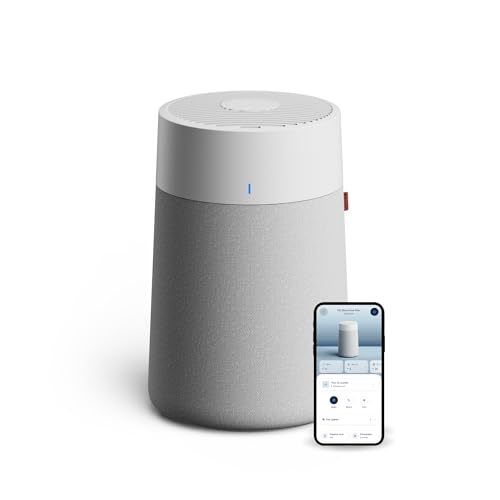
Blueair Blue Pure 511i Max — Quietest bedroom performer
Thin walls make noise a shared resource in apartment buildings, and the 511i Max treats it with unusual respect. Its night mode is rated down to a genuinely hushed level that even the resident — let alone the neighbours — will struggle to locate in a dark room, while the HEPASilent approach blends mechanical filtration with an electrostatic assist to move air without brute fan force. For a bedroom in a flat where the couple next door can hear a kettle, that discretion is not a luxury; it is the feature that decides whether the machine runs at night at all.
The maker rates coverage up to roughly 1,138 square feet, and in apartment terms that translates to authority over a main bedroom with the door closed, or a studio where the sleeping area is the priority zone. A washable fabric pre-filter wraps the body and comes in colours, a small thing that matters in small spaces where the purifier is always visible, and the 360-degree intake keeps placement forgiving when the only free floor patch is half behind the bed frame.
Smart control suits rental life in a specific way: the app lets you start the machine from the train home, so the bedroom is already settled when you walk in, and schedules can follow shift patterns that a simple timer handles clumsily. Auto mode reads the room and adjusts without the display lighting up the dark, and the whole unit is light enough to relocate to the living end for a weekend of guests, then return to bedside duty on Sunday night without the move feeling like a project.
Blueair ownership asks for genuine filters on schedule and a modest premium for the brand’s engineering, and the electrostatic element means purists who want purely mechanical filtration should read the wider range before committing. For the apartment bedroom, though, the equation is compelling: serious filtration, the quietest night in this guide, and a machine that looks like a deliberate object rather than a medical device someone wheeled in.
- Coverage hint: bedspaces up to roughly 1,138 sq ft by maker rating
- Filtration: HEPASilent with washable fabric pre-filter
- Night mode: rated down to a very low 19 dB
- Controls: app, auto mode and air quality feedback
- Placement: compact body with 360-degree intake
Strengths
- Exceptionally quiet through the sleeping hours
- Fabric pre-filter washes and personalises the look
- App scheduling fits irregular renter routines
Trade-offs
- Brand filters carry a modest premium
- Electrostatic assist is not purely mechanical filtration
- Best in one room rather than across a flat
Best for: bedrooms in flats where walls carry every sound.
Not suited for: households wanting one unit for several rooms.
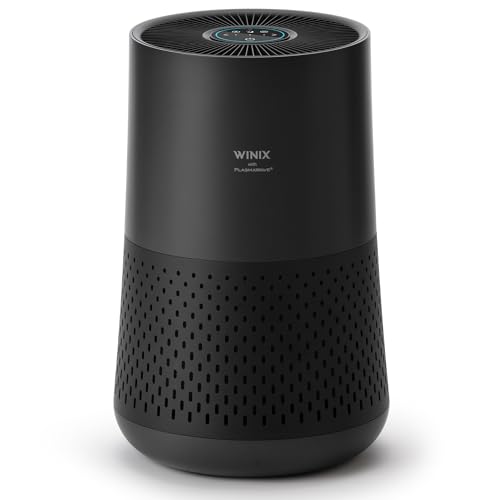
Winix A230 — Best tower for narrow rentals
Rental floor plans are full of leftover spaces — the strip between wardrobe and wall, the corner the radiator rejected — and the A230’s tower shape is built to colonise exactly those leftovers. Standing narrow and upright, it delivers Winix’s full formula to rooms the maker rates up to roughly 1,110 square feet in an hour: true HEPA for particles, a carbon filter for the odour traffic of dense living, and an air quality monitor that lets the machine govern itself while the household gets on with dinner, work or sleep.
That self-governance suits apartment rhythms particularly well. A tower by the bedroom door notices the evening’s events — the hallway door opening, a shower’s humidity carrying bathroom smells, the cat’s post-dinner patrol — and adjusts its fan in small increments rather than the dramatic surges of cheaper auto modes. At night it eases down to a sleep setting that keeps the air turning over without the tonal wobble that makes some towers impossible to ignore in a quiet building at two in the morning.
The A230 also carries Winix’s PlasmaWave stage, which can be switched off for anyone who prefers filtration unaccompanied, a flexibility worth having in a bedroom appliance. Controls are legible, the filter change is a front-of-unit job that needs no furniture moving, and the tower’s weight is low enough that carrying it to the living room for a smoky evening and back again is a whim rather than a chore — a small freedom that apartment owners use more often than they expect.
Choose it when the flat’s geometry is the binding constraint: narrow rooms, galley layouts, bedrooms where the only free patch is vertical. It will not match the Vital 200S for open-plan muscle, and its tower silhouette asks for a stable floor spot away from bumping traffic. Within its intended territory, though, it delivers brand-grade filtration in the one shape that awkward rental corners consistently accept.
- Coverage hint: rooms up to about 1,110 sq ft in one hour
- Filtration: true HEPA plus carbon filter
- Sensor: air quality monitor with auto mode
- Technology: PlasmaWave stage, switchable on or off
- Placement: slim tower for narrow floor patches
Strengths
- Tower shape fits leftover rental corners
- Auto mode modulates gently rather than surging
- Front filter access needs no furniture moving
Trade-offs
- Needs a stable spot away from foot traffic
- Less muscle than the largest pick here
- Tower look divides opinion in styled rooms
Best for: narrow bedrooms and galley-shaped rentals.
Not suited for: open-plan spaces needing maximum reach.
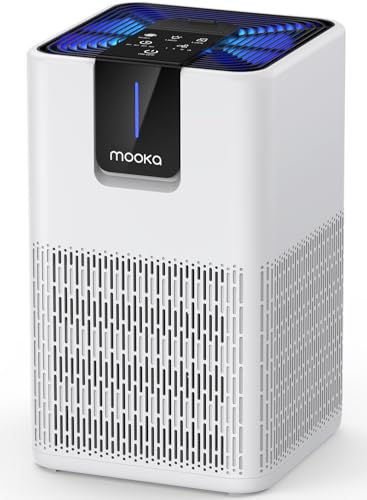
MOOKA M05 — Best for studio flats
A studio flat is a single volume of air asked to be kitchen, office, sitting room and bedroom in rotation, and the M05 is shaped for that rotation. Its maker rates it for rooms up to roughly 1,250 square feet, its intake wraps the body so it can stand in the middle of the action, and its quietest operation is hushed enough for the bed that shares the room with everything else. An H13 HEPA filter handles the particle load while the surrounding pre-filter catches the lint that one-room living generates in unusual abundance.
The aromatherapy feature, easy to dismiss as decoration, earns a second look in studios. When the same room hosts a workout, a stir-fry and a night’s sleep within six hours, a drop of something pleasant on the scent pad marks the transitions that walls would otherwise provide — a small ritual of changing the room’s mode. Owners use it the way house-dwellers use separate rooms: scent for the evening, plain clean air for the night, and the purifier’s steady work underneath both, flattening cooking smells faster than an open window on a still day manages.
Placement strategy in a studio usually means choosing the diagonal: purifier near the bed, as far from the kitchenette as the room allows, so cleaned air pools where breathing is slowest and longest. The M05’s light weight encourages that experimentation; you can trial it by the desk for a working week, then by the bed for the next, and let your own sleep and the dust on the shelves arbitrate. Few appliances in this guide invite that kind of casual optimisation, and fewer still cost so little to try.
Expectations should match the format. A studio with a serious smoke problem or a large dog will test the M05’s limits, and its feature set stops at the sensible basics rather than stretching to sensors and dashboards. What it offers instead is the studio essential: quiet, constant, affordable tidying of one shared volume of air, in a body that looks at home among the plants and lamps of a carefully arranged single room.
- Coverage hint: rooms up to about 1,250 sq ft by maker rating
- Filtration: H13 HEPA with surrounding pre-filter
- Intake: 360-degree draw for central placement
- Extras: aromatherapy pad for scent rituals
- Placement: studios, bedrooms and offices
Strengths
- Quiet enough for bed-sharing studio layouts
- Central placement works thanks to wraparound intake
- Scent pad helps studios shift between modes
Trade-offs
- No sensor-driven automation on offer
- Heavy smoke or big pets can outpace it
- Feature list deliberately stops at basics
Best for: studio flats living in one shared volume of air.
Not suited for: demanding smoke or multi-pet households.

Levoit Vital 200S — Best for larger open-plan rentals
Some rentals break the one-room rule: the converted warehouse, the open-plan one-bed where kitchen, sofa and desk share a single sweep of floor. The Vital 200S is the pick for those spaces, with the maker rating it for rooms up to roughly 1,875 square feet and a fan with the muscle to keep a large volume honestly turning over. An air quality monitor and auto mode govern that muscle intelligently, and the app extends control to the commute home, so the flat can be aired and settled before the key turns.
Levoit tuned this model with pets in mind, which in rental terms means the hair on the sofa, the dander in the rug and the litter corner behind the bathroom door. The filtration stack is built to load gracefully with that material, and the display’s feedback loop teaches owners the geography of their own flat’s air: which corner spikes after the dog’s evening shake, how long a cooking session takes to clear, when the bedroom door should stay open to share the cleaning and when it should close to concentrate it.
Despite the coverage, the Vital keeps bedroom manners. Its quietest operation is rated low enough for the open-plan sleeper whose bed shares the volume, and a proper sleep mode darkens the display so the machine does not become the room’s nightlight. During the day it can run a pet-focused higher gear while the household is out, then step down for the evening — a schedule the app makes trivial, and one that suits renters whose neighbours appreciate quiet evenings as much as they do.
The trade-offs are footprint and appetite: this is the largest machine in the guide, it wants a deliberate parking spot rather than a leftover corner, and its filter is a bigger cartridge with a bigger replacement cost. In the right flat those are fair trades. Open-plan renters otherwise face buying two small units and managing two of everything; the Vital offers the alternative of one capable machine that treats the whole sweep of the home as its parish.
- Coverage hint: areas up to about 1,875 sq ft by maker rating
- Filtration: multi-stage stack tuned for pet households
- Sensor: air quality monitor with display feedback
- Controls: app, auto mode and dedicated sleep mode
- Placement: open-plan living areas and large bedrooms
Strengths
- Covers open-plan rentals single-handedly
- Pet-aware design loads gracefully with hair
- Smart scheduling suits working renters perfectly
Trade-offs
- Largest footprint in this guide by far
- Bigger cartridge means bigger replacement bills
- Wants a deliberate spot, not a leftover corner
Best for: open-plan rentals and pet-owning tenants.
Not suited for: tiny studios where floor space is precious.
How do the six divide up apartment life?
Apartment buying is mostly geometry plus diplomacy: the machine must fit the floor plan and coexist with the people on both sides of the walls. The table below sorts the six by the rental situation each was plainly built to serve.
A useful way to read the table is backwards, starting from the room you cannot change. The studio’s single volume, the narrow bedroom’s leftover corner, the open-plan sweep — each constraint names its machine before any feature list gets a vote. Features then break the tie between the two or three models that fit the geometry, which is a far more reliable order of operations than falling for a specification and then negotiating with your floor plan.
| Model | Best room fit | Filtration approach | Standout trait |
|---|---|---|---|
| Levoit Core 300 | Studios and first bedrooms | Three-in-one HEPA cartridge | Smallest, simplest bedside guardian |
| Coway Airmega 150 | Main bedroom or studio living end | HEPA, carbon, washable pre-filter | Furniture-grade looks, auto behaviour |
| Blueair Blue Pure 511i Max | Bedrooms behind thin walls | HEPASilent with fabric pre-filter | Quietest night operation here |
| Winix A230 | Narrow rooms and tight corners | True HEPA plus carbon | Tower shape for leftover spaces |
| MOOKA M05 | Studio flats in one volume | H13 HEPA with wraparound pre-filter | Scent rituals for mode-switching rooms |
| Levoit Vital 200S | Open-plan and pet rentals | Pet-tuned multi-stage stack | Whole-flat reach with smart control |
What makes apartment air different from house air?
Density is the short answer. An apartment concentrates more cooking, more textiles, more people and more pets into fewer cubic metres, and then surrounds that concentration with other households doing exactly the same on the other side of every wall and floor. Air arrives pre-used: through corridors, shared shafts, the gap beneath the front door. The result is a flavour of indoor pollution that is less about any single source and more about accumulation — nothing dramatic, everything slightly present, all of the time.
Control is the second difference. A householder with stale air can commission a vent, drill a core hole or blame the builder; a renter can open a window, run a fan and buy a purifier. That constraint is why purification carries more weight in flats than in houses: it is not one option among many but frequently the only lever the occupant personally owns. Choosing it well — sized to the room, quiet enough to run constantly, strong on the carbon side for odour drift — is therefore a quality-of-life decision disguised as an appliance purchase.
The third difference is turnover. Apartments change occupants, and each arrival inherits the previous household’s residue in carpets and curtains while adding their own. A purifier smooths those transitions, working through the settling-in month when boxes shed cardboard dust and cleaning products perfume everything. It then stays for the ordinary years, which is why this guide keeps emphasising portability: the machine is one of the few home improvements a renter fully owns.
How do you size a purifier for a studio or one-bedroom layout?
Start with the room where the bed is, and measure it honestly, including the ceiling height if the building is old enough to have grand ones. Maker coverage figures assume vigorous fan speeds, so the practical rule is to choose a unit whose rating comfortably exceeds the room and then live on its middle gears, where the noise is neighbourly and the filter lasts. A machine loafing in a small room cleans more pleasantly than a small machine straining in a large one, and the price difference between those two purchases is usually smaller than a single replacement filter.
Studios complicate the arithmetic because the kitchen shares the volume. Cooking is the most intense particle event in most homes, and in a studio it happens metres from the pillow. The pragmatic studio layout pairs a mid-sized purifier near the sleeping zone with the habit of running a higher gear during and after cooking, letting the machine harvest the plume before it settles into bedding. The M05 and the Core 300 both suit that pattern; larger studios, or studios with pets, justify stepping up to the Airmega 150 or the Vital.
One-bedroom flats reward a border strategy. A single capable unit placed near the bedroom door, with the door open by day and the machine moved or a second small unit added for the night, stretches one purchase across both rooms better than a compromise position in the hallway, where it cleans the corridor beautifully and both rooms partially. Hallways are where purifiers go to be fair to everyone and useful to no one; apartments reward partisanship toward the room where you sleep.
Where should a purifier stand when every corner has a job?
Small homes turn placement into a negotiation with furniture, and the purifier usually loses the first round, exiled behind the sofa where its intake sips upholstery dust. Resist the exile. The machine needs a hand’s width of air around its intake and a clear path for its output, and within those constraints the best address is near the dominant source or the dominant sleeper: beside the bed for night benefit, near the kitchen threshold in a studio, by the door that admits corridor air in a flat with mystery smells.
Vertical thinking helps in tight rooms. Cylinders like the Core 300 can stand on a sturdy shelf or the top of a low bookcase, freeing the floor entirely, provided the outlet’s path stays clear and the unit cannot be knocked by a passing hip. Towers exploit the opposite dimension, occupying a column of airspace that furniture rarely wants. The A230’s whole design premise is that apartments have spare height everywhere and spare floor almost nowhere, and its owners consistently report finding it a home in minutes.
Finally, let the machine migrate with the week. A purifier light enough to carry will serve the living end during a weekend of guests and return to the bedroom for the working week, and that flexibility is a genuine feature in homes where rooms change purpose daily. The Vital is the exception that proves the rule — it earns a fixed post through sheer capability — but for the other five, mobility is part of the specification, and renters should use it without feeling the placement must be perfect on day one.
How do you keep the peace with neighbours and housemates?
Sound etiquette in a flat building is mostly about nights and floors. A purifier on a hard floor can telegraph a faint vibration downward, so a rug, a mat or a sturdy shelf makes a diplomatic difference the downstairs neighbour will never know they are grateful for. Choosing a machine with a genuinely quiet low gear — the 511i Max is the exemplar here — and running it there through the sleeping hours keeps the building’s acoustic commons intact while still turning the room’s air over many times before morning.
Housemates present the indoor version of the same diplomacy. A shared living room purifier should have controls everyone understands, a display that does not light the room during films, and a schedule agreed before it is programmed, because an appliance that wakes a shift-working flatmate at dawn will be unplugged by Friday. The app-controlled models help here: schedules can follow the household’s real rhythm, and the machine can be silenced from the sofa without a negotiation conducted in whispers.
There is a positive side to the ledger too. A purifier that flattens cooking odours quickly is a gift to everyone in the building, and more than one renter has reported that the flat’s curry, fish and frying smells stopped touring the corridor once a capable machine took up residence by the kitchen end. Good fences make good neighbours, but good carbon filters run them close.
Which apartment air problems should you tackle first?
Rank the problems by hours of exposure. Sleep dominates the arithmetic — a third of life is spent breathing one room’s air at close range — so bedroom dust, pollen and the general stillness of a closed room at night come first, and every pick in this guide can own that brief. Second comes cooking, because it is the most intense recurring event and the one whose odours colonise soft furnishings; carbon capacity and an auto mode that reacts quickly are the tools, which is why the Airmega 150 and the Vital rank so well for keen cooks.
Third is the inherited and the ambient: corridor smells, traffic particles through a street-facing window, the dust that high-density living generates simply by existing. These yield to consistency rather than power — a machine running steadily at a modest gear will flatten background levels across a week in a way that occasional heroic blasts never match. Pet households add a fourth problem with its own geography, concentrated at floor level and in fabrics, and should weight their choice toward the models whose pre-filters can be cleaned often without cost.
The discipline is to solve the problems in that order with one machine before buying a second for the next problem. Apartment owners who chase every complaint at once end up with an undersized unit in the wrong room; those who sequence — bedroom first, then the living end, then the hallway if it still matters — build a small system that actually matches how their flat’s air behaves across a day.
How does a purifier routine survive the move to the next rental?
The move is where apartment appliances justify or betray their design. These six all travel without ceremony: no wall fixings to make good, no installation to abandon, no landlord deposit held hostage by a vent hole. Pack the filter separately if the machine will ride in a van, keep the remote with the unit rather than in a kitchen drawer destined for the wrong box, and photograph your preferred settings before the app meets a new network — small rituals that make the first night in the new flat feel equipped rather than improvised.
A new flat also deserves a fresh assessment rather than a copy of the old one’s answers. The bedroom may be larger, the kitchen may finally have a door, the street may be quieter or the walls thinner. Run the machine in the sleeping room for the first fortnight wherever it lands, then re-decide its post with the new floor plan in mind. Owners who treat the move as a recalibration consistently end up with better placement than those who simply recreate the old corner out of habit.
And keep the paperwork with the machine. Filter part numbers, the purchase date and the warranty details are worth a note in the same phone file as the lease, because the middle of a tenancy is the worst moment to discover which cartridge your purifier eats. Renters who keep that small administration tidy find their purifier is the one appliance that never becomes a moving-day problem — it simply changes address and carries on cleaning.
What should renters verify before ordering anything?
Measure the intended corner and compare it against the machine’s footprint, then measure the route: hallways, lifts and stair turns have ended more appliance plans than any specification. Check the socket situation too, because a purifier that needs an extension lead trailing across the room will be resented within a week; the right corner has power within the cable’s honest reach. Finally, confirm the filter’s part number and price on the same day as the machine, so the running costs enter the decision while they can still change it.
Read the lease’s small print once, not because a plug-in purifier is likely to trouble it, but because scented features and candles sometimes do, and it is better to know the building’s rules before the aromatherapy pad becomes a discussion. Nothing in this guide requires permission in ordinary circumstances — no fixings, no venting, no alterations — which is precisely why purifiers are the renter’s air upgrade of choice. The verification list is short because the category is mercifully simple.
Then set expectations at the level this guide has used throughout: one machine, one room, steady running, honest sizing. Renters who buy on those terms report the same arc — a bedroom that feels settled within a fortnight, a flat that holds its freshness between cleans, and a small appliance that earns its corner so completely that it becomes part of the definition of home the tenant carries to the next address.
How do you share one purifier between housemates fairly?
Shared flats add a negotiation that couples and solo renters never face: whose room gets the machine, and who pays for the cartridge when it expires. The households that handle it best treat the purifier like the wifi router — a house appliance with a house budget — placing it in the room where the group actually gathers and splitting filter costs with the same casual mechanism as cleaning supplies. A living-room post serves everyone’s evenings, and individuals who want bedroom-grade air can add a personal compact unit without reopening the group negotiation.
Rotation is the other workable pattern, though it suits some layouts better than others. A light cylinder can spend the pollen months with the housemate whose windows face the park and the smoke season with the one whose room adjoins the kitchen, provided the schedule is agreed in daylight rather than improvised at midnight. What never works is the unspoken assumption that the machine belongs to whoever bought it while also serving everyone; that ambiguity is how purifiers end up unplugged during arguments about entirely unrelated things.
The deeper point is that shared living multiplies both the need and the benefit. More occupants mean more cooking, more showers, more doors opening onto corridor air — and a machine quietly flattening all of that in the common room improves every bedroom by proximity, because the air that drifts under each door at night starts cleaner. Housemates who grasp that arithmetic stop seeing the purifier as one person’s gadget and start defending its corner of the living room like any other piece of shared infrastructure.
Which apartment-specific mistakes waste the most money?
Rental living adds its own failure modes to the usual purifier errors, and most of them are visible in hindsight within the first month of ownership.
- Buying for the whole flat’s square footage. One machine cleans the room it stands in; a whole-flat rating leads to a unit that is oversized for the bedroom and absent everywhere else.
- Exiling the unit behind the sofa. Starved intakes and blocked outlets shrink a good machine to a fraction of itself, especially in small rooms with no spare air to waste.
- Ignoring the noise rating for night use. In a studio, the purifier shares your room and your walls; a loud low gear means it gets switched off, and an off purifier cleans nothing.
- Forgetting the neighbours’ cooking entirely. Odour drift is half the apartment problem, so a particle-only choice with a token carbon layer disappoints by the second week.
- Leaving the machine behind mentally at moving time. A purifier bought for one flat should be packed like the personal equipment it is, filter protected and remote kept with it.
- Running it only for guests. Sporadic showpiece use surrenders the cumulative benefit; these machines earn their keep in the unglamorous middle of ordinary weeks.
The common thread is treating the purifier as a furnishing decision rather than a living arrangement. Apartments reward the opposite mindset: choose for the room you sleep in, place for airflow rather than photography, run it constantly, and let it follow you when the lease ends. Owners who adopt that mindset rarely report disappointment with any of the six machines above.
One more rental-specific trap is worth naming: assuming the building will solve it. Landlords are responsible for many things, but the particle count inside a tenant’s bedroom is rarely among them, and waiting for a ventilation upgrade that exists only in a leasing brochure wastes seasons. The purifier’s appeal is precisely that it needs nobody’s permission, budget cycle or contractor — a rare home improvement entirely within the tenant’s own authority.
Final Recommendation
If one recommendation must stand for the whole guide, it is the Coway Airmega 150 for the typical one-bedroom flat — composed looks, genuine automation, a washable pre-filter suited to dusty rental life — and the Levoit Core 300 for studios and first rentals, where its size and simplicity fit the space and the budget simultaneously. Step up to the Vital 200S when the floor plan opens out or a pet joins the tenancy, choose the 511i Max when silence is the binding constraint, and let the A230 and the M05 solve the narrow and the one-room layouts respectively.
Buy for the room behind the door you close at night, run the machine like you mean it, and let the flat’s air become the one part of the building that answers entirely to you. In a rented home, that small sovereignty is worth more than any single specification on the box.
Frequently Asked Questions
Can one purifier handle a whole one-bedroom flat?
It can handle the room it stands in thoroughly and the rest of the flat partially, with the balance set by doors. Left open, doorways let a capable unit like the Vital 200S influence the living area from a bedroom post, but closed doors divide the flat into separate air kingdoms. Most one-bed households settle on one main machine for the sleeping room and accept lighter coverage elsewhere, then add a compact second unit later if the living room’s cooking and guests justify it.
Apartment veterans add one refinement: whichever room hosts the machine, keep its door’s habits consistent. A bedroom door closed nightly and a living-room door open daily lets one purifier serve a predictable pattern, and predictability is what lets a modest machine outperform a powerful one used randomly.
Will a purifier bother the neighbours through the wall?
On its low and sleep settings, a well-chosen apartment model is quieter than a refrigerator’s hum and far quieter than the television it replaces in the evening soundscape. The diplomacy details are placement and surface: a rug or mat under the unit stops vibration travelling through the floor, and keeping the machine off its highest gear after midnight covers the rest. The 511i Max was picked with exactly this building politics in mind.
How do I stop cooking smells from taking over the flat?
Give the carbon side of the machine a chance to work by positioning the purifier between the kitchen and the soft furnishings you are protecting, and run a higher gear during cooking and for half an hour after, rather than waiting for the smell to settle into the sofa. Auto models do this themselves when their sensors catch the plume. In a studio, that single habit — purifier up while the pan is on — changes how the room smells at bedtime more than any other routine.
Is a purifier worth it in a short tenancy?
Usually yes, because the machine is not a fixture: it leaves with you, works in the next flat from the first night, and asks for no installation or permission in the current one. A six-month tenancy still contains roughly eighteen hundred hours of sleep in that bedroom’s air, which is the exposure the purchase actually addresses. Renters on very short lets sometimes choose the smallest picks here precisely because they pack like luggage.
Where should the purifier go in a studio with no spare floor?
Look up before you look around: a sturdy shelf, a wide windowsill clear of curtains, or the top of a low bookcase can host a compact cylinder like the Core 300, provided the outlet’s path is unobstructed. If floor space exists anywhere, the patch beside the bed is worth more than the patch beside the door. The governing idea is to clean the air where your head spends eight hours, and let the rest of the room benefit by proximity.
Do I need my landlord’s permission for any of these?
In ordinary circumstances, no: every pick is a plug-in appliance that sits on the floor, makes no fixings and alters nothing about the property. It is in the same category as a fan or a lamp for lease purposes. The only courtesy worth extending is acoustic — keep night running on the quiet gears — and the only paperwork worth keeping is your own, so the filter type and warranty travel with you when the tenancy ends.
Related Guides
Apartment air problems often have a specific name — a dog, a sensitive sleeper, a damp bathroom — and these guides take each one in turn: Best Air Purifiers for Asthma and Allergies Best Air Purifiers for Dogs Best Air Purifiers for Allergies and Mold



[…] fan is only one piece of your home’s air plan, these guides cover the neighbouring decisions: Best Air Purifiers for Apartments Best Air Purifiers by Verified Lab Ratings Best Air Purifiers for […]