What's inside
- Key Takeaways
- Quick Picks
- How We Chose These Picks
- How Does Each Technology Actually Clean the Air?
- What Is the Ozone Question, Stated Fairly?
- Where Did These Two Technologies Come From?
- What Does the “Filterless” Promise Really Cost?
- What About the Middle Technologies Nobody Puts in the Title?
- What Happens to a Bedroom’s Air Overnight, Hour by Hour?
- How Do the Technologies Age Across Five Years?
- How Can You Judge a Machine Honestly in Its First Fortnight?
- Which Technology Wins in Each of These Six Machines?
- How Should a Congested Sleeper Actually Decide?
- Which Mistakes Do Shoppers Make in This Comparison?
- Final Recommendation
- Frequently Asked Questions
- Related Guides
As an Amazon Associate I earn from qualifying purchases. This post may contain affiliate links at no extra cost to you.
cottageverdict.com is reader-supported. When you buy through links on our site, we may earn an affiliate commission.
Where to buy: The six machines below are available on Amazon; follow a linked pick to its listing to check price on Amazon and read exactly which technologies that model combines. In this category more than any other, the fine print is the product.
Stand in the air-purifier aisle — physical or digital — and two philosophies compete for your money. One traps particles in a dense fibrous filter, a technology with seventy years of hospital and laboratory service behind it. The other charges particles electrically, or releases charged ions into the room, and promises filterless, silent, almost magical cleaning. The best air purifiers for allergies and sinus: ionic vs HEPA is the comparison shoppers are really asking about when they stand in that aisle, usually because someone in the house wakes up congested and the family is deciding what kind of machine deserves the bedroom. This guide gives the honest version of that contest. HEPA wins the bedroom, and it is not especially close — but the ionic side deserves a fair hearing rather than a caricature, because some ionic technologies are legitimate supporting players, some hybrid designs use charge intelligently inside the cabinet, and a few situations genuinely favor them. What no honest version can offer is a medical promise: a purifier of either type manages airborne particles to make a room more comfortable. It is not a medical device, it does not treat sinus conditions or allergies, and persistent symptoms are a conversation for a clinician. Within that frame, let us compare the technologies properly.
First, definitions, because the marketing blurs them deliberately. A true HEPA purifier pulls room air through a pleated filter dense enough to capture 99.97 percent of particles at 0.3 microns — pollen, dust, dander, mold spores, and the mite debris that housekeeping launches into the air. An ionic purifier, in its pure form, has no such filter: it emits negative ions that attach to particles, making them clump and settle onto surfaces, or it charges particles so they stick to collector plates inside the unit. Hybrid machines combine an electrostatic stage with a filter. The difference that decides everything follows from those definitions: HEPA removes particles from the room’s ecosystem entirely, into a filter you later throw away; pure ionization mostly relocates them onto your floor, furniture, and walls, from where ordinary life re-launches them.
Key Takeaways
- For a bedroom where someone wakes congested, true HEPA is the recommendation: it captures allergens outright instead of settling them onto the bedding.
- Pure ionizers can generate ozone as a by-product of charging air; even small amounts are an unwelcome addition to a sleeping room, and ozone-free verification is the minimum standard for any ionic device.
- Settled is not removed — ionized particles land on surfaces and return to the air with every disturbance, which is why ionic-only cleaning disappoints in practice.
- Electrostatic stages inside a cabinet, paired with a real filter, are a different and defensible technology; judge hybrids by their tested clean-air delivery.
- Several strong machines let you switch their ion feature off, giving you HEPA’s certainty with the option retained — the configuration we suggest for bedrooms.
Quick Picks
| Pick | Badge | Why it made the list |
|---|---|---|
| Sharp KCP110UW Purifier + Humidifier | Best ion-hybrid, large rooms | Sharp’s Plasmacluster ion system paired with a true HEPA filter and humidifier, for very large spaces. |
| Sharp KCP70UW Purifier + Humidifier | Best ion-hybrid, standard rooms | The same pairing in a smaller cabinet, suited to a main bedroom. |
| Winix 5520 | Best switchable design | True HEPA and strong carbon, with a PlasmaWave feature you can simply leave off. |
| Coway Airmega Mighty AP-1512HH | Best pure-HEPA classic | The benchmark mechanical purifier: no ions, no ambiguity, a decade of bedroom service. |
| Levoit Core 400S | Best smart pure-HEPA pick | App-driven auto mode and verified ratings with straightforward cartridge filtration. |
| IQAir Atem Desk | Best personal-zone HEPA | A HyperHEPA desktop unit that builds a clean-air pocket at a desk or bedside. |
How We Chose These Picks
A comparison guide has a special obligation: the picks must embody the verdict honestly rather than decorate it. We therefore chose two genuine ion-hybrid machines from the manufacturer that has invested most seriously in the technology, one respected hybrid whose ion stage can be disabled entirely, two reference-standard pure HEPA machines against which everything else is measured, and one personal-space HEPA unit for readers whose real question is smaller than a whole room. Every pick captures particles with a real filter — there is no ion-only machine on this list, and the reasons for that absence are the substance of the article.
We also weighted verifiability. HEPA’s claims rest on a defined standard anyone can test; ionic claims often rest on chamber demonstrations that do not translate to furnished rooms. Where a hybrid’s performance is backed by recognized clean-air testing, we say so; where a technology’s benefit is asserted mainly by its maker, we say that too. Sinus comfort, the human stake in this comparison, is treated throughout as a matter of cleaner air and better nights — the outcomes a purifier can plausibly deliver — never as treatment.
One more editorial rule shaped the list: no machine appears here as a punchline. The hybrids are represented by their strongest implementations, the mechanical camp by its benchmarks, because a comparison that rigs its examples teaches nothing. If the verdict still lands where it lands, it does so against the ionic side’s best case, which is the only kind of verdict worth printing.
How Does Each Technology Actually Clean the Air?
HEPA’s mechanism is almost disappointingly physical. A fan draws air through a pleated mat of fine fibers; particles are captured by interception, impaction, and diffusion — they hit fibers, stick, and stay. The filter does not care what a particle is: pollen grain, spore, dander flake, and soot mote are all simply objects of a size, and the rating certifies capture at the hardest size to catch. Performance is therefore predictable, testable, and boring in the best way. The costs are equally physical: the filter gradually loads and must be replaced, the fan must work against the filter’s resistance, and the machine makes some noise doing it.
That noise deserves its sentence, because it is the ionic pitch’s strongest honest card: a filter demands a fan, and a fan is audible. The mechanical camp’s answer has been engineering rather than denial — larger filters with lower resistance, motors tuned for a low, even note, and coverage headroom that lets a machine cruise instead of straining. The result is that the modern HEPA bedroom machine at its working speed is quieter than the street outside most windows. Silence, it turns out, was a solvable problem; settling was not.
Ionization’s mechanism is subtler and its failure modes follow from it. Ions attach to airborne particles and give them a charge; charged particles attract each other, clump into heavier aggregates, and settle faster — onto the floor, the bedding, the bookshelf, and the walls, where a dark grime line near a hard-working ionizer is a familiar sight. Collector-plate designs catch some charged particles inside the unit, but plates are small, load quickly, and lose effectiveness as they coat. Crucially, nothing in the pure ionic mechanism destroys or removes the allergen: the pollen grain on your pillowcase is the same pollen grain, awaiting the disturbance of your head. In a living room that is a tolerable bargain; in the bedroom of someone who wakes congested, it relocates the problem to the exact surface they press their face into.
There is a laboratory subtlety worth airing, because ionic marketing leans on it: in a sealed test chamber, a settling device can post impressive particle reductions, since the chamber’s surfaces are bare, its air is still, and nobody sleeps in it. Move the same device into a furnished bedroom — with bedding reservoirs, a sleeper’s movements, and a door opening at intervals — and the chamber’s numbers stop describing anyone’s night. HEPA’s ratings, by contrast, describe the machine itself rather than the room’s cooperation, which is why they survive the move from laboratory to bedroom intact. When a claim depends on the room behaving like a chamber, discount it by the difference between a chamber and your home.
Electrostatic hybrids split the difference intelligently: a charging stage inside the cabinet makes particles easier for a downstream filter to capture, so the filter does the removing while the charge does the assisting. That architecture — ions as the filter’s helper, never as its replacement — is the respectable face of ionic technology, and it is the form in which it appears in this guide’s picks.
What Is the Ozone Question, Stated Fairly?
Charging air can split oxygen molecules, and some of the fragments recombine as ozone. This is not a controversy about whether it happens but about how much a given device produces. Ozone is a reactive gas that irritates airways — the very outcome a household buying a purifier for nighttime comfort is trying to avoid — and regulators treat it accordingly: California, for instance, caps ozone emissions from indoor air cleaners, and independent certification programs exist specifically to verify that a device emits negligible ozone. A shopper considering any ionic device should look for that verification by name and treat its absence as a decision made for them.
Stated fairly in the other direction: a well-engineered, verified low-emission device is not the same object as the ozone generators once marketed — irresponsibly — as air fresheners, and this guide does not pretend otherwise. The Sharp hybrids below are built by a manufacturer that publishes its technology’s test basis, and the Winix’s ion stage can be switched off altogether, which converts the ozone question into a preference rather than a risk. Our bedroom advice remains conservative: where a sleeper’s comfort is the entire point of the purchase, the burden of proof sits on the ion feature, and the simplest way to satisfy it is a machine whose filtration needs no ions at all — or one whose ions can be retired with a button.
Children’s rooms deserve the conservative setting of that advice without exception. Whatever an adult household decides about its own tolerance, the bedroom where a child sleeps is the place to run the purely mechanical configuration — filter doing the work, ion features off or absent — both because small airways deserve the plainest air and because the mechanical machines lose nothing by the choice. The same applies, with love, to the guest room prepared for a grandparent: hospitality is not the occasion for a technology experiment.
Where Did These Two Technologies Come From?
HEPA was born serious: it was developed in the 1940s to protect workers handling hazardous fine particles, then migrated into hospitals, laboratories, and cleanrooms — environments where filtration claims are audited because lives depend on them. Its domestic career began when that industrial technology shrank into appliances, carrying its test culture with it. When a HEPA rating appears on a bedroom machine, it refers to the same defined standard, measured the same way, that governs the serious rooms. That lineage is the deep reason this guide trusts it: the technology’s promises were never primarily marketing.
The migration matters in one more way: hospitals and laboratories also normalized the idea that filtration is a system — filter, airflow, maintenance schedule — rather than a talisman. The domestic machines that honor that systems view are the ones this guide keeps recommending, whatever extra features their cabinets contain.
Ionization’s lineage is more romantic and more troubled. The observation that charged air feels fresh — after thunderstorms, near waterfalls — inspired a century of devices, from early electrostatic precipitators in industry (a legitimate, large-scale technology for factory emissions) to a procession of consumer gadgets whose claims repeatedly outran their physics. Regulators and consumer testers pushed back hardest on the ozone question and on chamber demonstrations that flattered the devices. The technology’s respectable modern forms — precipitator stages inside cabinets, verified low-emission hybrids — emerged from that pushback. Knowing the history explains the present: HEPA sells certainty, ions sell a feeling, and the wise shopper buys the certainty and treats the feeling as a bonus where it appears.
None of this makes the feeling fraudulent in itself — charged air after a storm is genuinely pleasant, and a hybrid that delivers a trace of it alongside real filtration is selling a real, if minor, pleasure. The guide’s quarrel is only with the substitution: the feeling offered in place of the filtration, at the price of the filtration, to the household that needed the filtration.
What Does the “Filterless” Promise Really Cost?
The ionic pitch often leads with freedom from replacement filters, and the savings are real but miscategorized. A filterless room device does not abolish the particles’ destination; it outsources it to your furnishings, which then require the cleaning — the dusting, vacuuming, and laundering — that the filter would have absorbed into a single disposable object. Collector-plate models reintroduce maintenance in a less convenient form: plates that must be washed carefully and lose performance as they coat. The honest comparison is not filter cost versus nothing; it is filter cost versus your household labor and your bedding’s reservoir, priced over years.
Run the comparison the other way and HEPA’s costs are equally plain: a cartridge or filter set on a schedule, electricity for the fan, and a noise floor set by physics. Nothing about that list is hidden, which is itself a form of value — the mechanical machine’s whole ownership story can be known on the day of purchase, while the ionic device’s story depends on how a particular home’s surfaces, habits, and sensitivities respond to settled particles. Households that prize predictability — and a bedroom is where predictability matters most — will keep landing on the filter.
There is a resale-and-regret footnote: mechanical machines hold their usefulness across households and rooms, because their performance is a property of the device. A settling device’s performance is a property of the device plus the room it happened to be in, which is why the secondhand market is littered with ionic units whose first owners could not say what went wrong — only that the bedroom never felt different. Knowability, again, is the filter’s quiet superpower.

Sharp KCP110UW Purifier + Humidifier — Best ion-hybrid, large rooms
If ionic technology has a flagship, it is Sharp’s Plasmacluster system, and the KCP110UW is its largest household expression: a true HEPA purifier rated for extra-large rooms up to about 2,603 square feet in an hour, combined with a humidifier and an ion generator that releases positive and negative ions into the room. Sharp’s claim for the ions is that they act on airborne particles and surfaces alike; the claim a buyer can verify independently is the HEPA stage’s particle capture, which is why we classify this machine as a HEPA purifier with an ion feature rather than the reverse.
The humidifier half is genuinely relevant to the sinus-comfort brief: winter heating dries indoor air severely, and dry air is its own source of nighttime stuffiness quite apart from allergens. A machine that filters the air and restores measured moisture addresses both halves of the winter bedroom’s complaint in one cabinet, with smart controls and voice-assistant compatibility to run it. The ion stage is the element each household must decide about for itself, armed with the ozone discussion above and Sharp’s published test material.
Our placement advice for this pick is specific: it shines in large living spaces and open plans, where its scale and its feature set are assets, and where the ion question is less intimate than at a bedside. Households that fall in love with it for a bedroom should simply note that its purification does not depend on the ions — the filter carries the brief.
Scale is its argument in every direction: it is the machine for the great room that hosts the whole family’s evenings, where a merely adequate purifier would be outnumbered by the space. Households with that room — and a winter dryness to match — will find its combination of coverage, humidity, and developed ion technology the most complete single purchase in this guide, asterisks and all.
- Filtration: true HEPA with Plasmacluster ion system and humidifier
- Coverage: rated up to about 2,603 sq ft per hour
- Extras: smart controls, voice-assistant compatibility
- Care: humidifier tank needs regular cleaning
Strengths
- Enormous coverage with real HEPA capture
- Humidifying addresses dry-air stuffiness directly
- The most developed ion implementation in the category
Trade-offs
- Ion feature will not suit ozone-cautious households
- Humidifier hygiene is an ongoing commitment
- Premium scale and price for a single bedroom
Best for: Large rooms in dry-winter homes curious about ion hybrids. Not suited for: Anyone who wants a strictly mechanical, ion-free bedroom machine.
Sharp KCP70UW Purifier + Humidifier — Best ion-hybrid, standard rooms
The KCP70UW brings the same Sharp formula — true HEPA filtration, Plasmacluster ions, and a humidifying function — down to the scale of a main bedroom or a modest living room. For the household whose congestion peaks in heating season, when the radiators parch the air and the windows stay shut for months, it is the most direct single-box response on this page: particles captured by the filter, dryness answered by the tank, and the ion system present for those who value it.
Read it with the same classification discipline as its larger sibling. The HEPA stage is the allergy worker; the humidifier is the comfort worker; the ions are the optional philosophy. Sharp has sold this combination for years to households that swear by the whole ensemble, and the honest reviewer notes both that loyalty and its proper attribution problem — when three systems run in one cabinet, no owner can say which delivered the better night, which is precisely why this guide keeps returning to the stage whose effect is independently measurable.
As with all humidifying appliances, the tank and wick demand their cleaning rhythm; a household that will not keep it should buy a purifier-only machine and accept dry air as a separate problem. Kept properly, the KCP70UW is the ion-curious bedroom’s most considered option.
It is also the friendlier housemate of the two Sharps: sized to be carried between rooms by one person, plausible on a bedroom floor without rearranging the furniture, and quiet enough in its night operation to share the room it serves. For the household conducting its ionic experiment in the room that matters most, it is the considered way to run it.
- Filtration: true HEPA with Plasmacluster ion system and humidifier
- Coverage: large bedrooms and modest living rooms
- Extras: combined water tank, smart controls
- Care: scheduled humidifier cleaning required
Strengths
- Filtration plus humidity in a bedroom-scale cabinet
- Developed, long-marketed ion implementation
- Addresses the dry-season half of nighttime congestion
Trade-offs
- Ion stage is a judgment call each household must make
- Water components add weekly chores
- Not the pick for damp-prone rooms
Best for: Bedrooms in dry, heated homes open to the hybrid approach. Not suited for: Ion-averse households or damp rooms.
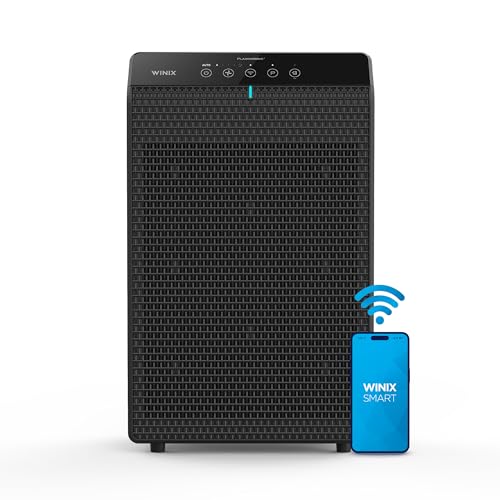
Winix 5520 — Best switchable design
The 5520 is the diplomat of this comparison: a true HEPA machine with a high-deodorization carbon filter, an air-quality monitor, and coverage rated up to about 1,882 square feet per hour — plus Winix’s PlasmaWave technology, an ion-emitting stage that the owner can switch off. That switch transforms the ionic debate from a purchase decision into a setting. The cautious household runs it as a pure mechanical purifier forever; the curious household can experiment in the living room while keeping the bedroom mechanical; nobody is locked into a philosophy by a receipt.
As a HEPA machine in its own right it is formidable — the sensor-driven auto mode responds to the day’s events, the carbon stage is the strongest in its class for the odors that accompany closed-window seasons, and the coverage headroom means bedroom duty happens at the quiet end of its range. In the context of this guide it is the pick we would hand to the couple arguing in the aisle: it lets the argument end, because both parties get their machine.
Our own setting recommendation is on the record: bedroom, ions off, HEPA and auto mode doing the work. But the existence of the choice, honestly labeled and instantly reversible, is what consumer technology is supposed to look like.
There is an educational side effect to owning it: households that can toggle the ion stage become their own comparison study, and most report that the experiment ends the household debate more conclusively than any article — including this one — could. Evidence gathered in your own bedroom, across your own seasons, outranks every reviewer’s verdict.
- Filtration: true HEPA with high-deodorization carbon
- Coverage: rated up to about 1,882 sq ft per hour
- Extras: air-quality monitor, auto mode, switchable PlasmaWave
- Note: ion stage fully optional in daily use
Strengths
- Lets the household choose its ionic position by switch
- Excellent sensor-driven mechanical performance
- Strong carbon for closed-window seasons
Trade-offs
- Display brightness needs managing for some sleepers
- Mid-to-upper tier filter costs
- Choice itself may be unwanted complexity for some
Best for: Households divided on ions, and anyone wanting options open. Not suited for: Shoppers who want the simplest possible appliance.

Coway Airmega Mighty AP-1512HH — Best pure-HEPA classic
Every comparison needs its control group, and the Mighty is this one’s: true HEPA, a carbon stage, a washable pre-filter, an air-quality sensor with auto mode, an eco mode that rests the fan when the air stays clean, and coverage rated up to about 1,748 square feet. No ions are emitted, no philosophy is required, and the machine’s long tenure as the default allergy-bedroom recommendation constitutes its own form of evidence — a decade of households voting with their nights.
For the sinus-comfort question specifically, its virtues are the mechanical ones this guide keeps endorsing: allergens are captured into a filter rather than settled onto the pillow, the eco mode keeps the cleanest hours of the night silent, and the whole performance is certified against standards a buyer can look up. If the ionic sections of this article left you more cautious than curious, this is your machine, and you are in the majority this guide expected.
It concedes the humidifier’s dry-air comfort to the Sharp picks and the switchable experiment to the Winix. What it offers instead is the absence of asterisks — the purifier equivalent of a plain, well-made tool that does the one job completely.
Notice, too, what its longevity implies about the comparison itself: across the years in which ionic devices arrived in waves of publicity, this unglamorous mechanical box kept being bought by the households with the strongest incentive to get the bedroom right. Markets are noisy judges, but a decade of repeat allegiance from congested sleepers is a data point no chamber test can manufacture.
- Filtration: true HEPA with carbon stage and washable pre-filter
- Coverage: rated up to about 1,748 sq ft
- Extras: auto and eco modes, air-quality indicator, timer
- Technology: purely mechanical filtration
Strengths
- Reference-standard HEPA performance for bedrooms
- Eco mode suits the night’s clean hours
- No ozone question arises at all
Trade-offs
- No humidifying function for dry homes
- No app control
- Carbon stage is modest for odor-led problems
Best for: The bedroom of anyone who wants the settled answer. Not suited for: Households wanting humidity help or smart features.

Levoit Core 400S — Best smart pure-HEPA pick
The Core 400S represents the modern mechanical mainstream: a 3-in-1 cartridge (pre-filter, HEPA, carbon), AHAM-verified ratings for rooms up to about 1,718 square feet, an air-quality sensor driving an auto mode, app control with scheduling, and a sleep mode that darkens its display for the bedroom. Its relevance to this comparison is that it achieves everything the ionic marketing promises — quiet, automatic, set-and-forget air care — by purely mechanical means, with the receipts of a verified rating.
For a household whose congestion follows the day’s events, the sensor is the star: cooking, cleaning, a window opened at the wrong hour each register and are answered without anyone touching the machine. Scheduling through the app adds the commuter’s trick of a boost timed for the hour before bed, so the bedroom’s air is already settled when its occupant arrives.
Cartridge ownership is the trade: all layers renew together, at mid-tier prices, and the carbon within is sized for ordinary household odors rather than a damp basement’s biography. As the smart, purely mechanical answer for a bedroom or a flat’s main room, it is the pick that makes the ionic question feel, for many households, already answered.
Its app data quietly serves the comparison as well: a household can watch its air-quality readings respond to events in real time and learn, within a week, what mechanical filtration at a verified rate actually does to a room. That visibility is the modern answer to the ionic promise of invisible magic — the magic, shown as a graph, turning out to be a fan and a filter all along.
- Filtration: 3-in-1 cartridge with HEPA and carbon
- Coverage: rated up to about 1,718 sq ft
- Extras: app control, air-quality monitor, auto and sleep modes
- Verification: AHAM Verifide rating
Strengths
- Smart automation with purely mechanical filtration
- Verified ratings anchor its claims
- Sleep mode respects the bedroom fully
Trade-offs
- Cartridge replaces all layers at once
- No humidity assistance
- App account needed for scheduling
Best for: Smart-home households wanting HEPA without asterisks. Not suited for: Anyone avoiding apps or wanting separate filter layers.

IQAir Atem Desk — Best personal-zone HEPA
The Atem Desk reframes the whole comparison at personal scale. It is a desktop unit with a HyperHEPA filter — capture rated far below standard HEPA’s particle sizes — designed to build a clean-air zone around one person’s breathing space: a desk where someone works all day, a bedside where someone reads before sleep. Its rated territory is small, around 150 square feet, and within that territory its filtration depth exceeds everything else on this page.
Its place in an ionic-versus-HEPA guide is as the minimalist’s verdict: no ions, no room-scale claims, just the finest mechanical capture in the category aimed at the few cubic feet that matter most. For the home worker whose afternoons narrow in a stuffy study, or the reader who wants the bedside air tended without furnishing the whole room with a tower, it is a genuinely different answer rather than a smaller one.
The limits are definitional: it will not hold a whole bedroom against a pollen season, and its premium per cubic foot is the highest here. As a supplement to a room machine — or as the whole strategy for a desk-bound life — it earns its place on depth of filtration alone.
It also makes an unusually honest gift: for the student in a dorm-adjacent flat, the parent in a small apartment, the partner whose desk sits in a dusty study — a defined zone of demonstrably cleaner air, delivered by the deepest filtration in the business, without asking the recipient to rearrange a room or adjudicate a technology debate.
- Filtration: HyperHEPA personal-zone filter
- Coverage: personal space, around 150 sq ft
- Extras: portable, desktop design, quiet operation
- Tier: premium for its size
Strengths
- Deepest particle capture in this guide
- Perfect for desks and bedsides
- Purely mechanical, no ionic questions
Trade-offs
- Personal zone only, not a room solution
- Premium price for its scale
- No carbon stage for odors
Best for: Desk workers and bedside readers wanting a clean-air pocket. Not suited for: Whole-room allergy duty as the only machine.
What About the Middle Technologies Nobody Puts in the Title?
Between the two headline philosophies sits a quieter family worth understanding, because it appears inside several good machines. Electrostatic precipitator stages — the industrial technology miniaturized — charge particles and collect them on plates inside the cabinet; unlike room ionization, the destination is a washable plate rather than your bedding, which moves the design from relocation toward removal, with the caveat that fouled plates lose their grip and need their washing rhythm kept. Activated carbon, meanwhile, is not a particle technology at all: it adsorbs gases and odors, and it partners with either camp without adjudicating between them. And ultraviolet stages, where fitted, act on what passes through the cabinet — a supporting role, never a substitute for capture.
The lesson of the middle family is that “ionic versus HEPA” is a headline, not a taxonomy. Real machines are assemblies, and the intelligent shopper reads the assembly: which stage removes particles, which stage handles gases, which stage is garnish. A purifier whose particle removal is a certified filter, whose carbon is honestly sized, and whose extra stages are labeled as extras is a well-built machine whatever its marketing calls it. A purifier whose particle strategy is a hope and a charge is not, whatever its price.
Reading assemblies is a transferable skill: it applies to vacuum cleaners boasting cyclones, to water filters boasting stages, to every appliance whose box counts features instead of outcomes. The shopper who learns to ask “which part does the work, and who measured it” in this aisle will ask it in every aisle thereafter — the comparison’s most durable gift.
What Happens to a Bedroom’s Air Overnight, Hour by Hour?
Picture the room at lights-out: it holds the day’s accumulated particles — the pollen that rode in on hair and clothing, the dust the evening’s activity stirred, whatever the cat contributed — suspended in still, warming air. In the first hour behind a closed door, the largest particles settle on their own; the finest, which include the allergen fragments that matter most, can remain suspended for many hours, drifting with the sleeper’s own movements. Every turn in bed re-lofts the bedding’s share. Without intervention, the sleeper breathes that slowly evolving mixture at its most concentrated, face at pillow height, for the longest unbroken exposure of the day.
Now run the two technologies through the same night. The HEPA machine steadily retires the suspended load into its filter; by the small hours the room’s airborne count is a fraction of its lights-out level, and what the bedding re-lofts is captured in its turn, so the whole system spirals downward toward clean. The ion-only device accelerates settling — the room’s air does clear faster than unaided — but the retired particles have gone to the room’s surfaces, including the bed, where the sleeper’s movements keep a local share in circulation at exactly face height. The night thus dramatizes the entire comparison: removal versus relocation, measured at the pillow.
Add the morning’s evidence: the HEPA household wakes to a room whose surfaces collected only the night’s ordinary dust, while the settling household wakes to bedding that has done a shift as the room’s filter. Laundering can retire that load, of course — but a strategy that requires the sheets to be washed to complete the cleaning has quietly reassigned the filter’s job to the washing machine, at higher effort and lower frequency.
This is also why auto modes and eco modes earn their keep in the mechanical camp: the night’s need is not constant, and a machine that works early and idles later matches the curve of the problem. The bedroom rewards the technology whose effect compounds while you sleep.
How Do the Technologies Age Across Five Years?
A HEPA machine’s five-year story is written in its filters: performance renews completely with each change, the fan and housing age slowly, and a well-kept unit in year five cleans essentially as it did in year one. Its failure mode is neglect — a filter run years past its interval — which announces itself honestly in reduced airflow and returning stuffiness. The ionic device’s story is subtler: emitter points and collector surfaces foul gradually, output declines without any consumable to blame, and the owner has no scheduled moment at which performance is restored to new. Hybrid machines inherit the HEPA pattern for their filter stage, which is one more argument for judging them as filter machines with features.
Warranties tell the same story in legal language: the mechanical makers warrant their machines for years with the filter as the acknowledged consumable, a structure that presumes the device itself endures. When a technology’s own maker will not stand behind its fifth year, the shopper has learned something no advertisement would have mentioned.
There is a household-knowledge angle too. Five years with a mechanical purifier teaches its owners their home’s air: which seasons load the filter, which habits spike the sensor, what a fresh cartridge does to a room in a day. That literacy transfers to every future purchase. Five years with a settling device teaches mainly whether the household tolerates it. When the congested sleeper is choosing a technology to grow old with, the one that keeps explaining itself is the safer companion.
How Can You Judge a Machine Honestly in Its First Fortnight?
Give the trial a fair design. Run the machine continuously in the bedroom for two full weeks before judging — not two nights — because the room’s reservoirs and your own expectations both need time to settle. Keep a three-line morning note: sleep quality, waking comfort, and anything unusual (a window left open, a dog on the bed, a storm). Patterns worth trusting emerge from that little record; single mornings do not deserve verdicts. If the machine has an ion stage that can be disabled, run the fortnight with it off first, so the mechanical baseline is known before any experiment begins.
Inspect the physical evidence at the fortnight’s end. The pre-filter’s loading tells you the room’s true particle traffic; the dust on a wiped shelf, compared with your memory of its old pace, tells you the airborne fraction’s direction. And apply the pillow test that gives this guide its closing image: a bedroom strategy is working when the surface you breathe against all night is part of the solution. If it is functioning as the filter — collecting what the technology settled — the technology has failed the only test that matters to a sleeper.
Should the fortnight disappoint, diagnose before you return. A mechanical machine that disappoints is usually misplaced, undersized, or running too little — three fixable causes that a different placement or a sterner routine resolves more often than a different technology does. A settling device that disappoints has usually performed exactly as its physics predicts, which is the one diagnosis in this guide that does argue for changing camps.
Which Technology Wins in Each of These Six Machines?
| Model | Technology | Coverage guide | Standout trait |
|---|---|---|---|
| Sharp KCP110UW Purifier + Humidifier | HEPA plus ions plus humidifier | Up to ~2,603 sq ft/hr | Largest hybrid |
| Sharp KCP70UW Purifier + Humidifier | HEPA plus ions plus humidifier | Bedroom scale | Bedroom hybrid |
| Winix 5520 | HEPA, switchable ion stage | ~1,882 sq ft/hr | Choice by switch |
| Coway Airmega Mighty AP-1512HH | Pure HEPA | Up to ~1,748 sq ft | The control group |
| Levoit Core 400S | Pure HEPA, smart | Up to ~1,718 sq ft | Verified smart automation |
| IQAir Atem Desk | HyperHEPA personal | ~150 sq ft | Deepest capture, smallest zone |
How Should a Congested Sleeper Actually Decide?
Work through three questions in order. First: is the problem particles or dryness? If your worst nights arrive with the heating season in a dry house, humidity is a co-defendant and the Sharp hybrids earn their hearing; if the worst nights track pollen counts, open windows, and the cat, particles are the case and mechanical filtration is the whole answer. Second: how do you feel about the ion question after the ozone section? Households range from untroubled to absolutist, and both positions are respectable — the list is built so that either lands on a good machine. Third: what scale is the problem — a whole bedroom, a whole flat, or one person’s desk? Answer those honestly and the six picks sort themselves; the technology debate, which looms so large in marketing, shrinks to its proper size, which is one factor among three.
Then run whichever machine you choose the way the evidence supports: continuously, in the bedroom, with the door in its decided position, and with the bedding and humidity habits that keep the room’s reservoirs low. A mid-tier HEPA machine run properly will outperform a flagship of any technology run occasionally — the least glamorous sentence in this guide and the truest.
One more decision hides inside the third question: who else breathes this room? A partner with different sensitivities, a child in the bed on stormy nights, a pet with its own claim on the duvet — each shifts the balance toward the conservative, mechanical, generously sized end of the list. The bedroom is a shared atmosphere before it is a shopping problem, and the machine that respects every breather in it is usually the one nobody has to apologize for.
Which Mistakes Do Shoppers Make in This Comparison?
The first is buying an ion-only device for a bedroom on the strength of the word “silent,” then discovering that settled allergens on the bedding are not the bargain they hoped for. The second is the mirror error: dismissing every hybrid unread, including switchable designs that would have served perfectly well with their ion stage off. Third is ignoring verification — accepting either technology’s claims without asking who tested them, when the category offers verified ratings to anyone who wants them.
A fourth shopping habit deserves gentle correction: reading the technology label and stopping there, as though two machines sharing a label share a fate. Within the HEPA camp alone, airflow, sealing, and carbon separate the excellent from the adequate by rather more than the camps differ at their best.
Fourth is expecting any purifier to adjudicate a health question. A machine that leaves the air cleaner is a comfort purchase; symptoms that persist, worsen, or worry you belong in a clinician’s office, where the conversation can include everything an appliance cannot know. Fifth is forgetting the filter in the filter-versus-filterless framing: the ionic pitch leans on having no filter to replace, but a HEPA machine’s filter is not a defect in its design — it is the visible evidence that the particles went somewhere definite, and that somewhere was not your pillow.
Sixth is a subtler shopping error: comparing a hybrid’s price against a pure HEPA machine’s without noticing that the hybrid’s extra systems carry their own upkeep — tanks to clean, wicks to replace, plates to wash. Every technology in this guide has a maintenance shadow; the honest comparison prices the shadow alongside the machine.
Final Recommendation
The verdict, plainly: for the bedroom of anyone who wakes congested, buy the filter. The Coway Airmega Mighty is the reference choice, the Levoit Core 400S its smart modern alternative, and the IQAir Atem Desk the connoisseur’s supplement for a desk or bedside. Choose the Winix 5520 if your household is genuinely divided and wants the question kept open by a switch. Choose a Sharp hybrid if dry winter air is half your problem and you have weighed the ion question with open eyes. But let the last word belong to the pillow test: whatever technology you bring home, the particles it deals with should end their long journey inside a filter you can throw away — not settled on the surface where you lay your head to breathe all night.
Frequently Asked Questions
Are ionic purifiers dangerous?
The careful answer is that it depends on the device and its emissions. Ion generation can produce ozone as a by-product, and ozone is an airway irritant no bedroom needs; reputable devices are tested and certified for negligible emissions, and those are the only ionic devices worth considering. A filter-based machine sidesteps the question entirely, which is one reason this guide defaults to HEPA for sleeping rooms. If a device in your home already has an ion feature and no certification you can find, the prudent course costs nothing: switch the feature off and let its filter work alone.
Do ions actually clean the air at all?
They change the air’s particle behavior — charged particles clump and settle faster — and in a test chamber that registers as cleaning. In a furnished room, settling means relocating allergens onto surfaces from which life re-launches them, which is why ionic-only devices disappoint the households that bought them for bedrooms. Inside a cabinet, as a filter’s assistant, the same physics is put to genuinely useful work. The distinction to carry into the shop is destination: ask of any technology where the particles end up, and prefer the answer that names a filter.
Why do some expensive machines include ion features if HEPA is better?
Because the combination can be legitimate: an electrostatic stage can raise a filter’s effective capture and let a machine run quieter for the same result, and manufacturers like Sharp have built long product lines on hybrid designs that many owners love. The guide’s objection is not to ions near filters; it is to ions instead of filters, and to any bedroom relying on settling as its strategy. Price, notably, does not settle the argument in either direction — some of the most expensive devices in the category are its most questionable, and some of its most trustworthy are resolutely mid-priced.
What about sinus pressure specifically — will a purifier help?
A purifier can reduce the airborne particles you breathe overnight and, in the Sharp hybrids’ case, counter the dry air that many people find aggravates nighttime stuffiness. That is a comfort claim, and a reasonable one. It is not treatment for sinus conditions, which have causes no appliance addresses; persistent or severe symptoms deserve a clinician’s assessment rather than a larger machine. Many readers will recognize the sensible middle path: the purifier manages the room, the clinician manages the person, and neither is asked to do the other’s job.
How can I tell whether a purifier’s claims are verified?
Look for the marks of independent testing: AHAM-verified CADR ratings for clean-air delivery, and recognized low-ozone certification for anything with an ion feature. A maker confident in its numbers publishes them in those programs; a maker offering only percentages and adjectives is asking for trust it has not earned. The verified figures are also the only honest basis for comparing one machine’s coverage against another’s. Keep the certificates’ names from the product page; they take a minute to check and they separate the category’s citizens from its tourists.
Related Guides
Readers deciding where this technology verdict lands in their own home can continue with Best Air Purifiers for a 500 Sq Ft Room for a common bedroom scale, Best Affordable Air Purifiers for the budget end of the mechanical mainstream, and Best Car Air Purifiers for the smallest airspace of all.


[…] pet household’s reading continues in three directions: the technology comparison in Best Air Purifiers for Allergies and Sinus: Ionic vs HEPA for readers weighing filtration types, Best Air Purifiers for 800 Square Feet for larger pet-shared […]