What's inside
- Key Takeaways
- Quick Picks
- How We Chose These Picks
- One Machine or Two in a One-Bedroom Flat?
- What Does “Coverage” Really Mean at Apartment Scale?
- How Does Apartment Air Differ From House Air?
- What Should Renters Check Before Ordering?
- How Do These Six Machines Stack Up Against Each Other?
- What Changes When the Flat Is Also Your Office?
- Which Features Actually Earn Their Place in a Small Home?
- How Should You Set Up a Purifier Routine in a Small Flat?
- Which Mistakes Shrink a Purifier’s Effect in an Apartment?
- How Do the Seasons Change a One-Bed Flat’s Air?
- What Does It Cost to Keep a Flat’s Purifier Running?
- Final Recommendation
- Frequently Asked Questions
- Related Guides
As an Amazon Associate I earn from qualifying purchases. This post may contain affiliate links at no extra cost to you.
cottageverdict.com is reader-supported. When you buy through links on our site, we may earn an affiliate commission.
Where to buy: All six machines are available through Amazon; follow any linked pick to its listing to check price on Amazon and confirm which filter bundle ships with it. In a small flat, also glance at the listed dimensions while you are there — a tape measure now beats a return later.
A one-bedroom apartment asks a purifier to do something quietly unreasonable: cover a bedroom where you sleep, a living area where you cook, eat, and unwind, and the invisible corridor of air connecting them — all from one plug socket, in a footprint that does not eat the room. Shopping for the best air purifiers for a 1 bedroom apartment is therefore less about raw power than about fit. The machine has to be strong enough for the whole flat when doors stand open, quiet enough to share a bedroom with at night, and small enough that you do not spend a year stepping around it. Get those three in balance and a single purifier genuinely can serve an entire one-bed home.
The apartments themselves vary more than the marketing admits. A modern one-bed might be 450 square feet of open plan with a sleeping alcove; an older one might be 750 square feet of separate rooms with real doors and a kitchen that vents into the hallway. Cooking is the wildcard pollutant in both: a small flat concentrates frying smells, steam, and fine particles in a way a big house dilutes, and the living room sofa usually sits within a few paces of the stove. So this guide weighs odor handling and auto modes more heavily than a bedroom-only guide would, and it treats the one-machine-versus-two question head-on, because for many one-bed homes the honest answer is one good machine moved thoughtfully, not two mediocre ones.
Nothing here requires a landlord’s permission, a handyman, or a free weekend: every pick plugs into an ordinary socket and starts work the evening it arrives. That immediacy is part of the appeal in a rental, where the list of improvements you are allowed to make is short and the list of improvements you would like is not.
Key Takeaways
- Size the machine for the whole flat’s open-plan hours, not just the bedroom, because daytime air drifts freely between rooms.
- Night noise matters more than headline airflow: the speed you can sleep beside is the speed that protects you for a third of your life.
- An auto mode with a real particle sensor earns its keep in small flats, where cooking spikes the air several times a day.
- Footprint is a feature — measure the corner, the nightstand gap, and the space beside the sofa before falling for a big tower.
- One well-chosen mid-size unit, repositioned seasonally, beats two underpowered units for most one-bedroom layouts.
Quick Picks
| Pick | Badge | Why it made the list |
|---|---|---|
| Levoit Core 400S | Best overall for one-bed flats | Smart auto mode, strong coverage for its size, and a sleep setting that respects a small bedroom. |
| Coway Airmega 150 | Best bedroom-first pick | Compact, handsome, and quiet, with a washable pre-filter that suits apartment housekeeping. |
| Blueair Blue Pure 511i Max | Quietest night running | A very low night-mode noise floor and 360-degree intake that forgives tight placement. |
| Winix 9800 | Best for cooking-heavy flats | Four-stage filtration and a tower shape that parks beside a kitchen doorway without blocking it. |
| Honeywell HPA030 Tower | Best slim tower | A narrow footprint for flats where floor space is genuinely scarce, from a long-running allergen line. |
| MOOKA M05 | Best budget pick | Very quiet, inexpensive to buy and run, and honestly sized for the bedroom half of a small flat. |
How We Chose These Picks
We started from the floor plan rather than the spec sheet. For each candidate we asked where it would physically live in a one-bedroom home — beside the bed, beside the sofa, or in the awkward triangle between kitchen and hall — and eliminated anything whose footprint or noise made all three answers awkward. Coverage ratings were then read against realistic apartment sizes: a machine claiming a huge area at one air change per hour is less useful than a slightly smaller claim that delivers several changes in 500 square feet. Several picks here carry AHAM-verified ratings, which anchor those claims to a tested standard instead of a marketing mood.
Filtration had to be true HEPA or an equivalent tested technology, because apartment air is personal air — you sleep in it, cook in it, and dry laundry in it. Carbon stages were judged for the cooking-and-corridor reality of flat living: a thin carbon sheet is fine for a bedroom-only machine, but a unit expected to face nightly frying needs more. Finally, we priced the whole ownership picture in qualitative tiers — purchase, replacement filters, and the electricity of near-constant running — and favored machines whose filters are widely stocked, because apartment dwellers rarely have a garage shelf of spares and a filter that takes three weeks to arrive is a filter that gets postponed.
We also kept a deliberate spread of philosophies on the list, because one-bed households disagree about what the machine is for. Some want a set-and-forget appliance that thinks for itself; some want the quietest possible bedroom companion; some are really buying odor control for a kitchen that shares a room with their sofa. Rather than crown a single ideology, the picks below name which philosophy each machine serves, so the right answer for your flat is the one whose trade-offs you recognize as your own.
One Machine or Two in a One-Bedroom Flat?
The purifier industry would love you to buy two, and sometimes that is right — but work through the logic before spending. Air in a one-bed flat mixes more than people expect. With interior doors open, a single machine in the living area measurably improves the bedroom over an evening, because the whole flat is only a few hundred cubic feet of connected air and normal movement stirs it constantly. The exception is the closed bedroom door at night: eight hours behind a shut door, the bedroom becomes its own small climate, and the living-room machine’s benefit fades. That single fact drives the smartest one-bed strategy — put the machine where the closed door is. Run it in the living space by day if you like, but let it spend the night in the bedroom, or simply keep it in the bedroom full-time if the bedroom is where you spend the most sealed-in hours.
Two machines earn their place when the flat is large for its category, when a partner works nights and the bedroom door is closed during the day as well, or when a specific second problem — a litter tray in the hall, a smoker’s balcony door — demands local treatment. Even then, the second machine can be small: a compact bedroom unit paired with a stronger living-area machine is a better split than two identical mid-size boxes. The picks below are ordered with the one-machine strategy in mind, and the final two are priced and sized to serve as the small half of a pair if your layout argues for it.
There is a hybrid worth naming for the undecided: buy the strong single machine now, live with it for a season, and let evidence decide. If your mornings are good and only the living room lags after cooking, the gap is a carbon-and-airflow gap a small second unit near the kitchen closes neatly. If instead the whole flat feels evenly improved, you have saved the price of a second machine and a second set of filters forever. Apartment equipment budgets reward that patience, because a one-bed home punishes every unnecessary object with rent-priced floor space.
What Does “Coverage” Really Mean at Apartment Scale?
Coverage numbers on purifier listings describe the largest room in which the machine can deliver a certain number of air changes per hour, and the assumed number varies. A rating built on two air changes per hour is a reasonable living standard; a rating built on one is a technicality. For a one-bed flat, translate any claim by asking how it performs at your actual size: a machine rated for roughly a thousand square feet will cycle a 500-square-foot flat’s air briskly, which lets it run on a lower, quieter speed and still keep up — the single most useful trick in small-space purification. Oversizing modestly is not waste here; it is how you buy quiet.
Ceiling height quietly edits every rating, since the figures assume a standard ceiling and taller rooms hold more air. Open-plan flats also behave like one big room for air purposes even when the lease calls them three, so count the whole connected area the machine must serve during the hours doors stand open. None of this needs a calculator: stand in your flat, picture the air as water filling it to the ceiling, and choose the machine that could plausibly stir all of that water several times an hour without roaring.
A worked example fixes the idea. Take a 600-square-foot flat with ordinary ceilings: its air volume is roughly 4,800 cubic feet. A machine delivering a few hundred cubic feet of cleaned air per minute turns that volume over several times an hour on a middle speed — which is why mid-size machines feel transformative in flats while merely adequate in houses. The same arithmetic explains the disappointment of tiny desktop units: at a trickle of airflow, the flat’s air changes so slowly that cooking and daily life refill it faster than the machine can clean it.
How Does Apartment Air Differ From House Air?
A flat concentrates life. The same cooking, showering, sleeping, working, and pet-keeping that a house spreads across two floors and a utility room happens in a one-bed within a few hundred square feet, so each activity’s contribution to the air looms larger. Steam from a shower does not dissipate down a hallway; it condenses on the nearest cool wall, often in the bedroom. A dog’s bed is not in a mudroom; it is beside the sofa. Even the building contributes: shared corridors leak cooking and cleaning smells under the door, neighbors’ renovations send fine dust through party walls, and a ground-floor flat near the car park breathes a little of every cold start outside the window.
The flip side is that a flat is a small, knowable volume of air, and small volumes respond quickly. A purifier that would take all evening to turn over a house’s air can cycle a flat’s air several times in an hour, which is why one-bed owners often report the difference within days rather than weeks — the morning stuffiness lifts, the cooking smell’s half-life shrinks, dust settles more slowly on the shelves. It also means the machine’s effect is fragile in a specific way: one propped-open window on a high-pollen day, or one evening of heavy frying with the extractor off, can refill the flat faster than a big house would refill, so the routine matters as much as the hardware.
Finally, flats impose social constraints houses do not. Thin walls make a roaring purifier a neighbor problem as well as a personal one, and lease rules forbid the drilling, ducting, and hard-wiring that house owners use to solve air problems permanently. Everything in this guide is therefore plug-in, portable, and quiet enough for a building full of other people’s bedrooms on the other side of the wall — the three constraints that define apartment purification.
What Should Renters Check Before Ordering?
Start with the unglamorous measurements. Confirm the machine fits its intended corner with clearance for its intake — a purifier suffocated against a wall underperforms exactly like a blocked vacuum. Check the outlet situation honestly: small flats often have one socket per wall, already committed to lamps and chargers, and a purifier deserves a direct socket rather than a daisy-chained strip. Note the filter’s replacement part number and glance at its availability now, not in eight months; choosing a model whose cartridge is stocked by several sellers protects you from the small-brand stock-out that turns a good machine into an ornament.
Think about the move-out test too. Everything you buy for a rental eventually rides in a car to the next flat, so weight and a carry handle are genuine features, and a machine that suits a bedroom will suit the next bedroom even if the next flat’s layout differs. Keep the box if storage allows — purifiers travel badly loose. And if your lease or building has rules about appliances or noise, a quiet plug-in purifier is about as uncontroversial as equipment gets, but a quick message to the landlord costs nothing and documents that you are improving, not altering, the property.

Levoit Core 400S — Best overall for one-bed flats
The Core 400S is the machine we would hand to a friend moving into a one-bed flat and asking for a single answer. It is rated for large rooms up to about 1,718 square feet, which in apartment terms means it can treat a whole 500–700 square foot home with headroom to spare — and headroom, as the coverage section explained, is what buys quiet. Its auto mode watches a built-in air-quality sensor and responds to the day’s rhythm: a stir-fry at seven, a vacuum at eight, still evening air after that, each met with the fan speed the moment actually needs rather than the speed you remembered to set.
At night it drops into a sleep mode with the display darkened, which matters in a flat where the bedroom machine is also the living-room machine and light discipline is poor. The 3-in-1 filter combines pre-filter, HEPA, and carbon in one cartridge — simple to change in a small kitchen, though cartridge designs mean buying the whole unit each time rather than replacing layers separately. App control sounds like a luxury until the first time you boost the machine from bed because the neighbors’ cooking has drifted through the shared wall’s gaps; then it becomes the feature you use weekly. In tier terms it sits in the middle of this list on purchase and running costs, which is exactly where the best overall pick for a flat usually lands.
Its shape helps too: a compact cylinder that reads as a small side table’s sibling rather than a medical device, with a footprint that fits the classic one-bed dead zones — the corner by the balcony door, the gap between sofa arm and wall. Owners of studio-adjacent one-beds, where the sleeping alcove has no door at all, will find its auto mode does the whole flat’s work without any nightly relocation ritual.
Flat-dwellers also tend to underrate its timer and scheduling through the app: set a daily boost for the hour before you typically get home and the flat greets you already freshened, which quietly removes the stale-air moment that makes people doubt a purifier works at all. First impressions compound — a machine that demonstrably changes the air on day one gets kept on, and a machine kept on is the only kind that helps.
- Filtration: 3-in-1 cartridge with HEPA and activated carbon
- Coverage: rated up to about 1,718 sq ft
- Extras: app control, air-quality monitor, auto and sleep modes
- Verification: AHAM Verifide rating
Strengths
- Whole-flat coverage with enough headroom to run quietly
- Auto mode genuinely suits cooking-driven apartment air
- Sleep mode with darkened display for bedroom duty
Trade-offs
- One-piece cartridge replaces all layers at once
- Carbon capacity is modest for heavy daily frying
- App setup is required to unlock scheduling features
Best for: Most one-bedroom homes wanting one machine to do everything well. Not suited for: Anyone who wants separate, long-life filter layers or zero apps in the house.

Coway Airmega 150 — Best bedroom-first pick
If your one-bed strategy starts from the closed bedroom door, the Airmega 150 is the machine designed around that priority. It is rated for bedrooms up to about 1,035 square feet, which covers the sleeping quarters of any one-bed flat several times over, and its design language — soft curves, muted colors, a top surface you can set a book on — acknowledges that in a small home the purifier is furniture whether it wants to be or not. It looks at home on a bedroom floor in a way most appliances simply do not.
The filtration arrangement suits apartment housekeeping: a washable pre-filter catches the coarse dust and hair that small homes generate disproportionately (every square foot of a one-bed flat is lived on hard), extending the life of the HEPA and carbon stages behind it. An air-quality monitor with auto mode handles the evenings, and the machine carries a notably long warranty for its class, which softens the mid-tier purchase. Where it gives ground to the Levoit is raw whole-flat muscle and smart features; where it wins is in being the machine you will still like looking at in year three, in the room where you spend the most hours of your life.
Renters should note the practical details: it moves easily between rooms, asks for no installation, and its filter door opens without tools — a small mercy in a flat where the toolbox is a kitchen drawer. Couples in one-bed homes often end up placing it in the bedroom permanently and letting the living area benefit through the open door during the day, which is the reverse commute of the Levoit strategy and works just as well.
One more bedroom virtue deserves naming: its light discipline. The display is present when you want information and unobtrusive when you do not, and in a small bedroom where every standby LED competes with darkness, that restraint is the difference between a machine that stays plugged in and one that gets its power cut by an annoyed sleeper — the most complete filtration failure of all.
- Filtration: HEPA plus carbon, with washable pre-filter
- Coverage: bedrooms up to about 1,035 sq ft
- Extras: air-quality monitor, auto mode, long warranty for its class
- Form factor: compact, furniture-friendly design
Strengths
- Design that genuinely suits a small bedroom
- Washable pre-filter lowers running costs and fuss
- Quiet, even-tempered fan character at night speeds
Trade-offs
- Less whole-flat headroom than the Core 400S
- No app control for remote adjustments
- Premium touches push it above budget tier
Best for: Bedroom-first one-bed homes and design-conscious renters. Not suited for: Large open-plan flats needing one machine to dominate the whole space.
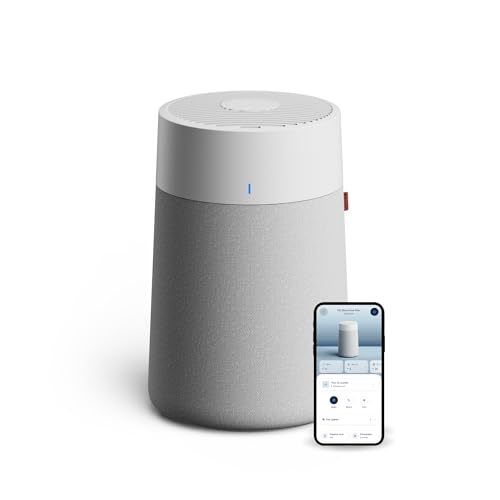
Blueair Blue Pure 511i Max — Quietest night running
Some people shop for a purifier; light sleepers shop for silence that also purifies. The 511i Max’s night mode runs at a whisper level the maker puts around 19 decibels — quieter than a typical bedroom’s ambient sounds — while its HEPASilent approach blends mechanical and electrostatic capture to move a lot of air for that hush. It is rated for bedrooms up to about 1,138 square feet, so in a one-bed flat it is never straining, and a machine that is never straining is a machine that stays quiet at the speeds real life uses.
The 360-degree intake is the other small-flat virtue: air enters from every side, so the machine forgives the imperfect placements apartments force on you — near a wall, beside the bed frame, in the corner the wardrobe left behind. A washable fabric pre-filter wraps the body and comes in colors, letting the machine pass as a soft furnishing accent rather than an appliance; it also catches the lint and hair load before the main filter sees it. App control and auto mode are present for those who want them.
Be clear-eyed about the filtration style: HEPASilent is a tested, effective technology, but it is not a traditional true HEPA cartridge, and shoppers who specifically want dense mechanical media should look at the Coway or Levoit instead. For the light sleeper in a one-bed flat, though, the trade is usually worth it — the best purifier is the one still running at 3 a.m., and this is the one least likely to be switched off by a tired hand.
It is also, incidentally, the pick most likely to be mistaken for a stool or a fabric ottoman by guests, which in a one-bed flat — where every object is visible from every seat — counts as a genuine quality-of-life feature. Appliances you do not have to apologize for visually are appliances that stay out, stay on, and keep working.
- Filtration: HEPASilent technology with fabric pre-filter
- Coverage: bedrooms up to about 1,138 sq ft
- Extras: WiFi app, auto mode, very low night-mode noise
- Intake: 360-degree air intake for flexible placement
Strengths
- Quietest night operation on this list
- Forgiving placement thanks to all-around intake
- Washable fabric pre-filter doubles as a design element
Trade-offs
- Not a conventional true HEPA cartridge design
- Replacement filters are brand-specific
- Less carbon for cooking odors than the Winix below
Best for: Light sleepers and bedroom-centered one-bed flats. Not suited for: Purists who want traditional true HEPA media only.
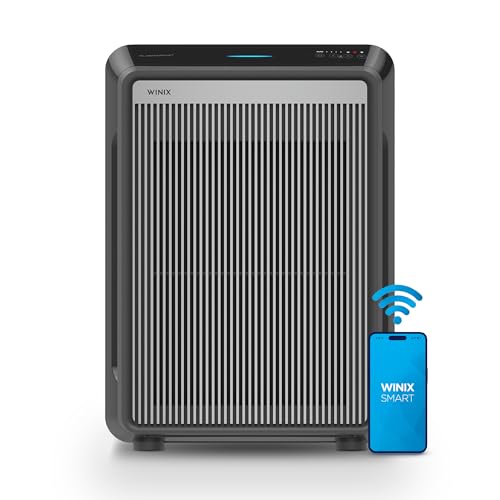
Winix 9800 — Best for cooking-heavy flats
In a one-bedroom apartment, the kitchen is never really a separate place — it is a corner of your living room with a stove in it. The Winix 9800 is the pick for flats where that corner works hard. Its four-stage filtration adds a substantial carbon stage to true HEPA, giving it the odor appetite that nightly cooking demands, and its tower form parks in the vertical dead space beside a kitchen doorway or at the end of a counter run, pulling the cooking plume’s drift before it settles into the sofa cushions.
Winix rates it for rooms around 500 square feet, which is the honest size of the connected living-kitchen zone in many one-bed flats, and WiFi control lets you start a boost from the sofa when the searing starts rather than after the smoke alarm offers its opinion. PlasmaWave technology is fitted and — as with other Winix models — it can be left off entirely if your household prefers purely mechanical filtration; run that way, the 9800 is a straightforward, effective HEPA-and-carbon tower.
The tower shape cuts both ways in a small home: it uses vertical space beautifully and reads as a slim column rather than a box, but it needs a stable patch of floor away from foot traffic, because a tall unit in a walkway is a unit that gets knocked. Place it with the same care you would give a floor lamp and it disappears into the flat’s geography while quietly handling the one pollutant source — your own cooking — that no amount of window-opening fully solves in winter.
Households that batch-cook on Sundays will appreciate the pattern it enables: machine on boost through the cooking session, back to auto for the week, with the carbon stage absorbing the slow release of smells from soft furnishings that even good ventilation leaves behind. It is the difference between a flat that smells neutral by Tuesday and one that remembers Sunday’s onions at Thursday’s breakfast.
- Filtration: four-stage with true HEPA and carbon
- Coverage: rooms around 500 sq ft
- Extras: WiFi control, PlasmaWave (switchable), tower design
- Form factor: slim vertical footprint
Strengths
- Strongest cooking-odor handling in this group
- Tower shape fits kitchen-adjacent dead space
- Four full stages of filtration at a mid-tier position
Trade-offs
- Tall body needs a traffic-free corner
- Coverage rating suits the living zone, not the largest flats
- Ion feature will not be to every household’s taste
Best for: Keen cooks in one-bed flats with an open or adjoining kitchen. Not suited for: Anyone wanting a single machine to cover a very large open-plan home.

Honeywell HPA030 Tower — Best slim tower
Some one-bed flats do not have a spare corner; they have a spare sliver. The HPA030 is built for the sliver — a narrow tower from Honeywell’s long-running allergen-reducer line, rated for rooms around 200 square feet, which in practice means the bedroom of a compact flat or the sleeping end of a studio-style one-bed. It makes no claim to whole-flat glory, and that honesty is its charm: it does one room properly, quietly, and without demanding furniture rearrangement.
Honeywell’s ecosystem is the practical argument here. Replacement filters and pre-filters for this family are stocked everywhere purifiers are sold, the carbon pre-filter can be cut and replaced cheaply to keep everyday odors in check, and the controls are simple physical buttons that a guest or a half-asleep hand can operate. There is no app and no sensor-driven auto mode, so you choose speeds yourself — many apartment dwellers run it on low all day and medium overnight and never think about it again.
As the small half of a two-machine arrangement, paired with something stronger in the living area, it makes excellent sense; as the only purifier in a larger one-bed, it will leave the living room underserved. Judge it by the job it is actually for — a slim, dependable bedroom tower in a genuinely small home — and it is one of the most sensible buys on this page.
There is also a honesty-of-expectations benefit to starting here: a household that begins with the bedroom properly covered learns what purified air feels like in the room where it matters most, and can then judge — from experience rather than advertising — whether the living area needs its own machine. Many discover the bedroom was the whole problem and the search ends with this slim tower.
- Filtration: HEPA with replaceable carbon pre-filter
- Coverage: rooms around 200 sq ft
- Extras: simple controls, widely stocked filters
- Form factor: narrow tower for tight spaces
Strengths
- Slimmest footprint on this list
- Filters available almost everywhere
- Simple, durable, no-account-required operation
Trade-offs
- Bedroom-scale coverage only
- No auto mode or air-quality sensing
- Basic design next to the Coway and Blueair
Best for: Very compact flats, or the bedroom half of a two-machine setup. Not suited for: Whole-flat coverage in a larger one-bedroom home.
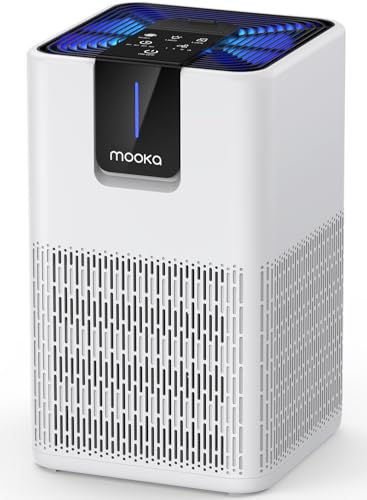
MOOKA M05 — Best budget pick
Every one-bed guide needs an honest budget answer for the renter whose deposit already ate the savings account, and the M05 is ours. It is a compact cylinder with an H13 HEPA filter, 360-degree intake, and a headline claim of covering rooms up to about 1,250 square feet — a figure to read generously, as budget listings often assume ideal conditions; treat it as a strong bedroom-and-living-corner machine for a small flat rather than a whole-home guarantee, and it performs its real job well.
What surprises people is the noise discipline: MOOKA rates its sleep operation around 15 decibels, and while laboratory numbers flatter every brand, owners consistently describe it as effectively silent at night settings. There is even an aromatherapy pad for those who like a scented room — optional, and best skipped if your goal is the plainest possible air. Running costs sit in the budget tier for both filters and electricity, and the whole unit costs less than some rivals charge for a single replacement cartridge.
The compromises are the expected ones: no app, no sensor-driven auto mode, a lighter carbon stage that keeps up with ordinary cooking but not a nightly fry-up, and a brand ecosystem smaller than Honeywell’s. For a first flat, a spare-room corner, or the bedroom end of a one-bed while you save for a flagship, those compromises are rational — clean air on a budget beats perfect air postponed indefinitely.
Students in their first one-bed, young renters furnishing on a shoestring, and anyone outfitting a flat they expect to leave within a year or two are its natural audience: the investment is small enough to be painless, the benefit immediate, and the unit light enough to be the last thing tossed into the moving car rather than the first thing abandoned.
- Filtration: H13 HEPA, 3-in-1 filter with 360-degree intake
- Coverage: listed up to about 1,250 sq ft; best in bedroom-scale use
- Extras: very quiet sleep mode, aromatherapy pad
- Tier: budget purchase and running costs
Strengths
- Lowest cost of entry and upkeep here
- Genuinely quiet at night settings
- Compact cylinder fits almost any corner
Trade-offs
- Coverage claim should be read conservatively
- No auto mode or app control
- Light carbon stage for heavy cooking homes
Best for: First flats, tight budgets, and bedroom duty in small one-bed homes. Not suited for: Large open-plan flats or heavy cooking households as the only machine.
How Do These Six Machines Stack Up Against Each Other?
| Model | Filtration | Coverage guide | Standout trait |
|---|---|---|---|
| Levoit Core 400S | 3-in-1 HEPA cartridge | Up to ~1,718 sq ft | Whole-flat auto mode |
| Coway Airmega 150 | HEPA plus carbon | Up to ~1,035 sq ft | Bedroom design and washable pre-filter |
| Blueair Blue Pure 511i Max | HEPASilent | Up to ~1,138 sq ft | Quietest night running |
| Winix 9800 | Four-stage HEPA and carbon | ~500 sq ft | Cooking-odor appetite |
| Honeywell HPA030 Tower | HEPA plus carbon pre-filter | ~200 sq ft | Slimmest tower |
| MOOKA M05 | H13 HEPA 3-in-1 | Bedroom scale | Budget price, near-silent |
What Changes When the Flat Is Also Your Office?
Working from home quietly rearranged the one-bed purifier’s job description. The desk — often in the bedroom or the living room’s far corner — is now occupied for the same long, sealed-in hours that used to belong only to sleep, and the air around it accumulates the day: your own breathing in a closed room, the dust every keyboard and paper file sheds, the afternoon slump that stuffy air makes worse. A purifier placed within the desk’s general zone, running a steady low speed, keeps that working pocket fresher without the fan note intruding on calls — which is one more argument for the auto and sensor-equipped picks, since a machine that reacts to the day’s cooking at lunch and settles again by the afternoon meeting is managing a schedule you would never bother to keep manually.
There is also a boundary benefit nobody advertises: the purifier’s gentle white noise at a low setting softens the flat’s other sounds — corridor footsteps, a neighbor’s television through the wall — and many home workers find the workday focus improves for reasons that have nothing to do with particles. If your one-bed doubles as an office, weight that placement flexibility and noise character even more heavily than this guide already does, and treat the bedroom-versus-desk placement question as a genuine tie that a two-week trial in each spot resolves better than any review can.
Which Features Actually Earn Their Place in a Small Home?
Small flats punish feature bloat, because every sensor and screen shares your living space. Rank features by whether they change what you do. An air-quality sensor with auto mode changes behavior daily — it makes decisions you would otherwise forget — so it earns its place at the top. A sleep mode with a genuinely dark display changes whether the machine survives the night in a bedroom; also top-tier. A timer matters for households with a rhythm: boost after the morning shower-and-cooking hour, ease off while the flat is empty. App control is a convenience that becomes a real feature only when the machine migrates between rooms or when someone in the home has mobility reasons to avoid crouching at a floor-level panel.
At the other end, treat fragrance features, decorative lighting, and elaborate multi-color air displays as garnish: pleasant for a week, invisible by month two, and occasionally — in the case of scent pads — working against the plain-air goal. Child lock, by contrast, is garnish that becomes essential the day a toddler discovers buttons, and in a one-bed flat the toddler and the purifier are never far apart. The pattern to notice is that the valuable features all serve the same master: keeping the machine running, appropriately, without demanding your attention. In a small home, attention is the scarcest resource of all.
How Should You Set Up a Purifier Routine in a Small Flat?
Begin with a two-week experiment rather than a permanent decision. Place the machine in the living area for the first days and pay attention to cooking smells: how long does the flat hold onto dinner? Then move it to the bedroom for a week and notice your mornings. Most one-bed households discover a clear preference from that simple trial, and it beats any amount of spec-sheet reasoning. Once placed, run the machine on auto if it has it, or on the highest speed you can ignore; in a small flat, the purifier’s real enemy is not dust but the off switch, reached for during a film because the fan competes with dialogue. A machine placed a few feet farther from the sofa often survives the evening at a working speed.
Build the small habits around it: crack the kitchen window or run the extractor while cooking so the purifier handles the residue rather than the whole event; vacuum the pre-filter when you vacuum the flat, since the two jobs share a trigger; and keep the bedroom door in whatever position your strategy assumes — a closed-door plan with the door habitually open is no plan at all. When guests stay over on the sofa, let the machine spend those nights in the living room; flexibility is the dividend of choosing a unit light enough to carry one-handed.
Give the arrangement a full month before judging it, because a flat’s air has memory: soft furnishings release stored cooking smells slowly, settled dust in undisturbed corners takes a few vacuuming cycles to stop re-entering the air, and your own sense of “normal” needs time to recalibrate. Owners who judge at day three often conclude the machine does little; owners who judge at week four, walking in from a trip with fresh noses, tend to become the people who recommend purifiers to their neighbors.
Which Mistakes Shrink a Purifier’s Effect in an Apartment?
The most common is buying for the flat’s total area but placing the machine where it can only serve half of it — wedged behind the bedroom door it cannot reach past, or in a hallway where its cleaned air dilutes into every room and masters none. Second is under-sizing to save money and then running the poor machine on turbo forever: a small unit at full scream moves less air, more noisily, than a mid-size unit cruising. Third is forgetting that apartment air has sources a house dilutes — the hallway’s shared smells through the door gaps, the laundry dried on a rack in the living room, the litter tray or the dog bed. Local sources want the machine near them, or at least not sealed away from them.
Fourth, neglecting filter changes because the machine still sounds fine. A loaded HEPA filter passes less air every month while the fan note barely changes, so the flat’s air quietly returns to its old state while everyone believes it handled. Mark the change date on the cartridge itself with a pen. Fifth, expecting any purifier to fix a ventilation problem: a flat that steams up daily from showers and cooking needs its extractor fans used and its windows opened when weather allows. The purifier polishes air; it does not replace exchanging it.
Sixth — and specific to small homes — parking the purifier where it cleans the air of a room nobody is in. The storage nook, the spare corner of the hall, the space behind the bedroom door: all are places a machine can run faithfully for a year while the sofa and the bed, the two spots where flat-dwellers actually live, get whatever air drifts over. Placement follows people, not leftover space.
How Do the Seasons Change a One-Bed Flat’s Air?
Spring and summer bring the open-window dilemma: fresh air is free and lovely, and it arrives carrying pollen and city dust in quantities no indoor source matches. One-bed households split into two camps — window people who accept the load and lean on the purifier to scrub it back down each evening, and sealed-flat people who keep windows shut on high-pollen days and let the machine carry the whole burden. Either strategy works if it is deliberate; what fails is drifting between them, windows open all day and purifier off all night. Pick the camp that matches your comfort and let the machine’s routine support it consistently.
Autumn adds the drying rack. Indoor laundry is a one-bed institution, and a rack of damp clothes is a day-long humidity and lint source parked in the living room. The purifier cannot dry clothes, but placing it within the rack’s general air path captures the lint and keeps the room from taking on that faintly swampy note while shirts dry. Winter then seals the flat for months: cooking moisture condenses on windows, dust recirculates, and the purifier becomes the flat’s hardest-working appliance precisely when nobody thinks about air at all. A filter check at the start of heating season — before the sealed months begin — is the one calendar habit we would press on every one-bed owner.
What Does It Cost to Keep a Flat’s Purifier Running?
Running costs in a small flat are refreshingly legible. Electricity first: a purifier on a low or auto setting draws roughly what a modest lamp or a small fan draws, and even run around the clock it typically costs less per month than the standby habits of the rest of the home’s electronics combined. Turbo is the exception — an hour of boost after cooking is cheap, but a life lived on turbo is both louder and pricier than the same air cleaned by a bigger machine cruising. That is the economic echo of the sizing advice above: modest oversizing pays for itself in quiet and in watts.
Filters are the larger line. Cartridge machines concentrate the cost into one annual-ish purchase; layered machines spread it across a cheap pre-filter habit and a longer-lived main element. Either way, set the money aside when you buy the machine rather than being ambushed by it later — a postponed filter change is the most common way a good purifier quietly becomes a bad one. In tier terms, every pick here except the two flagships costs less to feed per year than a streaming habit; the flagships cost more because their filters are bigger, not because their makers are greedy. Budget honestly at purchase and the flat’s air stays clean without the subject ever becoming a household argument.
Final Recommendation
For the typical one-bedroom home, the Levoit Core 400S is the one-machine answer: enough coverage to treat the whole flat, an auto mode tuned to apartment rhythms, and a sleep setting that respects the bedroom it will end up in. Choose the Coway Airmega 150 if your strategy is bedroom-first and you care how the machine looks doing it, and the Blueair 511i Max if you are the lightest of sleepers. Keen cooks should look hard at the Winix 9800, small flats at the Honeywell tower, and tight budgets at the MOOKA M05 without a trace of apology. A one-bed flat rewards the purifier that fits its geography — measure your corner, pick your machine, and enjoy a home where last night’s dinner no longer attends this morning’s breakfast, and where the smallest room in the whole building somehow has the freshest air in it.
Frequently Asked Questions
Can one purifier really handle a whole one-bedroom apartment?
Yes, with placement discipline. During open-door hours a mid-size machine treats the connected air of a typical one-bed flat well. The bedroom door at night is the exception, which is why we suggest the machine sleep where you sleep, or at the very least spend all of its nights in the bedroom. Flats with a sleeping alcove instead of a separate bedroom are the easiest case of all, since the air never gets divided in the first place.
Where is the single best spot if I never want to move it?
The bedroom, a little away from the bed itself and clear of the wardrobe’s swing. You spend the longest unbroken stretch of your day there, behind a closed door, breathing deeply. A bedroom machine also improves the rest of the flat modestly during the day through the open door, while the reverse — a living-room machine helping a closed bedroom — barely works at all.
How loud is too loud for a bedroom purifier?
Most people sleep comfortably beside a low, steady fan note in the range of a quiet room’s ambient sound, especially when the tone is even rather than cycling. What disturbs sleep is change — fans that surge and fall — which is why a steady low speed often beats an overactive auto mode at night, and why several picks here offer a dedicated sleep setting. If you share the flat with a partner whose tolerance differs from yours, agree the night setting together during the first week rather than relitigating it at midnight.
Do I need a purifier with an app in a small flat?
Need is too strong a word, but it is more useful in practice than it first sounds. Scheduling the machine to boost before you come home, checking it actually got switched back on after cleaning, and adjusting it from bed all happen more in a small flat where the machine serves every room. If you dislike apps on principle, the Coway and Honeywell picks lose nothing essential.
How often do apartment purifier filters really need changing?
Follow the maker’s interval as a ceiling, then adjust for flat life: heavy cooking, a pet, or a dusty building all shorten a filter’s useful span, while a washable pre-filter kept clean extends it. The honest test is performance — if odors linger longer than they used to or the machine seems to work harder for the same result, the filter is telling you its schedule regardless of what the calendar says. Most one-bed households land on a main-filter change roughly once or twice a year.
Will a purifier help with cooking smells in an open-plan flat?
It helps with the lingering half of the problem — the fine particles and odor compounds that hang around for hours after cooking ends. It will not outrun an active plume of smoke, so pair it with the extractor or an open window during cooking, then let the machine finish the job. Models with a real carbon stage, like the Winix 9800, do this best. In practice, dinner cooked at seven stops announcing itself by nine instead of following you to bed.
Related Guides
Small-flat air is one chapter of the whole-home story. Readers working through a season of sneezing should see Best Air Purifiers for Allergies, those furnishing a single room on a budget will find Best Affordable Air Purifiers for a Single Room useful, and anyone comparing options across flat sizes can browse Best Air Purifiers for Apartments.



[…] Storage pairs naturally with the cabinet guide beside it, while the remaining companions cover the bedroom and the air that moves between both rooms: Best Bathroom Storage and Vanity Cabinets Best Alarm Clocks with Bedside Lamps Best Alarm Clocks for the Deaf and Hard of Hearing Best Air Purifiers for a 1-Bedroom Apartment. […]