What's inside
- Key Takeaways
- Quick Picks
- How We Chose These Picks
- What Actually Makes a Purifier Good Against Mold Spores?
- How Do Mold Spores Behave Inside a Real House?
- Which Filter Details Separate a Mold-Capable Machine from a Dust-Only One?
- How Can You Tell Whether the Purifier Is Winning?
- What Will Five Years of Mold Duty Actually Cost?
- How Do the Six Picks Compare Side by Side?
- Where Should a Purifier Sit in a Damp Room, and How Should You Run It?
- How Do You Tackle a Small Mold Patch While the Purifier Does Its Part?
- Which Mistakes Do Damp-House Owners Keep Making?
- Final Recommendation
- Frequently Asked Questions
- Related Guides
As an Amazon Associate I earn from qualifying purchases. This post may contain affiliate links at no extra cost to you.
cottageverdict.com is reader-supported. When you buy through links on our site, we may earn an affiliate commission.
Where to buy: Every model below is sold through Amazon, and each linked pick takes you to that machine’s listing, where you can check price on Amazon and confirm the current filter bundle before ordering. Replacement filters matter as much as the machine itself with mold, so it is worth glancing at filter availability while you are there.
Finding the best air purifiers for mold spores starts with an uncomfortable truth: a purifier can only work on spores that are still floating in the air, and it does nothing at all about the damp patch feeding them. That is not a reason to skip one. In a house with a steamy bathroom, a basement that smells faintly of old cardboard, or a laundry corner that never quite dries, airborne spores are the part of the problem you breathe in all day, and pulling them out of circulation is a genuine comfort win. The trick is choosing a machine built for the job — true HEPA filtration to trap the spores themselves, enough activated carbon to handle the musty odor that travels with them, and enough airflow to keep turning over the air in a room that keeps generating moisture.
This guide leans into the damp end of the problem. Some picks are heavyweight whole-home units for houses where the mustiness has spread beyond one room. Others are mid-size machines that make more sense parked outside a bathroom door or in a basement family room. One even adds a humidifier, which sounds backwards for mold until you understand the difference between a controlled, filtered humidity level and the uncontrolled damp that grows on grout. Throughout, remember that no purifier is a medical device and none of these machines treats a health condition. They clean air, thoroughly and continuously. If mold covers a large area of your home, or anyone in the house has ongoing health concerns, that is a job for a remediation professional and, where health is involved, a clinician — the purifier is the supporting act, not the headline.
Key Takeaways
- True HEPA filtration is the non-negotiable layer for mold spores, because spores are particles and particles are what HEPA media is built to capture.
- Musty odor is a gas problem, not a particle problem, so homes with a persistent damp smell benefit from generous activated carbon alongside the HEPA filter.
- A purifier cannot fix the moisture source; pair any machine here with ventilation, leak repair, and keeping indoor humidity in a moderate range.
- Room size ratings assume a ceiling height and a number of air changes, so a damp room usually deserves a machine rated above its bare square footage.
- Continuous running on a low or auto setting beats occasional blasts, because spores keep shedding into the air as long as the colony exists.
Quick Picks
| Pick | Badge | Why it made the list |
|---|---|---|
| IQAir HealthPro Plus XE | Best for severe mold sensitivity | Its HyperHEPA stage catches particles far smaller than a typical mold spore, and the build quality suits years of continuous duty. |
| Austin Air HealthMate Plus Junior A250 | Best for musty odor | A deep bed of activated carbon and zeolite goes after the damp, earthy smell that HEPA alone leaves behind. |
| Fellowes AeraMax 290 | Best mid-size all-rounder | Four-stage purification aimed squarely at mold, odors, and allergens, sized for a real living room rather than a closet. |
| Medify MA-112 UV | Best for large damp spaces | Huge hourly coverage for open-plan lower levels, with a UV stage added to the HEPA and carbon stack. |
| Winix 5510 | Best smart pick | App control and an auto mode that reacts to air quality make it easy to leave running in a basement you rarely visit. |
| Sharp KCP110UW Purifier + Humidifier | Best purifier-humidifier combo | Balances filtered humidity in dry seasons while its HEPA stage handles spores, for very large rooms. |
How We Chose These Picks
Mold changes the shopping criteria. For ordinary dust, almost any true HEPA box will do a decent job; for spores in a damp house, we weighted four things more heavily than usual. First, filtration depth: every pick here uses true HEPA or better as its particle stage, because spores typically run a few microns across and a loose “HEPA-type” filter leaves too much wiggle room. Second, odor handling. The musty smell of a damp room comes from microbial volatile compounds, and those are gases — they pass straight through HEPA media and need activated carbon, ideally a lot of it. Third, honest coverage. Damp rooms are usually the worst-ventilated rooms in the house, so we favored machines whose rated coverage gives headroom rather than barely matching the floor plan. Fourth, running costs and filter life, because a mold-focused purifier tends to run around the clock for months, and a cheap machine with a filter that needs replacing every season can cost more than a serious unit with a multi-year filter.
We also deliberately mixed form factors. A finished basement with an open plan needs a different machine from a small bathroom-adjacent bedroom, and a renter who cannot drill vents or run a dehumidifier line needs options that simply plug in and work. Renters in particular should note how many of these picks ask for nothing but an outlet and floor space — no installation, no landlord negotiation — which makes them one of the few damp-home interventions fully within a tenant’s power. Homeowners with a known, dated remediation ahead of them face a different calculation: buy the machine that will still suit the house after the remediation, not a stopgap sized for the worst month. What we left out: ozone-generating ionizers as a primary technology, because deliberately adding a reactive gas to a room you are trying to make more comfortable is a trade most households should not make, and tiny desktop units whose airflow is too low to matter in a genuinely damp space. Each pick below earned its place against those filters, and each has real trade-offs we will name plainly.
What Actually Makes a Purifier Good Against Mold Spores?
A mold spore is, physically, just a particle — typically somewhere between two and ten microns, which puts it comfortably inside the capture range of a true HEPA filter. That is the good news, and it is why the particle stage matters more than any marketing label on the box. When a manufacturer says a machine is suitable for mold, the claim only means something if the air actually passes through dense HEPA media at a decent rate. A purifier with a wonderful filter and a weak fan will clean the air in a small bubble around itself while the rest of the room stays as it was. Clean air delivery — how much filtered air the machine pushes per hour relative to your room — is the number that decides whether the whole room improves.
The second half of the mold problem is smell, and smell behaves differently. That earthy, closed-up odor is made of gases released by growing colonies, and gases slip through HEPA fibers untouched. Activated carbon adsorbs them, but carbon capacity varies enormously: a thin carbon sheet in a budget machine saturates quickly in a damp house, while a deep carbon bed keeps working for years. If your main complaint is the smell of a basement, weight carbon heavily. If your main complaint is visible dust and a gritty feeling in the air after disturbing a damp corner, weight airflow and HEPA. Many damp homes have both complaints, which is why several picks below pair a strong HEPA stage with a serious carbon stage rather than excelling at only one.
Finally, humidity is the puppeteer behind all of it. Spores become airborne most readily when colonies are disturbed or when air moves across them, and colonies grow when surfaces stay damp. A purifier treats the airborne symptom continuously and usefully, but the household that wins long-term also runs the bathroom fan after showers, fixes the slow leak under the sink, and keeps indoor relative humidity moderate — roughly the range where dust mites and mold both struggle. Think of the purifier as the night watchman and moisture control as locking the doors.
How Do Mold Spores Behave Inside a Real House?
Understanding the enemy’s habits makes the buying decisions below much easier. Mold colonies live on surfaces — the back of a bathroom cabinet, the dust layer on a basement joist, the grout that never fully dries — but the spores they release are travelers. A single colony can shed spores for months, and ordinary household activity launches them: walking across a carpet, opening a stored box, running a vacuum without good filtration, even the convection currents from a radiator. Once airborne, the smallest spores can stay suspended for hours, drifting well beyond the room where they started, which is why a purifier in the problem room often improves how the whole floor feels.
Season and weather steer the load. In wet seasons, foundation walls sweat, window frames condense, and colonies grow faster and shed more. In heating season, the air dries but the house is sealed tighter, so whatever is airborne circulates longer instead of being diluted by open windows. Bathrooms spike the load daily in miniature: a hot shower saturates the air, the fan (if there is one, and if anyone runs it) clears some moisture, and the rest condenses on cool surfaces where colonies wait. A purifier cannot intervene in any of those events directly, but by steadily drawing down the background spore count between them, it lowers the total exposure the household lives with — and, just as noticeably, it keeps the settled dust in the room from becoming quite so loaded with what the colony sheds.
One more behavior matters for expectations: spores settle. Given still air, larger spores fall onto floors, bedding, and upholstery within hours, where a filter cannot reach them. That is why purifier advice always pairs the machine with ordinary housekeeping — vacuuming with a sealed, well-filtered vacuum, damp-wiping hard surfaces rather than dry-dusting them back into the air, and laundering the bathroom rug and basement textiles that sit closest to damp. The purifier handles the air; you handle the surfaces; together the room genuinely changes.
It also helps to know that not every spore in the air came from your house. Outdoor air carries a natural background of mold spores, especially in leaf-fall season and after rain, and open windows import them freely. That background is normal and not a sign of failure — every home’s indoor count sits somewhere on a line between outdoor air and an active indoor colony. The goal of everything in this guide is to push your home toward the outdoor-background end of that line and keep it there, so the air indoors feels like the air on a clear day rather than the air inside a closed shed.
Which Filter Details Separate a Mold-Capable Machine from a Dust-Only One?
Start with the particle stage’s exact wording. “True HEPA” is the meaningful phrase: it describes media tested to capture 99.97 percent of particles at 0.3 microns, the most penetrating size. “HEPA-type,” “HEPA-style,” and “99 percent filtration” are lesser constructions with looser performance, and while they help with dust, mold duty is exactly where the gap shows, because you are asking the filter to work continuously against a living source. Some machines go further — the IQAir in this list finishes with a HyperHEPA stage rated far below standard HEPA sizes — and that depth is a legitimate reason to pay more when the household’s sensitivity is high.
Next, weigh the carbon stage by quantity, not by presence. Nearly every purifier claims activated carbon somewhere in its stack; the difference between a carbon-coated sheet and several pounds of granular carbon is the difference between weeks and years of odor control in a damp house. If a listing does not say how much carbon the machine carries, treat that silence as information. Then look at how the machine seals: a powerful filter in a leaky cabinet lets air sneak around the media instead of through it, so gasketed, well-fitted filter bays are a quiet mark of a serious design. Finally, check the pre-filter. Damp rooms are dusty rooms, and a washable or vacuumable pre-filter that catches the coarse load first is what keeps the expensive HEPA stage alive for its full rated life instead of choking early.
Certifications and test language deserve a skeptical read while you shop. Independent verification programs test machines for clean-air delivery in defined room sizes, and a model that submits to that testing is making a checkable claim; a model surrounded only by percentages and laboratory adjectives is making a mood. Percentages in particular mislead: a filter can honestly capture a high share of particles that pass through it while the machine moves so little air that the room barely notices. For mold duty, always translate marketing into two practical questions — how much air per hour, through how good a filter — and let the answers rank the machines.

IQAir HealthPro Plus XE — Best for severe mold sensitivity
The HealthPro Plus XE is the machine people end up buying after a cheaper purifier disappoints them in a damp house, and the reason is its final filtration stage. Where most purifiers stop at standard HEPA, this one finishes with a HyperHEPA element rated for particles far below the size of any mold spore — down into the ultrafine range where fragments of spores and other microscopic debris live. In a home where someone notices the air in certain rooms immediately, that extra depth is the difference between a machine that helps and a machine that merely reassures.
The rest of the design supports serious, continuous use. A gas-phase cartridge works on the musty compounds and household chemicals that ride along with damp, the housing is built like laboratory equipment rather than a kitchen appliance, and casters let you roll it from a problem basement to a problem bedroom as seasons change. It is a premium-tier machine in every sense — purchase, filters, and footprint — and it asks for a corner of the room rather than a shelf. Households dealing with a known mold issue while remediation is planned, or with a finished lower level that must stay comfortable year-round, are exactly who it suits.
Living with it day to day, the detail owners mention most is how little attention it demands between filter changes: the fan note is a low, even wash rather than a cycling whine, the controls are physical and legible, and the machine’s weight — considerable — stops mattering once the casters have rolled it into its corner. For a household that has already decided the mold problem is a years-long condition of the house rather than a passing episode, that steadiness is the real product being bought.
- Filtration: multi-stage with HyperHEPA final stage
- Coverage: large rooms, rated around 1,125 sq ft
- Extras: WiFi control, wheeled base, gas-phase cartridge
- Filter life: long intervals, with the HyperHEPA stage lasting years in typical use
Strengths
- Finest particle capture on this list, well beyond ordinary HEPA
- Gas-phase filtration tackles musty odor at the source of the smell
- Built for continuous duty over many years
Trade-offs
- Premium pricing on both the unit and its replacement elements
- Large, heavy cabinet that dominates a small room
- Airflow at the top setting is audible across a quiet house
Best for: Homes with a significant, ongoing mold problem where the purifier is part of a long-term plan. Not suited for: Small apartments or anyone shopping on a tight budget.

Austin Air HealthMate Plus Junior A250 — Best for musty odor
Ask people what bothers them most about a damp room and many will describe the smell before they mention anything visible. The HealthMate Plus Junior is built around that complaint. Inside its steel cabinet sits a deep bed of activated carbon blended with zeolite — measured in pounds, not in the thin coated sheets most purifiers use — and in the Plus version the carbon blend is treated to be especially aggressive toward the chemicals and microbial odors that come with moisture problems. Air passes slowly through that bed, which is exactly what gas adsorption needs.
The Junior size covers rooms up to roughly 750 square feet, which makes it a natural fit for a basement bedroom, a ground-floor flat, or the living room of a smaller house with a damp crawl space beneath it. The filter is rated for years rather than months, so the running-cost math looks very different from cartridge-style machines: you pay more up front and then mostly forget about it. There is no app, no air-quality display, and no auto mode — just a speed dial — and for a machine whose job is to sit in a corner quietly eating odor for five years, that simplicity is arguably a feature.
One practical note on running it: because the carbon bed does its best work with steady airflow, the Junior rewards being left on a low speed permanently rather than switched on when the smell bothers someone. Owners of damp ground-floor rooms often report the room simply stops smelling like a basement within the first couple of weeks, and the effect holds as long as the machine keeps its quiet routine. The steel case also shrugs off the knocks of a working basement — a bumped laundry basket, a vacuum’s handle — that would crack lesser plastic cabinets.
- Filtration: four-stage with deep activated carbon and zeolite bed
- Coverage: up to about 750 sq ft
- Extras: steel housing, three fan speeds, manual control
- Filter life: rated up to five years
Strengths
- Best odor and musty-smell handling in this group
- Multi-year filter life keeps long-term costs predictable
- Simple, durable construction with very little to go wrong
Trade-offs
- No sensors, auto mode, or app — you choose the speed yourself
- Heavy for its size because of the carbon bed
- Replacement filter is a significant purchase when it finally comes due
Best for: Damp rooms where the earthy smell is the main complaint and set-and-forget running appeals. Not suited for: Anyone who wants air-quality readouts or smart-home control.

Fellowes AeraMax 290 — Best mid-size all-rounder
Fellowes comes from the office-equipment world, and the AeraMax 290 shows it in a good way: it is a businesslike machine aimed at exactly the cluster of problems a damp house produces. Its four-stage system pairs true HEPA with carbon filtration and an antimicrobial treatment on the filter itself, and the listing names mold first among its targets. An automatic mode watches air quality and adjusts the fan, including a seasonal setting intended for periods when airborne allergens run high.
Sized for rooms in the 300–600 square foot range, the 290 fits the spaces where mold trouble usually lives — a main bedroom over a damp crawl space, a living room with a bathroom off it, a finished basement den. It is not the deepest carbon machine here and it is not the finest particle filter here, but it is the most balanced: respectable at particles, respectable at odor, reasonably quiet, and priced in the middle tier rather than the premium one. For a household buying its first serious purifier for a damp home, balance is often the right call, because the mold problem rarely arrives alone — it brings dust, pet hair, and cooking smells with it.
In daily use its most appreciated trait is the indicator light that translates air quality into a color across the room, because a damp house’s air changes with the weather and it is genuinely useful to glance up after a storm and see the machine has noticed too. The footprint suits an apartment or a house without a spare corner to dedicate, and the carry handle makes the seasonal migration — bedroom in summer, living room in the wet months — a one-trip job rather than a furniture shuffle.
- Filtration: four-stage purification with true HEPA and carbon
- Coverage: rooms of roughly 300–600 sq ft
- Extras: auto mode with air-quality sensing, filter-change indicators
- Form factor: floor-standing tower-style cabinet
Strengths
- Well-rounded performance across spores, odor, and everyday dust
- Auto mode handles the daily speed decisions for you
- Mid-tier price for a genuinely four-stage machine
Trade-offs
- Carbon stage is thinner than the Austin Air’s deep bed
- Replacement filters are proprietary and mid-priced
- Less suited to very large open-plan spaces
Best for: A first serious purifier for one damp living space or main bedroom. Not suited for: Whole-floor coverage or the most odor-heavy basements.
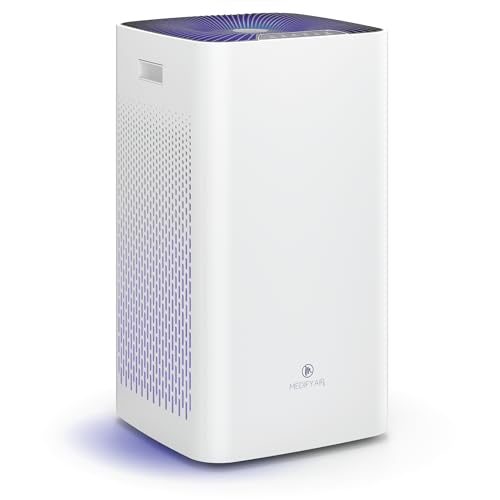
Medify MA-112 UV — Best for large damp spaces
Some damp problems are not one-room problems. A finished basement with an open plan, a lower-level family room plus laundry plus storage, can run past a thousand square feet of connected air, and a mid-size purifier in the corner will spend its life cleaning the same few feet around itself. The MA-112 UV is Medify’s answer to that scale: it is rated to turn over more than 4,400 square feet of air in an hour, which means it can give a genuinely large lower level several full air changes while running at a sensible speed.
The filtration stack pairs true HEPA with carbon, and adds an ultraviolet stage inside the cabinet. UV is best understood here as a supporting technology: it acts on what passes through or settles within the unit rather than sanitizing a room at a distance, and we would never choose a purifier for UV alone. But as a third layer in a big machine that already has the particle and odor bases covered, it is a reasonable extra for households dealing with persistent damp-air issues. The cabinet is substantial — this is furniture-scale equipment — and replacement filters for a machine this size are a real budget line, so measure your space and your commitment before ordering.
Scale cuts both ways, and it is worth picturing this unit in your actual basement before ordering: it needs clearance around its intakes, a reachable outlet, and a spot where its working airflow is not blocked by storage totes. Households that give it that room get something smaller machines cannot offer — the ability to host a movie night, a workout, or overnight guests in a lower level that used to smell like a cave by August. Run it a day ahead of guests arriving and the room greets them as ordinary living space.
- Filtration: true HEPA plus carbon, with an internal UV stage
- Coverage: rated around 4,455 sq ft per hour
- Extras: multiple fan speeds, timer, filter indicator
- Form factor: large floor unit for open-plan spaces
Strengths
- Airflow that genuinely suits open basements and lower levels
- Three-layer approach covers particles, odor, and an added UV stage
- One unit can replace two mid-size machines in connected spaces
Trade-offs
- Oversized and overpowered for a single small bedroom
- Large replacement filters carry a large-machine price
- UV stage adds little if the real problem is a hidden active leak
Best for: Open-plan basements and big lower levels with whole-zone damp air. Not suited for: Small rooms, tight budgets, or anyone expecting UV to substitute for fixing moisture.

Winix 5510 — Best smart pick
The 5510 is the current generation of a long-running Winix design, updated with app support, and it earns its place here for a practical reason: damp rooms are often rooms nobody sits in. A basement purifier that needs its dial checked in person tends to end up left off after the first filter change. One you can check from your phone — confirming it is running, nudging the speed up after a wet week, seeing the air-quality trend — actually stays on the job.
Filtration is true HEPA backed by a high-deodorization carbon filter, and Winix rates the machine for large rooms up to about 1,881 square feet in an hour. Auto mode reads the air and adjusts, which pairs well with the rhythm of a damp house: quiet during dry spells, working harder after rain soaks the ground against the foundation. Winix also fits its PlasmaWave technology, which can be switched off — and that switch matters, because households cautious about ionization can simply leave it disabled and run the machine as a straight HEPA-and-carbon unit, which is how we would use it in a bedroom.
The 5510 also handles the social side of a damp room well: its air-quality display gives a plain, visible answer when a visiting relative wrinkles their nose and asks whether the basement is healthy to sleep in — not a medical answer, but a particulate reading that shows the machine working. Filter changes are tool-free and quick, which matters more than it sounds in a room people visit reluctantly; a five-minute job gets done, while a twenty-minute wrestling match gets postponed until the odor returns.
- Filtration: true HEPA with high-deodorization carbon filter
- Coverage: large rooms up to roughly 1,881 sq ft per hour
- Extras: WiFi app control, auto mode, air-quality sensor
- Note: PlasmaWave can be turned off entirely
Strengths
- Remote monitoring suits basements and little-used rooms
- Strong carbon filter for a machine in this tier
- Auto mode matches fan effort to damp-weather swings
Trade-offs
- App setup is one more account and password to manage
- Ionization feature will not appeal to every household
- Carbon capacity still trails the Austin Air’s deep bed
Best for: Owners who want to keep an eye on a basement or guest-room machine from upstairs. Not suited for: Anyone who prefers a purifier with no app and no electronics beyond a dial.

Sharp KCP110UW Purifier + Humidifier — Best purifier-humidifier combo
Recommending a humidifier in a mold guide needs explaining, so here it is. Mold trouble comes from uncontrolled moisture: leaks, condensation, steam that lingers for hours. A humidifying purifier does the opposite — it adds a measured amount of moisture to air that has become too dry, usually in heating season, and it does so through a filtered system with antibacterial treatment in the water path. Many homes swing between both problems: damp basement in October, desert-dry bedrooms in January. For a large open space in that kind of house, the KCP110UW covers an enormous rated area — up to about 2,603 square feet in an hour — while keeping winter air comfortable.
Sharp’s Plasmacluster ion technology is part of this machine, and we flag it for the same reason we noted it on the Winix: households who prefer to avoid ionization should weigh that, though the core purification here is a true HEPA filter doing the particle work. The honest framing is that this pick is for the dry-season half of the year and for big rooms; if your only problem is a wet basement in July, the Medify or the Austin Air is the more direct answer. But for a great room that hosts both the damp shoulder seasons and the parched winter, one cabinet doing both jobs has real appeal.
Where it quietly shines is the shoulder-season week when the house is neither heated nor cooled and the air sits still and heavy: the purification keeps the great room from taking on that faintly stale note, and when the first cold snap arrives the humidifier side takes over without anyone dragging a second appliance out of a closet. Treat the water tank with the respect any humidifier demands — empty, rinse, and refill on schedule — and the combination stays a convenience rather than becoming a second moisture problem of your own making.
- Filtration: true HEPA with humidifying function
- Coverage: rated up to about 2,603 sq ft per hour
- Extras: smart controls with voice-assistant compatibility, combined water tank
- Care: humidifier components need regular cleaning
Strengths
- Huge coverage for open-plan main floors
- Handles the dry-season problem other picks ignore
- One appliance instead of two competing for floor space
Trade-offs
- Humidifier section adds weekly cleaning chores
- Ion technology will not suit ion-averse households
- Wrong tool for a room whose only issue is excess moisture
Best for: Large rooms in homes that swing between damp and very dry seasons. Not suited for: Actively wet rooms, or anyone who will not keep up with tank cleaning.
How Can You Tell Whether the Purifier Is Winning?
Mold progress is annoyingly invisible — you cannot watch a spore count — so households do better with a few humble indicators than with vibes. The first is your nose, used carefully: enter the problem room first thing in the morning, after the door has been closed all night, and note whether the closed-up smell greets you. Over the first two or three weeks of continuous running, that greeting should soften from obvious to faint to absent on most days, returning only after exceptional weather or a fresh disturbance. The second indicator is settled dust. Wipe a dark shelf or the top of a door frame with a fingertip weekly; in a room where the airborne load is falling, surfaces stay cleaner longer between wipes, because less of what the colony sheds is landing there.
The third indicator is the machine itself. Several picks here carry air-quality sensors whose readings trend downward over weeks in a room that is genuinely improving, and filter inspection tells its own story: a pre-filter that loads more slowly month over month is evidence the room’s background dust is thinning. Keep expectations calibrated, though. A purifier draws down airborne spores; it does not sterilize a house, and readings will spike when you vacuum, when the basement door stands open on a humid day, or when a hidden moisture source gets worse. A spike is information, not failure — a pattern of rising spikes, on the other hand, is your cue to go hunting for new water rather than shopping for a bigger machine. The households that succeed with damp problems treat the purifier’s feedback as a monitoring system for the house itself, and that habit, more than any single specification, is what turns a purchase into a result.
Guests notice it too, which makes visitors an accidental test panel. The relative who used to comment on the basement smell and stops commenting, the friend who sleeps in the spare room over the damp crawl space and reports a normal night — these small social signals, accumulated over a season, are often the most convincing evidence a household gets that the air in the problem room has genuinely changed rather than merely been perfumed or briefly stirred.
What Will Five Years of Mold Duty Actually Cost?
The sticker price of a purifier is the smallest part of mold ownership, because mold duty means daily running for years. Work through three running costs before choosing. Filters first: a machine with a mid-priced cartridge replaced twice a year can quietly outspend a premium unit whose main element lasts five years, which is why the Austin Air and IQAir designs — expensive boxes, long-lived filters — often win the five-year math despite losing the first-day math. Ask, for any model, what a full set of replacement filters costs and how often the maker says to change them in continuous use, then multiply honestly.
Electricity second. A purifier running around the clock draws power like a small fan — modest on low, noticeable on turbo. Machines with efficient motors and a genuinely usable low speed cost less to live with than machines that only clean well at their loudest setting, because a purifier you turn down is a purifier still working, while one you turn off is furniture. Features third: app subscriptions are rare in this category, but proprietary filter ecosystems lock you into one supplier’s pricing for the life of the machine. None of this argues for buying the cheapest or the dearest unit; it argues for pricing the whole five years, including the filter you will buy in year three when the musty smell creeps back and reminds you the carbon stage has quietly retired.
How Do the Six Picks Compare Side by Side?
| Model | Filtration focus | Coverage guide | Standout trait |
|---|---|---|---|
| IQAir HealthPro Plus XE | HyperHEPA plus gas phase | Large rooms | Finest particle capture |
| Austin Air HealthMate Plus Junior A250 | Deep carbon and zeolite | Up to ~750 sq ft | Odor removal, 5-year filter |
| Fellowes AeraMax 290 | Four-stage HEPA and carbon | ~300–600 sq ft | Balanced all-rounder |
| Medify MA-112 UV | HEPA, carbon, UV stage | ~4,455 sq ft/hr | Whole lower-level airflow |
| Winix 5510 | HEPA plus deodorizing carbon | ~1,881 sq ft/hr | App control and auto mode |
| Sharp KCP110UW Purifier + Humidifier | HEPA plus humidifier | ~2,603 sq ft/hr | Two-season versatility |
Where Should a Purifier Sit in a Damp Room, and How Should You Run It?
Placement decides whether a good machine performs like a good machine. Keep the purifier in the room where the damp problem lives, not in the hallway outside it, and give the intake and outlet breathing room — a hand’s width from walls and furniture at minimum, more where the manual asks for it. In a bathroom-adjacent setup, the practical spot is usually just outside the bathroom door in the room people sleep or sit in, because bathrooms themselves are often too small and too steamy for an appliance that plugs into the wall. In a basement, center the machine in the used part of the space rather than tucking it beside the water heater, and keep it away from the dampest wall so the air it samples represents the room.
Run it continuously. Spores do not shed on a schedule, and a purifier that runs two hours a day leaves twenty-two hours of accumulation untouched. Use auto mode if the machine has it, or a low-to-medium manual speed you can live with around the clock, and reserve the highest speed for after disturbances — vacuuming a basement carpet, moving stored boxes, cleaning a bathroom. Close the door of the treated room when you can; a purifier sized for one room cannot hold its own against the whole house’s air drifting through an open doorway. Finally, change or check filters on the maker’s schedule and sooner if the musty smell returns, because a carbon stage that has saturated quietly stops doing the odor half of the job while the fan keeps humming.
Noise deserves a word of placement strategy too. The speed you can sleep or read beside is the speed that defines your real protection, so position the machine where its working hum fades into the room — across the space rather than beside the bed’s headboard, on carpet or a rug rather than bare boards that carry vibration, and away from corners that boom. In a basement family room, placing the unit near the seating area rather than near the laundry tubs prioritizes the air people actually breathe during the hours they spend down there. And think about the path air takes: a purifier draws from its surroundings and pushes cleaned air outward, so avoid aiming the outlet straight at a damp wall, which can stir settled spores off the surface faster than the intake can collect them. A gentle circulation pattern that sweeps the occupied zone first is the pattern that pays.
How Do You Tackle a Small Mold Patch While the Purifier Does Its Part?
For a small, surface-level patch — the corner of a shower grout line, a spot on a window frame smaller than a dinner plate — careful household cleaning is reasonable, and the purifier plays a real supporting role in it. Run the machine on its highest speed in that room starting an hour before you begin, because disturbing a colony is precisely when spores flood the air, and you want maximum capture during and after the disturbance. Open a window if the room has one, close the door to the rest of the house, and keep children and pets out until you finish.
Work gently. The goal is to remove growth without launching it: mist the area lightly so spores are less inclined to go airborne, scrub with a detergent solution rather than blasting with a dry brush, and bag any sponges, cloths, or porous material that touched the patch rather than carrying them through the house. Porous materials that have been colonized deeply — a soaked section of carpet padding, crumbling drywall, a musty ceiling tile — are a different category: they usually need to come out, and if the affected area is more than a small patch, or you cannot see where the growth ends, stop and bring in a professional. After cleaning, let the purifier keep running on high for several hours to draw down what the work released, then return it to its normal continuous setting. And address the moisture that fed the patch in the same week — reseal the grout, fix the condensation path, extend the fan’s run time — because a cleaned patch over a live moisture source is just a colony waiting for its second act.
Which Mistakes Do Damp-House Owners Keep Making?
The classic mistake is expecting the purifier to win a fight against an active leak. If water is still entering — a cracked foundation joint, a gutter pouring against the wall, a shower valve dripping inside the stud bay — the colony keeps growing and the machine becomes an expensive way to feel better about a worsening problem. Fix water first, then let the purifier manage the air. A close second: buying by room size alone and choosing the smallest machine whose rating technically covers the floor plan. Damp rooms deserve headroom, because the air changes per hour implied by headline ratings are optimistic for a space with a moisture source.
Third, neglecting the unglamorous maintenance. A pre-filter clogged with basement dust strangles airflow, and the machine’s real-world delivery falls off a cliff while the indicator still glows a reassuring color. Vacuum or wash the pre-filter as directed. Fourth, sealing the purifier into a corner behind furniture, where it recirculates its own cleaned air in a tiny loop. Fifth, treating a visible mold patch larger than a small area as a DIY wipe-down: disturbing a big colony without containment throws an enormous spore load into the air at once. Large or recurring growth is a remediation job; run the purifier to support the cleanup, not to replace it.
A sixth mistake is subtler: scenting over the problem. Plug-in fragrances, scented candles, and odor-masking sprays can make a damp room smell decorated while the colony underneath keeps growing, and they add their own compounds to air you are trying to simplify. If a room needs perfume to be tolerable, it needs investigation, not fragrance. Let the purifier’s carbon stage do the honest version of that job — removing odor compounds instead of covering them — and treat any returning mustiness as a message from the house worth listening to.
Final Recommendation
Start by matching the machine to the shape of your damp problem. If odor is the headline complaint in a bedroom-size space, the Austin Air HealthMate Plus Junior’s deep carbon bed is the most direct tool on this list, and its five-year filter makes it the easiest to live with. If the problem is a whole lower level, the Medify MA-112 UV has the airflow to matter down there, with the Winix 5510 as the smarter, more monitorable alternative for a single large room. The Fellowes AeraMax 290 is the sensible first purchase for one damp living space, and the IQAir HealthPro Plus XE is the step up for households where the mold issue is serious and long-term. Choose the Sharp only when dry winter air is genuinely half your problem. Whichever you pick, fix the water, run the machine daily, and let the quiet disappearance of that closed-up smell after a rainy week be the sign your damp room has finally met its match.
Frequently Asked Questions
Can an air purifier remove mold that is already growing on a wall?
No. A purifier filters air, and growth on a wall, grout line, or window frame has to be cleaned or removed at the surface itself. What the machine does is capture spores that the colony releases into the room, which reduces what you breathe and what settles elsewhere while you deal with the source.
How long should I run a purifier in a room with a mold problem?
Continuously is the honest answer, at a low or automatic setting you can tolerate all day. Spores shed whenever air moves across a colony, so part-time running leaves long unfiltered stretches. Most owners notice the room smelling fresher within days, with steadier improvement over the first few weeks. If noise at night is the obstacle, run the higher speed during the hours nobody is in the room and let the quiet setting hold the gains overnight, rather than switching the machine off entirely.
Is a dehumidifier or a purifier the better first buy for a damp basement?
They do different jobs. A dehumidifier attacks the cause by pulling moisture from the air; a purifier attacks the airborne result. If you can only buy one first and the basement is genuinely wet, control the moisture first — then add the purifier for spores and odor. Many damp basements eventually want both.
Do UV or ion features replace a HEPA filter for spores?
They do not. A spore is a particle, and physically trapping particles is HEPA’s job. UV stages inside a cabinet can support the process, and ion features vary widely, but neither substitutes for air actually passing through dense filter media at a good rate.
Should the purifier live in the bathroom itself?
Usually not. Most bathrooms are too small for a floor appliance, and the steam density during a shower is hard on electronics that are not rated for wet rooms. The better arrangement is a purifier in the room the bathroom serves — the bedroom or hallway living space — combined with a bathroom fan that actually runs during showers and for a while afterward. The fan handles the moisture at its source; the purifier handles the air people spend their hours breathing.
When should I call a professional instead of buying a bigger purifier?
When growth covers a large area, keeps returning after cleaning, follows a flood, or sits inside walls or ductwork — and whenever anyone at home has health symptoms they are worried about. A professional remediator handles the source safely, and health questions belong with a clinician, not an appliance.
Related Guides
Once the damp room is under control, the same filtration thinking applies across the rest of the home. Our companion guides cover Best Air Purifiers for a 1-Bedroom Apartment for smaller floor plans, Best Affordable Air Purifiers for Mold and Dust for tighter budgets facing the same spore problem, and Best Air Purifiers and Fans for rooms that need air movement as well as cleaning.



[…] the spore-focused treatment the 290’s brief points toward, continue to Best Air Purifiers for Mold Spores. Room-sizing discipline for the SE’s territory is covered in Best Air Purifiers for a 500 Sq […]