What's inside
- Key Takeaways
- Quick Picks
- How Did We Choose These Picks?
- Comparison Table
- How Do You Keep the Peace With a Roommate Over Alarms?
- What Is Snooze Discipline, and How Does a Clock Enforce It?
- How Do You Survive the Shared Power Strip?
- What Are the Most Common Mistakes Students Make With Dorm Alarms?
- Final Recommendation
- How Do You Choose Between One Shared Clock and Two Personal Ones?
- What Does a Dorm Morning Routine Actually Look Like?
- How Do You Handle Exam Season and All-Nighters?
- What Should Parents and Gift-Buyers Know?
- How Do Bunk Beds and Loft Beds Change the Choice?
- What About Noise Beyond the Alarm, Corridors and Neighbours?
- How Does the Clock Survive Move-Out, Summers and Storage?
- How Do You Set Up the Room in the First Weekend?
- What Is the Right Budget for a Dorm Clock?
- How Do Shared Bathrooms and Queues Shape the Wake Time?
- What About Students Who Work Early Shifts?
- How Do You Keep the Clock From Being Borrowed Into Oblivion?
- A Last Word on the First Morning
- What If Your Course Starts at a Different Time Every Day?
- Frequently Asked Questions
- Related Guides
As an Amazon Associate I earn from qualifying purchases. This post may contain affiliate links at no extra cost to you.
cottageverdict.com is reader-supported. When you buy through links on our site, we may earn an affiliate commission.
Where to buy: each clock below links to its Amazon listing, where you can check price on Amazon and confirm the size, power arrangement and backup details that matter in a shared room. Dorm specifications are unforgiving, so read the dimensions line twice; a clock that fits the catalogue photograph may not fit the desk you actually own.
The best alarm clocks for dorm rooms are designed by a set of constraints no home bedroom imposes all at once. The desk is small and shared with a laptop, three textbooks and the debris of student life. The room contains another human whose timetable, temper and 8 a.m. lecture differ from yours, and whose goodwill is a finite resource that a badly chosen alarm spends quickly. The power comes from a shared strip that someone will unplug to charge a games console. And the sleeper is a student, which is to say a person whose bedtime is negotiated nightly against deadlines, societies and a social life, and whose morning self cannot be trusted with anything complicated.
A good dorm clock therefore optimises for four things: a footprint that survives the desk, a volume that can be set loud for its owner without declaring war on the roommate, a snooze that disciplines rather than indulges, and a backup plan for the night the power strip gets borrowed. Displays must dim, because a roommate’s ceiling-facing glare complaint is legitimate. Prices must respect a student budget, because the clock competes with textbooks for the same money and will lose that argument if it costs like furniture.
The six picks below divide by strategy. Three small digitals, the Amazon Basics oval, the DreamSky and the REACHER, cover the compact-and-clear school, two of them charging a phone as they go. The Peakeep brings analogue force for the student who negotiates with every snooze button ever made. The Netzu brings dual alarms and serious volume for shared schedules and heavy sleepers. The uscce wooden clock brings dual alarms and a display that can vanish entirely, for the room where darkness is the treaty both sides signed. Every one of them can be carried home in a backpack at term’s end, which is the dorm category’s final, unspoken specification.
Key Takeaways
- Footprint is destiny in a dorm: measure the desk corner before falling for features.
- Volume control is a roommate treaty, letting the alarm be loud for you and survivable for them.
- Battery backup matters because shared power strips get unplugged without malice or warning.
- Dual alarms serve two schedules in one room, or one student’s warning shot and final call.
- The Amazon Basics oval is the budget default; the uscce wooden clock is the darkness-respecting upgrade.
- Agree the snooze rules with your roommate in week one, while everyone is still being polite.
Quick Picks
| Pick | Badge | Why it made the list |
|---|---|---|
| Amazon Basics Small Digital Oval Alarm Clock | The dorm default | A tiny oval with a nightlight, snooze and battery backup at a price that survives a student budget. |
| DreamSky Small Digital Alarm Clock | Big numbers, small body | Large clear digits, a USB charging port for the phone and USB-C power in a desk-friendly footprint. |
| REACHER Digital Alarm Clock | The colourful charger | Colour-shifting dimmable digits and a USB port that charges the phone from the same small clock. |
| Peakeep Twin Bell Alarm Clock | The snooze-proof option | Twin bells with no snooze to negotiate with, battery powered so no power strip can disarm it. |
| Netzu Digital Alarm Clock | Dual alarms, real volume | Bold digits, four volume levels and two alarms for roommates on different lecture schedules. |
| uscce Wooden Digital Alarm Clock | The treaty clock | Dual loud alarms with volume control and a display that dims to nothing in a wood-finished body. |
Notice what the table does not contain: anything large, anything app-dependent, and anything whose alarm cannot be moderated. Dorm life punishes all three. The detailed reviews keep returning to the same witnesses, the desk, the roommate and the power strip, because in this category those three witnesses outvote every feature list ever printed.
How Did We Choose These Picks?
Size came first, measured against the real estate a dorm actually offers: the corner of a desk, the top of a mini-fridge, a shelf above the bed. Anything that could not live in those places without evicting the laptop was excluded, however accomplished. Volume behaviour came second, and it was judged as a range rather than a maximum: a dorm clock must be capable of force for a heavy sleeper and of restraint for a roommate’s lie-in, sometimes on the same morning, so adjustable volume scored heavily and fixed loudness was treated as a diplomatic incident waiting to happen.
Power arrangements formed the third screen. Battery backup on the plug-in models guards against the shared strip’s adventures; the Peakeep’s battery-only design sidesteps the strip entirely. USB charging ports scored because a dorm phone is its owner’s library card, social life and family line in one device, and a clock that charges it frees a socket on the contested strip. Displays had to dim properly, in one case to complete darkness, because light discipline is half of roommate peace.
Price and durability closed the list. Student budgets set the ceiling, and the knowledge that this clock will be packed, dropped, lent and possibly sat on set the floor for build expectations. Nothing here is precious; everything here is expected to survive four years of term-time and still be correct on the morning of the final exam, which is the only review that ultimately counts.

Amazon Basics Small Digital Oval Alarm Clock — The dorm default
If every dorm room arrived with one clock pre-installed, it would look like this: a small smooth oval with an LED display, a nightlight, a snooze and battery backup, costing little enough that losing it to the end-of-term chaos is an annoyance rather than a tragedy. The oval shape matters in practice, since it has no corners to catch on the desk’s clutter and no flat top inviting a mug to colonise it, so it keeps its small territory semester after semester.
The nightlight earns a paragraph of its own in a shared room. It is bright enough for a midnight trip to the corridor bathroom and dim enough not to stage a protest from the other bed, which makes it the most diplomatic light in the building. Battery backup covers the power strip’s moods, and the single alarm keeps the contract simple: one wake time, honestly kept.
Its limits are the honest kind. There is one alarm, no phone charging and no volume subtlety beyond its setting, so roommates on wildly different schedules should look at the dual-alarm models below. As the first clock a student owns, the spare in a drawer, or the answer when the budget has been spent on textbooks, it is very hard to beat, and its price means a student can own two and keep one at home for the holidays.
There is a reason this little oval appears in so many first-week photographs of dorm rooms: it is usually the first object unpacked, because the first night away needs a clock more than it needs a poster. Parents slipping one into the top of the last box are practising an old and sound tradition, and students who rolled their eyes in September are frequently its defenders by June.
- Display: LED with built-in nightlight
- Power: mains with battery backup
- Alarm: single with snooze
- Size: compact oval, roughly palm-sized footprint
Strengths
- Smallest footprint in this guide
- Nightlight pitched perfectly for shared rooms
- Battery backup survives power-strip accidents
Trade-offs
- Only one alarm for two possible schedules
- No USB charging for the phone
- Basic volume options
Best for: first-year students, tight budgets and anyone whose desk corner is truly tiny. Not suited for: roommates needing separate alarms from one clock. Check price on Amazon.

DreamSky Small Digital Alarm Clock — Big numbers, small body
The DreamSky solves the dorm desk’s central contradiction: the clock must be small, but its numbers must be readable from a bunk, a beanbag and the doorway. Its display digits are generously sized for its compact body, dim smoothly for the night, and the alarm volume adjusts across a range wide enough to cover both the light sleeper and the student who sleeps like the recently deceased. A large snooze button on top accepts a palm slap without aiming, which at 7 a.m. is a genuine ergonomic feature.
Two power details suit student life particularly. The clock runs from a USB-C adapter, the same cable family as half the devices a student already owns, and it offers a USB charging port for the phone, turning the clock into the desk’s charging point and freeing a socket on the strip. Battery backup guards the alarm settings against the strip’s unplugging incidents.
Against the Amazon oval it trades the nightlight for charging and bigger digits, a swap most students will take. Against the REACHER it offers a calmer, more classic face. It is the pick for the student whose phone battery and eyesight both need help, and whose desk can spare exactly one small rectangle for the whole enterprise.
Dorm staff and older students recognise this model on sight, because it has become a default recommendation in packing lists passed down between cohorts. That kind of quiet institutional adoption is worth more than a launch review: it means the clock has survived thousands of rooms, strips, roommates and revision weeks, and been recommended by the only reviewers whose evidence is a degree completed on time.
- Display: large digits with smooth dimmer
- Power: USB-C adapter, battery backup
- Extras: USB charging port for the phone
- Alarm: adjustable volume, large snooze
Strengths
- Readable across the room despite its size
- Charges the phone and frees a strip socket
- Snooze button works by palm, not by eyesight
Trade-offs
- No nightlight for corridor trips
- Single alarm rather than dual
- Plain styling
Best for: students who read the time from across the room and charge a phone at the desk. Not suited for: roommates needing two alarms or a nightlight. Check price on Amazon.
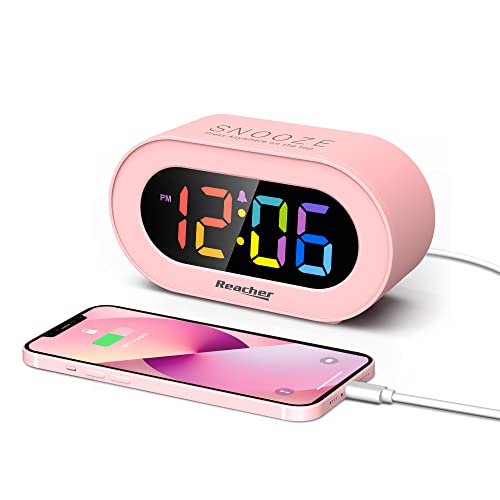
REACHER Digital Alarm Clock — The colourful charger
The REACHER understands that a dorm room is also a personality statement, and lets its digits change colour to prove it. Beneath the colour play sits a sensible student clock: a USB port that charges the phone overnight, a display that dims across its full range so the colour never becomes a roommate grievance, adjustable alarm volume and an easy snooze. The footprint is compact enough for the desk corner or the fridge top.
Colour turns out to have a functional side in shared housing. A clock a student has personalised is a clock whose alarm gets respected, set nightly rather than resented, and in a room where two people’s mornings interlock, that small ownership effect keeps the peace better than any specification. The charging port does the same work on the power strip, consolidating the phone’s nightly fill into the clock’s own supply.
It lacks dual alarms and a nightlight, and its playful face will not suit the student cultivating a minimalist cell. For the majority, though, it is the dorm clock most likely to be photographed in the room tour and the one least likely to be left behind at move-out, because it has become part of the room’s identity rather than part of its equipment.
Room tours and video calls home reveal another of this clock’s quiet functions: it makes the room look inhabited and intentional on camera, a small coloured heartbeat on the desk that tells parents the chaos is organised. Students are not obliged to care about that signal, but the ones who send it report the parcels from home improve in quality, which may be the most practical feature in this entire guide.
- Display: colourful LED, fully dimmable
- Extras: USB charging port for the phone
- Alarm: adjustable volume, easy snooze
- Form: compact desk or shelf size
Strengths
- Colour display students actually enjoy owning
- Charges the phone from the clock
- Dims completely for roommate-friendly nights
Trade-offs
- Single alarm focus
- No nightlight
- Style will not suit minimalists
Best for: students personalising a first room and charging a phone at the desk. Not suited for: dual-schedule roommates or monochrome tastes. Check price on Amazon.
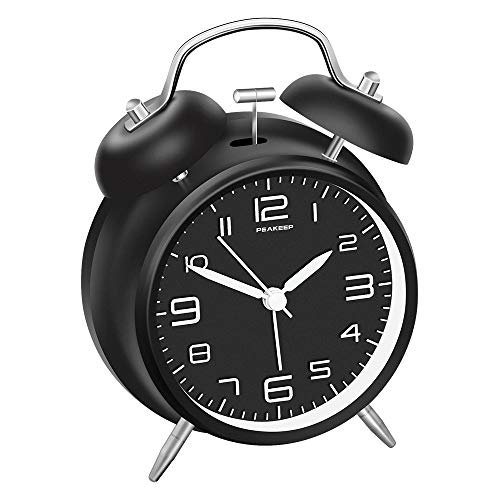
Peakeep Twin Bell Alarm Clock — The snooze-proof option
Every dorm has one student whose relationship with the snooze button is a documented campus legend, and the Peakeep is that student’s intervention. Twin metal bells, a hammer, no snooze control of any kind, and a battery inside that no power strip, blackout or borrowed socket can disarm. In the morning it rings with the bright, unignorable authority of a school corridor in 1962, and it stops when a conscious person crosses the room to stop it, which is precisely the behaviour the purchase is buying.
The diplomatic warning must be printed in the review, not the footnotes: in a shared room this clock is a treaty-level decision. Its bells do not distinguish between its owner and a roommate whose first lecture is at noon, so it belongs in single rooms, in suites where the bedroom door closes, or in shared rooms only under a written-in-week-one agreement. Deployed with consent, it has ended more oversleeping careers than any app ever written.
The backlight flashes on demand for a midnight time check without flooding the room, the bold 3D dial reads at a glance, and the whole object costs little enough to be the second clock in a two-clock system, the analogue backstop behind a gentler digital. Students also report an unexpected benefit: it photographs beautifully and starts conversations, which in a first term is worth several decibels by itself.
Student folklore attaches to this clock quickly: it acquires a name, a reputation on the corridor and, in at least one hall known to the editors, a small fan club of former oversleepers. Folklore is not a specification, but it is evidence of adoption, and adoption is the whole game in a dorm. A clock the room has feelings about is a clock whose alarm is set, defended and, crucially, answered.
- Alarm: twin bells, very loud, no snooze
- Power: battery operated, strip-proof
- Display: analogue dial, on-demand backlight
- Size: compact four-inch body
Strengths
- Cannot be snoozed, unplugged or updated into failure
- Battery power makes it immune to dorm electrics
- Cheap enough to serve as a backstop clock
Trade-offs
- Wakes the room, not just the owner
- Single alarm, approximate setting
- Fixed, formidable volume
Best for: single rooms, snooze addicts and anyone needing an unbreakable backstop. Not suited for: shared rooms without a roommate treaty. Check price on Amazon.

Netzu Digital Alarm Clock — Dual alarms, real volume
The Netzu is the shared room’s negotiator: two independent alarms under one display, so the roommate with the 8 a.m. lab and the student with the 10 a.m. seminar can each keep their own schedule on the same desk. Bold digits serve the whole room as its reference clock, four volume levels let each alarm be tuned to its sleeper, and five dimmer levels keep the display polite after lights-out. Setup is deliberately simple, because a clock two people must programme cannot afford a learning curve.
For the heavy sleeper it offers the strongest purely digital volume in this guide, assertive enough to matter through earplugs-adjacent student sleep, while its gentler settings spare the room on the mornings when only resolve is needed. The snooze exists and behaves, neither absent nor endlessly indulgent.
It charges no phones and lights no corridors, and its functional styling will not win the room tour. What it wins is the timetable, which in a dorm is the territory that matters. Suites and shared rooms with clashing schedules should start their shortlist here and only move on if the desk cannot spare its modest footprint.
One under-sung virtue: because the Netzu is plainly a shared appliance rather than a personal gadget, roommates actually discuss it, and the discussion is where the treaty gets written. Many dorm objects are suffered in silence until they are resented; a clock both people set is a clock both people have consented to, and consent, in shared housing, is the difference between equipment and provocation.
- Alarms: dual, independently set
- Volume: four levels, properly loud at the top
- Display: bold digits, five dimmer levels
- Power: plug-in
Strengths
- Two alarms solve the roommate schedule problem
- Strongest digital volume here for deep sleepers
- Simple setup both roommates can manage
Trade-offs
- No phone charging or nightlight
- Utilitarian looks
- Plug-in only, so place it near the strip
Best for: shared rooms with two schedules and heavy sleepers needing digital force. Not suited for: students wanting charging or design flair. Check price on Amazon.

uscce Wooden Digital Alarm Clock — The treaty clock
The uscce is the dorm clock for the room that has negotiated its peace and intends to keep it. Its display dims across the full range to complete invisibility, so the room can be truly dark, a concession light-sensitive roommates value above rubies. Its dual alarms are loud with proper volume control, letting each sleeper calibrate force without flooding the room, and its wood-finished body looks like a deliberate furnishing in a sea of plastic, which matters in the room a student will live in for years.
Large numerals keep it readable in daylight hours when it serves as the room’s clock, and the dual-alarm staging suits the student who wants a warning call and a final call from the same device. In suites and upper-year housing, where the dorm has matured into a small flat, this is the clock that graduates with its owner rather than being donated to the corridor at move-out.
It is the premium pick here, and its price should be weighed against that longevity rather than against a single term. It charges no phone, so the strip still hosts a charger, and its good looks invite the one dorm crime that matters, being borrowed permanently by a departing friend. Engrave nothing; just know where it lives.
Suitemates describe an unexpected effect of the vanishing display: the room’s sense of time relaxes after dark, because no glowing digits keep announcing the hour to people trying to forget it. The clock is present when consulted and absent when not, a manners pattern most technology has forgotten. In a shared room negotiating its peace, that discretion can be worth more than any alarm specification on the box.
- Alarms: dual, loud with volume control
- Display: large numbers, dimmable to fully off
- Form: wood-finish body, desk or shelf size
- Power: plug-in
Strengths
- Display vanishes completely for dark-room treaties
- Dual alarms with civilised volume control
- Looks like furniture, lasts like it too
Trade-offs
- Premium tier for a dorm purchase
- No USB charging for the phone
- Too handsome to lend safely
Best for: upper-year students, suites and roommates whose peace treaty is built on darkness. Not suited for: the tightest budgets or phone-charging hunters. Check price on Amazon.
Comparison Table
| Pick | Alarms | Power and backup | Standout trait |
|---|---|---|---|
| Amazon Basics Small Digital Oval Alarm Clock | Single | Mains, battery backup | Nightlight, tiniest footprint |
| DreamSky Small Digital Alarm Clock | Single | USB-C powered, battery backup | Big digits, phone charging |
| REACHER Digital Alarm Clock | Single | Plug-in | Colour digits, phone charging |
| Peakeep Twin Bell Alarm Clock | Single analogue | Battery only | No snooze, strip-proof |
| Netzu Digital Alarm Clock | Dual | Plug-in | Four volumes, bold digits |
| uscce Wooden Digital Alarm Clock | Dual | Plug-in | Display to black, wooden finish |
How Do You Keep the Peace With a Roommate Over Alarms?
Negotiate in week one, in daylight, while the goodwill is fresh. The durable agreements share a shape: each person’s alarm volume is set for their own bed’s distance, the early riser silences promptly and completely, snoozes are rationed to a number both sides can live with, and the truly antisocial equipment, bells and maximum volume, requires explicit consent renewed each term. Write nothing down if you like, but say it all out loud, because unspoken alarm expectations are the mould in many a roommate relationship, invisible until the morning they are not.
Technology can soften what negotiation cannot. A dual-alarm clock like the Netzu or uscce lets one object serve both schedules without either person touching the other’s settings. A display that dims to black removes the light grievance entirely. A vibrating phone under a pillow can serve as the first, private stage before the room’s clock speaks. The room that combines a small treaty with the right hardware rarely argues about mornings after September, which frees the arguing budget for the thermostat and the washing-up, where it belongs.
What Is Snooze Discipline, and How Does a Clock Enforce It?
Snooze discipline is the agreement that the alarm’s first call is the wake-up and the snooze is a bridge, not a residence. In dorm terms it matters doubly, because one student’s snooze chain is the other student’s alarm too, repeated at nine-minute intervals through their best sleep. The clocks here enforce discipline in three dialects: the Peakeep by abolition, the dual alarms by replacing snoozes with a planned second call at a civilised interval, and the plain digitals by making the snooze a single, deliberate press rather than a lifestyle.
The routine that works in shared rooms is boringly consistent: alarm across the desk rather than beside the pillow once the first fortnight proves the volume, feet on the floor before the phone is touched, and the roommate’s schedule treated as a reason to be brisk rather than as background music. Students who adopt it discover the hidden curriculum of dorm life, which is that self-management is mostly furniture arrangement plus promises kept at low bandwidth.
How Do You Survive the Shared Power Strip?
Assume the strip will be unplugged, overloaded and borrowed, and design for its betrayal. Battery backup on the Amazon oval and DreamSky keeps their alarms armed through an outage of the strip’s making; the Peakeep ignores the strip altogether. Charging clocks like the DreamSky and REACHER reduce the strip’s population by absorbing the phone, which lowers the odds that your clock’s plug is the one evicted for a console or a kettle.
Physical habits complete the defence. Claim the socket nearest the strip’s switch for the clock and label the plug with tape if the corridor is feral about borrowing. Route the cable where a vacuum or a chair leg cannot worry it. And keep one entirely power-free backstop in the room, even if it is the phone in a drawer, for the morning of the exam that the whole building’s electrics choose to commemorate with a blackout.
What Are the Most Common Mistakes Students Make With Dorm Alarms?
The first is buying for the bedroom at home: a big, loud, single-purpose clock that fitted a private room and fits a shared one like a drum kit fits a library. The second is trusting the phone alone while knowing its battery, its updates and its owner’s evening habits intimately. Third comes the unnegotiated bell, deployed in a shared room in week one and remembered in the final week. Fourth, students place the clock within arm’s reach and then blame their character for a geometry problem. The last is forgetting the clock entirely at packing, buying whatever the campus shop stocks in September at campus prices, when the whole of this guide could have been ordered calmly in August.
One packing-list note from experience: buy the clock in the summer, at home, where it can be tested on a home nightstand and returned without drama if its volume or display misses the mark. The same clock bought in the first week of term is bought in a queue, under time pressure, with the return window expiring during freshers’ events. August is this category’s season, and the students who shop then arrive with their mornings already solved.
And tell the roommate, before either of you buys anything, what you are bringing. Half the treaties in this guide begin as a message sent in August, and a clock that arrives expected is a clock that starts its career with consent, the rarest and most valuable specification in shared housing.
Keep the packaging until the end of the first month, flattened under the bed with the rest of the term’s insurance. A clock that fails its fortnight trial can then go back without a hunt for the box, and a clock that passes will never need the packaging again, which is the natural order of dorm possessions.
Finally, photograph the desk once the system works, clock in its corner and cables behaving. Move-out, room swaps and the spring clean all scramble arrangements that took a term to tune, and the photograph restores in a minute what memory would rebuild in a week of slightly wrong mornings.
There is a small ceremony worth adopting on the first Sunday of term: both roommates set their alarms for the week ahead at the same time, out loud, and confirm the treaty still holds. It takes three minutes, it catches the timetable changes nobody mentioned, and it turns the clock from one person’s appliance into the room’s shared institution, which is where dorm equipment does its best and longest work.
Resist, finally, the urge to solve a bad first week by buying a second, louder clock. Adjust the volume, the placement and the treaty first, in that order, because nine dorm alarm problems in ten live in those three settings rather than in the hardware, and the tenth is solved by the Peakeep, which was on the list all along.
Label the plug, as the power section advised, before the first corridor borrowing spree rather than after it. Small preventions, applied in the calm of the first weekend, are what separate a system from a hope.
Final Recommendation
Match the clock to the room’s actual politics. A single room or a consenting suite can take the Peakeep’s glorious certainty; most shared rooms will live happiest with the Netzu’s dual alarms or the uscce’s darkness-respecting dual system. The small digitals divide the rest by need: the Amazon oval for the tiniest desk and budget, the DreamSky for big digits and phone charging, the REACHER for colour and charging in a personalised room. Buy it before term starts, negotiate its use in the first week, and the clock will repay you in the only currency a dorm really trades in, mornings that begin when they were supposed to.
How Do You Choose Between One Shared Clock and Two Personal Ones?
The shared dual-alarm clock wins on territory and tidiness: one object, one plug, one display the whole room reads. It suits roommates whose schedules are cousins, an hour apart rather than four, and whose trust extends to shared furniture. Two personal clocks win on sovereignty: each sleeper owns their volume, their snooze habits and their consequences, and a falling-out over mornings cannot confiscate the other person’s alarm. Suites and rooms with desks at opposite ends drift naturally toward the two-clock answer, especially when the budget picks here make owning one each cheaper than many single fashionable clocks.
There is a hybrid that experienced students swear by: a shared room clock for the time, the Netzu or uscce as the wall of record, plus a personal backstop each, the phone or the little Amazon oval, set five minutes behind the main event. The hybrid costs little, survives every failure mode in this guide, and gives each roommate a private layer of insurance that harms nobody’s sleep. Choose the architecture in the first week and the hardware will follow it obediently.
What Does a Dorm Morning Routine Actually Look Like?
It looks shorter than the routines in magazines, because it is built by a person who was asleep four minutes ago. Alarm, stand, bathroom queue, kettle, clothes chosen the night before, bag already packed: the whole liturgy fits in fifteen minutes when the decisions were made at midnight rather than at dawn. The clock’s contribution is to start the liturgy at the same minute daily, because a body that wakes at a fixed time begins preparing for it, and by mid-term many students surface a moment before the alarm with the eerie reliability of a train arriving.
Evenings carry the routine’s real weight. The student who lays out clothes, charges the phone at the clock and sets the alarm as part of undressing has effectively attended their own morning in advance. Roommates who synchronise even loosely, lights low by a shared hour, alarms respected without commentary, find the room itself becomes a routine machine. None of this requires virtue; it requires the same small sequence repeated until it is furniture.
How Do You Handle Exam Season and All-Nighters?
Exam season breaks ordinary schedules in both directions: revision until three, an exam at nine, a celebratory collapse, then another exam. The clock system should bend without breaking. Dual alarms earn their keep here, one set for the exam morning and one left at the term’s normal hour as the anchor to return to. Students pulling a genuine all-nighter should still set the clock, because the planned twenty-minute nap at dawn is where all-nighters go to become disasters, and a loud, across-the-room alarm is the only colleague who will reliably end it.
After the exams, resist the month-long lie-in that resets the body to nocturnal. A few anchor mornings a week, kept by the same clock at the same hour, preserve the term’s hard-won rhythm for the placement, the job or the next semester that will demand it. The clock, indifferent to results day, is the household’s memory of what a morning is.
What Should Parents and Gift-Buyers Know?
A dorm clock is one of the few student gifts that is used daily, costs modestly and cannot be eaten, worn out or left at a party. Buy for the room the student actually has: ask about the roommate, the desk and the course’s start times before choosing, because the difference between the Peakeep and the uscce is a question about another person’s sleep, and the giver who asks it looks thoughtful rather than merely generous. Include the batteries where the design wants them, and resist engraving, monogramming or otherwise marking the object as a keepsake; its value is that it is equipment.
The DreamSky and REACHER suit the student whose phone is their lifeline, the Netzu suits the shared-room negotiator, and the Amazon oval suits everyone as the spare that lives in the drawer against the day the main clock meets the floor. A clock plus a decent power strip, given together, quietly solves half the dorm’s electrical politics in one parcel.
How Do Bunk Beds and Loft Beds Change the Choice?
Height rearranges everything. A student sleeping in a loft bed cannot reach a desk clock’s snooze, which is either the system’s genius or its fatal flaw depending on the student’s honesty. For the snooze negotiator, the unreachable clock is the point: the Peakeep or Netzu on the desk below makes standing, and therefore waking, part of the mechanism. For the responsible sleeper, a small clock on the bed’s shelf, the Amazon oval or DreamSky, keeps the time visible and the alarm manageable without a ladder descent in the dark.
Displays matter differently at height too. A bright display at pillow level in a bunk glares; the uscce’s vanish-to-black screen and the REACHER’s full dimming earn their keep in rooms where one student’s clock faces another’s bunk. Route cables so nothing dangles across the climbing route, and never let a charging phone sleep in the bedding, a rule whose reasons every campus safety talk recites and every term somebody relearns.
What About Noise Beyond the Alarm, Corridors and Neighbours?
Dorm walls are famously theoretical, so a clock’s volume is a building-level decision as well as a room-level one. The student with the earliest start on the corridor owes the corridor a prompt silencing and a volume no higher than their own waking requires. Conversely, corridor noise argues for the alarm being unmistakable against a background of other people’s evenings, which is where the Netzu’s top volume and the Peakeep’s bells justify themselves on nights before big mornings, used sparingly and apologised for in advance.
Quiet hours, where the residence enforces them, bind alarms in spirit rather than letter: an alarm that ends promptly is a courtesy, an alarm left ringing into an empty room while its owner showers is a small crime. Set the clock for when you will actually be there to silence it, and let the building’s rhythm and your own grow together across the term.
How Does the Clock Survive Move-Out, Summers and Storage?
Student possessions lead hard lives in transit, and the clock should be chosen like luggage. The small digitals here travel in a shoe or a washbag without complaint; the Peakeep’s bells survive drops that would retire a screen; even the uscce’s wooden body tolerates the box-of-everything method of packing. Remove batteries for a summer in storage so a leak cannot write the clock off, photograph the alarm settings if they were hard-won, and keep the clock with the bedding, because the first night in a new room is exactly when it is needed and exactly when a box labelled miscellaneous cannot be found.
Graduation divides the list by sentiment. The Amazon oval and its budget cousins get donated to the corridor’s next generation with the guide’s blessing. The uscce and the Netzu tend to emigrate to first flats, where their dorm service becomes a story told over the very mornings they once enforced. A clock that survives university has earned that promotion.
How Do You Set Up the Room in the First Weekend?
Unpack the clock before the posters. Place it, set it, and run one rehearsal alarm while both roommates are present and amused, because the rehearsal converts the abstract treaty into a shared joke with a volume setting attached. Agree the snooze ration, the quiet hours and the rule for the morning somebody’s alarm fires into an empty room, and write the agreement nowhere more formal than memory; the point is that it was said aloud once, early, by people still introducing themselves.
Then leave the system alone for a fortnight. The temptation to upgrade, rearrange and re-litigate in week two is strong and should be resisted, because a morning routine needs repetitions more than it needs improvements. By the third week the clock will have become part of the room’s weather, noticed only when it fails, which, if this guide has done its work, it will not.
What Is the Right Budget for a Dorm Clock?
Price it against the cost of the failures it prevents. A missed 9 a.m. exam, a forfeited shift, a term of roommate friction: against those, even the premium uscce is inexpensive, and the budget picks are close to free. The false economy is the novelty clock bought for a laugh in freshers’ week, musical, fragile and unlamented by November. Students should spend once, at the level their sleep honestly requires, and direct the savings from not buying twice toward the kettle, which is the dorm’s other morning institution and deserves a guide of its own.
Second-hand deserves a word, because dorm clocks circulate. A used digital from this list, tested for its alarm and its backup before money changes hands, is a perfectly honourable purchase, and the Peakeep, having no software and few moving parts to wear, may be the most immortal object in the building. Buy the used clock in daylight, hear it ring, and it will outlast the degree.
How Do Shared Bathrooms and Queues Shape the Wake Time?
The dorm morning has a hidden timetable that no lecture schedule prints: the bathroom queue. A room of students waking at the same minute for the same lecture competes for the same showers, and the clock’s real job is often to start its owner ten minutes ahead of the corridor’s rush rather than merely on time for class. Students learn their building’s rhythm within a fortnight, who showers at seven, which floor’s water runs cold at eight, and set their alarms by that intelligence. The dual-alarm clocks help here too, the first call claiming the bathroom, the second guaranteeing the lecture even if the queue wins a round.
This is also where the night-before system pays its highest dividend. A bag packed and clothes chosen mean the bathroom minutes are the morning’s only queue, and a student can afford to lose it gracefully. The clock cannot shorten the queue, but a household that plans around it stops experiencing the queue as an emergency, and dorm mornings improve out of all proportion to the change.
What About Students Who Work Early Shifts?
A large minority of students fund the degree with dawn labour, café openings, gym desks, cleaning rounds, and their alarm problem is the dorm problem squared: a 5 a.m. start inside a room where nobody else rises before nine. The equipment answer is restraint with reliability, a dual-alarm clock set at the lowest volume that genuinely works, placed close, silenced instantly, with the phone’s vibration under the pillow as the private first stage on the most delicate mornings. The uscce and Netzu both serve this pattern well, and the Amazon oval’s nightlight guides the corridor trip without waking the room.
The social answer matters as much: tell the roommate the schedule once, keep it visibly consistent, and let the early riser’s discipline become part of the room’s furniture. Roommates forgive an alarm that behaves like a train timetable; they resent one that behaves like weather. The working student’s clock, chosen and used with that courtesy, rarely features in any complaint, which is the highest praise dorm equipment can earn.
How Do You Keep the Clock From Being Borrowed Into Oblivion?
Dorm possessions migrate, and clocks migrate with the best of them, lent for an exam morning and absorbed into another room’s furniture. The defences are social rather than technical: lend the spare, never the system; write a name on the underside in the first week, when marking territory is still funny; and keep the household’s main clock plugged into its treaty position, since an object with a place is harder to borrow than an object in a drawer. The Amazon oval’s price makes it the natural designated lender, which is one more reason households end up owning two clocks and calling the arrangement wisdom.
If the main clock does vanish into the corridor’s economy, replace it like-for-like rather than upgrading in a panic, because the room’s treaty was written around its volume, its display and its alarms. Consistency is the system’s real asset, and a familiar model restores it overnight.
A Last Word on the First Morning
Every student’s first dorm morning sets a tone out of proportion to its importance, which is exactly why it deserves a working clock rather than a hope. Arrive with the system chosen, set it up while the room is still boxes, and let the first alarm be a small, kept promise in a week of new ones. The students who look back fondly on their first term rarely remember the alarm clock, and that amnesia is the product working: the mornings simply happened, underneath everything else that made the term worth remembering.
What If Your Course Starts at a Different Time Every Day?
Variable timetables punish clocks that are hard to set, which is why this guide weighted simple controls so heavily. The routine that survives a rotating schedule is a Sunday-evening one: the week’s alarms reviewed and set in a single sitting, with the dual-alarm models holding the early pattern and the late pattern without daily reprogramming. Students who re-set nightly forget; students who set weekly merely confirm. Where the clock allows only one alarm, pair it with the phone for the odd days and keep the clock as the anchor for the common ones, because an anchor that covers most mornings beats a perfect system that covers the calendar and collapses by October.
Frequently Asked Questions
How loud should a dorm alarm be?
Loud enough to wake its owner at the distance it sits, and no louder. Adjustable volume exists precisely because that level differs by sleeper and by room, so start moderate and raise it only on evidence. A clock at full volume in a shared room is a declaration that your schedule outranks your roommate’s sleep, and it will be answered in kind.
Can one clock serve two roommates?
Yes, if it has dual alarms, as the Netzu and the uscce wooden clock do. Each person keeps their own time and volume, and neither touches the other’s settings. Where schedules differ wildly, two small clocks, one per desk, can be even simpler, and the budget picks here make that affordable.
What happens when the power strip gets unplugged?
Clocks with battery backup, the Amazon oval and the DreamSky among these picks, keep their alarms armed and their settings safe. The Peakeep, running on its own battery, does not notice at all. For plug-in clocks without backup, the defence is placement and labelling, plus a phone alarm as the room’s insurance policy.
Is a bell clock fair in a shared room?
Only with explicit, cheerful consent from everyone who sleeps within earshot, which in practice means single rooms, suites with doors, or roommates who rise together. Without that consent the Peakeep is a wonderful clock in the wrong room, and the dual-alarm digitals will keep both the peace and the schedule better.
Should I bring a clock or just use my phone?
Bring the clock. The phone in a dorm is a social device that stays up as late as its owner does, while the clock’s only job is the morning. A dedicated clock also survives the phone being lost, broken, lent or dead after a festival weekend, all of which are scheduled events in student life whether the timetable admits it or not.
Where should the clock sit in a dorm room?
On the desk or shelf across from the bed once you trust its volume, so waking requires standing; beside the bed during the first fortnight while you calibrate. Keep it off the floor, away from the power strip’s traffic, and where its display, dimmed, faces the room rather than the ceiling or your roommate’s pillow.
Related Guides
Students furnishing the rest of the room should start with Best Alarm Clocks for Kids for the younger siblings inheriting the hand-me-downs, and browse Best Bath Mats by Color when the shared bathroom needs civilising. For the graduate flat that comes next, Best Stone Bathroom Sinks awaits at the ambitious end of the catalogue. And the air in a small shared room deserves its own plan, covered in Best Air Purifiers for Apartments.


[…] setting up shared sleeping quarters should continue to Best Alarm Clocks for Dorm Rooms, where small clocks and roommate diplomacy take centre stage. For sleepers who need more than an […]