What's inside
- Key Takeaways
- Quick Picks
- How We Chose These Picks
- How Do the Six Clocks Compare Side by Side?
- Why Do Bed Shakers Wake People That Sound Cannot?
- How Should You Read a Decibel Claim Without Being Misled?
- How Do You Build a Wake-Up System Instead of a Single Alarm?
- What Should Shift Workers Demand From an Alarm Clock?
- How Does Alarm Habituation Work, and How Do You Defeat It?
- What Do Parents of Teenagers Need From a Clock Like These?
- How Should You Set Up a Shaker Clock on the First Night?
- What Role Does the Nightstand Display Play in Sleep Quality?
- How Do You Wake in a Shared Room, a Dorm or a Barracks?
- How Do Hearing-Impaired Sleepers Choose Differently?
- What Should Travellers and Frequent Flyers Look For?
- How Does the Snooze Button Betray Heavy Sleepers?
- What Does a Good Alarm Sound Actually Sound Like?
- How Should Couples With Different Wake Times Negotiate One Nightstand?
- What Is the First Week With a Serious Alarm Clock Like?
- How Do You Keep an Alarm Clock Working for Years?
- How Should You Choose Between the Two Stated-Decibel Clocks?
- What Does a Heavy Sleeper’s Bedroom Need Beyond the Clock?
- How Do You Test a New Alarm Clock Fairly?
- What Should Grandparents and Older Sleepers Prioritise?
- What Mistakes Do Heavy Sleepers Make When Buying an Alarm Clock?
- How Do Winter Darkness and Summer Dawn Change the Waking Problem?
- What Should You Do on the Morning the System Still Fails?
- How Do You Talk to Your Household About a Louder Morning?
- How Do You Choose a Clock for a Guest Room or a Holiday Let?
- Final Recommendation
- Frequently Asked Questions
- Related Guides
As an Amazon Associate I earn from qualifying purchases. This post may contain affiliate links at no extra cost to you.
cottageverdict.com is reader-supported. When you buy through links on our site, we may earn an affiliate commission.
Where to buy: the six clocks below are sold through Amazon, and each model name in the Quick Picks table, the detailed reviews and the comparison table links to its listing, where you can check price on Amazon and confirm the alarm features, shaker type and backup arrangements of the exact version offered.
The best alarm clocks for hard sleepers exist because ordinary alarms fail a specific kind of person in a specific way: the sound registers, somewhere below consciousness, and gets filed as weather. Heavy sleepers do not need a slightly louder beep. They need an escalation, volume that borders on rude, a bed that physically shakes, a bell that no snooze-drunk hand can negotiate with, or several of those at once. The six clocks in this guide attack the problem from different angles, and the honest differences between them matter more than any single decibel headline.
A note on numbers before we begin, because this guide keeps its promises: only two listings here state a decibel figure, the Acedeck at 115dB and the Cadmos at 110dB, and we quote only those two figures. Where a listing gives no decibel rating, we say so and judge the clock by its mechanism instead, a shaker’s strength, a bell’s metal voice, a light show, rather than inventing a number that sounds scientific. A heavy sleeper’s trust is earned the same way their waking is: without pretending.
Key Takeaways
- Bed shakers wake heavy sleepers whom sound alone cannot reach, by moving the mattress rather than arguing with the ears.
- Only the Acedeck (115dB) and Cadmos (110dB) listings state decibel figures here; the other clocks are judged on mechanism, not invented numbers.
- Dual alarms matter for couples and shift patterns, letting two wake times live on one nightstand without nightly reprogramming.
- The Peakeep twin bell is the battery-powered, electronics-free option, immune to power cuts and impossible to snooze politely.
- Dimmer controls and battery backup separate the clocks you will love at 3 a.m. from the ones that glow and die at the wrong moments.
Quick Picks
| Pick | Badge | Why it earns its place |
|---|---|---|
| Sonic Bomb Extra Loud Alarm Clock Bed Shaker | Best Shaker-First Classic | The original wake-with-a-shake formula: dual alarms, a bed shaker and battery backup from Sonic Alert. |
| Acedeck Super Loud Alarm Clock 115dB | Loudest Stated Figure, 115dB | The only 115dB claim in this guide, with dual alarms and six sounds for adults and shift workers. |
| ANJANK Extra Loud Alarm Clock Wireless Bed Shaker | Best Wireless Shaker and Light | A wireless bed shaker, vibrating dual alarm, wake-up light and a nine-colour night light in one unit. |
| Peakeep Loud Alarm Clock Twin Bell | Best Battery Analog Bell | A four-inch metal twin bell that runs on batteries, needs no outlet and cannot be negotiated with. |
| uscce Loud Alarm Clock Bed Shaker | Best Adjustable Shaker | A powerful bed shaker with adjustable strength, full-range dimmer and battery backup for hearing-impaired sleepers. |
| Cadmos 110dB Extra Loud Alarm Clock | Best 110dB Colour Display | A stated 110dB alarm with an RGB display, seven-colour night light and dual USB charging for the nightstand. |
How We Chose These Picks
We ranked waking mechanisms before features. A heavy sleeper’s alarm succeeds by changing the sensory channel when sound fails, so bed shakers anchor this guide: three of the six picks shake the bed, each with a different shaker philosophy, wired and proven, wireless and flexible, or adjustable in strength. Pure volume came next, judged only where a listing states it, and after that the analogue argument, because a metal twin bell has woken farmers, soldiers and students for a century without a single firmware update.
Nightstand citizenship decided the rest. A clock that wakes you brilliantly but glows like a billboard all night has merely moved the sleep problem earlier, so dimmer quality counted heavily; the ANJANK and uscce both offer 0-100% dimming, which is the correct range. Battery backup counted too, because the morning after a power cut is the morning a heavy sleeper can least afford a dead clock. Dual alarms, USB charging and night lights were scored as quality-of-life evidence, never as waking evidence.
We also kept the household in the room. An alarm that wakes one partner at 5 a.m. and the other at 7 has a marriage to consider, which is where a targeted bed shaker under one pillow outperforms any speaker, however loud. The reviews below keep returning to that question, whose sleep is being protected while whose is being ended, because the best heavy-sleeper clock is the one the whole household can live with.

Sonic Bomb Extra Loud Alarm Clock Bed Shaker — Best Shaker-First Classic
The Sonic Bomb built this category’s reputation, and its formula remains the reference: a dual extra-loud alarm paired with a bed shaker that goes under the mattress or pillow and physically moves the sleeper’s world. Sonic Alert designs for heavy sleepers and the hearing impaired as its core audience rather than as an afterthought, and the clock’s whole personality follows from that mission. Its listing does not state a decibel figure, so we will not invent one; the shaker is the argument here, and it is a strong one, because vibration reaches sleepers that no speaker has ever convinced.
Battery backup guards the alarm through power cuts, which matters disproportionately to people who cannot afford one missed morning. The black, unapologetic design looks like equipment because it is equipment. Partners appreciate the shaker’s targeting: placed on the sleeper’s side, it does most of its work there, sparing the other half of the bed the full earthquake. If you buy one clock from this guide on reputation and mechanism alone, this is the one with the longest shadow.
- Waking system: extra loud dual alarm plus bed shaker
- Decibel figure on listing: none stated
- Alarms: dual alarm settings
- Backup: battery backup included
- Colour of this listing: Black
- Maker focus: Sonic Alert, heavy sleeper specialists
Strengths
- Shaker-first design reaches soundproof sleepers
- Dual alarms suit couples and shift changes
- Battery backup protects the critical morning
Trade-offs
- No decibel figure published on the listing
- Utilitarian looks divide nightstand stylists
- Shaker placement takes a night to perfect
Best for: the heaviest sleepers and hearing-impaired users. Not suited for: buyers wanting a gentle, pretty wake-up.

Acedeck Super Loud Alarm Clock 115dB — Loudest Stated Figure, 115dB
The Acedeck makes the boldest printed claim in this guide: 115dB of wake-up power, stated on its listing, the highest figure any of these six makers commits to paper. Six alarm sounds and dual alarms wrap around that headline, aimed explicitly at heavy-sleeping adults and shift workers, the two audiences whose mornings are genuinely unforgiving. White digits keep the display legible without colour theatrics. If your waking problem is purely that alarms are too quiet, this is the clock that answers in the same language.
Honesty requires two footnotes. A decibel figure describes the alarm’s output at the maker’s chosen measurement, and your bedroom’s distance, soft furnishings and pillow position will tax it before it reaches you; treat 115dB as a statement of intent and class rather than a guarantee delivered to your ear. Second, volume alone does not help the sleeper who sleeps through sound itself, which is why the shaker clocks exist. For the large group who are simply under-served by polite alarms, though, the Acedeck’s stated power plus dual alarms is a direct and credible answer.
- Waking system: extra loud alarm, no shaker listed
- Decibel figure on listing: 115dB stated
- Sounds: 6 alarm sounds to choose from
- Alarms: dual alarms for two schedules
- Display: white digits
- Audience named on listing: heavy sleepers, shift workers
Strengths
- Highest stated decibel figure in this guide
- Six sounds reduce alarm fatigue and habituation
- Dual alarms cover rotating shift patterns
Trade-offs
- No bed shaker for sound-immune sleepers
- Real-world loudness varies with the room
- Volume this serious will wake the household
Best for: sound-responsive heavy sleepers and shift workers. Not suited for: light-sleeping partners in the same bed.

ANJANK Extra Loud Alarm Clock Wireless Bed Shaker — Best Wireless Shaker and Light
The ANJANK modernises the shaker idea by cutting its cord. A wireless bed shaker goes wherever it works best, under a pillow, beneath a mattress corner, even in a travel bag, without a cable negotiating with your bedside geography. Around that shaker the clock builds a small waking system: a vibrating dual alarm, a light wake-up function that brightens toward the alarm moment, eight sounds, a nine-colour night light and a dimmer that runs the full 0-100% range, plus a USB charger for the phone that also lives on the nightstand.
The listing does not state a decibel figure, so its loudness is judged as extra loud by description rather than by number, and the shaker remains the primary argument as with the Sonic Bomb. Where the ANJANK pulls ahead is targeting and gentleness of escalation: light first, vibration doing the heavy work, sound as reinforcement, a sequence designed to wake one sleeper thoroughly while giving a partner’s sleep a fighting chance. For couples with mismatched alarms, this is the most diplomatic machine in the guide.
- Waking system: wireless bed shaker plus alarm and light
- Decibel figure on listing: none stated
- Alarms: vibrating dual alarm
- Light: wake-up light, 9-colour night light
- Dimmer: 0-100% display dimming
- Extras: 8 sounds, USB charger port
Strengths
- Wireless shaker places exactly where it works
- Light and vibration escalate kindly but firmly
- Full-range dimmer keeps nights properly dark
Trade-offs
- Wireless shaker needs its own charging discipline
- No stated decibel figure for comparison shoppers
- Feature richness means a manual worth reading
Best for: couples and light-plus-shaker waking fans. Not suited for: buyers wanting one button and no settings.
Peakeep Loud Alarm Clock Twin Bell — Best Battery Analog Bell
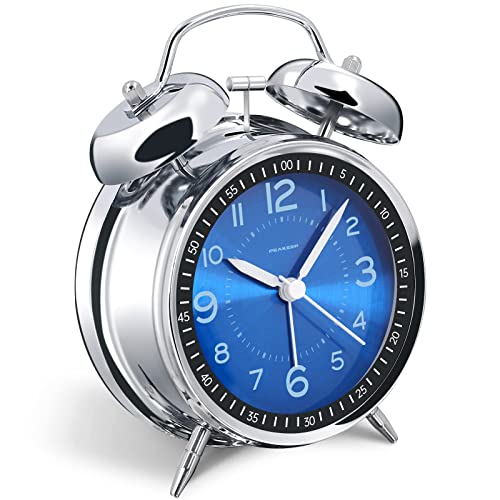
The Peakeep rejects the entire digital premise. Two metal bells on a four-inch analogue clock, a hammer between them, and a battery to run the movement: when this alarm fires, it produces the oldest loud sound in domestic life, a ringing that fills a room with mechanical urgency no electronic beep has ever matched for sheer startle. There is no snooze button to negotiate with, no menu, no app, and no decibel figure on the listing, because bells were never sold by numbers; they are sold by the experience of being rung awake, which generations can describe in detail.
Battery operation makes the Peakeep immune to power cuts and free to live anywhere, a guest room, a caravan, a student’s desk, and its jewel blue metal body doubles as the kind of retro object people leave out on purpose. The costs are analogue costs: you set the alarm by a dial’s best estimate rather than to the minute, and the whole household will hear a full ring. For the sleeper who defeats electronics by sleeping through their politeness, the bell’s rudeness is precisely the feature.
- Waking system: metal twin bell, analogue hammer alarm
- Decibel figure on listing: none stated
- Power: battery operated, no outlet needed
- Size: 4 inch metal clock face
- Colour of this listing: Jewel Blue
- Snooze: none, by design
Strengths
- Bell startle defeats electronic-alarm immunity
- Power cuts cannot silence a battery clock
- Zero setup, zero menus, zero updates
Trade-offs
- Alarm time setting is approximate by dial
- The whole house hears a full performance
- No dual alarms, dimmer or backup light
Best for: electronics-immune sleepers and retro lovers. Not suited for: precision schedulers or shared thin walls.
uscce Loud Alarm Clock Bed Shaker — Best Adjustable Shaker
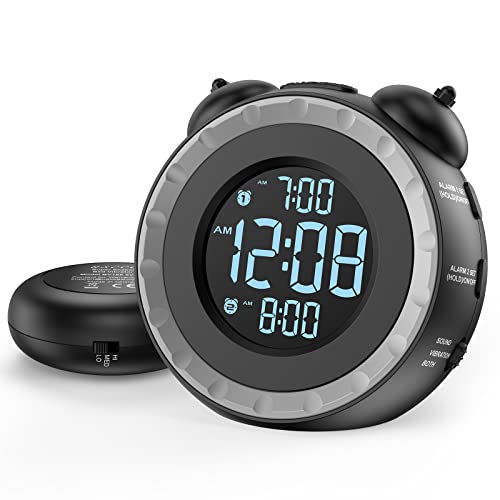
The uscce clock’s distinguishing word is adjustable. Its bed shaker is described as powerful and adjustable, which matters more than it sounds: a shaker set for a teenager’s deep sleep will redecorate a lighter sleeper’s entire night, and the ability to tune the vibration’s strength lets one device serve a household’s range of sleepers and evolve with one sleeper’s changing habits. Dual alarms, a 0-100% dimmer and battery backup complete a specification aimed squarely at heavy sleepers and the hearing impaired, whom the listing names directly.
No decibel figure is stated, so the uscce competes on its shaker and its manners rather than on a number. Those manners are good: the full-range dimmer means the clock can vanish visually at night, the setup is described as easy, and the shaker’s adjustability doubles as a partner-peace feature, strong on the sleeper’s side without declaring war on the whole mattress. If the Sonic Bomb is the category’s classic and the ANJANK its moderniser, the uscce is its diplomat with a dial for diplomacy.
- Waking system: loud dual alarm plus adjustable bed shaker
- Decibel figure on listing: none stated
- Shaker: powerful, adjustable strength
- Dimmer: 0-100% display dimming
- Backup: battery backup included
- Audience named on listing: heavy sleepers, hearing impaired
Strengths
- Adjustable shaker tunes to the sleeper
- Full dimmer protects the night’s darkness
- Dual alarms and backup cover real schedules
Trade-offs
- No published decibel figure to compare
- Fewer light features than the ANJANK
- Shaker tuning takes a few nights to settle
Best for: households tuning one clock to different sleepers. Not suited for: buyers who shop by decibel numbers alone.
Cadmos 110dB Extra Loud Alarm Clock — Best 110dB Colour Display
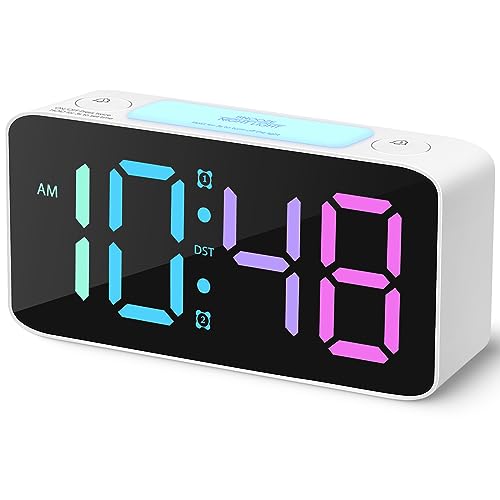
The Cadmos states its case in numbers and colour: a 110dB extra loud alarm, per its listing, an RGB display, a seven-colour night light and dual USB chargers, in a small clock aimed at bedrooms from teenagers’ to adults’. The stated figure sits just below the Acedeck’s 115dB, and the honest reading of that gap is that both clocks live in the same very-loud class, with the Cadmos trading a whisper of headline volume for a nightstand presence some households will prefer, especially where the clock also serves as the room’s night light and phone charger.
Colour is not frivolous here. A display whose colour and a night light whose hue can be chosen are easier to live with at 3 a.m. than a fixed glare, and teenagers in particular keep clocks they like looking at. What the Cadmos does not offer is a shaker, so its audience is the sound-responsive heavy sleeper, the deep-but-not-deaf student, the shift worker whose ears still work as an alarm channel. For that audience, a stated 110dB with charging for two devices is a tidy, modern answer.
- Waking system: extra loud alarm, no shaker listed
- Decibel figure on listing: 110dB stated
- Display: RGB display with colour choice
- Light: 7-colour night light
- Charging: dual USB charger ports
- Colour of this listing: White with RGB
Strengths
- Stated 110dB output in the loudest class here
- Dual USB charging declutters the nightstand
- Colour display and light suit younger rooms
Trade-offs
- No bed shaker for sound-immune sleepers
- RGB brightness needs taming for purists
- Small size means small buttons at dawn
Best for: students and sound-responsive deep sleepers. Not suited for: anyone whose waking requires vibration.
How Do the Six Clocks Compare Side by Side?
| Pick | Waking system | Stated dB | Standout detail |
|---|---|---|---|
| Sonic Bomb Extra Loud Alarm Clock Bed Shaker | Alarm + bed shaker | Not stated | Category classic, battery backup |
| Acedeck Super Loud Alarm Clock 115dB | Alarm only | 115dB | 6 sounds, dual alarms |
| ANJANK Extra Loud Alarm Clock Wireless Bed Shaker | Wireless shaker + light | Not stated | 9-colour night light |
| Peakeep Loud Alarm Clock Twin Bell | Metal twin bell | Not stated | Battery analogue, no snooze |
| uscce Loud Alarm Clock Bed Shaker | Alarm + adjustable shaker | Not stated | 0-100% dimmer |
| Cadmos 110dB Extra Loud Alarm Clock | Alarm only | 110dB | RGB display, dual USB |
Why Do Bed Shakers Wake People That Sound Cannot?
Deep sleep raises the brain’s threshold for sound dramatically, and some sleepers, including many with hearing loss, sit above the reach of any speaker a nightstand can hold. Vibration travels a different road: the mattress moves, the body’s balance and touch systems report an event, and the sleeper surfaces because the bed itself has become unreliable. That is why three of these six picks shake, and why their shakers differ in placement and strength rather than in basic principle.
Placement is the craft. Under the pillow, a shaker is unmistakable and localised; under the mattress, it is gentler and spreads wider, which suits couples differently. The wireless ANJANK makes experimentation easy because nothing tethers the unit, while the uscce’s adjustable strength lets you tune the same position across a range. Give any shaker three nights of honest testing before judging it, because the first night’s novelty wakes anyone and the third night tells the truth.
How Should You Read a Decibel Claim Without Being Misled?
A decibel figure is a measurement with the conditions trimmed off. Distance halves the drama quickly, soft rooms absorb, and a clock across the room works under different physics than the same clock at your ear. The two stated figures in this guide, 115dB and 110dB, tell you both makers built for the loudest class and were willing to print a number; they do not tell you the Acedeck will feel exactly five units ruder than the Cadmos in your bedroom, because decibels are logarithmic and rooms are individuals.
The absence of a figure is not an absence of loudness, either. Sonic Alert’s whole business is waking the unwakeable, and a twin bell’s output has never needed a datasheet. Read numbers as one kind of evidence among several: mechanism, maker focus and features like dual alarms and backup often predict your actual morning better than the biggest integer on the box.
How Do You Build a Wake-Up System Instead of a Single Alarm?
One clock is a hope; a system is a plan. Heavy sleepers who cannot afford failure layer their defences: the clock across the room so the body must stand, a shaker as the first strike, a phone alarm as the late safety net set fifteen minutes after the main event, and light, from a wake-up feature or a timer on a lamp, raising the room’s brightness in support. Each layer covers the failure mode of the one before it, because the morning you sleep through one alarm is rarely the morning you sleep through three different senses.
Placement is the cheapest layer of all. An alarm within arm’s reach is an alarm that will be silenced by a hand with no memory of the act. Put the clock where your feet must touch the floor, and let the snooze, if you use it at all, be the one on the far device. The clocks in this guide are the strong centre of such a system; your habits are its walls.
What Should Shift Workers Demand From an Alarm Clock?
Rotating shifts break ordinary alarms in two places: the schedule changes faster than habits form, and daytime sleep needs waking at hours when the household is awake and unhelpfully quiet around the sleeper. Dual alarms, as on the Sonic Bomb, Acedeck and uscce, let two patterns coexist without nightly reprogramming. A shaker earns double pay here, because it can wake the sleeper at 4 p.m. without announcing the event to children doing homework downstairs.
Daytime sleepers should also interrogate the dimmer. A display that cannot go fully dark will sit inside blackout curtains like a small moon, and the 0-100% dimmers in this guide exist for exactly that room. The Acedeck names shift workers on its listing outright, and its six sounds help fight the habituation that rotating schedules accelerate, since a brain that hears the same tone at six different hours learns to file all of them under ignore.
How Does Alarm Habituation Work, and How Do You Defeat It?
Repeat any sound nightly and the sleeping brain, which is an efficient filing clerk, learns that this noise predicts nothing important and routes it to the background. This is why an alarm that worked in January fails by June, and why the fix is variation: multiple sounds to rotate, as the Acedeck’s six and the ANJANK’s eight allow, or a mechanism change, from sound to shaking, that the filing clerk has no folder for.
Rotate on a schedule rather than on a failure. Change the tone monthly, move the clock quarterly, and let the shaker carry the mornings that matter most, because vibration habituates more slowly than sound. The twin bell defeats habituation by being an event rather than a tone, though even bells can be learned by the truly gifted sleeper, at which point the honest answer is a system, a shaker and a household agreement, in that order.
What Do Parents of Teenagers Need From a Clock Like These?
A teenage heavy sleeper is a household project disguised as a purchase. The clock must be louder than a phone under a pillow, immune to being unplugged in protest, and ideally incapable of being snoozed by a hand that has mastered the gesture in its sleep. The Peakeep bell has ended many such negotiations by simply having no snooze to find, while the Cadmos’s stated 110dB and colourful display give a teenager a clock they might actually accept into the room’s aesthetic.
Parents should keep one principle: the clock is a tool the teenager must eventually own, not a weapon deployed against them. Let them choose between the shortlist’s personalities, set it together, and agree the consequence structure once. A shaker under a teenager’s pillow also protects the rest of the house from a 115dB dawn chorus, which is the kind of family diplomacy everyone appreciates by the second week of term.
How Should You Set Up a Shaker Clock on the First Night?
Start with the shaker under the pillow, centred where your head actually rests rather than where the pillow’s photograph would put it. Set the alarm fifteen minutes earlier than the true deadline for the first three nights, buying insurance while you learn the system’s timing. Keep the clock itself across the room if the design allows the shaker to reach, so silencing it requires standing, which is the second alarm hidden inside the first.
Adjust one variable per night. If the shake feels violent, move it under the mattress corner before reducing strength on an adjustable model; if it feels faint, bring it closer before increasing anything. By the fourth night the configuration should be boring, which is the goal: a wake-up system you never think about is one that will still be working in a year, long after novelty-based systems have been negotiated into silence.
What Role Does the Nightstand Display Play in Sleep Quality?
The display is the part of the clock you live with for eight hours to earn the thirty seconds of alarm, so its manners matter disproportionately. Brightness that cannot be tamed leaks into sleep, invites clock-watching at 3 a.m. and turns every wakeful moment into a calculation of remaining hours. The full-range dimmers in this guide, 0-100% on the ANJANK and uscce, are the correct specification, and the Cadmos’s colour choice lets a household pick the hue it finds least alerting.
Number size cuts the other way for the short-sighted, who need digits legible without glasses at the exact moment of waking confusion. Test any clock from your pillow’s position, lights off, before the return window closes. A display that serves both the night and the morning is rarer than it should be, and it is one of the quiet reasons two clocks with identical alarms can produce very different years of ownership.
How Do You Wake in a Shared Room, a Dorm or a Barracks?
Shared sleeping quarters rewrite the ethics of loud. A 115dB alarm in a dorm room is a declaration of war, and the correct weapon there is vibration: a shaker under your pillow, a clock whose sound starts low, and the discipline of rising on the first strike. The ANJANK’s wireless shaker is the diplomat of this guide for exactly these rooms, and the uscce’s adjustable strength lets a sleeper calibrate to the mattress rather than to the corridor.
Agree the system with the room’s other sleepers before the first dawn. People forgive a shaker’s muffled buzz they were warned about and resent a surprise bell at any volume. The Peakeep, glorious in a private house, should be deployed in shared rooms only under a treaty, ideally one signed by everyone who will hear it, preferably before midnight.
How Do Hearing-Impaired Sleepers Choose Differently?
For a sleeper who cannot hear the alarm at all, the hierarchy inverts completely: the shaker is the alarm, and the speaker is the accessory for the rest of the household. That makes shaker strength, adjustability and reliability the whole specification, which is why the Sonic Bomb and uscce, both built with hearing-impaired users named on their listings, anchor this guide’s recommendations for that audience. Flashing-light features, like the ANJANK’s wake-up light, add a third channel for sleepers with partial hearing.
Backup becomes safety equipment rather than convenience in this context. A missed alarm for a hearing-impaired worker can mean a missed shift with no audible warning that anything failed, so battery backup and a shaker with its own dependable power deserve priority over every decorative feature. Test the system on a weekend morning with a household member awake as an observer, and let evidence, not hope, certify the setup.
What Should Travellers and Frequent Flyers Look For?
Travel punishes heavy sleepers twice, with time zones scrambling the body’s clock and hotel alarms of unknown temperament standing guard. A portable shaker is the traveller’s insurance, and the wireless design in this guide travels without a cable to lose. Battery operation, the Peakeep’s whole identity, suits caravans, cabins and guest rooms where the outlet situation is a rumour.
Hotel discipline completes the kit: set two alarms on two devices, request the wake-up call as a third, and put the loudest device across the room by the door where your shoes are. The morning of a flight is the wrong stage for a single point of failure, and heavy sleepers who travel well are simply heavy sleepers who learned to build redundancy before they learned it the expensive way.
How Does the Snooze Button Betray Heavy Sleepers?
Snooze was designed for light sleepers who surface easily and enjoy a shallow drift before rising. For a heavy sleeper it is a trap with a friendly name, because the hand learns the button’s location faster than the brain learns the alarm’s meaning, and nine-minute fragments of deep sleep are worse than either waking or sleeping properly. Many veterans of this category disable snooze entirely or choose clocks, like the twin bell, that never offered it.
If you keep a snooze, ration it by architecture: one press, with the clock far enough away that the press requires standing, converts snooze from a sleep-extender into a two-stage alarm. The second stage should be louder or shakier than the first, an escalation the ANJANK’s light-vibration-sound sequence models well. Design the morning so that staying in bed requires more effort than leaving it, and willpower stops being part of the system.
What Does a Good Alarm Sound Actually Sound Like?
Effective alarm sounds share three traits: they startle mildly, they vary enough to resist the brain’s filing system, and they are unpleasant in direct proportion to how much you need them. Multi-sound clocks, six options on the Acedeck and eight on the ANJANK, let a household rotate through that palette. Sounds with changing pitch and rhythm resist habituation longer than a monotone beep, which the sleeping brain learns to summarise and dismiss within weeks.
Personal associations matter more than acoustics textbooks admit. A tone that resembles your phone’s notification will be filed with the notifications; a tone reserved exclusively for waking acquires a Pavlovian authority over months. Keep one sound sacred to the alarm, never use it for anything else, and its power compounds. The bell needs no such management, being less a sound than a household event, which is its own ancient strategy.
How Should Couples With Different Wake Times Negotiate One Nightstand?
Start with the targeted tools: a shaker on the early riser’s side, dual alarms so the later time is already set, and an agreement that the early riser leaves the room with the snooze conversation rather than conducting it in bed. The ANJANK and uscce were practically designed for this negotiation, pairing shakers with dimmers that keep the later sleeper’s darkness intact. Where one partner is the heavy sleeper and rises later, the early partner’s gentler alarm can stay conventional while the heavy artillery waits for its own hour.
Revisit the arrangement seasonally. Shift changes, new jobs and babies all rewrite the household’s sleep map, and a system that was fair in January can become a grievance by June. The couples who keep the peace treat the alarm as shared infrastructure, reviewed like any other household system, rather than as one person’s problem that the other person endures.
What Is the First Week With a Serious Alarm Clock Like?
Expect to wake annoyed, which is the sound of the product working. The first mornings with a shaker or a bell feel excessive because your previous system had trained you to expect a negotiation. By the fourth or fifth morning, most sleepers report a stranger benefit: they begin surfacing shortly before the alarm, because a brain that trusts it will be woken stops keeping one ear open all night, and sleep deepens in the hours before dawn.
Use the week to calibrate rather than to judge. Move the shaker once, rotate the sound once, and set the dimmer for the room’s true darkness. Note which morning felt easiest and what was different about the night before it. A serious alarm clock is not a purchase so much as a small system being commissioned, and the commissioning week is where its decade of service is decided.
How Do You Keep an Alarm Clock Working for Years?
These are simple machines with simple needs. Keep the shaker’s cable or charging routine respected, because a shaker that dies quietly is an alarm that fails silently, the worst failure mode in this category. Replace backup batteries on a calendar rather than after an outage teaches you they were dead. Dust the speaker grilles and bell mechanisms, since a muffled alarm is often just a dusty one.
Analogue clocks ask for the least: a battery on schedule and a dial kept honest against a phone’s clock monthly. Digital clocks ask that you re-teach them after long outages and check the alarm after every settings change, because a volume reset to polite has ended more good intentions than any snooze button. Ten minutes of maintenance a year is the entire contract, and it buys the one thing this category sells: certainty.
How Should You Choose Between the Two Stated-Decibel Clocks?
Acedeck or Cadmos is the duel for buyers who want a number. The Acedeck states 115dB, offers six sounds and dual alarms, and wears plain white digits like work clothes. The Cadmos states 110dB and spends its difference on an RGB display, a seven-colour night light and dual USB charging. Five decibels on paper is a smaller real-world gap than the numerals suggest, so the honest decider is the nightstand around the alarm: a charging-starved, style-conscious room belongs to the Cadmos, while a pure waking brief belongs to the Acedeck.
Neither offers a shaker, so both presume a sleeper whose ears remain a viable channel. If a month with either leaves you still surfacing late, the diagnosis has changed, not the volume: add a shaker clock as the system’s core and demote the loud clock to a very capable second stage. Escalation by mechanism beats escalation by decibel every time the two are compared in real bedrooms.
What Does a Heavy Sleeper’s Bedroom Need Beyond the Clock?
The clock is the last five percent of a waking system whose other ninety-five is the room. Blackout curtains that keep dawn from confusing the schedule, a phone that charges outside the bed’s reach, clothes laid out so the morning has no decisions in it, and a light that comes on with the alarm all multiply any clock’s effectiveness. The ANJANK’s built-in wake-up light is one piece of that room built into the clock itself.
Sleep timing is the deepest layer. A heavy sleeper waking from the deepest part of a cycle will defeat equipment that would have succeeded forty minutes earlier, which is why consistent sleep and wake times do more for hard waking than any purchase. Set the alarm for the same hour for a fortnight, weekends included, and the clock you already own may suddenly seem twice as loud, because the sleeper it meets has changed.
How Do You Test a New Alarm Clock Fairly?
Give it three real mornings with real consequences softened by a backup phone alarm set twenty minutes late. Night one tests placement, night two tests settings, night three tests the truth, because novelty has worn off and habituation has begun its work. Judge by how you feel at the second alarm’s time: if the main clock has done its job, the backup should be an irrelevance you switch off standing up.
Change one variable at a time and write nothing down unless you are the kind of person who reads their own notes. Most households need only remember which shaker position and which sound survived the week. If a clock fails the third morning honestly configured, return it without sentimentality; the category is full of mechanisms, and the right one for your particular depth of sleep is a discovery, not a loyalty.
What Should Grandparents and Older Sleepers Prioritise?
Age changes the specification in kind directions. Buttons must be findable by touch, digits legible without glasses, and the alarm strong through hearing that may have lost its high frequencies, which is where shakers stop being a specialty feature and become the main event. The uscce and Sonic Bomb, both designed with hearing-impaired sleepers in mind, serve this audience with the least fuss, and their full backup arrangements protect mornings that often carry medication schedules.
Simplicity is a safety feature here. A clock whose alarm a grandparent can set confidently will be set; a clock with menus will be quietly abandoned in favour of hoping to wake naturally. Families buying for an older sleeper should set the clock up together, run a test morning, and leave the instructions in large print beside it, because the best alarm in this guide is the one its owner trusts completely.
What Mistakes Do Heavy Sleepers Make When Buying an Alarm Clock?
The first mistake is buying volume to solve a vibration problem, escalating speakers against a brain that has stopped listening to speakers. If ordinary alarms have failed you for years, start with a shaker and let sound be the support act. The second mistake is the opposite romance: choosing the charming analogue bell for a household with a baby, a night-shift partner and thin walls, where its glorious rudeness becomes a diplomatic incident by Wednesday.
Third, people ignore the display. A clock that lights the room all night degrades the very sleep it exists to protect, so the full-range dimmers on the ANJANK and uscce are waking features in disguise. Fourth, snooze architecture gets no thought until the first morning a practised hand silences a month’s good intentions in its sleep. And fifth, backup gets skipped until a power cut teaches its value at 6:40 on the morning of a flight. Buy for your failure mode, not for the feature list, and the clock will fit the sleeper you actually are.
How Do Winter Darkness and Summer Dawn Change the Waking Problem?
Season bends the difficulty curve. Winter mornings ask a heavy sleeper to rise in full darkness, with the body’s chemistry voting unanimously for the duvet, and this is where light-assisted systems like the ANJANK’s wake-up glow earn their place as the first stage of the assault. Summer reverses the problem for daytime sleepers and shift workers, when dawn arrives hours before the alarm and only blackout curtains plus a properly dimmed display protect the sleep the clock will later need to end.
Adjust the system twice a year as the clocks change. Move the shaker’s start earlier in the darkest weeks if your rising has begun to slip, rotate the alarm sound with the season to outrun habituation, and check the backup batteries when you check the smoke alarms. A waking system maintained on the same rhythm as the house itself rarely fails without warning, and warning is all a heavy sleeper has ever asked of the morning.
What Should You Do on the Morning the System Still Fails?
It will happen once, and the correct response is engineering, not self-blame. Reconstruct the failure like an incident report: was the shaker displaced, the volume reset, the sleep debt simply larger than the equipment? Each answer maps to a fix, a repositioned shaker, a settings check added to the Sunday routine, an earlier bedtime defended like an appointment. Systems improve through their failures when the failures are read properly.
Then forgive the morning and keep the system. Heavy sleepers who abandon a good clock after one bad dawn cycle through equipment for years, when the evidence usually says the setup needed one adjustment. The clocks in this guide are strong enough to be worth that adjustment, and the sleeper who treats waking as a solvable design problem, rather than a character flaw, is the one these machines were built for.
How Do You Talk to Your Household About a Louder Morning?
Warn the house before the first dawn. A family briefed that the new clock will be rude for one week, while it is calibrated, becomes a family of collaborators; a family ambushed at 5:40 becomes a review panel with grievances. Agree the test period, the backup plan and the hour after which complaints may be filed, and most households discover the new system is quieter in total than the old routine of shouted stairs and repeated phone alarms.
Children, especially, convert quickly when they are given a role, official keeper of the shaker’s position or captain of the Friday sound rotation. The morning is a household system, and the clock is merely its loudest employee. Manage it like a manager, with notice, roles and a review date, and even a 115dB alarm can become part of the family’s peace rather than its opposite.
How Do You Choose a Clock for a Guest Room or a Holiday Let?
Guest rooms invert the usual brief: the sleeper is unknown, the wake time is early, and the clock must explain itself to a stranger at midnight. Choose clarity over artillery. A dual-alarm digital with a tameable display suits most guests, while the Peakeep bell charms a cottage guest room where character is part of the hospitality and the nearest neighbour is a field away. In a rental property, instructions matter as much as equipment; a card beside the clock explaining the shaker, the dimmer and the alarm’s setting ritual prevents both missed mornings and 5 a.m. accidents.
Hosts should test their own guest clock quarterly, because a guest will never report that the backup battery died or the volume crept down; they will simply miss their train and remember the house for it. The clocks in this guide are all guest-capable in the right room, but the household that checks them is the one whose visitors leave on time and fondly. A spare battery in the nightstand drawer and a phone number for a local taxi on the instruction card complete the hospitality, quietly covering the two failures a clock alone cannot.
Final Recommendation
Start with the mechanism that matches your failure mode. If sound has stopped working on you, take the Sonic Bomb Extra Loud Alarm Clock Bed Shaker and its proven shake, or the ANJANK Extra Loud Alarm Clock Wireless Bed Shaker if a partner’s sleep needs the diplomacy of light and a wireless shaker. If volume is genuinely your gap, the Acedeck Super Loud Alarm Clock 115dB states the biggest number in the guide and backs it with dual alarms. Whichever you choose, set it across the room, forgive it its rudeness, and let it do the one job your willpower was never hired for: ending the deepest sleep you own, on time, every single morning it is asked.
Frequently Asked Questions
Will a bed shaker wake my partner too?
Less than a loud speaker will. A shaker placed under your pillow or your side of the mattress concentrates its work on you, and adjustable models like the uscce let you tune the spread. It is the most partner-considerate way to wake a very heavy sleeper.
Is 115dB safe to sleep next to every night?
The alarm is brief and its job is to end sleep, not accompany it. Both stated-figure clocks here are designed for bedroom use, and the exposure lasts seconds. Anyone with hearing concerns should favour a shaker-first clock, which is why three of the six picks shake instead of shout.
What happens to these clocks in a power cut?
The Sonic Bomb and uscce carry battery backup for the alarm, and the Peakeep runs on batteries entirely, so it does not notice outages at all. Check each listing’s backup description if stormy grids are part of your life.
Can I use a shaker clock if I sleep on a thick memory foam mattress?
Yes, with placement care. Foam absorbs vibration, so put the shaker under the pillow rather than deep under the mattress, and choose an adjustable or strong shaker. Test for three nights before deciding, as foam density varies.
Why would anyone choose the analogue bell in a digital age?
Because it cannot be snoozed by a sleeping hand, never needs charging or updates, survives every power cut, and produces a startle that electronic tones rarely match. For the right sleeper those are not nostalgic traits; they are the specification.
Do light wake-up features help heavy sleepers?
Light alone rarely wakes the truly deep sleeper, but as the first stage of an escalation, as on the ANJANK, it lightens sleep so the shaker and sound finish the job more kindly. Think of light as the opening act, not the headliner.
Related Guides
Waking is only half of the sleep contract. For the gentler end of the morning, Best Alarm Clocks for Peaceful Wakeup covers sunrise clocks that coax rather than ambush. The bed those clocks stand beside gets its own scrutiny in Best Sleeper Sofas and Loveseat Sleepers, for homes where guests sleep in the living room. And the air of the bedroom itself is the subject of Best Air Purifiers for 1000 Sq Ft, because the deepest sleep is easier to leave when it was worth having.


