What's inside
- Key Takeaways
- Quick Picks
- How We Chose These Picks
- How Do the Six Machines Compare Side by Side?
- How Should You Work Out the CADR a 1,000 Square Foot Room Really Needs?
- Why Do Manufacturer Coverage Claims Run So Far Ahead of Reality?
- Where Should a Large Purifier Stand in an Open-Plan Floor?
- Should You Run One Large Machine or Two Smaller Ones?
- How Do Filters, Carbon and Running Costs Change the Real Price?
- What Mistakes Do Buyers of Large-Room Purifiers Make Most Often?
- How Should Pet Owners Judge a Purifier Differently?
- What Should You Do Differently During Smoke or Heavy Pollen Weeks?
- How Reliable Are the Air Quality Sensors in These Machines?
- What Does a Sensible Maintenance Calendar Look Like?
- How Much Does Noise Really Decide Long-Term Satisfaction?
- How Does Seasonality Change What a Big-Room Purifier Must Do?
- What Should Renters and Owners of Older Homes Consider First?
- How Can You Tell Within a Month Whether Your Choice Is Working?
- What Is the Right Way to Introduce a Purifier to a Skeptical Household?
- Final Recommendation
- Frequently Asked Questions
- Related Guides
As an Amazon Associate I earn from qualifying purchases. This post may contain affiliate links at no extra cost to you.
cottageverdict.com is reader-supported. When you buy through links on our site, we may earn an affiliate commission.
Where to buy: each machine below is sold through Amazon, and the names in the Quick Picks table, the review headings and the comparison table all link to the matching listing, so you can check price on Amazon and confirm the current filter type, coverage claim and control layout before you order. Shoppers hunting the best air purifiers for 1000 sq ft usually start with a tape measure and end with a headache, because the number printed on the box rarely means what a living room actually needs.
A thousand square feet is an awkward size. It is bigger than a bedroom, smaller than a whole house, and in open-plan homes it is often one connected sweep of kitchen, dining space and seating that shares air around the clock. A purifier asked to serve that sweep has to move serious volumes of air without sounding like a dishwasher, and it has to keep doing so after its filter has loaded up with a season of cooking haze and tracked-in dust.
The honest starting point is arithmetic, not marketing. The Association of Home Appliance Manufacturers, AHAM, sizes a purifier by its Clean Air Delivery Rate, and its long-standing two-thirds rule says the CADR figure should equal at least two thirds of the room area in square feet. For a 1,000 square foot space that points to a CADR near 667, a number very few single machines reach on a quiet speed. Turn the same maths around and a purifier rated at 400 CADR, running flat out in a room with eight-foot ceilings, changes the air roughly three times an hour. Drop to a middle speed and the real figure falls again.
That gap explains why manufacturer coverage claims look so generous. A claim of 1,800 or 2,900 square feet usually assumes one or two air changes per hour, sometimes on the highest and loudest setting, which is a best-case scenario rather than a working promise. One or two changes an hour will slowly dilute a haze; it will not keep pace with a frying pan, a shedding dog and an open window in pollen season all at once. Throughout this guide the coverage figures are treated as optimistic ceilings, and the picks are judged on filtration hardware, fan behaviour and controls instead.
One boundary deserves stating plainly at the outset. A purifier captures particles: dust, pollen grains, pet dander, smoke particulate and the fine debris that rides on indoor air. Capturing those particles is a measurable, mechanical job. It is not a treatment for any medical condition, and nothing in this guide should be read as a promise about asthma, allergies or any other health outcome. What a well-sized machine can honestly offer is cleaner air passing through a good filter, fewer settled dust films on shelves, and a room that smells less of last night’s cooking by morning.
The six machines below approach the thousand-foot brief from different directions. Two lean on smart controls and app scheduling, one is a big dual-intake tower built for raw throughput, one spends its budget on carbon for odours, one whispers for bedroom-adjacent spaces, and one packs a respected filter stack into a footprint that fits beside a sofa. None of them truly owns a thousand square feet alone on a quiet setting, and the sections after the reviews explain how to pair, place and run them so the combined result matches the promise on the box.
Key Takeaways
- AHAM’s two-thirds rule points to a CADR near 667 for 1,000 square feet, which most single units only approach on their loudest speed.
- Headline coverage numbers from manufacturers assume gentle air-change rates, so treat them as best-case ceilings rather than working figures.
- Two mid-sized machines at opposite ends of an open-plan floor often clean more evenly than one large unit straining in a corner.
- Carbon content matters for cooking and pet odours; a thin carbon sheet saturates far sooner than a deep, heavy carbon bed.
- Particle capture is a mechanical specification, not a medical claim, and filter replacement discipline decides long-term performance.
- Noise at the speed you will actually tolerate matters more than the maximum CADR printed in the listing title.
Quick Picks
| Pick | Badge | Why it earns its place |
|---|---|---|
| Shark Clean Sense Air Purifier MAX HP201 | Best Straightforward Coverage | A filter rated beyond standard HEPA claims and a clean, sensor-led automatic mode aimed squarely at thousand-foot rooms. |
| LEVOIT Core 600S Smart Air Purifier | Best Smart Controls | App and voice control, an AHAM-verified listing and a three-in-one filter built for large connected living spaces. |
| Medify MA-112 Air Purifier | Best Throughput Headroom | A tall dual-intake tower whose enormous hourly coverage claim translates into genuine spare capacity at this size. |
| WINIX 5520 Air Purifier | Best for Odour Control | A high-deodorisation carbon filter paired with true HEPA media and a live air quality monitor. |
| LEVOIT Vital 200S Smart Air Purifier | Best Quiet Manners | A published sleep-mode noise figure low enough for rooms that double as guest bedrooms. |
| COWAY Airmega Mighty2 Air Purifier | Best Compact Footprint | The next generation of a long-running Coway design, combining HEPA and activated carbon in a modest cabinet. |
How We Chose These Picks
Selection began with the listing data itself: filter construction, stated coverage, verification badges and control types were read off each manufacturer’s Amazon listing, and any machine whose filtration story was vague or whose coverage claim rested on an unnamed test was left out. What survived had to show a genuine HEPA-grade filter stage, because the thousand-foot brief is fundamentally about moving large volumes of air through media fine enough to trap particles down to a fraction of a micron.
AHAM verification carried real weight. A listing that submits to that programme has had its CADR measured under a shared protocol, which gives shoppers one number that can be compared across brands without decoding each maker’s private arithmetic. Not every pick carries the badge, and where it is absent the guide says so and leans harder on filter hardware and design.
Running costs shaped the shortlist too. A purifier is a subscription disguised as an appliance: filters need replacing on a schedule, and a machine with cheap hardware but exotic, short-lived cartridges can cost more over three years than a pricier unit with generous filter life. Picks were favoured when their replacement filters were mainstream, widely stocked and sized generously enough to last.
Finally, the mix was balanced deliberately across use patterns. Open-plan family rooms, pet-heavy households, keen cooks and light sleepers all live inside thousand-foot footprints, and a guide that only served one of those households would fail the rest. Each pick below is therefore introduced with its household in mind, and its trade-offs are stated as plainly as its strengths.

Shark Clean Sense Air Purifier MAX HP201 — Best Straightforward Coverage
Shark built its name on vacuum cleaners, and the Clean Sense MAX shows that heritage in a good way: the design assumes the machine will live in the middle of family traffic, get knocked by chair legs and need its filter swapped by someone who has never read a manual. The listing describes a filter that exceeds standard HEPA performance claims, and the rated coverage lands exactly on the thousand-foot figure this guide is built around, which makes the HP201 the most literal answer to the search that brought you here.
The sensor package is the interesting part. Rather than asking you to guess a fan speed, the unit samples the air and reports a cleanliness percentage, then adjusts its own effort to match. In a kitchen-adjacent living space that behaviour matters, because particle load swings wildly across a day: still air at breakfast, a storm of flour and frying vapour at six, dog dander drifting after the evening walk. A machine that ramps up only when the air actually deteriorates spends most of its life quiet, which is precisely how a large-room purifier earns permanent floor space instead of being unplugged and exiled to a cupboard.
Size the HP201 honestly, though. Its thousand-foot rating is the manufacturer’s own framing, and by the AHAM two-thirds yardstick a single unit at a civilised speed will serve the busiest zone of a thousand-foot floor rather than every corner equally. Positioned between kitchen and seating, it will do strong, visible work; expected to patrol a long L-shaped plan from one end, it will leave the far end to fend for itself.
- Filter: HEPA-exceeding filter stage per the listing
- Stated coverage: 1,000 square feet, large-room positioning
- Controls: sensor-driven automatic mode with air cleanliness readout
- Colour and finish: white cabinet
- Intended setting: large rooms and bedrooms per the listing
Strengths
- Automatic mode reacts to real particle events instead of running blind on a timer.
- The cleanliness display gives the household feedback that encourages leaving the machine on.
- Filter access and handling suit owners who dislike fiddly maintenance rituals.
Trade-offs
- Coverage claim is a manufacturer figure, not an AHAM-verified rating.
- Peak cleaning power arrives with peak fan noise, as with every pick here.
- The white finish shows scuffs in high-traffic hallways more than darker cabinets would.
Best for: households wanting one sensor-led machine for the busiest thousand-foot living zone. Not suited for: buyers who insist on independently verified CADR figures before spending.

LEVOIT Core 600S Smart Air Purifier — Best Smart Controls
The Core 600S is the largest machine in Levoit’s Core family, and its listing leads with a coverage figure approaching three thousand square feet. Read that number the way this guide has taught you: it is an hourly, best-case framing. The useful fact underneath it is that the 600S carries enough fan and filter capacity to work a thousand-foot space at moderate speeds, where smaller siblings would be running at full shout just to keep up.
Connectivity is the reason to choose it over plainer rivals. The listing confirms app control, voice assistant compatibility and a remote, plus an AHAM-verified badge that anchors its CADR in a tested protocol. Scheduling is where smart control stops being a gimmick: a purifier that quietly raises its speed for the hour before the household wakes, settles dust before bedtime and idles while everyone is out will clean more air across a week than a stronger machine that only gets switched on when someone remembers.
The three-in-one filter wraps pre-filtration, HEPA-grade media and carbon into a single cartridge. That keeps changes simple, though it also means the whole cartridge is retired when any one stage tires, and in a kitchen-heavy home the carbon stage usually tires first. Budget for that rhythm rather than being surprised by it, and keep a spare cartridge in the cupboard so a filter warning never becomes a week of unfiltered air while a delivery crawls across the country.
- Filter: three-in-one cartridge with HEPA-grade stage
- Stated coverage: up to 2,933 square feet per the listing
- Verification: AHAM Verified per the listing
- Controls: app, voice assistant and remote control
- Modes: sleep mode with low-noise running
Strengths
- Scheduling through the app turns cleaning into a background habit rather than a chore.
- Independent verification gives its CADR claim a firmer footing than most rivals here.
- Generous capacity headroom lets it work large spaces without living at maximum speed.
Trade-offs
- Combined cartridge design means one tired stage retires the whole filter.
- Smart features depend on home Wi-Fi behaving itself during setup.
- The tower format needs clear floor space around its intakes to breathe properly.
Best for: connected households that will actually use schedules and voice control. Not suited for: buyers who want a purifier with no app account and no network features at all.

Medify MA-112 Air Purifier — Best Throughput Headroom
Stand the MA-112 in a room and two things become obvious: it is tall, and it breathes from both sides. Medify’s flagship draws air through dual intakes and pushes an hourly coverage claim just shy of six thousand square feet. Discount that claim by the usual optimism and a useful truth remains: at a thousand square feet, this machine has so much spare capacity that its middle speeds, the ones a family can talk over, still move a serious volume of air through its HEPA filter.
That headroom changes the ownership experience. Most purifiers force a choice between cleaning power and conversation; the MA-112 lets a big open-plan room have both, most of the time. During a wildfire-smoke week or a renovation next door you will still reach for the top setting and accept the roar, but ordinary Tuesdays can run at a civilised level while the machine quietly outworks smaller rivals running flat out.
The filter is specified to capture particles down to 0.3 microns, the size band where HEPA-grade media does its defining work. What the listing does not offer is an AHAM badge, so the throughput story rests on Medify’s own testing. The physical evidence supports the broad claim, though: dual intakes, a large filter surface and a cabinet built like a small tower all point the same way. Treat the MA-112 as the pick for buyers who would rather over-buy capacity once than under-buy it twice.
- Filter: HEPA filter, capture stated to 0.3 microns
- Stated coverage: 5,948 square feet in one hour per the listing
- Intake design: dual-sided air intake
- Positioning: smoke, wildfire and odour duty per the listing
- Colour and finish: white, single-pack listing
Strengths
- Spare capacity means useful cleaning at speeds the room can tolerate all evening.
- Dual intakes suit central placement in genuinely open floor plans.
- Large filter surface should age more gracefully than compact cartridges under load.
Trade-offs
- The cabinet is a substantial piece of furniture that smaller rooms will notice.
- No AHAM verification is claimed in the listing for its headline figure.
- Replacement filters for a flagship tower are a bigger line item than compact cartridges.
Best for: large open-plan floors where one machine must carry the whole space. Not suited for: compact apartments where a tall tower would dominate the room.
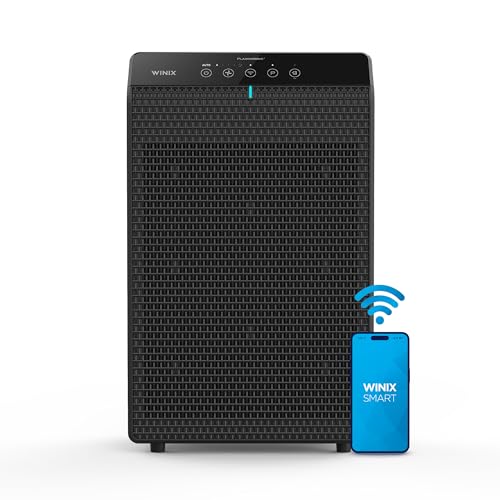
WINIX 5520 Air Purifier — Best for Odour Control
Winix separates itself from the pack with one phrase in its listing: high deodorisation carbon filter. Most purifiers treat odour as an afterthought, sliding a carbon-dusted sheet behind the HEPA media and calling the job done. The 5520 instead advertises a carbon stage built specifically to adsorb the gases that make a home smell lived-in: cooking vapours, litter-box drift, the faint mustiness of a room that hosts both teenagers and gym bags.
Carbon works by surface area and contact time, and it saturates. That is the honest physics every buyer should hold onto: a deeper carbon bed keeps adsorbing for longer before smells start slipping past, and the 5520’s emphasis on that stage is exactly what a thousand-foot open plan with the kitchen inside it demands. Particle capture is handled by true HEPA media, and a built-in air quality monitor drives an automatic mode that responds when the room’s air changes.
The stated coverage reaches a little beyond eighteen hundred square feet in an hour, which under this guide’s sceptical reading still leaves the 5520 comfortably matched to a thousand-foot brief at working speeds. Households whose main complaint is smell rather than visible dust will get more from this pick than from any rival here, provided they accept that carbon is a consumable with a finite appetite and plan replacements around cooking habits rather than calendar dates alone.
- Filter: true HEPA with high-deodorisation carbon stage
- Stated coverage: up to 1,882 square feet in one hour
- Monitoring: built-in air quality monitor with automatic mode
- Positioning: pet, smoke and dust particle capture per the listing
- Series: current-generation Winix large-room model
Strengths
- Carbon stage is a headline feature rather than a token sheet.
- Automatic mode reacts to cooking events without manual intervention.
- True HEPA media covers the particle side of the job properly.
Trade-offs
- Heavy cooking households will exhaust the carbon stage ahead of the HEPA media.
- Odour adsorption does nothing for particles, so filter discipline still rules.
- The design language is functional rather than decorative in a styled living room.
Best for: open-plan homes where the kitchen shares air with the seating. Not suited for: buyers whose only concern is dust and who would rather spend on CADR alone.

LEVOIT Vital 200S Smart Air Purifier — Best Quiet Manners
Thousand-foot spaces are rarely single-purpose. The same open floor that hosts dinner guests on Saturday becomes a guest bed on Sunday when the sofa folds out, and the Vital 200S is built for that double life. Its listing publishes a sleep-mode noise figure of 27 decibels, a level closer to a whisper than to appliance hum, alongside AHAM verification and a coverage claim of up to 1,875 square feet.
Do not mistake quiet manners for weakness. The Vital 200S carries a proper HEPA filter and an air quality monitor, and its smart controls allow the classic night strategy: run a higher speed during the evening’s activity, then let the schedule drop the machine into its hushed mode as the house settles. Air cleaned earlier in the evening does not need re-cleaning at full power all night, so the quiet hours mostly maintain rather than rescue.
Within a thousand-foot plan this Levoit works best as the zone anchor for the sleeping end of the space, or as one half of a two-machine arrangement with a brawnier partner near the kitchen. Asked to carry the whole floor alone through a smoky week, it will need its louder speeds and lose the very quality that justifies choosing it. Matched to the right zone, though, it is the pick light sleepers will still have plugged in a year from now.
- Filter: HEPA filter with smart air quality monitoring
- Stated coverage: up to 1,875 square feet per the listing
- Noise: sleep mode published at 27 decibels
- Verification: AHAM Verified per the listing
- Controls: app-connected smart operation
Strengths
- Published sleep noise is low enough for genuine bedroom duty.
- Verified rating gives its capacity claim independent support.
- Scheduling pairs naturally with a clean-hard-then-rest-quietly routine.
Trade-offs
- Quiet mode cleans slowly, so it maintains air rather than rescuing it.
- Whole-floor duty in a crisis pushes it onto louder settings.
- Pet-heavy homes may load its filter faster than the schedule expects.
Best for: open plans that double as sleeping space, and light sleepers generally. Not suited for: sole-machine duty in a smoky or renovation-heavy household.

COWAY Airmega Mighty2 Air Purifier — Best Compact Footprint
Coway’s original Airmega Mighty spent years as the default recommendation in this category, and the Mighty2 is its designated successor. The listing positions it for large rooms with cleaning claims up to 1,800 square feet, pairing HEPA filtration with an active carbon stage in a cabinet that stays noticeably smaller than the towers elsewhere in this guide.
That footprint is the argument. In a thousand-foot open plan, floor space near the seating is contested by side tables, plant stands and the dog’s bed; a purifier that fits a modest gap gets placed well, and a purifier placed well cleans better than a giant exiled behind a door. The Mighty2’s combination of a washable pre-filter for coarse dust, carbon for everyday odours and HEPA media for fine particles covers the full particle-size ladder without asking the owner to manage separate exotic cartridges.
As a successor model it also benefits from a mature accessory ecosystem: replacement filters for the Mighty line are among the most widely stocked in the category. The honest limit is scale. Its claim, like every claim here, is an hourly best case, and in a true thousand-foot sweep the Mighty2 is best deployed as the seating-zone anchor or paired with a second unit. Within that role its blend of size, filtration breadth and lineage makes it the easiest pick in this guide to live with.
- Filter: HEPA with active carbon stage and pre-filtration
- Stated coverage: cleans up to 1,800 square feet per the listing
- Lineage: next generation of the AP-1512HH Mighty
- Positioning: smoke, dust, pet and mould particles per the listing
- Form factor: compact cabinet for large-room duty
Strengths
- Small footprint earns good placement, which quietly improves real cleaning.
- Three-stage filtration spans coarse dust through fine particles and odours.
- Established model line keeps replacement filters easy to source.
Trade-offs
- Single-unit coverage of a full thousand feet asks a lot of its fan.
- Carbon stage is sized for everyday odours, not relentless frying.
- Successor pricing reflects the line’s reputation rather than bargain positioning.
Best for: style-conscious rooms where the purifier must fit a modest gap. Not suited for: buyers wanting maximum raw throughput from a single cabinet.
How Do the Six Machines Compare Side by Side?
| Model | Filtration focus | Stated coverage | Standout trait |
|---|---|---|---|
| Shark Clean Sense Air Purifier MAX HP201 | HEPA-exceeding filter | 1,000 sq ft | Sensor cleanliness readout |
| LEVOIT Core 600S Smart Air Purifier | Three-in-one cartridge | Up to 2,933 sq ft | App and voice scheduling |
| Medify MA-112 Air Purifier | HEPA, dual intake | 5,948 sq ft per hour | Throughput headroom |
| WINIX 5520 Air Purifier | True HEPA plus deodorising carbon | Up to 1,882 sq ft per hour | Odour-focused carbon stage |
| LEVOIT Vital 200S Smart Air Purifier | HEPA with monitoring | Up to 1,875 sq ft | 27 dB sleep mode |
| COWAY Airmega Mighty2 Air Purifier | HEPA plus active carbon | Up to 1,800 sq ft | Compact cabinet |
Read the coverage column as a ranking of headroom, not as a set of promises. The Medify’s enormous figure tells you its fan and filter are oversized for this brief; the Shark’s exact-thousand figure tells you its maker aimed at precisely this room size. Between those poles, the verified listings from Levoit carry the most trustworthy numbers, while the Winix spends its credibility on carbon rather than on the biggest claim in the table.
How Should You Work Out the CADR a 1,000 Square Foot Room Really Needs?
Start with the two-thirds rule and a pencil. Multiply your floor area by two thirds: a 1,000 square foot space calls for a CADR around 667 to satisfy AHAM’s sizing guidance, which is built around delivering roughly five air changes an hour with eight-foot ceilings. Then look at the CADR a purifier actually offers, remembering that published CADR is measured at the highest speed. If the machine you fancy offers 400, you are planning for about three changes an hour at full power and perhaps one and a half at the speed you will use while watching television.
Ceiling height bends the maths. Vaulted or double-height spaces hold far more air than the floor area suggests, and a loft-style thousand feet with twelve-foot ceilings contains half again as much air as the standard assumption. In those rooms either step up a class of machine or accept the two-unit strategy described below. Conversely, a thousand-foot floor divided into closable rooms does not need one giant at all; it needs honest mid-sized cleaning in the rooms where people spend their hours.
Finally, match the target to the pollution load. A quiet household of two adults generates a gentler particle burden than a home with three shedding pets, a wood stove and a keen stir-fry habit. The two-thirds rule assumes an average load; heavier loads argue for headroom, lighter loads forgive a smaller machine. The rule is a compass, not a court verdict, and your own dust film on the bookshelf is the most local evidence available.
Why Do Manufacturer Coverage Claims Run So Far Ahead of Reality?
Because nothing forces every brand to use the same test. One maker quotes the area a machine can process once per hour, another uses two changes, a third leans on a thirty-minute smoke test in a sealed chamber. Each figure can be technically defensible while describing wildly different real-world performance, which is why this guide keeps returning to CADR and verification as the common currency.
There is also a physics problem hiding in the claims: air does not queue politely. A purifier cleans the air near itself first, and in a long or L-shaped thousand-foot plan the far corners exchange air with the machine’s zone slowly. A claim measured in a single open chamber flatters any unit that will actually live behind a sofa in a subdivided home. Placement, doors left open and even the direction of the outlet grille shape real coverage as much as the fan does.
The practical response is to buy for the zone, not the postcode. Decide which part of the floor matters most, usually the seating and sleeping areas, size the machine to clean that zone properly, and treat any cleaning that drifts further as a bonus. Shoppers who reframe the question that way rarely feel cheated by the arithmetic, because their expectations were set by air changes they can verify rather than by a number chosen to win a search-results page.
Where Should a Large Purifier Stand in an Open-Plan Floor?
Give the machine air on every side. Intakes pressed against a wall or curtain starve the fan and can halve effective throughput, so leave a hand’s breadth of clearance at minimum and more where the design breathes from the back. Central placement beats corner placement for open plans, even when the corner is tidier, because cleaned air radiates outward and the dirtiest air, near kitchens and entry doors, gets captured before it migrates.
Think about sources. Cooking particles rise and drift with the room’s currents; pet dander concentrates where animals sleep; entry dust settles along the path from the front door. A purifier parked between the dominant source and the main seating usually outperforms a stronger unit parked randomly. Keep the outlet from blowing directly across a desk or dining table, though, since a constant breeze of cleaned air is still a breeze, and papers and napkins will object.
Beware the short-circuit: a machine tucked beside a wide-open doorway can spend its life re-cleaning hallway air while the living zone waits. If the plan forces a doorway position, angle the unit so its intake faces into the room it serves. Small adjustments of a metre or two, tested over a week each, teach more about a particular home’s air currents than any generic diagram.
Should You Run One Large Machine or Two Smaller Ones?
Two machines solve the distribution problem that one machine cannot. Air changes at opposite ends of a thousand-foot floor even out the cleaning, cut the distance particles must travel, and let each unit run a speed lower, and quieter, than a single unit straining to cover everything. Several pairings suggest themselves from the picks above: the Medify or Core 600S anchoring the kitchen end, the Vital 200S or Mighty2 guarding the quieter seating and sleeping end.
The costs are real. Two machines mean two filters on the replacement calendar, two plugs, two cabinets to place well. Households that already struggle to maintain one appliance should be honest about that burden. There is also redundancy to weigh in the other direction: when one of two machines awaits a filter delivery, the home still has cleaning; when a sole machine stops, the whole floor goes unfiltered.
A sensible middle path is to start with one well-chosen unit in the busiest zone, live with it for a month, and let the dust film on distant shelves deliver the verdict. If the far end stays dusty, add the second machine with evidence in hand rather than on a hunch. Purifiers are easy to add and awkward to return, so sequencing the purchase beats doubling it on day one.
How Do Filters, Carbon and Running Costs Change the Real Price?
The purchase is the down payment; filters are the mortgage. Before choosing, price the replacement cartridge for each candidate and divide by its realistic service life in your conditions. A pet-heavy, kitchen-adjacent home can consume filters noticeably faster than the interval printed on the box, which assumes average dust and average hours. Vacuuming a washable pre-filter monthly extends the expensive HEPA stage behind it, and that small habit is the cheapest performance upgrade in this entire category.
Carbon deserves its own line in the budget. Adsorption media cannot be washed back to life; once its pores fill, odours pass through untouched while the fan keeps humming reassuringly. Homes that cook daily with oil, spices or a gas hob should expect the carbon stage to set the replacement rhythm, and should favour designs, like the Winix above, where that stage is substantial. Keeping a dated note on the filter itself, written in pencil on the frame, removes all guesswork about when it went in.
Electricity, by contrast, is a minor character. Modern purifier fans sip power at low speeds and only drink at the top setting, so the energy difference between rival models over a year is small beside a single filter cartridge. Spend your attention on filter economics and noise, the two costs you will actually feel, and let the wattage look after itself.
What Mistakes Do Buyers of Large-Room Purifiers Make Most Often?
The classic error is buying the coverage claim instead of the CADR, then feeling betrayed when a machine rated for a huge area cannot keep a kitchen-adjacent living room clear during dinner. The second error is placement by furniture logic: the purifier goes where a gap exists, usually behind something, rather than where the air needs it. A week of testing positions costs nothing and often doubles the benefit of the same machine.
Third comes filter neglect. A loaded HEPA filter does not stop working dramatically; it fades, moving less air each month while the fan note rises. Owners adapt to the decline and conclude the machine was always mediocre. Fourth, some buyers run the unit only when they notice dust or smell, which inverts the logic of the device: purifiers excel at preventing build-up across quiet hours and struggle to rescue a room mid-event at polite speeds.
The final mistake is expecting a particle filter to solve problems it cannot touch. Humidity, carbon dioxide from a crowded room, and gases beyond a carbon bed’s capacity all need ventilation or source control, not filtration. Opening a window for ten minutes on a clean-air day remains a legitimate air-quality tool, and no honest guide should pretend a cabinet with a fan replaces fresh air.
How Should Pet Owners Judge a Purifier Differently?
Pets change the particle profile of a home in two ways: they shed continuously rather than in events, and their dander rides on flakes and hair that settle fast and re-launch every time a cushion is thumped. A purifier in a pet home therefore works as a capture device for airborne material between settling cycles, and its pre-filter becomes the hardest-working component. Hair mats against coarse pre-filtration long before the HEPA stage loads, so a washable or vacuumable pre-filter, checked fortnightly, is worth more to a dog household than a small CADR advantage on paper.
Placement follows the animal. Put the machine within the same zone as beds, favourite chairs and litter trays, not in a distant hallway where it cleans air the pets rarely visit. Odour from litter and bedding is a carbon problem again, which pushes pet owners toward the Winix-style carbon emphasis or toward more frequent carbon replacement. What a purifier cannot do is collect hair from carpets and sofas; vacuuming remains the primary tool, and the purifier’s role is to catch what vacuuming and daily life stir back into the air before it settles somewhere new.
What Should You Do Differently During Smoke or Heavy Pollen Weeks?
Bad-air weeks rewrite the operating rules. Close the windows, even though ventilation matters in normal times, because every open window imports the very particles the machine is removing. Move the purifier into the room where the household actually gathers, run a higher speed than your pride prefers, and accept the noise as the cost of the week. Creating one well-cleaned refuge room beats spreading mediocre cleaning across the whole floor when outdoor air turns hostile.
Filters suffer during these weeks, loading in days with material that would normally take months. Check the pre-filter after any prolonged smoke event, vacuum it, and inspect the main filter’s colour; a grey, matted surface is a filter nearing the end regardless of what the calendar says. Households in wildfire-prone regions should keep one sealed spare filter in store permanently, because regional demand spikes exactly when everyone needs one and delivery times stretch.
How Reliable Are the Air Quality Sensors in These Machines?
The sensors in consumer purifiers are useful trend-spotters and unreliable scientists. Most rely on a small laser or infrared beam counting particles in sampled air, which makes them quick to notice a cooking event or a shaken rug and slow to give trustworthy absolute readings. Treat the number or colour on the display as a weather report rather than a laboratory result: rising means something changed, falling means the machine is winning, and the exact figure matters far less than the direction.
Dust on the sensor lens is the quiet saboteur. A sensor that reads permanently clean may simply be blind, and one that cries wolf may be fouled; a gentle wipe with a dry cotton swab during filter changes keeps the readings honest. Automatic modes inherit the sensor’s limits, so if your household cooks with a lot of vapour, expect the machine to react to steam as if it were smoke. That overreaction is harmless, briefly louder cleaning after dinner, but it explains behaviour owners sometimes mistake for a fault.
What Does a Sensible Maintenance Calendar Look Like?
Monthly, vacuum the pre-filter and wipe the cabinet’s intake grilles, because dust caked on a grille is airflow the fan must fight for. Quarterly, check the sensor lens, inspect the main filter’s surface and confirm the machine still sits clear of walls and curtains after furniture has drifted around it. When the filter indicator lights, believe it approximately rather than literally: indicators count hours, not dirt, so a dusty home should change earlier and a clean one may stretch a little.
Annually, review the whole arrangement with fresh eyes. Has a new pet, a new stove or a newly finished basement changed the particle load since the machine was chosen? Has the seating moved to the far end of the plan, leaving the purifier guarding an empty zone? Purifiers are long-lived appliances, and the homes around them change faster than they do. A short annual audit of placement, filter stock and running schedule keeps a good purchase performing like one.
How Much Does Noise Really Decide Long-Term Satisfaction?
More than any specification on the box. A purifier only cleans while it runs, and machines that annoy their owners get switched off, which makes their effective CADR zero regardless of the laboratory figure. Judge noise at the speed that delivers your target air changes, not at the sleep setting quoted in headlines: a machine whispering at a speed too low to matter is a nightlight with a filter attached.
Sound character matters beside volume. A low, even rush of air disappears beneath conversation and television, while a whine, rattle or cycling surge draws attention at half the measured loudness. Placement can tame character flaws: a machine on carpet sounds softer than the same unit on bare boards, and a cabinet vibrating against a wall will broadcast its hum through the structure. Give any new purifier a week of evenings before judging it, because households habituate to steady sounds remarkably well and to irregular ones barely at all.
How Does Seasonality Change What a Big-Room Purifier Must Do?
Spring loads the air with pollen grains large enough to settle visibly on sills, and a purifier near the entry path catches a share before they spread. Summer brings open-window hours that defeat filtration entirely, plus cooking smells that linger in warm air and push the carbon stage harder. Autumn closes the house again and adds leaf mould and the first heating-system dust, that faint scorched smell when radiators wake, which is mostly burnt settled particles a running purifier can reduce in the following days.
Winter is the purifier’s showcase season and its sternest test. Sealed windows mean indoor sources dominate: cooking, candles, wood stoves, guests, pets and the steady shedding of skin and fabric from daily life. Air changes per hour matter most precisely when no window will be opened to help, so a machine that felt oversized in June may feel merely adequate in January. Judge any purchase by its winter workload, and the rest of the year becomes a pleasant surplus of capacity.
What Should Renters and Owners of Older Homes Consider First?
Older homes leak. Gaps around doors, single-glazed windows and elderly ductwork exchange indoor air with the outdoors constantly, which dilutes pollution but also imports it, and a purifier in a draughty house fights a tide rather than a pond. Sealing the worst gaps around the main living zone, a weekend of draught strips and door sweeps, can improve the machine’s effective performance more than stepping up a model class. Renters who cannot seal can still close the door of the room being cleaned, shrinking the volume the machine must serve.
Electrical reality deserves a glance too. A purifier is a gentle load, but older circuits shared with kettles and space heaters leave little patience for extra appliances on the same run. Freestanding placement flexibility helps here: every pick in this guide simply plugs in, needs no installation and leaves with you when you move, which makes a purifier one of the few air-quality investments a renter can take to the next home unchanged.
How Can You Tell Within a Month Whether Your Choice Is Working?
Forget the display for a moment and use the house itself as the instrument. Dust a dark shelf thoroughly, then check it weekly: a working arrangement stretches the interval before the familiar grey film returns. Note how long cooking smells survive after dinner compared with the week before the machine arrived, and whether the bedroom end of the floor feels fresher on waking. These homely measures track exactly the particles and gases the machine exists to capture, and they cannot be flattered by a sensor.
Keep a rough log for the first month: speeds used, hours run, any position changes. Patterns emerge quickly. Many households discover the machine spends its life one speed lower than planned because the room simply feels fine, which is evidence the sizing was right. Others find the far end of the plan still dusty at week three, the clearest possible signal to add the second unit rather than to blame the first. A month of honest observation converts a purchase into a system fitted to one particular home, and that fit, more than any badge or claim, is what the money was for.
What Is the Right Way to Introduce a Purifier to a Skeptical Household?
Start where the evidence will be believed: the busiest room, at a sensible speed, with the dust test running quietly in the background. Skeptics are rarely converted by specification sheets; they are converted by the shelf that stays clean a week longer and by the cooking smell that no longer survives until breakfast. Give the machine a month in the room where the household actually lives, not a week in a spare room where nothing ever challenged it.
Resist overselling it at the start. A purifier introduced as a silent background appliance that captures dust and keeps air fresher will be judged kindly against that promise, while the same machine introduced as a transformation will be judged against the transformation and found ordinary. Underpromise in the household meeting, overdeliver across the season, and the machine becomes furniture nobody votes to remove.
Final Recommendation
For most thousand-foot homes, begin with the headroom picks and place them with intent. The Medify MA-112 Air Purifier is the single-machine answer for genuinely open floors, while the LEVOIT Core 600S Smart Air Purifier suits households that will exploit scheduling and want a verified rating behind the claim. Where smell is the chief complaint, the WINIX 5520 Air Purifier spends its money on the carbon stage that actually addresses it, and the quieter Levoit and Coway models round out a two-zone arrangement beautifully.
Whichever you choose, commit to the unglamorous parts: sensible placement, a filter calendar you respect, and speeds chosen for the hours the room is used rather than for silence at any cost. A purifier rewarded with that discipline repays it every single day in air that feels lighter to live in. Buy the machine whose compromises match your household, set it between the cooking and the sitting, and let the dust settle somewhere other than your shelves for a change.
Frequently Asked Questions
Can one purifier really handle a whole 1,000 square foot open plan?
It can handle the zone around itself very well and the whole floor partially. At working speeds most single units deliver two to three air changes an hour near their position and fewer at the far end, so set expectations by zone. Homes that need even results across the full floor usually end up running two machines at moderate speeds.
How often will the filter need replacing in a home this size?
Follow the maker’s interval as a ceiling, then adjust for your load. Daily cooking, pets and open windows in pollen season all shorten real filter life, while a vacuumed pre-filter extends it. When airflow drops or the fan grows louder at the same setting, the filter is telling you its own schedule.
Does a HEPA filter help with cooking smells?
HEPA media captures the fine particles in smoke and vapour, but the smell itself is mostly gas, and gases are the carbon stage’s job. That is why the Winix pick emphasises its deodorising carbon. Venting the hob while cooking still removes more odour than any filter can catch afterwards.
Should the purifier run all night in a room used for sleeping?
Running through the night at a low, steady speed keeps the sleeping zone’s air turning over gently, and quiet models like the Vital 200S are designed for exactly that duty. A common pattern is a stronger clean during the evening followed by the hushed setting overnight, which balances freshness against sleep.
What does AHAM verification actually guarantee?
It means the model’s CADR for tobacco smoke, dust and pollen was measured under a shared industry protocol, so its core number can be compared fairly with other verified models. It does not certify the maker’s coverage headline, which remains a separate, more generous calculation.
Can a purifier replace opening the windows?
No, and it should not try. Filtration removes particles from indoor air but adds no oxygen and removes no carbon dioxide, so a crowded room still needs ventilation. Use the purifier for particle control and the windows for freshness, each doing the job it is actually built for.
Related Guides
Readers sizing machines for other rooms may also find our companion guides useful: Best Air Purifiers for 600 Sq Ft covers the next size down, Best Stand Mixers for Your Kitchen handles a very different kind of countertop workhorse, and Best Bathroom Towels That Do Not Shed tackles a smaller but equally irritating household problem.


