What's inside
- Key Takeaways
- Quick Picks
- How We Chose These Picks
- How Do the Six Compare on the Things That Matter at 600 Square Feet?
- What CADR Does a 600 Square Foot Room Actually Ask For?
- Why Does Closing the Door Change Everything at This Size?
- Where Should the Machine Stand in a Smaller Home?
- How Should You Budget for Filters Across Three Years?
- What Changes When the Filtered Room Is Also a Home Office?
- Which Mistakes Do Buyers at This Size Make Most Often?
- How Do You Handle a Bad-Air Week in a Small Home?
- What Should You Check in the First Fortnight of Ownership?
- How Do These Machines Behave Around Children and Visitors?
- What Role Does the Purifier Play Alongside an HVAC System?
- How Should You Think About Energy Use Across a Year?
- Can a Purifier Help a Room That Smells Damp or Musty?
- What Is the Sensible Upgrade Path From a First Machine?
- How Do You Read a Listing Like a Reviewer Rather Than a Shopper?
- Why Does the Same Machine Delight One Household and Disappoint Another?
- How Does a Purifier Fit a Nursery or a Child’s Bedroom?
- What Is the Kindest Way to Retire an Old Purifier?
- One Last Check Before You Order: the Plug and the Door Swing
- Final Recommendation
- Frequently Asked Questions
- Related Guides
As an Amazon Associate I earn from qualifying purchases. This post may contain affiliate links at no extra cost to you.
cottageverdict.com is reader-supported. When you buy through links on our site, we may earn an affiliate commission.
Where to buy: the six machines reviewed here are all listed on Amazon, and every name in the Quick Picks table, review headings and comparison table links straight to its listing so you can check price on Amazon and verify filter details before deciding. Six hundred square feet is the footprint of a generous apartment, a main bedroom with an ensuite and dressing area, or the closed-off living level of a small house, and the best air purifiers for 600 sq ft are the ones sized to that reality rather than to a studio or a mansion.
This size class is the sweet spot of the whole purifier market. Machines built for it are large enough to carry serious HEPA media and meaningful carbon, yet small enough to run quietly, fit beside furniture and use filters that do not cost a fortune to replace. Overshoot into the big-tower class and you pay for capacity you will never switch on; undershoot into desktop units and the machine spends its life at maximum speed, audible and still behind.
The sizing maths is friendlier here than at a thousand feet. AHAM’s two-thirds rule asks for a CADR of about 400 for a 600 square foot room with standard ceilings, and several machines in this class genuinely reach that territory at their top speeds, with working speeds delivering the two to three air changes an hour that keep a lived-in room feeling fresh. Manufacturer coverage claims still inflate the picture, quoting areas two or three times the room size by assuming a single gentle air change per hour, so this guide reads those claims as headroom indicators and judges the hardware underneath.
A note on honesty that applies to every pick below: these machines capture particles. Dust, pollen, dander and smoke particulate get trapped in filter media, and that capture is real, measurable work. It is not a cure or a treatment for anything, and this guide makes no medical promises on any manufacturer’s behalf. What a correctly sized purifier delivers is air with far less floating debris in it, surfaces that dust over more slowly, and a bedroom that smells like bedding rather than like the dog.
The six picks divide the brief by temperament. Two are long-running favourites with deep filter ecosystems, two add app control and scheduling, one is a tall tower with coverage to spare, one is shaped specifically around pet bedrooms, and one offers Winix’s PlasmaWave stage for buyers who want it, with the option to switch that stage off. Read the trade-offs as carefully as the strengths; at this size, the differences are about living with the machine, not about whether it works.
Key Takeaways
- A CADR near 400 satisfies AHAM’s two-thirds guidance for 600 square feet, putting honest sizing within reach of this whole class.
- Coverage claims two or three times the room size assume one air change an hour and should be read as headroom, not performance.
- Closed doors help enormously at this scale: one machine can own a 600-foot zone it could never hold in an open plan.
- Washable pre-filters are the pet owner’s best friend, catching hair before it chokes the expensive HEPA stage.
- Filter price and availability over three years matter more than small differences in headline specifications.
- Particle capture is mechanical and measurable; it is not a medical treatment and no pick here is sold as one.
Quick Picks
| Pick | Badge | Why it earns its place |
|---|---|---|
| COWAY Airmega Mighty Air Purifier AP-1512HH | Best Proven All-Rounder | Years of refinement, a four-stage filter stack and controls so simple the machine disappears into the routine. |
| WINIX 5510 Air Purifier | Best App-Connected Winix | The successor generation of a beloved model, adding app support to true HEPA and a serious carbon stage. |
| LEVOIT Core 400S Smart Air Purifier | Best Smart Mid-Size | AHAM-verified, app-driven and equipped with an air quality monitor and child lock for family rooms. |
| Medify MA-40 Air Purifier | Best Coverage Headroom | A tower whose hourly claim approaches eighteen hundred feet, leaving generous spare capacity at six hundred. |
| LEVOIT Air Purifier for Home Pets Bedroom | Best for Pet Bedrooms | A washable pre-filter and quiet sleep mode aimed at rooms shared with animals. |
| Winix C545 Air Cleaner PlasmaWave | Best Switchable Extra Stage | PlasmaWave technology that can be turned off, wrapped around a conventional filter stack. |
How We Chose These Picks
The first filter applied to candidates was filtration itself: a genuine HEPA stage was non-negotiable, because the particles that define this job, dust mite debris, pollen and fine dander, sit in the size range where lesser media simply waves them through. Listings that hid behind vague phrases about air freshening without naming their filter construction were set aside, however large their coverage claims ran.
Verification came next. Where a model carries AHAM verification, its CADR has been measured under a common protocol and can be trusted as a comparison point; where it does not, the guide leans on the maker’s track record and the physical scale of the filter. Both kinds appear below, labelled as what they are, because a shopper deserves to know which numbers are audited and which are asserted.
Ownership cost was the third sieve. At six hundred feet a purifier may run for a decade, and the difference between a mainstream cartridge stocked everywhere and an obscure one shipped slowly compounds year after year. Models were favoured when their filters were easy to find, sensibly priced relative to the machine, and long-lived enough that replacement feels like an annual event rather than a quarterly subscription.
Last, the shortlist was balanced across real households: the apartment dweller with a cat, the parents of a toddler who naps in the filtered room, the home worker whose office doubles as a guest room. Each pick below names its household in its verdict lines, and none is presented as the answer for everyone.

COWAY Airmega Mighty Air Purifier AP-1512HH — Best Proven All-Rounder
Few appliances in this category have been bought, reviewed and re-bought as often as the original Mighty. Its listing claims coverage up to 1,748 square feet, which under the sceptical reading used throughout this guide translates to a machine with comfortable surplus for a six-hundred-foot room. The filter stack runs four stages deep, from a washable pre-filter through carbon to HEPA media, with an ioniser stage that owners can leave off if they prefer filtration alone.
What long ownership teaches about the Mighty is that its controls respect the user. A pollution sensor drives an automatic mode, an eco setting lets the fan rest when the air stays clean, and a filter indicator removes the guesswork from maintenance. In a bedroom or living room of this size the machine spends most hours in its lower gears, where it is easy to ignore, and wakes itself when cooking or a shaken duvet loads the air.
The listing also mentions a three-year warranty, unusual generosity in a category where one year is common, and that detail says something about how the maker expects the machine to age. If your instinct is to buy the proven thing and stop thinking about purifiers for years, this is the pick that honours that instinct. Its successor appears in the thousand-foot guide; here, the original earns its place on maturity, parts availability and a control scheme that never demands an app.
- Filter: four-stage stack with washable pre-filter, carbon and HEPA
- Stated coverage: up to 1,748 square feet per the listing
- Controls: auto and eco modes, timer, filter indicator
- Warranty: three years per the listing
- Monitoring: built-in air quality sensor
Strengths
- Eco mode lets the fan rest during clean stretches, saving wear and power.
- Filter ecosystem is mature, widely stocked and competitively priced.
- Physical controls suit households that avoid app-dependent appliances.
Trade-offs
- Design has been around for years and looks it beside newer rivals.
- No app control for buyers who like scheduling from the sofa.
- Top speed is assertive in a quiet bedroom, as with all picks here.
Best for: buyers who want the proven option and years of easy filter shopping. Not suited for: shoppers who want the newest connected features in this category.

WINIX 5510 Air Purifier — Best App-Connected Winix
The Winix 5500-2 built a cult following on the strength of one component: a heavy, washable carbon filter that outlasted the token carbon sheets in rival machines. The 5510 is its new generation, and the listing confirms the family recipe survives, true HEPA media, a high-deodorisation carbon stage and automatic mode, now with app support added for remote control and scheduling.
That carbon stage is the reason to shortlist this machine for a six-hundred-foot apartment where the kitchen opens onto the living space. Odour adsorption is a contact sport, and a substantial carbon bed keeps working months after a thin sheet has saturated. Particle capture, handled by the HEPA stage, covers dust and dander; the air quality monitor watches the room and raises the fan when dinner or a visiting dog changes the air.
The stated hourly coverage runs to 1,881 square feet, roughly triple the target room, which in practice means the 5510 can hold a six-hundred-foot zone at civilised speeds with capacity in reserve for bad days. App support will divide households: some will schedule the machine around their lives and never touch its panel again, others will ignore the feature entirely. Both camps get the same filtration, which is exactly how a connected appliance should behave.
- Filter: true HEPA with high-deodorisation carbon stage
- Stated coverage: up to 1,881 square feet in one hour
- Controls: app support, automatic mode, onboard panel
- Monitoring: air quality sensor driving auto mode
- Lineage: new generation of the 5500-2 design
Strengths
- Carbon stage is built for kitchens that share air with living space.
- App scheduling adds convenience without removing physical controls.
- Coverage headroom keeps working speeds quiet in the target room.
Trade-offs
- Replacement carbon and HEPA parts are a recurring cost to plan for.
- App setup adds a step that appliance minimalists will resent.
- The cabinet is sized for floor duty, not for a crowded desk corner.
Best for: apartment cooks whose living room breathes the same air as the stove. Not suited for: buyers who want the smallest possible cabinet for a bedside table.

LEVOIT Core 400S Smart Air Purifier — Best Smart Mid-Size
The Core 400S sits in the middle of Levoit’s range and reads like a checklist of what family households ask for: AHAM verification, an air quality monitor with a visible readout, automatic mode, a sleep mode, app control and a child lock that keeps small fingers from reprogramming the machine at toddler height. Its listing claims coverage up to 1,718 square feet, which for a six-hundred-foot room means the 400S works well within itself.
Verification is the quiet headline. A tested CADR under the AHAM programme gives this Levoit a number that can be placed beside any other verified machine without translation, and for a room of exactly this size that number lands in the honest zone: enough for solid air changes at working speeds, without the fantasy arithmetic of the largest claims. The three-in-one filter keeps maintenance to a single cartridge swap.
Daily life with the 400S revolves around its display and schedule. The readout turns air quality into something the household can see, which changes behaviour: windows get closed on high-pollen days, the machine gets a boost before guests arrive, and children learn to read the colour like a weather gauge. Combined cartridges do mean the carbon stage’s fatigue retires the whole filter, the standard Levoit compromise, so keen cooks should expect replacement to follow the kitchen’s calendar rather than the manual’s.
- Filter: three-in-one cartridge with HEPA-grade stage
- Stated coverage: up to 1,718 square feet per the listing
- Verification: AHAM Verified per the listing
- Controls: app, auto mode, child lock, display readout
- Modes: sleep mode for low-noise running
Strengths
- Verified CADR makes cross-brand comparison straightforward and honest.
- Child lock and display suit family rooms with curious toddlers.
- Single-cartridge changes keep maintenance to a two-minute job.
Trade-offs
- One tired stage inside the cartridge means replacing the whole unit.
- Smart features need a stable home network to shine.
- Mid-size cabinet still claims real floor space in a small nursery.
Best for: families wanting verified numbers and app scheduling in one package. Not suited for: minimalists who prefer a dial and nothing else.

Medify MA-40 Air Purifier — Best Coverage Headroom
Medify’s MA-40 is the tower for buyers who like margin. Its listing claims 1,793 square feet of coverage in an hour for smoke, wildfire residue, odours, pollen and pet particles, with capture specified down to 0.3 microns. Discount the claim by the customary optimism and the MA-40 still brings more fan and filter than a six-hundred-foot room strictly requires, which is precisely the point: surplus capacity is quiet capacity, because the machine reaches the room’s target air changes without approaching its loudest self.
The tower format suits rooms where floor corners are free but shelf space is not. It stands in a corner without dominating the furniture plan, draws air across a tall filter surface and suits the open corner of a living room or a large bedroom. Medify positions the model for the nastier particle events too, wildfire drift and heavy pollen days, and the headroom that feels excessive in April feels wise in a smoky August.
No AHAM badge appears in this listing, so the numbers rest on the maker’s own testing, and the guide flags that plainly. What can be assessed independently is the design logic: a big filter, a tall intake path and a room rating triple the brief. Buyers who weight audited numbers above all else should look at the verified Levoit and Coway picks; buyers who weight spare capacity and a modest purchase price will find the MA-40’s argument persuasive.
- Filter: HEPA media rated by the maker to 0.3 microns
- Stated coverage: 1,793 square feet in one hour per the listing
- Form factor: floor tower for large-room placement
- Positioning: smoke, wildfire, odour and pollen duty
- Colour and finish: white, single-pack listing
Strengths
- Generous headroom keeps everyday speeds low and unobtrusive.
- Tall format fits corners that squat cabinets cannot use well.
- Filter surface area promises graceful ageing under heavy loads.
Trade-offs
- Headline coverage is a manufacturer figure without AHAM backing.
- A tower in a small room is visually present even when quiet.
- Fewer smart features than the app-driven rivals in this guide.
Best for: buyers who deliberately over-size for quiet running and bad-air weeks. Not suited for: shoppers who rank independently verified ratings above capacity.
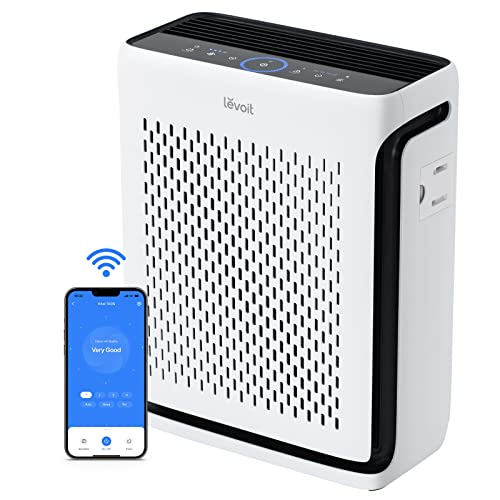
LEVOIT Air Purifier for Home Pets Bedroom — Best for Pet Bedrooms
Levoit aimed this model at a specific room: the bedroom that a cat or dog also calls home. The listing leads with a washable pre-filter, and that single feature explains the whole design. Pet hair is the pre-filter’s burden long before dander reaches the HEPA stage, and a pre-filter you can rinse or vacuum under a tap, dry and refit in minutes turns the most frequent maintenance in a pet household into a free chore instead of a consumable purchase.
Behind that washable screen sits a HEPA filter and a quiet sleep mode for the hours when the room’s other occupant, the human, needs silence more than maximum throughput. The strategy this machine invites is rhythm rather than force: a stronger clean while the room is empty during the day, a hushed maintenance speed overnight, and a pre-filter rinse every couple of weeks keeping the whole system breathing freely.
Be clear-eyed about scale. This is the most modestly sized pick in the guide, intended by its maker for bedroom duty rather than whole-apartment heroics. In a six-hundred-foot zone it works best as the bedroom anchor, or as the second machine in a flat whose living area has its own larger unit. Within that honest role, no pick here understands pet households better, and the savings on pre-filters alone will please anyone who has priced replacements for a shedding household.
- Filter: washable pre-filter ahead of a HEPA stage
- Positioning: pet bedrooms per the listing
- Modes: quiet HEPA sleep mode
- Controls: simple onboard operation
- Focus: hair, dander and everyday bedroom particles
Strengths
- Washable pre-filter removes the most frequent pet-home cost.
- Sleep mode is tuned for rooms where animals and people rest.
- Compact size fits beside a bed without rearranging the room.
Trade-offs
- Smallest capacity here; whole-flat duty is beyond its brief.
- Carbon provision is light for litter-box odour at close range.
- Pet hair still demands regular vacuuming of floors and bedding.
Best for: bedrooms shared with cats or dogs, and second-machine duty. Not suited for: sole coverage of a busy six-hundred-foot living area.

Winix C545 Air Cleaner PlasmaWave — Best Switchable Extra Stage
The C545 is the warehouse-club favourite of the Winix family, a four-stage cleaner built around conventional filtration with one addition: PlasmaWave, the maker’s switchable technology that acts on airborne material beyond the filter itself. The honest way to present that stage is as an optional extra. The filter stack does the documented work of capturing particles; PlasmaWave can be enabled or disabled from the panel, and owners who prefer filtration alone lose nothing by leaving it off.
Underneath the headline feature sits a practical machine for this room size: a washable pre-filter for coarse debris, carbon for everyday odours, HEPA-grade media for fine particles and a fan sized for medium-to-large rooms. The C545 has been sold in large numbers for years, which brings the usual benefit of a deep pool of replacement filters and owner experience to draw on.
Choose the C545 if you like having the extra stage available for musty weeks, a guest room aired after months closed, or a basement-adjacent flat, while resting your everyday confidence on the filters. Skip it if any switchable technology makes you uneasy and you would rather pay for a machine whose every feature you intend to use; the Coway and the 5510 make that purist case in different ways. Either way, the filtration underneath is the substance of this pick.
- Filter: multi-stage stack with pre-filter, carbon and HEPA-grade media
- Extra stage: PlasmaWave, switchable from the panel
- Positioning: medium-to-large room duty
- Controls: onboard panel with automatic operation
- Lineage: long-running high-volume Winix model
Strengths
- Optional stage can be disabled without affecting filtration.
- Conventional filter stack covers the full particle range.
- Long sales history means filters and advice are easy to find.
Trade-offs
- Buyers paying for PlasmaWave should be sure they will use it.
- Design and interface feel a generation behind the app models.
- Carbon stage is everyday grade rather than a heavy deodorising bed.
Best for: households wanting a conventional cleaner with an optional extra stage. Not suited for: purists who reject any feature they cannot verify with a filter.
How Do the Six Compare on the Things That Matter at 600 Square Feet?
| Model | Filtration focus | Stated coverage | Standout trait |
|---|---|---|---|
| COWAY Airmega Mighty Air Purifier AP-1512HH | Four-stage with washable pre-filter | Up to 1,748 sq ft | Eco mode and long warranty |
| WINIX 5510 Air Purifier | True HEPA plus deodorising carbon | Up to 1,881 sq ft per hour | App support, carbon depth |
| LEVOIT Core 400S Smart Air Purifier | Three-in-one cartridge | Up to 1,718 sq ft | Verified CADR, child lock |
| Medify MA-40 Air Purifier | HEPA tower | 1,793 sq ft per hour | Spare capacity, corner format |
| LEVOIT Air Purifier for Home Pets Bedroom | Washable pre-filter plus HEPA | Bedroom scale | Pet-room focus, quiet sleep mode |
| Winix C545 Air Cleaner PlasmaWave | Multi-stage plus PlasmaWave | Medium-to-large rooms | Switchable extra stage |
The table hides the real dividing line, which is temperament. The Coway and C545 ask nothing of your phone and little of your attention; the Levoit 400S and Winix 5510 reward households that enjoy scheduling and readouts; the Medify sells margin; the little Levoit sells a washable answer to pet hair. At six hundred feet all six can do the core job, so the choice is honestly about the life around the machine.
What CADR Does a 600 Square Foot Room Actually Ask For?
Work the familiar rule in this room’s favour. Two thirds of six hundred is four hundred, so a CADR around 400 matches AHAM’s sizing guidance for the space at standard ceiling height. In air-change terms, that output through a room holding roughly 4,800 cubic feet of air delivers about five changes an hour at full speed, and a realistic two to three changes at the middle speeds where these machines spend their evenings.
Two to three changes an hour is the practical target for ordinary life: enough to keep pace with dust raised by movement, dander shed by pets and the slow leak of cooking vapour from a kitchenette. It is not enough to clear a room instantly after an event, which is why every pick here keeps a turbo setting in reserve. Judge turbo by the minute, not the hour; it exists to rescue, and the rest of the day belongs to the quieter gears.
Ceilings and doorways adjust the answer. A lofted six hundred feet with tall ceilings holds more air and wants the headroom picks, the Medify or the 5510. A six-hundred-foot bedroom suite with a door that closes is the easiest brief in this guide, because the machine’s cleaned volume stays cleaned instead of drifting down a hall. Measure your actual space, including the ensuite the door never closes on, and size for the volume the machine will truly serve.
Why Does Closing the Door Change Everything at This Size?
A purifier cleans a volume, not a floor plan, and an open doorway is a leak in that volume. Shut the bedroom door and the machine’s output concentrates: air changes climb, the cleaned state holds, and a modest unit performs like a larger one. Leave every door open in a small house and the same machine is suddenly serving the hall, the stairs and half the kitchen, a brief it never signed up for.
This is why the guide resists telling apartment dwellers to buy the biggest tower. A six-hundred-foot flat with closable rooms can be served zone by zone, running the machine where the household currently lives and sleeping in air that was cleaned during the evening. The pet-focused Levoit exists for exactly this pattern: modest capacity, perfectly matched to a closed bedroom, maintained by a washable pre-filter.
There is a comfort footnote. A closed room with a running purifier gains a faint, steady background sound that many sleepers find masking rather than disturbing, softening street noise and household creaks. Households that hate any hum should test the sleep modes before committing the machine to the bedroom, because a purifier switched off at midnight delivers no air changes at all.
Where Should the Machine Stand in a Smaller Home?
Near the people and near the source, in that order of compromise. In a living room the best spot is usually within a few metres of the main seating, clear of walls on the intake side, where cleaned air reaches the occupants before it disperses. In a bedroom, place the unit where its intake faces the room rather than the wall, and keep it out of the direct line between an open window and the door, where it would spend its effort filtering the outdoors.
Corners tempt every owner and disappoint many. A corner crowds two of the machine’s sides, throttles its intake and aims its output along walls instead of into the room. If a corner is unavoidable, pull the unit out by a hand’s breadth on each side and angle it toward the seating. Under a desk or inside a shelving unit is worse still; a purifier is a lung, and furniture that would suffocate a lung suffocates the machine.
Test placements the cheap way: run each candidate spot for three evenings and dust the nearest shelf before and after. The shelf keeps the score honestly. Owners are often surprised that moving a machine two metres matters more than the specification gap between the models they agonised over, and that discovery is the most useful thing this section can teach.
How Should You Budget for Filters Across Three Years?
Price the machine and its appetite together. Before buying, find the replacement filter for each candidate, note its stated service life, and multiply out three years of ownership at your household’s intensity. A pet home or a keen cook should shorten the stated interval in the calculation, because loaded filters in those homes genuinely tire early, while a quiet adult household can take the printed interval at face value.
Washable pre-filters bend the curve in your favour. Every gram of hair and lint rinsed off a pre-filter is a gram the HEPA stage never has to hold, and across three years that habit can stretch the expensive cartridge meaningfully. The Coway, the C545 and the pet Levoit all build this advantage in; the cartridge-only designs trade it for simpler swaps, which is a fair trade if you know you will never rinse anything.
Keep one spare filter in the house once you settle on a model. Filters are needed on the machine’s schedule, not the retail calendar, and a spare on the shelf converts a filter warning from a week of diminished cleaning into a five-minute swap. Store it sealed and dry; a filter that spends a year absorbing garage damp has spent part of its life before it ever meets the machine.
What Changes When the Filtered Room Is Also a Home Office?
Offices add two demands bedrooms do not: alertness and calls. A machine droning beside a desk undermines the first and embarrasses the second, so office duty argues for headroom, a model that holds the room’s air at a low speed during the working day. The verified Levoit and the Coway both fit that pattern, cleaning steadily in their lower gears while meetings happen around them.
Scheduling earns its keep here. A pre-work boost, run before you sit down, clears the night’s settled dust; a lunchtime lull can drop the speed while you eat elsewhere; the evening can return the machine to automatic. Dust on monitors and keyboards is the office’s version of the shelf test, and most home workers notice the interval between screen wipes stretching within a fortnight of sensible running.
Paper and plants deserve a mention. An outlet aimed across a desk will riffle documents and chill a plant’s leaves, so angle the output toward the room. And remember the office’s other air problem is human: a small sealed room with one occupant still accumulates carbon dioxide across a long afternoon, and no filter in this guide touches that. Crack the door or window between calls; the purifier handles particles, and you handle freshness.
Which Mistakes Do Buyers at This Size Make Most Often?
Overbuying is the signature error of the six-hundred-foot class. A tower rated for three times the room looks like insurance and behaves like a compromise: louder at useful speeds, larger in the room, hungrier for expensive filters. The mirror error exists too, the desktop novelty bought for a real room, but the overbuy is more common because coverage claims train shoppers to fear small numbers.
Neglecting the pre-filter ranks second. Owners who would never skip an oil change let a washable screen mat solid with hair, then blame the machine’s fading performance on its age. Third is the windows-open fallacy: running the purifier beside an open window on a high-pollen day and concluding it does nothing, when it has spent the afternoon bravely filtering the neighbourhood.
Fourth comes indicator blindness, resetting the filter light without changing the filter because the machine still sounds fine. A loaded filter fails quietly, moving less air each week, and the only honest witnesses are the dust film and the calendar. Finally, some buyers place the machine in the least-used room because it looks tidy there. A purifier’s value is measured in the air its household breathes, and a guest room used twice a month is the last place it earns its keep.
How Do You Handle a Bad-Air Week in a Small Home?
Wildfire smoke and peak pollen weeks shrink the home to its best room. Close the windows, choose the room where the household spends its evenings, and move the purifier there even if it normally lives elsewhere; these machines are portable precisely so the cleaned zone can follow the people. Run a higher speed than usual and let the rest of the home wait out the week with doors closed.
Protect the filter during the siege. Check the pre-filter every couple of days while outdoor air is foul, because the loading that normally takes a season can arrive in a week, and a choked pre-filter strangles the whole system. If your region sees smoke most summers, the spare-filter habit stops being a nicety and becomes the difference between a working refuge and a noisy ornament.
When the air clears, resist switching everything off in relief. The particles that entered during the week are now in the carpets and upholstery, re-launching with every step, and a few days of diligent running at normal speeds clears that reservoir. Bad weeks end outdoors first and indoors later; the machine’s job is to shorten the lag.
What Should You Check in the First Fortnight of Ownership?
Run the shelf test, listen at night, and watch the sensor’s behaviour during cooking. The shelf test tells you whether placement works; the night test tells you whether the sleep mode is genuinely sleepable in your room, through your ears; the cooking test shows whether automatic mode wakes when it should. Fourteen days is long enough for all three verdicts and short enough to act on them.
Check the filter seating while you are at it. A cartridge installed with its wrapping partly on, or seated a few millimetres off, lets air bypass the media and quietly guts performance; it happens more often than any manufacturer admits. Confirm every film and bag was removed at setup, a sentence that sounds insulting until the first time it solves someone’s mystery.
Finally, note the baseline. Write the date on the filter frame, photograph the sensor reading on an ordinary evening, and record which speed the household settled into. Six months later those scraps of information will tell you whether the filter is ageing normally and whether the machine still performs as it did, turning guesswork into comparison.
How Do These Machines Behave Around Children and Visitors?
Small children treat a purifier as furniture, a drum and occasionally a step, so stability and control locks matter more than brochures suggest. The Core 400S answers with an explicit child lock; the other picks rely on panel placement and weight. Anchor any tall tower, the Medify especially, where it cannot be pulled over, and route its cable where small hands and pet teeth cannot reach it.
Visitors change the air too. A room holding six extra people, their coats, their outside dust and a door opening every few minutes presents a load the everyday settings were not chosen for. Hosts learn to give the machine a head start, running a higher speed for the hour before guests arrive and letting automatic mode referee the evening. The benefit is subtle but real: the room ends the night smelling like the home rather than like the party.
What Role Does the Purifier Play Alongside an HVAC System?
Central systems move air between rooms and filter it coarsely at the return; a standalone purifier filters one room finely and repeatedly. The two are complements, not rivals. A decent furnace filter protects the equipment and catches the largest debris, while the purifier’s HEPA stage handles the fine fraction in the room where people sit and sleep. Running the HVAC fan on a circulation setting can help distribute the purifier’s cleaned air in a small home, at the cost of some noise and energy.
Ductless homes, flats with radiators and rooms with split units have no such partner, which raises the standalone machine’s importance. In those spaces the purifier is the only device turning the room’s air over through fine media, and sizing discipline matters more. Either way, no purifier cools, heats or dehumidifies; households sometimes buy one hoping it will fix a stuffy, damp room, and the honest fix there is ventilation and moisture control, with filtration as the supporting act.
How Should You Think About Energy Use Across a Year?
At the low and middle speeds where these machines live, the fan draws modest power, closer to a lamp than to a heater, and running one around the clock is a small line in a household budget. Turbo is the exception, drawing several times more, which is another reason to reserve it for rescues rather than routine. Eco modes like the Coway’s, which rest the fan when sensors report clean air, trim the total further without asking the owner to think.
The larger economic story remains filters, not watts. A year of continuous running might consume less electricity value than a single replacement cartridge, so optimisation effort belongs on filter life: pre-filter care, sensible speeds and placement that does not force the fan to fight a wall. Buyers comparing two finalists will learn more from the price and lifespan of their cartridges than from any wattage figure printed on a box.
Can a Purifier Help a Room That Smells Damp or Musty?
Partly, and the boundary matters. Mustiness rides on airborne particles and on gases released by materials in the room; a HEPA stage captures the particles and carbon adsorbs some of the odour, so a filtered room often smells noticeably fresher within days. But if moisture is feeding the problem inside a wall, a carpet pad or a leaking pipe, filtration is perfume on a leak. The smell returns because its source remains, and the correct spending is on finding and drying that source.
Use the machine as a diagnostic as well as a treatment. If a room smells fresh while the purifier runs and turns musty within a day of switching it off, something in the room is generating odour continuously, and that pattern points at hidden damp rather than at stale air. Basements and ground-floor bedrooms in old houses produce this pattern often, and a moisture meter answers the question more cheaply than a larger purifier ever will.
What Is the Sensible Upgrade Path From a First Machine?
Most households should upgrade their arrangement before they upgrade their appliance. Placement experiments, a kept pre-filter and a schedule matched to the day deliver gains that a new box cannot. When those are exhausted, the honest gaps are usually coverage at the far end of the home or carbon depth for a kitchen that shares the living air, and each gap has a targeted answer: a second modest unit for the first, a Winix-style carbon emphasis for the second.
Replacing a working machine to chase a newer display or a slightly better claim rarely pays. Filters, by contrast, always pay: a fresh cartridge in an older machine restores more performance than any other single act. Treat the purifier as a chassis and the filter as the engine, maintain the engine, and the category’s marketing cycle loses its power to make a good purchase feel obsolete.
How Do You Read a Listing Like a Reviewer Rather Than a Shopper?
Start at the filter, not the headline. Name each stage the listing describes and ask what job it does: pre-filters catch the coarse fraction, HEPA media the fine, carbon the gases. A listing that cannot describe its own filtration in plain stages is asking you to buy a mystery. Then find the CADR or the verification badge; a tested number outranks any area claim, and the absence of both means the capacity story rests entirely on the maker’s say-so.
Next, translate the coverage claim by dividing. A machine claiming triple your room’s area is promising roughly one gentle air change an hour across that larger space, which in your room becomes a useful rate at working speeds. Finally, price the second year: the replacement filter, its interval and its availability. Reviewers who follow that order, filter, verified output, translated claim, running cost, rarely end up with a machine they regret, because every step replaces an advertisement with a measurement.
Why Does the Same Machine Delight One Household and Disappoint Another?
Because households buy the same box for different problems. The buyer fighting visible dust needs air changes and pre-filter discipline; the buyer fighting cooking smell needs carbon; the buyer fighting a snoring-adjacent hum needs a sleep mode they can tolerate. A machine excellent at the first job and ordinary at the second will collect a glowing verdict from one home and a baffled one from another, and both verdicts will be honest reports of different briefs.
The defence is to write your own brief before shopping: name the room, the dominant particle source, the hours of use and the noise ceiling. Then read every review, this one included, as evidence against that brief rather than as a ranking handed down from authority. The picks above are ordered by breadth of appeal, but the verdict lines exist precisely so a pet owner, a cook and a light sleeper can each find a different winner in the same six machines.
How Does a Purifier Fit a Nursery or a Child’s Bedroom?
Gently, stably and out of climbing range. Choose a machine whose controls can be locked or placed beyond a toddler’s curiosity, route its cable where it cannot be pulled, and favour the quiet end of this guide, since a child’s sleep is both lighter and more fiercely defended by its parents than any adult’s. The Core 400S, with its explicit child lock, was shortlisted with exactly this room in mind.
Expectations should stay in this guide’s honest register: the machine captures airborne particles in the room, keeps dust settling slower on the cot and the changing table, and does so without any medical promise attached. Clean air in the mechanical sense, a room that smells of bedding rather than of the day, is a worthwhile nursery upgrade on those terms alone, and parents do not need a larger claim to justify the plug it occupies.
What Is the Kindest Way to Retire an Old Purifier?
Pass it down the ladder of rooms before passing it out of the house. A machine outgrown by the living room still serves a study, a workshop or a teenager’s bedroom perfectly well, and its filters, bought in the same ecosystem you already stock, keep it useful for years. Only when the fan grows rough or the model line’s filters vanish from sale has the machine truly finished, and by then it has usually cleaned a decade of evenings, which is a fair life’s work for a box with one moving part.
One Last Check Before You Order: the Plug and the Door Swing
Confirm the socket nearest your chosen spot actually works and that the machine’s door or filter hatch can open fully where it will stand. More placements fail on these two centimetres than on any specification in this guide.
Final Recommendation
Most six-hundred-foot homes should start with the COWAY Airmega Mighty Air Purifier AP-1512HH, whose maturity, eco mode and filter ecosystem make it the easiest long-term ownership story here. Kitchens that share air with the sofa argue for the WINIX 5510 Air Purifier and its carbon depth, while households that want audited numbers and an app should take the LEVOIT Core 400S Smart Air Purifier without a backward glance.
Whichever machine comes home, give it the conditions it needs: a door it is allowed to work behind, a pre-filter rinsed before it mats, and a speed chosen for cleaning rather than for silence alone. Do that, and a modest cabinet in the corner will repay you in the least dramatic way imaginable, by making the room’s air a thing you simply stop thinking about.
Frequently Asked Questions
Is a 600 square foot rating the same as a CADR of 600?
No. The coverage figure is an area claim built on assumptions about air changes, while CADR is a measured airflow of cleaned air. For this room size, look for a CADR near 400 under AHAM’s two-thirds guidance, and treat any coverage number two or three times the room area as a sign of headroom rather than a literal promise.
Can I move one purifier between the living room and bedroom?
You can, and many apartment households do exactly that, cleaning the living space by day and the bedroom by night. The cost is discipline: the machine only serves the room it is in, and rooms it has left begin accumulating particles again. If moving it becomes a chore that gets skipped, a second smaller unit, like the pet-bedroom Levoit, usually wins.
Do I need the ioniser or PlasmaWave stage switched on?
No. The filters do the documented work of capturing particles, and the extra stages on the Coway and the C545 are optional by design. Owners who prefer filtration alone can leave them off permanently; owners who like the extra stage for musty rooms can enable it when wanted. The choice is a preference, not a requirement.
How loud will a machine this size be overnight?
On sleep settings these models are designed to sit below the level that disturbs most sleepers, a soft rush rather than a mechanical hum. Sensitivity varies, so use the first fortnight to test the machine in your own bedroom, and remember that a slightly higher speed behind a closed door often sounds quieter than a low speed beside the bed.
When does a room this size need a second machine instead?
When the space will not hold its cleaned state: doors that must stay open, a layout split by a stairwell, or a pollution source at the far end from the seating. The shelf test at the distant end delivers the verdict within weeks. A second modest unit at the far end beats one hero machine straining from a single corner.
What is the first maintenance job I should learn?
The pre-filter. Find it, learn how it releases, and put a monthly rinse or vacuum in the calendar before the machine even arrives. That single habit protects the expensive filter behind it, preserves airflow and prevents the slow fade that owners so often mistake for the machine wearing out.
Related Guides
If your rooms run larger or your smells run stronger, three companion guides continue the story: Best Air Purifiers for Bad Smells tackles the carbon question head-on, Best Blenders for Smoothies and Ice covers the kitchen counter’s loudest resident, and Best Gel Pillows for Side Sleepers looks after the other half of a good night in a freshly cleaned bedroom.



[…] sizing machines for other rooms may also find our companion guides useful: Best Air Purifiers for 600 Sq Ft covers the next size down, Best Stand Mixers for Your Kitchen handles a very different kind of […]