What's inside
- Key Takeaways
- Quick Picks
- How Did We Choose the Best Alarm Clocks for Elderly People?
- How Do the Six Picks Compare Side by Side?
- How Should an Adult Child Set Up a Clock for a Parent?
- Why Does Automatic Time Setting Matter More With Age?
- What Makes an Alarm Gentle but Still Effective for Older Sleepers?
- How Do Clocks Help With Medication Times and Daily Routines?
- How Can a Clock Support Someone Returning Home After a Hospital Stay?
- What About Older People Who Nap, Rise Early or Keep Unusual Hours?
- How Should Couples With Different Needs Share One Bedroom Clock?
- How Do Winter Darkness and Seasonal Changes Affect the Choice?
- What Should a Family Check a Month After the Clock Arrives?
- Why Do Simple Controls Protect Independence More Than Extra Features?
- What About Clocks for Guest Rooms and Family Visits?
- What Are the Most Common Mistakes When Buying a Clock for an Older Person?
- Final Recommendation
- Frequently Asked Questions
- Related Guides
As an Amazon Associate I earn from qualifying purchases. This post may contain affiliate links at no extra cost to you.
cottageverdict.com is reader-supported. When you buy through links on our site, we may earn an affiliate commission.
Where to buy: each clock below links to its Amazon listing, where you can check price on Amazon and confirm display size, controls and power arrangements before ordering for yourself or a parent.
The best alarm clocks for elderly people are judged by a stricter standard than almost any other category in this series: they must be easy to read without glasses, easy to set without a manual, and forgiving when arthritic fingers, fading eyesight or a moment’s confusion meet a small button at midnight. A clock that fails those tests is not merely inconvenient. It is a clock that will be unplugged, ignored or quietly replaced by a son or daughter’s phone calls — and the independence it was meant to protect goes with it.
This guide is written for two readers at once, because that is how these clocks are actually bought. The first is the older person choosing for themselves, who knows their own eyes, ears and habits better than any reviewer. The second is the adult child buying for a parent — often at a distance, often after a missed appointment or a power cut revealed that the old clock had been wrong for days. Both readers want the same things: digits that can be read from the bed in the small hours, controls that explain themselves, an alarm that is clear without being cruel, and a clock that recovers from a power cut without needing to be taught the time again.
Certain features recur through the picks because they answer those needs directly. Extra-large displays come first, sized for reading at arm’s length and beyond. Simple, physical controls follow — a switch that shows whether the alarm is on beats a menu that hides it. Automatic time setting earns a special place, because it removes the twice-yearly clock-change chore and restores the time after every outage. Gentle-but-clear alarms matter too: older sleepers often wake more lightly than they did at forty, and a clock that can be set to a kind, moderate volume — with headroom in reserve — respects both the sleeper and the spouse in the next bed or the next room.
Six clocks met the standard. None requires a smartphone, an account or an app. Each can be set up by a family member in one visit and then operated daily by its owner without assistance, which is the real definition of a successful purchase in this category. Where a pick asks something of its owner — a nightly charging habit, a tolerance for colourful digits — the text says so plainly, because honesty about small frictions now prevents a returned parcel and a harder conversation later.
Key Takeaways
- Digit size is the first feature: the time must be readable from the bed, without glasses, at 3 a.m.
- Controls should be physical and self-explanatory — a visible alarm switch beats any hidden menu.
- Automatic time setting removes the clock-change chore and repairs outages by itself.
- The right alarm is clear and kind, with volume in reserve rather than force by default.
- Displays must dim properly, because older eyes are more sensitive to night-time glare.
- Set the clock up with its owner, in their room, and test it together before trusting it.
Quick Picks
| Pick | Badge | Why it made the list |
|---|---|---|
| DreamSky Small Digital Alarm Clock | Best readable all-rounder | Large calm numbers, an honest dimmer and adjustable volume in a clock that explains itself. |
| Emerson SmartSet Dual Alarm Clock Radio | Best auto-setting choice | Sets its own time and restores it after cuts, with dual alarms, radio and a sleep timer. |
| Netzu Digital Alarm Clock | Best for two daily times | Bold digits and dual alarms with wide dimming and volume ranges for structured days. |
| REACHER Digital Alarm Clock | Best with phone charging | Colourful dimmable digits plus a USB port, handy when family calls arrive on a mobile. |
| Sharp Digital Alarm Clock with Keyboard Controls | Best tactile controls | Keyboard-style buttons and a front alarm switch that hands can find and understand by touch. |
| Amazon Basics Small Digital Oval Alarm Clock | Best simple backup | A small oval clock with a nightlight and battery backup for spare rooms and second posts. |
How Did We Choose the Best Alarm Clocks for Elderly People?
Readability was tested at realistic distances and in realistic light: from a pillow’s distance in a dim room, and from across a bedroom in daylight. Digits had to be legible without strain in both. We treated dimming range as part of readability rather than a separate luxury, because a display that cannot soften becomes a source of glare that older eyes feel more sharply — and a clock that lights the room all night will be turned to the wall by Friday.
Controls were judged by the midnight test. Could the alarm be checked, snoozed or switched off by touch, in the dark, by someone half-asleep with stiff fingers? Physical switches and large, separated buttons passed; tiny identical buttons in a row and settings buried behind long presses did not. We also favoured clocks whose state is visible at a glance — an indicator that the alarm is armed — because the question ‘did I set it?’ should be answerable from the bed, not by getting up to investigate.
Resilience formed the third test. Power cuts happen, grandchildren explore buttons, cleaners unplug things. Battery backup and automatic time restoration were therefore weighted heavily, as was the ability to survive being re-set by a visiting relative in a hurry. Finally, we considered sound as the sleeper experiences it: clear tones, moderate starting volumes and enough adjustment to be heard through a closed door by a carer if that is the household’s arrangement — without any pick relying on sheer loudness as its main idea.

DreamSky Small Digital Alarm Clock — Best readable all-rounder
The DreamSky’s large numbers do the heavy lifting in this category. They can be read from the bed without glasses by many owners, read from across the room in daylight, and — just as importantly — read with confidence: there is no decorative clutter around the digits to be misinterpreted at three in the morning by a person deciding whether it is time to get up or time to roll over. For anyone whose eyesight has made small bedside displays a nightly frustration, that clarity alone justifies the purchase.
The controls respect the same philosophy. Volume adjusts across a useful range, so the alarm can be set to the gentlest level that reliably works, with more in reserve for a heavy morning or a household where a spouse does the final rousing. The dimmer is a real control rather than a token gesture, taking the big display down to a night-time murmur. A USB charging port serves the mobile phone that most older people now keep nearby for family calls, and the plug-in design with its adapter keeps the whole arrangement compact and stable on a bedside table.
For an adult child setting this up on a visit, the kind sequence is: position it where the sightline from the pillow is direct, set brightness and volume together with the parent while they are sitting in the bed, and write nothing down — because nothing needs writing down. A clock that requires an instruction card taped to the wall has failed, and the DreamSky passes precisely by making the card unnecessary.
- Type: plug-in digital clock with extra-large display
- Display: big numbers with a genuine dimmer for night
- Sound: adjustable volume, gentle settings that still carry
- Extras: USB port for the bedside mobile phone
- Best setting: main bedside clock for independent living
Strengths
- The clearest digits in this list at pillow distance.
- Volume and brightness both adjust to the individual sleeper.
- Setup is a five-minute job a relative can do on a visit.
Trade-offs
- No automatic time setting after a power cut.
- The modern styling may not suit a traditional bedroom.
- Buttons are clear but still reward a guided first setup.
Best for: older sleepers whose main need is a display they can trust.
Not suited for: anyone wanting the clock to reset itself after outages.
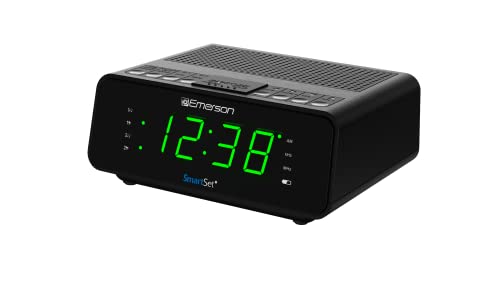
Emerson SmartSet Dual Alarm Clock Radio — Best auto-setting choice
The Emerson removes the two chores that most often defeat an otherwise good clock: setting it in the first place, and repairing it after the power fails. Its SmartSet system establishes the correct time and day when plugged in and restores them after an outage, so the clock on the bedside table is simply right — after a storm, after the clocks change, after a cleaner unplugs it to vacuum. For a parent living alone, that self-sufficiency is not a convenience feature; it is the difference between a clock that can be trusted and one that must be verified.
The rest of the design suits its audience with unusual thoughtfulness. Dual alarms allow a morning call and a medication-time reminder, or different times for different days. The radio, with twenty presets, serves the large audience for whom a familiar station is part of the day’s furniture — and waking to a human voice and the news is, for many older listeners, a gentler and more orienting start than any buzzer. A sleep timer lets the radio keep company at bedtime and switch itself off after its owner has drifted away. The jade-green display sits just under an inch tall and dims for the night.
It is the fullest-featured clock here, and a relative should do the one-time job of storing the favourite stations and setting the alarms. After that visit, the Emerson asks for almost nothing — which, for the right household, is the most valuable specification on this page.
- Type: dual-alarm clock radio with automatic time setting
- Display: jade-green digits just under an inch, dimmable
- Radio: AM and FM with twenty presets for favourite stations
- Extras: sleep timer for bedtime listening that ends itself
- Best setting: independent living where reliability must be total
Strengths
- Automatic setting ends clock-change and outage repairs forever.
- Waking to radio suits listeners who dislike buzzer alarms.
- Dual alarms cover mornings and daytime reminders alike.
Trade-offs
- The richest controls here reward a relative’s setup visit.
- Digits are clear but smaller than the DreamSky’s.
- Radio features are wasted in a household that never listens.
Best for: parents living alone who must never face a wrong clock.
Not suited for: minimalists wanting the fewest possible functions.

Netzu Digital Alarm Clock — Best for two daily times
Many older households run on two fixed points rather than one: a morning rise and an afternoon rest, a breakfast time and a tablets time, a weekday pattern and a different Sunday one. The Netzu’s dual alarms were built for exactly that shape of day, and its bold digits keep the time itself readable from the bed and from the armchair alike. Five dimmer levels let the display be bright company by day and near-invisible by night, a range that sensitive eyes will appreciate more with every passing week.
Four volume levels give the alarm a similar range. The lower settings suit the light sleeper who wakes at a kind word; the upper settings serve a household where the alarm must be heard from the kitchen, or by a spouse who acts as the second stage of the morning. The snooze is sized and placed for a hand that is not fully awake, and the plug-in design keeps the clock a stable, permanent piece of the bedside rather than a device that travels around the house and gets lost.
Setup deserves one calm session, ideally with a family member reading the steps aloud while the owner performs them — a division of labour that leaves the knowledge in the right hands. Once the two alarms are set, daily life with the Netzu is reduced to glancing and trusting, which is what its owners ask of it.
- Type: plug-in digital clock with dual alarms
- Display: bold digits with five dimmer levels
- Sound: four volume levels from gentle to carrying
- Snooze: easy to find and press while half-asleep
- Best setting: structured days with two fixed daily times
Strengths
- Two alarms match how older households actually schedule days.
- Wide dimming range protects light-sensitive night sleep.
- Bold digits read clearly from bed and armchair alike.
Trade-offs
- No charging port for the bedside phone.
- Dual-alarm setup is best done with help the first time.
- No radio for those who like waking to a station.
Best for: older people whose day has two non-negotiable times.
Not suited for: anyone wanting automatic setting after power cuts.
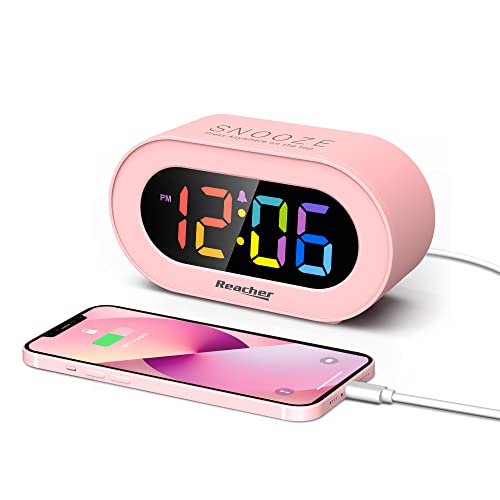
REACHER Digital Alarm Clock — Best with phone charging
The REACHER’s colourful display will not be to every older taste, and this guide will not pretend otherwise. But for the right owner — and there are many, particularly grandparents who enjoy a bit of cheer in their surroundings — its rainbow digits are large, high in contrast and genuinely easy to read, while the pink casing makes the clock simple to locate visually on a crowded bedside table. What elevates it in this category is the USB charging port: the mobile phone, which is now the family lifeline for most older people, charges from the clock’s own socket, fully powered by morning and always in the same place.
Volume adjusts to a civilised range and the snooze is easy to operate, so the daily experience is simple once a relative has helped choose the display’s night brightness. That one setting matters: the colourful digits are vivid at full strength, and the dimmer should be set in the actual dark of the bedroom, with the owner in the bed, before anyone declares the job done.
Consider it the sociable option in this list — the clock for a grandparent whose phone rings with grandchildren, whose bedside hosts photographs and a water glass, and who would like the object that wakes them to look like it belongs to a person with a sense of humour. Function first, but personality is not nothing, at any age.
- Type: compact digital clock with USB phone charging
- Display: colourful LED digits with dimming control
- Sound: adjustable volume with an easy snooze
- Finish: pink casing, easy to spot on a busy table
- Best setting: bedsides where the mobile must charge overnight
Strengths
- The charging port keeps the family phone ready every morning.
- High-contrast digits are easy to read at a glance.
- Cheerful design suits owners who dislike clinical gadgets.
Trade-offs
- The rainbow styling will divide taste in traditional rooms.
- Night brightness needs careful setting with the owner present.
- A single alarm path suits one main daily time best.
Best for: grandparents whose phone is the family’s main channel.
Not suited for: anyone who prefers a clock to disappear into decor.

Sharp Digital Alarm Clock with Keyboard Controls — Best tactile controls
Sharp laid this clock’s controls out like a keyboard, on top, where hands can find them — and for owners whose eyesight makes small rear buttons a misery, that layout is close to a revelation. Setting the time or the alarm becomes a tactile exercise performed by touch and logic rather than by squinting at symbols in poor light. The front alarm switch deserves equal praise: whether the alarm is on is a physical fact that can be checked with a fingertip in the dark, ending the small hours’ uncertainty that disturbs so many older sleepers’ rest.
The large snooze button continues the theme, sized for a descending hand rather than a precise fingertip. The red LED display is clear and traditional, readable without being glaring, and battery backup preserves the settings when the power blips. There is no charging port and no radio; this is a clock reduced to the essentials and then made exceptionally operable, which for many owners is a better gift than features.
It particularly suits anyone whose hands are more reliable than their eyes — the knitter, the gardener, the retired tradesperson — and households where the same clock gets set for different times across the week, because the keyboard layout makes changing it a ten-second job rather than a production. Dignity lives in details like these: a clock its owner can fully command, alone, at any hour.
- Type: digital clock with top keyboard-style controls
- Display: red LED, clear and traditional in character
- Controls: front alarm switch plus a large snooze button
- Power: mains operation with battery backup for settings
- Best setting: owners who set by touch more than by sight
Strengths
- Keyboard layout can be operated confidently by touch.
- The front switch makes the alarm’s state physically certain.
- Large snooze suits hands that are stiff first thing.
Trade-offs
- No USB charging for a bedside phone.
- Digits are clear but not the largest in this list.
- The red display is a matter of taste for some owners.
Best for: older people whose hands outperform their eyesight.
Not suited for: buyers who want radio or phone charging included.

Amazon Basics Small Digital Oval Alarm Clock — Best simple backup
Not every clock in an older person’s home carries the main morning. There is the spare room where grandchildren sleep, the second bedside in a couple’s room, the kitchen shelf where a reminder for the afternoon tablets would be genuinely useful. The little Amazon Basics oval serves all those posts with becoming modesty: a clear LED display, a simple snooze, a built-in nightlight for safe small-hours navigation, and battery backup so its settings survive the unplugging that happens in every real house.
Its small size is the honest limitation for a main clock — the digits serve a bedside distance well but cannot match the DreamSky’s from across a room — and its single alarm suits one daily signal. Judged as a household’s second clock, though, those limits shrink to irrelevance, and its gentle cost makes buying two a reasonable act rather than an extravagance. Families equipping a parent’s home often find that the second clock, placed where the afternoon is spent, prevents more missed moments than any single premium purchase.
It also travels gracefully between the houses of a family — to a daughter’s spare room for a convalescent week, to a holiday cottage — because it asks for nothing but a socket and forgives every interruption. In a category full of considered purchases, there is room for one clock that is simply, reliably there.
- Type: small oval digital clock, mains with battery backup
- Display: clear LED with a built-in nightlight
- Alarms: single alarm with a straightforward snooze
- Size: compact enough for shelves and spare rooms
- Best setting: second clocks, spare rooms and kitchen reminders
Strengths
- Battery backup makes it forgiving of real household life.
- The nightlight helps safe movement during the night.
- Low cost suits buying for a second location.
Trade-offs
- Digits are too modest for a main clock across a room.
- One alarm only, with no scope for a second daily time.
- No charging port or radio extras of any kind.
Best for: second posts around an older person’s home.
Not suited for: serving as the only clock for failing eyesight.
How Do the Six Picks Compare Side by Side?
| Pick | Digit size | Self-setting | Standout virtue |
|---|---|---|---|
| DreamSky Small Digital Alarm Clock | Largest here | No | Clarity at pillow distance |
| Emerson SmartSet Dual Alarm Clock Radio | Medium | Yes, automatic | Never needs resetting |
| Netzu Digital Alarm Clock | Bold | No | Two alarms, wide ranges |
| REACHER Digital Alarm Clock | Colourful, high contrast | No | Charges the mobile phone |
| Sharp Digital Alarm Clock with Keyboard Controls | Medium | No | Controls usable by touch |
| Amazon Basics Small Digital Oval Alarm Clock | Small | No | Backup-friendly second clock |
How Should an Adult Child Set Up a Clock for a Parent?
Begin by asking, not announcing. A clock chosen with a parent — even from a shortlist of two — will be used; a clock installed as a surprise intervention will be resisted, sometimes for reasons that have nothing to do with the clock. Frame the purchase around the parent’s own stated annoyances: the old clock’s tiny numbers, the radio station they miss, the morning the power cut made them late for an appointment they cared about. People accept help most readily when it answers a problem they named themselves.
Do the setup in the room, at the bedside, with the parent performing each step while you guide. Knowledge installed in the owner’s hands survives your journey home; knowledge installed in yours does not. Set the brightness after dark if the visit allows, or return for a five-minute evening check, because daylight setup of a night-time display is the single most common reason good clocks get turned to the wall. Then run a live test: set the alarm for five minutes ahead, let it ring, and let the parent silence it unaided. That small rehearsal converts a new object into a known one.
Resist configuring everything. The dual alarm that could hold a medication reminder should only be set if the parent wants the clock to carry that job; an alarm that rings at tablet time without the owner’s agreement becomes a nagging stranger in the bedroom. Agree what the clock is for, set exactly that, and leave a short note in large handwriting with the two or three operations that matter — how to snooze, how to switch the alarm off, what the indicator light means. Then phone in a week and ask how it is behaving, which is a better question than whether they like it.
Why Does Automatic Time Setting Matter More With Age?
Twice a year, every household performs the clock-change ritual, and in an older person’s home that ritual has failure modes that younger households shrug off. Clocks in ovens and cars get forgotten; a bedside clock set an hour wrong in the wrong direction can cost a medical appointment, a coach trip, a grandchild’s school play. Add power cuts — which arrive without ceremony at any season — and the opportunity for a quietly wrong clock multiplies. Each incident also costs confidence, and confidence is the real currency: an older person who stops trusting the clock starts sleeping lightly beside it, listening for a world they fear they have misread.
The Emerson’s self-setting removes the entire category of worry. The clock restores itself after outages and needs no seasonal attention, so the time on the bedside table can be taken on faith — and faith, in this small domain, is a form of rest. For households where a relative lives at a distance, it also removes the recurring telephone chore of talking a parent through a reset, a conversation that manages to be frustrating at both ends of the line.
Where an auto-setting model does not suit — because the owner prefers bigger digits or simpler controls — build the human version of the feature: a standing arrangement that the clock gets checked on every family visit and after every known power cut, written into the household’s habits rather than left to anyone’s memory.
What Makes an Alarm Gentle but Still Effective for Older Sleepers?
Older sleep is often lighter and more fragmented than the sleep of middle age, which cuts both ways: many older people wake at a modest sound that would not stir a teenager, yet they also surface more slowly and startle more unpleasantly. The ideal alarm for this audience is therefore clear rather than loud — a distinct tone at a moderate volume, given a few moments to work — with headroom available for the mornings when it is needed. Every pick in this guide offers that adjustability, and the correct setting is found by experiment at home, starting low and rising only until the alarm reliably does its job.
Radio deserves its reputation as the gentlest effective option. A familiar presenter’s voice arrives as orientation as much as sound; the sleeper wakes into a world that is already narrated, which many older listeners describe as the difference between being woken and being startled awake. The Emerson exists in this list largely for them. Couples should tune the arrangement together, because the volume that is gentle for the alarm’s owner may still be an event for a spouse — and the spouse’s goodwill is a household resource worth budgeting.
What no clock should do is frighten. A morning that begins with a racing heart colours the hours after it, and an alarm bought to protect independence should never tax it. If a parent reports dreading the sound of their own clock, believe them, lower it, change its character, or change the clock — the technology serves the person, never the reverse.
How Do Clocks Help With Medication Times and Daily Routines?
For many older households, the day’s most important times are not the morning at all. Tablets taken with breakfast and again at six, a district nurse’s window, a favourite programme, a neighbour’s daily call — the dual alarms on the Netzu and the Emerson can carry one of these as a second fixed point, turning the clock from a waking device into the day’s quiet secretary. Used this way, the alarm should be agreed and labelled in the owner’s mind: this ring means the morning, that ring means the tablets, and the distinction should be practised, not assumed.
Restraint is the governing virtue. A clock set to announce every obligation becomes background noise within a fortnight, and its morning voice loses authority with every unnecessary performance. One reminder beyond the wake-up is usually the productive limit for a single device; beyond that, the household needs a different system — a pill organiser, a calendar by the kettle, a carer’s visit — rather than a busier clock. This guide is about clocks, and it will not pretend they are a care plan.
Where routine is the real need, consistency of placement matters as much as the alarm itself. The little Amazon Basics oval on the kitchen shelf, ringing as the kettle boils, can anchor an afternoon dose more reliably than a sophisticated bedside device ringing in an empty bedroom. Match the reminder to the room where the action happens, and the technology disappears into the habit it was meant to support.
How Can a Clock Support Someone Returning Home After a Hospital Stay?
A homecoming rearranges a household’s rhythms at exactly the moment its members have the least spare capacity. Sleep in a convalescent house happens in fragments, appointments cluster at unforgiving hours, and medication times multiply temporarily beyond their usual count. A reliable clock — already installed, already familiar — is one of the few pieces of equipment that asks nothing during that fortnight. This is an argument for buying before the crisis: the DreamSky or Emerson set up in ordinary times will simply be there, correct and trusted, when the household comes home tired and the mornings suddenly carry consequences.
During recovery, use the alarm system modestly and explicitly. One wake time, one reminder, agreed with whoever is coordinating care, and the clock’s display checked as part of the evening round alongside doors and medication. Visitors and helpers should be told the arrangement rather than left to improvise resets; a well-meaning adjustment by a helper who then leaves is a classic source of the wrong-time morning. Write the household’s chosen settings on the large-print note by the bed, and the system survives changes of personnel.
As strength returns, hand the controls back in stages — the owner silences the alarm, then sets it, then owns the whole routine again. Equipment that was a support becomes a milestone, and the day a convalescent parent announces they have reset their own clock for a voluntary early start is a day the family will remember with more pleasure than the purchase ever gave them.
What About Older People Who Nap, Rise Early or Keep Unusual Hours?
Retirement rearranges the day more radically than any alarm clock can. Many older people rise earlier than they ever did in working life and nap after lunch; others, freed from schedules, drift later and treasure the drift. A good clock serves both patterns without judging either. The early riser’s need is mostly information — a display readable in the dark that confirms it is five, not three, and that the day may decently begin. The napper’s need is a trustworthy short alarm that ends the afternoon rest before it eats the evening’s sleep, set at a gentle volume and placed where it must be answered properly.
Dual alarms adapt gracefully to this life: one for the morning, one for the nap’s end, and the discipline that matters is keeping the pair consistent, because a body that naps to the same boundary daily sleeps better at night than one whose afternoons are improvised. The Netzu was practically designed for this household, and the Emerson’s sleep timer offers the napper a civilised variant — radio that plays them down and switches itself off, leaving the alarm to bring them back.
The later-drifting household deserves equal respect from its equipment. Not every older person wants to be reformed into dawn rising, and a clock’s job is to serve the chosen schedule — the nine o’clock start, the leisurely breakfast — with the same fidelity it would give a commuter. Independence includes the right to one’s own hours, and the best clock is the one that keeps them without commentary.
How Should Couples With Different Needs Share One Bedroom Clock?
Two sleepers rarely age in sync. One rises at six for a walking group; the other sleeps until eight and guards the privilege. One reads displays easily; the other needs the largest digits in the shop. The shared bedroom clock must therefore be a negotiated settlement, and the picks here offer different treaties. The DreamSky serves the couple whose main divide is eyesight, since its digits can be read by both from either pillow. The Netzu serves the couple divided by schedule, its dual alarms and volume range letting the early riser’s signal stay as personal as a single bed allows.
Where one partner is a much lighter sleeper, honesty about the physics helps: no bedside alarm is truly private, and the couple’s real choices are a gentler alarm plus an agreed second stage — the early riser simply gets up at the first sound, minimising its duration — or separate posts, with a small second clock like the oval on the early riser’s side. Many couples discover that the second-clock arrangement, bought cheaply and without drama, preserves more goodwill than any single premium device.
What matters most is that the negotiation happens in daylight, kindly, before resentment accrues. A clock is a small thing to argue about at six in the morning and a perfectly reasonable thing to discuss over lunch — and households that hold the lunch conversation rarely need to hold the dawn one.
How Do Winter Darkness and Seasonal Changes Affect the Choice?
Winter tests an older household’s timekeeping in ways summer never does. Mornings arrive in darkness, so the display’s night behaviour — bright enough to read, dim enough to sleep beside — stops being a preference and becomes the product. Evenings close in early, and a clock with a radio or a kind display becomes part of the room’s companionship as much as its equipment. Seasonal clock changes, already discussed, deserve repeating here because their cost rises with age: build the check into the family’s visiting rhythm, or choose the Emerson and retire the problem entirely.
Light in the bedroom deserves one further thought. Older eyes adapt more slowly between darkness and brightness, so a display that can be dimmed smoothly, like the DreamSky’s or the Netzu’s, is kinder during the night than one with a single harsh setting — and a small nightlight, like the little oval’s, placed to light the route rather than the pillow, can make the difference between a confident night-time journey and a hazardous one. None of this is medical advice; it is the accumulated practical wisdom of households that have arranged bedrooms for ageing eyes, and it is worth stealing.
Summer brings the mirror problem of dawn arriving before the household wants it, waking light sleepers at five and leaving them tired by noon. A clock cannot darken a room, but a clear display at least settles the question instantly — it is five, the day has not officially begun, and returning to sleep is a decision rather than a confusion. Blackout curtains complete that arrangement, and the clock’s job is simply to be believed when it gives the unwelcome news.
What Should a Family Check a Month After the Clock Arrives?
The one-month review separates successful purchases from tolerated ones. Ask three questions, in the parent’s own kitchen rather than by interrogation: Is the time readable in the night without effort? Has the alarm ever failed to do its job, or been switched off in confusion? And is there anything about the clock that gets cursed, even affectionately? A curse is data. Glare, a tone that grates, a snooze that gets hit three times by habit — each points to a setting that can still be adjusted, and a month is early enough that adjusting it feels like service rather than defeat.
Check the physical facts too. Backup batteries age; note the date they were installed on the note by the bed. Cables migrate; confirm the clock cannot be pulled from its table by a caught lead. Settings drift when grandchildren visit; confirm the two alarms still say what the household agreed they say. None of this takes ten minutes, and it converts a gift into a maintained system — which is, in the end, the difference between families who buy clocks and families whose parents are simply never late.
If the review reveals the clock itself is wrong — digits still too small, controls still baffling — act on the information without sentimentality. Move it to a second post, where its virtues fit, and buy the right main clock with the lesson included in the price. The goal was never the purchase; it was the mornings.
Why Do Simple Controls Protect Independence More Than Extra Features?
Every feature added to a clock is also a way for the clock to be in the wrong state. A device with one alarm can be wrong in one way; a device with modes, profiles and menus can be wrong in a dozen, several of them silent. For an owner who cannot easily audit those states — who cannot read the tiny icon that explains why nothing rang — simplicity is not a lack of ambition in the design. It is the design’s central kindness. The Sharp’s front switch states the alarm’s condition in a form that cannot be misread, and the little oval’s whole interface can be learned in one demonstration. Neither will ever surprise its owner at six in the morning with a mode neither of them remembers selecting.
This is why this guide keeps returning to the same small set of virtues — big digits, physical controls, visible state, automatic recovery — and treats everything beyond them as optional garnish. The garnish has its place: radio for the listener, charging for the grandparent whose phone is the family switchboard, colour for the owner who enjoys it. But the garnish must never be allowed to complicate the core transaction, which is a person trusting an object to wake them, correctly, every day, without assistance. Families choosing between a simpler and a cleverer clock at similar cost should choose the simpler one and spend the difference on a good visit — the configuration in which the setup happens, the rehearsal is run, and the clock becomes theirs.
What About Clocks for Guest Rooms and Family Visits?
Older people are also hosts, and the guest room clock deserves a sentence of its own. Visiting grandchildren and adult children keep hours their hosts may not share, and a simple, readable clock in the spare room — the little oval is the natural candidate — lets guests manage their own early departures without borrowing the household’s arrangements or waking it to ask the time. Choose a model a stranger can operate without instructions, set its brightness kindly, and check its alarm is off before each arrival; a guest woken at a previous guest’s five o’clock setting remembers the house for the wrong reason.
The same logic applies in reverse when an older person stays away — with family, in respite care, in hospital. A familiar small clock from home, where regulations allow, carries a piece of the owner’s routine into a strange room, and its known display is one less unfamiliar thing to interpret in the night. Independence travels best in small, familiar objects, and a clock is among the smallest that matter.
What Are the Most Common Mistakes When Buying a Clock for an Older Person?
Buying the clock you would want, rather than the one they need, leads the list — the app-connected marvel chosen by a tech-comfortable son for a mother who wanted three buttons and the news at seven. Close behind comes prioritising small size and neatness over digit size, as if the bedside table’s appearance outranked the owner’s ability to read the time in the night. A third error is setting the volume by guesswork in a shop or a hallway, rather than in the bedroom, from the bed, with the actual sleeper present.
Families also err by configuring in silence: the clock installed, the manual taken home ‘for safekeeping’, the parent left alone with an unfamiliar object and a reluctance to admit difficulty. And the subtlest mistake is buying a clock to solve a problem it cannot reach — persistent missed mornings despite adequate sleep and a working alarm are worth raising with a doctor, because sleep, hearing and health are connected in ways no purchase can untangle. A clock is a tool for independence. Used honestly, it also shows where independence needs company rather than equipment.
Final Recommendation
For most older readers, the DreamSky is the place to start: the clearest digits here, honest controls and volume that can be set kindly. Where the overriding fear is a clock that silently goes wrong — after cuts, after clock changes — the Emerson’s self-setting makes it the safer gift, and its radio will delight the listener it suits. Structured days with two fixed points belong to the Netzu; the Sharp belongs to hands that work better than eyes; the REACHER serves the grandparent whose mobile phone must wake up charged beside them; and the little oval earns its place as the household’s second clock, on the shelf where afternoons happen.
Buy it with the person who will use it, set it up in their room with their hands on the controls, and test it before you leave — because the right clock, chosen that way, is not really an appliance at all, but a small daily promise that the morning will arrive clearly, kindly and exactly when it was asked to.
Frequently Asked Questions
Which clock is easiest for someone with arthritis?
The Sharp, by design: its keyboard-style controls sit on top where they can be pressed with the flat of a finger, its snooze is large, and its front switch can be checked by touch. The DreamSky is the runner-up, with clear controls and the advantage of larger digits for owners whose eyes need as much help as their hands do each morning.
What if my parent keeps unplugging the clock?
Ask why before replacing anything — glare at night, an annoying tone and simple confusion about whether it is set are the usual causes, and each has a fix in the settings. Battery backup limits the damage when it happens, and the Emerson’s self-setting repairs the time automatically, which makes it the pragmatic choice for a household where unplugging is a habit.
How loud should the alarm be for an older sleeper?
As gentle as reliably works, found by testing from the bed rather than by specification. Start at a moderate setting and adjust over several mornings. If a parent sleeps through every reasonable volume, consider placement, a second-stage arrangement with a spouse or carer, and a conversation with their doctor — in that order — rather than simply buying the loudest clock available.
Is a radio alarm a good idea for elderly listeners?
For the many older people whose day has always included a favourite station, it is often the kindest option of all: familiar voices orient a waking mind better than a buzzer. The Emerson’s presets keep the station one button away. Listeners who prefer silence or tones lose nothing by choosing a digital pick instead. One practical tip for radio households: store the same favourite station on the first preset even if others are added later, so that the button a half-asleep hand finds first always produces a familiar voice rather than static, whatever has been pressed during the day.
Can one clock remind about medication as well as waking?
A dual-alarm model like the Netzu or Emerson can carry one extra daily reminder comfortably, provided the two alarms are clearly distinguished in the owner’s mind and practised together. Beyond one reminder, use a dedicated system — a pill organiser or a calendar routine — rather than asking a clock to become a carer.
Should I buy a clock with a battery or mains power?
Mains power with battery backup is the right default for a main bedside clock: no charging habits to maintain, and the backup preserves time and alarms through cuts. Pure battery models suit second posts and travel. Avoid anything that depends on the owner remembering to charge it weekly, unless that owner has chosen the arrangement themselves. If a clock does use replaceable backup batteries, write the month and year of their installation on a label underneath the unit, so the next family visit can judge their age at a glance instead of discovering their exhaustion during the first power cut of winter.
What colour display is easiest for older eyes?
There is no universal answer, which is why this list includes calm white-style digits, jade green and traditional red. Many older readers find a large, high-contrast display in any of these colours perfectly legible; sensitivity to glare varies more between individuals than between colours. Where possible, let the owner look at the shortlisted displays — or good photographs of them lit — and choose by their own report, then set the brightness in their actual bedroom after dark, because that is the examination the clock must pass every night of its working life.
Related Guides
These companion guides continue the theme of mornings made easier and homes made simpler: Best Alarm Clocks for Getting Out of Bed Best Bathroom Sinks by Verified Ratings Best 48-Inch Bathroom Vanities Best Air Purifiers for Allergies


