What's inside
- Key Takeaways
- Quick Picks
- How Did We Choose These Wake-Up Lights?
- Why Does Light Before Sound Change the Waking Sequence?
- How Do the Six Clocks Compare at a Glance?
- Where Should a Sunrise Clock Sit to Work Properly?
- How Long Should the Sunrise Last Before the Alarm Sounds?
- What Should You Check on the Listing Before Ordering?
- How Do You Build a Wind-Down Routine Around a Sunset Mode?
- What Mistakes Do Sunrise Clock Buyers Make Most Often?
- How Do Sunrise Clocks Suit Different Kinds of Sleepers?
- What Does the First Week With a Wake-Up Light Actually Look Like?
- How Should Early Risers and Shift Workers Use These Clocks?
- Why Do Some Mornings Still Feel Rough Even With a Gentle Alarm?
- How Do You Keep a Wake-Up Light Working Well for Years?
- What Is the Difference Between a Wake-Up Light and a Smart Bulb?
- How Should You Talk a Sceptical Household Into Trying One?
- Final Recommendation
- Frequently Asked Questions
- Related Guides
As an Amazon Associate I earn from qualifying purchases. This post may contain affiliate links at no extra cost to you.
cottageverdict.com is reader-supported. When you buy through links on our site, we may earn an affiliate commission.
Where to buy: each clock below is sold through Amazon, and every name in this guide links to its listing so you can confirm the current feature set, colour options and box contents before ordering. If you are shopping for the best alarm clocks for peaceful wakeup, the honest starting point is that none of these devices can promise you a transformed morning. What they can do is change the sequence your senses meet at waking: light first, arriving gradually, then sound that begins below conversation level and climbs only if you stay asleep. That ordering is the whole idea, and the six clocks here build it in noticeably different ways.
There is a second audience for this category that rarely appears in the marketing: people who wake easily enough but hate how it feels. They are upright on time, every time, and still spend the first stretch of the day irritable and fogged, because the manner of a waking colours the hour that follows it. For them the question is not whether a clock can raise them — anything loud can do that — but whether the day can start without the small daily shock they have stopped noticing they resent.
A jarring buzzer asks your body to go from deep sleep to full alertness in one step, and most people feel the cost of that jump as a racing pulse and a sour first ten minutes. A sunrise clock stretches the same transition across twenty or thirty minutes, letting brightness do the early work while you are still surfacing. Whether that gentler ramp suits you depends on your room, your curtains, your partner and how stubbornly you sleep through sound, so this guide spends as much time on placement, dimming ranges and backup alarms as on the headline glow.
Key Takeaways
- Gradual light is the core mechanism in every pick here; sound libraries and radios are supporting acts, not the main event.
- A fully dimmable or switch-off display matters as much as the sunrise itself if your bedroom is sensitive to stray light at night.
- Dual alarms earn their keep in households where weekday and weekend wake times differ sharply.
- Sunset or wind-down modes help people who struggle more with falling asleep than with getting up.
- Heavy sleepers should treat these as a first stage and keep a louder backup for deadline mornings.
- Tap snooze, button layout and cord length sound trivial until you are operating them half awake in the dark.
Quick Picks
| Pick | Badge | Why it earns a place |
|---|---|---|
| Philips SmartSleep Wake-Up Light | Best Premium Sunrise | Coloured sunrise and sunset simulation with five natural sounds, FM radio and a tap snooze on top. |
| JALL Sunrise Alarm Clock Wake Up Light | Best Value Sunrise | Sunrise simulation aimed at heavy sleepers, with a white noise side for the other end of the night. |
| Odokee Sunrise Alarm Clock White Noise Machine | Best with Bluetooth Speaker | Pairs a dimmable wake-up light with a Bluetooth speaker, so one device covers podcasts and dawn alike. |
| REACHER Wood Grain Sunrise Alarm Clock | Best Wood-Grain Look | A sound machine and nightlight wrapped in a wood-grain finish that disappears into a calm bedroom. |
| JALL Sunrise Alarm Clock White Noise 25 Sounds | Best Sound Library | Twenty-five nature sleep sounds behind a fully dimmable clock face for light-sensitive rooms. |
| Vivilumens Sunrise Alarm Clock Sound Machine | Best Gentle Dual Alarm | A gentle wake-up light with dual alarms, pitched at adults who sleep through ordinary clocks. |
How Did We Choose These Wake-Up Lights?
We began with the light itself, because a wake-up clock lives or dies on how its brightness behaves across half an hour. Listings that describe a sunrise simulation with a meaningful span of intensity levels went to the front of the queue, while single-brightness lamps with an alarm bolted on were set aside. Coloured simulation, where the glow shifts from deep red through orange to warm white, counted for more than a plain white ramp, since the colour journey is what distinguishes a dawn from a dimmer switch.
Sound came second, judged on variety and on how quietly it can start. Five natural sounds, a library of twenty-five, an FM tuner and a Bluetooth speaker each solve a different problem: the dawn chorus person, the rain-on-leaves person, the radio headlines person and the podcast person are not interchangeable. We also weighed the night side of the device. A clock that glows all night at a fixed brightness can undo its own good work, so fully dimmable displays and nightlight modes scored well.
We also read the listings the way a tired person would at midnight: could the alarm be set without a manual open, could the display be killed without a menu dive, and did the description state plainly what the box contains? Models that hid basic facts behind lifestyle photography sank in our estimation regardless of their glow. A wake-up clock is operated in the two least competent moments of the day — setting it while drowsy, silencing it while barely conscious — and its description should respect that reality.
Practical details filled the remaining gaps in the shortlist. Dual alarms matter to couples and to anyone whose Saturday starts three hours after their Monday. Tap snooze matters because fumbling for a small button is how clocks end up on the floor. Sunset simulation mattered because many readers who dread the alarm actually dread the night before it. Finally, we favoured established listings with clear feature descriptions over novelty shapes that hide the basics, and we kept one deliberately simple value pick for readers who want to test the concept before spending more.
Why Does Light Before Sound Change the Waking Sequence?
Left to itself outdoors, the human body reads dawn as a cue long before any sound arrives. Brightness leaking through closed eyelids nudges sleep lighter in stages, so by the time a noise registers, you are often surfacing rather than submerged. A sunrise clock imitates that order indoors: the lamp begins at a barely-there ember while the room is still dark, then builds until the bedside is properly lit. The alarm tone, when it comes, lands on a brain that has already been travelling toward waking for twenty minutes.
None of this requires exotic technology, which is why the differences between models sit in execution rather than concept. How low the first step of light sits, how smoothly the steps climb, whether the colour warms as it brightens, and whether the final brightness can genuinely fill a north-facing room in January — those are the questions that separate a convincing dawn from a lamp on a timer. The reviews below judge each clock on exactly those behaviours, using only what its listing describes, and flag where a model asks you to compromise.

Philips SmartSleep Wake-Up Light — Best Premium Sunrise
The Philips entry is the reference design for this category, and its listing leads with coloured sunrise and sunset simulation rather than a plain white fade. That colour journey matters more than it might sound. A ramp that begins in deep red and warms through amber reads to a half-asleep brain as outdoors in a way a white bulb brightening never quite manages, and the sunset reverse gives the same hardware a second job at the other end of the day, easing the room down toward darkness instead of snapping the lamp off.
Five natural sounds and an FM radio cover the audio side, and the reading lamp function means the unit replaces a bedside light rather than competing with one for socket and surface space. Tap snooze is the small mercy you will use most: a tap anywhere on the top extends the quiet without a hunt for buttons, which keeps the whole gentle premise intact on mornings when you negotiate for nine more minutes. As the premium option here, it asks the most money and the most nightstand room, and in return it offers the most complete dawn-to-dusk routine of the six.
- Light: coloured sunrise and sunset simulation
- Sounds: five natural sounds plus FM radio
- Extra role: reading lamp
- Snooze: tap on top of the unit
- Model reference: HF3520/60
Strengths
- Colour-shifting dawn feels closer to real daylight than white-only ramps
- Sunset mode gives the clock a genuine evening job
- Reading lamp function removes a separate bedside lamp
Trade-offs
- Premium positioning makes it the costliest route into the category
- Larger presence on a small nightstand than the compact rivals
- Five sounds is a short list beside the twenty-five-sound libraries below
Best for: readers who want one polished device to bookend the whole night. Not suited for: minimalists who only need a simple timed glow.
Ownership of this clock tends to reorganise the bedside. The phone migrates to a drawer because the radio handles headlines and the lamp handles last-chapter reading, and the sunset routine becomes a signal the whole household recognises. If you share the room, agree the final brightness together during the first week; the ramp that feels tender to a light sleeper can feel theatrical to a partner facing a later alarm, and angling the unit toward your side of the bed solves most of that friction.

JALL Sunrise Alarm Clock Wake Up Light — Best Value Sunrise
JALL pitches this clock at heavy sleepers, which is a useful honesty test for the whole category: a dawn simulator aimed at people who sleep through noise has to trust its light to do real work. The sunrise simulation builds before the alarm sounds, and the white noise side of the machine covers the night for sleepers who need a steady backdrop against hallway sounds and early traffic. It is a two-ended device, and both ends are aimed at depth of sleep rather than at decoration.
What you give up against the Philips is refinement. The colour journey and finish are simpler than the flagship’s, and the overall feel is functional rather than furniture-like, even though the feature list runs long on paper. What you gain is a low-risk way to learn whether gradual light suits your body at all. Many households sensibly start here, discover the ramp genuinely changes their mornings, and only then consider whether the premium colour simulation is worth pursuing; others find this clock entirely sufficient and stop shopping, which is also a good outcome.
- Light: sunrise simulation before the alarm
- Night side: white noise sound machine
- Aimed at: heavy sleepers
- Role: bedroom wake-up light and sleep sound source
- Approach: value-first feature set
Strengths
- Direct way to test sunrise waking without premium spending
- White noise covers thin walls and noisy streets at night
- Light-first design respects how deep sleepers actually surface
Trade-offs
- Simpler light show than the coloured simulation above
- Fewer evening wind-down refinements than the flagship models
- Finish and controls feel utilitarian beside wood-grain rivals
Best for: first-time sunrise buyers and deep sleepers on a budget. Not suited for: readers who want a design object as much as an alarm.
Give this clock a fair trial before judging it. Set the ramp longer than feels necessary for the first week, place it where the glow reaches your pillow rather than the ceiling, and resist enabling the loudest tone on day one, because the experiment is precisely whether light can carry you most of the way. Keep a conventional backup alarm running across the room during the trial fortnight if your mornings carry deadlines; confidence in the new routine should be earned by evidence, not assumed.

Odokee Sunrise Alarm Clock White Noise Machine — Best with Bluetooth Speaker
Odokee’s clock treats the bedside as an audio hub. Alongside the wake-up light and white noise machine, it carries a Bluetooth speaker, which quietly changes what the device is for: the same unit that glows you awake can carry a sleep playlist, a meditation track or the evening news from your phone. For small bedrooms and studio flats where every object must hold two jobs, that consolidation is the argument, and it is a strong one.
The dimmable clock face deserves its paragraph, because it solves the complaint that sinks many rival designs. A display that cannot go dark will keep a low conversation with your peripheral vision all night, and light-sensitive sleepers end up turning the clock to the wall, defeating the sunrise entirely. Here the numbers can be toned down to suit the room, so the lamp keeps facing the bed where it belongs. The trade is complexity: pairing, volume sources and light settings give you more to learn in week one than a plain dawn lamp asks of you.
- Light: natural wake-up light with dimmable clock
- Audio: white noise machine plus Bluetooth speaker
- Display: dimmable digits for dark rooms
- Role: alarm, night sound source and phone speaker in one
- Setting: bedrooms short on surfaces and sockets
Strengths
- Bluetooth playback folds three bedside devices into one footprint
- Dimmable display protects the darkness the sunrise needs
- White noise library covers the falling-asleep hours too
Trade-offs
- More settings to learn than a light-only clock
- Speaker quality serves speech and ambience rather than music lovers
- Phone pairing adds a step when you change devices
Best for: small rooms where one gadget must cover alarm, audio and ambience. Not suited for: anyone who wants zero menus between them and sleep.
Think about where the speaker points before you settle the clock’s position. A unit pushed to the back of a crowded nightstand will muffle its own dawn chorus behind books and water glasses, and Bluetooth range through a solid headboard wall can surprise you. A clear forward spot, roughly an arm’s length from the pillow, serves both the light and the sound honestly. Households that run a household speaker elsewhere may never use the Bluetooth side, in which case the simpler JALL designs above and below make a cleaner case.
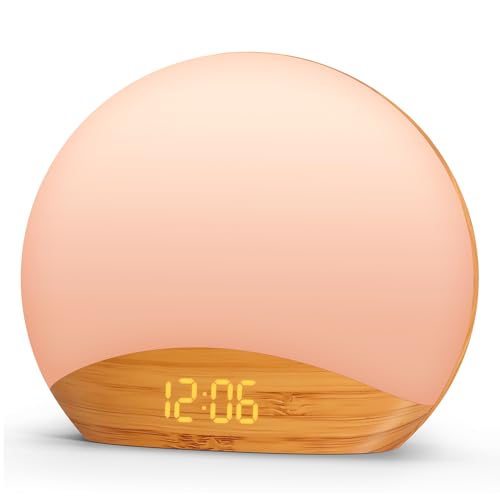
REACHER Wood Grain Sunrise Alarm Clock — Best Wood-Grain Look
REACHER wraps its sunrise clock in a wood-grain finish, and the choice is more than cosmetic. Bedrooms built around calm — linen, pale timber, no glowing plastic — often reject wake-up lights on sight, because a white gadget shell fights the room all day for the sake of thirty good minutes each morning. This unit sits on the dresser like a small piece of the furniture instead, and its nightlight and sound machine duties keep it visibly useful around the clock rather than only at dawn.
The listing counts twenty-six sounds, which places its library near the top of this group, and the digital display is dimmable so the wood effect is not undermined by a harsh readout at 2 a.m. As a sound machine first and a sunrise clock second in spirit, its light performance is pitched at ordinary sleepers rather than the truly immovable; if you sleep through thunderstorms, read the Vivilumens and JALL entries with more care. For everyone else, this is the pick that guests ask about, which tells you something real about how it sits in a room.
- Finish: wood-grain housing
- Sounds: twenty-six sound options
- Display: digital, dimmable
- Extra role: nightlight
- Character: sound machine with sunrise waking
Strengths
- Wood-grain finish blends into calm, natural bedrooms
- Generous sound count covers most night-time preferences
- Nightlight mode softens midnight trips across the room
Trade-offs
- Light show is gentler than the heavy-sleeper models
- Wood effect is a finish, not solid timber
- Fewer radio-style extras than the Philips flagship
Best for: style-led bedrooms that refuse obvious gadgets. Not suited for: the deepest sleepers who need maximum final brightness.
Placement flatters this clock when you treat it as décor with a job. On a dresser opposite the bed, its glow arrives more softly than a nightstand unit an arm away, which suits lighter sleepers; beside the pillow, the sound library gains clarity for masking a partner’s snoring or a boiler’s dawn clank. Wipe the finish with a dry cloth rather than sprays, keep it out of the steamiest bathroom-adjacent spots, and the grain keeps its quiet good looks for years of mornings.

JALL Sunrise Alarm Clock White Noise 25 Sounds — Best Sound Library
The second JALL in this guide earns its separate place through breadth of sound: twenty-five nature sleep sounds behind the sunrise, which turns the machine into a genuine library for households whose members disagree about what quiet should sound like. Rain steadies one sleeper, a brook irritates them, ocean surf sends a third straight off — a wide catalogue ends the negotiation, and the same library supplies the gentle end of the waking ramp for people who surface better to birdsong than to beeps.
Fully dimmable is the phrase in its listing that light-sensitive readers should underline. The clock face can go properly dark, which protects the very darkness the dawn is meant to interrupt, and it marks the difference between a machine designed by people who sleep in real bedrooms and one designed on a spec sheet. Against its own sibling above, this model trades the heavy-sleeper pitch for versatility; against the REACHER, it trades the timber look for a cleaner digital presence. It is the middle path of the six, and middle paths chosen deliberately are rarely wrong.
- Sounds: twenty-five nature sleep sounds
- Display: fully dimmable clock face
- Light: sunrise wake-up function
- Night side: white noise machine
- Character: library-first, all-round bedroom unit
Strengths
- Widest nature-sound catalogue in this line-up
- Display can go fully dark for sensitive sleepers
- Balances waking and falling-asleep duties evenly
Trade-offs
- Less specialised for very heavy sleepers than its sibling
- Plain housing beside the wood-grain alternative
- Sound choice this wide takes a few nights to explore honestly
Best for: couples and families who share one clock but not one idea of quiet. Not suited for: buyers who want a single perfect sound and nothing else to browse.
Spend the first three nights auditioning rather than committing. Rotate a sound per night at low volume, note which one you stop noticing fastest, and promote that one to your alarm’s opening act as well as your sleep backdrop; continuity between the two ends of the night is an underrated comfort. If a partner joins the experiment, alternate choices night by night instead of splitting the difference into a compromise neither of you loves.

Vivilumens Sunrise Alarm Clock Sound Machine — Best Gentle Dual Alarm
Vivilumens aims its gentle wake-up light squarely at adults who sleep heavily, and adds the feature that group most often needs once the concept works: dual alarms. Two independent wake times let a household run an early weekday setting and a later weekend one without nightly reprogramming, or let partners rise an hour apart from the same nightstand. The sound machine side covers the night, so the unit justifies its place across the full sleep cycle rather than for ten loud seconds a day.
Gentle, in this listing’s framing, describes the ramp rather than the ceiling: the light builds gradually, and the final stages are meant to be bright enough to matter to a deep sleeper. That combination — soft start, serious finish — is the correct engineering answer to heavy sleep, and it is rarer than it should be among clocks that advertise softness and then glow at nightlight levels. Set the second alarm as your safety net during the first month, ten minutes after the light peaks, and most users find they can retire it once the routine beds in.
- Alarms: dual alarm settings
- Light: gentle wake-up light with a strong finish
- Night side: sound machine
- Aimed at: heavy sleepers, adults
- Routine: weekday and weekend times side by side
Strengths
- Dual alarms end the nightly reprogramming ritual
- Gentle ramp with enough final brightness for deep sleepers
- Sound machine covers the whole night, not just the wake
Trade-offs
- No radio or Bluetooth extras for audio variety
- Two alarms mean one more setting to manage carefully
- Design is functional rather than decorative
Best for: heavy sleepers whose wake time changes across the week. Not suited for: readers who want their clock to double as a speaker or radio.
Label your alarms by intention when you set them, even if only mentally: the early one is the light-led experiment, the later one is the guarantee. Over a month, watch which one actually gets you upright; if the guarantee keeps firing, lengthen the ramp or move the unit closer before concluding that sunrise waking fails you. Deep sleep is a strong opponent, and this clock is built for the honest version of that contest rather than the brochure version.
How Do the Six Clocks Compare at a Glance?
| Pick | Light style | Sound side | Standout trait |
|---|---|---|---|
| Philips SmartSleep Wake-Up Light | Coloured sunrise and sunset | Five natural sounds, FM radio | Reading lamp and tap snooze |
| JALL Sunrise Alarm Clock Wake Up Light | Sunrise simulation | White noise machine | Heavy-sleeper pitch at a value level |
| Odokee Sunrise Alarm Clock White Noise Machine | Natural wake-up light | White noise plus Bluetooth speaker | Dimmable clock, audio hub role |
| REACHER Wood Grain Sunrise Alarm Clock | Sunrise with nightlight | Twenty-six sounds | Wood-grain finish |
| JALL Sunrise Alarm Clock White Noise 25 Sounds | Sunrise wake-up light | Twenty-five nature sounds | Fully dimmable display |
| Vivilumens Sunrise Alarm Clock Sound Machine | Gentle wake-up light | Sound machine | Dual alarms for heavy sleepers |
Where Should a Sunrise Clock Sit to Work Properly?
Distance decides more than most buyers expect. A wake-up light across a large bedroom behaves like a neighbour’s porch lamp: pleasant, ignorable. The same unit on the nightstand, angled toward the pillow at roughly an arm’s length, puts the ramp where your eyelids actually are. If you share the bed, angle it toward the sleeper it serves and let the other side of the room stay dimmer; most of these lamps throw their light in a broad but directional wash, and a few degrees of tilt changes who receives the dawn.
Height plays a quieter role. A clock sitting well below mattress level spends its brightness on the side of the bed frame, while one perched too high turns the ceiling into the show and the pillow into the stalls. Nightstand height, near the level of your head on the pillow, is the natural compromise the designers assume. Keep the front face clear of books, glasses cases and the water glass; sunrise through a cluttered foreground arrives as shadows and disappointment. Finally, mind the cord route on night one, because a lamp dragged off the stand by a dressing-gown sleeve at 6 a.m. teaches the whole household vocabulary.
How Long Should the Sunrise Last Before the Alarm Sounds?
Most of these clocks let you choose a ramp somewhere in the twenty-to-forty-minute neighbourhood, and the right answer is personal rather than technical. Light sleepers often surface within the first third of a long ramp and then lie there watching it, which converts a gentle wake into a slow tease; for them, twenty minutes is plenty. Deep sleepers need the full build, because their surfacing is gradual and the early stages are doing invisible work even when nothing seems to be happening.
Treat the first fortnight as calibration. Start at thirty minutes if the model allows it, note honestly when you actually became aware of the light, and shorten or lengthen from evidence. Weekends are the honest laboratory here, since a Saturday ramp carries no deadline and reveals your natural response. Whatever you settle on, keep the sound stage quiet at first: the tone that joins at the end should feel like a confirmation that you are awake, not the event itself, and its volume can creep up later if a run of heavy nights demands it.
What Should You Check on the Listing Before Ordering?
Feature lists in this category reward slow reading. Confirm the display can dim to a level your room tolerates — ideally fully off — because that single line predicts more satisfaction than any sound count. Check whether the alarm offers weekday and weekend separation or a true second alarm if your schedule splits. Look at what happens in a power cut: some units hold settings, others blink midnight and forget your dawn, and a battery backup line in the description is worth real money to anyone with an early shift.
Then verify the physical facts. Cord length decides whether the clock reaches the good spot or the merely available one. The size of the digits matters if you check the time at night without glasses. If the listing mentions an app or Bluetooth, decide whether that is a benefit in your house or one more password between you and bed. Reading recent owner comments about button layout is worthwhile too, since controls are operated by touch, half asleep, in the dark — the worst possible conditions for a clever interface.
How Do You Build a Wind-Down Routine Around a Sunset Mode?
Models with a sunset or reading-lamp side, the Philips most completely, let the same device close the day it opens. Set the fade to begin when you get into bed rather than when you hope to sleep; the dimming room becomes the cue that conversation, pages and thoughts should all lower their volume together. Pair it with a fixed lights-out habit — phone charging outside the room, alarm already confirmed — and the sequence starts to run itself within a couple of weeks.
Sound machines contribute the other half of the routine. A consistent backdrop, whether rain from the JALL library or surf from the REACHER, masks the irregular noises that keep a light sleeper’s attention patrolling the house: pipes, partners, the fridge’s midnight hum. Consistency beats realism here; the same sound every night becomes a learned signal for sleep in a way that a nightly novelty never does. Choose once, keep the volume lower than you think it needs to be, and let repetition do the work.
What Mistakes Do Sunrise Clock Buyers Make Most Often?
The classic error is judging the concept after two mornings. A body trained for years on a buzzer does not renegotiate in a weekend, and the ramp often needs a fortnight of calibration — length, brightness, placement — before it shows what it can do. The second error is buying for the sound library and ignoring the display: a clock whose digits cannot dim will be turned to the wall by light-sensitive owners, and a sunrise facing the wall wakes nobody. Third comes placement by socket rather than by pillow, which quietly halves the light the sleeper receives.
Two further mistakes belong to heavy sleepers specifically. Retiring the backup alarm on day one turns an experiment into a risk, and the first oversleep usually ends the experiment entirely; keep the safety net until the new routine has a month of evidence. And choosing the gentlest, prettiest unit — however lovely on the dresser — when your sleep is famously deep confuses the décor decision with the waking decision. Match the machine to the sleeper first, then let style arbitrate between the models that qualify.
How Do Sunrise Clocks Suit Different Kinds of Sleepers?
Back sleepers receive the dawn most directly, since their faces point at the ceiling and catch the wash of light early in the ramp. Side sleepers turned away from the nightstand are the hardest audience in the house: the glow lands on the back of the head and the far wall, and the fix is either a second look at placement — moving the unit to the side of the bed they face during the last hour of sleep — or accepting a longer ramp so the room as a whole brightens past the point where direction matters. People who sleep with an eye mask should be honest with themselves; a mask defeats the entire mechanism, and the sound-led models or a vibrating backup will serve them better than any lamp.
Teenagers deserve a mention of their own, because their sleep phase drifts late and school starts early, a combination that turns the family buzzer into a daily argument. A sunrise clock in a teen’s room removes the parent from the role of alarm, which changes the emotional weather of the morning even when the wake time itself stays stern. Students in shared dorm rooms sit at the opposite extreme: light is a public event there, and a dawn lamp needs a roommate conversation before it needs a socket. Agree the ramp, aim it at one bunk, and keep the sound stage personal or silent.
Older readers often ask whether these clocks help when sleep has become lighter and more broken with age. The honest answer is that the mechanism matters less than the consistency: a fixed, gentle cue at the same time each day gives a fragmented night a firm ending, and the wind-down side of the fuller models can help mark the beginning too. Nothing here replaces medical advice for genuine sleep disorders, and a clock that leaves you exhausted for weeks is a prompt to talk to a doctor, not to buy a brighter lamp.
What Does the First Week With a Wake-Up Light Actually Look Like?
Night one usually disappoints slightly, and it helps to know that in advance. You set the ramp with optimism, sleep through the early stages because your body has no reason yet to treat lamplight as information, and wake to the closing sound much as you did to the old alarm — except, often, a degree calmer. Night three or four is when most people report the first strange, pleasant moment: surfacing before the sound, in a room already lit, with no clear memory of being woken at all. That is the product working as designed, and it tends to arrive quietly rather than dramatically.
Adjust one variable at a time during that week. If you slept through everything, lengthen the ramp before you raise the sound, because the light is the part you are training. If you woke at the first ember and lay awake watching the show, shorten the ramp or lower the final brightness. If your partner complains, tilt the unit before you abandon it. By the second weekend most households have found their settings, and the clock drops out of conscious thought — which, for a bedside object, is the highest available praise.
Keep notes if your mornings carry real stakes. A simple line each day — when you woke relative to the sound, how the first ten minutes felt — turns a vague impression into evidence you can tune with. People who skip this often declare the concept a failure or a miracle based on whichever morning happened most recently, and both verdicts are usually premature.
How Should Early Risers and Shift Workers Use These Clocks?
A 4:30 a.m. start in midwinter is where sunrise simulation stops being a lifestyle garnish and becomes the only dawn on offer. When the real sun will not appear for three hours, the artificial one carries the whole burden, and final brightness matters more than colour subtlety. Choose from the stronger end of this list, give the ramp its full length, and place the unit close; a winter 4:30 wake-up is heavy-sleeper territory even for people who rise easily in June.
Shift workers rotating onto nights face the mirror problem: their dawn must happen at 4 p.m. in a darkened room while the household is awake around them. A wake-up light paired with blackout curtains creates a private sunrise on demand, and the dual alarms on the Vivilumens suit rotating patterns where two start times alternate across the week. The discipline that makes it work is protecting the artificial night as fiercely as the artificial dawn — eye masks for the day sleep, the sound machine masking the house, and the clock’s display dimmed to nothing so the room stays honest darkness until the ramp begins.
Partners on different shifts should treat the clock as shared infrastructure and negotiate it like heating or hot water. Whoever rises first owns the ramp settings; whoever sleeps on owns the complaint process, and tilting, distance and ramp length are the three levers to pull before anyone concludes the arrangement cannot work.
Why Do Some Mornings Still Feel Rough Even With a Gentle Alarm?
Because the alarm was never the whole story. A sunrise clock improves the final fifteen minutes of sleep; it cannot repay a five-hour night, undo a late and heavy meal, or silence the snoring that fragmented the hours before dawn. Readers who feel no benefit after a calibrated fortnight usually find the cause in bedtime rather than in the device: the ramp is landing in the deepest part of a shortened night, when any waking feels like an interruption, because it is one.
Sleep cycles add a second wrinkle. Waking from the light middle of a cycle feels disproportionately easy compared with surfacing from the deep trough before it, and the troughs arrive on a rhythm set by when you fell asleep, not when the alarm fires. A ramp softens the landing from any depth, which is its real value, but shifting bedtime by twenty minutes sometimes does more for a rough morning than any setting on the clock. Use the gentle alarm and the earlier night together and the two stop being rival explanations.
There is also a plain novelty curve. The first mornings with a new cue carry a small alertness of their own — you are listening for the light, in a sense — and that alertness fades as the routine becomes furniture. Judge the clock at week four, not morning two, and judge it against your old buzzer across the same span, with the same bedtimes, before deciding what it is worth to you.
How Do You Keep a Wake-Up Light Working Well for Years?
These are simple machines, and their enemies are dust, heat and bathroom steam rather than time. A lamp face filmed with dust dims the top of the ramp by a margin you will never notice week to week but will absolutely feel across a year, so wipe the front with a dry microfibre cloth monthly and make it part of the sheet-changing round. Keep the vents — where a model has them — clear of the books and scarves that colonise nightstands, and avoid placing any of these units where a radiator breathes directly onto them through the winter.
Settings drift is the subtler failure. A clock nudged during cleaning, a ramp shortened during a holiday and never restored, a second alarm left armed after a one-off early start — each quietly edits your mornings. Once a season, run a deliberate check: confirm the time, the ramp length, the alarm days and the display brightness in one sitting. It takes ninety seconds and it is the difference between a routine that compounds and one that slowly unravels without anyone deciding it should.
Cords and buttons wear in proportion to how they are treated at 6 a.m. Route the cable so it cannot be hooked by a dressing gown or a cat, and resist slapping the top of the unit harder than a tap; snooze mechanisms are built for fingertips, not for the full grievance of a Monday. Treated that way, there is little inside these clocks to fail, and owners routinely report the same unit serving across house moves and several changes of bedroom.
What Is the Difference Between a Wake-Up Light and a Smart Bulb?
The question arrives in most households eventually, because a smart bulb in the existing bedside lamp can be scheduled to brighten, and on paper that duplicates the trick for less hardware. In practice the differences are the ones that decide mornings. A dedicated clock ramps on a curve designed for waking, with the alarm, snooze and display integrated at the pillow; a bulb ramps on whatever curve its app offers, depends on the home network behaving at dawn, and leaves you reaching for a phone to snooze it — the very object the clock was bought to banish.
Smart bulbs also inherit the lamp they sit in. A shaded bedside lamp diffuses the dawn into décor, and a bulb bright enough to matter at the end of the ramp is often glaring as an evening reading light, so the compromise pleases neither hour. The dedicated units here were shaped around one job: their brightest faces the bed, their displays dim to darkness, their controls work by touch in the dark. Readers who already own smart lighting can absolutely experiment with a scheduled bulb for a week to test their response to gradual light; those who respond well usually graduate to a purpose-built clock for the controls and the reliability.
There is one honest exception. Renters who cannot add devices, and travellers who live out of a bag, may find a bulb or a phone-based dawn better than nothing. For a settled bedroom, though, the clock earns its socket — and the six above span the price and style range widely enough that the bulb compromise rarely needs to be permanent.
How Should You Talk a Sceptical Household Into Trying One?
Resistance usually wears a practical disguise: the clock is a gimmick, the buzzer works fine, the money could go elsewhere. The useful reply is rarely an argument about sleep science; it is a trial with terms. Propose a fortnight, settings agreed together, backup alarm running, and a simple shared test — each person rates the first ten minutes of the morning, out of ten, on the fridge calendar. Numbers on a calendar end debates that opinions prolong, and in most houses the ratings drift upward by the second week without anyone having to concede an argument.
Children change the negotiation again. A young child who rises at 5 a.m. regardless can be given the dawn as a boundary: the light coming on is the signal that the day may begin, and before it the house is still night. Several of these clocks serve that role in reverse, their glow marking permission rather than interruption, and parents report the arrangement works because the signal is consistent in a way a tired adult’s voice at dawn is not. Teenagers, as noted earlier, mostly welcome the removal of the parental alarm service.
If the household still splits after a fair trial, believe the split. Sleep is personal enough that one partner can thrive on a coloured dawn while the other genuinely prefers a firm tone and a dark room until it sounds. The dual-alarm and directional options in this list exist partly for such treaties: one clock, angled and timed for its believer, and a separate quiet arrangement for the sceptic sharing the same bed.
Final Recommendation
For most readers, the Philips SmartSleep Wake-Up Light remains the complete expression of the idea: coloured dawn and dusk, a reading lamp’s usefulness, and sounds enough for ordinary tastes. Households counting cost should start with the JALL Sunrise Alarm Clock Wake Up Light and learn what gradual light does for them before spending more, while couples split across schedules will get the most daily relief from the Vivilumens Sunrise Alarm Clock Sound Machine and its dual alarms. Whichever of the six you choose, give it a calibrated fortnight, a clear line to the pillow and a backup alarm standing guard in the early weeks. A morning that begins with light instead of alarm bells is a small daily kindness, and it compounds quietly across a year of ordinary Tuesdays.
Frequently Asked Questions
Can a sunrise clock wake a genuinely heavy sleeper?
It can, provided the final brightness is strong and the ramp is long, which is why the JALL and Vivilumens models here are pitched at that group. Keep a louder backup alarm running until the light routine has proved itself across several weeks of real deadlines.
Will the light disturb a partner who sleeps later?
Angling the unit toward your side of the bed keeps most of the glow local, and lighter partners often surface briefly and settle again. Couples with very different schedules sometimes place the clock closer, on the early riser’s nightstand only, rather than centrally.
Do I still need the alarm sound at all?
Many light sleepers find the ramp alone brings them round and disable the tone entirely. Most people keep a soft sound as the closing step, set quiet enough that it confirms wakefulness instead of causing it.
What if my bedroom has blackout curtains?
That is the ideal setting for these clocks, because the artificial dawn becomes the only light story in the room and its timing stays entirely yours. Without competing daylight, ramp length and final brightness are easier to calibrate honestly.
Is a sunset mode worth paying for?
If your difficulty sits at both ends of the night, yes: the same hardware that brightens your morning can lower the room toward sleep, and the paired routine reinforces itself. Morning-only strugglers can save the money and choose a simpler model.
How bright is bright enough at the end of the ramp?
Enough that the room reads as morning rather than as a nightlight with ambitions. In a small bedroom a mid-strength finish often suffices, especially in winter darkness, while a large or sunlit room swallows light and needs the strongest setting a model offers. If you routinely wake unsure whether the ramp has finished, the finish is too low or the unit sits too far away.
Can I use a wake-up light as my only lamp?
The Philips, with its reading lamp function, is designed to carry that double duty, and the nightlight modes on the REACHER cover low-level lighting. Most other models here are dawn instruments first; a separate lamp still serves evening reading better than a clock face tilted hopefully toward a book.
Where do phones fit alongside a wake-up light?
Ideally outside the bedroom, charging. Every clock here removes the alarm excuse for keeping a phone at the pillow, and the radio, speaker and sound-library models between them cover most of the other bedtime uses too.
Do wake-up lights use much electricity?
Very little. These are small LED-based devices drawing a trickle beside the appliances a bedroom already hosts, and the lamp is at full brightness for a short window each day. Running cost should never decide between models here; brightness behaviour, display dimming and controls you can work by touch in the dark matter far more to how the clock feels across a year of mornings.
Related Guides
Readers gentling their mornings often refresh the bathroom next, and our guide to Best Bathroom Towels That Do Not Shed follows the same low-lint logic. In the kitchen, Best Cookware Sets Surgical Stainless Steel explains grades and clad construction without the marketing fog. And for the air side of a calmer home, Best Air Purifiers for 600 Sq Ft works through sizing honestly.


