What's inside
- Key Takeaways
- Quick Picks
- How Did We Choose These Alarm Clocks with Radios?
- How Do the Six Clock Radios Compare at a Glance?
- Why Wake to a Voice Instead of a Beep?
- How Do You Get Honest Reception in a Bedroom?
- What Does a Sleep Timer Actually Do for You?
- How Should Couples Share One Clock Radio?
- What Mistakes Do Clock Radio Buyers Make?
- How Do Clock Radios Serve During Emergencies?
- How Has the Clock Radio Survived the Smartphone?
- What Should You Set First: The Stations or the Alarm?
- How Do Clock Radios Fit a Child’s or Teenager’s Room?
- Why Do Hotels Still Put Clock Radios in Rooms?
- How Should You Clean and Care for a Clock Radio?
- What Is the Difference Between a Dimmer Wheel and Dimmer Steps?
- How Do You Choose Between AM/FM and FM-Only?
- How Loud Should a Radio Alarm Be Allowed to Get?
- What Role Does the Snooze Button Play With Radio?
- How Do Clock Radios Age Across a Decade of Mornings?
- Why Does the Morning Show Still Matter?
- How Should a Clock Radio Share a Room With a Television?
- What Should You Check in the First Week With a New Clock Radio?
- Final Recommendation
- Frequently Asked Questions
- Related Guides
As an Amazon Associate I earn from qualifying purchases. This post may contain affiliate links at no extra cost to you.
cottageverdict.com is reader-supported. When you buy through links on our site, we may earn an affiliate commission.
Where to buy: every clock radio below is sold through Amazon, and its name links to its listing in the Quick Picks table, in its detailed section and in the comparison table, so you can check price on Amazon and confirm the tuner and alarm details before ordering. The best alarm clocks with radios wake you with a human voice, a familiar station and the day’s first headlines instead of a beep that means nothing. All six picks here are true clock radios in the classic sense: a built-in FM or AM/FM tuner, per each listing’s own title, married to a bedside alarm clock. They are not internet radios, which stream stations over Wi-Fi, and they are not smart speakers with an alarm bolted on — no accounts, no apps, no microphone listening from the nightstand. A dial or a preset button, an antenna, and the open airwaves: that is the whole technology, and it still works beautifully.
Within that honest definition the six divide by personality. The Emerson SmartSet sets its own time automatically and remembers twenty presets. The DreamSky pairs its FM tuner with a dimmer wheel, a USB port and a temperature readout. The Jensen adds a top-loading CD player for the listener whose music still lives on discs. The BUFFBEE blends FM with a Bluetooth speaker, gradual wake sounds and an ambient night light. The HOUSBAY is the small, phone-free purist with a night light of its own. And the FUHONGYUAN offers AM as well as FM, twelve presets and a choice of three wake sounds including the radio itself. Choosing is mostly a matter of which station, and which sleeper, the clock will serve.
Key Takeaways
- Every pick here tunes broadcast FM, and two — the Emerson and the FUHONGYUAN — add AM for talk, news and sports stations.
- Presets are the feature that decides daily happiness: twenty on the Emerson, twelve on the FUHONGYUAN, and station memory matters more than raw tuning range.
- Waking to radio is a choice on the models that offer beep or music alternatives; the FUHONGYUAN lists three wake sounds explicitly, radio among them.
- Battery backup appears across the guide because a radio alarm that forgets the time in an outage has failed at both of its jobs.
- Extras divide the field: a CD player on the Jensen, Bluetooth on the BUFFBEE, a USB port on the DreamSky and Jensen, night lights on the BUFFBEE and HOUSBAY.
Quick Picks
| Pick | Badge | Why it earns its place |
|---|---|---|
| Emerson SmartSet Dual Alarm Clock Radio AM/FM | Best Auto-Setting | SmartSet automatic time setting, AM/FM with 20 presets, dual alarms and a dimmable jade green display. |
| DreamSky Alarm Clock Radio with Battery Backup | Best All-Round FM | Large numbers with a dimmer wheel, USB port, sleep timer, temperature display and battery backup. |
| Jensen JCR-375 CD Clock Radio | Best with CD Player | A stereo dual-alarm clock with a top-loading CD player, FM tuner, USB charging port and battery backup. |
| BUFFBEE Alarm Clock Bluetooth Speaker & FM Radio | Best Speaker Hybrid | FM radio plus a Bluetooth speaker, gradual wake-up sounds, a fully dimmable display and an ambient night light. |
| HOUSBAY Digital Alarm Clock Radio with Night Light | Best Phone-Free Small Clock | A compact FM clock radio with dual alarms, a night light and battery backup, built for a phone-free wake-up. |
| FUHONGYUAN Alarm Clock Radio AM/FM 12 Presets | Best Wake-Sound Choice | AM/FM with 12 presets, dual alarms and three wake sounds — beep, music or radio — with weekday and weekend settings. |
How Did We Choose These Alarm Clocks with Radios?
The first filter was definitional honesty. A clock radio must receive broadcast radio with its own tuner, as each of these listings states — FM on all six, AM added on the Emerson and the FUHONGYUAN. Products that merely stream, or speakers that borrow a phone’s radio app, were excluded, because the reader searching this term wants the resilience of broadcast: radio that works when the internet does not, in an emergency, during an outage, in a house with no Wi-Fi at all. That resilience is the category’s founding argument and we refused to dilute it.
The second filter was alarm craft. A radio beside a bed is an alarm clock first on the one morning that matters, so dual alarms, snooze behaviour, sleep timers and backup arrangements were weighed heavily. The Emerson’s automatic time setting removes the commonest failure of all — a clock blinking after an outage with its alarms lost. The FUHONGYUAN’s weekday and weekend settings remove the second commonest: the Saturday alarm that nobody remembered to cancel.
The third filter was spread of listening lives. Some readers wake to news, some to music, some keep a beloved CD collection, some want one device that also plays a phone’s audio by Bluetooth on a Sunday afternoon. The six picks map those lives deliberately. No single clock here does everything; each does its own thing completely, and the reviews say plainly where each one’s territory ends.
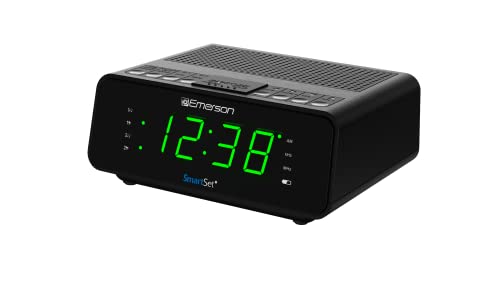
Emerson SmartSet Dual Alarm Clock Radio AM/FM — Best Auto-Setting
Emerson’s SmartSet idea is one of the genuinely useful inventions in this category: plug the clock in and it sets itself to the correct time automatically, and after a power interruption it recovers the time on its own. Anyone who has crouched beside a nightstand reprogramming a clock by storm lantern will understand why that feature headlines this review. The listing adds dual alarms, AM/FM radio with 20 presets, a sleep timer, snooze and an easy-to-read 0.9-inch jade green dimmable LED display, model CKS1900.
Twenty presets is a generous memory, and it changes how the radio gets used. Instead of hunting the dial each evening, the household banks its stations — news, classical, the sports station, the Sunday jazz programme — and the clock becomes a small jukebox of the airwaves. AM matters here more than younger listeners expect: talk radio, local news and many sports broadcasts still live on AM, and in rural areas the AM station may be the strongest signal in the house. A clock that receives both bands serves the whole broadcast map rather than its fashionable half.
The jade green display at 0.9 inches is a mid-size, calm readout, dimmable for the night. Dual alarms let two schedules share the clock, and the sleep timer lets the radio keep you company into sleep without broadcasting to an empty room until dawn. Taken together, this is the set-and-trust pick: the clock for readers who want radio’s pleasures with the least possible administration, and the one we would give a parent who has declared, reasonably, that they are finished learning new devices.
- Tuner: AM/FM with 20 presets
- Time setting: automatic SmartSet
- Alarms: dual, with snooze and sleep timer
- Display: 0.9-inch jade green LED, dimmable
- Model: CKS1900
Strengths
- Automatic time setting survives outages without reprogramming.
- Twenty presets and both bands cover a whole listening life.
- Dual alarms plus sleep timer complete the bedside brief.
Trade-offs
- No USB charging port is named in the listing, so phones charge elsewhere.
- Display is mid-size; readers wanting large numbers should compare the DreamSky.
- Radio-only audio; no CD or Bluetooth for personal music collections.
Best for: news and talk listeners, AM audiences, and anyone who hates resetting clocks.
Not suited for: CD collectors or readers who need a charging port at the bedside.
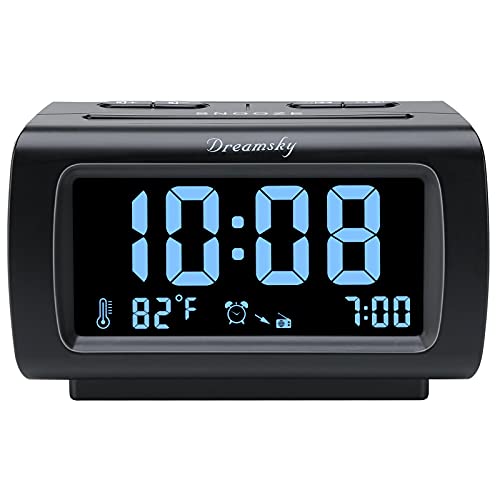
DreamSky Alarm Clock Radio with Battery Backup — Best All-Round FM
The DreamSky is the balanced centre of this guide. Its listing describes an alarm clock radio for bedrooms with battery backup, large numbers with a dimmer wheel, a USB port, an FM radio with sleep timer, a temperature display, adjustable volume and snooze. No single feature shouts; the competence is in the combination, and in one small control that connoisseurs of bedside clocks prize above almost any other — the dimmer wheel. A wheel gives continuous, fingertip brightness control, finer than any stepped dimmer, and at 3 a.m. that finesse is the difference between a display tuned exactly to your eyes and one that is merely close.
Large numbers serve the glasses-on-the-nightstand reality, and adjustable volume serves the shared bedroom: the radio can wake at a level chosen for the sleeper rather than endured by the partner. The USB port acknowledges the phone’s existence without surrendering to it — one device charges while the clock handles time and waking. The temperature display is a small morning kindness, the number that decides a layer before the window is opened, read here as the room temperature the clock reports, presented as convenience rather than precision instrumentation.
Battery backup completes the trust picture. This is the clock we would recommend to a reader who asked for “a good clock radio” with no further adjectives: FM for the mornings, a wheel for the nights, backup for the storms, and nothing in the design that will embarrass a guest room or date a bedroom. Specialists will find their specialists elsewhere in this guide; generalists have found their clock.
- Tuner: FM, with sleep timer
- Display: large numbers, dimmer wheel
- Extras: USB port, temperature display
- Alarm: adjustable volume, snooze
- Backup: battery backup per listing
Strengths
- Dimmer wheel offers the finest brightness control in this guide.
- Large numbers and adjustable volume suit real bedrooms and real hearing.
- USB port and battery backup cover the modern and the emergency cases.
Trade-offs
- FM only; AM talk and sports listeners should choose the Emerson or FUHONGYUAN.
- Preset count is not stated in the listing, so station memory may be simpler than the Emerson’s twenty.
- Single-speaker bedside audio; stereo seekers should look at the Jensen.
Best for: most bedrooms, guest rooms, and FM listeners who value control over spectacle.
Not suited for: AM listeners or CD owners.

Jensen JCR-375 CD Clock Radio — Best with CD Player
There is a shelf in many houses — sometimes a whole bookcase — of compact discs that streaming never quite replaced: the recordings with the right performances, the mixes burned by friends, the audiobooks bought disc by disc. The Jensen JCR-375 is built for that shelf. Its listing describes a stereo digital dual-alarm clock with a top-loading CD player, an FM tuner, a USB charging port and battery backup. Top-loading matters: the disc drops in from above like toast, visible and simple, rather than feeding into a slot that swallows it mysteriously.
Stereo is the second half of the proposition. Most clock radios are mono and proud of it; a stereo unit turns the bedside into a small listening post, and for music-first listeners — the reader who falls asleep to a favourite album and wakes to the FM morning show — that breadth is the product. Dual alarms keep two schedules, the USB port keeps a phone alive, and the battery backup keeps the whole arrangement honest through an outage.
Its trade-offs are the honest costs of moving parts. A CD mechanism is the only component in this guide that can wear, skip or meet a scratched disc unhappily, and the clock is sized to house it, so tiny nightstands should measure first. Readers whose discs are already donated will find the feature dead weight and should take the DreamSky’s simplicity instead. Readers who still say “put a record on” and mean a silver disc have exactly one pick in this guide, and it is a good one.
- Audio: top-loading CD player plus FM tuner
- Sound: stereo
- Alarms: dual
- Charging: USB charging port
- Backup: battery backup per listing
Strengths
- Plays the CD collection no streaming service fully replaces.
- Stereo sound lifts it above mono bedside radios for music.
- Dual alarms and USB charging keep the modern brief complete.
Trade-offs
- CD mechanism adds size and the only moving parts in this guide.
- AM band is not given in the listing, so assume FM territory.
- Disc listeners only; others pay for a feature they will never open.
Best for: CD owners, audiobook-on-disc listeners and music-first bedrooms.
Not suited for: minimalists or AM audiences.
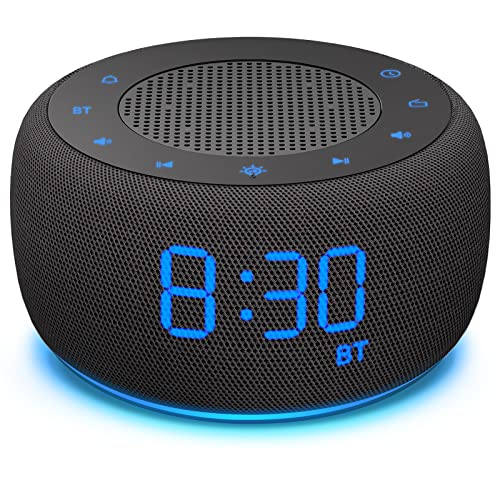
BUFFBEE Alarm Clock Bluetooth Speaker & FM Radio — Best Speaker Hybrid
The BUFFBEE is the pick for the listener whose audio life is split in two: broadcast radio for the mornings, and the phone’s own music, podcasts and audiobooks for the rest of the day. Its listing describes an alarm clock with a Bluetooth speaker and FM radio for the bedside, gradual wake-up sounds, a fully dimmable display and an ambient night light, in a plug-in digital design. Note what it is and is not: the radio is a true built-in FM tuner, as the lock for this guide requires, while the Bluetooth is a speaker connection to your phone — not an internet radio and not a voice-assistant speaker. It plays your library; it does not listen to your room.
Gradual wake-up sounds address the sleeper who finds any instant alarm — beep or broadcast — a small daily violence. A sound that arrives gently and grows respects the last minutes of sleep while still ending them, and paired with a fully dimmable display it makes the BUFFBEE the most sleep-courteous machine in this guide. The ambient night light extends that courtesy into the night itself: a soft presence for a hallway-facing bedroom, a child’s room, or a partner who reads late.
As a speaker it asks to be judged as a bedside speaker, not a party device: its stage is the pillow, its volume the room. Within that honest scope it replaces two objects — clock radio and small Bluetooth speaker — with one plug and one surface footprint. Readers who never play phone audio aloud should save the complexity and choose the HOUSBAY or DreamSky; readers whose evenings run on podcasts will wonder how the nightstand worked without it.
- Tuner: FM radio built in
- Speaker: Bluetooth connection for phone audio
- Wake: gradual wake-up sounds
- Display: fully dimmable
- Light: ambient night light
Strengths
- One device covers broadcast mornings and phone-audio evenings.
- Gradual wake sounds are the gentlest rising in this guide.
- Fully dimmable display plus night light suit light-sensitive rooms.
Trade-offs
- Plug-in design; backup arrangements are not stated in the listing, so outage behaviour should be checked before relying on it.
- AM is none stated in the listing; talk listeners on AM should look elsewhere here.
- Speaker ambitions are bedside-scale, not room-filling party volume.
Best for: podcast and music listeners who also want true FM, and gentle wakers.
Not suited for: AM listeners or anyone wanting a battery-powered radio.
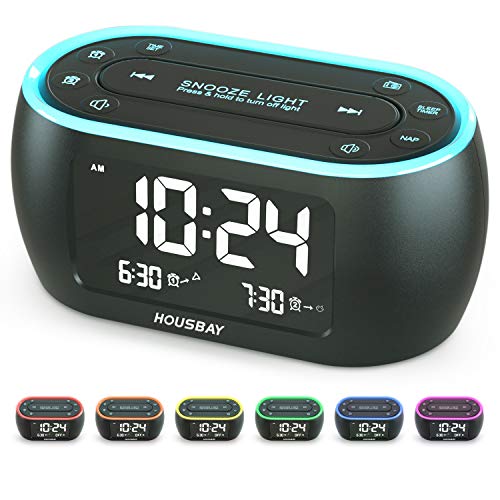
HOUSBAY Digital Alarm Clock Radio with Night Light — Best Phone-Free Small Clock
The HOUSBAY states its philosophy in its listing: a digital alarm clock radio for bedrooms with a night light, a phone-free wake-up with dual alarms, an FM radio for favourite stations, a small radio clock for the bedside, and battery backup. Phone-free is the headline. This is the clock for the reader executing the familiar modern resolution — the phone charges in the kitchen, the bedroom returns to sleep — who still wants to wake to a voice, a song and the weather rather than a beep in an empty room.
Smallness is its second virtue. A compact clock radio leaves the nightstand to the book and the water glass, fits the narrow shelf in a small apartment, and travels conceptually to the guest room without dominating it. The night light is sized to the same philosophy: enough to cross the room safely, not enough to perform as a lamp. Dual alarms keep it honest as a couple’s clock despite the small case, and battery backup keeps the phone-free promise credible on the one night the power fails — the night a phone-dependent sleeper would have been stranded.
What it does not attempt is equally clear. There is no CD, no Bluetooth, no charging hub ambition in its listing; the phone it excludes is excluded entirely, which is the point. Buyers should embrace that purity or choose a hybrid. For the bedroom that has declared independence from the phone, the HOUSBAY is the most coherent object in this guide: small, lit, backed up, and tuned to a favourite station.
- Tuner: FM radio
- Alarms: dual
- Light: night light included
- Backup: battery backup per listing
- Size: described in the listing as a small bedside clock
Strengths
- Purpose-built for a phone-free bedroom routine.
- Compact size suits small nightstands and guest rooms.
- Night light and battery backup complete the after-dark brief.
Trade-offs
- No USB charging is named in the listing; the phone truly lives elsewhere.
- FM only, so AM audiences are not served.
- Small speaker scale matches its size; music lovers may want the Jensen’s stereo.
Best for: phone-free bedrooms, small spaces and guest rooms.
Not suited for: anyone who wants charging or personal-music playback at the bedside.

FUHONGYUAN Alarm Clock Radio AM/FM 12 Presets — Best Wake-Sound Choice
Most clock radios make the wake sound a fixed decision; the FUHONGYUAN makes it a menu. Its listing offers AM/FM with 12 presets, dual alarms and three wake-up sounds — beep, music or radio — a dimmable red LED display, weekday and weekend settings, snooze and a sleep timer. That trio of wake sounds is a small psychology of mornings in one specification: the beep for the day that must not be missed, the music for an ordinary day, the radio for the day that can begin with the world’s voice. Different mornings deserve different sounds, and this clock is the only one here that says so.
Weekday and weekend settings are the second kindness. The commonest clock-radio failure is not electronic but calendrical: the 6 a.m. alarm faithfully firing on the one Saturday it was meant to spare. A clock that knows the week’s shape removes that betrayal structurally. Twelve presets sit between the DreamSky’s unstated memory and the Emerson’s twenty — enough for a household’s real stations, which in practice number about six — and AM joins FM, so the talk and sports bands are covered alongside music.
The red LED display is the night-vision-friendly choice discussed elsewhere in this guide, dimmable to bedroom levels. Dual alarms plus the weekday logic make this the scheduler’s pick: couples, school-run households, anyone whose week has two different mornings in it. If your life runs one alarm and one station, the Emerson’s auto-setting may serve you more; if your life runs a pattern, this clock was patterned for it.
- Tuner: AM/FM with 12 presets
- Wake sounds: beep, music or radio
- Alarms: dual, with weekday/weekend settings
- Display: red LED, dimmable
- Extras: snooze and sleep timer
Strengths
- Three wake sounds let each morning be woken appropriately.
- Weekday/weekend logic ends the Saturday alarm betrayal.
- AM plus FM with twelve presets covers a full listening map.
Trade-offs
- No USB port or extra playback is named in the listing.
- Red display divides taste; some readers prefer the DreamSky’s large numbers.
- Auto time setting is not given in the listing, so outages may need a manual reset despite the alarms’ sophistication.
Best for: households with weekday and weekend schedules, and listeners who vary their wake sound.
Not suited for: anyone wanting charging or disc and Bluetooth playback.
How Do the Six Clock Radios Compare at a Glance?
| Pick | Tuner | Presets | Distinguishing feature |
|---|---|---|---|
| Emerson SmartSet Dual Alarm Clock Radio AM/FM | AM/FM | 20 | Automatic time setting |
| DreamSky Alarm Clock Radio with Battery Backup | FM | Not stated | Dimmer wheel, USB port |
| Jensen JCR-375 CD Clock Radio | FM | Not given | CD player, stereo |
| BUFFBEE Alarm Clock Bluetooth Speaker & FM Radio | FM | None stated | Bluetooth speaker, night light |
| HOUSBAY Digital Alarm Clock Radio with Night Light | FM | Not stated | Small, phone-free design |
| FUHONGYUAN Alarm Clock Radio AM/FM 12 Presets | AM/FM | 12 | Three wake sounds, weekday/weekend |
Why Wake to a Voice Instead of a Beep?
A beep tells you one thing: stop sleeping. A radio wake-up tells you the time, the weather, the score and whether the trains are running, delivered by a voice your household may have shared breakfast with for years. Listeners describe the difference as joining the day rather than being ejected into it. There is also a practical mercy: a radio alarm keeps talking. A beep can be silenced by a reflex and forgotten; a presenter mid-sentence engages the waking brain, which is why radio alarms have a quiet reputation among heavy sleepers’ partners as the alarm most likely to actually complete the job.
The choice is personal enough that the FUHONGYUAN’s three-sound menu deserves its praise. Some mornings — a flight, an exam — deserve the beep’s certainty. Most mornings deserve the radio. A clock that lets you assign the sound to the day, rather than to the device, understands something true about how weeks actually feel from inside them.
How Do You Get Honest Reception in a Bedroom?
FM reception indoors is a matter of antenna and geography. Most clock radios use a wire antenna or the power cord itself; the craft is in placement. Run the wire out rather than coiling it behind the clock, keep the clock away from the interference of cheap LED bulbs and charging bricks where you can, and expect a window-side nightstand to outperform a basement one. If a favourite station crackles, rotate the clock a few degrees before condemning it — FM is directional enough that furniture geometry matters. AM, on the Emerson and FUHONGYUAN, plays by older rules: it travels far at night, fades near large metal structures, and rewards a clock placed away from the television’s electronics.
Set your presets on a clear evening, when signals are strong, and store the best version of each station. Then leave the dial alone. Half the reception complaints about clock radios are really preset complaints — a station stored a fraction off its centre on a bad night, faithfully reproduced every morning after. Five patient minutes at setup buys years of clean wake-ups.
What Does a Sleep Timer Actually Do for You?
The sleep timer is the radio’s lullaby function: play for thirty, sixty or ninety minutes, then fall silent on its own. Its value is not falling asleep to music, pleasant as that is, but what it prevents — the radio murmuring unwatched at 3 a.m., waking you in the light part of a cycle with a stranger’s voice. Emerson, DreamSky and FUHONGYUAN all list sleep timers, and the ANJANK in our USB guide does the same for its radio. Households split into those who have never used the feature and those who cannot sleep without it; if you have ever been woken by your own radio in the small hours, you already know which household is yours.
How Should Couples Share One Clock Radio?
Dual alarms solve the schedule; the politics need one more decision — whose station. The graceful arrangements are rotation (alternate weeks), territory (weekday news for the early riser, weekend music for the household), or volume diplomacy: the radio set at a level that wakes the nearer sleeper, who accepts the role of human snooze button for the other. The clocks here support the mechanics — dual alarms on the Emerson, Jensen, HOUSBAY and FUHONGYUAN — but the agreement is yours to draft. Draft it kindly; the first sound of the day sets a tone that outlasts the alarm itself, and a station both partners can bear is worth more than a station one partner loves.
What Mistakes Do Clock Radio Buyers Make?
The classic mistake is buying streaming when you wanted broadcast: discovering, in the first outage or the first house with bad Wi-Fi, that an internet radio is a silent radio. Every pick here is a true tuner, which is the protection. The second mistake is ignoring the backup story until a storm teaches it. The third is choosing by display size and forgetting the dimmer, then living with a glow. The fourth is undervaluing presets — a listener with eight beloved stations and a clock that stores none will fiddle nightly and blame the radio. And the fifth is expecting hi-fi from a bedside speaker: these are pillow-scale instruments, and judged at that scale the best of them are delightful. Judged against a living-room system, everything disappoints and nothing is learned.
How Do Clock Radios Serve During Emergencies?
Broadcast radio is the medium that survives. When storms take the power and the mobile network congests, the local station keeps transmitting and a battery-backed clock radio keeps receiving — weather warnings, road closures, the all-clear. This is not a reason to buy a clock radio in fear; it is a reason to feel quietly pleased that the pleasant object on your nightstand is also a resilient one. Keep its backup batteries fresh, know your local emergency station’s frequency and store it as a preset. The clock you bought for the morning show becomes, twice a decade, the most important appliance in the house, and it asks only a pair of batteries for the honour.
How Has the Clock Radio Survived the Smartphone?
Every few years the clock radio is declared dead, and every year it outsells the obituary. Its survival is not nostalgia; it is job design. The phone is a worse alarm clock in specific, repeatable ways: it must be charged, updated, unlocked and resisted. The clock radio asks for one button and gives back a station. It also occupies the nightstand with a single, stable identity — guests understand it, grandparents understand it, children understand it — while the phone’s alarm lives behind a passcode and a personality. Technologies do not survive by being old; they survive by being the simplest sufficient tool for a recurring job, and waking a household with the morning’s voice remains a job the clock radio does with unmatched economy.
There is also the matter of trust across decades. A clock radio bought today will work with broadcasts that have not changed their nature in half a century, using no account that can be closed, no service that can be discontinued, no app that can be abandoned by its developer. In a house filling with devices whose lifespans are negotiated by distant companies, an object whose future depends only on the airwaves and a pair of backup batteries has a kind of integrity that readers increasingly recognise and are willing to pay for.
What Should You Set First: The Stations or the Alarm?
Set the stations first, on a relaxed evening, because everything else in the clock’s life is downstream of reception. Find each favourite at its clearest point, store it, and only then set the alarms and choose which sound each alarm will use. New owners who reverse the order — alarm first, stations in a hurry — spend their first week waking to static-adjacent approximations of their station and quietly concluding that clock radios sound bad. The radio is innocent; the setup was rushed. A preset stored at leisure, at the signal’s best, will still be there, exact, on the greyest February morning.
While you are in the menus, set the unglamorous things too: the display brightness at true night level, the sleep timer’s default, the backup batteries installed and dated, the second alarm disabled if your household runs one schedule — a phantom second alarm set by a previous owner or a factory default is a classic source of 5 a.m. mysteries in second-hand and guest-room clocks. Ten unhurried minutes at the start is the whole maintenance philosophy of this category in miniature.
How Do Clock Radios Fit a Child’s or Teenager’s Room?
A clock radio gives a young listener a first private window on the broadcast world: their station, their alarm, their responsibility for the morning. For children, the HOUSBAY’s small scale and night light suit a room where the clock is also a comfort object, and waking to a familiar morning show is gentler than a beep’s small shock. For teenagers, the radio alarm builds the school-morning muscle without handing the phone a bedroom visa — the argument that has sold more of the BUFFBEE’s hybrid kind than any other, since its Bluetooth speaker concedes the evening’s podcasts while the FM alarm keeps the morning honest.
Choose the station together at first. A shared choice — the household’s news station, a music station the young listener claims as theirs — turns the alarm from an imposed noise into a small daily appointment. Within a term, most families report the same quiet miracle: the knock on the door becomes unnecessary, and the clock radio, an object the teenager owns and operates, takes the credit that no parental reminder ever earned.
Why Do Hotels Still Put Clock Radios in Rooms?
Because a hotel room must serve a stranger in thirty seconds. The clock radio is the only waking technology that needs no pairing, no password, no account and no instructions card: set the alarm, choose beep or radio, sleep. It also survives the room’s turnover — no previous guest’s alarms live in it once housekeeping resets it, no personal data lingers. Imitate the hotels at home in your guest room and you will have understood this category’s deepest virtue. The DreamSky or HOUSBAY in a spare room tells a visitor: your morning is your own here, and everything you need to own it is already plugged in.
The hotel lesson cuts the other way for your own bedroom. If a device would confuse a tired stranger, it will eventually confuse a tired you. The clock radios in this guide pass the hotel test to different degrees — the Emerson’s auto-setting passes it best of all — and that test, applied honestly, is a sharper buying tool than any feature list.
How Should You Clean and Care for a Clock Radio?
Care is light but not nothing. Dust is the enemy of both the display’s clarity and the speaker’s grille; a soft cloth weekly keeps a bedside radio sounding and looking as it should. Keep liquids — the water glass, the morning coffee — on the other side of the nightstand, because a clock radio’s top surface is where spills land and its speaker often faces up to receive them. The Jensen’s CD mechanism adds one ritual: handle discs by their edges, keep the lid closed when not loading, and let the player rest rather than spin for days as an accidental turntable.
Batteries are the recurring task. Backup cells sit forgotten for years, which is precisely when they are needed; replace them on an annual rhythm whether or not they have been called upon, and treat any outage that ran long as a reason to check them early. A clock radio cared for in these small ways measures its life in decades — there are Emerson-style clocks in service today that have woken the same household through several changes of everything else they own.
What Is the Difference Between a Dimmer Wheel and Dimmer Steps?
It sounds like a footnote and behaves like a headline. Stepped dimmers offer fixed brightness levels — three on the Sharps in our USB guide, five on the Peakeep there — and one of the steps must serve as your night setting, whether or not it is exactly right for your eyes and your room’s darkness. A wheel, as on the DreamSky here, is continuous: the display can be tuned to the precise point where the numbers float legibly in the dark and no brighter. Light-sensitive sleepers, migraine households and anyone who has ever draped a cloth over a too-bright clock will recognise the wheel as the feature they have been missing without knowing its name.
The fully dimmable display on the BUFFBEE pursues the same ideal by its own route, down to near-invisibility for the sleeper who wants a clock that performs only on demand. Between them, these two picks mark the category’s conscience: a bedside display’s first duty is to be ignorable, and its brightness controls are where that duty is kept or broken.
How Do You Choose Between AM/FM and FM-Only?
List your stations before you list features. If every station you love is on FM — most music, most local programming in cities — an FM-only clock loses nothing and the DreamSky, Jensen, BUFFBEE and HOUSBAY compete on their other merits. If your mornings run on talk, news analysis, call-in shows or certain sports broadcasts, check the band those stations actually occupy in your area; a surprising share still live on AM, and for those listeners the Emerson and FUHONGYUAN are not upgrades but requirements. Rural readers should weight AM doubly: its signals travel farther, and the station that reaches a farmhouse clearly at night may be an AM station or nothing.
There is no wrong answer, only an unexamined one. The five minutes spent checking your stations’ bands is the cheapest research in this guide, and it decides between two groups of picks more cleanly than any comparison of displays or speakers ever will.
How Loud Should a Radio Alarm Be Allowed to Get?
A radio alarm has a volume problem no beep faces: its content varies. A whispered overnight-style voice at your set volume may not wake you, while the same volume under a morning advert or a stadium crowd becomes a blast. The craft is to set the alarm volume against the station’s loudest plausible moment, not its average — test it during a commercial break or a sports segment, at the hour and in the room where it will serve. Adjustable volume, as the DreamSky lists, exists for exactly this calibration, and households that perform it once stop having the two classic failures: the alarm that murmured unwakefully under a soft interview, and the alarm that detonated under a jingle.
Placement helps more than power. A clock radio across the room at moderate volume wakes more reliably than a loud one at the bedside, because rising to silence it completes the waking that volume only began. Couples will find their own geometry; the principle is that a radio alarm is a small broadcast station, and like any station it should be sited for its audience of one or two sleepers, not merely placed where the outlet happens to be.
What Role Does the Snooze Button Play With Radio?
Snoozing a radio alarm is a different pleasure from snoozing a beep: the station returns, the programme has advanced, and the news summary repeats on its cycle like a tide coming back for you. Used honestly — once, perhaps twice — it is a gentle ramp into the day. Used as a lifestyle it fragments the last hour of sleep into unsatisfying shallows. The clocks here offer the standard snooze intervals; the discipline is the household’s. A workable rule many radio households adopt: the radio may be snoozed, the beep may not, because the beep was chosen for a morning that matters. Assign the sounds by the day, as the FUHONGYUAN invites, and let the snooze inherit the same honesty.
How Do Clock Radios Age Across a Decade of Mornings?
They age gracefully when they age at all, because their technology is finished. The tuner does not become obsolete; the alarm does not need a security patch; the display’s only enemy is dust. What changes across a decade is the household — stations rebrand, a partner’s schedule shifts, a child’s room becomes a guest room — and the clock radio absorbs those changes with presets and a moved plug. Buyers choosing for the long term should therefore weight the unglamorous virtues: backup that works, controls that stay legible, a case that cleans easily. The Jensen’s disc mechanism is the one component here with a mechanical lifespan to respect, and even it, treated gently, is measured in years of daily plays rather than months.
Why Does the Morning Show Still Matter?
Local radio’s morning programme is one of the last shared experiences a town or city has: the same voices, the same traffic report, the same weather, heard simultaneously in kitchens, cars and bedrooms across the area. Waking to it plugs a household into that commons before the day’s private feeds divide everyone into separate realities. Listeners defend their station with a loyalty no algorithm has replicated, because the relationship is genuinely local and genuinely mutual — the presenters know the roads you drive. A clock radio is the appliance of that relationship, and its presence in this guide, in an age of infinite streaming, is not a retro gesture. It is a subscription to the place you live, renewed every morning at the hour you choose, for the price of having once plugged in a small box and taught it where your stations live.
How Should a Clock Radio Share a Room With a Television?
Many bedrooms now hold two broadcast devices, and the clock radio’s role sharpens in the television’s presence. The television owns the evening’s long viewing; the clock radio owns the night and the first hour, at pillow volume, without a screen’s light. Households that keep both usually discover a natural treaty: the television goes dark at a set hour, the radio’s sleep timer takes the room down the rest of the way, and the morning belongs to the radio’s voice rather than the television’s glare. For that treaty to work, place the clock radio on the bed’s side of the room, not beneath the television, so its sound field is the pillow’s and its controls are reachable in the dark. The two devices stop competing the moment each is given its own shift.
What Should You Check in the First Week With a New Clock Radio?
Four small tests separate a keeper from a return. First, the dawn test: does the alarm, at its real station and volume, actually complete your waking on a workday, or does the programme’s softest segment let you drift? Adjust volume or station now, not after a missed meeting. Second, the 3 a.m. test: read the display in true darkness and judge whether its brightness, at its lowest comfortable setting, lets you fall back asleep. Third, the preset audit: confirm every stored station is centred and clean, re-storing any that were captured on a weak night. Fourth, the outage rehearsal: pull the plug for a minute and watch what the clock remembers. A clock radio that passes all four has been properly introduced to your household, and its next decade of mornings will mostly take care of themselves.
Final Recommendation
Choose by listening life. The reader who wants the radio to administer itself should take the Emerson SmartSet Dual Alarm Clock Radio AM/FM and its twenty presets; the reader who wants balance and the finest dimmer should take the DreamSky Alarm Clock Radio with Battery Backup. The scheduler with two kinds of morning belongs to the FUHONGYUAN Alarm Clock Radio AM/FM 12 Presets, and the disc owner has exactly one door, marked Jensen.
The BUFFBEE serves the split listening life, broadcast at dawn and the phone’s library by night, while the HOUSBAY serves the bedroom that has banished the phone entirely. None of these clocks needs an account, an update or a subscription, and each will still be doing its job on the morning the internet does not — waking you, as radio has for a century, with another human voice already awake and telling you what the day intends — and that, in the end, is the whole argument for the category, stated in a single sentence.
Frequently Asked Questions
Do these clocks receive real radio or internet streams?
Real broadcast radio. Every pick has a built-in FM tuner per its listing, and the Emerson and FUHONGYUAN add AM. None of them needs Wi-Fi, an account or an app to receive a station.
Can I wake to the radio instead of a beep?
On the models that offer wake-sound choice — the FUHONGYUAN lists beep, music and radio explicitly — yes. Radio waking is the category’s signature pleasure: the station starts at your alarm time and keeps talking until you are properly awake.
What happens to the alarm in a power cut?
Battery backup, listed on the DreamSky, Jensen and HOUSBAY, preserves the alarm through an outage, and the Emerson’s SmartSet restores the correct time automatically when power returns. Check the backup batteries yearly so the promise stays funded.
Is a smart speaker a better clock radio?
It is a different device. A smart speaker streams over the internet and listens for a wake word; these clock radios receive broadcast directly and listen to nothing. Choose streaming for libraries and voice control, broadcast for independence and simplicity.
How many presets do I actually need?
Most households rotate four to eight stations. Twelve, on the FUHONGYUAN, covers that comfortably; twenty, on the Emerson, covers a whole family’s separate tastes with room to spare.
Can a clock radio replace a bedside lamp’s night light?
Two picks here, the BUFFBEE and the HOUSBAY, include a night light, and both are honest about scale: enough glow to cross a dark room safely or reassure a child, not enough to read a novel by. Treat the light as navigation, keep the lamp for reading, and the combination serves the whole night without either device pretending to be the other.
Does the BUFFBEE’s Bluetooth make it an internet radio?
No. Its radio is a built-in FM tuner that receives broadcast directly, and its Bluetooth is simply a speaker connection that plays audio from your phone. There is no Wi-Fi streaming and no voice assistant in its listing — the two halves of the device stay honestly separate, which is exactly why it belongs in this guide.
Will a clock radio work in a rural area with weak signals?
Usually, and often better than streaming does on a thin connection. FM depends on distance from the transmitter, so placement and a fully extended wire antenna matter; AM travels much farther, especially at night, which is one reason the AM/FM Emerson and FUHONGYUAN suit rural readers. Set presets on a clear evening when signals run strong, and the stored stations will serve reliably.
Can I fall asleep to the radio without it playing all night?
Yes — that is the sleep timer’s whole purpose, listed on the Emerson, DreamSky and FUHONGYUAN among others. Set it for the interval you want, and the radio silences itself after you are asleep instead of murmuring into the small hours and waking you in a light cycle.
Which pick is best for a phone-free bedroom?
The HOUSBAY, which names phone-free waking as its purpose, with the Emerson close behind for listeners who also want AM and automatic time setting.
Related Guides
For the traveller’s version of the bedside clock, see Best Battery Operated Travel Alarm Clocks; for the children’s summer kit list, Best Beach Towels for Kids covers the shore side; and the cold-morning route from bed is finished in Best Men’s Sheepskin Slippers with Hard Soles.



[…] stage. Inside the house, the same household might be choosing a gentler start to the day with the Best Alarm Clocks with Radios, and warm-weather plans continue with the Best Extra Large Beach […]