What's inside
- Key Takeaways
- Quick Picks
- How Did We Choose These Bedroom Analog Alarm Clocks?
- How Do the Six Analog Clocks Compare at a Glance?
- Why Do People Return to Analog Clocks After Years of Phones?
- How Loud Is Too Loud: Matching Alarm Character to Sleeper Type?
- What Does a Silent Movement Actually Change at Night?
- How Should You Read a Dial in the Dark: Night Lights Versus Glow Hands?
- How Do You Set an Analog Alarm Precisely Enough to Trust It?
- What Mistakes Do Analog Clock Buyers Make?
- How Should You Care for a Mechanical or Battery Analog Clock?
- Where Should an Analog Clock Sit: Nightstand, Dresser or Shelf?
- How Do Analog Clocks Serve Guest Rooms and Older Relatives?
- What About Power Cuts, Travel and Other Bad Nights?
- How Do You Teach a Child to Wake to an Analog Clock?
- What Should You Check in the First Week With a New Analog Clock?
- Analog or Digital: Which Belongs Beside Your Bed?
- How Much Should an Analog Alarm Clock Cost You in Attention?
- Why Does the Twin Bell Design Refuse to Die?
- Final Recommendation
- Frequently Asked Questions
- Related Guides
As an Amazon Associate I earn from qualifying purchases. This post may contain affiliate links at no extra cost to you.
cottageverdict.com is reader-supported. When you buy through links on our site, we may earn an affiliate commission.
Where to buy: every clock below is sold through Amazon, and its name links to its listing in the Quick Picks table, in its detailed section and again in the comparison table, so you can check price on Amazon and confirm the dial size and power source before ordering. The best bedroom analog alarm clocks ask for almost nothing in return for waking you. There is no app to update, no account to sign into, no screen glowing at you through the night, and no phone that has to spend the night within arm’s reach of the pillow. You turn one small knob, you set one small hand, and the clock does the rest with gears, a battery or a wound spring.
That simplicity is also the trap. Analog clocks look interchangeable in photographs, yet they differ in the things that decide whether you keep one for a decade or replace it within a month: whether the second hand ticks audibly in a quiet room, whether the alarm creeps up gently or attacks, whether the night light helps you read the dial at 3 a.m. without waking a partner, and whether the case is honest metal or thin plastic wearing a metal costume. The six clocks in this guide were chosen to cover those differences rather than to repeat one design six times.
One of them needs no battery at all. Two are built around a loud twin bell for people who sleep through polite alarms. Three are silent sweep designs for light sleepers who hear everything. Sizes run from a compact 4-inch dial to a 6-inch face you can read from across the room. Colours run from avocado green to a cheerful yellow that treats the nightstand as a place for a little joy. What follows explains how each one behaves in a real bedroom, at real hours, for real sleepers.
Key Takeaways
- A wind-up mechanical clock is the only option here that never needs a battery, and its twin bell is the loudest wake-up in this guide.
- Silent non-ticking movements matter more than dial style if you are a light sleeper; three of the six picks are built around them.
- Night lights on analog clocks come in two kinds: a soft press-or-switch glow for reading the dial, and glow-in-the-dark hands that need no power at all.
- Dial size is a vision question before it is a style question; the 6-inch pick exists for readers who check the time from the doorway.
- Twin bell alarms wake heavy sleepers reliably but offer almost no volume control, so shared bedrooms usually suit a beep alarm better.
Quick Picks
| Pick | Badge | Why it earns its place |
|---|---|---|
| Vintage Wind Up Mechanical Twin Bell Alarm Clock | Best Battery-Free | A hand-wound mechanical movement with a metal twin bell, for bedrooms kept deliberately free of batteries and chargers. |
| Peakeep Loud Twin Bell Alarm Clock 4-inch | Best for Heavy Sleepers | The classic loud twin bell in a 4-inch avocado green case, aimed squarely at adults and kids who sleep through phone alarms. |
| JALL Analog Alarm Clock Silent Non Ticking | Best Silent All-Rounder | A silent sweep movement, a night light and a simple old-fashioned face in green, for light sleepers who still want an alarm. |
| AYRELY 4.5-inch Analog Retro Alarm Clock | Best Shelf Presence | A slightly larger 4.5-inch silent metal clock in blue that reads as decor on a shelf as happily as it works beside a bed. |
| Konigswerk Analog Alarm Clock 6-inch Yellow | Best Large Dial | The biggest face here at 6 inches, silent and battery operated, in a yellow finish that is easy to find with sleepy eyes. |
| Tetino Analog Alarm Clock Retro Backlight | Best Small and Cute | A compact retro design with backlight and a silent movement, sized for kids’ rooms, desks and travel between them. |
How Did We Choose These Bedroom Analog Alarm Clocks?
We started from a simple observation: most analog alarm clocks fail in one of four ways. They tick loudly enough to annoy. Their alarm is either too weak to trust or so violent it ruins the first minute of the day. Their night light is a gimmick that either does nothing or lights the whole room. Or the case feels so flimsy that the clock migrates to a drawer. So the first filter was honesty of construction and clarity of purpose: every pick here states plainly, in its own listing, what it is — a wind-up mechanical, a loud twin bell, a silent non-ticking design — and the rest of its description supports that claim rather than contradicting it.
The second filter was bedroom fit. A clock for a hallway or a kitchen can be anything; a bedroom clock lives two feet from a sleeping person’s ear for eight hours a night. That is why silent movements earned three of the six places, why night lights appear on four of the six listings, and why we kept one genuinely loud bell and one battery-free mechanical for the sleepers and households the silent majority does not describe. A guide that only served light sleepers would be a guide for one kind of household.
The third filter was size spread. Dial diameter changes who a clock serves. Four inches suits a small nightstand and a reader with good near vision. Four and a half inches buys a little presence on a shelf. Six inches changes the job entirely: the clock becomes readable from bed without glasses for many people, and from the doorway for almost everyone. We wanted that ladder represented, because “analog clock” searches hide readers with very different eyes.
Finally, we checked what each listing does not say, and we have written those gaps into the reviews rather than papering over them. Where a listing gives no snooze, we do not invent one. Where a bell clock gives no volume figure, we describe the bell’s character instead of quoting a number. An analog clock is a simple object; a review earns its length by being precise about simple things, not by decorating them.

Vintage Wind Up Mechanical Twin Bell Alarm Clock — Best Battery-Free
There is a particular pleasure in a clock that owes nothing to a battery drawer. This vintage wind-up model runs on a mechanical movement: you turn the key, the spring stores your effort, and the clock spends it slowly across the day. Its listing describes a loud twin bell for heavy sleepers, glow in the dark hands, and an all-metal, sturdy structure, and it positions the clock as home decor and a gift as much as a tool. That framing is fair. A twin bell clock is a small piece of industrial jewellery, and this one leans into the role.
The mechanical nature changes your habits in ways worth understanding before you buy. Winding becomes a tiny evening ritual, a few seconds that mark the end of the day the way locking a door does. Forget for a couple of days and the clock stops — not as a fault, but as the honest physics of a spring. People who love that rhythm describe it as the clock asking to be cared for; people who travel often or keep irregular hours tend to find it one chore too many. Neither reaction is wrong, and knowing which person you are is the whole buying decision here.
The bell deserves its own paragraph. A twin bell alarm is struck by a small hammer driven by the movement, and the sound is bright, metallic and impossible to confuse with a phone. For heavy sleepers it cuts through in a way beeps often do not, because the ear treats a struck bell as an event rather than a tone. In a shared bedroom, though, it wakes everyone, every time, at full commitment. There is no gentle setting hiding in a menu. Buy it for a solo sleeper, a guest room with a sense of humour, or a household where everyone rises together.
- Movement: wind-up mechanical, no battery required
- Alarm: twin bell, described in the listing as loud
- Hands: glow in the dark
- Case: all metal construction
- Dial size: none stated in the listing
Strengths
- Never leaves you hunting for a battery at midnight.
- The bell’s physical strike wakes deep sleepers convincingly.
- Metal build gives it the weight and presence of an heirloom object.
Trade-offs
- Needs regular winding; a forgotten wind means a stopped clock.
- The bell offers no soft option for a partner on a different schedule.
- Mechanical ticking is part of its character, which light sleepers may not enjoy.
Best for: battery-free households, heavy sleepers who live or rise alone, and anyone who wants the nightstand clock to be an object with a past life.
Not suited for: light sleepers, frequent travellers, or couples keeping very different hours.

Peakeep Loud Twin Bell Alarm Clock 4-inch — Best for Heavy Sleepers
Peakeep’s twin bell takes the same basic idea as the wind-up clock — a real bell, struck hard — and removes the one chore that puts people off: this one runs on a battery, so there is nothing to wind. The listing calls it a loud battery alarm clock for heavy sleepers, adults and kids, in an analog 4-inch twin bell old school fashioned style, finished here in avocado green. Four inches is the classic nightstand diameter: large enough to read at arm’s length, small enough to share the surface with a book, a glass of water and a lamp base without a negotiation.
The avocado green matters more than colour usually does. Twin bell clocks are bought partly as decor, and a soft green reads as retro without shouting. In a kids’ room it looks playful; in a guest room it looks intentional; in a plain white bedroom it becomes the one deliberate accent. If your taste runs quieter, treat the colour as this model’s personality and check whether the shape suits you, because the shape — bells up top, little feet below, a handle between the bells — is the same silhouette clocks have worn for a century.
As an alarm, expect commitment. A battery-driven bell mechanism does not do gradual. When the alarm hand reaches its hour, the room knows. That is precisely the point for the audience named in the listing: people who have slept through ascending phone tones, through radio voices, through a partner’s elbow. The trade is the same as with any bell — a sleeping partner gets the full performance too — and there is no snooze culture around a bell clock; you get up, which many heavy sleepers privately admit is the feature.
- Movement: battery operated analog
- Alarm: twin bell, described in the listing as loud
- Dial: 4 inches
- Finish: avocado green
- Intended users per listing: heavy sleepers, adults and kids
Strengths
- Bell volume with none of the winding a mechanical clock demands.
- Compact 4-inch footprint suits crowded nightstands.
- The retro green finish works as deliberate decor, not just equipment.
Trade-offs
- No gentle wake option; the bell is an all-or-nothing sound.
- No night light is named in the listing, so midnight time checks need room light or glowing hands you cannot assume.
- Battery changes, while rare, remain part of ownership.
Best for: heavy sleepers who want bell power without a winding ritual, and kids’ rooms where a phone does not belong overnight.
Not suited for: couples on staggered schedules or anyone who checks the time often in the dark.
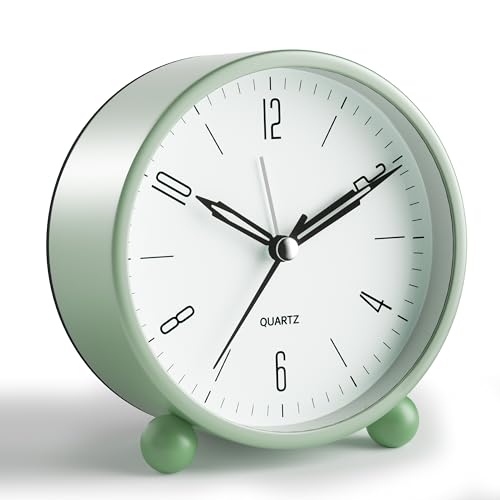
JALL Analog Alarm Clock Silent Non Ticking — Best Silent All-Rounder
The JALL is the clock for the reader who has been kept awake by a clock. Its listing leads with the words super silent non ticking, and that phrase is the product: a sweep movement that carries the second hand around the dial in a smooth glide instead of a stepped tick. In a quiet bedroom at night, the difference is not subtle. A ticking clock becomes a metronome your brain counts against your will; a silent one simply tells the time and keeps its counsel.
Around that movement, JALL keeps everything deliberately plain. It is a 4-inch, battery operated clock with a night light, a simple design and an old fashioned style, offered here in green and described as ideal decor for bedroom, bedside and desk, for adults and as a gift. Plainness is a virtue in this category. The dial is uncluttered, the numbers are the point, and nothing on the face is trying to be a feature. Readers who want a clock that disappears into the room’s routine — noticed only when consulted — will recognise the appeal immediately.
The night light follows the same philosophy. On clocks like this it is a modest glow for reading the dial in the dark, not a lamp substitute, and that modesty is what makes it bedroom-appropriate: enough light to learn that it is 4 a.m. and go back to sleep, not enough to signal your body that the day has begun. Paired with the silent movement, it makes the JALL the natural recommendation for light sleepers, for nurseries where a ticking clock competes with a settling baby, and for anyone whose partner has ever asked, from the dark, whether that ticking is really necessary.
- Movement: silent non-ticking, battery operated
- Dial: 4 inches
- Night light: included per listing
- Style: simple, old fashioned design
- Finish: green
Strengths
- The silent sweep removes the most common analog clock complaint entirely.
- Night light supports dark time checks without flooding the room.
- Understated face suits bedrooms that do not want a statement piece.
Trade-offs
- The alarm is a conventional beep class sound, not a heavy-sleeper bell.
- Four inches asks for decent near vision at nightstand distance.
- Simplicity means few extras; readers wanting multiple alarms should look at digital models instead.
Best for: light sleepers, shared bedrooms, and anyone replacing a ticking clock that has outstayed its welcome.
Not suited for: very heavy sleepers or readers who need a large dial.

AYRELY 4.5-inch Analog Retro Alarm Clock — Best Shelf Presence
Half an inch does not sound like a design decision until you live with it. The AYRELY’s 4.5-inch dial gives its retro face a little more air than the standard 4-inch clocks here, and its listing aims it not only at the bedside but at living room decor and shelves — a silent metal table clock with light, battery operated, in blue. That dual ambition shapes the review: this is the pick for people who place a clock the way they place a framed photograph, where it will be seen by guests as often as by its owner at dawn.
The metal construction supports that ambition. A clock destined for a shelf gets picked up, dusted around and occasionally knocked; metal shrugs off the small insults that crack thin plastic shells. The blue finish is the other half of the presence. It is a calm, slightly vintage blue that pairs with wood shelves and white walls, and it photographs the way it looks in person — a considered object rather than an appliance that wandered out of a kitchen drawer.
Function keeps pace with the looks. The movement is silent, so the clock can live in a bedroom without the tick problem, and the built-in light covers the night-check role. As an alarm it is a civilised beep-class wake-up rather than a bell, which suits its decor-first audience: households that rise to a routine rather than being dragged from deep sleep. If your mornings need force, the twin bells above are your clocks; if your mornings need a beautiful object that also happens to ring, this is the one to linger on.
- Movement: silent, battery operated
- Dial: 4.5 inches
- Case: metal
- Light: included per listing
- Finish: blue
Strengths
- Slightly larger dial and metal case give it genuine shelf presence.
- Silent movement keeps it bedroom-safe despite its living room ambitions.
- Blue retro finish reads as decor in photographs and in person.
Trade-offs
- Beep-class alarm will not satisfy the heaviest sleepers.
- Its size is presence, not large-print readability; the 6-inch pick serves weak eyes better.
- Metal and size make it less of a travel companion than the compact picks.
Best for: style-led bedrooms and living rooms, gift buyers, and anyone furnishing a shelf and a nightstand with one purchase.
Not suited for: heavy sleepers or readers who need maximum dial size.

Konigswerk Analog Alarm Clock 6-inch Yellow — Best Large Dial
Six inches changes what a bedside clock is for. At that size, the Konigswerk stops being an object you lean toward and becomes a surface you glance at — from the bed without glasses for many readers, from the doorway for nearly everyone. Its listing keeps the specification honest and short: an analog alarm clock, 6 inch, yellow, silent non ticking, night light, battery operated, simply design. Every one of those words earns its place, and the combination — big, silent, lit — is rarer than it should be.
The yellow deserves a defence, because it will be the reason some readers scroll past. In a dark room at 5 a.m., a pale or black clock is a shape you hunt for; a yellow case is a landmark. Your half-awake eye finds the bright frame first and the hands second, which is the correct order of operations before coffee. In daylight it is cheerful in the way kitchen radios used to be cheerful, and in a child’s or teenager’s room it reads as fun rather than furniture. Readers furnishing a calm, neutral guest room may prefer the green JALL; readers who lose their glasses on the nightstand will understand the yellow at once.
Silence at this size is the quiet triumph. Large clocks often carry large, resonant cases that amplify a ticking movement; a silent movement in a big case gives you the readability without the soundtrack. The night light completes the night-shift duties. Taken together, this is the pick we would hand to an older parent who wants one clock, readable and calm, and to anyone whose first act of the morning is squinting.
- Movement: silent non-ticking, battery operated
- Dial: 6 inches
- Night light: included per listing
- Design: described in the listing as a simple design
- Finish: yellow
Strengths
- Largest dial here, readable at distances the 4-inch clocks cannot serve.
- Silent movement keeps a big case from becoming a big echo.
- Yellow frame is genuinely easier to locate with sleepy eyes.
Trade-offs
- Needs a nightstand with real surface area to spare.
- The colour is a commitment; it will be the brightest object in most rooms.
- Alarm character is not stated in the listing beyond the clock’s alarm function, so heavy sleepers should treat the bells as the safer bet.
Best for: readers with weaker eyesight, older households, and anyone who checks the time from across the room.
Not suited for: tiny nightstands or strictly neutral decor schemes.

Tetino Analog Alarm Clock Retro Backlight — Best Small and Cute
The Tetino is the clock in this guide most likely to be bought twice: once for a child’s desk, once for the buyer. Its listing describes an aesthetic retro cute desk clock with a night light, silent non-ticking movement and battery power, aimed at kids, bedrooms, travel and kitchen as well as the bedside, in green. Small analog clocks live or die by charm, because their dials are too small to compete on readability; the Tetino leans into charm completely, with a rounded retro case that looks like it was designed to be smiled at.
Do not let the cuteness undersell the specification. Silent non-ticking matters as much in a child’s room as in an adult’s — more, arguably, since children fall asleep to whatever rhythm the room provides. The backlight gives a child the small independence of checking the time at night without calling out or turning on a ceiling light, and it gives a parent a clock that can travel to grandparents’ houses and holiday rentals without a charger cable entering the packing list. Battery power and small size make it the only pick here that genuinely doubles as a travel clock among the decor designs.
Its limits are the honest limits of its class. A small dial is a near-distance dial. The alarm is sized for ordinary sleepers, not for teenagers in exam-week hibernation. And a clock bought for its looks in a kitchen or on a desk may migrate there permanently, leaving the bedroom unsolved. Buy it as the household’s cheerful small clock — for a child, a desk, a guest shelf — and it will be loved; ask it to be a large-print bedside instrument and you have chosen the wrong tool.
- Movement: silent non-ticking, battery powered
- Light: backlight / night light per listing
- Style: retro, described in the listing as cute and aesthetic
- Dial size: not given in the listing
- Finish: green
Strengths
- Charming retro design that children actually want in their rooms.
- Silent movement and backlight make it properly bedroom-capable, not just decorative.
- Compact and battery powered, so it travels between rooms and houses easily.
Trade-offs
- Small dial limits distance readability.
- Alarm suited to ordinary sleepers rather than the deepest ones.
- Its desk-and-kitchen appeal may steal it from the bedroom you bought it for.
Best for: children’s rooms, desks, guest shelves and small-space households that want one cheerful clock.
Not suited for: weak eyesight at distance or heavy sleepers.
How Do the Six Analog Clocks Compare at a Glance?
| Pick | Power | Dial | Distinguishing feature |
|---|---|---|---|
| Vintage Wind Up Mechanical Twin Bell Alarm Clock | Wind-up mechanical | Not stated | Glow hands, all-metal case |
| Peakeep Loud Twin Bell Alarm Clock 4-inch | Battery | 4 in | Loud bell for heavy sleepers |
| JALL Analog Alarm Clock Silent Non Ticking | Battery | 4 in | Silent sweep with night light |
| AYRELY 4.5-inch Analog Retro Alarm Clock | Battery | 4.5 in | Silent metal shelf-ready design |
| Konigswerk Analog Alarm Clock 6-inch Yellow | Battery | 6 in | Largest dial, silent, night light |
| Tetino Analog Alarm Clock Retro Backlight | Battery | Not given | Compact retro with backlight |
Why Do People Return to Analog Clocks After Years of Phones?
The pattern is familiar to anyone who has sold or bought bedroom goods in the last decade. A person spends years waking to a phone, and the phone slowly colonises the night: the alarm is set after the last scroll, the first waking act is opening the same screen, and a 2 a.m. wake-up becomes a forty-minute detour through messages. The analog clock is bought as a boundary. It does one thing, it does it without a feed attached, and it lets the phone charge in another room — which is the real purchase. The clock is inexpensive; the boundary is the valuable part.
There is also a reliability argument that has nothing to do with wellness. A battery analog clock does not care about overnight software updates, dead charging cables or a power cut’s effect on a router-dependent smart display. A wind-up clock cares about nothing electrical at all. For readers whose work punishes lateness — nurses, bakers, train crews, parents on school-run duty — a wake-up device with almost no failure modes is not nostalgia. It is risk management with a retro face.
How Loud Is Too Loud: Matching Alarm Character to Sleeper Type?
Forget decibel figures, which none of these listings publish; match character instead. Bells produce a bright, irregular, physical sound that the brain files under “something is happening,” and they suit deep sleepers, earplug wearers and people who sleep alone. Beep alarms on silent-movement clocks are steadier and more localised — enough for ordinary sleepers, kinder to partners. The mistake is buying by hope: a light sleeper who buys a bell “just in case” will dread it nightly, and a heavy sleeper who buys a gentle beep will sleep through it weekly. Your history with alarms is the specification sheet that matters.
Household geometry matters too. A bell in a studio flat is a private event; the same bell in a house with thin walls and a baby is a diplomatic incident. If your wake time is hours before the rest of the household, choose a beep clock and place it close; proximity beats volume. If the whole household rises together — school mornings in many homes — a bell’s everyone-up quality becomes a feature the family may quietly rely on.
What Does a Silent Movement Actually Change at Night?
A ticking clock produces a sound every second, all night, whether or not anyone is listening. Most adults filter it out; a meaningful minority cannot, and the filtering itself costs sleep quality in ways people describe as “I slept, but lightly.” A silent sweep movement removes the stimulus entirely. The second hand glides, the room stays acoustically empty, and the clock’s presence becomes purely visual. That is why three of our six picks lead with silence, and why we treat “non ticking” in a listing as a headline feature rather than a footnote.
Silence also changes who else the clock serves. In a nursery, a ticking clock competes with the white-noise hush parents work to create. In a guest room, a tick is the unfamiliar sound a visitor cannot unhear at 1 a.m. In a home office that doubles as a spare bedroom, silence keeps the clock welcome in both roles. If a clock will ever share a room with someone whose sleep you care about — including future you, on a stressful week — silent is the safer default.
How Should You Read a Dial in the Dark: Night Lights Versus Glow Hands?
The wind-up pick’s glow-in-the-dark hands are the oldest solution: they absorb light by day and release a soft visibility at night, needing no battery and producing no glow beyond the hands themselves. Their weakness is dependence on the day’s light and a fade toward morning. A built-in night light, as on the JALL, AYRELY, Konigswerk and Tetino, is the modern answer: consistent brightness whenever you trigger or enable it, at the cost of battery draw and a slightly stronger presence in the room.
Choose by your actual habit. If you glance at the time once, half asleep, glow hands are enough and beautifully self-sufficient. If you wake often and read the time properly — parents of infants, shift workers checking “how long until I must get up” — a real night light earns its battery. Either way, avoid judging by daytime photographs: a night light’s job is measured in the dark, at arm’s length, through unfocused eyes.
How Do You Set an Analog Alarm Precisely Enough to Trust It?
Analog alarms use a fourth hand, set with its own knob, and their precision is measured in minutes rather than seconds. The technique that makes them trustworthy is boring and effective: set the alarm hand a few minutes before a round hour, watch it fire once during the day while you are awake and nearby, and learn your individual clock’s small bias. Every analog clock has one; knowing yours turns “about seven” into a time you can plan a morning around. Test again after every battery change or, for the wind-up, after any long stop.
Build the rest of the morning around the clock’s nature. Analog alarms ring for a fixed, generous period and then stop; they do not escalate, negotiate or re-ring unless the model offers a snooze. So the clock belongs within reach but not within silencing distance of a lazy arm — on the far side of the nightstand, or on a dresser you must stand to reach, if your history says you switch alarms off in your sleep. Placement is the snooze feature of the analog world.
What Mistakes Do Analog Clock Buyers Make?
The commonest mistake is buying the photograph instead of the specification: choosing by case colour while ignoring movement type, then discovering a tick in a silent household or a whisper of an alarm in a deep sleeper’s room. The second is assuming all “night lights” behave alike; a glow hand and a lamp-bright backlight are different tools. The third is placing a bell clock where its virtues become vices — beside a partner’s side of the bed, or in a child’s room adjoining a baby’s. The fourth is neglecting the test ring: an analog alarm trusted untested is a hope, not a plan. And the fifth is buying a small, charming clock for eyes that needed the 6-inch dial; sentiment is a poor optician.
How Should You Care for a Mechanical or Battery Analog Clock?
For the wind-up clock, care is rhythm: wind at the same point in your evening routine, wind gently until resistance firms, and never force the key past that firmness. Keep it out of bathroom steam, which mechanical movements dislike, and dust the bells occasionally so their ring stays bright. For battery clocks, care is mostly battery honesty: replace the battery when the second hand begins to hesitate or the alarm sounds thin, rather than after a missed morning teaches the lesson. A spare battery in the nightstand drawer converts a failure into a thirty-second errand.
All six clocks share one care rule: treat the knobs gently. Analog setting knobs are small, often plastic-shafted, and they are turned twice a day for years. Turn them in the direction the hands naturally travel where the design allows, and avoid spinning the time forward through the alarm point repeatedly, which on some movements can confuse the alarm setting. A clock treated gently in these small ways is the kind of object that gets handed to a student leaving for university — which is, in the end, the analog clock’s natural life story.
Where Should an Analog Clock Sit: Nightstand, Dresser or Shelf?
Placement quietly decides whether an alarm works. On the nightstand, a clock is readable and reachable — ideal for a silent beep model whose owner wakes easily and wants the snooze-distance to be short. On a dresser across the room, the same clock becomes a commitment device: the alarm can only be silenced by standing, and standing is most of waking. Heavy sleepers who know they can disable a bedside alarm unconsciously should treat distance as their primary feature and choose a clock loud enough to remain commanding from six feet away, which in this guide means one of the bells.
Shelves suit the decor-led picks, the AYRELY above all, but a shelf clock used as an alarm needs a sightline test: lie in bed, at your real pillow height, and check that the dial is visible without sitting up. Clocks placed for how a room looks at noon often fail the room at 6 a.m. The Konigswerk’s size forgives casual placement; the smaller dials do not. Spend one evening testing positions with the clock unplugged from duty — set it, watch it, move it — and the morning version of you will inherit a decision the evening version made with full information.
How Do Analog Clocks Serve Guest Rooms and Older Relatives?
A guest room is where analog clocks quietly outperform every digital alternative. A visitor does not know your home’s Wi-Fi, does not want to download anything, and may not trust a smart display beside a strange bed — but every adult alive knows how to read hands and turn a knob. A simple silent clock with a night light, the JALL pattern, is the most hospitable object you can leave beside a guest bed: it asks nothing, explains itself, and respects the guest’s privacy in a way a voice-assistant screen never will.
For older relatives the calculus adds eyesight and habit. Many people in their seventies and eighties spent fifty years reading analog faces; the hands communicate at a glance in a way digits, paradoxically, do not for them. What they need is scale and contrast — the 6-inch Konigswerk’s territory — plus controls large enough for less nimble fingers. When you buy for a parent, set the clock up for them, test the alarm together, and write nothing down: a well-chosen analog clock needs no instructions, which is precisely its dignity.
What About Power Cuts, Travel and Other Bad Nights?
Every battery and mechanical clock in this guide is indifferent to the state of the power grid, and that indifference is worth more than it sounds. The night the power fails is usually the night before something that matters — a flight, an exam, a shift — because storms and outages keep their own schedule. A phone on a low battery, plugged into a dead wall, is a fragile plan; a clock with a spring or a fresh AA is not. Households in outage-prone areas often keep one analog clock for exactly this reason, the way they keep a torch in a known drawer.
Travel splits the picks honestly. The Tetino’s compact battery design packs happily and asks for no adapter abroad, where hotel clocks are unreliable and phone alarms depend on roaming behaving itself. The wind-up clock travels too, in the older sense — no battery rules to worry about in luggage — though its bell will announce your wake time to an entire thin-walled guesthouse. The large Konigswerk and the metal AYRELY are home clocks; their virtues are size and presence, and travel punishes both. Match the clock to the journey rather than forcing a favourite to do every job.
How Do You Teach a Child to Wake to an Analog Clock?
An analog clock teaches time itself while it teaches waking, which no digital display does. A child with a Tetino on the desk learns that the little hand crawling toward seven is the morning approaching — a picture of time passing that educators prize and that makes “five more minutes” a visible, negotiable quantity. Start on weekends, when a missed alarm costs nothing. Let the child set the alarm hand themselves; ownership of the knob is ownership of the morning, and children rise to it with a seriousness that surprises most parents.
Choose the sound with the child’s temperament, not the parent’s schedule anxiety. A bell that delights a deep-sleeping ten-year-old can frighten a sensitive six-year-old into dreading bedtime. The gentle route — silent movement, modest beep, backlight for reassurance — builds the habit without the battle. And keep the clock consistent: the same sound, the same place, the same small ritual of setting it after story time. An analog clock in a child’s room is less an appliance than a first piece of personal infrastructure, and it tends to be remembered, decades later, with unreasonable affection.
What Should You Check in the First Week With a New Analog Clock?
Run the alarm test on day one, at a harmless hour, and note two things: how long the alarm sounds before it stops, and how your particular clock’s alarm hand bias runs — a few minutes early is a gift, a few minutes late is a fact to set by. Check the night light or glow hands on the first genuinely dark night, from your real sleeping position, because showroom brightness tells you nothing. Listen, once, in the small hours: is the movement as silent as promised, and does the case buzz or resonate against the nightstand surface? A small felt pad under a clock cures resonance that owners often blame on the movement.
By the end of the week, check the boring things that predict a long life together. Are the knobs still tight and positive, or already vague? Does the time agree with your phone to the minute, or is the movement drifting in a way that will compound? Analog clocks drift slowly and honestly; a minute a week is a habit to manage, a minute a day is a fault to return. A clock that passes its first week — accurate, quiet, readable, and waking you as intended — will very likely still be on that nightstand in ten years, which is the entire promise of the category.
Analog or Digital: Which Belongs Beside Your Bed?
The honest answer is that the two formats fail differently. Digital clocks fail loudly — a dead backup battery after an outage, a display too bright to sleep beside, a setting lost to a confusing button combination. Analog clocks fail quietly and slowly: a drifting minute here, a weakening battery there, an alarm hand set to the wrong twelve hours by a tired hand. Choose the failure style your household tolerates. If precision to the minute and multiple alarms rule your mornings, digital wins and our USB charging guide is the better read. If calm, legibility and independence from the grid rule them, analog wins, and this guide is your shortlist.
Many households end with both, in different rooms, and that is not indecision but zoning. The analog clock guards the bedroom’s quiet; the digital clock with its ports and dual alarms works the kitchen counter or the home office where its brightness and complexity belong. Thinking of clocks as room equipment rather than personal gadgets resolves most buying dilemmas: each room states its requirements, and the clock that meets them is rarely the clock that meets another room’s.
How Much Should an Analog Alarm Clock Cost You in Attention?
Price is a subject this guide deliberately keeps at the listing, but attention is a currency worth budgeting openly. The wind-up clock charges the most attention: a daily wind, a weekly glance at its accuracy. Battery clocks charge almost none — a battery a year or so, a test after each change — and repay it with set-and-forget service. Decor clocks charge a little placement thought and return daily visual pleasure. None of these is expensive, yet the differences are real, and the readers who love their clocks are reliably the ones who chose the attention tariff they actually enjoy paying. A ritual you resent becomes a chore you skip, and a skipped chore, in a clock, becomes a missed morning.
Why Does the Twin Bell Design Refuse to Die?
The twin bell silhouette is more than a century old, and its survival is not sentimentality. The design puts the alarm’s sound source — two bells and a hammer — outside the case, in open air, where nothing muffles it. It puts the winding keys and setting knobs at the back, large and graspable, where sleepy fingers can find them by touch. It stands on splayed feet that keep it upright on soft bedding when it is knocked at dawn. Every element is an answer to a 6 a.m. problem, arrived at before electronics existed to offer lesser answers. Modern versions like the Peakeep keep the answers and swap the spring for a battery; the wind-up pick keeps the original bargain entire. When a design persists unchanged through the quartz revolution, the phone revolution and the smart speaker, the respectful conclusion is that the design was finished — complete — long ago, and the rest of the industry has been circling it ever since.
Final Recommendation
Start with your sleeper type, because it decides more than style ever will. Heavy sleepers should choose between the two bells: the Vintage Wind Up Mechanical Twin Bell Alarm Clock if the battery-free, wind-up ritual appeals, or the Peakeep Loud Twin Bell Alarm Clock 4-inch if you want bell force with battery convenience. Light sleepers and shared bedrooms belong to the silent three, and among them the JALL Analog Alarm Clock Silent Non Ticking is the balanced default for a standard nightstand.
Then let your eyes arbitrate. If reading the time at distance is the recurring frustration, the 6-inch Konigswerk solves the actual problem. If the clock will live on a shelf and be seen by the whole household, the AYRELY’s metal retro presence justifies itself daily. If the buyer is a child, or the room is small, or the clock will travel, the Tetino’s cheerful compactness is the right scale of purchase. None of these clocks will organise your life; each will simply be there, correct and calm, at the one moment of the day when correctness matters most — and on the morning the power fails and the phones die, the little clock on the nightstand will be the only voice in the house still keeping time.
Frequently Asked Questions
Do analog alarm clocks tick?
Some do and some are built not to. Three picks here — the JALL, the AYRELY, the Konigswerk and the Tetino among them — use silent non-ticking sweep movements, while mechanical and bell clocks make the traditional sounds of their mechanisms. Check the movement description, not the product photograph, before buying for a quiet room.
Will a twin bell wake a very heavy sleeper?
A struck metal bell is the most assertive sound in this category, which is why both bell picks are described in their listings as suited to heavy sleepers. No alarm can promise to wake every sleeper on every night, but a bell at close range is the strongest tool analog clocks offer.
How often does the wind-up clock need winding?
Mechanical clocks of this type are wound as a daily or near-daily habit; the safe routine is a gentle wind each evening. If it stops, no harm is done — set the time, wind it, and carry on.
Can I read these clocks at night without turning on a lamp?
Four picks include a night light and the wind-up model uses glow-in-the-dark hands, so yes for most of the guide. The Peakeep listing does not name a light, so treat that one as a daytime-readable clock.
Are analog alarms precise enough for an early shift?
Yes, once you know your clock. Set it, test-fire it once while awake, and learn its few-minutes bias; after that an analog alarm is a dependable instrument, which is why shift workers used them for generations.
Do I need to worry about an analog clock during a power cut?
No, and that indifference is one of the category’s oldest virtues. Battery models keep time and keep their alarm through any outage, and the wind-up mechanical pick does not know the grid exists. The morning after an overnight outage is when analog owners feel quietly vindicated: the clock is correct, the alarm fires, and the day starts on schedule while the rest of the house’s electronics are still blinking and rejoining networks.
Which of these suits a child’s bedroom best?
The Tetino, for its size, charm and backlight, and the Peakeep bell for older children who sleep deeply. Match the alarm’s force to the child rather than to the parent’s frustration.
Related Guides
Readers setting up a calmer, screen-light bedroom often continue with our charging-focused picks in Best Alarm Clocks with USB, plan the summer linen refresh through Best Beach Towels That Repel Sand, and finish the barefoot route from bed to bathroom with Best Hard Sole Slippers for Women.


