What's inside
- Key Takeaways
- Quick Picks
- How Did We Choose Alarm Clocks That Stay Dark?
- Which Dark-Room Alarm Clocks Earned a Place by the Bed?
- How Do the Six Compare Side by Side?
- Why Does a Glowing Clock Damage Sleep at All?
- Analog or Digital: Which Belongs in a Dark Bedroom?
- How Loud Should an Alarm Actually Be?
- How Do You Make the Whole Bedroom Dark, Beyond the Clock?
- How Do You Test a Clock’s Darkness Before You Trust It?
- What Happened to the Humble Bedside Clock?
- How Should You Place a Dark Clock for Best Effect?
- Which Clock Suits Which Sleeper? A Plain Matching Guide
- Do Children Need Dark Clocks Too?
- What Does a Dark Clock Cost Across Its Life?
- What Are the Most Common Mistakes Buyers Make?
- Final Recommendation
- Frequently Asked Questions
- Related Guides
As an Amazon Associate I earn from qualifying purchases. This post may contain affiliate links at no extra cost to you.
cottageverdict.com is reader-supported. When you buy through links on our site, we may earn an affiliate commission.
Where to buy: all six clocks below are sold through Amazon, and their names in the Quick Picks table, the detailed sections and the comparison table link to their listings, so you can check price on Amazon and confirm size, colour and power source before ordering. The best alarm clocks that don’t glow at night answer a problem the modern bedroom created for itself: the clock that was bought to tell the time at 7 a.m. insists on broadcasting it, brightly, at 3 a.m. too. Light at night fragments sleep, draws the eye during every waking, and turns a bedside table into a small, glowing control panel. These six clocks refuse — each in a different way — to shine while you sleep.
The ways matter, so this guide separates them into three honest tiers, and keeps them separate in every section. Tier one is complete darkness: the Equity wind-up clock has no light of any kind, no battery, no display — hands on a dial, and nothing to glow even if it wanted to. Tier two is light on demand: analog clocks whose backlight wakes only when a button is pressed, then goes out — the Peakeep travel clock, the FAMICOZY and, in its own luminous-dial way, the AYRELY twin bell. Tier three is the self-managing digital: the Peakeep battery digital, whose display dims itself automatically rather than shining at full brightness all night.
One pick needs its light described with precision. The Noubnea’s numerals are glow-in-the-dark: they absorb light by day and release a faint luminescence at night. That is not a lit display — there is no bulb, no LED, no screen — and in a dark room it reads as a soft, dim legibility rather than a glow that lights the bedside. We place it honestly between tiers two and three in character: always faintly readable, never bright. And to be unambiguous about the whole list: no pick here has an always-on bright display. If a clock face could double as a nightlight, it was excluded.
Who needs this guide? Light-sensitive sleepers, partners of light-sensitive sleepers, parents building genuinely dark children’s rooms, and anyone who has ever turned a clock to face the wall and wondered why the solution should be necessary. A clock’s job at night is to be findable in the morning and invisible until then. These six understand the assignment.
Key Takeaways
- The six picks divide into three light tiers: completely dark, light only on demand, and digital that dims itself — kept distinct throughout this guide.
- The Equity wind-up is the only pick with no light source at all: no battery, no backlight, no luminous paint doing night duty.
- On-demand backlights (Peakeep travel, FAMICOZY) light the dial for a few seconds when pressed, then go dark again.
- The Peakeep digital is the one screen in the list, and it earns its place by auto-dimming rather than shining steadily.
- The Noubnea’s glow-in-the-dark numerals are a faint luminescence, not a lit display — dim legibility, not bedside glow.
- No pick here has an always-on bright display; every clock can sit in a dark room without becoming a nightlight.
Quick Picks
| Pick | Badge | Why it made the list |
|---|---|---|
| Equity Analog Wind-Up Alarm Clock | Best completely dark | The darkness purist’s clock: wind-up, analog, black — no battery, no light, nothing that can glow. |
| Peakeep Analog Travel Alarm Clock | Best on-demand light for travel | A small silent travel clock, black, whose light exists only when demanded — with snooze and an ascending, gentle-wake alarm. |
| FAMICOZY No Ticking Analog Alarm Clock | Best for seniors at home | A 4.5-inch white analog with big numbers, a soft on-demand backlight, gradual-rise alarm and a side on/off switch — built for seniors. |
| AYRELY Super Loud Twin Bell Alarm Clock | Best loud with luminous dial | A 4.5-inch metal twin bell, super loud for heavy sleepers, with a silent quartz movement, backlight and luminous dial. |
| Peakeep Battery Digital Alarm Clock Auto Dimming | Best self-dimming digital | The one digital in the list: battery, cordless, big red digits — and a display that dims itself for the night. |
| Noubnea Metal Loud Alarm Clock Glow in Dark Numbers | Best faint-glow numerals | A 4.5-inch silver metal bell clock whose numerals glow faintly in the dark — luminescence, not a lit screen. |
How Did We Choose Alarm Clocks That Stay Dark?
The first filter was absolute and excluded most of the clock market: any model with a permanently illuminated display — LED panels that cannot be switched off, backlit screens that glow through the night — was rejected regardless of its other virtues. What survived had to handle darkness in one of the three ways this guide keeps separate: no light at all, light strictly on demand, or a display that manages its own dimming without being asked.
The second filter was alarm honesty. A dark clock that cannot wake its owner is a sculpture. The listings here span the waking spectrum deliberately: gentle ascending beeps for light sleepers (both Peakeeps and the FAMICOZY use rising or gentle-wake alarms), and full twin-bell volume from the AYRELY and the Noubnea for heavy sleepers who sleep through polite electronics. Silence of mechanism mattered too — five of the six are analog or no-ticking designs for bedrooms where a ticking clock is its own kind of pollution.
Finally we checked the unglamorous facts from the listings: size where stated (4.5 inches for the FAMICOZY, AYRELY and Noubnea), power source (wind-up, battery), and readability features such as big numbers for seniors. Where a listing does not state a dimension or a battery type, the spec boxes record that honestly rather than filling the silence with a guess.
Which Dark-Room Alarm Clocks Earned a Place by the Bed?

Equity Analog Wind-Up Alarm Clock — Best completely dark
Begin with the only clock in this guide that is dark by physics rather than by settings. The Equity 14075 is a wind-up analog alarm clock in black: a mechanical movement, hands on a dial, an alarm set by a knob and powered by a spring you wind. There is no battery to power a light, no backlight to leak, no luminous feature listed — at 3 a.m. this clock emits exactly as much light as the furniture it sits on. For the sleeper who has tried dimmers and demand-lights and still wants the bedside to be cave-dark, this is the end of the search.
Wind-up ownership is a small ritual with real consequences. The clock must be wound — daily, in the traditional rhythm — and in exchange it is immune to every modern failure: no flat battery on the morning of the flight, no power cut resetting the alarm, no charger cable colonising the bedside. Its alarm is a mechanical bell in character, honest and unignorable, and its timekeeping carries the gentle imprecision of spring-driven movements, which matters to engineers and not at all to sleepers.
The trade is total: in darkness you cannot read this clock at all. Checking the time at night means a lamp, a phone, or the discipline of not checking — which many sleep researchers would call the point. Buyers who need a 3 a.m. time check should choose an on-demand light below. Buyers who want the night to contain no information whatsoever have found their clock.
- Movement: wind-up mechanical, per the listing
- Light: none — no backlight or display of any kind
- Power: spring-wound; no battery required
- Colour listed: Black
- Display: analog dial with hands
- Dimensions: not stated in the listing title
Strengths
- Absolutely zero light emission; the darkest option that exists
- Immune to power cuts and flat batteries
- Mechanical simplicity with nothing to configure or update
Trade-offs
- Cannot be read in the dark at all
- Needs regular winding or the alarm fails silently
- Mechanical timekeeping is less precise than quartz or digital
Best for: darkness purists and power-cut-prone homes wanting a clock that cannot glow
Not suited for: anyone who checks the time during the night, or forgets daily rituals
The Equity also has an unlikely second career: it is the clock of cabins, caravans, boats and power-cut-prone farmhouses, anywhere a mains clock is a liability and a battery clock is an errand. Wound on arrival, it simply works for the duration of any stay, indifferent to the grid entirely. Travellers who keep one in a wash bag report a particular pleasure in its anachronism — the holiday begins, arguably, at the first winding.
Check price on Amazon for the Equity wind-up clock in the size and colour you want.

Peakeep Analog Travel Alarm Clock — Best on-demand light for travel
The Peakeep travel clock defines tier two of this guide: darkness by default, light by permission. Its listing phrase is “lighted on demand” — press, and the dial lights long enough to read; release, and the room is dark again. Around that central courtesy it builds the complete small-clock package: battery operation, a silent no-ticking movement, snooze, and an alarm that ascends in beeps toward a gentle wake rather than detonating at full volume. In Black, it disappears into a dark room both visually and literally.
Travel is its stated habitat and the design shows it: small, light, battery-powered, easy to set in a hotel room at midnight. But the same virtues serve the home bedside of anyone whose sleep is fragile — shift workers sleeping days behind blackout curtains, guests in a spare room, children old enough for their own alarm. A silent sweep matters more than travellers expect: in a quiet room, a ticking clock is a metronome the brain cannot unhear, and this one makes no such demand.
Its limits are a travel clock’s limits. Small means a small dial, read at arm’s length rather than across a room, and its gentle ascending alarm — merciful to most sleepers — will not trouble a genuinely heavy sleeper. For volume, read on to the bells. For a dark, silent, portable clock that lights only when asked, this is the reference design.
- Movement: battery-operated analog, silent no-ticking
- Light: lighted on demand only, per the listing
- Alarm: ascending beep, gentle wake, with snooze
- Colour listed: Black
- Size class: small travel format, per the listing
- Battery type: not stated in the listing title
Strengths
- Dial lights only when pressed, then returns to darkness
- Silent movement suits light sleepers and daytime sleepers
- Compact battery design travels and fits small bedside tables
Trade-offs
- Small dial is not readable from across a room
- Gentle ascending alarm may not wake heavy sleepers
- Travel size can feel insubstantial as a permanent bedroom clock
Best for: travellers, shift workers and light sleepers wanting darkness with a light on request
Not suited for: heavy sleepers, or anyone wanting a large, room-readable dial
Hotel rooms are the Peakeep’s natural laboratory, because hotels are where glowing clocks do their worst work: unfamiliar bright displays, in unfamiliar positions, shining on a sleeper already displaced from their own bed. A traveller who carries darkness with them — a small silent clock that lights only when pressed — removes one variable from every trip. Business travellers whose sleep is money swear by less romantic equipment than this, but few swear by anything smaller.
Check price on Amazon for the Peakeep travel alarm clock in the size and colour you want.

FAMICOZY No Ticking Analog Alarm Clock — Best for seniors at home
The FAMICOZY is tier two grown up and settled at home: a 4.5-inch battery analog clock in White whose listing reads like a checklist written by someone who has watched an elderly parent struggle with a modern clock. Big numbers, readable at a glance. No ticking. Easy to set. A gradual-rise alarm with a gentle wake and snooze. An on/off switch on the side, where a hand can find it without lifting or turning the clock. And a soft backlight — on demand, in the tier-two manner — for the night-time check that does not flood the room.
The word “soft” in that backlight deserves emphasis. Demand-lights vary from torch-bright to candle-gentle, and a clock designed for seniors and light sleepers chooses the gentle end: enough to read big numbers by, not enough to startle a dark-adapted eye or wake a partner. Combined with the big-number dial — legible in daylight without glasses, which is when most time-checking actually happens — the FAMICOZY treats readability and darkness as partners rather than enemies.
White is the right colour for its audience: visible against dark furniture when reaching for it at dawn, cheerful in a bright room by day. Its compromises are few and honest — it is a home clock, too substantial for a travel bag, and its gentle alarm, like the Peakeep’s, is calibrated for normal rather than heroic sleepers. Within its brief, it is the most thoughtfully specified clock in this guide.
- Size: 4.5 inches, stated in the listing
- Movement: battery-operated analog, no ticking
- Light: soft backlight, on demand
- Alarm: gradual rise, gentle wake, snooze
- Dial: big numbers, designed readable for seniors
- Colour listed: White; on/off switch on side
Strengths
- Big-number dial readable without glasses in daylight
- Soft demand backlight checks the time without flooding the room
- Side on/off switch and easy setting suit arthritic hands
Trade-offs
- Gentle alarm is not built for very heavy sleepers
- Home-sized rather than travel-sized
- White case shows dust and marks more than dark finishes
Best for: seniors and their families wanting a readable, quiet, dark-at-night home clock
Not suited for: heavy sleepers needing bell volume, or travellers wanting pocket size
Families buying the FAMICOZY for a parent should set it up rather than handing over the box: place it where the morning hand falls naturally, set the alarm together once, and press the backlight together so its softness is understood. A clock for seniors succeeds or fails on confidence, and confidence is installed by demonstration, not by instruction leaflets. Its big numbers will do the rest of the persuading across the following week of mornings.
Check price on Amazon for the FAMICOZY analog clock in the size and colour you want.
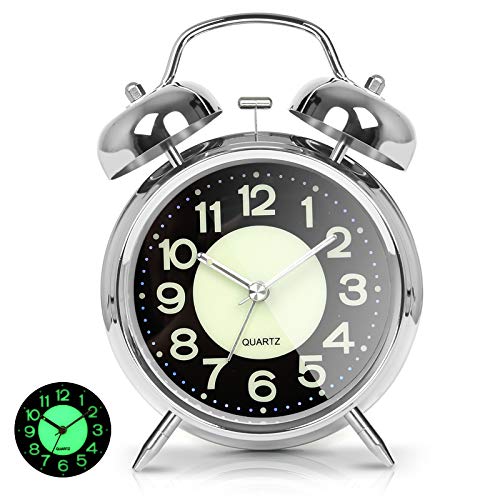
AYRELY Super Loud Twin Bell Alarm Clock — Best loud with luminous dial
The AYRELY brings the thunder. It is a 4.5-inch retro twin bell alarm clock in metal, described in its listing as super loud for heavy sleepers — and a twin bell earns that description mechanically, with a hammer striking bells rather than a speaker imitating one. Yet its night behaviour belongs in this guide: the movement is silent non-ticking quartz, and its light comes from a backlight used on demand plus a luminous dial. It sits in tier two with an asterisk this guide will state plainly: luminous dial markings hold a soft charge of light, far dimmer than any lit display, in the same family as the Noubnea’s numerals discussed below.
The combination it offers is genuinely rare: a clock that is quiet and dark for the nine hours of sleep, then unignorable for the one minute of waking. Heavy sleepers — teenagers, deep-sleeping adults, the medication-drowsy — are failed by gentle electronics daily, and the twin bell’s indifference to snooze-button negotiation is its entire virtue. The metal retro body, meanwhile, survives the bedside knocks that plastic clocks accumulate, and looks like furniture rather than gadgetry.
Choose it with open eyes. Super loud is a household decision, not a personal one — partners, children and thin walls all get a vote the listing cannot take for you. The luminous dial, while dim, is not the absolute zero of the Equity. And a bell this decisive offers no ascending mercy. For the right sleeper, those are not flaws; they are the specification.
- Size: 4.5 inches, stated in the listing
- Movement: silent non-ticking quartz
- Alarm: twin bell, super loud for heavy sleepers
- Light: backlight on demand plus luminous dial markings
- Case: metal, retro twin-bell design
- Power source: not stated in the listing title
Strengths
- Twin-bell volume wakes sleepers whom electronic alarms fail
- Silent quartz movement keeps the sleeping hours quiet
- Metal retro build is durable and looks like furniture
Trade-offs
- Volume will wake partners and possibly the neighbouring room
- Luminous dial is dim but not the absolute darkness of the wind-up
- No gentle or ascending wake option
Best for: heavy sleepers who need mechanical certainty and a dark, silent night
Not suited for: light sleepers, shared rooms with a light-sleeping partner, or darkness absolutists
The AYRELY’s retro shape carries a practical benefit disguised as style: weight and presence. A metal twin bell sits where it is put, survives being knocked by a sleepy hand without skidding off the bedside table, and its bells are far enough apart to ring with genuine mechanical violence. Light plastic clocks bounce; this one endures, which for the heavy sleeper who hits snooze like a drum is a structural requirement rather than an aesthetic one.
Check price on Amazon for the AYRELY twin bell clock in the size and colour you want.

Peakeep Battery Digital Alarm Clock Auto Dimming — Best self-dimming digital
Tier three exists because some sleepers genuinely need a digital display — failing eyesight that reads big numerals better than hands, a preference for exact time, a household that runs on minutes — and refuse, reasonably, to accept a glowing panel as the price. The Peakeep digital answers with the feature its listing names: auto dimming. The large display, with big numbers in red digits, dims itself for the night rather than holding full brightness until morning. It is the only screen in this guide, admitted on the strength of that self-management, and we state its tier plainly so no reader mistakes it for the darkness of the analog picks.
Its other virtues are practical. Battery operation means cordless: no cable dictating the bedside layout, no mains glow from a charger, easy moves between rooms and easy travel. The listing aims it at seniors and at heavy sleepers simultaneously — big numbers for the first, adjustable volume and a loud alarm for the second — a pairing few clocks attempt. Red digits are a thoughtful choice for a night display, red being the colour least disruptive to dark-adapted vision, which is why observatories and cockpits have used it for a century.
The honesty box: an auto-dimming display is dimmer, not dark. In a pitch-black room it will still be the faintest light source present, visible in a way the Equity or a demand-light analog never is. Sleepers for whom any photons are too many should choose from tiers one and two. Sleepers who need digits and want them civilised will find this the most considerate digital clock in its class.
- Type: battery-operated digital, cordless
- Display: large, big numbers, red digits
- Light management: auto dimming, per the listing
- Alarm: adjustable volume, loud, aimed at heavy sleepers
- Audience named: seniors and adults
- Exact dimensions: not stated in the listing title
Strengths
- Auto-dimming tames the digital display for night hours
- Big red digits are readable and gentle on dark-adapted eyes
- Cordless battery design frees bedside placement completely
Trade-offs
- Dimmed is not dark; a faint display remains visible at night
- Battery changes are part of ownership
- Digital format lacks the analog dial’s at-a-glance time-remaining feel
Best for: seniors and exact-time sleepers who need digits without the all-night glare
Not suited for: darkness purists for whom any display light is too much
Cordlessness changes the Peakeep digital’s social life as well as its placement. It can spend the week on a bedside, the weekend in a guest room and a fortnight in a suitcase without a cable ever being hunted, and in a household with one good bedside socket — already claimed by a lamp and a charger — a clock that asks for no power at all is a clock that starts no arguments. Battery clocks lost the last decade to mains digitals on features; this one wins some of it back on manners.
Check price on Amazon for the Peakeep digital auto-dimming clock in the size and colour you want.

Noubnea Metal Loud Alarm Clock Glow in Dark Numbers — Best faint-glow numerals
The Noubnea requires the most careful description in this guide, and it gets it. This is a 4.5-inch metal analog clock in Silver, battery operated, silent with no ticking, with bells and a loud alarm for heavy sleepers — and numerals that glow in the dark. That glow is photoluminescence: the numerals absorb light while the room is lit and release it slowly in darkness as a faint, soft legibility. There is no bulb, no LED, no powered display, and the effect is a dim readability — enough to find the hour if you wake facing it, nowhere near enough to light a bedside, a page or a partner’s pillow. Anyone picturing a glowing screen should recalibrate completely.
Understood on those terms, the Noubnea serves a real sleeper: the one who wakes in the night and wants the time without reaching, pressing or switching anything — the information simply there, at the lowest brightness physics allows. Its loud bells then handle the morning with the same mechanical certainty as the AYRELY, while its silent movement keeps the night quiet. The old-school metal design, which the listing offers for bedroom, bedside or office desk, is handsome in Silver and indifferent to fashion.
The compromises follow from its physics. Glow numerals fade across the night as their stored light depletes, so the 5 a.m. reading is dimmer than the midnight one, and a clock kept in a dark drawer or a dim room all day charges weakly. And faint though it is, the glow is a light source — the darkness absolutist has the Equity waiting at the top of this list. For everyone else, this is night legibility at its most courteous.
- Size: 4.5 inches, stated in the listing
- Movement: battery-operated analog, silent no ticking
- Alarm: bells, loud, for heavy sleepers
- Light: glow-in-the-dark numerals (passive luminescence, no powered light)
- Case: metal, Silver, old-school design
- Backlight: none stated in the listing
Strengths
- Time is faintly readable all night with no button to press
- Loud bells wake heavy sleepers reliably
- Silent movement and metal build suit bedside and desk alike
Trade-offs
- Numeral glow fades through the night as stored light depletes
- A faint light source is still a light source for purists
- Needs daytime light exposure to charge its numerals
Best for: night-wakers who want the time visible without touching anything, and heavy sleepers
Not suited for: absolute-darkness seekers, or rooms where the clock gets no daylight to charge
On a desk, the Noubnea’s brief reverses happily: by day it is a handsome silver analog whose numerals need no glow at all, and its bells are as capable of ending a work sprint as a night’s sleep. The listing itself suggests office duty, and the suggestion is sound — the same person who cannot abide a glowing clock at midnight rarely wants a buzzing phone alarm at noon either. One clock, two rooms, no light misbehaving in either.
Check price on Amazon for the Noubnea glow-number clock in the size and colour you want.
How Do the Six Compare Side by Side?
| Pick | Standout detail | Best for |
|---|---|---|
| Equity Analog Wind-Up Alarm Clock | Wind-up analog, no light source of any kind | darkness purists and power-cut-prone homes wanting a clock that cannot glow |
| Peakeep Analog Travel Alarm Clock | Battery analog, silent, lighted on demand, travel size | travellers, shift workers and light sleepers wanting darkness with a light on request |
| FAMICOZY No Ticking Analog Alarm Clock | Analog 4.5 in, big numbers, soft backlight on demand | seniors and their families wanting a readable, quiet, dark-at-night home clock |
| AYRELY Super Loud Twin Bell Alarm Clock | Twin bell 4.5 in, quartz, luminous dial plus backlight | heavy sleepers who need mechanical certainty and a dark, silent night |
| Peakeep Battery Digital Alarm Clock Auto Dimming | Battery digital, big numbers, auto-dimming display | seniors and exact-time sleepers who need digits without the all-night glare |
| Noubnea Metal Loud Alarm Clock Glow in Dark Numbers | Analog bells 4.5 in, glow-in-dark numerals, Silver | night-wakers who want the time visible without touching anything, and heavy sleepers |
The comparison table’s most important column is the light behaviour, and it should be read as three distinct promises. Complete darkness: the Equity alone. Darkness with light on request: the Peakeep travel clock and FAMICOZY by backlight, the AYRELY by backlight over a luminous dial. Managed light: the Peakeep digital dimming itself, and the Noubnea’s numerals glowing faintly and passively all night. No row in that table is a clock that shines at full brightness while you sleep — that product category was excluded at the door.
Alarm character divides the list just as sharply. The ascending, gentle school — Peakeep travel, FAMICOZY — trusts that the sleeper wants to surface gradually. The bell school — AYRELY, Noubnea — assumes the sleeper cannot be trusted with gradual. The Peakeep digital splits the difference with adjustable volume. Choose your tier for the night and your school for the morning; the two decisions are independent, and this list lets you make both.
Why Does a Glowing Clock Damage Sleep at All?
Because the sleeping brain never fully stops monitoring light. Even through closed eyelids, a bright bedside display registers — suppressing the darkness signals that keep sleep deep, and giving the half-waking mind a target: the time, and with it the arithmetic of how little sleep remains. That arithmetic is its own insomnia. A clock that glows invites the 3 a.m. calculation; a clock that stays dark lets a waking pass without information, and most such wakings end in sleep again within minutes.
There is also the partner problem. Light is shared property in a bedroom: one sleeper’s informative glow is the other’s intrusion, falling across pillows and walls with no regard for whose eyes it enters. Every pick in this guide was chosen partly as an act of consideration — a clock whose light, if it has any, is brief, dim, self-managed or confined to faint numerals. Bedrooms are negotiated spaces, and the clock is one of the few negotiables entirely within the buyer’s control.
Analog or Digital: Which Belongs in a Dark Bedroom?
Analog is the natural citizen of the dark room. A dial with hands needs no power to be a dial; it can be read in daylight at a glance, judged in the dark by a brief demand-light, and it communicates time spatially — the shape of the remaining night is visible in the hands’ positions in a way digits never offer. Its costs are precision and features: no exact minute at a sleepy glance, no multiple alarms, and setting is a knob-turning exercise.
Digital earns its place for specific needs: eyesight that resolves big numerals more reliably than hands, shift patterns that run on exact minutes, and users who simply think in digits. The Peakeep in this guide shows digital’s path to the dark bedroom — battery-powered so it can sit anywhere, big red numerals, and auto-dimming that lowers its presence at night. Choose digital for a reason, analog by default, and either way insist the light behaviour is stated before the style is admired.
How Loud Should an Alarm Actually Be?
Exactly as loud as the sleeper requires and not one bell more. Alarm volume is a matching problem: a gentle ascending beep is the correct tool for a light sleeper, for whom a twin bell is a small morning trauma repeated daily; a twin bell is the correct tool for the heavy sleeper who has slept through three phone alarms and a radio. The listings in this guide label their intentions honestly — gentle wake and gradual rise at one end, super loud for heavy sleepers at the other — and the buyer’s job is self-knowledge, including the uncomfortable kind about how deep their sleep really runs.
Household acoustics referee the extremes. A bell alarm in a room adjoining a baby’s nursery is a family decision; an ascending beep that fails its owner and makes them late is a career decision. Where two sleepers share a room with different depths of sleep, the lighter sleeper’s tolerance usually governs — or the heavy sleeper graduates to a vibrating or wearable alarm and leaves the bedside clock to the gentle school entirely.
How Do You Make the Whole Bedroom Dark, Beyond the Clock?
The clock is one light among many, and a dark-clock purchase is a good occasion to audit the rest. Standby LEDs on televisions and chargers, the hallway light under the door, the streetlight through a curtain’s edge — each is small, and together they are the room’s true light level. Blackout curtains or a sleep mask solve what furniture cannot; electrical tape over a standby light is ugly and effective; chargers can live in another room, which most sleep advice recommends anyway.
Within that audit, the clock choices in this guide slot into place: the wind-up for the room that achieves true dark, the demand-lights for rooms where a brief check must be possible, the auto-dimming digital where digits are non-negotiable. A dark bedroom is a system, and the clock — the one object whose entire night job is to wait quietly — is the right place to start building it.
How Do You Test a Clock’s Darkness Before You Trust It?
Give any new clock three nights before judging it, and judge it at the right hour. Night one is novelty; the room feels different because something in it is new. By night three, at the 3 a.m. waking that every sleeper knows, the truth announces itself: can you see the clock when you are not looking at it? A demand-light analog and the wind-up pass this test perfectly, because there is nothing to see. The auto-dimming digital and the glow-numeral clock should be present only as the faintest suggestion — findable when sought, invisible when not.
Test the alarm with the same honesty. Set it for a morning that does not matter before trusting it with one that does, and let partners deliver their verdict on bells without diplomacy. A clock is a household treaty in object form: its light governs the night for everyone in the room, and its volume governs the morning for everyone in the house. Three nights is long enough to negotiate both clauses properly.
What Happened to the Humble Bedside Clock?
It was eaten by the phone, and then the phone’s glow drove its owners back to it. The dedicated alarm clock spent a decade in decline as smartphones absorbed its job, and its revival — visible across this entire list of analog, battery and wind-up designs — is a reaction to what the phone brought into the bedroom: light, notifications, and the infinite scroll at the exact hours when humans are worst at resisting it. The clocks in this guide are the beneficiaries of that reaction, and their makers know it: silent, dark, single-purpose is now a selling point printed in listings.
There is a design lesson in the revival. The winning clocks are not the ones that added features — weather stations, projectors, radios glowing through the night — but the ones that subtracted them, until what remained was a dial, an alarm, and darkness. In a market that spent twenty years adding light to everything, subtraction turned out to be the premium feature, and the sleeper is the beneficiary.
How Should You Place a Dark Clock for Best Effect?
Within arm’s reach and below the eye line is the classic position: near enough that a demand-light can be pressed without sitting up, low enough that even a dimmed display or glow numerals fall outside the direct view of a sleeper lying down. Face analog dials toward the bed’s centre rather than at a pillow, so any brief light spreads across the room’s middle instead of into a partner’s eyes. The wind-up, needing nothing, can live anywhere — including the far side of the room for sleepers who want the alarm to require standing, the oldest heavy-sleeper strategy of all.
Keep the clock off the phone’s charging spot, conceptually as much as physically. The bedside table that holds a dark clock, a book and a glass of water is a different piece of furniture from the one that holds two glowing rectangles, and households feel the difference without analysing it. Placement is the last step of the purchase: the right clock in the wrong pool of light is only half a solution.
Which Clock Suits Which Sleeper? A Plain Matching Guide
The sleeper who wakes often and checks the time compulsively should, paradoxically, buy the clock that shows nothing: the Equity wind-up removes the information that fuels the checking habit, and within a week most such sleepers report fewer, shorter wakings. The sleeper who wakes and needs reassurance — a parent listening for a child, a carer on night duty — belongs with the demand-lights, where the time is one press away and the darkness returns the instant the question is answered.
The sleeper who shares a room with a baby should weigh silence above all: no ticking, a gentle or ascending alarm, and light that never floods — the FAMICOZY and the travel Peakeep were practically specified by that household. The sleeper who lives alone and sleeps like the dead should buy bells without embarrassment and place them across the room. And the sleeper whose eyes have changed with age should not struggle heroically with hands and dials: big dimming digits exist, in this guide, precisely so that dignity and darkness can coexist.
Do Children Need Dark Clocks Too?
Children’s bedrooms accumulate light even faster than adults’ — nightlights, glowing toys, chargers, and clocks bought for their novelty displays. A child learning to sleep through the night is learning it in whatever light the room provides, and a clock that glows teaches the room to glow. The analog demand-light picks here suit older children learning to tell time and wake for school: the dial teaches the skill, the darkness protects the sleep, and the alarm — gentle school — builds the morning habit without a parent’s voice as the mechanism.
For teenagers, the calculus inverts toward volume. The AYRELY’s bells have ended more school-morning negotiations than any parental speech, and a clock of one’s own — metal, retro, defiantly unconnected — carries a status in a teenager’s room that a phone alarm never will. Darkness and thunder in one object: adolescence contains multitudes, and so, fortunately, does this list.
What Does a Dark Clock Cost Across Its Life?
Very little, and the arithmetic is part of the category’s charm. The wind-up consumes nothing at all — no batteries, no electricity — for as many years as its spring is treated kindly. The battery clocks sip a cell or two a year. None of the six asks for a subscription, an app, a firmware update or a replacement cycle dictated by a manufacturer. Against a smart display that will be obsolete, unsupported and still glowing in five years, the analog dark clock is close to a permanent object, bought once and bequeathed casually to guest rooms and children as decades pass.
That permanence reframes the purchase. A clock is not a gadget to be optimised but a fixture to be chosen once, well — which is why this guide has spent so many words on light behaviour and alarm character rather than on features that will date. Choose the tier of darkness that fits your sleep, the alarm that fits your depth of slumber, and the object itself will take care of the next twenty years of mornings without further consultation.
One last scenario deserves a sentence of its own: the guest room. Guests sleep worst in strange light, and a host who provides a dark, silent, obviously simple clock — set, wound or fitted with fresh batteries before arrival — has removed the strangest light of all from the room. It is a small hospitality that guests rarely mention and always register, somewhere in the quality of the morning they bring down to breakfast.
Daylight saving, twice a year, is the analog clock’s small revenge on the digital world: one knob, one turn, and the clock is correct, while phones and ovens and car dashboards argue among themselves for a week. Owners of the picks in this guide tend to perform the ritual with disproportionate satisfaction. A clock that asks for two small acts of attention a year — and a winding or a battery now and then — has a fair claim to being the lowest-maintenance object in the house.
Keep the box and instructions until the clock has woken you on one morning that mattered. Darkness can be judged in a night, but an alarm is only ever truly judged under pressure — the early train, the examination, the flight — and the right response to a clock that passes that test is to stop shopping for clocks entirely and let it get on with its decades.
Partners should be consulted before the bells arrive, not after. A twin bell chosen unilaterally has started more household negotiations than any other object on a bedside table, while the same clock chosen together — demonstrated, laughed about, agreed as the necessary thunder — becomes a shared joke with a function. The gentle picks need no such diplomacy, which is itself a point in their favour for light-sleeping households. Trust the three-night test over any showroom impression, because darkness, like quiet, can only be assessed in the room and the hour where it will actually be used.
What Are the Most Common Mistakes Buyers Make?
Buyers of dark-room clocks make a short list of errors, most of them in the first five minutes of shopping.
- Buying a clock described as dimmable without checking whether the display can go fully dark or be lit only on demand — many merely glow at a lower level all night.
- Assuming glow-in-the-dark numerals mean a lit display, or the reverse: dismissing them as glow when they are only a faint luminescence.
- Choosing a gentle ascending alarm for a genuinely heavy sleeper because the clock was prettier.
- Forgetting that a wind-up clock must be wound, then blaming it for the morning it was never prepared for.
- Placing a demand-light clock across the room, where its light cannot be reached and its dial cannot be read.
- Solving the clock’s glow while leaving a charger, a standby light and a streetlit curtain to light the room anyway.
A dark bedroom is achievable with any budget on this page; it only requires reading the light behaviour as carefully as the alarm features.
Final Recommendation
For the darkest possible bedside, the answer is the Equity Analog Wind-Up Alarm Clock — nothing to glow, nothing to charge, nothing to configure. Most households will land one tier along, with the FAMICOZY No Ticking Analog Alarm Clock for the home bedside or the Peakeep Analog Travel Alarm Clock where travel and silence matter, each dark until the moment a light is honestly needed.
Heavy sleepers should choose by bell and by light together: the AYRELY where a backlight and luminous dial are welcome, the Noubnea where faint all-night numerals are the point, and the Peakeep digital where big dimming digits serve eyes that analog hands no longer do. Every one of those choices keeps the night’s darkness intact in its own way.
A bedroom clock should be a servant of the morning and a stranger to the night — set it, trust it, and let the hours between belong to the dark they were always meant to be slept in. And on the first morning it wakes you from a genuinely dark room, on time, without having stolen a single minute of the night to do it, the purchase will explain itself more completely than this guide ever could.
Frequently Asked Questions
Which of these clocks is truly, completely dark?
Only the Equity wind-up. It has no battery, no backlight and no luminous feature — a mechanical dial that emits no light whatsoever. Every other pick manages light rather than abolishing it: backlights that wake only on demand, an auto-dimming display, or numerals with a faint passive glow. Choose the Equity if absolute darkness is the requirement; choose the others if brief or faint light is acceptable.
Are glow-in-the-dark numerals the same as a glowing display?
No, and the difference is the whole point of the Noubnea’s inclusion. A glowing display is powered — a bulb or LED shining continuously. Glow-in-the-dark numerals are passive photoluminescent paint: they store daylight and release it as a very faint luminescence, dim enough to read the hour at close range in a dark room and far too dim to light the bedside. The glow also fades gradually across the night.
Will an auto-dimming digital clock still disturb a light sleeper?
Possibly, and this guide will not pretend otherwise. Auto-dimming reduces a display’s night brightness dramatically, and red digits are the gentlest colour for dark-adapted eyes, but a dimmed display is a visible light source in a way a demand-light analog is not. The most light-sensitive sleepers should choose from the analog tiers; the digital pick serves those who need numerals and accept a managed minimum of light.
I sleep through everything. Which clock actually wakes me?
The twin bells: the AYRELY, listed as super loud for heavy sleepers, or the Noubnea with its bell alarm — mechanical volume that does not negotiate. The Peakeep digital is the electronic alternative, with adjustable volume and a loud alarm aimed at heavy sleepers. Avoid the gentle-wake picks; ascending beeps are designed for people unlike you, and they will not apologise for failing.
Do wind-up clocks keep good time?
Well enough for waking, which is their job. A spring-driven movement drifts more than quartz — a minute here or there across days — and needs regular winding and occasional resetting. In exchange it never dies overnight from a flat battery or a power cut. Households that check their clocks against a phone weekly will never notice the drift; perfectionists should choose quartz analog instead.
What about using my phone as the alarm instead?
A phone is a glowing screen with an alarm attached: it lights for notifications, invites midnight checking, and brings the whole internet into the pillow’s reach. A dedicated dark clock — any of the six here — does one job and then stays dark and silent. That single-purpose discipline is most of what this guide is really recommending, whichever tier of darkness you choose.
Related Guides
A dark bedroom is a system, not a single purchase; the guides below cover the down quilts to sleep under in it, the gym towels for the morning after, and the camping pillows for nights away from it. Best Down Quilts Best Microfiber Gym Towels Best Inflatable Camping Pillows



[…] the linen towels that finish a kitchen properly, and the sheet sets sized for a college dorm. Best Alarm Clocks That Don’t Glow at Night Best Linen Dish Towels Best Sheet Sets for […]