What's inside
- Key Takeaways
- Quick Picks
- How Did We Choose These Battery Operated Travel Alarm Clocks?
- How Do the Six Travel Clocks Compare at a Glance?
- Why Not Just Trust the Hotel Clock or Your Phone?
- How Do You Pack a Travel Clock So It Survives the Trip?
- What About Time Zones, and the Alarm That Must Not Fire?
- What Mistakes Do Travel Clock Buyers Make?
- How Long Will the Batteries Last, and Which Should You Carry?
- How Do Travel Clocks Serve Campers, Sailors and Night Trains?
- What Should Business Travellers Demand That Holidaymakers Can Skip?
- How Do You Handle the Clock in a Shared or Family Room?
- Why Does the Snooze Interval Matter More on the Road?
- How Should You Test a Travel Clock Before the First Trip?
- What Is the Case for Carrying Two Alarms?
- How Do Travel Clocks Help Children Sleep Away From Home?
- What Happens When the Clock Comes Home?
- How Do You Read a Travel Clock in the Dark Without Waking Anyone?
- Why Do Some Travellers Refuse Digital and Pack Analog?
- How Should the Clock Handle Daylight Saving and Other Calendar Traps?
- What Makes a Travel Clock a Good Gift?
- How Much Should a Travel Clock Weigh in Your Packing Decisions?
- How Do Travel Clocks Cope With Hostels and Other Communal Sleep?
- What Should You Do on the Morning the Clock Is the Only Alarm?
- How Does a Travel Clock Change the First Night in a New Place?
- Why Does Every Seasoned Traveller’s Clock Look Slightly Beaten Up?
- How Do You Choose Between the Two Data-Rich Clocks?
- Final Recommendation
- Frequently Asked Questions
- Related Guides
As an Amazon Associate I earn from qualifying purchases. This post may contain affiliate links at no extra cost to you.
cottageverdict.com is reader-supported. When you buy through links on our site, we may earn an affiliate commission.
Where to buy: all six travel clocks below are sold through Amazon, and each name links to its listing in the Quick Picks table, in its detailed section and in the comparison table, so you can check price on Amazon and confirm size and battery details before ordering. The best battery operated travel alarm clocks share one founding refusal: they will not depend on the room. Hotel clocks are missing, wrong or glowing like runways; phone alarms depend on a charger, a cable and a battery that travel days devour; a small clock that runs on its own batteries, folds flat and wakes you with its own voice removes the whole chain of dependencies. You set it on the train, the nightstand of a rented cottage or a tent’s groundsheet, and it simply keeps your time.
The six picks divide by traveller type. The Travelwey folds, with an on/off switch made for luggage. The SHARP wraps its clock in a soft-touch case with an on-demand blue backlight and an ascending alarm. The MeesMeek is the information-rich digital: a 3.54-inch LCD with temperature and calendar, weekend mode and two volume levels. The Peakeep is the lone analog, silent, with a lighted-on-demand face and a gentle ascending beep. The FAMICOZY is the bold-digits simple digital with high and low volume. And the NOKLEAD folds around a mirror, showing temperature and calendar on a 3.23-inch display. All run on batteries; none needs the wall. What follows is about which compromises each one makes, and for whom.
Key Takeaways
- Battery power is the whole point: every pick keeps time and alarm through any hotel, outage or campsite without a socket.
- Folding designs — the Travelwey and the NOKLEAD — protect the face in luggage and stand themselves up on arrival.
- On-demand backlights, rather than always-on displays, are how these clocks read in the dark while sipping battery for months.
- Ascending alarms appear on the SHARP and Peakeep, waking in stages instead of ambushing a traveller in a strange room.
- Weekend mode on the MeesMeek and NOKLEAD stops the work alarm from firing on the holiday mornings the trip was taken for.
Quick Picks
| Pick | Badge | Why it earns its place |
|---|---|---|
| Travelwey Digital Travel Alarm Clock | Best Folding Classic | A small folding digital with snooze, an on-demand light and a travel on/off switch, in black. |
| SHARP Battery Alarm Clock Soft-Touch Case | Best Protected Case | A soft-touch rubberised case, blue backlight on demand, ascending alarm and snooze in charcoal black. |
| MeesMeek Digital Travel Alarm Clock | Best Information Display | A 3.54-inch LCD with temperature and calendar, 5-second backlight, weekend mode and two volume levels. |
| Peakeep Small Analog Travel Alarm Clock Silent | Best Analog Traveller | A silent battery analog with lighted-on-demand face, gentle ascending beep alarm and easy setting. |
| FAMICOZY Compact Digital Travel Alarm Clock | Best Bold and Simple | Bold digits, high/low volume options, snooze backlight and simple setting on 2 AAA batteries. |
| NOKLEAD Travel Alarm Clock Foldable with Mirror | Best with Mirror | A foldable 3.23-inch LCD with mirror, temperature, calendar, weekday mode and a 10-second blue backlight. |
How Did We Choose These Battery Operated Travel Alarm Clocks?
The first filter was genuine independence. A travel clock must run on batteries alone, keep its alarm armed without mains power, and survive being carried — which is why folding shells, protective cases and compact footprints run through this list. Any model whose alarm depended on a plug, or whose design assumed a permanent nightstand, failed the brief no matter how handsome it was. Travel is the test; the bedroom is merely where the test is rehearsed.
The second filter was legibility under travel conditions: jet-lagged eyes, dark tents, unfamiliar rooms at 4 a.m. Backlights on demand appear on nearly every listing here, in timed bursts of five or ten seconds that tell you what you need and then let the battery rest. Bold digits on the FAMICOZY, the MeesMeek’s large LCD and the Peakeep’s clean analog face each solve the same problem in a different dialect.
The third filter was alarm manners. Travellers sleep in thin-walled hotels, in family homes, in the back of vehicles; an alarm that escalates politely, offers two volumes, or can be switched wholly off for the journey — the Travelwey’s travel switch is a small masterpiece of forethought — respects both the sleeper and the neighbours. Weekend and weekday modes earned their mentions because the cruellest travel alarm is the work alarm on a holiday.
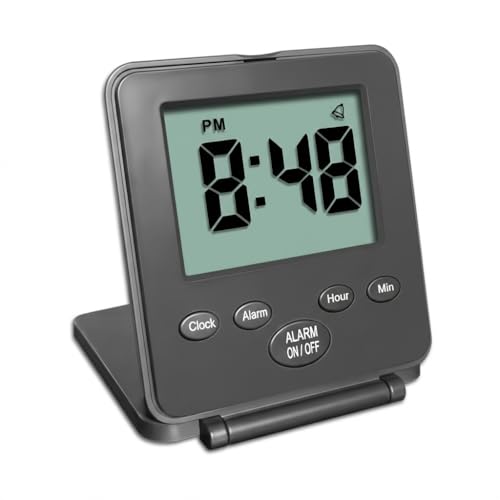
Travelwey Digital Travel Alarm Clock — Best Folding Classic
The Travelwey is the design most travellers picture when they picture a travel clock, refined by years of being exactly that. Its listing describes a small battery digital with snooze and light in black, folding, with an on/off switch for travel, a light on demand, and a shape that fits a bag or a bedside. The fold does three jobs at once: it protects the display face in a packed bag, it forms the stand when opened on a nightstand, and it keeps the clock’s profile slim enough for the corner of a wash bag or a jacket pocket on a short trip.
The on/off switch deserves its reputation. Battery clocks without one can be triggered in luggage — buttons pressed by a shoe, an alarm set off against a suitcase wall — and arrive depleted or, worse, beeping inside a bag at a border. A true off switch makes the clock inert for the journey and instant at the destination. That single control is the difference between a clock designed for travel and a small clock merely taken travelling.
Its virtues are the virtues of restraint. The display tells the time, the light appears when asked, the snooze is where a hand expects it. Travellers who want temperature, calendar and modes should read on to the MeesMeek and NOKLEAD; travellers who want the classic instrument, perfected and unbothered, will recognise the Travelwey as the one that has been riding in carry-ons for years precisely because it never tries to be anything else.
- Form: folding, fits a bag or bedside
- Power: battery operated
- Light: on demand
- Travel control: on/off switch for travel
- Alarm: with snooze
Strengths
- Folding shell protects the face and forms its own stand.
- Travel on/off switch prevents in-bag alarms and battery drain.
- Small and simple enough for any bag, any trip, any traveller.
Trade-offs
- No temperature or calendar display; information minimalists only.
- Single-alarm simplicity will not run two schedules.
- Volume options are not stated in the listing, so very heavy sleepers should compare the FAMICOZY’s stated levels.
Best for: frequent flyers, minimal packers and anyone buying a first travel clock.
Not suited for: travellers who want a data-rich display.

SHARP Battery Alarm Clock Soft-Touch Case — Best Protected Case
Travel clocks die by impact more often than by electronics, and the SHARP is built around that fact. Its listing leads with a soft-touch rubberised case in charcoal black, battery operation, a blue backlight on demand, an ascending alarm, snooze and easy operation. The case is not a cosmetic finish; it is armour with a pleasant hand-feel, the kind of surface that survives being dropped on a tiled bathroom floor in an unfamiliar rental and shrugged off. For clumsy packers, young travellers and anyone whose clock rides in a gym bag, that case is the feature.
The ascending alarm suits the traveller’s psychology. Waking in a strange room is disorienting enough without a siren; an alarm that begins gently and climbs gives the brain a few seconds to remember which city this is before insisting on the day. The blue backlight on demand follows the same courtesy — bright enough to read, brief enough to preserve both the battery and your night vision’s remains.
Easy to use, the listing’s closing promise, is the travel virtue that outranks all others at 11 p.m. in a new time zone. A clock that can be set correctly by a tired person, in poor light, without instructions, will be set correctly; a clever clock will be set approximately and forgiven until the morning it matters. The SHARP’s restraint in features is what buys that ease, and travellers who value arrival-night simplicity over display data will find this the most reassuring object in the guide.
- Case: soft-touch rubberised, charcoal black
- Power: battery operated
- Light: blue backlight on demand
- Alarm: ascending, with snooze
- Controls: described in the listing as easy to use
Strengths
- Rubberised case shrugs off the drops travel guarantees.
- Ascending alarm wakes gently in unfamiliar rooms.
- Simple controls stay usable through jet lag.
Trade-offs
- No folding shell, so the face travels less protected than the Travelwey’s.
- Display data is minimal; no temperature or calendar is named in the listing.
- Battery type and count are not given in the listing, so check before packing spares.
Best for: rough packing, young travellers and anyone who drops things.
Not suited for: data-display lovers or travellers needing weekend modes.
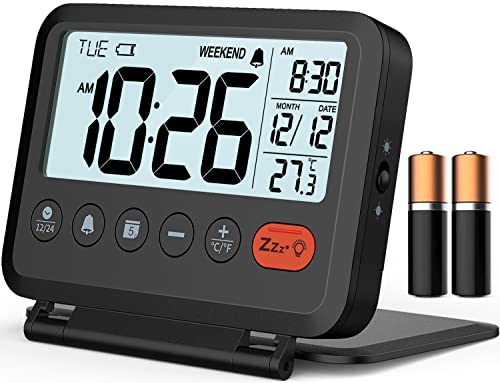
MeesMeek Digital Travel Alarm Clock — Best Information Display
The MeesMeek treats the travel clock as a small instrument panel. Its listing specifies a battery operated clock with a 5-second backlight, a 3.54-inch LCD display, a 9-minute snooze, weekend mode, two volume levels, temperature and calendar, with the battery included. That last detail — battery included — is a traveller’s kindness: the clock works out of the box, in the airport hotel, on the first night, without a scavenger hunt for cells in an unfamiliar town.
Weekend mode is the feature holidaymakers will feel most. The clock can hold a weekday alarm that simply does not fire on Saturday and Sunday, ending the oldest travel-clock betrayal: the 6 a.m. work alarm on the first morning of the holiday, in the room you paid extra for the quiet of. Two volume levels give the alarm a choice of voices — full for the work trip, lower for the family house with thin walls — and the temperature readout answers the traveller’s nightly question of how the room will feel by morning, presented as the clock’s own reading rather than a laboratory claim.
The 3.54-inch display is large for the category, which cuts both ways: it reads beautifully from a hotel bed, and it asks a little more bag space than the folding minis. Travellers who pack by the gram should weigh that; travellers who pack by the trip’s comfort will not notice the difference and will enjoy the calendar every time a multi-city itinerary blurs the date. This is the business traveller’s and the long-trip planner’s pick.
- Display: 3.54-inch LCD with temperature and calendar
- Light: 5-second backlight
- Alarm: 9-minute snooze, 2 volume levels
- Mode: weekend mode
- Battery: included per listing
Strengths
- Richest display here: time, temperature and calendar at a glance.
- Weekend mode protects holiday mornings from the work alarm.
- Battery included means it works on the first night anywhere.
Trade-offs
- Larger display means a larger packing footprint than the folders.
- No protective fold or rubber case is named in the listing.
- Feature richness means a slightly longer first setup than the simplest picks.
Best for: business travellers, long itineraries and holidaymakers who fear their own weekday alarm.
Not suited for: ultralight packers.

Peakeep Small Analog Travel Alarm Clock Silent — Best Analog Traveller
Every other pick here is digital; the Peakeep is the analog dissenter, and its listing makes the case plainly: a small battery operated analog travel alarm clock, silent with no ticking, lighted on demand, with snooze, beep sounds, a gentle wake ascending alarm and easy set, in black. Silence is its travel superpower. Hotel rooms amplify small sounds at night, tents amplify them more, and a ticking clock in a light sleeper’s luggage is a companion that outstays its welcome by the second night. The Peakeep glides instead.
The ascending beep continues the gentleness: a wake that begins softly and builds, suited to shared rooms, family homes and the traveller who is technically the guest. Lighted on demand means the dial can be checked in the dark with a press, then returns to darkness and battery thrift. Easy set matters doubly on an analog, where the alarm is a fourth hand positioned by a knob; a well-made knob and a clear dial turn that into a ten-second ritual rather than a squinting negotiation.
Analog travel clocks ask one honest trade: no calendar, no temperature, no modes — the dial shows the time and the alarm hand shows its intention, and that is the whole instrument. For travellers whose phones already carry the data and who want the bedside object to be calm, silent and beautiful in its restraint, the Peakeep is not the compromise pick. It is the point.
- Movement: analog, silent, no ticking
- Power: battery operated
- Light: lighted on demand
- Alarm: beep, gentle ascending, with snooze
- Setting: described in the listing as easy set
Strengths
- Silent movement suits hotels, tents and light sleepers.
- Gentle ascending alarm respects shared and strange rooms.
- Analog dial needs no menus, modes or instructions, ever.
Trade-offs
- No temperature, calendar or weekend mode — the dial is the whole display.
- Analog alarm precision is to the few minutes, set by hand and eye.
- Dial size is not stated in the listing, so distance readability should not be assumed.
Best for: light sleepers, analog loyalists and calm travellers.
Not suited for: data seekers or anyone needing minute-exact alarms.

FAMICOZY Compact Digital Travel Alarm Clock — Best Bold and Simple
The FAMICOZY’s listing reads like a traveller’s checklist answered in order: a compact digital travel alarm clock with high/low volume options, simple to set, easy to read, bold digits, snooze backlight, quality construction, running on 2 AAA batteries, in black. Bold digits headline it. Travel clocks are read at the worst moments — 4 a.m., one eye open, glasses elsewhere — and a display that survives those conditions without a backlight press is worth more than a cleverer clock’s extra data.
High and low volume is the two-traveller feature: high for the deep sleeper in a noisy city hotel, low for the light sleeper in a quiet country rental, chosen in one decision rather than negotiated with a pillow over the speaker. Simple to set is the third promise and the one that will be tested nightly; a clock that a tired arrival can programme correctly in under a minute earns its bag space every trip. The 2 AAA power source is the traveller’s friend worldwide, the battery most easily replaced in any town on earth.
Quality construction, the listing’s own phrase, is the claim time will audit; compact clocks live hard lives in bags and bathrooms, and a well-built small case is the difference between a five-year companion and a one-trip purchase. Buyers wanting modes and mirrors should read the NOKLEAD next; buyers wanting the bold, simple instrument will stop here, as many have.
- Display: bold digits, easy to read
- Alarm: high/low volume options, snooze
- Light: backlight for snooze checks
- Power: 2 AAA batteries
- Setting: described in the listing as simple to set
Strengths
- Bold digits readable at the worst hour with the worst eyes.
- Two volume levels cover deep and light sleepers in one clock.
- AAA batteries are replaceable anywhere in the world.
Trade-offs
- No folding or mirrored case is named in the listing.
- Temperature and calendar are not given in the listing.
- Weekend mode is none stated in the listing, so holiday sleepers must switch the alarm manually.
Best for: travellers who read clocks at 4 a.m. without glasses, and simplicity seekers.
Not suited for: mode lovers or mirror wanters.

NOKLEAD Travel Alarm Clock Foldable with Mirror — Best with Mirror
The NOKLEAD folds, and what it folds around is a small vanity: its listing describes a foldable battery operated clock with a mirror, a compact 3.23-inch LCD showing temperature and calendar, a 9-minute snooze, a 10-second blue backlight and weekday mode. The mirror is not a gimmick. In hostel bunks, festival tents, overnight trains and the guest bathrooms of the world, a mirror that travels with the clock serves the morning’s other half — the face that must be made presentable after the alarm has done its work. Two objects become one, and the wash bag gets lighter.
The display spec is the MeesMeek’s rival at a slightly smaller scale: temperature and calendar on a 3.23-inch LCD, with a 10-second blue backlight that gives a slower, more readable burst of light than the five-second standard — long enough, at 4 a.m., to absorb time, date and temperature in one press rather than two. Weekday mode repeats the MeesMeek’s holiday protection, keeping work alarms in their working days.
The fold protects both the screen and the mirror in transit, which is the design’s quiet intelligence: the two fragile faces close against each other and the case takes the journey’s knocks. Travellers for whom the mirror is pointless should take the Travelwey’s purer fold; travellers who have ever applied eyeliner by phone-light in a tent will understand the NOKLEAD instantly and completely.
- Form: foldable, with mirror
- Display: 3.23-inch LCD with temperature and calendar
- Light: 10-second blue backlight
- Alarm: 9-minute snooze
- Mode: weekday mode
Strengths
- Mirror deletes a second object from the wash bag.
- Ten-second backlight is the most readable night check here.
- Fold protects screen and mirror together in transit.
Trade-offs
- Mirror adds a fragile element the plain folders do not carry.
- Volume levels are not stated in the listing.
- Battery details are not given in the listing, so spares planning needs a check.
Best for: campers, festival and train travellers, and anyone who packs a mirror anyway.
Not suited for: travellers who want the simplest possible clock.
How Do the Six Travel Clocks Compare at a Glance?
| Pick | Form | Display extras | Distinguishing feature |
|---|---|---|---|
| Travelwey Digital Travel Alarm Clock | Folding | None | Travel on/off switch |
| SHARP Battery Alarm Clock Soft-Touch Case | Soft-touch case | None stated | Ascending alarm, rubberised case |
| MeesMeek Digital Travel Alarm Clock | Compact digital | Temperature, calendar | Weekend mode, battery included |
| Peakeep Small Analog Travel Alarm Clock Silent | Analog | None | Silent movement |
| FAMICOZY Compact Digital Travel Alarm Clock | Compact digital | None given | Bold digits, two volumes |
| NOKLEAD Travel Alarm Clock Foldable with Mirror | Foldable + mirror | Temperature, calendar | 10-second backlight |
Why Not Just Trust the Hotel Clock or Your Phone?
Because both have failure modes that cluster on exactly the mornings that matter. Hotel clocks are set by previous guests, baffled by housekeeping, or absent; the wake-up call is a human system with human error in it. Phone alarms fail by battery, by silent switch, by the update that reboots at 3 a.m., by the charger left in the previous city. A battery travel clock fails by almost nothing: its batteries fade slowly and audibly in the alarm’s weakening voice weeks before they die. Travellers who cannot miss the flight, the train or the trailhead carry the clock whose failures are gradual and announced, and they sleep the deeper for it.
There is a second, quieter reason: continuity. The same clock, with the same alarm sound, in every room, gives the travelling brain one fixed point. Sleep scientists talk about the first-night effect — half the brain staying alert in a new place — and familiar objects are its known remedy. Your own small clock, ticking or gliding beside an unfamiliar pillow, is a piece of home that fits in a wash bag.
How Do You Pack a Travel Clock So It Survives the Trip?
Use the protections the designs offer. Fold the folders — that is what the hinge is for — and let the Travelwey’s switch stand guard over its battery. Give the SHARP’s rubber case the outside of the packing cube, where its toughness protects softer things. Keep any clock out of the toiletries bag’s wet zone; battery compartments and shower gel are enemies. And on arrival, make the clock the first object out: set it on the nightstand, set the alarm, and the room becomes yours in the one way that matters at 6 a.m. Travellers who unpack the clock last, or leave it in the bag as a backup to the phone, have bought insurance and declined to carry the policy.
What About Time Zones, and the Alarm That Must Not Fire?
A travel clock holds one time zone honestly: yours, wherever you currently are. The discipline is to reset it on arrival, before sleep, as part of the room-claiming ritual — clock out, time set to local, alarm set, phone left to its own automatic adjustments for communication. Mixing the two, setting the clock from a phone still showing home time, is the classic first-night error; the ritual prevents it by making the clock the authority for waking and the phone the authority for everything else. For the alarm that must not fire — the holiday lie-in, the rest day — use the modes the MeesMeek and NOKLEAD provide, or the Travelwey’s honest off switch, rather than trusting a tired memory at midnight.
What Mistakes Do Travel Clock Buyers Make?
The first is buying a mains clock with a battery “backup” and calling it a travel clock; backup preserves settings, it does not run the clock, and the distinction is discovered in the first powerless room. Every pick here runs on batteries as its primary power. The second mistake is ignoring the in-bag problem — no fold, no case, no off switch — and meeting it as a dead or beeping clock at the destination. The third is choosing a rich display for a trip that needed simplicity, or a simple clock for a six-week itinerary that needed a calendar. The fourth is never test-firing the alarm at home. A travel clock, like a passport, should be checked before the journey, not during it.
How Long Will the Batteries Last, and Which Should You Carry?
Battery clocks sip rather than drink: an LCD or analog movement runs for many months on a set of cells, with backlight presses and alarm minutes as the main expenses. The honest variables are how often the light is used and how long the alarm rings each morning, which is why no listing here promises a figure and why this guide will not invent one. Carry the discipline instead: fresh batteries before a long trip, one spare set in the bag — the FAMICOZY’s AAA format makes that spare set findable in any shop on earth — and a note of the fitting date. The traveller who treats batteries as part of the packing list, beside adaptors and chargers, never meets the dead-clock morning at all.
How Do Travel Clocks Serve Campers, Sailors and Night Trains?
Off-grid travel is where battery clocks stop being conveniences and become equipment. A tent has no nightstand and no socket; a boat’s bunk has a socket you may not trust in a swell; a night train’s couchette has neighbours inches away through a curtain. The small clock answers all three: it stands on a groundsheet or a shelf lip, it asks nothing of the vessel’s electrics, and its alarm — chosen at the right volume, low on the FAMICOZY, ascending on the SHARP or Peakeep — wakes its owner without broadcasting to the whole carriage. Campers add one requirement: a backlight that works with gloves half-on and eyes barely open, which is the on-demand press these designs share.
Sailors historically kept the most disciplined time of any travellers, standing watches by the clock’s word, and the modern leisure version of that discipline is the anchor watch and the dawn departure for a tide. A battery clock below deck, indifferent to the shore-power connection, is the natural heir. If your travel includes water, tents or rails, weight the protective designs — fold, case, switch — as heavily as the display, because the environment will test the case long before it tests the timekeeping.
What Should Business Travellers Demand That Holidaymakers Can Skip?
Precision of routine. The business traveller’s clock is a professional tool: it must set in seconds at midnight in a new zone, fire exactly as expected at 5:40, and never require a manual, a menu dive or a prayer. That argues for the Travelwey’s switch-and-go simplicity or the MeesMeek’s calendar certainty on multi-city weeks, when the day of the week itself becomes a fact worth displaying. The business traveller should also rehearse the clock at home — one object, perfectly known, outperforms a new gadget bought at the airport every time, because the morning it serves is not a morning that forgives learning curves.
Holidaymakers can trade that rigour for comfort features: the mirror, the gentle ascending wake, the weekend mode standing guard over lie-ins. Neither traveller is wrong; they are buying for different mornings. The mistake is borrowing the other traveller’s clock — the executive precision instrument on a honeymoon, beeping at conference volume, or the charming analog on a dawn-flight itinerary that needed a snooze with a nine-minute promise.
How Do You Handle the Clock in a Shared or Family Room?
Family travel compresses everyone’s mornings into one room, and the clock becomes a negotiator. Set it for the earliest necessary riser and let its volume be the room’s decision, made the night before with everyone’s consent — children, told the plan, usually sleep through a modest alarm or rise with an excitement adults find exhausting and endearing. The ascending designs earn their keep here, giving light sleepers a chance to surface gently and deep sleepers a growing insistence, all from one setting. Place the clock nearer the riser than the sleeper, a geometry as old as the alarm clock itself.
For the parent rising before dawn to catch a run or a quiet hour, the discipline reverses: clock on the far side of the riser, volume at its lowest effective setting, clothes laid out beyond the door. A travel clock’s small courtesies — a brief backlight instead of a lamp, a snooze that does not require a screen — are what make one person’s early morning survivable by everyone else’s sleep.
Why Does the Snooze Interval Matter More on the Road?
At home, snooze is a habit; on the road it is arithmetic. Nine minutes — the interval the MeesMeek and NOKLEAD both specify — is the industry’s settled compromise: long enough to feel like sleep, short enough to grant two snoozes inside a twenty-minute safety margin. Travellers should plan backwards from the hard deadline — the departure, the boarding, the tour’s meeting point — and set the alarm so that the maximum snoozes they might actually take still land them upright in time. The clock cannot know about the airport’s distance or the border queue; the margin is the traveller’s contribution, and the honest ones build it the night before rather than negotiating with the snooze button at dawn.
How Should You Test a Travel Clock Before the First Trip?
Give it a home trial with travel rules. Set it on a Friday night for a Saturday hour that matters mildly — a market, a match, a train to somewhere pleasant — and let it be the only alarm. Note how the backlight reads in true dark, whether the alarm’s volume suits a quiet house, how the fold or case behaves on a real nightstand. Pack it in the bag you will actually carry and unpack it once, timing the setup; a clock that takes five fiddly minutes at home will take ten in a jet-lagged midnight. Travellers who run this rehearsal discover their clock’s one quirk while the stakes are a missed farmers’ market, which is exactly when such discoveries should be made.
What Is the Case for Carrying Two Alarms?
Professional travellers — pilots, medics on call, anyone whose lateness has consequences beyond embarrassment — often run a primary and a backup: the phone for its convenience, the battery clock for its independence, set ten minutes apart. The logic is failure-mode diversity: the events that kill a phone alarm (flat battery, silent switch, a crashed update) do not touch a battery clock, and the event that kills a battery clock (exhausted cells, announced for weeks by a weakening ring) does not touch a phone. Two alarms that share no weakness are not paranoia; they are engineering. The small clocks in this guide are cheap insurance in weight and money, and the travellers who carry them are, empirically, the ones telling the story of the morning everyone else overslept.
How Do Travel Clocks Help Children Sleep Away From Home?
A child’s own clock is a portable piece of the bedroom’s order. In a grandparent’s spare room or a holiday rental, the familiar object with its familiar alarm sound tells a small traveller that mornings work the same here as at home — a reassurance out of proportion to the object’s size. The Peakeep’s silence and gentle ascent suit young sleepers, and a backlight press gives an older child the small sovereignty of checking the time without summoning a parent. Families who travel often let the child pack the clock themselves; ownership of the ritual is the point, and a child who sets their own alarm in a strange house is learning the exact skill the whole category exists to teach.
What Happens When the Clock Comes Home?
A good travel clock earns a second life between trips. It becomes the guest room clock, the bathroom clock for timing showers and teeth, the garden-office clock that never needs a socket, the power-cut sentinel that lives in a drawer with the torch. Households often find the travel clock quietly becoming the most-used clock they own, precisely because its independence makes it placeable anywhere. That afterlife should inform the purchase: buy the clock you would be happy to meet in your own guest room, with a face you like and an alarm you trust, and the object will serve fifty weeks a year instead of two — the best value arithmetic in this entire guide.
How Do You Read a Travel Clock in the Dark Without Waking Anyone?
The on-demand backlight is a small social technology: a press, a few seconds of glow, darkness restored. Its timed brevity — five seconds on the MeesMeek, ten on the NOKLEAD — is calibrated to a glance, and the traveller’s skill is to need only the glance. Read the time, release, and let the room return to night; the partner, the child in the travel cot and your own half-asleep brain all benefit from light that visits rather than moves in. Analog travellers have the Peakeep’s lighted-on-demand dial, the same courtesy in an older dialect. What none of these clocks does is glow all night, and that absence is a feature the battery budget and the room’s sleepers share an interest in protecting.
Why Do Some Travellers Refuse Digital and Pack Analog?
Beyond silence, the analog case is about legibility of a different kind. A dial shows the shape of the night: the distance between now and the alarm is visible as an angle, graspable by a brain too tired for arithmetic. Digital numbers demand a small calculation — it is 3:12, the alarm is 6:30, that is three hours and change — while hands simply show a shrinking wedge of darkness remaining. Travellers who cross time zones report the analog face kinder to a displaced sense of time, and the Peakeep’s existence in this guide is our acknowledgment that the oldest interface in the category still wins some mornings outright.
How Should the Clock Handle Daylight Saving and Other Calendar Traps?
Travel clocks keep the time you give them; they do not negotiate with legislatures. The traps are human: arriving the night the clocks change, in a country whose changeover date differs from home, and waking an hour adrift from the airport’s reality. The defence is the arrival ritual performed against a trusted local source — the station clock, the hotel’s own time, a phone that has already joined the local network — and, for the calendar-rich MeesMeek and NOKLEAD, a glance at the date as well as the hour, since the traveller’s other classic error is the right time on the wrong day. A battery clock’s honesty is that it shows exactly what it was told; tell it carefully, once, on arrival.
What Makes a Travel Clock a Good Gift?
It is given to people at thresholds: the student leaving for university, the friend taking the job with the travel in it, the parent finally taking the trip deferred for decades. The right model signals that the giver thought about the recipient’s actual journeys — the folding Travelwey for the carry-on minimalist, the mirrored NOKLEAD for the camper, the soft-cased SHARP for the grandchild whose possessions live hard lives. Include the batteries, set nothing, and write the alarm-test advice on the card. A travel clock is a small, serious wish: that wherever they wake, they wake on time and in command of the morning. Few gifts at this size carry that wish as literally.
How Much Should a Travel Clock Weigh in Your Packing Decisions?
Every pick here is small, but small is not a weight class, and travellers who count grams will feel the difference between the folding minis and the larger-LCD MeesMeek. The honest accounting includes what the clock replaces: the NOKLEAD deletes a mirror, the MeesMeek deletes a calendar-checking phone habit, and any of them can delete the anxiety-weight of an unreliable hotel clock, which frequent travellers will tell you is the heaviest item in the bag. Judge the clock against the system it joins, not against an empty pocket. A few dozen grams that guarantee the morning are among the best-spent in the whole packing list, and the travellers who begrudge them are usually found, once a year, sprinting through an airport in yesterday’s clothes.
How Do Travel Clocks Cope With Hostels and Other Communal Sleep?
Communal sleeping rewrites alarm etiquette. In a dormitory bunk, your 6 a.m. alarm is a public announcement unless you manage it: volume at the lowest effective setting — the FAMICOZY’s low option exists for this room — the clock inside the bunk’s curtain where its sound is muffled for others and clear for you, and a snooze discipline of exactly one, pre-committed. The ascending alarms help by beginning below the threshold that wakes a room. Many hostel travellers pair the clock with placement rather than power: beside the pillow, under its edge if necessary, so the alarm’s audience is an audience of one. Courtesy at dawn is remembered by strangers with surprising warmth, and the traveller who masters the quiet wake-up is welcome in every bunk room on earth.
What Should You Do on the Morning the Clock Is the Only Alarm?
Some mornings the travel clock carries the whole day: the phone is dead, the hotel call was never booked, the companions are relying on you. The preparation happened the night before — fresh confidence in the batteries, the alarm test-fired at setting time, the clock placed where a sleepy hand cannot silence it by accident. On such mornings, honour the instrument with a margin: set it fifteen minutes earlier than the plan strictly needs, and let the surplus become a calm breakfast rather than a platform sprint. Travellers who build that margin report a curious effect: the mornings with the most at stake become the calmest of the trip, because the one system that had to work was the one system fully within their control.
How Does a Travel Clock Change the First Night in a New Place?
The first night away is the worst night’s sleep most travellers get, and the clock is part of the small set of rituals that improve it. Arrive, claim the room, and put your own objects in their travelling places: the clock on the nightstand, showing your set time and your set alarm, is a declaration that this room, too, will obey the household’s order. Psychologists call such objects anchors; travellers call them the difference between a room and their room. The clock’s contribution is uniquely temporal — it promises that the night has a known length and a planned end, which is precisely the uncertainty a displaced brain worries at in the dark. Set the alarm, and the night becomes a bridge with a far side, rather than an open sea.
Why Does Every Seasoned Traveller’s Clock Look Slightly Beaten Up?
Because it has been somewhere. The scuffed case, the fold’s softened hinge, the battery door taped by a traveller who lost the original clip in Patagonia — these are not damage so much as a service record. Travel clocks are among the few objects that accompany their owners through the dislocated, high-stakes hours of journeys, and they accumulate the marks honestly. This is one more argument for the protective designs in this guide and against preciousness in choosing one: buy the clock that can be dropped, packed and lent without a flinch. The traveller’s clock that still looks new after five years is either a marvel of care or a clock that never really travelled, and only its owner knows which story they would rather be able to tell.
How Do You Choose Between the Two Data-Rich Clocks?
The MeesMeek and the NOKLEAD both display temperature and calendar, both guard the weekend, and both light their faces in timed bursts — so the choice between them is really about form. The MeesMeek is a small panel: larger display at 3.54 inches, battery included, built to stand on a hotel nightstand and be read. The NOKLEAD is a folding case at 3.23 inches that adds a mirror and protects itself in the bag. Travellers whose clock lives on surfaces choose the MeesMeek; travellers whose clock lives in luggage choose the NOKLEAD. It is the guide’s cleanest illustration of its own thesis: in travel gear, the right answer is usually a shape, not a specification, and the shape is dictated by where the object spends the journey — open and working, or closed and riding.
Final Recommendation
Match the clock to the traveller. The classic journey — bag, hotel, early start — belongs to the Travelwey Digital Travel Alarm Clock, and the rough journey belongs to the SHARP Battery Alarm Clock Soft-Touch Case. The long, complicated itinerary belongs to the MeesMeek Digital Travel Alarm Clock, with its calendar, temperature and holiday-protecting weekend mode.
The light sleeper packs the silent Peakeep, the glasses-free reader packs the bold FAMICOZY, and the camper packs the NOKLEAD and leaves a separate mirror at home. Whichever rides with you, give it the nightstand, set it first, and let it be the authority — because the whole point of a travel clock is that one small object, in every strange room on earth, keeps your time exactly as faithfully as it did at home, in every port, platform and pasture the journey offers.
Frequently Asked Questions
Do these clocks run entirely on batteries?
Yes. Battery operation is the entry requirement for this guide: each pick keeps time and sounds its alarm with no mains power, which is what makes them travel clocks rather than bedside clocks with a backup.
Will a travel clock’s alarm go off inside my luggage?
It can if buttons are pressed in transit, which is why designs differ: the Travelwey has a travel on/off switch, and the folding models close their faces away from the bag’s pressure. Switch off or fold before packing, and check the alarm state on arrival.
Which of these is easiest to read at night?
The FAMICOZY’s bold digits for unaided reading, and the NOKLEAD’s 10-second backlight for lit reading. The MeesMeek’s large LCD sits between them, with the most information to read once lit.
What does weekend mode actually do?
It lets a weekday alarm skip Saturday and Sunday automatically, so the work schedule survives the holiday without firing into it. The MeesMeek lists weekend mode and the NOKLEAD lists weekday mode — the same kindness described from opposite ends of the week.
Is an analog travel clock precise enough for a flight?
Yes, with the analog caveat: set it carefully, test it once at home, and allow its few-minutes character into your planning by setting the alarm a little early. Generations of travellers caught trains on analog alarms; the instrument is proven, the ritual is the precision.
What is the first thing to check when I unpack the clock?
That the journey did not change its mind: confirm the time survived, the alarm is in the state you left it — off if you switched it off, set if the first morning is already planned — and the fold or case took no damage that matters. Thirty seconds at unpacking prevents the one failure this category cannot survive, which is a surprise discovered at bedtime.
Should I set my travel clock to home time or local time?
Local time, always, for the alarm’s sake — flights, tours and breakfasts all run on local time, and a clock showing home time invites exactly the arithmetic error jet lag makes likely. Let the phone keep home time for calling family; let the clock own the place you are sleeping in. Reset it as part of the arrival ritual, before the first sleep, and the question never has to be asked again at 4 a.m.
Can a travel clock wake me without waking my roommate?
It can come close. Choose an ascending or low-volume model — the SHARP and Peakeep ascend, the FAMICOZY offers a low setting — place it on your side, inside the bunk curtain or beside your pillow, and commit to a single snooze. No alarm is truly private in a shared room, but a managed one is a courtesy most roommates will accept without a word.
How do I stop my clock losing time across a long trip?
Battery clocks keep time well; the usual culprit is a battery nearing its end, which slows the clock before it stops it. Fit fresh cells before a long trip, carry one spare set, and check the clock against local time at each arrival ritual. If it drifts noticeably with fresh batteries, retire it at home rather than mid-journey.
Which batteries should I pack as spares?
Match the clock: the FAMICOZY’s listing specifies 2 AAA, the most available battery on earth. Where a listing does not state the battery type, check the product details before the trip rather than at the destination.
Related Guides
Back home, the bedside version of this discipline continues in Best Digital Alarm Clocks with Temperature Sensor; the trip’s daylight hours are covered by Best Cotton Bamboo Towels for the spa stop; and the wide-fit traveller’s feet are served by Best Wide Slippers for Men.


