What's inside
- Key Takeaways
- Quick Picks
- How Did We Choose These Picks?
- Comparison Table
- What Makes a Clock’s Light Good Enough to Replace a Lamp?
- How Do Sunset Modes Actually Help an Evening?
- Which Rooms Suit Which of These Clocks?
- How Do You Set Up a Light Clock for the First Week?
- What Are the Most Common Mistakes Buyers of Light Clocks Make?
- Final Recommendation
- What Should You Know About Light Colour and Your Evenings?
- How Do Light Clocks Compare With a Separate Lamp and Clock?
- What About Power, Cords and the Reality of Nightstands?
- How Do You Maintain a Light Clock?
- Which Households Should Skip Light Clocks Entirely?
- How Does a Light Clock Fit a Child’s Bedroom?
- What Do Owners Learn After the First Month?
- How Should Couples With Different Schedules Share One?
- What Is the Right Budget Logic for a Lamp-Clock?
- Frequently Asked Questions
- Related Guides
As an Amazon Associate I earn from qualifying purchases. This post may contain affiliate links at no extra cost to you.
cottageverdict.com is reader-supported. When you buy through links on our site, we may earn an affiliate commission.
Where to buy: each clock below links to its Amazon listing, where you can check price on Amazon and study the lamp’s brightness range, colour behaviour and dimming controls in the manufacturer’s specification. For a product you will look at every night, those lamp details matter as much as the alarm details, and they are exactly what the listings document best.
The best alarm clocks with bedside lamps exist because the nightstand is the most contested square foot in the home. A lamp, a clock, a phone charger, a book and a glass of water all claim the same small territory, and something usually loses. A clock whose lamp is genuinely good, not a glowing novelty bolted to a timer, reclaims that territory in a single object: one plug, one footprint, and light that serves the room from the first page of the evening’s reading to the simulated dawn that starts the next day.
Judging these products means judging two appliances at once, and most roundups judge only the clock half. A bedside lamp has its own standards. It must dim low enough to find a corridor at 3 a.m. without waking a partner, rise bright enough to read small print without eye strain, throw its light in a direction that flatters a page rather than the ceiling, and shift its colour warmer as the evening deepens, because bright white light at midnight argues with the body’s sense of what time it is. The six clocks below were chosen by those lamp standards first and alarm standards second, which inverts the usual order deliberately.
Within the six, two philosophies compete. The Philips and JALL models treat light as a programme, a dawn that builds and a dusk that fades on schedule. The Hatch and Loftie treat light as one instrument in a wider sleep environment, bundled with sound libraries and app-led routines. The REACHER takes the sunrise idea to a friendlier price, and the original Philips HF3520 remains the benchmark the others are measured against. Every one of them can also simply be a lamp, switched on for reading and off for sleep, which sounds obvious until you meet rivals whose light only exists inside their alarm theatre.
Key Takeaways
- Judge the lamp first: dimming range and warm colour at low levels decide nightly comfort more than alarm volume.
- Sunrise simulation and sunset fading are the two programmes worth paying for; colour discos are not.
- A tap or button you can find half-asleep matters more than an app you must unlock.
- The Philips Sleep and Wake-Up Light offers the most refined light; the REACHER brings sunrise waking to a modest budget.
- Clocks with screens should dim to true darkness, or the lamp you bought for evenings becomes a glare all night.
- One object on the nightstand means one plug, one cable and a surface that finally fits the book and the water glass.
Quick Picks
| Pick | Badge | Why it made the list |
|---|---|---|
| Philips SmartSleep Wake-Up Light HF3520 | The original sunrise benchmark | Coloured dawn and dusk simulation, natural sounds, FM radio and a tap-anywhere snooze in the design that defined the category. |
| Philips SmartSleep Sleep and Wake-Up Light | The refined flagship | A sculpted light with guided wind-down breathing, richer sunset colours and the most lamp-like presence on a nightstand. |
| JALL Sunrise Alarm Clock | The feature-packed all-rounder | Sunrise colours, a large sound library, radio, Bluetooth and a multicolour night light at a mid-level tier. |
| Hatch Restore 3 | The routine designer’s choice | Circadian lighting paired with a deep audio library and phone-free controls, built around a full evening-to-morning routine. |
| Loftie Clock | The minimalist’s lamp-clock | A warm adjustable glow, blackout mode and a two-phase alarm inside the most furniture-like object here. |
| REACHER Sound Machine Sunrise Alarm Clock | Sunrise on a budget | Dawn simulation, nature sounds and a fully dimmable face in a compact clock that costs a fraction of the flagships. |
Read that table as a spectrum of lamp ambition. At one end the Philips flagship behaves like a piece of lighting design that happens to wake you; at the other the REACHER is an honest clock that borrows the sunrise idea and executes it simply. The middle is where most households land, and the detailed reviews are written to locate your nightstand on that spectrum rather than to push everyone toward the expensive end.
How Did We Choose These Picks?
Lamp quality came first, tested against four questions. Does the light dim smoothly to a level usable for a midnight corridor trip? Does it reach a brightness that supports reading in bed without a second lamp? Does its colour warm as it dims, the way lamplight should, or stay a flat electronic white? And can it be operated as a plain lamp, on and off at will, outside any alarm programme? Models that failed the plain-lamp question were excluded regardless of their dawn choreography, because a bedside lamp that only performs on schedule is a prop.
Clock quality came second, with emphasis on the hours around sleep. Displays had to dim to darkness or near it. Alarms needed a gentleness gradient, some path from light alone through soft sound, rather than a single blast. Snooze design was judged by touch: a tap on a dome, a large button, anything a hand can find without eyes or spectacles. Radio, Bluetooth and sound libraries counted as supporting features, welcome where they replaced a separate speaker on the nightstand.
Two fashionable features earned no points and should be named so readers can discount them elsewhere. Colour-cycling party modes appear on several rivals and on one pick here; they are harmless and irrelevant to waking or reading, and no model was promoted for possessing them. Voice control through external assistants likewise added nothing to a device whose whole virtue is working with your eyes shut, and in one case argued against a model whose basic lamp functions hid behind a microphone.
Ownership realities closed the selection. App-dependent models were checked for how much function survives without the phone, because a lamp you cannot light during a router outage fails the furniture test. Subscription elements were noted plainly rather than hidden, since a clock that rents back its own sounds library is a different purchase from one that owns them. Price tiers were spread deliberately from the REACHER’s budget bracket to the Philips flagship, so the guide serves a first flat and a forever home with equal honesty.

Philips SmartSleep Wake-Up Light HF3520 — The original sunrise benchmark
The HF3520 is the design that taught the market what a wake-up light could be, and its lamp credentials remain formidable. The dome glows through a graduated dawn that begins in deep red, warms through orange and arrives at a bright yellow-white, mimicking the colour journey of an actual sunrise rather than simply brightening a white bulb. At full strength it lights a small bedroom well enough to dress by; at its lowest it serves as a nightlight that will not bully a partner awake.
As a reading lamp it performs respectably, with the caveat that its light radiates in every direction from the dome rather than pooling on a page. Readers who share a bed may find that omnidirectional generosity lights the whole room when only one person is awake with a novel. The tap snooze is the interface detail owners praise for years: slap anywhere on the dome, half-asleep, and the sound pauses while the light stays, a design that acknowledges the state its user is in.
Five natural sounds and an FM radio cover the audio side without fuss, and the sunset programme reverses the dawn to mark bedtime. There is no app and no Bluetooth, which some buyers will count as missing features and others as the entire point. Against its own flagship sibling it lacks the guided breathing wind-down and the more sculpted form, but as a lamp that wakes, it remains the reference against which newcomers are quoted.
Longevity deserves a sentence, because this model has been sold, revised gently and sold again for years, and the second-hand market and spare-parts trail reflect that. A lamp-clock is a decade-scale purchase in most homes, and the HF3520’s long production run is the closest thing the category offers to a guarantee that the design was right. Buyers choosing between it and its flagship sibling are really choosing between proven simplicity and added evening refinement, and neither answer embarrasses the other.
- Light: coloured sunrise and sunset simulation, reading-lamp brightness
- Sounds: five natural sounds plus FM radio
- Controls: tap-anywhere snooze, onboard buttons
- Extras: sunset fading programme for bedtime
Strengths
- Dawn colour progression feels genuinely like morning arriving
- Tap snooze works with eyes shut and spectacles off
- No app or account stands between you and the lamp
Trade-offs
- Omnidirectional glow can light a partner’s side too
- No Bluetooth streaming for your own audio
- Design is familiar rather than striking
Best for: readers and risers who want the classic sunrise lamp without an app ecosystem. Not suited for: households wanting streamed music or a directional reading beam. Check price on Amazon.
Philips SmartSleep Sleep and Wake-Up Light — The refined flagship
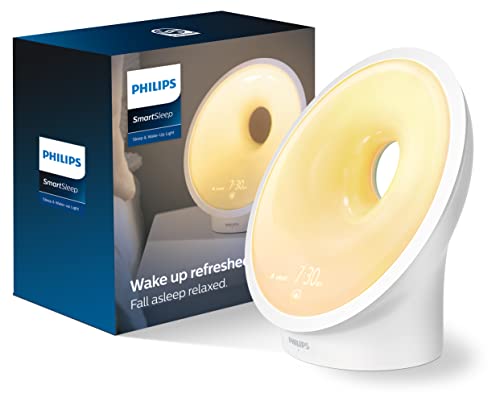
Philips’ flagship takes the HF3520’s idea and gives it a sculptor. The light rises from a sculpted column like dawn over a horizon, and the sunset programme is richer, drifting through ambers and reds while optional audio fades beneath it. Its signature addition is a guided wind-down that pulses the light gently to slow breathing before sleep, a lamp behaviour closer to a bedtime ritual than to a switch. Households that struggle more with falling asleep than with waking often find this end of the day is where the flagship earns its premium.
As a lamp across the evening it is the strongest here: bright enough at the top to replace a reading lamp for most people, capable of sinking to a ember-level glow, and warm in colour throughout its range. The display tucks into the base and dims intelligently. Sounds span nature recordings and radio, and the whole object has the finished, furniture-grade presence that justifies its nightstand territory against a separate lamp and clock combined.
The honest costs are its price tier, the highest in this guide, and a control scheme that rewards a careful first setup. Guests confronted with it cold will manage the lamp and fail the menus, so hosts should set the programmes for them. For the owner who lives with it nightly, those menus become muscle memory within the week, and what remains is the best light in the category attached to a very good clock.
There is a ritual quality to its evenings that owners describe with unusual affection: the light begins its descent, the room’s colour warms and lowers, and conversation, reading and finally silence follow the gradient down. It is the closest any product here comes to the feeling of a sunset watched from a porch, compressed into furniture. Households that entertain the idea of lighting as part of the home’s emotional furniture, rather than as plumbing, will understand the flagship’s price as the category’s honest top rather than its indulgence.
- Light: sunrise and sunset simulation with guided breathing wind-down
- Sounds: multiple nature sounds and FM radio
- Controls: onboard with app-free operation
- Form: sculpted column, furniture-grade finish
Strengths
- Most refined light quality and colour journey here
- Wind-down programme serves the falling-asleep end of the night
- Bright enough to be the room’s only bedside lamp
Trade-offs
- Highest price tier in this guide
- Menus need a deliberate first setup
- Too much appliance for a guest room
Best for: primary bedrooms where the lamp-clock replaces both lamp and clock for years. Not suited for: spare rooms, tight budgets, or anyone who wants zero setup. Check price on Amazon.

JALL Sunrise Alarm Clock — The feature-packed all-rounder
The JALL approaches the lamp-clock from the opposite direction to Philips: instead of refining one idea, it gathers nearly all of them. Sunrise simulation in warm colours, a sunset counterpart, a night light offering a rainbow of shades, a sound library spanning wake tones and white noise, FM radio, Bluetooth streaming and dual alarms, all in a single mid-priced dome. For a teenager’s room or a first flat, where the nightstand budget must cover lamp, clock, speaker and night light at once, the arithmetic is compelling.
Judged strictly as a lamp, it is good rather than great. Maximum brightness wakes a room convincingly and the dawn build is smooth, but the colour at reading levels runs cooler than the Philips pair, and the coloured night-light modes are decoration rather than illumination. The dual alarms and generous snooze suit households with two schedules, and the display dims adequately for sleep.
Where the JALL quietly wins is resilience of purpose: if the sunrise idea delights you, it is here; if you tire of it, the clock remains a radio, a Bluetooth speaker and a lamp, still earning its plug. Owners should expect a first evening with the manual, because a device with this many modes organises them in menus that reward learning once and punish guessing forever. After that evening, it settles into being the hardest-working object on the nightstand.
One more audience claims the JALL disproportionately: shift workers and students in bedsits, where a single room must be office, lounge and bedroom and every object is audited for usefulness. A lamp, radio, speaker, night light and dual alarm in one footprint is not a luxury in that geometry; it is how the room functions. The colours that read as novelty in a master bedroom read as personality in a bedsit, and the guide declines to sneer at either.
- Light: sunrise and sunset simulation, multicolour night light
- Sounds: large library, white noise, FM radio, Bluetooth
- Alarms: dual with generous snooze
- Extras: doubles as bedside speaker
Strengths
- Replaces lamp, clock, speaker and night light in one purchase
- Dual alarms suit couples and staged routines
- Mid-level price for a long feature list
Trade-offs
- Reading light runs cooler than the Philips models
- Menus take an evening to learn properly
- Coloured light modes are novelty rather than utility
Best for: teens’ rooms, first flats and anyone consolidating a crowded nightstand on a budget. Not suited for: purists wanting the warmest reading light or the simplest controls. Check price on Amazon.

Hatch Restore 3 — The routine designer’s choice
The Restore 3 thinks in evenings, not alarms. Its programme runs backwards from bedtime: a wind-down phase of warm light and chosen audio, a night phase of darkness or the faintest glow with sleep sounds if wanted, and a morning phase where circadian-minded lighting brightens before a gentle alarm. The light itself is soft and diffuse, more lantern than lamp, which suits winding down beautifully and reading adequately for short stretches rather than long chapters.
Hatch’s defining decision is that the routine, once built in the app, runs from the device with big, findable physical controls: tap to move through phases, no phone glowing in the bedroom required. The audio library is deep, spanning meditations, stories and soundscapes, with the fuller catalogue sitting behind a subscription that buyers should price into the decision honestly. Without it, the device still covers the essentials; with it, the nightstand gains a content service.
The lamp-first buyer should note the trade clearly: this is a light for atmosphere and rhythm rather than a reading lamp, and its brightest levels will not replace a dedicated lamp for a devoted bedtime reader. As a system for households whose evenings feel chaotic and whose mornings feel abrupt, it is the most thoughtfully sequenced product in this guide.
Couples should note how the Restore handles the shared bed: its phases are a household programme, not a personal one, so it suits partners whose schedules roughly agree and frustrates those whose do not. Where it shines brightest is the solo bedroom or the couple in sync, where the whole room can exhale on schedule. The device’s calm industrial design, fabric-wrapped and pebble-like, also earns it a place in rooms where visible technology is unwelcome after hours.
- Light: circadian sunrise, warm wind-down glow
- Sounds: deep library of sleep audio and meditations via app
- Controls: large tactile on-device controls, app for setup
- Note: full audio catalogue involves a subscription
Strengths
- Evening-to-morning routine is the most complete here
- Physical controls keep the phone out of the bedroom
- Soft lantern light flatters small bedrooms
Trade-offs
- Not bright or focused enough for serious reading
- Best content sits behind a subscription
- Setup lives in the app even if daily use does not
Best for: households rebuilding their whole evening routine around light and sound. Not suited for: devoted bedtime readers or subscription refusers. Check price on Amazon.
Loftie Clock — The minimalist’s lamp-clock
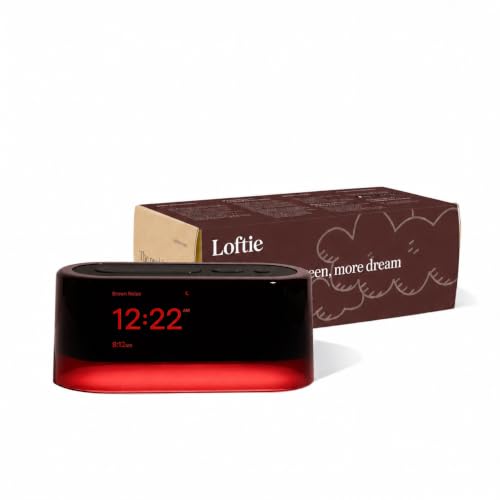
The Loftie looks like a small piece of furniture that happens to tell the time, and its lamp behaviour follows the same philosophy of restraint. A warm glow adjusts across a useful range for reading and for midnight navigation, and a blackout mode extinguishes the display entirely so the bedroom can be properly dark, a feature light-sensitive sleepers rank above every smart extra. Its alarm works in two phases, a gentle first call followed by a more insistent second, designed to mimic being woken by another person rather than by machinery.
Sound is the second pillar: a library of white noise and nature recordings, Bluetooth streaming for your own audio, and an offline mode that keeps the essentials running without WiFi. Loftie makes a point of needing no subscription for its core library, which distinguishes it from the Hatch across the aisle. The night light’s warmth suits bedrooms that favour calm over colour, and the whole object, especially in its softer shell colours, sits on a nightstand without announcing itself as technology.
Its lamp ceiling is lower than the Philips pair; this is a glow for ambience and short reads, not a flood for needlework. Buyers who want a lamp-clock that disappears into a serene bedroom, and who value darkness at night as highly as light in the morning, will find the Loftie the most congenial object in this guide.
The Loftie’s two-phase alarm deserves a closer description, because it embodies the brand’s whole theory. A first, soft sound stirs the sleeper and then retreats, granting a few minutes of surfacing that feel like being woken by a considerate person; the second phase arrives firmer, once the brain is near the surface. Owners who dread the single-blast alarm describe the pattern as the first clock that feels on their side. As a lamp it will not flood a room, but as a bedside companion it is unusually well mannered.
- Light: warm adjustable glow, night light, blackout display mode
- Sounds: library of over a hundred sounds, Bluetooth speaker
- Alarm: two-phase gentle-then-firm design
- Extras: offline mode, no subscription for core features
Strengths
- True blackout mode protects genuinely dark sleep
- Two-phase alarm wakes without a jolt
- Furniture-like design suits calm bedrooms
Trade-offs
- Lamp brightness tops out below the Philips models
- Premium tier for a deliberately simple object
- No sunrise colour journey for dawn enthusiasts
Best for: minimalists and light-sensitive sleepers who want lamp, clock and sound machine in one calm object. Not suited for: readers needing a powerful lamp or buyers wanting dramatic sunrise effects. Check price on Amazon.

REACHER Sound Machine Sunrise Alarm Clock — Sunrise on a budget
The REACHER demonstrates how far the sunrise idea has travelled down the price ladder. It builds a dawn across the minutes before the alarm, offers a library of nature-inspired sleep sounds, works as a night light, and dims its clock face across the full range to black. In a child’s room, a guest room or a first rental, that bundle answers the lamp-clock brief at a fraction of the flagship money.
The compromises live where you would predict. The light’s colour journey is simpler, closer to a brightening warm white than to the Philips’ painted dawn, and maximum brightness suits small rooms rather than grand ones. Sound quality from the compact body is pleasant at bedside volumes and thin beyond them. Controls are straightforward buttons rather than sculpted gestures, which many owners will count as a virtue.
What elevates the REACHER above other budget sunrise clocks is the dimming discipline: the face truly disappears at night and the night light can run without the clock glowing beside it. Households testing whether sunrise waking suits them at all should start here, because the experiment costs little and the clock remains useful as a sound machine and lamp even if the dawn idea fades.
Parents in particular report a use the designers may not have led with: the REACHER’s night light and sound library make it a nursery-to-bedroom graduate, starting as a white-noise companion and ending, years later, as the child’s first alarm. Few electronics survive that whole journey in a family, and a clock that begins by helping a household sleep and ends by helping it rise has justified its socket several times over.
- Light: sunrise simulation lamp with night light
- Sounds: nature-inspired sleep sound library
- Display: fully dimmable from bright to off
- Form: compact body for small nightstands
Strengths
- Sunrise waking at a genuinely modest tier
- Display dims completely for dark sleep
- Compact footprint suits children and guest rooms
Trade-offs
- Simpler colour journey than the premium dawns
- Speaker thins out at higher volumes
- Light output sized for smaller rooms
Best for: children, guests and anyone trialling sunrise waking without flagship money. Not suited for: large master bedrooms or buyers wanting the richest light quality. Check price on Amazon.
Comparison Table
| Pick | Lamp character | Wake style | Standout trait |
|---|---|---|---|
| Philips SmartSleep Wake-Up Light HF3520 | Coloured dawn dome, reading-capable | Light then natural sounds | Tap-anywhere snooze |
| Philips SmartSleep Sleep and Wake-Up Light | Finest light, guided wind-down | Light then sound | Breathing-led bedtime programme |
| JALL Sunrise Alarm Clock | Bright dome, colourful night light | Light, sounds, radio | Most features per coin |
| Hatch Restore 3 | Soft lantern glow | Phased routine | Evening-to-morning sequencing |
| Loftie Clock | Warm glow, blackout mode | Two-phase alarm | Calmest object here |
| REACHER Sound Machine Sunrise Alarm Clock | Simple warm dawn | Light then nature sounds | Budget sunrise, dark display |
What Makes a Clock’s Light Good Enough to Replace a Lamp?
Three properties separate a lamp from a glow. The first is range: the ratio between the brightest and dimmest settings must span the distance between reading a paperback and crossing the room at night without waking anyone, and most cheap light clocks fail at one end of that span, either too dim to read by or too bright to sleep near. The second is colour behaviour. Real lamplight warms as it dims, and the eye reads that warmth as evening; a clock whose low settings stay blue-white will feel like a phone screen at exactly the hours it should feel like a candle. The Philips pair handle this best here, with the Loftie’s warm glow close behind.
The third property is direction, and it is the one brochures never mention. A dome radiates; a shaded lamp pools. For solitary readers the dome’s generosity is pleasant, for couples it can be a nightly negotiation, and the practical answer is placement: the light clock on the reader’s side, angled where possible, with its lower evening settings doing the work after the other side of the bed has gone dark. None of the six is a directional task lamp, and a household with a serious needleworker or a student annotating textbooks in bed should keep a focused lamp and let the clock handle dawn and dusk.
How Do Sunset Modes Actually Help an Evening?
A sunset programme is a dimmer with a promise. Left to ourselves, most of us keep the bedroom at daytime brightness until the moment we intend to sleep, then ask the body to change state instantly. A lamp that begins fading half an hour before bedtime turns the room itself into a countdown, and the household starts drifting toward sleep the way it drifts toward a table when dinner smells ready. The Philips flagship’s guided breathing adds a metronome to that drift; the Hatch builds the whole evening around it.
The practical rules are simple. Start the fade earlier than feels necessary, pair it with the same sounds or silence each night, and let the lamp reaching darkness be the signal for phones to leave the room. Children respond to the programme particularly well because it replaces a parental announcement, which can be argued with, with an environmental fact, which cannot. The REACHER and JALL offer simpler versions of the same descent, and even a basic fade, honestly used, outperforms an elaborate one admired and ignored.
Which Rooms Suit Which of These Clocks?
The master bedroom rewards the flagships, because its lamp works every night for years and its occupants can amortise both the price and the setup evening. Put the Philips Sleep and Wake-Up Light where a couple wants one shared dawn, the Hatch where the evening routine itself is the project, and the Loftie where serenity and darkness outrank drama. The HF3520 remains the connoisseur’s value pick in this room, all of the dawn with none of the ecosystem.
Children’s rooms and teenagers’ rooms want durability of purpose more than refinement: the JALL’s everything-in-one abundance, or the REACHER’s gentle dawn and night light for younger children who need the corridor glow as much as the alarm. Guest rooms want the opposite of a learning curve, which argues for the REACHER or a simple Philips dawn the visitor can operate by instinct. A studio flat, where the bedside lamp is also the room’s evening lamp, should look hardest at the Philips pair, because their top brightness can carry a small living space after dark.
How Do You Set Up a Light Clock for the First Week?
Begin with the lamp, not the alarm. Spend the first evenings learning its range as a reading and night light, set the display’s night brightness honestly, and only then programme the dawn, starting the simulation earlier and dimmer than your ambition suggests. Most owners who abandon sunrise clocks set the dawn too short and too bright, manufacturing a prettier version of the same jolt they were escaping. Thirty unhurried minutes of build is the classic recipe; adjust in five-minute steps across the week.
Placement experiments belong in that first week too. Try the clock at the near corner of the nightstand and then the far corner; a dome’s dawn feels different at arm’s length than at a metre, and the reading light’s pool moves with it. Note where the water glass and book now live, because a lamp-clock that forces the rest of the nightstand into exile has failed its founding purpose even if its dawn is beautiful.
Keep a conventional backup alarm armed for the first fortnight, set a few minutes after the light clock, and retire it only when the diary shows the dawn doing the work alone. That safety net lets you experiment with gentler settings without gambling a workday on the experiment, and experimentation is where the personal settings, your brightness, your sound, your fade length, actually get found.
What Are the Most Common Mistakes Buyers of Light Clocks Make?
The favourite mistake is buying the dawn and ignoring the dusk, using a sophisticated light programme to wake while keeping a glaring ceiling light until midnight. The second is placing the clock across the room for the walk-to-silence trick, which works for bells and ruins lamps, whose light should arrive from beside the pillow. Third, owners leave the display at daytime brightness and then blame the clock for a restless night that its own glow engineered. Fourth, couples buy one light clock for a bed where two schedules collide, when the honest answer is a dawn for the early riser and a dark, silent clock for the other side. The last mistake is expecting the first week to feel miraculous; light routines compound quietly, and the household that judges at a month keeps the clock.
Seasonality is the last practical note. A light clock earns most in the dark months, when its dawn may be the household’s only morning light and its fade the only dusk anyone notices on a workday. In high summer its role inverts toward the evening, keeping a bedroom’s light warm and low while daylight lingers outside the curtains. Owners who re-aim the programmes twice a year, once at each equinox as a household ritual, report the device never fades into the background the way single-purpose gadgets do.
A word about returns windows, because light is personal in a way specifications cannot capture. Two households can agree on every measurement in this guide and still disagree about whether a given dome feels warm or clinical at midnight. Buy from a seller whose returns policy lets the clock live on your nightstand for a few real evenings, and use them: read by it, wake to it, watch it fade. The right lamp-clock announces itself within three nights, and the wrong one does too, which is exactly the information the return window exists to provide.
Finally, resist matching the clock to the bedroom’s paint and start by matching it to the household’s schedule. The right choice follows the shape of your nights, and the colour of the shell can be settled in the last thirty seconds of the decision.
Final Recommendation
Choose by the evening you actually have. If reading in bed is sacred, the Philips pair are the only two here whose light fully honours it, with the flagship ahead on refinement and the HF3520 ahead on simplicity. If the whole night’s rhythm is the project, the Hatch Restore 3 sequences it best; if calm and darkness are the values, the Loftie is the nightstand’s quietest citizen. The JALL serves the crowded, multi-purpose room, and the REACHER proves the sunrise idea at a price that invites experiment. Whichever dome or column you bring home, give its dusk as much respect as its dawn, because the lamp that ends your day well is the one that gets to start it.
What Should You Know About Light Colour and Your Evenings?
Bedroom light carries information the body reads without asking permission. Bright, blue-leaning light resembles midday and tells the household’s internal clocks to stay alert; warm, dim light resembles firelight and dusk, the conditions human evenings ran on for millennia. A bedside lamp-clock earns its place partly by respecting that code: warming as it dims, sinking low without turning harsh, and never presenting a cool white glare at the hour when the room should be winding down. This is why the colour behaviour at low settings, not the headline brightness, separates the Philips pair and the Loftie from cheaper domes whose dim light still looks like an office.
None of this requires believing extravagant claims. The guide’s position is the modest one: a warm, dimming lamp makes an evening feel like an evening, helps a household keep a consistent wind-down, and removes the small nightly friction of a too-bright room. Treat any product that promises to fix your sleep with light alone as marketing; treat the lamp that makes your room pleasant at 10 p.m. and persuasive at 6 a.m. as a tool doing an honest job at both ends of the night.
How Do Light Clocks Compare With a Separate Lamp and Clock?
The separate pair wins on specialisation. A dedicated reading lamp throws a better pool of light, and a dedicated clock can be as loud or as plain as you like, each replaceable without disturbing the other. The combined clock wins on territory, wiring and choreography: one object, one socket, and light that can be programmed against time, fading and dawning on a schedule no manual lamp follows. On a generous nightstand with two sockets, specialisation is attractive; on the small tables most bedrooms actually contain, choreography usually wins.
There is also a failure argument. When a combined unit dies, lamp and clock die together, which argues for buying the combined object from the more established end of this list, where the Philips designs have long track records. Households that travel the middle path keep a simple lamp in a drawer or another room as the household spare, the way they keep a spare kettle, and stop worrying about the arithmetic.
What About Power, Cords and the Reality of Nightstands?
Every model here is mains powered, because a lamp bright enough to read by would eat batteries as a hobby. That makes the socket map of the bedroom a real selection criterion: measure the distance from nightstand to outlet, check whether the cord must cross a walkway, and remember that the phone charger, and possibly a purifier or fan, are competing for the same two sockets. A small multi-socket extension with a short lead, tidied behind the nightstand, solves most of these geometries; a clock whose cord is too short to reach it solves none.
Cord management matters doubly for the app-led models, whose owners sometimes unplug them to reset a router-era glitch and disturb the whole arrangement. Set the furniture once, route the cable where it will not be kicked, and let the object become permanent. Permanence is underrated in this category: a lamp-clock’s programmes only compound into a routine when the device is simply always there, like the bed itself.
How Do You Maintain a Light Clock?
Dust is the only real enemy. A dome wiped monthly keeps its dawn honest, since a film of bedroom dust measurably dulls output over a season, and the wipe takes twenty seconds with a dry cloth. Check the time after outages even on models with backup, confirm the programmes survived any app update on the connected models, and revisit your settings when the seasons turn: the dawn that suited June’s early light needs re-aiming in December, when the clock’s simulation may be the only sunrise the household sees before work.
Owners of the fabric-friendly Loftie and the smooth Philips domes will find cleaning trivial; the JALL’s coloured dome benefits from the same monthly wipe. None of the six has consumables, which is part of the category’s charm against appliances like purifiers: the purchase is the cost, plus a trickle of electricity at lamp levels.
Which Households Should Skip Light Clocks Entirely?
Honesty requires a paragraph for the people this category cannot serve. Sleepers who wake best to vibration, including many deaf and hard-of-hearing readers, need a shaker system, and a lamp can only ever be its companion. Bedrooms flooded by street lighting or early summer dawn may find a simulated sunrise redundant without blackout curtains, in which case the curtains are the first purchase and the clock the second. And households whose mornings are already calm and punctual gain the least; a light clock is a remedy for abrupt waking and chaotic evenings, not a garnish for a routine that works.
There is also the simplicity constituency, readers who want a clock to be a clock and a lamp to be a lamp, each excellent and each replaceable. This guide respects that position enough to have judged these six as lamps first; if none clears your lamp standards, the correct conclusion is to buy the two objects separately and let the nightstand negotiate. The six above simply happen to clear the bar, at six different prices and in six different dialects of light.
How Does a Light Clock Fit a Child’s Bedroom?
Children’s rooms ask the lamp-clock to do its kindest work. The sunset fade gives bedtime a shape that does not depend on a parent winning an argument, the night light setting answers the fear of total darkness without flooding the room, and the dawn offers school mornings a beginning gentler than a hallway shout. Choose the simpler machines here: the REACHER for younger children, whose controls a parent sets and a child can read at a glance, and the JALL for older ones who will use the radio and colours as their own.
Safety and habit notes are brief. Cords route out of reach and out of the cot zone entirely; brightness for the night light sits at the lowest setting that comforts, since a bright all-night lamp teaches the room to need it; and the alarm’s sound should be tested awake, with the child present, so the first real morning contains no frightening novelty. Families report the fade becomes a ritual children defend themselves within a fortnight, which is the surest sign a routine tool has been adopted rather than imposed.
What Do Owners Learn After the First Month?
Three lessons recur in owner accounts across all six models. The first is that the sunset programme, bought as an afterthought, becomes the feature they would not surrender, because evenings are longer than mornings and the fade quietly organises them. The second is that display brightness needs one honest adjustment after the first night, almost always downward, and that the households who make it sleep better beside their purchase than the households who endure the glow and blame the category. The third is that the dawn settings drift personal: brightness, duration and sound all migrate away from the factory defaults toward a signature the owner could not have specified in advance, which is why a clock with adjustment range outlasts a clock with a single perfect programme.
A fourth, quieter lesson concerns guests and partners. The light clock becomes part of how the household explains its evenings, and visitors who sleep over frequently ask after it in the morning. Few appliances earn that conversational place; kettles and lamps do, novelties do not. It is as good a test as any of whether the category belongs in a home: if the object would be discussed over breakfast, it has become furniture, and furniture is what the nightstand needed.
How Should Couples With Different Schedules Share One?
Start by deciding whose morning the dawn serves; a light clock is a shared environmental signal and cannot keep two secrets. The early riser takes the dawn, at the lowest peak brightness that works, placed on their side and angled away where the dome allows. The later sleeper’s side gets darkness and, if needed, their own quiet clock or a vibrating puck under their pillow for their own hour. What fails is the compromise dawn, bright enough to annoy the sleeper and too dim to wake the riser, which satisfies the arithmetic of fairness and the needs of nobody.
Evenings divide more easily. A shared sunset fade suits most couples because bedtime, unlike waking, is often shared even when schedules differ, and the partner rising later can read by a separate small lamp after the fade completes. The flagship Philips and the Hatch both assume this shared-evening pattern; the Loftie’s blackout mode then protects whichever partner sleeps first from the other’s display. Negotiate the light the way you negotiate the thermostat, once and explicitly, and the clock stops being a nightly referendum.
What Is the Right Budget Logic for a Lamp-Clock?
Price the object against the two purchases it replaces. A decent bedside lamp and a decent alarm clock bought separately reach the middle of this list’s range quickly, and neither can fade or dawn on a schedule. Against that baseline the REACHER is a bargain experiment, the JALL and HF3520 are fairly priced consolidations, and the flagship Philips, Hatch and Loftie charge their premium for refinement: better light, deeper libraries, calmer design. The premium is real but it is not mysterious, and it should be bought by households that will use the evening programmes nightly rather than admire them for a week.
The false economy in this category is the very cheap light clock with a dawn too crude to use and a display too bright to sleep beside; it gets unplugged by March and teaches the household that the whole idea failed, when only the execution did. If the budget is tight, the REACHER is the floor this guide is willing to recommend, precisely because its dimming and dawn behave well enough to give the concept a fair trial.
Frequently Asked Questions
Can a wake-up light really replace my bedside lamp?
For most readers, the Philips models can, offering reading-level brightness with proper dimming. The Hatch and Loftie replace a lamp’s ambience rather than its reading beam, and the REACHER suits small rooms and shorter reads. If you annotate, sew or study in bed, keep a directional lamp and let the clock own dawn and dusk.
Will the sunrise wake my partner as well?
Light is harder to aim than sound, so a partner facing the clock will notice a bright dawn. Mitigations include placing the clock on the riser’s side, choosing lower peak brightness, and letting the later sleeper face away or use an eye mask. Couples with very different schedules often pair a light clock for one side with a vibrating or quiet clock for the other.
How long should the sunrise simulation run?
Around half an hour is the setting most households settle on, long enough for light sleep to lighten gradually and short enough to fit a morning. Start there, then adjust by feel across a week. Very deep sleepers sometimes extend the build and add sound at the end as a backstop.
Do I need the app for the Hatch or Loftie?
Both use an app for setup and deeper libraries, then run their daily routines from the device. The Hatch’s full audio catalogue involves a subscription; the Loftie’s core library does not. If you want zero accounts in the bedroom, the Philips models and the REACHER operate entirely on the device.
What brightness do I need for reading?
Enough to read a paperback comfortably at arm’s length without leaning toward the light, sustained without glare. In practice that means choosing models whose top settings are described as reading lamps, as both Philips entries are, and testing during the return window with your actual book and your actual eyes.
Can children use sunrise clocks?
Yes, and the sunset side may help more than the dawn, since a fading lamp gives bedtime a visible, arguable-with-nobody signal. The REACHER’s night light and gentle sounds suit younger children; the JALL’s colours and radio suit older ones. Keep cords managed and the clock beyond toddler reach, as with any lamp.
Related Guides
Households comparing wake technologies should read next about Best Alarm Clocks Compatible with iPhone, where app-led clocks take a different approach to the same nightstand. For the purely practical end of the category, see Best Alarm Clocks for a Desktop, and anyone furnishing the bathroom end of the morning routine will want Best Bath Towel Sheets. Finally, the room these lamps wake you into deserves its own air, covered in Best Air Purifiers for a 500 Sq Ft Room.



[…] waking is handled, the bedside itself deserves attention, starting with Best Alarm Clocks with Bedside Lamps for clocks that light the room as well as fill it with sound. Readers furnishing rooms for people […]