What's inside
- Key Takeaways
- Quick Picks
- How Did We Choose These Picks?
- Comparison Table
- Why Does Vibration Wake People When Sound Fails?
- How Do You Build a Morning Routine That Survives Bad Nights?
- What Should Partners and Housemates Agree Beforehand?
- What Are the Most Common Mistakes Heavy Sleepers Make?
- Final Recommendation
- How Do You Stage Two Alarms Into One Reliable System?
- Which Clock Suits Which Kind of Sleeper?
- What Does the Snooze Button Really Cost You?
- How Should You Judge a New Clock During Its First Fortnight?
- Why Do Phone Alarms Fail Deep Sleepers So Often?
- How Do You Handle Travel, Guests and Odd Schedules?
- What Role Does the Evening Play in All This?
- How Much Should You Expect to Spend, and Where Does Money Help?
- How Should You Read Volume Claims on the Box?
- Frequently Asked Questions
- Related Guides
As an Amazon Associate I earn from qualifying purchases. This post may contain affiliate links at no extra cost to you.
cottageverdict.com is reader-supported. When you buy through links on our site, we may earn an affiliate commission.
Where to buy: each clock below links to its Amazon listing, where you can check price on Amazon and confirm the alarm volume, shaker type and backup arrangements in the manufacturer’s own specification before ordering. With wake-up equipment, the detail page is worth two minutes, because the difference between a clock that works for a deep sleeper and one that merely annoys the cat lives in those details.
The best alarm clocks for heavy sleepers and ADHD households solve a problem that ordinary clocks were never designed for. A standard alarm assumes a sleeper who surfaces through light sleep in the small hours and needs only a polite suggestion to complete the journey. Deep sleepers do not surface on schedule; they sleep through smoke-detector chirps, phone alarms and partners leaving for early shifts. Many adults and teenagers with ADHD describe the same cliff edge from the other side: falling asleep late after a wired evening, then needing to be vertical at an hour their body treats as the middle of the night, with a morning routine that collapses if the first step fails.
This guide treats waking as a design problem rather than a character flaw. The tools that work share a philosophy: attack more than one sense at once, make the off switch require actual consciousness, and remove every decision from the groggy first minute. Sound alone is the weakest lever, which is why bed shakers, sunrise light and bells with no snooze culture all appear below. A note on scope: nothing here treats or manages any medical condition, and persistent inability to wake can be worth raising with a clinician. What these clocks do is build a morning routine sturdy enough that willpower stops being the load-bearing wall.
The six picks divide into three families. Two pair very loud alarms with vibrating bed shakers that go under the mattress or pillow. Two wake with light, either a full sunrise simulation or a dawn that builds across half an hour. Two rely on honest mechanical or digital loudness at friendly prices. Most heavy sleepers eventually settle on a layered answer, a shaker or light as the foundation with sound as the escort, and the reviews below are written to help you assemble that layer rather than crown a single winner.
Key Takeaways
- Vibration wakes deep sleepers more reliably than volume, because the mattress delivers the signal directly to the body.
- Dual alarms let you set a warning shot and a final call, which suits households building a staged morning routine.
- Sunrise light works upstream of the alarm, easing the sleeper toward light sleep before any sound begins.
- Battery backup is not a luxury on a clock your whole morning depends on.
- The Sonic Bomb remains the heavy artillery; the JALL sunrise clock is the gentler system that still gets results.
- Place the clock across the room once the wake signal works, so standing up becomes part of the alarm.
Quick Picks
| Pick | Badge | Why it made the list |
|---|---|---|
| Sonic Bomb Dual Alarm Clock with Bed Shaker | The heavy artillery | A famously loud alarm paired with a vibrating puck for the mattress, plus flashing lights, in one uncompromising package. |
| uscce Loud Dual Alarm Clock with Bed Shaker | Shaker power, calmer design | An adjustable bed shaker and dual alarms in a clock that looks at home on an adult nightstand. |
| JALL Sunrise Alarm Clock | The light-first system | Sunrise simulation, a library of sounds, FM radio and Bluetooth in a clock that wakes by degrees instead of ambush. |
| Peakeep Twin Bell Alarm Clock | The analogue enforcer | Twin bells with no snooze button to negotiate with, powered by a battery that cannot be silenced by a power cut. |
| ANJANK Extra Loud Alarm Clock with Wireless Bed Shaker | Wireless shaker freedom | A cordless vibrating shaker, colour-changing night light and dual alarms for sleepers who hate cables. |
| Netzu Digital Alarm Clock | The straightforward loud digital | Bold digits, four volume levels and dual alarms in a plug-in clock that a groggy brain can operate. |
Notice what is absent from that table: any clock whose only trick is a novel sound. Novelty fades by the fourth morning, because the sleeping brain learns tunes the way it learns a partner’s snore. The mechanisms below persist precisely because they do not rely on surprising you; they rely on light reaching your eyes, vibration reaching your spine, or a bell that simply will not be argued with.
How Did We Choose These Picks?
The first screen was escalation. A clock for this guide must be able to raise its voice beyond the level of a phone alarm, deliver vibration to the bed, or deliver light to the pillow; ideally it layers at least two of those. Manufacturer volume claims were read with suspicion, since decibel figures are measured under conditions makers rarely state, so proven designs with long sales histories and consistent owner reports of actually waking people carried more weight than spectacular numbers from newcomers.
The second screen was routine design, the quality that matters most in ADHD households. Dual alarms scored highly because a staged morning, first call to stir and second call to stand, mirrors how many people successfully build the habit. Displays that dim properly scored too, since a clock that floods the room with light at 2 a.m. undermines the sleep it is meant to protect. Snooze behaviour was examined unsentimentally: an endlessly repeatable nine-minute snooze is a trap dressed as a feature, while a limited or effortful snooze supports the routine instead of dissolving it.
Reliability checks came third. Battery backup on a plug-in clock, a battery-only clock that cannot die with the power grid, shaker cables long enough to reach the middle of a real bed, controls that a half-asleep hand can find by touch: these unglamorous properties decide whether a system survives February. Price tier was the final sort, ensuring the list spans from the Peakeep’s pocket-money bracket to the Sonic Bomb’s specialist territory without asking every reader to start at the top.
What did not earn points: novelty wake sounds, celebrity-voiced alarms, and clocks whose primary innovation was an app. Apps break, accounts lapse, and a morning system must be at its most reliable on the household’s worst week, not its best. Every model below can be set, adjusted and silenced entirely on the device, in the dark, by touch, which the editors treated as a hard requirement rather than a preference. Connectivity appears only where it serves the routine, as with the JALL’s Bluetooth audio for winding down, never as the load-bearing wall of the wake itself.
One more principle guided the ordering. The clock is the last link in a chain that includes bedtime, light exposure and where the phone sleeps. The surrounding sections therefore cover routine-building and placement with the same seriousness as the hardware, because in household after household the winning change is a system, clock plus habits, rather than a louder box.

Sonic Bomb Dual Alarm Clock with Bed Shaker — The heavy artillery
The Sonic Bomb does not believe in gentle. Its alarm is among the loudest fitted to a consumer clock, its display flashes, and a vibrating puck on a long cord slides under the mattress to shake the bed itself. Any one of those channels would wake a normal sleeper; layered together, they reach people who have slept through fire drills. Dual alarms let you stage the assault, a first call that starts the surfacing and a second, minutes later, that finishes it.
Living with it requires honesty about collateral waking. In a shared house the Sonic Bomb is a household event, not a private one, and partners with different schedules should negotiate its use or choose the shaker-only mode, which is its secret courtesy: vibration alone wakes the sleeper in the bed while leaving the room’s other occupant largely undisturbed. Volume and tone adjust, so the sound can be tuned down once the shaker proves itself, and many long-term owners end up using far less volume than the first desperate week suggested.
The design is proudly industrial, all function and red digits, and the controls assume you will set it once and defend the settings. Battery backup keeps the alarm armed through outages. For the sleeper who has genuinely tried everything else, this is the purchase that usually ends the search, not because it is pleasant but because it is final.
One practical ritual separates satisfied Sonic Bomb owners from frustrated ones: rehearse it awake. Set the alarm for two minutes ahead on a Sunday afternoon, lie down, and learn exactly what the shaker feels like at each setting and how the tone behaves at half volume. The first real morning then contains no surprises, and the settings chosen calmly at noon replace the settings guessed at midnight. Every clock in this guide rewards that rehearsal, but the Bomb, with the widest range between its gentlest and rudest behaviour, rewards it most.
- Wake channels: extra-loud alarm, bed shaker puck, flashing display
- Alarms: dual, with adjustable volume and tone
- Power: mains with battery backup
- Shaker: corded puck for under mattress or pillow
Strengths
- Strongest combined wake signal in this guide
- Shaker-only mode protects a partner’s sleep
- Dual alarms support a staged morning routine
Trade-offs
- Far too much clock for anyone who wakes reasonably easily
- Styling belongs in a barracks, not a boutique bedroom
- Full-volume use will be heard through walls
Best for: the deepest sleepers and anyone who has already failed with ordinary alarms. Not suited for: light sleepers, thin-walled flats with early-rising neighbours, or minimalists. Check price on Amazon.
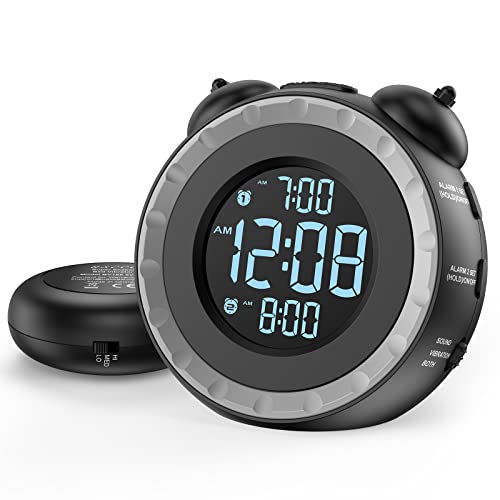
uscce Loud Dual Alarm Clock with Bed Shaker — Shaker power, calmer design
The uscce takes the same proven recipe, loud dual alarm plus bed shaker, and dresses it for a grown-up bedroom. The shaker’s strength adjusts, which matters more than it sounds: a puck set to maximum under a thin mattress can rattle the frame, while the gentlest setting still reaches a sleeper who would ignore any tone. Tuning that dial across the first week is how owners find the line between effective and theatrical.
The display dims across its full range down to completely dark, a detail deep sleepers with light-sensitive partners will appreciate, and the dual alarms carry separate settings for weekday patterns. Battery backup guards the schedule against outages. In daily use the clock feels less like specialist equipment and more like a normal bedside clock that happens to have a decisive streak, and for many households that normality is exactly what makes the system sustainable across years rather than abandoned after a month.
Against the Sonic Bomb it concedes the absolute top end of volume, and buyers choosing between them should ask whether they need the loudest alarm or merely a very loud one with better manners. For most heavy sleepers the shaker does the real work anyway, and this clock’s shaker is strong, adjustable and reliable.
Set-up has one trap worth naming: the shaker belongs between mattress and base or under the pillow, not loose on the bed where it can walk itself onto the floor at 5 a.m. and buzz impotently against the skirting board. Owners who route the cord along the headboard and fix the puck’s position once report it stays put for months. The clock’s weekday and weekend alarm separation then does the rest, and the system fades into the furniture, which is the fate of every successful routine tool.
- Wake channels: loud alarm plus adjustable bed shaker
- Alarms: dual, independently set
- Display: full-range dimmer to fully dark
- Power: mains with battery backup
Strengths
- Adjustable shaker strength suits different mattresses
- Display can go completely dark overnight
- Looks like ordinary furniture rather than medical kit
Trade-offs
- Maximum volume sits below the Sonic Bomb’s ceiling
- Shaker is corded, so placement follows the cable
- Fewer tone choices than the JALL’s sound library
Best for: heavy sleepers who want shaker waking in a clock that suits an adult bedroom. Not suited for: the absolute deepest sleepers who need maximum volume as well. Check price on Amazon.

JALL Sunrise Alarm Clock — The light-first system
The JALL attacks the problem half an hour before the alarm. Its lamp builds from a deep red glow through warm dawn colours to full bright light, simulating a sunrise compressed into the minutes before you must rise. For sleepers whose difficulty is the violence of the transition, being hauled from deep sleep by a siren, arriving at the alarm already halfway surfaced changes everything downstream: the sound, when it comes, lands on a brain that is nearly awake.
Around that central trick sits a capable bedside hub: a library of wake and sleep sounds, white noise for masking a noisy street, FM radio, Bluetooth streaming and dual alarms. The coloured night light offers more shades than anyone needs, though teenagers furnishing a first room of their own tend to disagree. Light intensity at maximum is genuinely bright, enough to read by and enough to matter through closed eyelids, which is the entire physiological point.
Its limits are the mirror of its strengths. There is no vibration channel, so a sleeper who can ignore light on a bright summer morning pattern may still need a shaker clock as the backstop, and many owners run exactly that pairing. As a system anchor for a routine-focused household, though, the JALL offers the most humane mornings in this guide.
The sunset side of the JALL deserves its paragraph, because for this guide’s audience the evening is half the battle. The lamp can run its colours in reverse, bright to ember, while sleep sounds play on a timer, giving the bedroom a visible closing time. Teenagers who resist being told to wind down often accept the lamp’s dimming as the household’s neutral signal, and adults building a routine find the ritual easier to keep than a resolution. It will not fix a chaotic evening by itself, but it gives the evening a shape, and shape is what routines are made of.
- Wake channels: sunrise simulation light plus sound library
- Alarms: dual, with FM radio and Bluetooth audio
- Extras: white noise sounds, multicolour night light
- Power: mains powered
Strengths
- Gradual dawn makes the alarm moment far less brutal
- Sound library covers waking and falling asleep
- Bright maximum light suits winter mornings
Trade-offs
- No bed shaker for sleepers who sleep through light
- Menus take a few days to learn by touch
- Light can disturb a partner facing the clock
Best for: heavy sleepers whose mornings fail at the transition, and ADHD households building a gentler staged routine. Not suited for: anyone needing vibration, or bedrooms where a partner faces the lamp. Check price on Amazon.
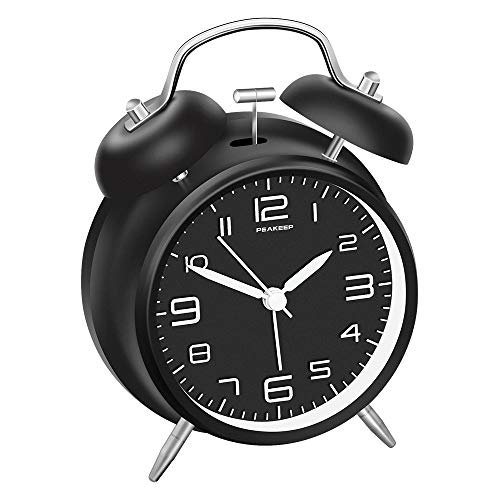
Peakeep Twin Bell Alarm Clock — The analogue enforcer
Two metal bells and a hammer: the Peakeep’s mechanism predates electricity in spirit and remains undefeated in one specific contest, which is producing a sound nobody describes as ignorable. There is no snooze button, no menu, no firmware, and no possibility of the clock updating itself into a new personality overnight. You wind the alarm hand to the hour, flip the switch, and in the morning the bells ring until a conscious hand crosses the room’s worth of resolve to stop them.
That simplicity is a genuine strategy for routine-building. Every digital convenience is also a negotiation surface, and a sleeper skilled at negotiating with a snooze button at 6 a.m. meets, in the Peakeep, an opponent with nothing to concede. Battery operation means a power cut cannot disarm it, and the backlight on demand keeps the dial readable without glowing all night. The 3D dial’s bold numerals suit bleary eyes and grandparents alike.
Precision is its honest weakness: an analogue alarm lands within a few minutes of the target rather than on the second, and there is exactly one alarm, so staged routines need a second device. Tick volume bothers some light sleepers sharing the room. But as a first alarm for a teenager, a backstop in a guest room, or the nuclear option on a dresser across the room, it earns its tiny price many times over.
There is a small ceremony to owning one well. Set it in the evening as part of undressing, the switch flipped with intent, and place it where the morning self must stand to silence it, ideally beside the clothes laid out the night before. Households that treat the Peakeep as furniture with a job, rather than a gadget with settings, find it asks almost nothing and delivers almost everything. Its single battery lasts through seasons of mornings, which quietly removes the last maintenance excuse a digital clock can offer.
- Wake channel: twin metal bells, very loud
- Alarms: single analogue setting
- Power: battery operated, immune to outages
- Extras: on-demand backlight, bold 3D numerals
Strengths
- No snooze means no morning negotiation
- Cannot be silenced by a power cut or a dead phone
- Costs little enough to buy as a backstop
Trade-offs
- Setting accuracy is approximate rather than exact
- Only one alarm time at once
- Bell volume is fixed and formidable
Best for: snooze negotiators, teenagers, and anyone wanting a cheap second line of defence. Not suited for: staged dual-alarm routines or precision scheduling. Check price on Amazon.

ANJANK Extra Loud Alarm Clock with Wireless Bed Shaker — Wireless shaker freedom
The ANJANK removes the one annoyance shared by both wired shaker clocks above: the cable. Its vibrating shaker connects wirelessly, so it can live under a pillow on either side of the bed, travel to a sofa nap, or move between a teenager’s bedroom and a university room without a cord dictating the furniture arrangement. The trade is a battery inside the shaker that needs periodic charging, a small ritual the routine-minded can attach to laundry day.
The clock itself layers an extra-loud alarm with a colour-changing night light across nine shades, dual alarms and a full-range display dimmer, plus a USB port for the phone that now sleeps across the room. Owners building an ADHD-friendly morning often describe the winning arrangement precisely: phone charging far from the pillow, shaker under it, clock light beginning the room’s brightening. The ANJANK was plainly designed by someone who had read that description.
Vibration strength is strong rather than adjustable in fine steps, so very light mattresses may find it enthusiastic. As with all wireless accessories, the shaker must be charged to be trusted, and the household that forgets cables will also forget charging cables. For everyone else, this is the most flexible shaker system in the guide.
Charging discipline decides whether the wireless design delights or betrays, so build it into an existing weekly anchor: the shaker charges on the night the bedding is changed, beside the phone charger it shares a cable standard with. Owners who adopt that rhythm report never meeting a flat shaker on a weekday; owners who charge reactively meet one within the month. The clock itself keeps time and alarms on mains power regardless, so a neglected shaker degrades the system to a loud clock rather than to silence, a failure mode with a safety net.
- Wake channels: extra-loud alarm plus wireless bed shaker
- Alarms: dual, with eight sound options
- Extras: nine-colour night light, USB charging port, full dimmer
- Power: mains clock, rechargeable shaker
Strengths
- Cordless shaker goes anywhere sleep happens
- Night light doubles as a gentle first wake cue
- USB port supports a phone-across-the-room routine
Trade-offs
- Shaker battery must be remembered and recharged
- Vibration intensity lacks fine adjustment
- Costs more than the wired shaker alternatives
Best for: heavy sleepers who hate cables, students moving between rooms, and couples wanting the shaker on one side only. Not suited for: anyone who knows they will forget to charge the shaker. Check price on Amazon.

Netzu Digital Alarm Clock — The straightforward loud digital
Not every heavy sleeper needs vibration; some simply need a digital clock that refuses to be subtle and refuses to be complicated. The Netzu offers bold digits readable across a room, four volume levels topping out at a genuinely assertive blast, dual alarms and a snooze that exists but does not dominate the top panel like an invitation. Five dimmer levels tame the display for the night.
Its audience is the practical middle: older relatives who want big numbers and louder mornings, teenagers whose phone alarm disappears under a pillow, guest rooms and spare beds. Setup is a short, logical sequence rather than a manual-reading project, which matters because a clock that is annoying to programme gets programmed once, wrongly, and blamed forever.
There is no shaker and no light show, so the deepest sleepers should treat it as the sound layer of a system or choose above it on this list. Judged as what it is, a loud, clear, dual-alarm digital at a modest tier, it is difficult to fault, and its simplicity will outlast trendier rivals in many households.
In practice the Netzu also moonlights as the household’s reference clock, the one whose digits settle arguments about whether there is time for breakfast. That sounds trivial until a family has lived with clocks that drift or hide their numbers behind glare. A big, calm, always-legible display earns its nightstand territory every hour of the day, and the alarm, when it fires, borrows authority from that familiarity.
- Wake channel: digital alarm, four volume levels
- Alarms: dual, easy-set controls
- Display: bold digits, five dimmer levels
- Power: plug-in
Strengths
- Large digits suit seniors and bleary teenagers alike
- Top volume is properly loud for a plain digital
- Setup takes minutes, not a manual study session
Trade-offs
- No vibration or light channel for the deepest sleep
- Design is functional rather than decorative
- Snooze discipline still required from the sleeper
Best for: households wanting loud, simple and dual-alarmed without specialist hardware. Not suited for: sleepers who already sleep through phone alarms at full volume. Check price on Amazon.
Comparison Table
| Pick | Wake channels | Alarms | Standout trait |
|---|---|---|---|
| Sonic Bomb Dual Alarm Clock with Bed Shaker | Sound, vibration, flashing light | Dual | Maximum combined force |
| uscce Loud Dual Alarm Clock with Bed Shaker | Sound, adjustable vibration | Dual | Calm design, dark display |
| JALL Sunrise Alarm Clock | Sunrise light, sound library | Dual | Gentlest effective system |
| Peakeep Twin Bell Alarm Clock | Twin bells | Single | No snooze to negotiate with |
| ANJANK Extra Loud Alarm Clock with Wireless Bed Shaker | Sound, wireless vibration, light | Dual | Cordless shaker freedom |
| Netzu Digital Alarm Clock | Sound, four volumes | Dual | Bold digits, simple setup |
Why Does Vibration Wake People When Sound Fails?
Sound arrives through a channel the sleeping brain has spent all night learning to filter. It must classify the noise, decide it matters, and promote it to consciousness, and in deep sleep that committee moves slowly. Vibration skips the meeting. A shaking mattress registers as a physical event, closer to being nudged by another person than to hearing a tone, and the body responds to being moved with older, faster reflexes than it applies to being serenaded. That is why shaker owners so often report waking alert rather than startled: the signal feels like information, not attack.
Placement decides how much of that advantage you collect. A puck centred under the mattress spreads its energy through the whole bed, which suits a single sleeper; under the pillow it concentrates the effect and can spare a partner. Thick memory foam absorbs some of the energy, so foam-bed owners should start with a stronger setting. The wired uscce and Sonic Bomb pucks draw power continuously and never need charging, while the ANJANK’s wireless puck trades that certainty for placement freedom. Neither answer is wrong; they suit different bedrooms.
Hearing-impaired sleepers rely on the same channel for a different reason, and the overlap benefits both groups: the shaker designs here descend from accessibility equipment, built to a standard where failure is not an anecdote but a missed job or a missed flight. That heritage shows in the hardware’s sturdiness. A puck designed to wake a deaf sleeper every morning for years does not wilt at the task of waking a teenager for a semester, and buyers in this guide’s audience are, in effect, borrowing reliability that another community insisted on first.
How Do You Build a Morning Routine That Survives Bad Nights?
Start the night before, because every successful morning in an ADHD household is pre-loaded. Clothes out, bag by the door, coffee machine staged, and the alarm set at the moment of deciding rather than negotiated with at midnight. The clock’s job shrinks to one task, starting the sequence, when the sequence itself needs no decisions. Two alarms fifteen minutes apart work better than one alarm and four snoozes, because the interval is planned rather than stolen, and the second alarm can live across the room where silencing it requires standing.
Light is the routine’s second pillar. A sunrise clock handles the bedroom, but the bathroom and kitchen lights matter too: bright light early anchors the day’s rhythm far more effectively than dim scrolling in bed. Keep the phone out of the first ten minutes if you can; the feed is engineered to dissolve time, and a routine’s scarcest resource is the gap between waking and leaving. Finally, protect the routine’s reputation. A system that works six mornings and collapses on the seventh after a late night is still a working system, and treating one bad morning as data rather than verdict is what keeps households adjusting instead of abandoning.
What Should Partners and Housemates Agree Beforehand?
Heavy-sleeper equipment operates in shared airspace, so negotiate it like adults. The shaker-only modes on the Sonic Bomb, uscce and ANJANK exist precisely for couples on different schedules; agree which mornings justify full volume and which call for vibration alone. In shared student housing, warn the room before the first dawn with a new clock, and consider the Peakeep’s bell a declaration of war unless the household has consented. A small courtesy that pays for itself: the early riser silences promptly and completely, every time, so the alarm never becomes background resentment.
One agreement is worth writing down rather than assuming: who resets the system after a holiday, a clock change or a power cut. More mornings are lost to an alarm left disarmed after travel than to any failure of volume, and a household that assigns the reset to the person who unpacks the suitcase closes the gap entirely.
What Are the Most Common Mistakes Heavy Sleepers Make?
A related error deserves its own mention: testing a new clock on a weekend lie-in and declaring it a failure or a triumph from a sample of one. Saturday sleep is deeper, later and differently motivated than Tuesday sleep, and equipment judged by it gets misjudged in both directions. Judge on workdays, across the fortnight described earlier, and let the pattern speak. Households also sabotage new systems by keeping the old phone alarm armed at the same minute, so two devices fire together in a confusion nobody can learn from; retire the old arrangement cleanly when the new one arrives, keeping only a deliberate five-minute backstop.
The deepest mistake is buying volume when the problem is depth, escalating sound while the sleeper’s brain files each new alarm under ignorable within a week. The second is placing a perfectly good clock within arm’s reach, where the snooze reflex operates before consciousness arrives to supervise it. Third comes the phone-as-alarm habit in a household that knows the phone is also the reason bedtime slid to 1 a.m. Fourth, owners forget the backup: a mains clock with no battery reserve fails exactly once, on the morning of the interview. And the quietest mistake is changing five variables at once, new clock, new bedtime, new routine, then being unable to tell which one worked when mornings improve.
Daylight saving changes deserve a footnote, because they ambush more routines than any equipment fault. Check on the Friday before which of your clocks adjust themselves and which expect a human, and make the adjustment part of the evening routine rather than a discovery at dawn on Monday.
Final Recommendation
Begin where your failures actually happen. If alarms sound and you never surface, buy vibration first: the Sonic Bomb for maximum force, the uscce for the same idea in calmer dress, the ANJANK if cables would doom the habit. If you surface but cannot start, build the staged system around the JALL’s sunrise and a dual alarm, with the Peakeep across the room as the non-negotiable final word. The Netzu covers households that simply need louder and clearer. Give any new system two honest weeks before judging it, because the first three mornings measure novelty, not fit, and the routine you are really buying only exists once the clock has become boring.
How Do You Stage Two Alarms Into One Reliable System?
A staged system treats waking as a ramp rather than an event. The first alarm, set twenty to thirty minutes before you must be upright, has one job: to pull you from deep sleep into the shallow end, where the second alarm can finish the work cheaply. Sunrise clocks automate the ramp with light, but any dual-alarm model here can imitate it, first call gentle and near, second call decisive and far. The ANJANK and uscce suit this pattern well because their two alarms carry independent volume and channel choices, letting the shaker whisper first and shout later.
The interval matters more than the exact times. Too short, under ten minutes, and the two alarms merge into one confusing event; too long, beyond forty, and the sleeper can complete a full extra sleep cycle and surface groggier than the first call found them. Twenty minutes is the interval most households settle on after experimenting. Protect the staging from its natural enemy, the improvised third alarm added on a tired evening, because a system with a secret extra snooze built in teaches the brain to wait for it.
Weekends deserve a policy rather than an exception. Sleeping until noon on Saturday demolishes Monday’s staging more thoroughly than any equipment failure, so households serious about their mornings keep the weekend wake time within an hour or so of the weekday one and let an afternoon nap carry the recovery instead. The clock cannot enforce that policy, but a dual-alarm model with separate weekday and weekend settings, or the simple discipline of leaving the alarms armed, makes it easier to keep than to break.
Which Clock Suits Which Kind of Sleeper?
Picture the shift worker first, sleeping days behind blackout curtains while the household lives around them. Their need is a wake signal that works at 4 p.m. in a bright house and disturbs nobody else: a shaker on a quiet setting, the uscce or ANJANK, with sound kept in reserve for the days exhaustion wins. Sunrise light is useless to them at waking but the sunset modes on light clocks can help mark the start of their night, a neat reversal of the usual advice.
The student in shared housing needs force tempered by diplomacy. A vibrating puck under their own pillow wakes one bed in a room of four, and the Netzu’s volume stays holstered for the mornings after all-night revision when diplomacy yields to necessity. The Peakeep, beloved in folklore, should be deployed in shared rooms only under a treaty, because its bells do not recognise whose morning it is.
New parents occupy the strangest category: people who wake at a pin drop all night yet must guarantee rising at five for a shift or a flight. For them the problem is not depth but certainty, and the answer is redundancy rather than power, a Netzu set normally plus the Peakeep across the room as insurance. Older adults, finally, often need clarity more than force: bold digits, simple controls, a dimmer that respects light-sensitive eyes, and volume that compensates for a television-trained ear. The Netzu and the uscce serve them best, in that order.
What Does the Snooze Button Really Cost You?
Nine minutes is too short to restore anything and long enough to fragment the shallow sleep you fall back into, so a chain of snoozes delivers the worst of both states: you are neither sleeping properly nor waking cleanly, and the grogginess that follows, sleep inertia, can outlast the grogginess of a single decisive rise by an hour. That is the physiological bill. The behavioural bill is worse. Every snooze is a small rehearsal of the lesson that the first alarm is negotiable, and the brain, an excellent student, applies the lesson earlier each week until the alarm is set half an hour ahead to budget for its own disobedience.
Breaking the pattern rarely requires heroism. It requires moving the decision to a moment when you are competent to make it: the evening. Set one alarm at the true time, place the clock beyond reach, and let the first feet-on-floor moment be the day’s first kept promise. Households report the third morning is dramatically easier than the first, because the body begins preparing to wake at a consistent signal. The clocks above support the change in different dialects, the Peakeep by refusing negotiation entirely, the dual alarms by making the staging official, the sunrise models by making the whole business gentler to comply with.
How Should You Judge a New Clock During Its First Fortnight?
Keep score honestly. Note each morning whether you rose at the first signal, the second, or the emergency backup, and how the first hour felt. A system trending toward first-signal rises by the second week is fitting; one still relying on the backstop needs adjustment, not replacement, in most cases: move the shaker, raise the light, lengthen the staging interval, or move the clock further away. Change one variable every few days so the diary can attribute the improvement.
Also judge the clock’s nights, not just its mornings. A display that cannot dim enough will tax the very sleep the household is trying to protect, and a shaker puck that migrates under the mattress by Thursday is a placement problem worth solving with its position rather than its power. The fortnight test, taken seriously, is why so many owners end up fond of unglamorous models: reliability reveals itself slowly, and novelty burns off in days.
Why Do Phone Alarms Fail Deep Sleepers So Often?
The phone’s failures are structural. Its speaker is small and aimed at a room it may be face-down in. Its alarm volume shares a control with media volume in many owners’ habits, so last night’s quiet video becomes this morning’s whisper. It sleeps where the hand can reach it, which converts silencing it into a reflex requiring no consciousness at all. And it spends the night delivering the notifications, messages and feeds that delayed bedtime in the first place, taxing the morning twice for the same device.
None of that makes the phone useless; it makes it a fine backup and a poor foundation. The households in this guide’s audience that succeed tend to demote it deliberately: phone charging in the kitchen or across the room, its alarm set five minutes after the real clock as a safety net rather than the main event. The bedside clock, single-purpose and slightly boring, wins precisely because it cannot do anything else. A device with one job, done loudly, in the same way every day, is what a sleeping brain can learn to trust and obey.
There is a subtler point about consistency. A phone’s alarm tone often changes with updates, playlists and whims, while a dedicated clock sounds identical for years. The sleeping brain habituates to novelty poorly and to routine well; it learns that this exact sound, in this exact room, means feet on floor, and begins surfacing in anticipation. Owners who keep the same clock for years often report waking a minute before it rings, which is the routine completing itself.
How Do You Handle Travel, Guests and Odd Schedules?
Travel breaks every home system, so carry a reduced version of it. The ANJANK’s wireless shaker packs flat and works in a hotel bed; a phone alarm staged twice, plus a request for a wake-up call, covers the rest. What matters is rehearsing nothing new on the road: keep the wake time, keep the staging interval, and let the equipment be the only variable. Shift workers rotating between patterns should anchor the clock settings to the shift rather than the clock time, reviewing them on the first evening of each rotation, because a system set for last week’s pattern fails silently and completely.
Guests deserve a working clock and a thirty-second briefing. Spare rooms with a Netzu or a Peakeep save the household’s own system from being dismantled and reprogrammed by a visitor’s experiments, and the guest wakes without needing to master anyone’s app. Households that host often treat the spare-room clock as permanent furniture for exactly this reason.
What Role Does the Evening Play in All This?
Every clock in this guide is fighting the previous night, whether it knows it or not. A wake time chosen without a bedtime is arithmetic with a missing term: seven to eight hours before the alarm is when the day actually starts being built, and the households that fix their mornings usually fix them at both ends within the same fortnight. The evening routine does not need to be elaborate. It needs to be a sequence the tired brain can run without decisions: alarm set and checked, clothes staged, lights lowered, phone exiled to its charging spot, and the sunrise clock’s sunset or sleep sounds marking the descent for anyone who wants a signal to wind down by.
Caffeine and late heavy meals sit outside this guide’s remit as anything more than common sense, but one environmental point belongs here: a bedroom that stays bright and warm until midnight teaches the body that the day is long, and no alarm, however violent, fully refunds that lesson at dawn. Cool, dark and boring is the specification. The clock then becomes the final ten percent of a system that was already going to work, which is the honest proportion manufacturers’ packaging never mentions.
How Much Should You Expect to Spend, and Where Does Money Help?
The price ladder in this category buys channels, not polish. The first step up from a basic digital buys volume and dual alarms, the Netzu’s territory. The next step buys a second sense: vibration from the uscce and Sonic Bomb, or a serious light engine from the JALL. The top step buys refinement of those channels, the ANJANK’s wireless shaker, adjustable everything, displays that vanish at night. Money spent climbing from one channel to two transforms outcomes; money spent on styling, extra sounds or novelty voices mostly transforms the receipt.
That ordering suggests a buying sequence for uncertain households. Start with the channel you lack, not the clock you admire: sound-only sleepers add vibration, light-starved winter risers add dawn. Keep the receipt and the fortnight diary together, because the second purchase, if one is needed, should be aimed by evidence from the first. The household that buys the Peakeep as a backstop in the same basket as a shaker clock is not being extravagant; it is buying the complete system in one delivery, at a combined cost below many single fashionable clocks that would have solved neither half of the problem.
How Should You Read Volume Claims on the Box?
Decibel figures in this category are measured the way fuel economy is measured: honestly, under conditions that flatter. Distance from the microphone, the room’s surfaces and the tone’s pitch all move the number, and pitch matters to waking as much as loudness does, because a penetrating high tone at moderate volume can outperform a booming low one. Read the figures as a rough ordering within a brand rather than a comparison across brands, and weight owner reports of actual waking above all of them. The clocks above were chosen on that evidence, which is why the list contains no paper champion that nobody can sleep through yet everybody sleeps through.
Frequently Asked Questions
Will a bed shaker wake my partner too?
Less than a loud alarm will. Vibration travels through the mattress, so a partner on the far side feels some of it, but shaker-only mode is dramatically more private than full volume. Puck placement under your pillow concentrates the effect further. Couples on very different schedules usually find the compromise workable within a week.
How loud is too loud for an alarm clock?
Loud enough to wake you, no louder. Start any adjustable clock below its maximum and raise it only if you sleep through it, because ears adapt and headroom is a resource. If a clock at moderate volume plus a shaker wakes you, that combination is kinder to the whole household than sound alone at full blast.
Can a sunrise clock work in a bright summer bedroom?
Its advantage shrinks when dawn arrives before the alarm does, unless blackout curtains restore the contrast. In summer many owners lean more on the sound layer and let the light assist; in winter the same clock becomes the strongest tool they own. Treat it as a seasonal partnership rather than a single mechanism.
What if I sleep through everything in this guide?
Layer the channels: shaker under the pillow, sunrise light building, a bell clock across the room as the final backstop, and a household member briefed for the mornings that truly matter. If profound difficulty waking persists despite a layered system, raise it with a clinician, because it can occasionally point to something about sleep itself that deserves proper attention.
Should teenagers use the same clocks as adults?
Largely yes, with supervision of the settings rather than the concept. The Peakeep and Netzu suit younger teens; shaker systems suit older teens with jobs or early training. The shared rule is that the phone sleeps elsewhere, which does more for a teenager’s morning than any single feature on any clock here.
Do these clocks work during a power cut?
The Peakeep runs on its battery and does not notice outages. The Sonic Bomb and uscce carry battery backup that preserves the alarm, and the others should be checked model by model. For a household where one missed morning is expensive, the analogue bell on the dresser is cheap insurance regardless of what else you buy.
Related Guides
Once waking is handled, the bedside itself deserves attention, starting with Best Alarm Clocks with Bedside Lamps for clocks that light the room as well as fill it with sound. Readers furnishing rooms for people who rely on vibration and flashing alerts should continue to Best Alarm Clocks for the Deaf and Hard of Hearing, while anyone stocking a linen cupboard properly will appreciate Best Bath Sheets and Large Towels. And for the small homes where all of this must fit gracefully, see Best Air Purifiers for a 1-Bedroom Apartment.


