What's inside
- Key Takeaways
- Quick Picks
- How Did We Choose the Best Alarm Clocks for Kids?
- How Do the Six Picks Compare Side by Side?
- Why Does a Colour Signal Work Better Than a Telling-Off?
- What Should Parents Check About Cords, Volume and Placement?
- How Can Families Introduce a New Clock Without a Power Struggle?
- Which Features Matter Most at Each Age?
- How Does the Bedtime Half of the Routine Affect the Morning?
- What Should Happen When the Clock Changes for Daylight Saving?
- How Can Parents Tell Whether a Clock Is Actually Working?
- Why Do Some Children Wake Happier to Light Than to Sound?
- How Should the Clock Travel Between Rooms, Houses and Holidays?
- What About Children Who Share With Parents or Sleep in Unusual Spaces?
- What Are the Most Common Mistakes When Buying a Clock for a Child?
- Final Recommendation
- Frequently Asked Questions
- Related Guides
As an Amazon Associate I earn from qualifying purchases. This post may contain affiliate links at no extra cost to you.
cottageverdict.com is reader-supported. When you buy through links on our site, we may earn an affiliate commission.
Where to buy: each clock below links to its Amazon listing, where you can check price on Amazon and confirm colours, power type and included accessories before ordering for a child’s room.
The hunt for the best alarm clocks for kids rarely starts with an alarm at all. It starts at half past five on a Saturday, with a small person standing beside your bed announcing that the sun is awake, so everybody must be. Or it starts on a school morning, when the same child who rose with the dawn on weekends cannot be coaxed upright for love or gentle reasoning. A good children’s clock solves both ends of that problem: it teaches a young sleeper when the night is still theirs to enjoy quietly, and it makes the official start of the day feel like an event rather than an ambush.
That teaching job is why this category looks so different from adult clocks. Faces glow in colours a child can read before they can read numbers. Lights turn green at an hour parents choose, which turns an abstract rule — stay in bed until morning — into something a three-year-old can actually follow. Sounds lean towards birdsong, soft chimes and familiar melodies instead of the electronic bleating that works on grown-ups. And because the user is small, strong-willed and occasionally sticky-fingered, the clock has to survive being hugged, dropped, reprogrammed by curious thumbs and carried into a blanket fort.
Safety runs through every judgement in this guide, treated as practical household guidance rather than fine print. Cords belong behind furniture where little hands and cruising toddlers cannot reach them, never draped across a cot rail or within grabbing distance of a crib. Volume deserves a ceiling: a clock that can startle a teenager awake is far too much beside a preschooler’s pillow, so every pick here either keeps its loudest setting modest or lets parents cap it. Buttons that lock matter too, because a wake time changed by midnight experimentation helps nobody. Where a clock offers a battery option, that option earns genuine credit in a child’s room, since a cord-free unit on a low shelf removes a whole category of worry.
Six clocks made the final list, and they split into clear camps. Two are true sleep trainers built around the ok-to-wake idea, with friendly faces and colour signals. Two are sunrise models that trade on light, filling the room gradually so waking feels like morning arriving rather than a buzzer firing. Two are straightforward digital clocks for older children who can read the time and want a proper alarm of their own, with dimmers and volume controls that keep them civilised at close range. Read the picks with your child’s age in mind: the right clock for a two-year-old learning to stay in bed is a different object entirely from the right clock for a nine-year-old with a school bus to catch.
Key Takeaways
- Colour signals teach pre-readers the household rule better than any lecture: green means morning, and the clock says so.
- Keep cords behind furniture and out of reach; battery-friendly picks earn extra credit in rooms with toddlers.
- Gentle sounds and capped volume suit small ears — the loudest adult settings have no place beside a child’s pillow.
- Sunrise clocks suit children who wake grumpy in dark winter months, because light does the persuading gradually.
- Lockable settings protect the wake time from curious midnight button-pressing expeditions.
- Match the clock to the age: sleep trainers for toddlers, honest digitals for children who can already tell time.
Quick Picks
| Pick | Badge | Why it made the list |
|---|---|---|
| LittleHippo Mella Kids Alarm Clock | Best all-round sleep trainer | A friendly-faced trainer with colour wake signals, a sound machine and a night light in one tidy unit. |
| Windflyer OK to Wake Clock for Kids | Best simple ok-to-wake signal | A cheerful blue clock built around one clear idea: the light changes when it is time to get up. |
| DreamSky Small Digital Alarm Clock | Best first real clock for older children | Big calm numbers, a proper dimmer and adjustable volume in a compact plug-in design children can run themselves. |
| JALL Sunrise Alarm Clock | Best sunrise option for light sleepers | Gradual dawn light, a deep sound library and a colourful night light for children eased awake by brightness. |
| REACHER Sound Machine Sunrise Alarm Clock | Best sound library for restless sleepers | Nature-inspired sleep sounds paired with a sunrise lamp and a fully dimmable clock face for shared rooms. |
| REACHER Digital Alarm Clock | Best colourful pick for tweens | A rainbow LED display, phone charging and easy snooze in a clock that feels grown-up without sounding harsh. |
How Did We Choose the Best Alarm Clocks for Kids?
We started by throwing out anything designed primarily for adults and merely painted a cheerful colour. A children’s clock has to communicate with someone who may not read yet, so the first test was legibility of the signal itself: could a sleepy four-year-old, glancing across a dim room, tell instantly whether it was morning or still night? Clocks that answered with colour, faces or light scored well. Clocks that answered with a tiny icon in the corner of a crowded display did not.
The second test concerned sound, judged at pillow distance rather than across a showroom. We favoured alarms with genuine low settings, pleasant tones and volume that ramps or stays modest, and we marked down anything whose minimum volume still felt like a rebuke. Sleep sounds were judged the same way: a loop that clicks, hisses unevenly or restarts audibly will train a child to listen for the machinery instead of drifting off, so smooth, even soundscapes earned their places here.
Parental controls formed the third test. Settings that lock, buttons that resist random reprogramming, and displays that dim to true darkness all protect the fragile achievement of a child sleeping through. We also weighed build: rounded edges, stable bases that shrug off a knock from a passing stuffed animal, and materials that wipe clean after the inevitable encounter with toothpaste or jam.
Finally, we considered the handover. The best children’s clock is one a child gradually operates alone — silencing it, reading it, eventually setting it — because that independence is the real prize for the whole family. Each pick below notes where it sits on that journey, from parent-run trainer to a first clock a child can proudly manage without help.
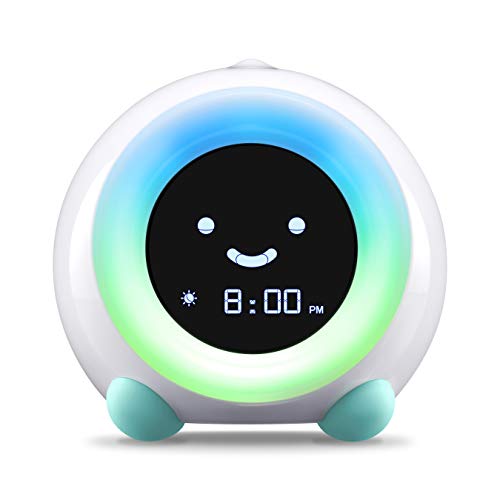
LittleHippo Mella Kids Alarm Clock — Best all-round sleep trainer
Mella has a face, and that turns out to matter enormously. The sleepy expression that rests on the display during the night and the smiling one that arrives with morning give a toddler something to relate to: the clock itself is sleeping, then the clock wakes up happy, and the child is invited to copy it. Around that face, coloured light does the formal teaching. Parents set the wake moment, the glow shifts to green when the household day may begin, and a yellow warning glow can warn that morning is close but not quite here — a nuance that saves many almost-morning negotiations.
As a sound machine it covers the bedtime end of the contract as well, with white noise and gentle melodies that run while the face sleeps. The night light function is warm rather than theatrical, enough for a child who dislikes complete darkness without turning the room into a landing strip. Controls sit where adults can reach them and, importantly, the settings can be locked, so the wake time you agreed at bedtime is still the wake time at dawn. The Arctic Blue finish suits most children’s rooms, and the rounded body feels designed to be patted goodnight, which it will be.
- Type: sleep trainer with ok-to-wake colour signals
- Light: coloured wake glow plus warm night light
- Sound: built-in sound machine with white noise and melodies
- Controls: parent-set wake time with lockable settings
- Power: mains powered, so plan cord placement behind furniture
Strengths
- The expressive face gives toddlers a story to follow, not just a rule to obey.
- Green means morning is a signal even very young children grasp within days.
- Lockable settings survive curious fingers and midnight investigations.
Trade-offs
- Mains power means the cord needs deliberate, out-of-reach routing.
- Children who can already tell time may outgrow the face within a year or two.
- The wake glow is a signal, not a sunrise — it will not brighten a whole dark room.
Best for: toddlers and preschoolers learning to stay in bed until an agreed morning moment.
Not suited for: older children who want a conventional alarm they fully control themselves.
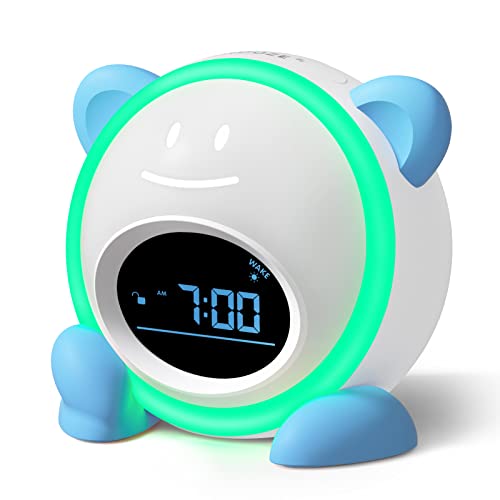
Windflyer OK to Wake Clock for Kids — Best simple ok-to-wake signal
The Windflyer strips the sleep-trainer idea down to its friendly essentials. One clock, one clear promise: when the light says morning, morning has arrived. For families who found feature-stacked trainers overwhelming — or who watched a grandparent defeat a complicated menu in real time — that simplicity is the entire appeal. The blue body reads as a toy-adjacent object rather than a piece of electronics, which helps it earn a place on a child’s shelf without argument.
Alongside the wake signal it works as a night light and a sound machine, covering the two jobs parents most often buy separately. The glow is soft enough to reassure without flooding the room, and the sounds give bedtime a consistent audio cue, which sleep routines thrive on: same sound, same light, same sequence, night after night. Setting the wake time is a short job rather than a project, and once set, the clock simply keeps its promise at the same moment each day, including the weekends when parents feel the benefit most keenly.
It will not grow with a child the way a full digital clock does, and it is not trying to. Think of it as training wheels for the concept of morning — a season or two of reliable service at exactly the age when five-thirty feels like a reasonable hour to start the day, to exactly one member of the household.
- Type: ok-to-wake trainer clock for young children
- Light: wake-signal glow that doubles as a night light
- Sound: built-in sound machine for bedtime routines
- Controls: deliberately simple, set by parents in moments
- Finish: cheerful blue body sized for a child’s shelf or dresser
Strengths
- One unmistakable signal that pre-readers understand without coaching.
- Setup is quick enough for grandparents and babysitters to manage.
- Night light and sounds cover bedtime as well as the morning moment.
Trade-offs
- A short working life by design — most children outgrow it by early school age.
- Fewer sounds and settings than the fuller-featured trainers here.
- The playful styling may clash with a carefully neutral nursery scheme.
Best for: families wanting the ok-to-wake idea without menus, apps or fuss.
Not suited for: children past the training stage who need a real alarm for school.

DreamSky Small Digital Alarm Clock — Best first real clock for older children
There comes a morning when a child announces that the cartoon-faced clock is for babies, and this DreamSky is the dignified next step. Its large numbers are the headline: clear, calm digits a child can read from the bed without squinting or getting up, which matters when the skill being built is checking the time and making a decision about it. It plugs in, sits compactly on a bedside table, and behaves like a proper clock rather than a toy — precisely the compliment its target audience is seeking.
The details suit young ownership well. Volume adjusts, so the alarm can start modest and grow only if a deep sleeper demands it; parents should set that level together with the child rather than discovering the maximum setting during the first week. A real dimmer tames the display at night, and the USB charging port will inevitably become the home of a tablet cable or a reading light, which is fine — a clock that earns its socket tends to stay used. The snooze is easy to find by touch, though families may want a house rule about how many presses a school morning allows.
Because it is mains powered with a USB-C adapter, cord placement deserves the usual thought: route it behind the bedside table, keep slack off the floor, and the clock becomes part of the furniture. For a child moving from being woken to waking themselves, that quiet permanence is the point.
- Type: compact plug-in digital clock with large display
- Display: big numbers with a proper dimmer for night use
- Sound: adjustable alarm volume, set it jointly with your child
- Extras: USB charging port for a tablet or reading light
- Power: USB-C adapter powered for a tidy bedside setup
Strengths
- Digits are genuinely easy to read from across a child’s bed.
- Adjustable volume lets the alarm mature alongside the sleeper.
- The grown-up design flatters children who have rejected trainer clocks.
Trade-offs
- No colour wake signal — the child must read numbers to use it well.
- Plug-in power ties it to a socket and a thoughtfully routed cable.
- The snooze is tempting enough to need a family agreement.
Best for: school-age children ready to own their weekday wake-up.
Not suited for: toddlers who still need a colour signal instead of numerals.

JALL Sunrise Alarm Clock — Best sunrise option for light sleepers
Some children do not resist waking; they resist the shock of it. The JALL approaches the problem with light first. Its sunrise simulation builds brightness gradually before the alarm moment, so a child surfaces through stages of sleep instead of being dropped out of it, and on dark winter mornings that difference can transform the emotional weather of the whole house. By the time sound joins in, the room already looks like morning, and getting up feels like joining something rather than obeying something.
The sound side is unusually deep for a child’s room: a library of twenty-five sounds, FM radio for older children who want music, and Bluetooth for a parent’s chosen playlist or audiobook chapter at bedtime. The seventeen-colour night light will be received as a feature by the child and should be received as a negotiation by the parent — agree the night colour and brightness in advance, because a rainbow disco setting at bedtime serves nobody. Dual alarms allow a school-day setting and a weekend setting to coexist, teaching the idea that mornings have types.
Volume control matters here more than most: sunrise clocks are often bought for gentleness, so begin at the lowest effective level and resist a child’s request to test the top of the range at close quarters. Placed across the room on a dresser, the light spreads better and the walk to silence it completes the waking it started.
- Type: sunrise wake-up light with dual alarms
- Light: gradual dawn simulation plus seventeen night-light colours
- Sound: twenty-five sounds, FM radio and Bluetooth playback
- Alarms: two settings, handy for school days versus weekends
- Placement: works best across the room on a dresser or shelf
Strengths
- Gradual light genuinely softens waking for children who hate alarms.
- The sound library covers bedtime stories, music and morning tones.
- Dual alarms introduce weekday and weekend rhythms in one device.
Trade-offs
- Menus reward a parent’s setup session rather than a child’s improvisation.
- The colourful night light needs an agreed setting to stay sleep-friendly.
- Its talents are wasted in a room already flooded with early daylight.
Best for: children who wake tearful or groggy and respond better to light than noise.
Not suited for: toddlers who need a simple stay-in-bed signal above all else.

REACHER Sound Machine Sunrise Alarm Clock — Best sound library for restless sleepers
Where the JALL leads with dawn, this REACHER leads with the night before. Its twenty-six nature-inspired sounds — rain, streams, birdsong, pink and brown noise among them — exist to smooth the journey into sleep for children whose minds keep racing after lights-out. A consistent sound blanket also masks the household noises that otherwise puncture a light sleeper’s evening: doors, kettles, an older sibling’s television bleeding through a wall. Morning then arrives via its sunrise lamp, so the same object bookends the night at both ends.
The clock face dims across the full range down to darkness, a detail parents of light-sensitive children will appreciate more than any headline feature. A display that can vanish entirely means the room’s only glow is the night light you deliberately chose. The sunrise itself is warm and gradual, pairing well with the gentler sounds for children who surface slowly, and the whole unit has a soft, rounded look that sits comfortably in a child’s room rather than a home office.
Shared rooms are this clock’s natural habitat. Siblings with slightly different schedules benefit from the sound masking at bedtime, and the gradual light disturbs a still-sleeping brother or sister less than a sudden buzzer. Set the volume for the child nearest the clock, keep the unit on the shared dresser rather than one child’s pillow-side, and the arrangement respects both sleepers.
- Type: sound machine combined with a sunrise wake lamp
- Sound: twenty-six nature-inspired options including brown and pink noise
- Display: dimmable across the full range, down to completely dark
- Light: warm sunrise simulation with a night-light function
- Room fit: rounded styling made for bedrooms rather than desks
Strengths
- The sound library tackles falling asleep, not just the waking half.
- A fully dark display protects children who notice every glow.
- Gentle light suits shared rooms where a buzzer would wake everyone.
Trade-offs
- No expressive face or character to engage very young toddlers.
- Sound choice overload is possible — pick one bedtime sound and keep it.
- Sunrise brightness alone may not rouse a determinedly deep sleeper.
Best for: restless children whose main battle is falling asleep in a noisy house.
Not suited for: families wanting a loud, unmissable alarm for a heavy sleeper.
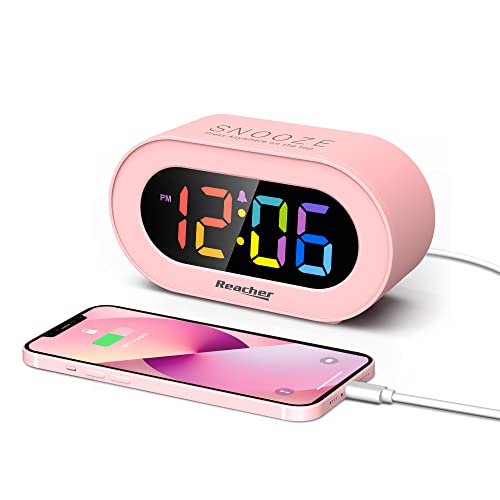
REACHER Digital Alarm Clock — Best colourful pick for tweens
The pink REACHER with its rainbow LED display understands its audience precisely: children old enough to want technology, young enough to want it cheerful. The colourful digits are the draw, and they are more than decoration — a display a child enjoys looking at gets consulted, and a consulted clock quietly teaches time awareness all day long. Brightness dims properly for the night, so the rainbow can be dialled down to a murmur after lights-out.
Practically, it behaves like a friendly first gadget. The snooze is easy, the volume adjusts across a sensible range, and the USB charging port will host whatever small device a tween is allowed to keep in their room. The compact body leaves space on a crowded bedside table for the book, the water glass and the alarmingly large collection of hair ties that also live there. Setting it is intuitive enough that most children this age will manage alone, which is rather the point of the purchase.
Parents should still make the first setup a joint project: agree the alarm volume, agree the display brightness, and route the charging cable so it does not trail across the bed. After that, step back. A clock a tween chose, configured and operates is a small daily proof of competence, and it tends to be treated with more respect than one imposed from above.
- Type: compact digital clock with colourful LED display
- Display: rainbow digits with dimming for night hours
- Sound: adjustable volume with an easy snooze
- Extras: USB port for charging a small device overnight
- Audience: older children and tweens wanting a first real gadget
Strengths
- The playful display makes checking the time a habit, not a chore.
- Simple controls let tweens run the clock entirely by themselves.
- Compact size respects the limited territory of a child’s bedside table.
Trade-offs
- No sleep-training signals for younger siblings hoping to inherit it early.
- The colourful digits, even dimmed, may distract a very light-sensitive child.
- Charging duties mean the cable needs the usual out-of-the-way routing.
Best for: tweens who want a clock that feels like theirs in every sense.
Not suited for: toddlers or preschoolers still learning what morning means.
How Do the Six Picks Compare Side by Side?
| Pick | Main signal | Sleep sounds | Best age fit |
|---|---|---|---|
| LittleHippo Mella Kids Alarm Clock | Colour glow plus friendly face | Yes, with white noise | Toddlers and preschoolers |
| Windflyer OK to Wake Clock for Kids | Single ok-to-wake light change | Yes, simple library | Two to five years |
| DreamSky Small Digital Alarm Clock | Large readable numerals | No, alarm tones only | Seven years and upward |
| JALL Sunrise Alarm Clock | Gradual brightening light | Yes, twenty-five options | Five years and upward |
| REACHER Sound Machine Sunrise Alarm Clock | Gentle sunrise lamp | Yes, twenty-six nature sounds | Four years and upward |
| REACHER Digital Alarm Clock | Colourful LED digits | No, alarm tones only | Nine years and upward |
Why Does a Colour Signal Work Better Than a Telling-Off?
Small children live in a world governed by signals they can see. Traffic lights, the oven timer’s beep, the bath running — the household already runs on cues, and a wake clock simply adds one more, pointed at the hardest hour of the day. When the rule lives in the clock rather than in a parent’s voice, mornings lose their courtroom quality. Nobody is arguing about whether it is morning; the green light has settled the question, and a child who pads back to bed after checking it is practising self-control with the evidence right in front of them.
The learning curve is usually measured in days, not weeks, provided the adults hold their side of the bargain. If green means up, then adults must actually get the child up warmly when the light changes, even on the mornings when another twenty minutes would suit the grown-ups better. Inconsistency teaches faster than any device: one weekend of being fetched early anyway, and the signal becomes decorative. Pair the clock with a quiet-activity box beside the bed — books, a puzzle, soft toys approved for solo play — and a child who wakes before the light has somewhere legitimate to put that early energy.
Expect the system to wobble during clock changes, illnesses and holidays, when every household rhythm loosens. The fix is boring and effective: restate the rule at bedtime, point at the clock together, and let a few ordinary mornings rebuild the habit. Children are excellent at returning to a routine that visibly still exists.
What Should Parents Check About Cords, Volume and Placement?
Start with the cord, because it is the least glamorous and most important item on this page. Any mains-powered clock in a young child’s room should sit on furniture the child cannot pull down, with its cable routed behind that furniture and out of reach — never looped over a cot rail, never dangling within grabbing range of a crib, never trailing across the floor where small feet trip at dawn. Where a room layout makes tidy routing impossible, favour the clock you can position safely over the clock you merely prefer, and revisit the arrangement whenever furniture moves or a cot converts to a bed.
Volume deserves a deliberate decision rather than a default. Set the alarm while your child is awake, at the distance their pillow will be, and choose the lowest level that reliably registers. A clock blasting at full tilt beside a small head teaches dread, not punctuality, and may simply produce a child who sleeps in self-defence with a pillow over both ears. Gentle sounds — chimes, birdsong, a parent’s chosen tone — wake most children perfectly well, because young sleepers surface more easily than the teenagers they will become.
Placement completes the trio. A trainer clock belongs where its face is visible from the pillow without being reachable enough to become a midnight toy. A sunrise clock belongs across the room, where its light can spread and where silencing it requires actual verticality. And any clock belongs away from the draughts and direct sun patches that make displays hard to read at the very moment they are needed.
How Can Families Introduce a New Clock Without a Power Struggle?
Unbox it together, in daylight, with ceremony. A clock that arrives as a present with a story — this is your morning clock, it will tell you when the day begins — lands very differently from one installed silently as an enforcement device. Let the child choose its spot from two parent-approved options, press its buttons under supervision, and hear its sounds before bedtime rather than being surprised by them in the dark. Novelty explored at noon rarely frightens anyone at midnight.
Run a practice morning on a weekend. Set the signal for a time everyone is already awake, let the light change, and celebrate the entirely theatrical getting-up that follows. Children who have rehearsed the routine treat the real performance as familiar, and parents learn the clock’s quirks — how the glow looks in daylight, whether the volume survived the rehearsal — without stakes. Then hold the line kindly for the first school week, because the second and third mornings, not the first, are when the novelty fades and the habit is actually built.
Older children need a different ceremony: a handover. Show them the settings once, set the alarm together, and then genuinely leave it to them, including the natural consequence of a snooze too many. A nine-year-old who misses the bus once because of five extra snoozes has received an education no lecture delivers, and the clock becomes their tool rather than your weapon.
Which Features Matter Most at Each Age?
Between two and four, the clock is really a parent’s tool wearing a friendly face. What matters is the clarity of one signal, a night light gentle enough to leave on, sounds that smooth the landing into sleep, and settings that stay where adults put them. Numerals are decoration at this age; colour and expression carry the meaning. Durability matters too, because a trainer will be carried, kissed and dropped, sometimes in that order before breakfast.
From five to seven, children begin reading the time in earnest, and the clock can start teaching in numbers as well as signals. This is the sunrise clock’s sweet spot: the child understands that light growing means morning approaching, enjoys choosing a wake sound, and can manage a simple snooze rule. Dual alarms earn their keep here, separating school mornings from the slower weekend rhythm and making the difference itself a small lesson in how weeks work.
From eight upward, dignity becomes the dominant feature. A child this age wants equipment that looks like it belongs to a person, not a nursery: readable digits, a display with some personality, perhaps a charging port for the small technology of their lives. Control should migrate steadily to the child — setting, silencing, deciding about snooze — because the family’s goal has quietly changed from keeping a toddler in bed to launching a person who gets themselves up. The DreamSky and the rainbow REACHER serve exactly this handover, and choosing between them is mostly a matter of taste: calm clarity versus colourful cheer.
Across all ages, two features never stop mattering. The first is a display that can go properly dark, because bedrooms that glow all night produce sleepers who surface at every small disturbance. The second is an alarm whose character suits the child — some wake best to light, some to music, some to a parent’s recorded silliness where a clock allows it — and discovering which is a matter of a week’s honest experiment, not guesswork at the checkout.
How Does the Bedtime Half of the Routine Affect the Morning?
Every clock in this guide is secretly a bedtime device. Children wake at the hour their sleep began plus the sleep they needed, which means a wake-up problem is very often a lights-out problem viewed from the other end. The sound machines in the Mella, the Windflyer and the REACHER sunrise exist because a consistent audio cue — the same rain, the same stream, started at the same point in the routine — teaches a child’s body that the day is closing, and bodies that close the day on time open it on time far more reliably.
Build the cue into a short, repeatable sequence: bath, pyjamas, teeth, two books, sound on, light low, goodnight. Fifteen unhurried minutes beat forty minutes of negotiation, and the clock’s glow becomes the final full stop of the sentence. Where siblings share, stagger the sequence rather than the clock — the younger child’s sound starts first, the older one reads under a dim lamp until their own cue begins — and the shared unit serves both without becoming a battleground.
Weekend drift is the routine’s natural enemy. Letting bedtime slide an hour on Friday and Saturday feels kind, but Monday’s alarm then lands in a deeper part of the sleep cycle, and the whole household pays. Keep weekend bedtimes within half an hour of school-night ones for young children, and let the lie-in, when it comes, be a modest extension of the wake signal rather than a collapse of the schedule. The clock can only signal a rhythm that actually exists.
Finally, notice what the clock reveals. A child who suddenly starts waking long before the signal after months of success is telling you something — a room grown too light with the season, a nap outgrown, a worry about school. Treat the clock’s data as information rather than disobedience, adjust the surrounding conditions first, and the signal usually regains its authority without a single battle.
What Should Happen When the Clock Changes for Daylight Saving?
Twice a year, the household’s careful rhythm meets the calendar’s jump, and children’s clocks handle it in ways worth planning around. The plug-in digitals here hold their settings through the change but must be reset by hand, which is a two-minute job easily forgotten until Monday’s alarm fires an hour adrift. Make resetting the children’s clocks part of the same round as the oven and the car, and check the wake signal rather than assuming it followed the time.
The child’s body, of course, does not observe the change at all. In the days after a spring shift, the green light will appear to arrive cruelly early, because biologically it does. Shifting bedtime fifteen minutes earlier for three or four nights beforehand softens the landing far better than any alarm setting. Autumn’s extra hour creates the opposite puzzle: a child waking at what feels like five. Hold the wake signal firm at the new time, keep pre-signal activities quiet and dim, and most children re-sync within the week.
Travelling across time zones follows the same logic in miniature. Take the clock, keep its home routine of sounds and light, and move the signal in daily steps towards local time rather than demanding an instant adjustment. A familiar glow in an unfamiliar room is a small piece of home, and children sleep — and wake — better in its company than among a hotel’s anonymous electronics.
How Can Parents Tell Whether a Clock Is Actually Working?
Give any new arrangement two honest weeks before judging it, because the first three mornings measure novelty rather than learning. The signs of success are quieter than most parents expect. A child who still wakes early but now plays in bed until the signal has succeeded, even though the house stirs at the same hour as before — the victory is the calm, not the clock-watching. Similarly, a schoolchild who needs one call instead of five is progressing, and a sunrise clock that turns tears into mere grumbling has done real work even if nobody leaps up singing.
Track the failures by pattern rather than by frustration. Sleeping through happens on late nights, after swimming days, during growth spurts — contexts that point at sleep quantity rather than alarm quality. Early waking clusters around seasonal light changes and dropped naps. A clock blamed for a pattern it did not cause gets replaced pointlessly, and the replacement inherits the same pattern. Change one variable at a time: bedtime first, then signal time, then sound or light, with several nights between adjustments.
When a clock genuinely is the problem, the evidence looks different. A signal a child cannot see from the pillow, a volume floor still too harsh for the room, menus so fiddly that settings drift — these are hardware faults, and the honest response is to move the clock to a sibling, a guest room or a different job, and choose again with the lesson learned. Children’s equipment that survives contact with reality gets handed down; the rest becomes a story.
Why Do Some Children Wake Happier to Light Than to Sound?
Sound arrives as an event; light arrives as a condition. A tone, however gentle, announces that something has happened and demands a response, while brightening light changes the room itself, letting a child surface through the shallow end of sleep at their own pace. For children who startle, who cry on waking without knowing why, or who share with a sibling who should stay asleep, that gradualism is not a luxury — it is the entire mechanism. The JALL and the REACHER sunrise both exploit it, differing mainly in whether sound variety or sound-at-bedtime matters more to your household.
Light has limits worth respecting. In high summer, a bedroom flooded with dawn at five will defeat any lamp’s choreography, and blackout curtains become the sunrise clock’s essential partner rather than its rival. Conversely, a child who sleeps like a stone through thunderstorms will likely sleep through a simulated dawn too; for that sleeper, light should accompany sound rather than replace it, which is why both sunrise picks here carry proper alarms behind their glow. Match the mechanism to the sleeper you have, and revisit the match yearly — children’s sleep changes as fast as their shoes.
How Should the Clock Travel Between Rooms, Houses and Holidays?
Children’s sleep equipment leads a travelling life. The trainer that rules the nursery will be asked to perform at grandparents’ houses, on holiday lets and during the occasional night in a parent’s room after a bad dream. Portability is therefore worth a thought at purchase: compact digitals like the DreamSky shrug off a suitcase corner, while the sunrise units prefer a stable dresser and a proper unpacking. Whatever travels, take its routine with it — the same bedtime sound, the same signal logic — because familiarity is the active ingredient, and a strange room is precisely when a child needs the familiar most.
Split households add another layer. A clock in each home, ideally the same model with the same signal, spares a child from relearning the morning rule twice a week and spares both households from comparing whose mornings run better. Where budgets allow only one unit, let it live where school mornings happen, since those are the mornings with consequences attached. Grandparents, meanwhile, deserve a written note of the settings taped inside a drawer; the Windflyer’s simplicity exists for exactly this constituency, and choosing it for a second home is a kindness to everyone.
Holidays deserve a deliberate loosening rather than an accidental collapse. Move the signal later in honest steps, keep bedtime sounds running, and expect the first home morning afterwards to be ragged whatever you do. Then restore the school rhythm two nights before term resumes, not on the night before, and the clock that supervised the holiday will supervise the return without protest. Equipment, unlike children, never argues about bedtime — one of its underappreciated virtues.
Finally, plan the clock’s retirement as carefully as its arrival. When a trainer is outgrown, hand the child a role in choosing its successor from the honest digitals, and let the old unit pass to a sibling or cousin with its reputation intact. Rituals of succession turn a piece of nursery equipment into a milestone, and milestones, unlike rules, are things children actively want to reach.
What About Children Who Share With Parents or Sleep in Unusual Spaces?
Room-sharing families — whether by choice, by housing reality or by a toddler’s nightly migration — need the signal to serve two audiences at once. A trainer’s glow pitched at a child in a cot beside the parental bed should sit where the child sees it and the adults mostly do not, and its sounds should be the ones the whole room can drift off to, not merely tolerate. The REACHER sound machine earns a special mention here, since its masking audio often improves the adults’ sleep too, turning a compromise into a quiet upgrade for everyone within earshot.
Unusual sleeping spaces make their own demands. A child in a cabin bed or bunk needs the display angled to their pillow, not the room’s; a child in a bright loft conversion needs dimming range more than sunrise power. Measure the actual sightline from pillow to shelf before buying, because a signal that requires sitting up to check will be checked by sitting up — at which point the battle the clock was bought to prevent has already been lost for that morning.
What Are the Most Common Mistakes When Buying a Clock for a Child?
Buying for the child you wish you had tops the list. A household dreaming of lie-ins buys a trainer for a baby still waking for night feeds, then blames the clock for failing at a job no device can do yet. Sleep trainers earn their keep once a child sleeps through and wakes early out of enthusiasm — usually somewhere in the toddler years — and before that point, patience outperforms shopping. The second mistake is choosing by cuteness alone: a clock shaped like a beloved animal but with a piercing, unadjustable alarm will be unplugged within a week, however charming it looks on the shelf.
Skipping the dimmer check is another classic. Children’s displays that cannot darken properly turn bedrooms into softly lit control rooms, and light-sensitive sleepers pay for it nightly. Equally common is placing a brand-new clock within arm’s reach of the pillow, where it will be hugged, reprogrammed and occasionally thrown. Finally, many families set the wake moment aspirationally — the hour they wish the day began — rather than honestly. A signal set thirty minutes after a child’s natural waking simply trains them to ignore it. Meet the child’s real rhythm first, then nudge it earlier in small steps if the school run demands.
Final Recommendation
For most families, the LittleHippo Mella is the clock to buy first: its face and green glow teach the morning rule with unusual clarity, its sounds cover bedtime, and its lockable settings protect the whole arrangement from small saboteurs. Choose the Windflyer instead when simplicity outranks features, particularly if grandparents handle bedtime often. Children who have outgrown trainers should graduate to the DreamSky’s honest big numbers, while light-sensitive or sound-sensitive sleepers will thank you for one of the sunrise models — the JALL for its dawn and sound variety, the REACHER sound machine for troubled bedtimes. The rainbow REACHER digital belongs to tweens who want technology that feels like theirs.
Whichever you choose, spend the saved money and effort on the surrounding ritual: the practice morning, the quiet-activity box, the cord routed safely out of sight. A clock teaches a signal, but a household teaches the habit around it — and on the first Saturday your child waits for the green light while you finish your coffee in peace, you will know the lesson landed.
Frequently Asked Questions
At what age does an ok-to-wake clock start to make sense?
Most children grasp the colour rule somewhere between two and three, once they sleep through the night and can connect a signal with an action. Before that, a night light and consistent responses do more than any device. Start when early waking becomes a pattern rather than an occasional event, and give the idea a full week of consistent mornings before judging it. Twins and close siblings can start together on one shared signal, which often works better than staggered introductions, because the rule visibly applies to the room rather than singling out one child as the household’s early riser.
Should a child’s alarm ever be loud?
Rarely, and never at pillow distance. Young children wake readily to light and gentle sound, so choose the lowest effective volume and softer tones. If a child consistently sleeps through a reasonable alarm, look first at bedtime and total sleep rather than reaching for more decibels — an exhausted child is a scheduling problem wearing an alarm clock costume.
Is a sunrise clock worth it for a child who already wakes early?
Its value shifts rather than vanishes. The dawn simulation will not delay an early riser, but it can make the official wake moment gentler for siblings sharing the room and kinder during dark winter school mornings. For pure early-waking, a trainer with a clear stay-in-bed signal is the sharper tool.
Where exactly should the clock sit in a young child’s room?
On stable furniture, visible from the pillow, with the cord routed behind and out of reach. Keep it away from cot rails and crib sides entirely, and off the floor where it can be tripped over or adopted as a toy. Recheck the arrangement after any furniture move or bed change.
Can one clock serve siblings of different ages?
Yes, with the signal pitched at the younger child and the older one given a supplementary rule, such as quiet reading until the light changes. Sound-machine models suit shared rooms particularly well, since the same audio blanket settles both sleepers even when their bedtimes differ slightly.
What if my child simply ignores the green light?
Then the teaching, not the hardware, needs attention. Restate the rule at bedtime, practise on a weekend morning, reward the waits that do happen, and check that the wake time respects the child’s natural rhythm. A signal set unrealistically late will be ignored by any self-respecting four-year-old.
Should the wake time change as my child grows?
Yes, and usually in the direction of less sleep needed rather than more tolerance for late nights. Review the signal each school year: a wake moment that suited a four-year-old’s twelve-hour night will strand a seven-year-old awake and bored before it, which teaches exactly the ignoring habit you worked to avoid. Move bedtime and wake time together in fifteen-minute steps, keep the total sleep honest for the age, and let the child help choose the new arrangement — a negotiated clock is obeyed far more cheerfully than an imposed one, at seven and at every age after.
Related Guides
Children’s rooms lead naturally to the next stages of independent mornings and the rest of the home beyond: Best Alarm Clocks for College Students Best Bath Mats for Cleanliness 30 Bathroom Storage Ideas to Save Space Best Air Purifiers for a Baby’s Room


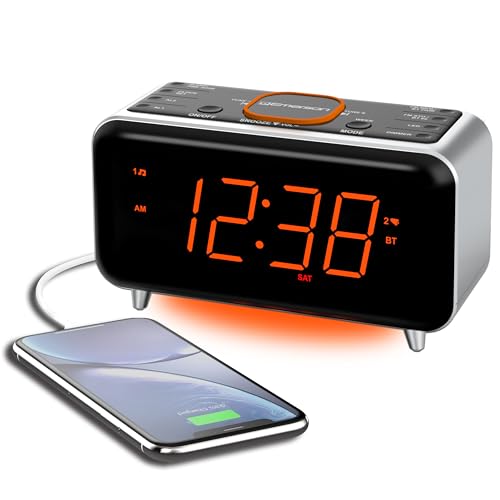
[…] furnishing the rest of the room should start with Best Alarm Clocks for Kids for the younger siblings inheriting the hand-me-downs, and browse Best Bath Mats by Color when the […]