What's inside
- Key Takeaways
- Quick Picks
- How Did We Choose the Best Alarm Clocks for College Students?
- How Do the Six Picks Compare Side by Side?
- How Does a Student Clock Survive a Roommate’s Schedule?
- What Does a Sensible Student Budget Actually Allow?
- How Should a Student Set Up for Exam Season Specifically?
- Why Do Students Sleep Through Alarms They Set Themselves?
- How Do Early Shifts and Part-Time Jobs Change the Calculation?
- What Should a Student Do When the Alarm Keeps Failing Socially?
- How Does the Clock Fit a Student’s Wider Sleep Routine?
- How Should Students Handle the Clock When Moving Rooms or Travelling?
- Which Clock Suits Which Kind of Student, Honestly?
- What About Students Who Study and Sleep in the Same Chair’s Reach?
- How Do Students Use an Alarm for Naps Without Ruining the Night?
- Should a Student Buy the Clock Before or After Arriving?
- What Are the Most Common Mistakes Students Make With Alarm Clocks?
- Final Recommendation
- Frequently Asked Questions
- Related Guides
As an Amazon Associate I earn from qualifying purchases. This post may contain affiliate links at no extra cost to you.
cottageverdict.com is reader-supported. When you buy through links on our site, we may earn an affiliate commission.
Where to buy: every clock below links to its Amazon listing, where you can check price on Amazon and confirm size, power type and alarm features before it joins a student’s luggage.
The best alarm clocks for college students are not really about telling the time. They are about the eight o’clock lecture that sits on the far side of a night that ended at two, the roommate asleep three metres away whose first class is at noon, and a budget that treats every purchase as a negotiation with next month’s food money. A student clock lives a harder life than almost any other household object: it gets knocked off desks, buried under laundry, unplugged to free a socket for a kettle, and asked — daily — to perform the single most unwelcome task in undergraduate life.
This guide judges clocks by student reality rather than showroom virtues. Dual alarms matter because a student’s week is not one schedule but several: early lectures on Monday and Wednesday, a lie-in on Tuesday, a part-time shift on Friday. Volume matters in both directions — enough to cut through deep, debt-laden sleep, but controllable enough not to declare war on a shared suite. Displays must dim, because a bedroom that doubles as a study, cinema and social space cannot glow like an airport departure board all night. And everything here sits in the budget or mid tier when described in words, because a clock that costs a textbook is a clock a student should not buy.
Notice what this guide is not: a tour of dorm decoration. The question is not how a clock photographs against a tapestry but whether it gets a tired nineteen-year-old upright, dressed and across campus before the lecture theatre doors close. Reliability beats novelty, a snooze button that can be found by touch beats an app that needs updating, and battery backup beats elegance every time an old building’s wiring gives up mid-semester. Six clocks passed those tests, ranging from a twin-bell traditionalist that could wake the dead to a wooden-faced digital that keeps the peace in a shared room.
Key Takeaways
- Dual alarms are the student’s essential feature, because no undergraduate week runs on one schedule.
- Volume must be adjustable both ways: fierce enough for deep sleep, tame enough for a sleeping roommate.
- A dimmable display protects sleep in a room that serves as bedroom, study and cinema at once.
- Battery backup is cheap insurance against old wiring, tripped breakers and borrowed sockets.
- Every pick here is budget or mid tier in spirit — student money has better places to go.
- The clock that survives college is the boringly reliable one, not the cleverest gadget on the desk.
Quick Picks
| Pick | Badge | Why it made the list |
|---|---|---|
| Netzu Digital Alarm Clock | Best all-round student clock | Dual alarms, bold digits and four volume levels in an easy plug-in clock that shrugs off semester chaos. |
| uscce Wooden Digital Alarm Clock | Best for shared suites | A wood-faced clock with a fully dimmable display and dual alarms that will not light up a roommate’s night. |
| Amazon Basics Small Digital Oval Alarm Clock | Best budget buy | A small oval clock with a nightlight, snooze and battery backup at the gentlest end of student spending. |
| REACHER Digital Alarm Clock | Best for phone chargers | Colourful dimmable digits plus a USB port, so the clock earns the socket it occupies every single night. |
| DreamSky Small Digital Alarm Clock | Best readable display | Large calm numbers, a real dimmer and adjustable volume in a compact clock that suits desk or bedside. |
| Peakeep Twin Bell Alarm Clock | Best for champion oversleepers | A battery-run twin bell with a ring no amount of deadline exhaustion can sleep through politely. |
How Did We Choose the Best Alarm Clocks for College Students?
We began with the academic calendar rather than the product catalogue. A student clock must handle a week with at least two different wake times without a full reprogramming session each night, so dual alarms — or an alarm that is genuinely quick to reset — formed the first filter. Clocks that demanded a phone, an account or a firmware update to perform their basic job were set aside; at eight in the morning, a student needs a button, not an ecosystem.
Volume was judged socially as well as personally. Every pick can be heard by its owner, but the better picks let that owner choose how much of the corridor hears it too. We favoured stepped volume controls and gentler tones for shared rooms, reserving true loudness for the twin bell, whose job is different: it serves the solo room, the heavy sleeper, and the student who has already slept through two phone alarms and a roommate’s shaking.
Survivability came third. College furniture is narrow, semesters involve moves, and anything fragile will meet a floor eventually. Compact footprints, simple shapes and battery backup all scored, as did displays that dim to darkness — a detail that matters when your bedroom is also where a roommate revises, watches films and attempts to sleep through your early starts. Price framing stayed verbal and honest: these are budget and mid-tier objects, judged on whether their cost feels proportionate to a student’s term, not on features nobody will use twice.

Netzu Digital Alarm Clock — Best all-round student clock
The Netzu reads like a checklist written by someone who has actually survived freshers’ week. Dual alarms handle the split personality of a student timetable. Bold digits can be read through the particular squint of a person who went to bed during the small hours. Five dimmer levels take the display from revision-desk bright to shared-room invisible, and four volume settings let the same clock whisper on a light morning and insist on a heavy one. Nothing about it requires an app, an account or a manual kept in a safe place.
Its manner is plug-in and get-on-with-it, which suits a life where the clock may be set up on a landing-week desk and moved twice before Christmas. The snooze is findable by touch — a genuine virtue at seven in the morning — and the whole unit feels built to be operated by someone whose fine motor skills are temporarily offline. Students sharing with an early riser will appreciate that the alarm can be kept personal: set the volume for your pillow, not for the whole floor, and the Netzu does its job without becoming a corridor event.
For a first purchase it is hard to beat as a default. It costs student money rather than gadget money, covers the timetable problem completely, and asks for nothing in return except a socket. If the rest of this list is about specialisms, the Netzu is the sensible centre they orbit.
- Type: plug-in digital clock with dual alarms
- Display: bold digits with five dimmer levels
- Sound: four volume levels from polite to insistent
- Snooze: large, findable without opening both eyes
- Best setting: bedside in a single or shared student room
Strengths
- Two alarms map neatly onto a timetable with early and late days.
- Dimming range genuinely suits rooms where someone else is sleeping.
- Setup takes minutes and survives being redone after every move.
Trade-offs
- No charging port, so the socket serves the clock alone.
- The styling is functional rather than a design statement.
- Plug-in power means placement follows the room’s sockets.
Best for: students wanting one dependable clock for a mixed timetable.
Not suited for: anyone needing a wake-up violent enough to defeat earplugs.

uscce Wooden Digital Alarm Clock — Best for shared suites
Shared accommodation runs on small courtesies, and this uscce is a courteous object. Its wooden face softens the look of a room full of plastic and cables, while the display behind that face dims across the full range to nothing — the single most roommate-friendly feature any clock can offer. Your six-thirty start no longer requires the room to be lit like a control tower while your suite-mate’s first commitment is at eleven.
Function keeps pace with manners. It carries dual alarms with volume control, aimed at heavy sleepers yet adjustable down to civilised levels, and the large numbers stay legible from a bed pushed against the far wall — a common geometry in student rooms, where the desk, bed and wardrobe negotiate a tight treaty. The wood finish also disguises the clock as furniture, which helps in the small diplomacy of a shared space: equipment that looks calm tends to be treated calmly.
Choose it when the social contract matters as much as the wake-up. A student in a single room can buy pure function for less; a student sharing should weigh the full-range dimmer and the gentle presence heavily, because the roommate relationship will outlast any single module, and it is built out of exactly these small considerations.
- Type: wooden-faced digital clock with dual alarms
- Display: large numbers dimming from full brightness to dark
- Sound: volume control with settings for deep sleepers
- Finish: wood decor that blends into shared living space
- Best setting: suites and rooms shared with a later riser
Strengths
- Full-range dimming is the kindest feature a shared room can host.
- Dual alarms cover early lectures alongside a partner’s lie-in.
- The wooden face makes a cramped room feel marginally more civilised.
Trade-offs
- The calm styling costs more than the plainest plastic rivals.
- Maximum volume serves its owner, not the truly unreachable sleeper.
- Wood tones may argue with a aggressively monochrome room scheme.
Best for: students in shared suites who start earlier than their roommates.
Not suited for: solo heavy sleepers who need maximum force above all.

Amazon Basics Small Digital Oval Alarm Clock — Best budget buy
Every student list needs an honest cheap option, and this oval Amazon Basics clock is it. The proposition is minimal and complete: a clear LED display, a snooze, a built-in nightlight for the corridor-stumble hours, and battery backup so a tripped breaker in an old house does not silently cancel the morning. Its footprint is tiny — a few inches in each direction — which in a student room is not a detail but a destiny: surfaces are scarce, and anything small survives longer.
What it does not do defines it as clearly. There is one alarm rather than two, no charging port, no menu of sounds. For a student whose timetable is uniform — same start most days, weekends handled by switching the alarm off — those absences barely register. For a student juggling lectures and shifts, the single alarm becomes a nightly arithmetic chore, and the Netzu above is the wiser spend. Judged as a backup clock, a travel clock or a first-term stopgap, though, the little oval is exactly proportioned to its job.
It also travels well between the places a student year actually happens: term room, family home at Christmas, a friend’s floor before an early train. Battery backup means it forgives being unplugged in haste, and its cheapness means losing it is an annoyance rather than a financial event — a realistic consideration in communal living.
- Form: compact oval digital clock on mains power, battery backup fitted
- Display: clear LED with a built-in nightlight
- Alarms: single alarm with snooze
- Size: compact in every dimension, made for crowded surfaces
- Best setting: uniform timetables, travel and backup duty
Strengths
- The gentlest strain on a student budget in this entire list.
- Battery backup protects mornings in houses with elderly wiring.
- Tiny footprint fits shelves and windowsills other clocks cannot.
Trade-offs
- One alarm only, so varied weeks mean nightly resetting.
- No USB charging for the phone that shares its socket.
- The nightlight is fixed rather than finely adjustable.
Best for: students on the tightest budgets with a regular daily start.
Not suited for: shift workers or students running two different wake times.
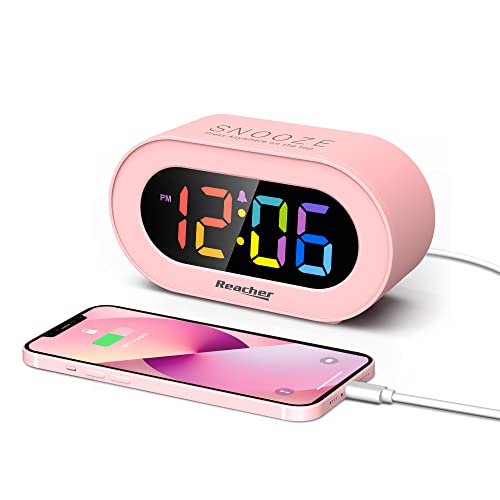
REACHER Digital Alarm Clock — Best for phone chargers
Sockets are the contested territory of student housing, and the REACHER settles the dispute by sharing. Its USB charging port means the clock and the phone — the two devices that must live beside a student bed — run from one plug, ending the nightly negotiation with the laptop charger and the lamp. The phone wakes up charged even when its owner does not, which at least removes one excuse from the morning.
The display is the colourful REACHER signature: pink casing, rainbow-tinted digits, dimmable down for the night. In a beige institutional room, that cheerfulness is not trivial; students live in these rooms for most of a year, and an object consulted daily might as well be pleasant. Volume adjusts, the snooze is easy, and the compact body leaves room on the bedside crate — furniture being a generous word — for the water bottle and the reading that was definitely going to happen.
One caution belongs to shared rooms: a charging phone beside the bed is a phone within reach at two in the morning, and the clock cannot be blamed for what its owner does with that proximity. Set the alarm, plug in, and put the phone face down. The REACHER will handle the morning; the discipline, as ever, is outsourced to the student.
- Type: compact digital clock with USB phone charging
- Display: colourful LED digits with dimming
- Sound: adjustable volume with easy snooze
- Finish: pink casing that brightens institutional rooms
- Best setting: bedsides where one socket must serve everything
Strengths
- The charging port ends the nightly battle for the bedside socket.
- Cheerful display makes a rented room feel personally claimed.
- Compact size suits the crates and shelves students actually use.
Trade-offs
- A single alarm path limits complicated weekly schedules.
- The colourful digits will not suit every taste in a shared room.
- Charging speed serves overnight top-ups, not emergency revivals.
Best for: students whose phone and clock compete for one bedside plug.
Not suited for: minimalists who keep phones charging outside the bedroom.

DreamSky Small Digital Alarm Clock — Best readable display
The DreamSky’s argument is legibility. Its large numbers can be read from a bed, from a desk, and from the doorway by a student checking whether there is time to shower — three distances that cover most undergraduate time enquiries. There is no squinting, no leaning, no phone picked up ‘just to check the time’ that returns its owner to consciousness forty minutes later holding a social feed. In an economy of attention, a clock you can read at a glance is a small daily mercy.
Supporting details are equally student-proof. A proper dimmer keeps the big display from flooding a dark room. Volume adjusts so early starts can be kept personal in shared housing. The USB charging port repeats the REACHER’s socket diplomacy, and the plug-in design with its USB-C adapter keeps the setup compact on a desk that also hosts a laptop, a mug and a semester’s worth of paper. It is the clock equivalent of a well-organised seminar handout: nothing decorative, everything findable.
Students who split their lives between desk and bed will get most from it, since the display serves both posts equally. Put it where the morning light does not wash it out, set both the brightness and volume during daylight, and it will simply be there — legible, punctual and uncomplaining — for the length of a degree.
- Type: plug-in digital clock with extra-legible display
- Display: large numbers with a proper dimmer
- Sound: adjustable alarm volume for shared housing
- Extras: USB charging port beside the bed or desk
- Best setting: rooms where the clock serves desk and bed alike
Strengths
- Numbers readable at every distance a student room offers.
- Dimmer and volume controls respect roommates and sleep alike.
- Charging port keeps the phone powered without another adapter.
Trade-offs
- The plain design prioritises clarity over character.
- Big digits mean a bigger night-time presence, even dimmed.
- Mains power ties it to wherever the room’s sockets happen to be.
Best for: students who check the time constantly and hate squinting.
Not suited for: anyone wanting a clock that disappears into the decor.
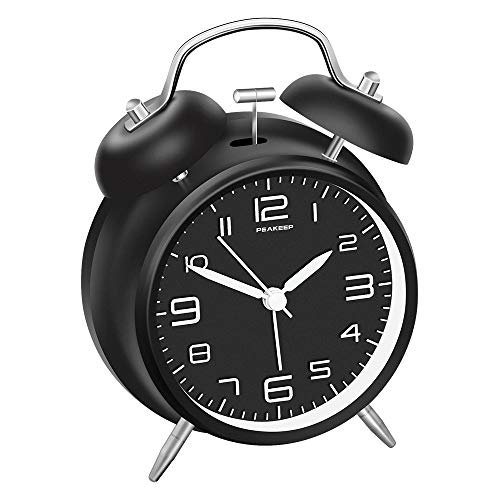
Peakeep Twin Bell Alarm Clock — Best for champion oversleepers
Some students do not need a clock; they need an event. The Peakeep twin bell is that event — an old-fashioned, battery-run alarm whose ring has ended more lie-ins than any motivational poster. There is no volume knob because there is no negotiation: when the hammer meets the bells, the room knows. For the student who has slept through phone alarms, a roommate’s alarm and once, memorably, a fire drill rehearsal, this analogue certainty is the honest answer.
Battery operation is a strategic advantage disguised as simplicity. The Peakeep can live anywhere — across the room on a wardrobe top, where silencing it requires standing, walking and committing to the day. No socket is consumed, no cable trails, and a power cut cannot touch it. The backlight serves the occasional night-time check, and the four-inch dial with its 3D numerals reads clearly without any electronics at all. Setting it involves turning a knob, a skill that survives hangovers better than any touchscreen.
The social warning is real: in a shared room, this clock is a declaration of war, and it should be deployed only with a roommate’s informed consent or a solo room. Used justly — single room, heavy sleeper, early exam — it is the most reliable object on this page, and the one most likely to be remembered, with complicated affection, for decades.
- Type: battery-operated twin bell analogue clock
- Sound: full mechanical ring with no volume setting
- Display: four-inch dial with backlight for night checks
- Power: batteries only, immune to cuts and socket shortages
- Best setting: across the room, where stopping it requires standing
Strengths
- The ring defeats sleep that electronic tones cannot reach.
- Battery power frees it from sockets, cables and outages.
- Analogue setting is instant, tactile and impossible to misconfigure.
Trade-offs
- Utterly unsuitable for shared rooms without a roommate’s consent.
- No snooze subtlety — the morning starts at full volume immediately.
- Precision is analogue: near enough, rather than to the minute.
Best for: solo students who sleep through everything electronic.
Not suited for: shared suites, light sleepers or the easily startled.
How Do the Six Picks Compare Side by Side?
| Pick | Alarms | Charging | Roommate manners |
|---|---|---|---|
| Netzu Digital Alarm Clock | Dual | No port | Good, with five dimmer levels |
| uscce Wooden Digital Alarm Clock | Dual | No port | Excellent, display dims to dark |
| Amazon Basics Small Digital Oval Alarm Clock | Single | No port | Fair, small and unobtrusive |
| REACHER Digital Alarm Clock | Single path | USB port | Good, dimmable colourful digits |
| DreamSky Small Digital Alarm Clock | Single path | USB port | Good, dimmer tames big digits |
| Peakeep Twin Bell Alarm Clock | Single | Battery only | None — solo rooms only |
How Does a Student Clock Survive a Roommate’s Schedule?
The defining negotiation of shared student living happens at six in the morning. One person’s seminar is another person’s deep sleep, and the alarm clock sits exactly on that border. Survival — of the clock, and of the friendship — depends on keeping the wake-up personal. Volume set for a pillow rather than a postcode, a display dimmed to invisibility, and a snooze button that can be silenced by touch before the second ring: these are not features, they are diplomacy conducted in electronics.
Placement helps the diplomacy along. A clock on the early riser’s own side, angled away from the roommate’s bed, keeps both light and the first moments of sound local. Vibrating phone alarms under a pillow can supplement a quiet clock for the truly divergent schedules, though they belong to a different guide. What does not work is escalation: a roommate war fought with increasing volumes ends with both parties exhausted and the whole corridor involved. If your starts differ by more than a couple of hours most days, agree the arrangement explicitly in September, while goodwill is fresh, rather than litigating it at dawn in November.
The uscce wooden clock exists for this negotiation, with its display that can vanish entirely, and the Netzu’s five dimmer levels serve the same treaty. Buy the manners first and the loudness second; a clock can always be supplemented, but a roommate relationship, once rung awake at full volume for a month, takes longer to repair than any timetable.
What Does a Sensible Student Budget Actually Allow?
Student money arrives in lumps and leaves in a stream, so the honest way to frame a clock purchase is by tier rather than by tag. The budget tier — the little Amazon Basics oval is its representative here — buys punctuality and nothing else, and for a regular timetable that is a complete purchase, not a compromise. The mid tier buys the things a complicated student life genuinely uses: a second alarm, finer volume steps, a charging port, a display that behaves in the dark. Nothing in this guide reaches the premium tier, deliberately, because the features up there — designer materials, app ecosystems, speaker systems — solve problems students do not have.
Resist the false economy of the very cheapest unknown brands, whose alarms drift, whose buttons fail by November and whose replacement costs more than the saving. Equally, resist the phone-only strategy that feels free: a phone alarm is hostage to a flat battery, a silent mode set for an exam and forgotten, and an operating system update that rearranges the app in the night. A dedicated clock is a single, boring insurance policy, and boring is precisely what a student wants from the object standing between them and a missed exam.
Second-hand is a legitimate route for the analogue Peakeep especially, since a mechanical bell has little to wear out — but test the ring before money changes hands, and remember that a clock bought from a graduating student comes with its own history of mornings survived, which some buyers count as a recommendation in itself.
How Should a Student Set Up for Exam Season Specifically?
Exam mornings are not ordinary mornings with higher stakes; they are logistics operations, and the clock is only the first link. Set the alarm the night before with the exam’s actual geography in mind — travel across campus, a building you have visited twice, doors that close without sentiment. Then add a second, independent wake-up: the dual alarm on the Netzu or uscce, a phone across the room, a friend in the same exam under a mutual-waking pact. Redundancy feels excessive until the morning it saves a degree classification.
The week before matters more than the night before. Shifting sleep earlier in half-hour steps across several days moves the alarm out of the deepest sleep, where waking is hardest and snoozing most seductive. An alarm that lands in light sleep feels gentle even at an early hour; the same alarm ninety minutes deeper feels like an attack. Protect the last night especially: the clock cannot compensate for a revision session that ended at four, and no setting on this page changes that arithmetic.
On the morning itself, put distance between the clock and the bed for the exams that matter most. A clock across the room converts the first snooze into a decision made standing up, and standing decisions are far more honest than horizontal ones. Lay out clothes, bag and water the night before, so the vertical student has a path to follow rather than a fresh set of problems to solve at dawn.
Why Do Students Sleep Through Alarms They Set Themselves?
Sleep debt is the usual culprit, and it is structural rather than moral. A timetable that permits lie-ins on four days teaches the body that mornings are negotiable, so the fifth day’s alarm arrives as a suggestion the sleeping brain is trained to decline. The fix is unglamorous: narrow the gap between earliest and latest wake times across the week, and let the dual alarms enforce a rhythm instead of recording chaos. A body that rises within the same hour daily starts surfacing before the alarm, which is the closest thing to a superpower undergraduate life offers.
Alcohol deserves its honest mention. Even moderate late drinking fragments the second half of the night and deepens the sleep that follows, which is why the morning after a big night defeats alarms that work perfectly all term. Students who know a heavy evening is coming should set the clock before going out, place it across the room, and arrange the human backup of a friend — because the version of them making decisions at midnight is not the version who has an exam at nine.
Finally, some oversleeping is a signal rather than a failure: persistent exhaustion despite adequate hours, or sleep that no alarm seems to reach, deserves a conversation with a doctor or the university’s support services rather than a louder purchase. The Peakeep is the end of the shopping road; beyond it lies advice, and seeking it is a strength, not an admission.
How Do Early Shifts and Part-Time Jobs Change the Calculation?
A growing share of students wake not for lectures but for work: café openings, supermarket shifts, cleaning rounds that begin while the campus still sleeps. Those mornings differ from lecture mornings in one brutal respect — somebody else is counting on you, and the consequence of oversleeping is a phone call, a warning and eventually a lost job rather than a missed handout. A work alarm deserves the redundancy usually reserved for exams: dual settings where the clock allows, a second device as backstop, and a wake time built around the bus or the walk, not around optimism.
Shift patterns also scramble the week’s rhythm in ways lectures rarely do. A student closing a bar at midnight and opening a bakery at six is living two days inside one, and their clock strategy should admit it: protect one anchor sleep, even a short one, at a consistent hour, and let naps be scheduled events with alarms of their own rather than collapses. The DreamSky and REACHER earn their charging ports double here, because a phone that must serve as backup alarm cannot be allowed to die overnight.
Employers, incidentally, can tell which students run a system. The ones who arrive composed, with time for the handover and the coffee, are rarely the ones with the most talent for mornings — they are the ones whose clocks, placements and bedtimes were arranged before the rota was published. Reliability is a reputation, and at student wages it compounds faster than the pay itself.
What Should a Student Do When the Alarm Keeps Failing Socially?
Sometimes the clock works and the corridor objects. Repeated early alarms bleeding through thin walls, a twin bell deployed in a shared suite, a snooze cycle that rings six times while its owner showers — these are social failures wearing technical costumes. The first remedy is information: tell neighbours your early days, keep a small mental map of who sleeps latest, and treat the week after moving in as the negotiation window when arrangements are cheap to make and expensive to skip.
The second remedy is substitution. Move the alarm’s burden from sound to structure: a clock with a strong dimmer used at low volume beside the pillow, a phone vibrating under the mattress as the first nudge, the audible alarm reserved as the second stage only if the first fails. Staged waking is how hospitals and barracks solve the same problem, and a student corridor is closer to a barracks than most residents care to admit. The uscce and Netzu both support the quiet end of such a system without complaint.
If complaints persist despite honest adjustments, the housing office is a better venue than an escalating dawn arms race. But in practice, most alarm friction dissolves once the early riser demonstrates effort — volume down, display dark, snooze rationed — because what neighbours resent is rarely the sound itself. It is the suspicion that the sound’s owner never considered them at all.
How Does the Clock Fit a Student’s Wider Sleep Routine?
A clock is the last five percent of a sleep system; the rest is light, timing and the phone’s exile from the pillow. Students who charge the phone at the REACHER or DreamSky across the room gain twice: the alarm’s distance in the morning, and an evening without the feed’s blue argument that sleep can wait. Pair that with a consistent lights-out target on lecture nights and the alarm’s job shrinks to a formality — most well-rested students surface minutes before it, and regard its ring as confirmation rather than rescue.
Weekends are where routines go to negotiate. Sleeping until noon on Saturday feels like recovery and functions like jet lag, shifting the body clock so that Sunday night’s sleep will not come and Monday’s alarm lands in the deepest trench of the night. A compromise most students can actually keep is a weekend lie-in capped at an hour beyond the weekday wake time, enforced by the second of the dual alarms rather than by willpower. The week then starts from a rhythm instead of from a wreck.
None of this requires virtue, only arrangement. The students who rise well are seldom the most disciplined people in the building; they are the ones whose rooms, clocks and evenings were set up so that the easy thing and the necessary thing coincide. A good clock purchase is the start of that arrangement, which is why this guide keeps returning to placement, dimming and sockets rather than to novelty features.
How Should Students Handle the Clock When Moving Rooms or Travelling?
A student clock changes address more often than almost any other possession: halls to house-share, house-share to a summer sublet, sublet to a placement in another city. Portability therefore deserves a line in the buying decision. The battery-run Peakeep and the little Amazon Basics oval travel without ceremony, while the plug-in digitals need their adapters remembered — a detail that has stranded more clocks in vacated rooms than theft ever will. Photograph your setup before the first move, cables and all, and reassembly at the new desk becomes a two-minute job instead of an archaeological dig.
Travel for early trains and flights poses the sharper test, because those mornings carry fixed departures and unfamiliar rooms. Take the clock you trust rather than relying on a hotel’s wake-up call or a phone in a strange socket landscape, set it before dinner rather than after midnight, and place it where the room’s layout forces a proper stand. Students returning from field trips, matches and family weekends at unprintable hours will recognise the pattern: the mornings that go wrong are the ones arranged last, in the dark, by a tired person. Arrange them early, in daylight, like someone who intends to succeed.
At the year’s end, the clock also becomes a small asset decision. A reliable digital in good order sells or passes to a first-year in minutes; a clock with a failed button becomes landfill. Buying the sturdier mid-tier option, keeping its box through the first term, and wiping it down before resale are dull habits that quietly return a meaningful slice of the purchase — and in a student budget, dull habits that return money are worth cultivating early.
Which Clock Suits Which Kind of Student, Honestly?
The organised student with a varied timetable — the one with colour-coded seminars and a society committee on Thursdays — needs only the Netzu’s dual alarms and the discipline they already own. Their risk is not oversleeping but over-scheduling, and a clock that simply keeps the week’s two rhythms without fuss is the correct, unglamorous answer. They will set it once in September and think about it never again, which is the highest praise a clock can earn.
The social student in shared housing, whose room is the corridor’s informal common room, needs the uscce’s vanishing display and volume manners, because their mornings begin inside other people’s sleep. The broke and cheerful student needs the Amazon Basics oval and the honesty to admit their timetable is simple. The phone-attached student needs the REACHER or the DreamSky, not for their alarms but for their sockets — the charging port is the feature that will actually change their nights. And the legendary heavy sleeper, the one friends describe with awe, needs the Peakeep across the room and a standing arrangement with a backup human, because at that depth of sleep a clock is a component, not a solution.
Notice that none of these matches is about taste in objects. Students buy clocks at the start of a life stage defined by new schedules, new rooms and new obligations, and the right purchase is the one that fits the obligations. Choose for the timetable you actually have — including the shifts, the shared walls and the budget — and the clock will repay you in the only currency that matters at eight in the morning: being already awake when it rings.
What About Students Who Study and Sleep in the Same Chair’s Reach?
In the smallest student rooms, the desk and the bed are practically one piece of furniture, and the clock must serve both posts without confusing them. A display legible from the desk helps revision sessions end on time — a genuinely underrated function, since the student who notices midnight arriving can still protect the night, while the one who surfaces at two has already spent tomorrow. The DreamSky’s big digits were practically designed for this double duty, and the Netzu’s dimmer range lets the same display shout across a study session and whisper through the night that follows it.
The boundary matters as much as the visibility. Students who can silence the morning alarm from the desk chair, half-asleep, without ever truly standing, have built themselves a snooze machine with extra steps. Keep the clock’s night post and day post the same physical spot — beside the bed, angled for both — but let the alarm’s off switch require the one thing the desk cannot offer: getting up. Small rooms reward this kind of choreography, because there is no space in them for wasted motion or ambiguous furniture.
Lighting completes the small-room system. A dimmed display, a desk lamp that goes off at a set hour, blackout curtains against the corridor’s all-night brightness — together they tell one consistent story to a tired brain. The clock is the story’s punctuation. Choose it well, place it deliberately, and even nine square metres can run a respectable morning.
How Do Students Use an Alarm for Naps Without Ruining the Night?
The student nap is a precision instrument misused daily. Twenty minutes restores; ninety minutes relocates the sleeper into deep sleep and steals the following night. A clock with an easy countdown or a quickly set alarm — the Netzu and DreamSky both qualify — turns napping into a deliberate tool: set it before lying down, keep the room dim rather than dark, and rise at the first signal while the decision is still easy. Libraries and common rooms have their own etiquette here, but in a private room the discipline is simply this: the nap ends when the clock says, not when the sleeper feels ready, because the sleeper will never feel ready at minute twenty.
Timing matters as much as length. A nap before mid-afternoon borrows against alertness; a nap at six in the evening borrows against the night itself, and the debt collector arrives at two in the morning. Students pulling late library sessions should treat the early-afternoon nap as part of the timetable — timetabled, alarmed, defended — rather than as a collapse that happens to them. Shift workers among the student body know this already; their anchor sleeps are the same technology at a larger scale.
And when the alarm ends a nap, light and movement finish the job the sound began. Open the curtains, stand, drink water, and let the clock return to its ordinary duties. The students who nap well are, once again, not the most virtuous — they are the ones who set the ending before they allowed the beginning.
Should a Student Buy the Clock Before or After Arriving?
Buying before arrival has one clear advantage: the first morning of term, in an unfamiliar room with an early induction session, is the worst possible moment to discover that a phone alarm and a flat battery have conspired. A clock unpacked with the bedding simply works from night one. Buying after arrival has the opposite virtue — the room reveals its socket positions, its shelf depths and its roommate, and the purchase can be fitted to facts rather than guesses. Students in shared suites especially benefit from one week’s evidence about whose schedule runs earlier before choosing between the uscce’s manners and the Netzu’s all-round competence.
The sensible compromise is a two-stage approach. Arrive with the cheapest reliable stopgap — the little oval Amazon Basics travels in a washbag and forgives every early mistake — then upgrade deliberately once the timetable settles, keeping the stopgap as the travel and backup clock it was born to be. Two clocks across a degree is not extravagance; it is how a student ends up with a system instead of a hope.
What Are the Most Common Mistakes Students Make With Alarm Clocks?
Relying on a phone alone leads the list, for reasons already rehearsed: batteries, silent modes and updates all conspire at the worst hour. Close behind comes the single-alarm clock bought for a two-schedule life, which trains its owner to reprogram nightly and forget weekly. A third classic is volume bravado — buying the loudest available clock for a shared room, then spending the term apologising to a roommate whose goodwill was worth more than the feature.
Placement mistakes are quieter but just as costly. A clock within arm’s reach invites the horizontal snooze negotiation, which the sleeping brain nearly always wins. A clock left unplugged after being moved for a party weekend simply never comes back into service. And the subtlest error is setting the alarm for the time you wish you rose rather than the time the lecture requires, building a daily snooze allowance into the plan until the allowance itself becomes the schedule and the lecture becomes optional in practice. Set the real time, place the clock at a distance, and let the morning be honest.
Final Recommendation
Most students should start with the Netzu: dual alarms for a real timetable, volume and dimming ranges that respect both deep sleep and roommates, and a price posture that respects a term budget. Sharers in suites should look hard at the uscce wooden clock, whose disappearing display is the politest feature in student housing. The Amazon Basics oval is the right buy when money is tightest or a backup is all that is needed, the REACHER earns its socket by charging the phone, and the DreamSky serves anyone who reads the time twenty times a day. The Peakeep stands apart for the solo heavy sleeper whose mornings need force, not features.
Buy the clock in the first week of term, set it up in daylight, and test it on a morning that does not matter — because the student who meets their alarm for the first time on exam day has confused a purchase with a plan.
Frequently Asked Questions
Is a phone alarm not enough for a student?
It is enough until the night it is not: a flat battery, a silent mode left on after a library session, an update that moves the app. A dedicated clock costs little, does one job and keeps doing it through every phone mishap. Most students end up using both, with the clock as the reliable senior partner. There is also a quieter benefit that shows up within a fortnight: when the clock owns the morning, the phone can stay face-down and charging until its owner is dressed, which removes the single most common way a punctual start dissolves into a horizontal scroll through other people’s breakfasts.
How loud should an alarm be in a shared room?
As quiet as its owner can reliably hear at pillow distance, which for most sleepers is far below maximum. Test volumes together with your roommate during the day, agree what is fair, and keep the fierce settings — and certainly the twin bell — for solo rooms and exceptional mornings.
Do dual alarms really matter?
For any week containing two different start times, yes. They remove the nightly reprogramming that causes most missed alarms, and they let weekends differ from weekdays without a settings session. Students with one fixed start every day can happily save the money and take a single-alarm clock.
Where should the clock go in a small student room?
Heavy sleepers should place it across the room, so silencing it requires standing. Everyone else does best with it beside the bed but angled away from a roommate’s pillow, with the display dimmed. Keep it off the floor, where student rooms conduct their floods, spills and lost-shoe incidents.
What happens to the alarm when the power goes out?
Plug-in clocks with battery backup keep their time and alarm through an outage; those without simply stop, which is why backup matters in older housing. The battery-run Peakeep ignores the grid entirely. Check which kind you own before the first storm of the winter term, not after it. A torch beside the bed and a clock that kept its time turn a power cut from a crisis into a story told at breakfast.
Can a clock help with an all-night revision session?
Only at the edges: set it for a short nap’s end rather than letting a twenty-minute rest become three hours, and set the real morning alarm before the session begins, while judgement is still available. No clock makes an all-nighter a good idea; it can merely limit the damage.
What if my timetable changes every single week?
Rotating seminars, clinical placements and shift rotas can defeat even dual alarms, and the answer is a weekly ritual rather than a better clock: every Sunday, spend two minutes setting the coming week’s wake times against the actual timetable, and delete any alarm that no longer corresponds to a real obligation. Stale alarms are worse than none, because a clock that cries wolf on free mornings trains its owner to ignore it on the mornings that count. Students on placements with dawn starts should also keep the backup arrangement — second device, placed clock, waking pact — permanently in place rather than assembling it in a panic the night before each early start.
Related Guides
Student mornings connect to the wider questions of shared and small-space living covered across the site: Best Alarm Clocks for the Deaf and Hard of Hearing Best Bath Sheets and Large Towels Best Bathroom Storage and Vanity Cabinets Best Air Purifiers for a 1-Bedroom Apartment


[…] rooms lead naturally to the next stages of independent mornings and the rest of the home beyond: Best Alarm Clocks for College Students Best Bath Mats for Cleanliness 30 Bathroom Storage Ideas to Save Space Best Air Purifiers for a […]