What's inside
- Key Takeaways
- Quick Picks
- How Did We Choose the Best Bean to Cup Coffee Machines for Home Kitchens?
- Comparison Table
- What Actually Changes Between a Good Bean to Cup Machine and a Great One?
- How Do You Keep a Bean to Cup Machine Tasting Fresh Week After Week?
- What Are the Most Common Mistakes New Owners Make?
- Final Recommendation
- How Should You Set the Grinder and Strength During the First Week?
- Which Drinks Does a Home Bean to Cup Machine Genuinely Do Well?
- What Will Ownership Actually Cost You Beyond the Purchase?
- Where Should the Machine Live, and How Much Room Does It Really Need?
- Who Should Skip This Category Entirely?
- Do Plant-Based Milks Froth Properly in These Systems?
- What Changes in the Second Year of Ownership?
- Frequently Asked Questions
- Related Guides
As an Amazon Associate I earn from qualifying purchases. This post may contain affiliate links at no extra cost to you.
cottageverdict.com is reader-supported. When you buy through links on our site, we may earn an affiliate commission.
Where to buy: every machine in this guide is sold through Amazon, and the pick names in the Quick Picks table, the detailed reviews and the comparison table all link to the matching listing so you can check price on Amazon before deciding. That matters when you shop for the best bean to cup coffee machines for home use, because this category shifts constantly — new series arrive, older flagships get discounted, and refurbished units like the Saeco in this list appear and disappear with stock.
Here is the honest starting point. A bean to cup machine is a small café folded into one box: it stores whole beans, grinds a dose on demand, tamps and brews espresso under pressure, and — on most of the models below — froths milk without asking you to learn a steam wand. What it replaces is not skill so much as sequence. Instead of a separate grinder, scale, kettle and portafilter routine spread across your counter, you press a button and the machine walks through the steps in order, the same way every morning, whether you are fully awake or not.
That convenience has a shape, though, and the shape differs more between these six machines than their marketing suggests. Two households can both want “one-touch coffee” and need opposite machines: one drinks straight espresso and values a quiet, well-built brewer above everything; the other runs a weekend rotation of cappuccinos for guests and needs a milk carafe that lives in the fridge between uses. The six picks below were chosen to cover those different homes rather than to crown a single winner, and each review says plainly who should walk past it.
One disclosure belongs up front rather than buried. The Saeco Xelsis at the end of the list is a Renewed unit — factory-refurbished stock, not a brand-new machine — and it is labelled that way everywhere it appears in this article. It earns its place because a refurbished flagship can deliver features that new machines at similar money simply do not offer, but it is a different kind of purchase and the review treats it as one.
Key Takeaways
- Bean to cup machines grind, tamp and brew in one housing; the real differences are milk handling, cleaning burden and how much the machine lets you adjust.
- Philips LatteGo carafes detach and rinse in seconds, which suits households where milk drinks happen daily and nobody wants to scrub tubes.
- The Jura E4 brews coffee and espresso only — there is no automatic milk system — so it fits drinkers who take their coffee black.
- Miele’s CM 6360 is the premium build of the group, with a stainless milk flask and a quieter, heavier feel throughout.
- The Saeco Xelsis (Renewed) is refurbished stock: flagship features, a different warranty conversation, and availability that comes and goes.
- Whichever model you choose, fresh beans and a weekly rinse cycle matter more to cup quality than any single headline feature.
Quick Picks
| Pick | Badge | Why it earns its place |
|---|---|---|
| De’Longhi Magnifica Duo Automatic Espresso Machine | Best all-round family pick | A balanced automatic with a milk frother that handles the weekday espresso-and-latte routine without fuss or a steep learning curve. |
| PHILIPS 4400 Series Fully Automatic Espresso Machine LatteGo | Best for milk-drink variety | Twelve hot and iced presets behind the easiest milk system in this guide to clean, the two-part LatteGo carafe. |
| PHILIPS 2300 Series Fully Automatic Espresso Machine LatteGo | Best compact Philips | The same LatteGo convenience in a smaller, simpler machine with three presets for households that drink a short menu well. |
| Miele CM 6360 MilkPerfection Bean-to-Cup Coffee Machine | Best premium build | A weighty, quiet machine with a proper milk flask and the most polished fit and finish of the six. |
| Jura E4 Automatic Coffee Machine | Best for black coffee purists | Espresso and long coffee brewed with Jura’s pulse extraction, and no milk hardware to clean because there is none. |
| Saeco Xelsis Super-Automatic Espresso Machine (Renewed) | Best value flagship (Renewed) | A refurbished top-tier Saeco with user profiles and a touch display, offered as Renewed stock rather than new. |
How Did We Choose the Best Bean to Cup Coffee Machines for Home Kitchens?
We started from the way these machines are actually used at home, which is not the way showrooms present them. A home machine is operated half-asleep, cleaned by whoever happens to be near the sink, and filled with whatever beans were on offer that week. So the first filter was forgiveness: how does each machine behave with ordinary beans, ordinary water and an owner who reads the manual once? Models that demand precise dialling-in before they produce a decent cup were marked down, however impressive their specification sheets looked.
Milk handling carried the second-largest weight, because it decides the daily cleaning burden. We looked at whether the system uses a carafe that stores in the fridge, a panarello-style wand, or — in the Jura’s case — nothing at all, and we treated “nothing at all” as a legitimate design answer rather than a missing feature when the machine is honest about it. A household that never drinks milk drinks should not pay, in money or in counter space, for a frothing system it will clean out of guilt twice a year.
Third came the ownership trail: brew group access for rinsing, drip tray size, water tank position, and how the machine tells you something needs doing. Bean to cup machines fail socially before they fail mechanically — they get abandoned when descaling becomes a mystery or the puck bin overflows unnoticed. Clear prompts and front-access tanks scored well. Finally, we checked value in the broad sense: not the cheapest ticket, but whether the features you pay for are ones a home user will still be touching in month six.
Every pick below was verified against the manufacturer’s listing data through the site’s own product feed, and the model names, series numbers and headline features in each review match that verified data. Where a machine’s ability is commonly overstated — refurbished condition, milk capability, iced-drink claims — the review says so in plain language.
We also weighted the unglamorous geography of the counter. A machine that must be dragged forward to fill its tank will, in real homes, be filled less willingly and descaled later than one whose tank slides out at the front; a hopper lid that cannot open under your cupboards will be propped, spilled around and eventually left ajar to stale the beans. These small frictions compound across thousands of mornings, so front access, lid clearance and drip-tray capacity all earned their place in the scoring alongside extraction quality — a machine is a piece of kitchen furniture you operate daily, not a specification sheet you read once.

De’Longhi Magnifica Duo Automatic Espresso Machine — Best all-round family pick
The Magnifica line is the range many households meet first when they leave pod machines behind, and the Duo carries that lineage sensibly: a built-in grinder, a compact brew unit that slides out for rinsing under the tap, and a milk frother arranged for cappuccino-style drinks without a separate jug ritual. In daily terms it behaves like a dependable kitchen appliance rather than a hobby. Fill the tank, keep the hopper topped up, empty the grounds container when the machine asks, and it returns consistent espresso-based drinks morning after morning.
What recommends it as the opening pick is balance rather than brilliance in any single column. The espresso extraction is honest and repeatable, the milk side covers the drinks most families actually make — cappuccino, latte macchiato, hot milk for the children — and the controls stay readable for a household where three different people operate the machine with three different levels of patience. Guests can be handed a drink without a tutorial. Teenagers can be trusted with it. That social usability is a genuine feature in a shared kitchen, and several more expensive machines in this guide are worse at it.
The compromises are the familiar De’Longhi ones. The housing uses more plastic than the Miele or the Jura, the grinder is audible in a quiet early kitchen, and the drink customisation, while adequate, stops short of the profile-saving depth the Saeco offers. None of that undermines it as a first bean to cup machine; it defines the audience. If your household wants good automatic coffee with milk, minimal ceremony and a brand with a long service network, the Duo sits in the middle of the road on purpose — and the middle of this particular road is a comfortable place to be.
- Format: fully automatic bean to cup espresso machine with milk frother
- Grinder: built-in, fed from a top bean hopper
- Brew group: removable for rinsing under the tap
- Milk drinks: cappuccino-style drinks via the frothing system
- Controls: front panel with direct drink selection
Strengths
- Forgiving with ordinary supermarket beans and inconsistent users
- Removable brew unit makes the weekly rinse genuinely easy
- Covers the standard family milk-drink menu without add-ons
Trade-offs
- More plastic in the housing than the premium picks here
- Grinder noise carries in an open-plan morning kitchen
- Customisation is shallower than profile-based rivals
Best for: families buying their first automatic machine who want espresso and milk drinks handled by one appliance.
Not suited for: drinkers who want to fine-tune extraction parameters or save detailed personal profiles.
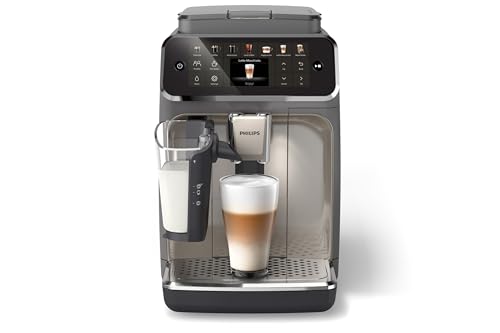
PHILIPS 4400 Series Fully Automatic Espresso Machine LatteGo — Best for milk-drink variety
The 4400’s argument begins in the fridge, not on the counter. Its LatteGo carafe — two pieces, no tubes, no hidden channels — clips onto the front of the machine, froths milk directly into the cup, then unclips and goes back into the fridge door with the leftover milk inside. When it finally needs washing, it comes apart in your hands and rinses clean in seconds, or goes in the dishwasher. Anyone who has owned a milk system with a thin internal tube that quietly turned will understand why this design keeps winning households over: the cleaning task people actually dread simply is not there.
Around that carafe sits a broad, modern automatic. Twelve hot and iced coffee presets cover the current household menu — espresso, coffee, cappuccino, latte macchiato, iced variations — and a ceramic grinder does the daily work without the metallic edge steel burrs can add over years of use. The iced presets deserve a fair description: the machine brews a concentrated shot over ice rather than chilling the drink, which is the right method and produces a genuinely cold coffee rather than a lukewarm compromise.
Where does it give ground? The drinks lean crowd-pleasing rather than intense; espresso purists chasing a syrupy, dialled-in shot will find the ceiling of adjustment lower than they want, and the water tank and bean hopper, while sensibly placed, ask for refills in a busy house more often than the biggest rivals. But as a milk-drink machine for a family — the use case where variety, speed and painless cleaning decide whether the machine is loved or resented — the 4400 is the most complete answer in this list.
- Format: fully automatic espresso machine with LatteGo milk carafe
- Menu: 12 hot and iced coffee presets
- Grinder: ceramic burr grinder
- Milk system: two-part carafe, tube-free, dishwasher-safe, stores in the fridge
- Drinks style: brewed-over-ice method for iced presets
Strengths
- Easiest serious milk system here to keep clean day to day
- Widest ready-made drink menu of the six picks
- Ceramic grinder and quiet, modern operation
Trade-offs
- Espresso intensity will not satisfy dedicated shot tuners
- Tank and hopper need frequent topping in heavy use
- Preset-led design gives less manual control
Best for: milk-drink households that want cappuccinos and iced coffees on tap with almost no cleaning friction.
Not suited for: espresso purists who judge a machine by extraction adjustability alone.

PHILIPS 2300 Series Fully Automatic Espresso Machine LatteGo — Best compact Philips
Think of the 2300 as the 4400’s household logic with the menu trimmed to the essentials and the footprint trimmed with it. Three coffee presets, the same ceramic grinder family, and the same LatteGo carafe idea in a machine aimed at kitchens where counter depth is negotiated in centimetres. For a couple who drink espresso in the morning and a cappuccino after lunch, the shorter menu is not a deprivation — it is the actual menu of their lives, presented without pages of options they would scroll past forever.
The LatteGo system matters even more at this level, because buyers of simpler machines are precisely the people least willing to adopt a cleaning ritual. The carafe rinses under the tap, has no tubes to flush, and returns to the fridge between drinks. Combined with a front-access water tank and a brew group that lifts out for its weekly rinse, the 2300 asks for a few minutes of attention a week and otherwise stays out of the way — the correct temperament for an appliance bought to simplify mornings rather than to become a project.
Honesty about the ceiling: three presets means three presets. There is no iced menu to speak of, no profile memory to store two drinkers’ preferences side by side, and the smaller platform shows itself when you entertain — back-to-back milk drinks for six guests will keep you standing at the machine, refilling and rinsing between rounds. Within a small household, though, none of that bites. The 2300 is the pick for buyers who know their routine is short and want a well-made machine that matches it exactly, rather than a flagship whose extra talents would go permanently unused.
- Format: fully automatic espresso machine with LatteGo milk carafe
- Menu: 3 coffee presets
- Grinder: ceramic burr grinder
- Milk system: tube-free LatteGo carafe, fridge-storable
- Footprint: compact countertop format for smaller kitchens
Strengths
- Same painless milk cleaning as its bigger Philips sibling
- Compact body suits flats, small kitchens and second homes
- Simple controls that a new owner masters in one morning
Trade-offs
- Only three presets, with no iced-drink programme
- No user profiles for multi-drinker households
- Slower when serving a table of guests
Best for: couples and small households with a short, settled drink routine and limited counter space.
Not suited for: hosts who regularly make varied milk drinks for a crowd.

Miele CM 6360 MilkPerfection Bean-to-Cup Coffee Machine — Best premium build
Pick the Miele up by its edges — metaphorically, since it is a countertop machine — and the difference announces itself in weight, panel fit and the damped way its parts move. The CM 6360 comes from a manufacturer that builds washing machines expected to run for decades, and that engineering culture shows in a coffee machine that feels assembled rather than snapped together. For buyers who keep appliances a long time and notice build quality every single day, that solidity is not decoration; it is the product.
The MilkPerfection name refers to its milk handling, which uses a proper stainless flask rather than a plastic carafe or a tube dipped into a carton. Milk texture is the CM 6360’s party piece: fine, dense foam that pours like a café’s, supported by a double-spouted central dispenser that can fill two cups at once and a programme range covering the classic menu plus tea water at considered temperatures. Miele also builds in guided cleaning programmes with on-screen walk-throughs, and its descaling and milk-system rinses are harder to postpone accidentally than on most rivals — the machine is politely persistent.
The costs of this polish are literal and practical. The CM 6360 sits at the premium end of this list, its flask system asks for a little more washing-up than a LatteGo carafe, and the interface, though clear, moves at a measured pace that impatient users notice. None of that will trouble its intended owner. If your instinct is to buy the best-built version of an appliance once and keep it for a decade of breakfasts, this is the machine in the guide written for you.
- Format: fully automatic bean to cup machine with stainless milk flask
- Milk system: MilkPerfection flask for fine-textured foam
- Dispensing: central double spout, two-cup capability
- Maintenance: guided on-screen cleaning and descaling programmes
- Build: heavyweight housing with premium fit and finish
Strengths
- Finest milk texture and overall build quality in this guide
- Two-cup dispensing suits couples with synchronised mornings
- Guided maintenance keeps long-term care on schedule
Trade-offs
- Premium pricing relative to the rest of the list
- Flask needs more washing than a rinse-and-fridge carafe
- Interface pace feels deliberate rather than snappy
Best for: long-term owners who value café-grade milk foam and appliance-grade construction.
Not suited for: buyers watching a tight budget or wanting the absolute simplest milk cleanup.

Jura E4 Automatic Coffee Machine — Best for black coffee purists
The E4 is the contrarian of this guide, and its honesty deserves respect: it makes coffee and espresso, and it does not make milk drinks at all. There is no frother, no carafe, no wand — Jura stripped the machine back to the brewing core and spent the effort there instead. Its pulse extraction process pushes water through the puck in short bursts, a method Jura uses to draw more aroma from the dose, and a professional-grade aroma grinder feeds that puck with a consistency that black-coffee drinkers can taste in the cup.
Consider what that omission buys. Every milk system in this article is also a cleaning system; the E4’s owner never rinses a carafe, never finds a forgotten flask, never descaling-froths anything. The machine’s week consists of beans in, water in, pucks out, and an occasional tablet cleaning cycle that Jura’s integrated programme walks through. For the drinker whose order is an espresso, a long black or an Americano — topped up from the E4’s hot water function — this is not a stripped-down compromise but the correct tool, Swiss-built and focused.
The boundary is equally clear. A cappuccino household should not buy this machine and a separate frothing gadget and call the combination convenient; that path ends with the gadget in a drawer. Nor does the E4 court tinkerers — Jura’s philosophy is that the machine decides, and adjustments stay within a designed envelope. Buy it knowing your household drinks its coffee black, and it will repay you with the least-demanding ownership experience here and cups that justify the focus.
- Format: automatic coffee machine for espresso and black coffee
- Milk system: none — no automatic frothing of any kind
- Extraction: pulse extraction process for aroma
- Grinder: professional aroma grinder
- Extras: hot water function for Americanos and tea
Strengths
- Superb black coffee with zero milk-system cleaning
- Swiss build quality and a calm, compact presence
- Guided tablet cleaning keeps upkeep simple
Trade-offs
- Cannot make cappuccino or latte drinks automatically
- Limited user adjustability by design philosophy
- Premium cost for a deliberately narrow menu
Best for: households that drink espresso and long black coffee and want nothing else from the machine.
Not suited for: anyone whose daily drink involves steamed or frothed milk.

Saeco Xelsis Super-Automatic Espresso Machine (Renewed) — Best value flagship (Renewed)
Read the badge twice: this Saeco Xelsis (Renewed) is a refurbished machine, professionally inspected and restored for resale, not a new unit in a sealed box. That single fact shapes everything about its value. The Xelsis was Saeco’s flagship — a stainless-fronted super-automatic with a colour touch display, a carafe-based milk system, and user profiles that remember how each person in the house takes their drink, down to strength, volume and milk proportions. As Renewed stock it reaches buyers at a level that new flagships rarely touch, but it arrives with a refurbished product’s paperwork: check the listing carefully for the exact Renewed terms, the inspection promise and the return window before you commit.
As a coffee machine, the Xelsis (Renewed) remains formidable. The profile system is the feature owners talk about years later, because it ends the morning negotiation between a short, fierce espresso drinker and a tall, milky latte drinker sharing one machine — each taps their own picture and gets their own drink. The milk carafe produces proper cappuccino foam, the ceramic grinders are quiet, and the front-access water tank and removable brew group keep the weekly chores where they belong, at the front of the machine rather than behind it.
The cautions are the honest ones for any renewed appliance. Cosmetic condition can vary between units in ways a new purchase never presents. Accessory completeness — the full set of carafe parts, the water filter, the test strip — should be verified on arrival against the manual’s checklist. And stock is finite: when a batch of renewed flagships sells through, the listing may vanish rather than restock. If you are comfortable buying refurbished goods and you check the terms with open eyes, the Xelsis (Renewed) offers the richest feature set in this guide. If the word refurbished gives you pause, that instinct is information too — choose the De’Longhi or a Philips and sleep untroubled.
- Format: super-automatic espresso machine, supplied as Renewed (refurbished) stock
- Display: colour touch screen with user profiles
- Milk system: carafe-based frothing for cappuccino and latte drinks
- Grinder: ceramic burr set
- Condition note: inspected refurbished unit — verify Renewed terms and accessories on the listing
Strengths
- Flagship profile memory no new rival here matches
- Excellent milk drinks and a polished touch interface
- Front-access tank and removable brew group ease upkeep
Trade-offs
- Refurbished condition varies; not a brand-new machine
- Renewed warranty and returns differ from new stock
- Availability is finite and can disappear without restock
Best for: feature-hungry buyers who are comfortable purchasing inspected refurbished appliances.
Not suited for: anyone who wants a sealed-box machine with a standard new-product warranty.
Comparison Table
| Pick | Milk approach | Standout trait | Watch out for |
|---|---|---|---|
| De’Longhi Magnifica Duo | Integrated frother | All-round family balance | Plastic housing, audible grinder |
| PHILIPS 4400 Series LatteGo | LatteGo carafe | 12 hot and iced presets | Preset-led, less manual control |
| PHILIPS 2300 Series LatteGo | LatteGo carafe | Compact Philips footprint | Only three presets |
| Miele CM 6360 MilkPerfection | Stainless flask | Build quality and foam texture | Premium tier, flask washing |
| Jura E4 | None fitted | Black coffee focus | No milk drinks at all |
| Saeco Xelsis (Renewed) | Milk carafe | User profiles, touch display | Refurbished stock, finite supply |
What Actually Changes Between a Good Bean to Cup Machine and a Great One?
Stand in a showroom and the differences look like screen size and preset counts. Live with the machines and the differences relocate. The first is grinder behaviour: a good machine grinds consistently enough that Tuesday’s cup tastes like Monday’s without adjustment, and it does so without a noise that wakes the household. The second is thermal stability across back-to-back drinks — the second and third cups of a family morning should not drift thinner or hotter than the first. The third, and the one owners underestimate, is how the machine communicates. A great machine tells you the grounds bin is nearly full before it overflows, prompts the rinse at a moment that suits you, and never presents a fault code with no explanation attached.
There is also the question of drift over months. Brew groups accumulate coffee oils; milk systems accumulate everything. Machines that make their cleaning paths short and obvious — a brew unit that lifts out under the tap, a carafe with two parts — stay tasting fresh because their owners actually maintain them. Machines with buried components slowly decline, and their owners blame the beans. When you compare the six picks above, weigh the cleaning photographs in each listing as seriously as the drink photographs. You will perform the cleaning hundreds of times; you will admire the display for the first week.
How Do You Keep a Bean to Cup Machine Tasting Fresh Week After Week?
Begin with the beans, because no machine rescues stale inputs. Buy whole beans in quantities your household finishes within a few weeks, store them sealed away from the hob’s steam, and avoid very oily dark roasts in any automatic — the oils coat grinder burrs and brew paths, and several manufacturers quietly discourage them for exactly that reason. Medium roasts are the natural diet of this entire category, and a bean that tastes balanced as a pour-over will usually behave beautifully in these machines.
Water is the second lever. If your tap water scales a kettle, it will scale a thermoblock faster, and scale is the slow assassin of automatic machines — it narrows water paths, confuses temperature control and eventually forces a service visit. Use the machine’s water filter if it offers one, set the hardness level honestly during setup using the test strip in the box, and descale when prompted rather than dismissing the alert. The prompt intervals are calculated from that hardness setting; lying to the machine at setup only defers the problem to a worse moment.
Then build the small weekly rhythm: empty and rinse the drip tray and grounds bin before they demand it, lift out the brew group where the design allows and rinse it under lukewarm water, and wipe the milk system’s contact points the day milk passes through them. None of this takes longer than loading a dishwasher. Owners who adopt the rhythm describe these machines as effortless; owners who wait for warning lights describe them as temperamental. The machines are the same. The rhythm is the difference.
What Are the Most Common Mistakes New Owners Make?
The classic error is filling the hopper with a kilogram of beans on day one and leaving them there for a month, breathing kitchen air and losing aroma, while the owner concludes the machine underperforms. The hopper is a dispenser, not a storage jar — keep a few days’ worth in it and the rest sealed in a cupboard. A second mistake is skipping the water hardness setup because the first cup cannot wait; that single skipped screen governs every descaling reminder the machine will ever give you.
Third comes milk neglect, the fastest route to a machine nobody wants to drink from. Milk residue sours within hours at room temperature, so carafes go back to the fridge and contact points get their quick rinse the same day, every day, without negotiation. Fourth, owners chase better cups by changing five settings at once and learn nothing; change one variable — grind fineness first — and drink three cups before judging. Finally, buyers of renewed or discounted flagships sometimes skip reading the exact condition terms in their excitement. The Xelsis (Renewed) in this guide is a strong purchase for the informed; the terms are part of the product, so read them like one.
Final Recommendation
Most households landing on this page will be happiest with one of two answers. The De’Longhi Magnifica Duo is the balanced default: forgiving, complete and easy for a whole family to operate. The PHILIPS 4400 Series LatteGo is the milk lover’s answer, with the broadest menu and the least cleaning friction of any carafe system here. Between them they cover the great majority of real kitchens, and neither asks its owner to become a hobbyist.
Beyond that pair, choose by temperament. The PHILIPS 2300 Series LatteGo distils the same ideas for small households and tight counters. The Miele is the decade-long keeper, the Jura E4 the black-coffee specialist, and the Saeco Xelsis (Renewed) the feature-rich refurbished gamble that informed buyers can win. There is no shame in any of these choices; there is only the mistake of buying a menu your household will never drink. Count the drinks your family actually orders in a week, honestly, and the right machine from this list will be standing in plain sight. May your first morning with it begin before your eyes are fully open and still end with a cup worth sitting down for.
How Should You Set the Grinder and Strength During the First Week?
New owners often judge a machine on its very first cup, which is unfair to everyone involved — the grinder’s burrs are settling, the brew path is pristine in a way it will never be again, and the factory settings are a manufacturer’s guess about beans you have not bought yet. Give the machine a week and a method. Start with the grinder in the middle of its range, the strength one step above the default, and a medium-roast bean you already know you like in other brewing methods. That familiar bean is your control sample: any strangeness in the cup then belongs to the machine’s settings, not to an experimental coffee.
From there, adjust grind only, and only while the grinder is running, which is the rule manufacturers repeat because burrs adjusted at rest with beans wedged between them can jam or misalign. One step finer will slow the extraction and deepen the flavour if cups taste thin or sour; one step coarser will open things up if cups taste harsh, ashy or bitter. Drink at least two cups at each setting before moving again, because the first cup after an adjustment still contains grounds from the previous setting sitting in the chute. This patience feels excessive on day two and saves real money on day twenty, when the alternative is a cupboard of rejected bean bags.
Strength settings deserve a plain explanation, since the word misleads. On most automatics, strength changes the dose of ground coffee per shot rather than the pressure or the time, so a stronger setting is literally more coffee in the puck. If a drink tastes weak, raise the dose before you touch the grind; if it tastes muddy, check the dose is not maxed out before you blame the beans. Water volume is the third dial: a shorter pull concentrates, a longer pull dilutes, and programming your usual cup size into the machine once — most of these six remember it — ends the daily habit of hovering to stop the flow manually.
Temperature, where a machine offers it, is the last variable to touch and the one most drinkers should simply leave high for espresso-based drinks, since cups and milk both steal heat. The deeper lesson of the first week is that these machines reward small, recorded changes. Keep a note on the fridge — bean, grind step, dose step — and within a fortnight you will know your machine’s dialect well enough to adjust for a new bag of beans in two cups instead of six.
Which Drinks Does a Home Bean to Cup Machine Genuinely Do Well?
The honest centre of the repertoire is the milk drink built on a double shot: cappuccino, latte, flat-white-style cups and latte macchiato. These forgive small extraction imperfections because milk rounds the edges, and they are what the carafe and frother systems on the Philips, De’Longhi, Miele and Saeco picks were engineered around. A household whose real order is “two cappuccinos and a latte” is buying exactly the right category of machine, and will use it daily with pleasure.
Straight espresso is the second strength, with a caveat about expectations. The Jura E4 and the Miele produce espressos that satisfy committed drinkers; none of the six will reproduce the dense, syrup-heavy shot of a café running a commercial grinder and a manual machine in expert hands, and buyers chasing that specific texture are shopping in the wrong aisle — a dedicated grinder and a prosumer machine are their honest destination. Long black coffees and Americanos sit comfortably in the middle: better than most pod output, helped by fresh grinding, and the daily drink of many owners who bought the machine for milk and stayed for the simplicity.
Iced drinks deserve the clarification started in the Philips reviews. A preset that brews a concentrated shot over a glass of ice is making a real iced coffee, and the Philips 4400’s menu leans into that well. What no machine in this guide does is cold-brew — that slow, cold-water extraction is a different drink made by different equipment, usually a jar and patience. Finally, hot water for tea and the occasional hot chocolate made from frothed milk and good cocoa are small, real pleasures of owning one of these machines, used more often than their owners predicted.
What Will Ownership Actually Cost You Beyond the Purchase?
The machine’s ticket is the beginning, not the budget. Beans are the standing expense, and a two-coffee-a-day household will move through a bag a week at typical doses, so the difference between supermarket beans and a local roaster’s subscription is the largest running-cost decision you will make — larger than anything electrical. Water filters, where the model uses them, are a recurring purchase on a schedule of roughly every couple of months in average water, and they earn their keep by stretching the interval between descaling cycles and protecting the machine’s internals.
Descaling solution, cleaning tablets for the brew group on models that use them, and the occasional replacement of a milk carafe seal or a water tank gasket form the small-change layer of ownership — individually minor, collectively worth expecting rather than resenting. Electricity, by contrast, is a rounding error: these machines heat water quickly, sip power on standby, and the efficient habit is simply to use the automatic switch-off timer they all provide rather than leaving the thermoblock warm around the clock.
The cost nobody budgets is the learning bag of beans — the first kilogram sacrificed to dialling in — and the occasional bag bought on holiday enthusiasm that the machine’s grinder dislikes. Accept both as tuition. Set against café prices for the same drinks, even a premium pick like the Miele typically justifies itself within a couple of years for a daily-drinking household, and the arithmetic only improves from there. The one financial trap is buying cheap and buying twice: a bargain machine abandoned in year two for its cleaning burden costs more than the mid-priced machine that would still be on the counter.
Where Should the Machine Live, and How Much Room Does It Really Need?
Measure before you fall in love, and measure the right things. Width is the figure listings advertise, but home machines fail on depth and height far more often: depth because the drip tray and cup clearance push the working face of the machine forward of its body, and height because the bean hopper lid needs to open fully under wall cupboards every time you refill it, which in a busy house is every few days. Swing the hopper lid in your imagination when you read the dimensions, and leave a hand’s width behind the machine for the power cord and ventilation.
Water access shapes the daily experience more than any specification. Front-loading tanks, like those on the Saeco and Philips models, can be refilled where the machine stands; top- or rear-loading designs in a machine pushed under cupboards mean sliding the whole unit forward on its feet several times a week, which is how scratches appear on worktops and tempers fray at seven in the morning. If your chosen machine loads from the top and your cupboards are low, consider a rolling appliance mat or a position at the end of the counter where the machine can turn sideways for filling.
Noise placement is the third consideration, and it is a household diplomacy question. Grinders are loud for ten seconds at a time; in a studio flat or a home where someone sleeps in the room above the kitchen, those ten seconds at dawn matter, and quieter ceramic grinders and machines with insulated housings earn goodwill that never appears in a specification table. Place the machine on a solid, level surface — a hollow worktop over a dishwasher amplifies vibration like a drum skin — and keep it within a step or two of the sink, because every rinse, empty and refill in its life will walk that path.
Who Should Skip This Category Entirely?
Honesty in a buying guide includes sending some readers away. If your household drinks one coffee a week, a bean to cup machine is an expensive ornament with a cleaning schedule; a simple pour-over setup or a small pod machine serves that rhythm better and asks almost nothing of you. If your pleasure is the ritual itself — weighing, tamping, watching the extraction bloom — automation will feel like the machine is stealing the hobby rather than serving the drink, and a manual espresso setup deserves your money instead.
Households with very hard water and no appetite for filters or descaling should also pause. These machines are water appliances as much as coffee appliances, and scale neglected becomes a repair bill with a waiting period. Likewise, anyone furnishing a rental property or an office kitchenette where nobody owns the maintenance should think twice: shared machines without a named caretaker decline quickly, and the picks in this guide deserve better than communal neglect.
Finally, if the drink you dream about is the towering, flavoured, café-chain creation — syrups, whipped toppings, flavoured foams — a home automatic covers the coffee base of that drink but not the theatre around it, and expectations should be set accordingly. What these six machines do superbly is the daily, unshowy miracle of fresh coffee at home: beans in the hopper at night, a proper cappuccino in your hand before the house is awake, and a machine that asks for ten minutes of care a week in exchange. Buy one for that life, and it will feel less like an appliance and more like a member of the household staff — the punctual, quiet kind who never takes a day off.
Do Plant-Based Milks Froth Properly in These Systems?
They do, with a learning curve and one golden rule: buy the barista editions. Oat, soy and almond drinks formulated for coffee carry added stabilisers and a little more fat and protein than their standard versions, and in a carafe system like LatteGo or the Saeco’s they foam convincingly enough for a cappuccino that holds its cap. Standard plant drinks, designed for pouring over cereal, tend to split under steam heat or produce a thin, bubbly froth that collapses before the cup reaches the table.
Temperature is the other half of the trick. Plant drinks scorch and turn bitter at lower temperatures than dairy, and several carry a recommended ceiling on their cartons; where a machine lets you moderate the milk temperature or shorten the frothing cycle, use that control rather than accepting the dairy default. Clean-up also matters slightly more, because plant residues bake onto steam paths with a stubbornness of their own — the same-day rinse that this guide recommends for dairy becomes non-negotiable. Households that run one dairy drinker and one oat drinker through the same carafe will find the Philips approach kindest, since the carafe rinses fully between users with no tube carrying yesterday’s choice into today’s cup.
What Changes in the Second Year of Ownership?
Year one is the honeymoon of any appliance; year two is where design decisions present their bills. Seals around brew groups and carafe connections begin their slow hardening, which is why a machine that made its wear parts cheap and reachable ages gracefully while a sealed design starts its journey to a service bench. Grinder burrs, steel or ceramic, will have processed a small mountain of beans by now — somewhere in the region of several thousand cups for a busy house — and while they rarely need replacement this early, the grind consistency of a well-kept machine at year two tells you whether you bought a durable core or a disposable one.
Habits matter as much as hardware by this point. Owners who settled into the weekly rhythm — brew group rinse, bin and tray emptied before the warning, descale on prompt — report machines that taste the same in year two as in month two. Owners who treated prompts as suggestions meet the second year with flow errors, sour notes from old residues in the milk path, and the suspicion that the machine has declined, when in truth it has only been keeping a diary of its neglect. The encouraging news is that nearly all of it is reversible with one thorough afternoon of cleaning, a fresh filter and a descale cycle. Buy any of the six picks here with that afternoon in mind as an annual ritual, and the machine will repay the attention for a long time.
Frequently Asked Questions
Do bean to cup machines make real espresso?
Yes — they grind a dose of beans, tamp it and force hot water through under pump pressure, which is the espresso method in automated form. The result will not match a skilled barista nursing a manual machine, but the better models here produce a genuine espresso with crema that stands up in milk drinks and satisfies most home drinkers completely.
How often does a bean to cup machine need descaling?
It depends on your water hardness and daily volume, and the machine itself tracks both once you set the hardness level at installation. Expect the prompt every few months in a typical home. Treat the alert as a scheduled half-hour of care rather than an inconvenience; regular descaling is what keeps an automatic machine’s temperature and flow honest for years.
Is a Renewed machine like the Saeco Xelsis a safe buy?
It is a reasonable buy when you treat it as what it is: an inspected, refurbished appliance sold under the Renewed programme’s stated terms rather than a new product. Read the listing’s condition and return details, check the accessories against the manual when it arrives, and test every drink function in the first week. Buyers who do that homework usually do well; buyers who assume it is new stock sometimes feel misled by their own assumption.
Can these machines use pre-ground coffee?
Most offer a bypass chute for a single dose of pre-ground coffee, which is handy for an occasional decaf. It is a one-cup-at-a-time feature measured with a scoop, not a second full mode, and the daily path should always be whole beans through the grinder — that freshness at the moment of brewing is the entire point of the category.
Why does the Jura E4 have no milk frother?
By deliberate design. Jura built the E4 for drinkers who take coffee black, and removed the milk hardware so there is nothing milky to clean, rinse or store. If your household drinks cappuccinos, it is simply the wrong model and one of the Philips or De’Longhi picks will serve you better; if nobody at home ever froths milk, the omission becomes the E4’s greatest convenience.
What beans suit automatic machines best?
Fresh medium-roast whole beans are the safe centre of the category. Very dark, oily roasts can coat the grinder and brew path over time, while beans bought in huge quantities stale in the hopper before they are used. Buy smaller bags more often, keep them sealed away from steam and light, and let the machine’s grinder do the last step seconds before brewing.
Related Guides
If your household’s coffee ambitions run larger than the morning routine, our guide to Best Biggest Coffee Machines covers urns and big-batch brewers for gatherings. For the rest of the kitchen counter, see Best Affordable Microwave Ovens, and if a range upgrade is part of the same renovation, Best 30 Dual Fuel Ranges explains the gas-top, electric-oven combination in detail.



[…] comparing machine families should continue with Best Bean to Cup Coffee Machines for Home, which widens the lens beyond cappuccino. For the rest of a compact kitchen, Best 700 Watt […]