What's inside
- Key Takeaways
- Quick Picks
- How Do You Judge a Machine With No Motor?
- Hands-On Machines, One Table
- How Do You Pull a Lever Shot That Tastes Sweet?
- What Does the Manual Ritual Cost in Time and Temper?
- Which Errors Ruin a Beginner’s First Month?
- Manual Espresso Where There Is No Kitchen
- The Lever and the Treadle: a Word About Hand-Powered Tools
- The Supporting Cast: Kettle, Grinder, Scale, Tamper
- Pressure Profiling, Explained by Your Own Arm
- Maintaining a Machine With Almost No Parts
- Who Should Not Buy a Lever, However Beautiful
- The Sound of a Quiet Kitchen
- Beans for Levers: What the Puck Forgives
- Secondhand, Heirlooms, and the Long Life of Levers
- A Beginner’s First Twelve Shots, Mapped
- Lever Espresso as a Party Trick and a Meditation
- Temperature: the Variable the Kettle Owns
- What the Arm Learns That the Palate Cannot Teach It
- Manual Espresso on a Boat, in a Van, at a Desk
- Gifting a Lever: a Warning and an Endorsement
- The Lever Community and Its Accumulated Wisdom
- Final Recommendation
- Frequently Asked Questions
- Related Guides
As an Amazon Associate I earn from qualifying purchases. This post may contain affiliate links at no extra cost to you.
cottageverdict.com is reader-supported. When you buy through links on our site, we may earn an affiliate commission.
Where to buy: The six manual machines below are all sold through Amazon, linked from the shortlist and from each review heading. Manual brewers are often sold by specialist storefronts in small batches, and bundles — an extra basket here, a travel case there — shift between listings, so read the contents of the exact listing you open, and let the purchase line in each spec box route you to that model’s current page.
Manual means something specific in this guide, and the definition excludes more than it includes. The best manual coffee machines make espresso with pressure generated by your own arm — a lever you pull, a hand press you squeeze — not by an electric pump. If a machine plugs in to brew, it is not here, however artisanal its marketing sounds. What remains is a small, devoted category: two lever machines from Flair, a chrome Italian lever classic from La Pavoni, a retro non-electric press from SUPERKOP, a dual-lever hand press from Bincoo, and Wacaco’s palm-sized travel press. Every one of them trades electricity for technique, and every one will make a fool of you before it makes you an espresso — that apprenticeship is not a defect of the category. It is the category.
Why would anyone choose the arm over the pump? Control, first: a lever lets you shape the shot’s pressure moment by moment, easing in with a gentle pre-infusion and leaning harder as the puck resists, in a way fixed pumps cannot imitate. Silence, second: a manual shot makes no noise but water and breath, which matters in sleeping households and thin-walled flats. Longevity, third: a machine with no pump, no boiler electronics, and no control board has almost nothing in it that can die an expensive death. And portability, fourth — several picks here brew wherever there is hot water, from a desk to a mountainside. Drinkers whose lives need coffee in genuinely small or off-grid spaces may also want Best Small Coffee Machines for the electric end of compact; this guide stays with the hand-powered tribe.
One honest cost belongs up front: every machine here needs hot water from somewhere else — a kettle — and ground coffee from a grinder you own, because none of them heats or grinds. The manual ritual is a small system, not a single object, and its pleasures are the pleasures of a system mastered. Readers who want the pump to do the work should close this guide without regret; readers still here are the ones the levers were built for.
Key Takeaways
- Manual here means hand-generated pressure only — levers and hand presses; no pick in this guide uses an electric pump to brew.
- The two Flair levers include pressure gauges, turning your arm into a readable instrument; the PRO adds a 49mm handled portafilter and a plastic-free brew path.
- La Pavoni’s Europiccola is the category’s chrome classic, a boiler-equipped lever machine with 0.8L water capacity and Italian craftsmanship.
- SUPERKOP and Wacaco remove electricity from the equation entirely — the Wacaco brews in a palm, anywhere hot water exists.
- The Bincoo S3’s dual-lever design claims 12Bar pressure profiling with pre-infusion, the most engineered hand press here.
- Every pick needs a kettle and a grinder beside it; budget and counter-plan for the system, not just the machine.
Quick Picks
| Machine | How your arm makes pressure | It belongs with |
|---|---|---|
| Flair Espresso Maker Classic (Manual Lever) | A lever press with a pressure gauge and two portafilters included, fully manual by design. | The learner who wants gauge feedback from the first shot |
| Flair 49 PRO Manual Lever Espresso Maker | A 49mm lever with a handled portafilter, a gauge, and no plastics anywhere in the brew path. | The purist upgrading within the manual faith |
| La Pavoni EPC-8 Europiccola Lever Espresso Machine | A boiler-fed chrome lever in the Italian tradition, with 0.8L water capacity on board. | The romantic who wants the classic machine as furniture and ritual |
| SUPERKOP Manual Espresso Maker | A non-electric, maintenance-free press holding an 18 gram dose, in retro styling. | The minimalist who wants espresso with nothing to plug or descale |
| Bincoo S3 Manual Espresso Maker (Hand Press) | A dual-lever hand press in stainless steel, claiming 12Bar profiling and pre-infusion. | The experimenter who wants profiling language in a hand tool |
| Wacaco Minipresso GR Portable Espresso Machine | A hand-pumped palm press for ground coffee, built for camping and hiking kits. | The traveler who refuses campsite coffee compromises |
How Do You Judge a Machine With No Motor?
By the quality of its resistance and the honesty of its feedback. A lever machine should move smoothly, with seals that hold pressure without weeping and a frame that does not flex when you lean your weight into the pull — flex is pressure stolen from the puck. Feedback separates the teachers from the toys: a pressure gauge, fitted to both Flairs, shows the arm what the palate will learn later, and it converts the first month’s wild shots into data. Dose capacity matters because espresso is a ratio drink; the SUPERKOP states its 18 grams plainly, and machines that hide their dose make consistency a rumor.
Materials carry unusual weight in this category because there is so little else: the brew path’s composition, the portafilter’s heft, the seals’ replaceability. A manual machine bought well is a decade-long object, closer to a good knife than to an appliance, and its listing’s material claims — stainless here, plastic-free there — deserve the closest reading in the spec boxes below. As ever in this batch, numbers appear only where the listing title prints them; where the title is poetic instead of numerical, the box notes the silence.
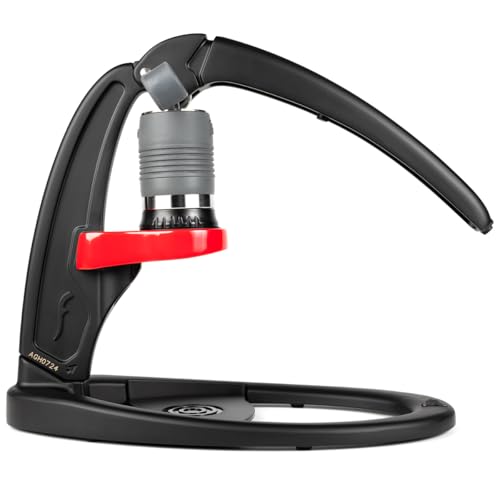
Flair Espresso Maker Classic (Manual Lever) — The Lever With a Teacher Built In
Flair’s Classic is the machine that revived lever espresso for the home, and its design reads like an argument: a lever, a brew head, a pressure gauge, and two portafilters in the box — one for learning, one for growing into. The gauge is the soul of it. A beginner pulling a lever blind produces shots that swing between sour trickles and choked drips with no idea which sin caused which; the gauge names the pressure in real time, and within a dozen shots the arm begins to understand what nine bars feels like in the shoulder. That education, more than any single espresso, is what the Classic sells.
The machine asks for the full manual system around it: kettle water at the right heat, a capable grinder, a scale if you want repeatability, and the patience to preheat its brew head so the metal does not steal the water’s warmth. In return it offers silence, a footprint that packs down remarkably small for storage or travel, and shots whose ceiling rises with the operator for years. Flair’s ecosystem of upgrades means the Classic is also a first step rather than a final one. For a drinker who wants to learn espresso as a physical skill — whose hands should know the drink — this is where the category properly begins.
- Pressure: hand lever, fully manual
- Feedback: pressure gauge included
- In the box: two portafilters, per the listing title
- Heating: none — supply hot water from a kettle
- Dose capacity: not printed in the listing title — check the product page for gram guidance
- Learners can check price on Amazon on the Flair Classic listing.
Strengths
- The gauge turns the learning curve into a readable lesson.
- Two portafilters support both learning and experimentation.
- Packs small and brews silently, anywhere hot water exists.
Trade-offs
- Every shot is arm work — no lazy mornings at this machine.
- Preheating and kettle management add steps pump owners skip.
- Back-to-back drinks for guests become a workout and a wait.
Best for: students of espresso who want feedback while they learn. Not suited for: households wanting push-button drinks or party volume.

Flair 49 PRO Manual Lever Espresso Maker — The Purist’s Refinement
The 49 PRO is Flair’s answer to the Classic’s graduates: a 49mm lever machine with a handled portafilter, the pressure gauge retained, and — the detail its listing insists on — no plastics in the brew path. That last claim speaks to a particular drinker, the one who thinks about everything the hot water touches on its way to the cup and wants the answer to be metal and seals all the way down. The 49mm basket size defines the machine’s puck geometry and its dose character, narrower and deeper than the wide baskets of café machines, with a forgiving depth that many lever owners credit for the Flair’s sweet extractions.
Black, handled, and built like an instrument, the PRO assumes its owner already owns the supporting system — a serious grinder, a good kettle, the patience the Classic taught — and it rewards that assumption with refinement rather than features. There is nothing here to update, subscribe to, or descale with a proprietary tablet. The trade-offs are the category’s own, sharpened: the arm is the pump, the kettle is the boiler, and a distracted morning makes a distracted shot. For the drinker who came to manual espresso for control and stayed for purity, the PRO is the line’s considered flagship.
- Basket: 49mm, handled portafilter
- Brew path: no plastics, per the listing title
- Feedback: pressure gauge included
- Finish: black
- Heating: none — kettle water required, as with the Classic
- Purists can check price on Amazon under the Flair 49 PRO listing.
Strengths
- Plastic-free brew path answers the purist’s first question.
- Handled portafilter improves the daily ergonomics of the ritual.
- Gauge feedback retained from the Classic’s teaching design.
Trade-offs
- Assumes an experienced owner and a serious grinder beside it.
- 49mm accessories live in Flair’s ecosystem, not the café standard’s.
- All the manual category’s labor, with no shortcuts added.
Best for: committed lever drinkers upgrading within the manual craft. Not suited for: beginners still deciding whether the craft is for them.

La Pavoni EPC-8 Europiccola Lever Espresso Machine — Chrome, Steam, and Seventy Years of Ritual
The Europiccola is not a product so much as an heirloom that happens to be sold new: a chrome and silver lever machine in the Italian tradition, with a 0.8L boiler on board — the one pick here that heats its own water, because its design descends from café machines rather than from camping gear. That boiler changes its character among these six. It lives on the counter, plugged in and gleaming; it can steam milk, which no kettle-fed rival here attempts; and its lever pull is the gesture home espresso romantics have been practicing since the design was young. Authentic Italian craftsmanship is the listing’s phrase, and for once the poetry describes the object accurately.
It is also the most demanding teacher in the guide. A boiler lever machine runs hot, and managing its temperature — knowing when the group is ready, when it has overheated, how a cooling flush behaves — is a craft layered on top of the lever craft itself. Owners describe a courtship of weeks before the shots turn sweet, and then a loyalty that borders on the unreasonable. The Europiccola is furniture, instrument, and argument in one chrome body: buy it because you want that object in your kitchen and that ritual in your morning, and it will repay you for decades. Buy it for convenience and it will educate you about yourself.
- Water capacity: 0.8L boiler on board
- Pressure: hand lever over a heated boiler
- Milk: boiler steam — the only pick here that can steam milk (verify the wand’s spec on the page)
- Finish: chrome and silver
- Model: EPC-8 Europiccola
- Romantics can check price on Amazon on the La Pavoni listing.
Strengths
- Its own boiler removes the kettle step and adds milk steaming.
- An iconic design with heirloom build and presence.
- The fullest traditional lever ritual available at home.
Trade-offs
- Temperature management is a second craft to learn.
- It is a resident countertop machine, not a traveler.
- The learning curve is the steepest and proudest here.
Best for: romantics and traditionalists who want the classic as a daily ritual. Not suited for: anyone seeking the manual category’s simplicity or portability.
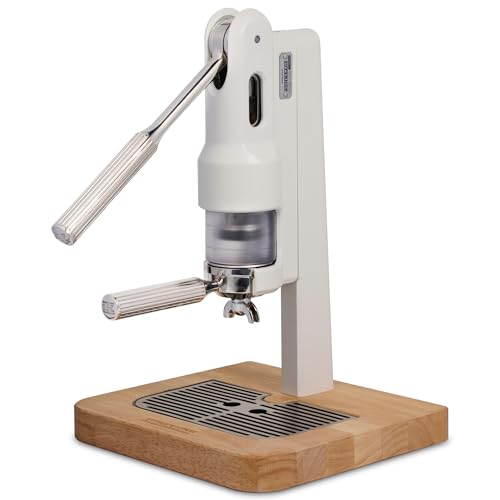
SUPERKOP Manual Espresso Maker — Espresso With Nothing to Plug In
SUPERKOP’s proposition is subtraction: a manual espresso tool with an 18 gram dose capacity, non-electric by design, described by its maker as portable and maintenance free, wearing retro styling that suits its philosophy. Where the Flairs teach with gauges, the SUPERKOP simplifies with form — a lever mechanism engineered so the press does the pressure work in one committed motion, at home or, as the listing notes, for commercial purposes where a quiet, cordless espresso station has obvious charm. The white retro body looks like an object from a Milanese kitchen of another era, which is precisely the point.
Maintenance free deserves a fair reading: with no boiler there is no scale, with no pump there are no pump seals to fail, and the ownership contract shrinks to rinsing and the occasional gasket’s attention. What remains manual is everything that matters — the dose, the tamp, the water from your kettle, the press itself. The 18 gram capacity is a grown-up dose, the double-shot standard of modern espresso, so the drinks are full-sized rather than the thimble shots travel gadgets sometimes produce. For the minimalist who finds the Flairs still too engineered and the La Pavoni too operatic, SUPERKOP is the category distilled to a gesture.
- Dose capacity: 18 grams, per the listing title
- Power: non-electric
- Upkeep: maintenance-free design claim
- Style: retro, white finish
- Feedback gauge: none mentioned in the listing title — the press is guided by feel
- Minimalists can check price on Amazon under the SUPERKOP listing.
Strengths
- Nothing to plug, descale, or update — the simplest ownership here.
- Full 18 gram dose makes proper double shots.
- Retro design earns its counter space aesthetically.
Trade-offs
- No gauge means the learning happens by taste alone.
- Kettle and grinder still required, as with all kettle-fed picks.
- One deliberate press per drink sets a contemplative pace.
Best for: minimalists and design-led kitchens wanting cordless espresso. Not suited for: data-driven learners who want pressure feedback.

Bincoo S3 Manual Espresso Maker (Hand Press) — Dual Levers and Profiling Language
The Bincoo S3 speaks the dialect of modern espresso engineering in a hand tool: a dual-lever manual press in stainless steel, claiming 12Bar pressure profiling and pre-infusion for custom shots. Profiling is the lever category’s native advantage — the ability to begin gently, let the puck saturate at low pressure, then build to full force — and the S3’s dual-lever layout is a mechanical bid for control over that curve, two hands sharing the work a single arm does on the Flairs. Pre-infusion, the wetting pause before full pressure, is where sour shots are prevented, and a hand press that builds it into the gesture understands the assignment.
Its green stainless form is the most contemporary object in this guide, portable in intent and aimed at the experimenter who journals shots. That owner should bring a skeptic’s notebook: a hand press’s stated bar figure is a capability the arm must actually deliver, and the S3’s pleasures will be found in repeatability — learning the exact lean that reproduces yesterday’s best shot. Without a gauge mentioned in its title, the palate and the notebook do the measuring. For the drinker who finds the Flairs’ classicism staid and wants the manual craft in a modern, dual-grip instrument, the S3 is the intriguing alternative.
- Mechanism: dual-lever hand press
- Claimed pressure: 12Bar profiling, per the listing title
- Pre-infusion: included in the design’s claims
- Body: stainless steel, green finish
- Gauge: not mentioned in the listing title — verify on the product page if you need one
- Experimenters can check price on Amazon on the Bincoo S3 listing.
Strengths
- Dual levers share the pressing work between both arms.
- Profiling and pre-infusion claims target the craft’s real variables.
- Stainless build in a portable, modern form.
Trade-offs
- Stated pressure depends on the operator’s arms, every time.
- No gauge in the title means feedback is by taste and notes.
- Newer name beside century-old category institutions.
Best for: experimenters who want profiling in a portable hand press. Not suited for: buyers who prefer proven, gauge-verified instruments.

Wacaco Minipresso GR Portable Espresso Machine — Espresso in a Coat Pocket
The Minipresso GR reduces manual espresso to its travel essence: a hand-operated pump in a body that disappears into a backpack’s side pocket, built for ground coffee — the GR designation — and aimed squarely at camping and hiking, per its listing. You add hot water from the camp kettle or the hotel room’s brewer, pump by hand to build pressure, and produce a real espresso shot in places where the alternative is instant coffee or a long walk. Wacaco essentially founded this pocket category, and the GR’s ground-coffee flexibility — no proprietary pods required — keeps it honest to the manual faith.
Its limits are the honest physics of its size: one shot per cycle, a dose smaller than the home levers command, and pressure that lives in your thumb’s endurance. Nobody should mistake it for a home machine, and its listing does not ask you to. Judged as travel equipment, it is close to miraculous — the difference between a summit sunrise with espresso and without one. Desk drawers and glove boxes are its other habitats, anywhere a person wants a true shot within reach of hot water and refuses to organize their day around finding a café. In a guide of instruments, the Minipresso is the pocketknife: smaller than the kitchen knives, and the one that is actually there when needed.
- Format: ground coffee (GR)
- Operation: manually pumped, no electricity
- Intended use: camping, hiking, travel, per the listing title
- Dose and water capacity: not printed in the listing title — check the product page for the gram and milliliter figures
- Home suitability: a travel tool first; the levers above serve the kitchen better
- Travelers can check price on Amazon under the Minipresso GR listing.
Strengths
- Genuinely pocketable espresso, anywhere hot water exists.
- Ground coffee freedom — no pods to source on the road.
- Dead simple mechanism with almost nothing to break.
Trade-offs
- One small shot per pumping session.
- Thumb-powered pressure varies with the traveler.
- Not a substitute for a home lever at the counter.
Best for: hikers, campers, and traveling espresso loyalists. Not suited for: home baristas or anyone brewing for two.
Hands-On Machines, One Table
| Machine | Pressure source | Feedback | Home ground |
|---|---|---|---|
| Flair Classic | Single lever | Pressure gauge | Counter or travel case |
| Flair 49 PRO | Single lever, 49mm | Pressure gauge | Counter |
| La Pavoni EPC-8 | Lever over boiler | Feel and tradition | Permanent counter shrine |
| SUPERKOP | Lever press, non-electric | Feel | Counter, cordless |
| Bincoo S3 | Dual-lever hand press | Taste and notes | Portable counter tool |
| Wacaco Minipresso GR | Hand pump | Thumb endurance | Backpack pocket |
How Do You Pull a Lever Shot That Tastes Sweet?
Begin before the lever moves. The brew head of a kettle-fed machine starts cold, and cold metal robs the first water it touches — so preheat: run kettle water through the empty machine, or let the brew components sit in hot water while you grind, because a shot extracted through a cold head is under-extracted no matter how heroic the pull. Grind fresh and fine, dose consistently, distribute the grounds so the puck has no weak channels, and tamp level. Then the signature move of the lever: begin the pull gently, holding low pressure while the puck saturates — the pre-infusion — watching for the first dark beads, and only then lean in toward full pressure, easing off as the shot pales near the end.
The gauge machines turn this choreography into numbers you can repeat; the gauge-less ones ask you to count seconds and watch color, the older literacy. Either way, taste is the examiner: sour means the water spent too little of itself on the coffee — grind finer, pull slower, preheat more — while bitterness means it spent too much. Change one variable per shot. A lever machine rewards this discipline faster than a pump machine does, because the operator is the variable, and operators learn.
What Does the Manual Ritual Cost in Time and Temper?
Honesty about minutes: a practiced lever owner produces a shot in about four unhurried minutes, kettle included; a beginner takes ten and wears some of it. Two drinks double the honest figure, and four drinks make the manual host a kitchen exile unless the gathering enjoys watching — many do, since a lever pull is a small theater. Temper is the other currency. The manual machine refuses to be hurried, and mornings with a train to catch will eventually produce the household’s one concession: a second, faster coffee method for weekdays, with the lever enthroned on weekends. There is no shame in that treaty; most long-term lever owners have signed it.
What the ritual returns is attention. A pump machine lets you check your phone during extraction; a lever occupies your hands and eyes for thirty continuous seconds, and the shot tastes of that attention in a way drinkers struggle to articulate and refuse to surrender. The category survives not despite its slowness but because a growing number of coffee drinkers count that slowness as the product.
Which Errors Ruin a Beginner’s First Month?
Skipping the preheat is the first, and it masquerades as the machine’s fault — thin, sour shots blamed on the lever when the brew head was simply cold. The second is grinding with a cheap blade or a coarse-focused grinder: espresso’s fine, even grind is non-negotiable, and a manual machine exposes a bad grinder more cruelly than any pump, because there is no pump pressure to bully through an uneven puck. The third is heroic pulling — maximum force from the first second — which fractures the puck’s surface and channels the water into a fast, pale gush. Gentleness first, force second; the lever’s whole pedagogy is in that order.
Fourth is neglecting the seals. A manual machine has few parts, which makes each one load-bearing: a dried or coffee-caked gasket leaks pressure, and pressure is the entire drink. Rinse the brew path after sessions, keep seals clean and occasionally conditioned as the maker directs, and the machine will hold its line for years. Fifth is giving up at shot twelve. The category’s learning curve is measured in weeks of mornings, and nearly every owner who persisted past the first month reports the same conversion — the ritual stops being the price of the espresso and becomes part of its flavor.
Manual Espresso Where There Is No Kitchen
The category’s romance peaks away from home. A Flair in a suitcase turns a rental cottage into a coffee house; the Minipresso turns a tent vestibule into a café with a view no café can buy; the SUPERKOP’s cordlessness suits the off-grid cabin where the kettle rides a wood stove. These scenes share a requirement the machines cannot supply: hot water discipline and a way to grind — a hand grinder is the travel system’s other half, and travelers who pack one own a complete espresso kit that fits in a shoebox. The same make-it-yourself spirit extends to dessert in those places: a cabin kitchen that pulls its own espresso tends to churn its own sweets too, and readers outfitting that life will find the dairy-free end of it in Best Vegan Ice Cream Machines. The manual espresso kit asks so little of a place — no outlet, no counter acreage — that it belongs in every version of that plan.
The Lever and the Treadle: a Word About Hand-Powered Tools
There is a kinship among machines that ask the body to be the motor, and coffee drinkers who love a lever often recognize it in other crafts. The treadle sewing machine, the hand-cranked grinder, the lever press — all of them trade the grid’s instant obedience for a feedback loop between hand and material that electric tools edit out. Readers who feel that kinship across the house may enjoy Best Straight Stitch Sewing Machines, where the machines likewise do one thing with total commitment rather than fifty things with menus. The manual espresso maker’s place in a home is rarely just about coffee; it is about keeping one daily ritual at human speed in a house that is automating everything else, and that is a design philosophy a household either recognizes as its own or does not.
The Supporting Cast: Kettle, Grinder, Scale, Tamper
Judge the manual purchase by its full cast list, because the machine is only the lead actor. The kettle wants temperature control or at least a thermometer’s honesty, since water a few degrees off boiling is the target and a violently boiling kettle overshoots it. The grinder wants espresso range and fine adjustment — in budget terms it often costs as much as the machine, and owners who skimp here spend months blaming the lever for the grinder’s sins. A small scale turns dosing from folklore into repeatability, and a tamper that fits the basket properly — 49mm for the Flair PRO’s world, the included sizes elsewhere — makes the puck’s surface a constant instead of a variable.
None of this cast needs to arrive on day one in its final form. Beginners assemble it in order of pain: grinder first, because it limits everything; kettle discipline second; scale and tamper as the shots begin to repeat. The machines’ low prices relative to pump espresso are real, but the honest system price narrows the gap — which is still worth paying, because every supporting tool outlives and out-serves any single machine, and the grinder you buy for a Flair will serve a La Pavoni or a future pump machine without complaint.
Pressure Profiling, Explained by Your Own Arm
Profiling is the word pump-machine marketing uses for varying pressure across a shot, and on a lever it is not a feature — it is the physics of your arm. The puck’s resistance changes as it saturates and as its fines migrate; a sensitive hand feels the shot loosen and compensates, holding the flow steady by feel. This is why two drinkers can pull the same machine, same beans, same dose, and produce distinguishable espressos: each arm has a signature. The gauge machines let you watch your signature as a curve; the Bincoo’s dual levers claim to make the curve easier to hold; the SUPERKOP’s single committed press deliberately simplifies the curve into one gesture for drinkers who prefer their espresso without a graph.
For milk-free espresso — the way these machines mostly serve it — profiling is where the sweetness lives. A gentle opening coaxes the sugars out before the pressure climbs; a tapering finish avoids dragging bitterness from an exhausted puck. Pump owners pay considerable sums for machines that imitate this curve electronically. Lever owners get it free, at the cost of being the electronics. Whether that trade reads as burden or birthright is the entire personality test of this category.
Maintaining a Machine With Almost No Parts
The manual machine’s service manual could fit on an index card, and that is its longevity argument. Rinse the brew path while it is still warm from the shot. Keep the seals clean, and replace them on the maker’s rhythm rather than after a leak teaches you the rhythm — a seal kit is cheap, and a pressure leak in a lever machine is the whole disease, easily cured. Descaling, the electric machine’s recurring chore, barely exists here: the kettle-fed machines never heat water internally, so scale lives in the kettle, where it is the kettle’s problem. The La Pavoni is the exception, with a boiler to descale on schedule like any boiler machine.
Storage is the other half of care. The Flairs and the Minipresso pack away, and a machine stored dry and clean wakes up identical to itself in a year; a machine stored wet grows the mustiness that punishes the first shot back. Metal parts want a wipedown before long rests, wooden handles — where fitted — want the same respect as any good tool’s. Owners speak of these machines in decades, and the maintenance card explains why: there is almost nothing in them that time can take, except the seals, and the seals are replaceable by design.
Who Should Not Buy a Lever, However Beautiful
The exits deserve the same candor as the entrances. If your household’s coffee is a volume business — four drinks before eight, every day, no exceptions — a lever will make you late and then make you resentful, and resentment is a flavor that gets into the cup. If anyone in the house has shoulder, wrist, or grip limitations, the category’s honest physicality becomes a barrier rather than a pleasure, and a good pump machine serves that house with more kindness. If your interest is milk drinks, only the La Pavoni here steams, and even it asks a craftsman’s patience for its lattes. And if you are buying a gift for someone who has not asked for a hobby, understand that a manual machine is precisely that — a hobby in a box — and give it only to the person who will read that as a compliment.
None of these exits diminishes the category. A tool that knows its user this precisely is a well-designed tool, and the drinkers it fits, it fits completely. The lever’s century-long survival, through every wave of automation the coffee industry has produced, is the market’s own testimony that the fit is real for the people it describes.
The Sound of a Quiet Kitchen
An underrated specification, printed in no listing here, is decibels. A pump espresso machine announces itself through walls; a lever shot is water, breath, and the soft knock of a spent puck. In a flat where a partner sleeps in the next room, in a house where the baby’s nap is the day’s fragile treaty, in an office corner where a colleague is on a call, the manual machine’s silence is not a nicety — it is the feature that decides whether espresso happens at all. Early risers in shared houses describe the same conversion: the lever did not just make their coffee quieter, it made their mornings earlier, because the first shot no longer had to wait for the house to wake.
Silence also changes the drinker’s attention. Without a pump’s roar marking the extraction, you hear the shot itself — the first drips, the flow’s steadiness — and hearing becomes one of the senses the craft trains. It sounds like a small thing until you have pulled a hundred quiet shots, after which a loud machine feels like it is shouting over the coffee.
Beans for Levers: What the Puck Forgives
Lever extraction has a reputation for sweetness with medium and medium-dark roasts, and the reputation has a mechanism: the naturally declining pressure at a shot’s end, as the arm tires or deliberately eases, extracts the puck’s final third more gently than a pump’s flat insistence, sparing the drink the bitter tail. This makes levers kind to forgiving blends and to beans a few days past their prime. Very light, dense roasts are the lever’s examination — they demand fine grinding, thorough preheating, and patient pre-infusion, and they reward it with clarity that surprises drinkers who thought levers were only for chocolate-heavy shots.
Practical bean advice follows: buy for the machine’s kindness, not against it. A household lever’s first bag should be a forgiving medium roast from a roaster whose freshness is real; save the demanding single origins for the month when your arm has its diploma. Decaf, often an afterthought, behaves beautifully under a lever’s gentle finish, and the evening shot — manual, quiet, decaffeinated — is one of this category’s signature pleasures, a full ritual with no caffeine debt attached.
Secondhand, Heirlooms, and the Long Life of Levers
Few appliance categories have a secondhand market worth praising, but levers do, because their simplicity makes a used example legible: seals, a lever’s smoothness, a boiler’s state on the La Pavoni — a buyer can assess nearly everything that matters in minutes, and wear parts are replaceable. New buyers here benefit from the same trait in reverse: the machine you buy today is unlikely to be orphaned by a discontinued control board in year six. Flair’s upgrade ecosystem, La Pavoni’s decades of parts continuity, and Wacaco’s simple mechanism all point the same direction — these are objects designed to be kept.
That longevity reframes the price conversation. A manual machine’s cost divides across a decade or more of mornings, against pump machines whose electronics set their own lifespan. Owners pass levers down, lend them, rescue them from cupboards. In a batch of guides full of appliances, these six are the closest things to tools in the old sense — bought once, learned deeply, and kept — and for the right household that is not a limitation of the category. It is the entire appeal, stated in chrome, steel, and one small traveling pump.
A Beginner’s First Twelve Shots, Mapped
Shot one will be wrong, and its wrongness is tuition. Expect a fast, pale, sour pour — the universal first pull — and change nothing yet except your understanding: that is what under-extraction looks like. Shots two through four belong to the grind: step finer each time until the flow slows to a thin, dark stream, and notice how the gauge, if your machine has one, climbs into its working zone as the puck’s resistance builds. Shots five through eight belong to pre-infusion: hold the opening pressure low, count a slow ten, and watch the puck bloom before you lean in — most beginners find their first genuinely sweet shot in this window, and it tends to arrive as a surprise mid-experiment.
Shots nine through twelve belong to consistency: same dose, same grind, same pull, three mornings running, until the drink repeats. Repetition, not brilliance, is the diploma. Keep a notebook if the Bincoo is your machine, keep the gauge’s numbers in your head if a Flair is, and keep the beans unchanged throughout — the twelfth shot, tasting like the eleventh, is the moment the manual machine stops being a puzzle and starts being your coffee maker. Everything after that is refinement, which is to say, the hobby proper.
Lever Espresso as a Party Trick and a Meditation
Two social truths about lever machines surprise their owners. The first is that guests love watching: a pull is legible theater — the lever rises, the pause hangs, the dark stream threads into the cup — and more than one dinner party has reorganized itself around the machine while the host performs. Hosts who lean into this serve espresso as the evening’s final course and entertainment in one, four cups at a stately pace, with conversation filling the intervals that a pump machine’s speed would leave awkwardly empty. The second truth is the opposite: alone, the same ritual is a meditation, thirty seconds in which the phone cannot be held and the mind cannot wander, because the shot punishes distraction instantly and visibly. Owners describe guarding that half-minute the way other people guard a morning run.
Both truths explain why manual machines so often survive household purges that claim cleverer appliances. An object that entertains guests and centers its owner has two jobs defending its counter space, and the drinks — by month two, genuinely excellent drinks — are almost the third reason. Buy a lever for the espresso, by all means. Expect to keep it for the theater and the quiet.
Temperature: the Variable the Kettle Owns
Every kettle-fed shot in this guide is a negotiation between the kettle’s water and the machine’s metal, and managing that negotiation is the manual craft’s least glamorous skill. Water leaves the kettle at its hottest and cools through every transfer — into the brew chamber, across the portafilter, through the puck — so the experienced owner starts a degree or two hotter than the target and preheats aggressively to narrow the losses. Darker roasts forgive a cooler extraction; lighter roasts expose every lost degree as sourness. A thermometer, or a temperature-controlled kettle, converts this from intuition to procedure, and it is the supporting purchase lever owners most often wish they had made in week one rather than month three.
The La Pavoni inverts the problem: its boiler holds temperature for you, and its craft is cooling — managing a group head that runs hotter with each successive shot. Two machines, two opposite temperature disciplines, one lesson: in manual espresso, heat is never the machine’s solved problem. It is the operator’s standing responsibility, and the drinkers who accept that responsibility cheerfully are, once again, exactly the people this category was built for.
What the Arm Learns That the Palate Cannot Teach It
Ask a lever owner of a year’s standing to describe their pull and they will talk about resistance the way a violinist talks about bow weight — as a language the hands speak fluently and the mouth translates badly. The puck talks back through the lever: a grind too fine announces itself as a wall, a channel as a sudden give, a perfect puck as a long, even sigh of resistance. This haptic channel is information no gauge fully digitizes and no pump transmits at all, and it is why manual drinkers develop an almost diagnostic intimacy with their coffee — they can feel a stale bag, a humid day’s effect on the grind, a new roast’s density, before the first sip confirms it.
None of this is mysticism; it is what happens when a sensor — the hand — sits directly in the process it measures. The category’s devotees are not romantics fleeing technology. They are drinkers who discovered that the most sensitive instrument in espresso was attached to their own wrist, and who organized their mornings around using it.
Manual Espresso on a Boat, in a Van, at a Desk
Three habitats deserve their own word because the machines divide across them so cleanly. The boat and the van reward the smallest systems — the Minipresso for true motion, a Flair for the moored and parked life where a case can open on a saloon table — and they punish anything with a boiler’s appetite for power, which is why the La Pavoni stays ashore in this guide’s geography. The desk rewards the quiet and the compact: a Flair or SUPERKOP beside a kettle makes an office espresso station that disturbs no one and needs no plumbing, provided the office forgives the grounds in the bin. The desk also rewards the gauge, since a worker learning between meetings needs the feedback fast.
What all three habitats share is the absence of a coffee shop. Manual machines flourish where the alternative is not a café but a compromise — instant, a long drive, a kettle of something brown — and their owners’ loyalty scales with the distance to the nearest good espresso. Judge your own habitat honestly: the closer the café, the more the lever must justify itself as pleasure rather than rescue, and for the drinkers in this category, it usually can.
Gifting a Lever: a Warning and an Endorsement
A manual espresso maker is a dangerous gift and a magnificent one, and the difference is the recipient’s curiosity. Given to a person who loves process — the bread baker, the fountain-pen user, the home brewer — a Flair or a SUPERKOP lands as an invitation they will thank you for across years of mornings. Given to a person who loves only coffee, it lands as homework. The safe form of the gift pairs the machine with its first bag of forgiving beans and, if the budget allows, the grinder that makes the system whole; the unsafe form assumes the recipient’s kitchen already contains the supporting cast. When in doubt, gift the Minipresso to the traveler, whose use for it needs no hobbyist’s vow — it asks for hot water and gives back a summit espresso, and that transaction suits almost everyone who camps.
The Lever Community and Its Accumulated Wisdom
Manual espresso has one more asset no listing mentions: its owners talk. Forums and local groups devoted to lever machines hold decades of accumulated, specific wisdom — which seals swell in which water, which grinder settings suit which Flair basket, how a Europiccola behaves at altitude — offered freely to newcomers who describe their shots honestly. A pump machine’s owner gets a manual and a warranty line; a lever owner gets a guild. For a craft learned by feel, that guild is infrastructure, and more than one discouraged beginner has been carried through the sour-shot weeks by strangers who remember their own. Buy the machine, by all means — but know that you are also joining the conversation that keeps it singing.
Final Recommendation
Start where the teaching is best: the Flair Classic, whose gauge turns your arm into an instrument you can read, is the finest first manual machine in this guide, and the 49 PRO waits as its purist’s upgrade when the craft takes hold. Choose the La Pavoni Europiccola when the heart wants the chrome classic and the ritual entire, boiler and all. Choose SUPERKOP for cordless minimalism with a full-sized dose, the Bincoo S3 for dual-lever experimentation, and the Minipresso GR for the road, where it has no rival at its size. Whichever lever you bring home, bring the kettle and the grinder with it, preheat without exception, and pull gently before you pull hard — the shot that results will be yours in a way no button has ever made a drink yours, brewed at the exact speed of your own two hands.
Frequently Asked Questions
Is a manual machine really capable of café-quality espresso?
Yes, in practiced hands — the pressure a lever generates is genuine espresso pressure, and the profiling control can exceed what entry pump machines offer. The caveat is the operator: the machine’s ceiling is high, and so is its floor, and the distance between them is your learning curve.
Do I need a special grinder for these machines?
You need an espresso-capable one: fine, even, adjustable in small steps. Lever machines are unforgiving of poor grinding because the puck’s resistance is the whole system. Budget for the grinder as part of the machine, whichever pick you choose.
Which pick can steam milk for lattes?
Only the La Pavoni, thanks to its on-board boiler. The kettle-fed machines make espresso only; their owners who want milk drinks heat and froth milk separately, or accept the espresso neat — as many lever purists happily do.
How hard is the physical effort, honestly?
A firm, sustained pull or press — comparable to using a well-set hand tool, not a gym exercise. The dual-lever Bincoo shares the work across both arms, and the Minipresso asks the most of your thumbs relative to its size. Most healthy adults find the effort part of the pleasure within a week.
Can a manual machine serve a dinner party?
It can serve espresso to a patient table that enjoys the theater, at roughly a shot every few minutes. For a crowd in a hurry, it is the wrong tool — make the levers the after-dinner ceremony for four, not the coffee service for twelve.
Why do two picks have gauges and others do not?
Design philosophy. Flair builds teaching instruments and fits gauges; SUPERKOP and Wacaco pursue minimalism and trust the hand. Beginners generally learn faster with a gauge; experienced hands often stop looking at one.
Related Guides
Manual espresso belongs to the off-grid and small-footprint imagination, and the cold-storage side of that life is covered in our guide to Best Freezers for Off-Grid Living — for cabins and compact homes where every appliance must earn its place without asking much of the place.


