What's inside
- Key Takeaways
- Quick Picks
- Why would a sewer choose a machine that only sews straight?
- The straight-stitch field, spec by spec
- What does the 1,600-per-minute pace actually change?
- How do you manage a large quilt in a nine-inch throat?
- How do you set up a straight-stitch station for piecing?
- Specialist-machine mistakes that waste the purchase
- How does piecing change when the machine is this fast?
- What maintenance does a high-speed specialist demand?
- How should a buyer test a straight-stitch machine before committing?
- Why do garment sewers adopt these machines too?
- What thread and needle strategy suits this pace?
- How does a specialist change a sewing room’s economics?
- What does the first month with a specialist teach?
- Can a specialist and a generalist share one sewing room gracefully?
- Final Recommendation
- Frequently Asked Questions
- Related Guides
As an Amazon Associate I earn from qualifying purchases. This post may contain affiliate links at no extra cost to you.
cottageverdict.com is reader-supported. When you buy through links on our site, we may earn an affiliate commission.
A straight-stitch machine is a refusal: no zigzag, no decorative library, no compromises negotiated with other stitch types — one stitch, engineered to be formed perfectly at speeds ordinary machines cannot sustain. It is worth pausing on how unusual that proposition is in a market that sells versatility by the hundred-stitch. Every other category in sewing competes by addition; this one competes by subtraction, and its buyers are correspondingly deliberate — they arrive knowing their work’s composition the way a carpenter knows which saw cuts ninety percent of their boards. If you are reading this guide with that knowledge already in hand, the six listings below will feel like a conversation among specialists. If you are reading it out of curiosity, let it serve as a map of where serious sewing can lead: to a room where the central machine does one thing, and does it so well that everything else in the room is arranged in its honor. The best straight stitch sewing machines in this guide are the high-speed specialists that quilters and serious garment sewers graduate to, and their listings share a striking signature: four of the six state the same headline figure of 1,600 SPM, because this class has converged on a professional pace and competes instead on workspace, thread handling, and build. We report each machine’s speed exactly as its listing states it — including the one famous name here whose title says only “high-speed” and leaves the number unstated, a silence we preserve rather than fill from reputation.
Purchasing in this class rewards the same discipline as sewing in it: precision. Bring a list. Write down the quilt size you make most, the fabrics that fill your year, whether your hands crave a cutter and a knee lift or are content with snips and patience, and the exact figures you refuse to leave unstated. With that list in hand, the six reviews below resolve quickly — each machine announces, in its own listing’s words, whether it was built for your list or for someone else’s, and the honest mismatches are as valuable as the matches. These are substantial, semi-professional machines, several with extension tables in their configurations, and the differences between listings — a table included or not, a cutter present or not, workspace dimensions stated to the half inch — are the substance of the choice. Order the exact configuration named in the title, confirm the workspace figures that matter to your quilts against the listing, and plan the machine’s home before it arrives: a straight-stitch specialist at full pace wants a table as committed as it is.
Key Takeaways
- Every pick sews straight stitch only, at professional pace — this is a specialists’ guide, not a generalists’ one.
- Five of the six listings state the 1,600-per-minute pace outright — the Janome HD9V3, Janome HD8, Janome 1600P QC, Bernette B08, and Handi Quilter HQ Stitch 510 — while the Brother PQ1600S leaves its figure unstated in its title.
- Automatic thread cutters appear on the HD9V3, HD8, and HQ Stitch 510, and they reshape piecework rhythm more than any other single feature.
- Workspace is the class’s second language: the HD8 states 9 by 6 inches, the HQ Stitch 510 states 9 by 5.5 inches, and the 1600P QC answers with a large throat described for quilts.
- Extension tables are named in the HD9V3 and HD8 configurations — check your chosen listing’s contents before assuming one.
- Because the class shares its headline speed so widely, the honest comparison axes are workspace dimensions, thread handling, and build language — the axes this guide’s comparison table is organized around.
Quick Picks
| Machine | Speed story per its listing | Built for |
|---|---|---|
| Brother PQ1600S High-Speed Straight Stitch Sewing Machine | “High-speed” — figure not stated in title | Quilters who want the class’s established Brother nameplate. |
| Janome HD9V3 Heavy Duty Straight Stitch Sewing Machine | 1,600 SPM | Heavy-duty pace with an extension table, cutter, and extra-large workspace. |
| Janome HD8 Straight Stitch Sewing and Quilting Machine | 1,600 SPM | Quilting with a stated 9 by 6 inch workspace and its own table. |
| Janome 1600P QC Straight Stitch Sewing and Quilting Machine | 1,600 stitches per minute | Large-throat quilting across quilts, denim, canvas, and thick fabric. |
| Bernette B08 Straight Stitch Sewing Machine | 1,600 SPM | Industrial-style heavy-duty design for professional sewing. |
| Handi Quilter HQ Stitch 510 High-Speed Straight Stitch Sewing Machine | the 1,600-per-minute pace | Quilters who want a knee lift, cutter, and threader in one package. |
Why would a sewer choose a machine that only sews straight?
Because most serious sewing is straight. Piecing is straight seams. Quilting lines are straight or gently curved runs of the same stitch. Garment construction is overwhelmingly straight stitching with occasional detours. A machine that does only this stitch can devote its entire engineering budget to forming it flawlessly at speed: a rigid frame that does not flex at pace, a feed system tuned for long even runs, a needle bar that does not need to swing sideways and so can be built tighter and faster. The result is a class of machine that feels less like an appliance and more like an instrument — narrower in repertoire, deeper in mastery.
Our criteria followed that philosophy. Speed counted, but only as the listings state it. Workspace counted heavily, because a straight-stitch machine’s natural prey is the quilt, and a quilt’s bulk must go somewhere. Thread handling counted — cutters and threaders are rhythm features across a thousand seams. And build language counted: heavy-duty, industrial-style, large throat are the listings’ own words for the composure that high pace demands. Machines that merely omitted other stitches without pursuing this one’s perfection did not make the list.
A word about who should not buy from this guide at all. A sewer whose work needs zigzag for knits, buttonholes for garments, or any decorative range will find these machines magnificent and useless in equal measure; they are second machines for most owners, partners to a generalist rather than replacements. Readers still equipping a first, all-purpose bench should start elsewhere — the hand-powered end of the craft is surveyed in our guide to Best Manual Sewing Machines, and the generalist roundups elsewhere on this site cover the do-everything machines. This guide begins where those leave off: at the moment a sewer knows exactly which stitch their work is made of.

Brother PQ1600S High-Speed Straight Stitch Sewing Machine — “High-speed” — figure not stated in title
The PQ1600S is the name quilters mention first in this class, and its listing title is the most restrained in the guide: brand, model, and the words “high-speed straight stitch sewing machine,” with no number attached. We take that restraint at face value. This guide does not import a speed figure from the model’s reputation, because our rule is that a specification lives in the listing or it lives in the manufacturer’s documentation the buyer should consult — and we flag the gap here so that a buyer comparing headline numbers knows this one must be confirmed at the source. What the title does establish is the class and the intent: a Brother built for high-speed straight stitch work, full stop.
Within those honest bounds, the case for the PQ1600S is the case for the established specialist. Quilters adopt this class of Brother for piecing and quilting at pace, and a model that has held its place in the category earns consideration on the strength of its installed base — the accumulated knowledge of owners, teachers, and technicians who know its habits. A buyer who values that depth of shared experience, and who is willing to confirm the unstated figures from documentation, will find this the most conservative purchase in the guide. A buyer who wants every number on the listing itself should look at the Janome and Handi Quilter picks below, whose titles read like specification sheets.
- Class: high-speed straight stitch machine, per the listing title
- Top speed: not given in the listing title — confirm the figure in Brother’s documentation before comparing headline numbers
- Workspace and included table: not stated in the listing title — verify against the product page for your quilting needs
- Thread cutter: not shown in the listing title — check the full specification
- Considering the Brother PQ1600S: check price on Amazon, then confirm its unstated figures in the official documentation
Strengths
- The established nameplate in the high-speed straight stitch class
- Deep owner and teacher knowledge surrounds this model family
- Single-purpose focus matches the class’s philosophy exactly
Trade-offs
- Listing title states almost nothing; research burden sits with the buyer
- Straight stitch only, like every pick here
- Table and cutter cannot be assumed from the title
Best for: quilters who value an established specialist and will verify its figures. Not suited for: anyone who needs a complete specification on the listing itself.

Janome HD9V3 Heavy Duty Straight Stitch Sewing Machine — 1,600 SPM
The HD9V3’s listing reads like a direct answer to the Brother’s silence. Heavy duty, straight stitch, 1,600 stitches per minute, an extension table, an automatic thread cutter, and an extra-large workspace — every claim a buyer in this class is scanning for, stated in one breath. The V3 in the name marks this as the evolved generation of Janome’s HD9 line, a machine family with its own loyal following among quilters who piece at professional pace and quilt large work at home.
The combination to appreciate is pace plus housekeeping. At 1,600 SPM, seams accumulate tails and thread management becomes a rhythm problem; the automatic cutter answers it at every seam end, keeping both hands on the work and the pace unbroken. The extension table answers the workspace half of the same problem, supporting the quilt so its weight never argues with the feed. “Extra-large workspace” is the listing’s phrase rather than a dimension, and buyers for whom the exact inches are decisive should confirm them — but the direction of the design is unmistakable. This is the pick for the quilter who wants the class’s full modern specification, stated, in a heavy-duty frame.
- Top speed: 1,600 SPM, as stated in the listing title
- Thread handling: automatic thread cutter, per the listing title
- Work support: extension table included, per the listing title
- Workspace: described as extra-large in the listing title; exact dimensions not stated there — verify if inches decide your purchase
- Claiming the Janome HD9V3: check price on Amazon, where the extension table belongs to this configuration
Strengths
- Complete modern specification stated on the listing
- Cutter sustains rhythm across production-style piecing
- Extension table supports large quilts from day one
Trade-offs
- Workspace praised in words rather than measured in the title
- Heavy-duty pace demands a stable, dedicated table
- Single stitch repertoire, as with the whole class
Best for: quilters wanting the full stated specification in a heavy-duty frame. Not suited for: sewers who need any stitch besides straight.

Janome HD8 Straight Stitch Sewing and Quilting Machine — 1,600 SPM
The HD8 is the HD9V3’s sibling with its measurements showing. Its listing states the same 1,600 SPM pace and the same automatic thread cutter, adds its own table, and then does what its bigger sibling does not: it gives the workspace as a dimension — nine inches by six. For a quilter, that figure is the machine’s biography in two numbers. Nine inches of throat is where quilt bulk rolls and rests during long quilting passes; six inches of height is the clearance that decides whether a rolled quilt feels accommodated or stuffed. Buyers can compare that statement directly against the HQ Stitch 510’s nine by five and a half below, which is exactly how this class should be shopped.
Janome positions the HD8 for sewing and quilting together, and the pairing of table and cutter supports both lives: piecing at pace with tails trimmed as you go, then quilting with the sandwich supported and the throat receiving its bulk. Choosing between the HD8 and HD9V3 is a matter of which specification style you trust — the HD8’s stated dimensions and table, or the HD9V3’s heavy-duty framing and extra-large claim — and of the configurations actually listed when you buy. Either way, the buyer is choosing inside one of the class’s strongest families, and the deciding test should be the size of quilt you make most, rolled and measured against those nine inches.
- Top speed: 1,600 SPM, as set out in the listing title
- Workspace: 9″ x 6″, as stated in the listing title
- Thread handling: auto thread cutter, per the listing title
- Work support: table included in the configuration, per the listing title
- For the Janome HD8: check price on Amazon and confirm the table is part of the listing you select
Strengths
- Workspace given as honest dimensions, not adjectives
- Cutter and table complete the quilting workflow
- Full class pace at 1,600 SPM
Trade-offs
- Slightly smaller stated workspace height than some rivals offer in words
- Heavy-duty designation sits with the sibling model instead
- Straight stitch only, as throughout this guide
Best for: quilters who shop by measured workspace. Not suited for: anyone needing zigzag or decorative capability.

Janome 1600P QC Straight Stitch Sewing and Quilting Machine — 1,600 SPM
The 1600P QC is the veteran of this guide — a Janome whose listing describes it in the language of the factory floor: extra high speed at the 1,600-per-minute pace, heavy duty, industrial sewing machine, with a large throat for quilts, denim, canvas, and thick fabric. That fabric list is the widest brief in the class. Where the other picks speak mainly to quilters, the 1600P QC claims the thick end of garment and goods sewing as well — the denim seam, the canvas tote, the layered strap — and its large throat serves the quilt and the workbench with the same geometry.
Longevity of design is this pick’s quiet argument. A model that remains listed and sought after while generations of machines rotate around it has usually earned that survival through mechanical honesty: a design with few vices, known to technicians, matched to real work. The buyer should still read its title with the same discipline as every other here — the listing does not name a thread cutter or an extension table, so neither is assumed — and should weigh whether its industrial breadth matches their sewing better than the quilting-specific packages around it. For the sewer whose straight stitching spans quilts on Sunday and canvas on Monday, this is the guide’s broadest instrument.
- Top speed: 1600 stitches per minute, as given in the listing title
- Build language: heavy duty, industrial-style machine with a large throat, per the listing title
- Named fabrics: quilts, denim, canvas, and thick fabric
- Thread cutter and extension table: not stated in the listing title — verify in the full specification if they are decisive
- Securing the Janome 1600P QC: check price on Amazon under the 1600P QC listing
Strengths
- Broadest fabric brief in the class, from quilts to canvas
- Large throat serves quilting and bulky goods alike
- Long-established design with deep technician familiarity
Trade-offs
- Cutter and table unstated in the title; check before assuming
- Industrial breadth may exceed a pure quilter’s needs
- Newer siblings state their specifications more completely
Best for: sewers splitting straight-stitch work between quilts and heavy goods. Not suited for: shoppers who need cutter and table confirmed in the title.
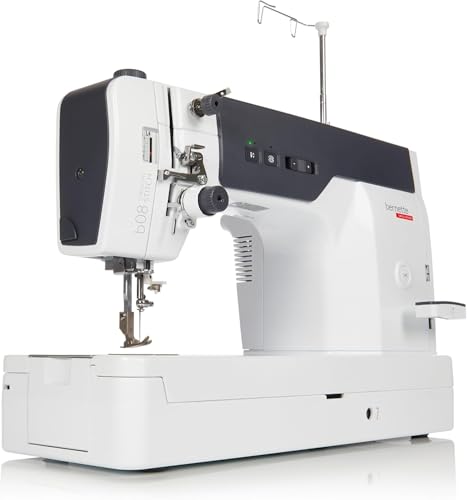
Bernette B08 Straight Stitch Sewing Machine — 1,600 stitches per minute
Bernette’s B08 brings a different badge into the class — the younger line of the Bernina family — with a listing that speaks in the class’s shared language: high-speed at 1,600 SPM, an industrial-style heavy-duty design, and professional sewing as its stated destination. That positioning matters because it widens the buyer’s map. A sewer whose other machines, feet, or local dealer relationships live in the Bernina world can now consider a straight-stitch specialist without leaving the ecosystem their hands and their shelves already know.
The listing is also the briefest of the specification-rich picks: beyond speed and design intent, it states no workspace dimension, no cutter, no table — and we record those silences in the spec box rather than borrow the family’s general reputation to fill them. What can be said is that industrial-style design in this class means a frame and feed built for sustained pace, and professional sewing as a destination means the machine expects to be worked, not admired. Buyers who prize the badge’s ecosystem and are comfortable confirming the remaining figures from documentation will find the B08 the class’s most interesting alternative; buyers who want everything stated should stay with the Janome HD models or the Handi Quilter below. Quilt-room mornings on any of them tend to start early and caffeinated, a ritual our colleagues document in Best Keurig Coffee Machines for the kitchen end of the studio.
- Top speed: 1600 stitches per minute, as shown in the listing title
- Design language: industrial-style, heavy duty, for professional sewing, per the listing title
- Workspace dimensions: not stated in the listing title — confirm from the manufacturer’s documentation
- Thread cutter and table: not set out in the listing title — verify before purchase if required
- For the Bernette B08: check price on Amazon, then confirm its remaining figures in the official documentation
Strengths
- Full class pace in an industrial-style frame
- Extends the Bernette and Bernina ecosystem into this class
- Professional positioning matches serious quilting and goods work
Trade-offs
- Several key figures unstated in the title
- Newer entrant beside long-established Janome and Brother names
- Straight stitch only, as with every pick here
Best for: Bernina-world sewers wanting a specialist without changing ecosystems. Not suited for: buyers who require a fully stated specification sheet.

Handi Quilter HQ Stitch 510 High-Speed Straight Stitch Sewing Machine — the 1,600-per-minute pace
Handi Quilter comes to this class from the quilting world itself — a brand quilters know from longarm frames — and the HQ Stitch 510 reads like a machine specified by people who quilt all day. Its listing states 1,600 stitches per minute, an automatic thread cutter, a needle threader, a knee lift, and a workspace measured at nine by five and a half inches. The knee lift is the feature that separates this pick in daily use: it raises the presser foot while both hands stay on the quilt, and across a day of piecing — pivot, turn, reposition, sew — that small liberation compounds into the smoothest workflow in this guide.
The needle threader joins the cutter in respecting the quilter’s rhythm: at this pace, thread changes and bobbin changes are frequent, and every friction removed is attention returned to the work. The stated workspace invites direct comparison with the HD8’s nine by six — a half inch of height is the difference on paper, and the honest way to choose is to roll your typical quilt and ask which throat receives it more kindly, while weighing the knee lift that only this pick names. For quilters building a dedicated piecing-and-quilting station, the HQ Stitch 510 is the most workflow-complete listing here, from a brand whose entire reputation rests on quilting rather than on sewing in general.
- Top speed: 1,600 SPM, as stated in the listing title
- Workspace: 9 x 5.5 inch, as given in the listing title
- Thread handling: automatic thread cutter and needle threader, per the listing title
- Ergonomics: knee lift included, per the listing title
- Bringing home the HQ Stitch 510: check price on Amazon for the Handi Quilter configuration
Strengths
- Knee lift transforms piecing and quilting workflow
- Cutter and threader together minimize hand interruptions
- Workspace stated in dimensions, from a quilting specialist brand
Trade-offs
- Workspace height a half inch under the HD8’s stated figure
- Extension table not named in the listing title
- Quilting-first design; garment specialists may prefer the 1600P QC’s breadth
Best for: dedicated quilters building a piecing and quilting station. Not suited for: sewers whose straight stitching is mostly garments and goods.
The straight-stitch field, spec by spec
| Model | Speed as listed | Workspace as listed | Named rhythm features |
|---|---|---|---|
| Brother PQ1600S | High-speed; figure not stated | Not stated in title | None stated in title |
| Janome HD9V3 | 1,600 SPM | Extra-large, unmeasured in title | Auto thread cutter; extension table |
| Janome HD8 | 1,600 SPM | 9″ x 6″ | Auto thread cutter; table |
| Janome 1600P QC | 1,600 SPM | Large throat, unmeasured in title | None stated in title |
| Bernette B08 | 1,600 SPM | Not stated in title | None stated in title |
| Handi Quilter HQ Stitch 510 | 1,600 SPM | 9″ x 5.5″ | Auto cutter; needle threader; knee lift |
What does the 1,600-per-minute pace actually change?
Less about finishing a seam sooner, more about how the seam forms. At professional pace, the machine completes each stitch cycle so decisively that long runs develop a momentum ordinary machines cannot offer — the fabric flows, the line settles, and the sewer’s job becomes guidance rather than propulsion. Piecing benefits arithmetically: hundreds of short seams per quilt, each started and finished cleanly, add up to hours returned across a project. Quilting benefits physically: long lines across a quilt’s field hold their evenness because the machine is never laboring at the top of its range, merely cruising in the middle of it.
Speed also disciplines the operator, and new owners of this class should budget an adjustment week. A machine that responds this quickly punishes a heavy foot and rewards a planned seam: fabric aligned before the needle drops, hands placed, the run visualized to its end. Sew practice yardage first — long strips, pieced rows, a sacrificial quilt sandwich — until pace feels like calm rather than urgency. Every pick here can be sewn slowly as well as fast; the professionals who love this class use the whole range, sprinting down the field of a quilt and creeping at its corners. The figure in the listings is a ceiling, and mastery is knowing how far below it each moment of the work belongs.
How do you manage a large quilt in a nine-inch throat?
By making the quilt smaller, one section at a time. The classic method rolls or accordions the bulk that must pass through the throat, leaving the region under the needle flat and supported, and repositions in planned pauses rather than mid-line struggles. The extension tables named in two listings here exist for the other half of the problem — the bulk outside the throat — because a quilt dragging off the machine’s edge steers the line as surely as a hand would. Pudding the fabric loosely around the needle area, rather than stretching it taut, lets the feed move the work without fighting tension from the quilt’s own weight.
Quilting pattern choice cooperates with geometry. Straight-line and gentle diagonal designs travel well through a throat; dense free-motion in a quilt’s center asks the most of the space and the sewer. Many owners of this class quilt in sections — stitch-in-the-ditch across the whole top first to stabilize it, then decorative work region by region — and the machines reward that patience with lines that look inevitable. The workspace figures in the listings are therefore best read as working envelopes rather than limits: nine inches, well managed, has produced generations of bed quilts, and the management is a learnable skill rather than a talent. Late-night quilting sessions, when the house is quiet and the lines run long, have their own fuel, and our notes on Best Nitro Coffee Machines exist for quilters who take that hour seriously.
How do you set up a straight-stitch station for piecing?
Wind bobbins in batches before the first seam — at this class’s pace, a bobbin empties in the middle of everything — and keep them in a row beside the machine, wound from the same thread the top uses. Set the stitch length once on a measured test: piece two strips, press, and check the finished unit against the pattern’s mathematics, adjusting the guide rather than your steering until units finish true. Arrange the work in sewing order, cut pieces stacked to the left, finished units to the right, so the station flows like the small production line it honestly is. The cutters on the HD9V3, HD8, and HQ Stitch 510 shine here, trimming at each seam’s end without a scissors hunt; owners of the other picks keep snips on a ribbon at the machine’s right and build the same rhythm by hand.
Lighting and seating finish the station. Light should fall on the needle from the front, because at speed the eye must read the seam guide without shadow. The chair should let the sewer sit close with forearms level, and the knee lift on the HQ Stitch 510 should be positioned so a nudge, not a reach, raises the foot. A station set this way disappears beneath the work — which is the highest state a sewing setup can reach, and the reason owners of this class describe their machines with a loyalty that puzzles generalists.
Specialist-machine mistakes that waste the purchase
Buying one as a first and only machine is the expensive one: the first time a knit, a buttonhole, or a zigzag finish is needed, the specialist sits silent while its owner borrows a generalist. The second is judging the class by speed alone and ignoring workspace and thread handling, which decide more working days than the shared 1,600 figure does. Third is assuming inclusions — a table, a cutter — that a given listing never stated; this guide has flagged every such silence precisely because the assumption is so natural. Fourth is neglecting the support surface: a high-speed specialist on a flimsy table will vibrate its way into wavy lines and loosened everything, and the finest frame in the class cannot sew straight on a dancing desk. Buy the station with the machine, in money and in floor space, or buy a humbler machine honestly.
How does piecing change when the machine is this fast?
It becomes a flow discipline. On a generalist machine, piecing is a series of individual seams; on a straight-stitch specialist, chain piecing turns it into a continuous process — unit after unit fed through without cutting threads between them, the chain snipped apart afterward in one calm pass at the pressing table. The arithmetic is startling the first time a quilter experiences it: hundreds of seams with no stops to trim, reposition scissors, or restart rhythm. The cutters on three of these picks sharpen the flow further for single seams and finishing work, but the deeper change is mental. The sewer stops thinking seam by seam and starts thinking in batches, in sequences, in the architecture of the whole top — which is how quilts actually get finished.
Accuracy, counterintuitively, improves with the pace once the station is set. A measured seam guide, a stitch length dialed to the fabric, and a machine whose feed does not hesitate at seam crossings produce units of a sameness that hand-wrestled sewing rarely achieves. The specialist’s rigidity matters here: at speed, a lesser frame flexes almost imperceptibly, and almost imperceptible flex, multiplied by five hundred seams, becomes the quarter inch your quilt top refuses to surrender. This class exists to remove that multiplication. Quilters who piece on one for a season and return to a generalist for a day describe the experience as sewing in sand — everything possible, nothing flowing — and that description, more than any figure, is the case for the category.
What maintenance does a high-speed specialist demand?
More lint discipline than a generalist, because quilting at pace generates lint at pace, and the bobbin area of a hard-worked specialist can felt itself into faults within a single large project. Brush it out at every bobbin change during heavy quilting; the habit takes seconds and prevents the tension mysteries that otherwise arrive precisely at the quilt’s center. Needles live shorter lives at 1,600 stitches per minute — the count of fabric penetrations per hour is simply higher — so change them on a schedule measured in projects, not in visible failures, and keep the correct system and sizes stocked in depth.
Oil and service follow the manual’s word for each model, and owners should learn which parts of their machine are user-serviceable and which belong to a technician, before the question becomes urgent in a deadline week. Keep the machine covered between sessions, keep its table clear of the grit that quilting sheds, and log your settings for recurring work — the stitch length your piecing likes, the tension your quilting thread prefers. A specialist rewards this professionalism symmetrically: it is a professional tool, and it behaves best in a professional routine. Owners who keep that routine report the same experience across all six badges here — a machine that feels, year after year, like the day it was dialed in.
How should a buyer test a straight-stitch machine before committing?
With their own fabric, their own thread, and their own worst seam. Bring a pieced block with its stacked seam crossings, a quilt sandwich basted from your actual batting, and a length of the fabric your garments use. Sew long lines and watch the edges arrive together; sew the crossing and listen for hesitation; quilt a curve and feel whether the feed argues. Check the underside of every test — bobbin formation is the machine’s confession — and press the samples, because some faults only declare themselves under heat. Where a purchase must be made from a listing alone, the discipline inverts: read the title as the contract this guide has modeled, confirm every unstated figure that matters from documentation, and let the return window be your test bench, used promptly and honestly in the first week.
Pay attention, during any test, to the things listings cannot say: the sound at pace, which should be even rather than strained; the start of a seam, which should form without a nest or a lurch; the feeling at a thickness change, which should be a negotiation rather than a collision. Two machines can share the 1,600 figure and differ in all of these, which is why this guide refuses to rank the class by its one common number. Your hands, on your fabric, are the final specification sheet — the listings simply tell you which machines deserve to be tested.
Why do garment sewers adopt these machines too?
Because garment construction, honestly examined, is a straight-stitch practice with occasional guests. Seams, darts, topstitching, hems by machine, waistbands, plackets — the architecture of a garment is straight lines, and a specialist forms them at a pace and evenness that make home garment sewing feel suddenly professional. The 1600P QC’s listing names denim and canvas for a reason: jeans, workwear, bags, and upholstery-adjacent garments are straight-stitch work in thick materials, and a machine built for pace and thickness changes the economics of sewing them at home. A jacket that once took a weekend of cautious generalist sewing becomes an afternoon of flowing seams.
The garment sewer’s pairing is the mirror of the quilter’s: the specialist handles construction, the generalist — kept, threaded, and unresented — handles buttonholes, knits, and finishing stitches. Studios that sew both garments and quilts sometimes find the specialist becomes the primary machine and the generalist the auxiliary, visited for its handful of tricks. That inversion is the surest sign the specialist philosophy has taken hold: the machine that does the essential thing superbly becomes the center of the room, and everything else arranges itself around it.
What thread and needle strategy suits this pace?
At 1,600 SPM, thread is no longer a passive supply; it is a component moving at speed through guides, tension discs, and a needle eye that heats with friction. Consistency becomes the first virtue: a quality thread of even weight, without weak spots or slubs, because a flaw that a slow machine tolerates becomes a break at pace, and breaks at pace cost the rhythm this class exists to protect. Many quilters settle on a small wardrobe of trusted threads — a piecing weight, a quilting weight, colors that serve their palette — bought in depth, because mid-quilt thread changes to a different batch or brand can shift tension behavior visibly across a single top.
Needles deserve the same strategic treatment. The specialist’s needle makes more penetrations per hour than a generalist’s, through more layers, and its point dulls on that schedule whether or not it announces itself. Change needles at project boundaries and at the first whisper of a changed sound, stock the machine’s correct system in the sizes your fabrics rotate through, and treat the needle as the cheapest insurance in the room — which it is, priced against a single ruined quilting line across a finished top. Spool management completes the strategy: cones or large spools for production piecing, bobbins wound in batches from the same source as the top thread, and a small notebook entry for the combinations each fabric prefers. At this pace, preparation is not fussiness; it is the difference between a machine that flows and a machine that interrupts.
How does a specialist change a sewing room’s economics?
Time is the currency. A quilter who pieces a top in two flowing evenings instead of five interrupted ones does not merely finish sooner — she finishes, full stop, because projects die in the gaps between sessions more often than at the machine. Garment sewers selling their work feel the same arithmetic in money: construction at professional pace reprices what a home studio can profitably make, and the 1600P QC’s thick-fabric brief extends that repricing to bags, workwear, and canvas goods. Even purely personal sewing is revalued; the specialist converts sewing from a weekend negotiation into a weeknight possibility, and skills compound with frequency in a way they never do in monthly marathons.
The honest ledger has a second column. A specialist costs more than a generalist of similar size, occupies a committed station, and still leaves its owner needing a second machine for everything else. The purchase pays when the straight-stitch share of a sewer’s work is genuinely dominant — measurable, if you care to measure it, in the last ten projects on your table. Count their seams. If the overwhelming majority are straight, the economics are already arguing for this class, and the only remaining question is which of these six listings states its case in the way you trust. That counting exercise, done honestly, is worth more than any recommendation — including the one that follows.
What does the first month with a specialist teach?
Respect for momentum, first of all. New owners typically spend week one sewing too fast — the machine invites it — and producing long, confident, slightly wandering lines. Week two teaches the counterintuitive correction: the pace that produces straight work is the pace at which the hands can plan, and for most sewers that is seventy percent of the ceiling on curves and a hundred percent only down the quilt’s long straights. By week three the pedal has become a musical instrument rather than a switch, and the sewer is modulating speed the way a driver modulates a throttle — without thought, in response to the road. Week four is when chain piecing clicks, and with it the realization that the machine has quietly reorganized how its owner thinks about a quilt: not as a pile of seams but as a flow of units.
The month also teaches the station’s importance in the body. Shoulders that ached after the first long session stop aching when the chair, table height, and light are corrected; the knee lift, for HQ Stitch 510 owners, goes from novelty to reflex; bobbin batches get wound without being reminded. Keep a short log through the month — settings, threads, the fabrics that sang and the crossings that argued — because a specialist’s owner is building a reference that will serve every future project. By the month’s end, the question that opened this guide will have answered itself in the owner’s hands: the narrow machine was not a limitation. It was a lens, focusing all of sewing’s scattered attention onto the one stitch that matters, until the work became as straight and as swift as the machine always promised it could be.
Can a specialist and a generalist share one sewing room gracefully?
They can, and the arrangement has a known choreography. The specialist takes the committed station — the stable table, the best light, the chair adjusted to its owner — because it does the volume. The generalist lives within reach but off the main stage: on a side table, in a case that opens quickly, threaded with the household’s default and ready for the buttonhole, the knit, the zigzag finish that the week’s work inevitably requests. Bobbins and needles must be kept honestly separate, because the two machines’ systems are rarely interchangeable and a mixed drawer is a fault waiting for its moment; label the specialist’s supplies with its name and let no borrowing occur. Thread, by contrast, can be shared wealth, racked between the stations.
The deeper grace is temperamental. Owners stop asking either machine to be the other. The generalist’s decorative library stops looking like clutter and becomes a service bureau; the specialist’s silence on everything but straight stitch stops looking like poverty and becomes focus. Projects route themselves: construction to the fast machine, finishing to the versatile one, and the room’s output rises not because either machine improved but because the questions each must answer became narrower. That is the mature form of the philosophy this whole guide describes — mastery through narrowing, applied first to a stitch and finally to an entire sewing room.
Final Recommendation
Choose by the specification style you trust and the work you sew most. The HQ Stitch 510 offers the most complete quilting workflow on paper — cutter, threader, knee lift, measured workspace — from a quilting specialist brand. The Janome HD8 matches its pace with a slightly taller stated workspace and its own table; the HD9V3 answers with heavy-duty framing and an extra-large claim for buyers who trust the line’s evolution. The 1600P QC is the broad instrument, as at home in canvas and denim as in quilts, with a veteran’s depth of support. The Bernette B08 brings the class to the Bernina ecosystem, and the Brother PQ1600S remains the established name for buyers content to verify its figures at the source. Whichever you choose, you are buying the same beautiful narrowness — one stitch, perfected — and the first long seam you sew at pace, straight as a ruled line from one end of a quilt to the other, will explain the entire category better than this guide can: some machines do everything adequately, and these do the essential thing superbly.
Frequently Asked Questions
Why do five of these machines share the same 1,600 SPM figure?
Because the class has converged on a professional standard. Convergence of that kind is information in itself: it tells the buyer that the industry’s argument about pace is settled, and that the live questions — the ones worth a buyer’s research hours — are workspace, handling, and build, exactly where this guide has spent its attention. At roughly the 1,600-per-minute pace, a domestic-format machine reaches the pace quilting and piecework reward, within what a rigid frame and a home power supply comfortably sustain. The figure’s sameness is why this guide compares the class on workspace, cutters, threaders, and knee lifts — the features that actually separate the picks in daily use.
Can a straight-stitch machine be my only machine?
Only if your sewing is entirely straight stitch — some quilters and minimalist garment sewers genuinely live there. Most owners pair a specialist from this guide with a generalist machine that covers zigzag, buttonholes, and knits. Buy the specialist as a partner, and it will be loved; buy it as a replacement for everything, and its narrowness will eventually send you shopping again. The pairing need not be expensive or simultaneous: many owners sew for a season with the specialist alone, note precisely which operations they had to borrow or postpone, and then buy the generalist that covers exactly that list — a second purchase made with evidence instead of speculation, which is the specialist philosophy applied to shopping itself.
What is a knee lift, and why do quilters prize it?
A knee lift raises and lowers the presser foot with a nudge of the knee, leaving both hands on the fabric. In piecing and quilting, where repositioning is constant, it removes hundreds of hand trips per project and keeps the work exactly where the hands placed it. Only the HQ Stitch 510 names one in its listing here, and for workflow-focused quilters that can be the deciding line.
Do I need the automatic thread cutter?
Need is strong, but at this class’s pace the cutter is the feature owners most quickly refuse to give up. It trims both threads at each seam’s end without moving the work or hunting for snips, which across a quilt’s hundreds of seams is a genuine saving of time and tidiness. Two Janome picks and the Handi Quilter state one; the other listings leave it unstated, so verify if it decides your purchase.
How large a quilt can these machines handle?
With rolled-bulk technique and table support, owners quilt full bed quilts on machines of this class routinely — the stated nine-inch throats are working envelopes, not hard limits. What changes with quilt size is effort and pattern choice: larger quilts reward simpler lines, sectional quilting, and patient repositioning. If king-size quilts are your standard work, sew a test on your finalist before committing. It is also worth remembering that generations of celebrated quilts were made on machines with throats smaller than anything in this guide, by quilters who treated the space as a technique to learn rather than a verdict on their ambitions — the nine inches here are, by historical standards, a luxury, and they reward the same patience that made those earlier quilts beautiful.
Is the Brother PQ1600S slower than the others?
Its listing title does not state a figure, so this guide does not rank its speed. The model belongs to the same high-speed class as the other picks — that is all its title claims and all we repeat. Buyers comparing headline numbers should confirm the PQ1600S’s specification in Brother’s documentation, where the figure is published, rather than assume either way from its absence here.
How loud is a machine at full pace, and does it matter?
A well-kept specialist at speed produces a purposeful mechanical hum rather than a clatter, and the difference is diagnostic: new noises at pace — a tick, a knock, a changed pitch — are the machine reporting a needle, a lint mass, or a lubrication need before any stitch fault appears. Owners learn their machine’s healthy voice in the first month and should treat deviations as information. For the household, the practical point is placement: a station on a solid table against a wall, used at sociable hours or behind a door, keeps the peace, and the sewing itself — being mostly long, even runs — settles into a rhythm most families describe as closer to weather than to noise.
Should I learn free-motion quilting on a straight-stitch machine?
Many quilters do, because the class’s feed authority, throat room, and pace control are exactly the qualities free-motion work draws on — though none of these listings promises a free-motion specification, and buyers for whom it is central should confirm feed-dog arrangements and suitable feet in the documentation of their finalist. Learn on practice sandwiches, begin with large gentle motifs, and let the machine’s speed become your servant in small increments; the technique rewards the same patience as everything else in this guide.
Related Guides
Workspace is this class’s second language, and readers who want the dimension explored across a whole guide should continue to Best Large-Throat Sewing Machines for Quilting. Between that roundup and this one, a quilter can separate the questions of pace, throat, and thread handling that decide a specialist purchase. And when the specialist is chosen and the station built, sew the first quilt slowly enough to learn the machine’s voice — the speed will still be there, waiting patiently, on the day your hands are ready to ask for all of it in full.


