What's inside
- Key Takeaways
- Quick Picks
- How Did We Sort One Design Sold Five Ways?
- Side-by-Side: The Six Manual Machines at a Glance
- What Should You Understand Before Sewing Without a Motor?
- How Do You Get a Clean First Seam on a Hand Cobbler?
- Which Buying Mistakes Catch Manual-Machine Shoppers?
- How Does Thread Choice Change a Repair’s Working Life?
- What Does a Sensible Manual Sewing Bench Look Like?
- When Is Neither a Cobbler nor a Treadle the Right Answer?
- What Work Actually Arrives at a Manual Repair Bench?
- How Do You Keep a Human-Powered Machine Honest for Decades?
- How Should You Read a Cobbler Listing Before You Order?
- Final Recommendation
- Frequently Asked Questions
- Related Guides
As an Amazon Associate I earn from qualifying purchases. This post may contain affiliate links at no extra cost to you.
cottageverdict.com is reader-supported. When you buy through links on our site, we may earn an affiliate commission.
Every pick below sits on its own Amazon product page, linked from the quick picks table and again from its review heading, so the buying step never requires a second search. Where to buy, in other words, takes care of itself. What deserves your attention first is a stranger question: what does the phrase manual sewing machines actually cover, because the honest answer spans three quite different families of equipment, and confusing them is the most expensive mistake in this category.
Start with the disclosure this guide owes you about its largest family. Five of the six picks are hand-crank cobbler machines — leather stitchers worked by turning a wheel with one hand while guiding material with the other. Here is the part most roundups will not tell you: those five listings are, underneath their different shop names, essentially one design. The same cast frame, the same long arm reaching into a shoe or bag, the same dual-line arrangement for cotton or nylon thread, sold by different storefronts with different bundles of needles and accessories. That is not a scandal; it is how this corner of the market works, and the design itself is genuinely useful. But it means your real choice among the five is about bearings, included parts, and which seller’s version of the shared design you trust — not about five rival technologies. This guide treats them that way, openly.
The sixth pick belongs to a different world entirely. The Janome 712t is a treadle machine: foot-powered through a rocking treadle and a belt, the way household sewing worked for generations before motors took over, with ten stitches and a buttonhole rather than a single repair stitch. Between the cobblers and the treadle sits a third idea worth naming even though no pick here fills it — the ordinary electric tabletop machine, which is manual only in the sense that your hands guide the cloth. If what you actually want is general sewing without a motor, the treadle is your machine. If you want to stitch a boot sole back to its upper at a workbench, that is cobbler territory. Readers comparing powered alternatives for regular garment work will find our guide to Best Sewing and Embroidery Machines useful once they have decided electricity is acceptable after all.
Why would anyone choose muscle power in a motorized age? The reasons are more practical than nostalgic. A hand cobbler goes where outlets do not: market stalls, farm workshops, boats, cabins, repair benches in sheds. It sews materials that defeat domestic electrics — thick leather, canvas, webbing, tent fabric — because the operator feels resistance directly through the crank and can slow down, lean in, or back up stitch by stitch. It has almost nothing electronic to fail, and its mechanical faults announce themselves visibly rather than hiding in a circuit board. Against that, hand power is slow, the stitch menu is essentially one stitch, and long seams demand patience and a steady rhythm. This guide keeps those trade-offs in front of you rather than romanticizing them.
Key Takeaways
- Five of the six picks share one hand-crank cobbler design sold under different shop names; compare bearings, bundles, and seller support rather than expecting five distinct machines.
- The Janome 712t treadle is the only true household machine here, offering ten stitches and a four-step buttonhole with no electricity at all.
- Cobbler machines exist for thick, awkward work — shoe uppers, bags, canvas, tents — where a long arm and hand-fed control matter more than speed.
- Thread choice is part of the machine: the cobbler listings are built around dual cotton and nylon lines, and heavy nylon is what most leather repairs actually need.
- Hand power rewards rhythm over force; most beginner failures come from rushing the crank and starving the stitch of consistent motion.
- None of these machines is a substitute for a general-purpose electric model if your sewing is mostly clothing construction from flat fabric.
Quick Picks
| Machine | Distinction | Why it earns a place |
|---|---|---|
| DODOQ Manual Leather Sewing Machine (Hand Cobbler) | The reference cobbler | The plainest statement of the shared hand-crank design, aimed squarely at shoe repair and patching work. |
| ColouredPeas Shoe Repair Hand Sewing Machine (10-Bearings) | Bearing-led variant | Its listing leads with an upgraded ten-bearing build, the one mechanical difference in this family worth weighing. |
| IRONWALLS Leather Cobbler Manual Sewing Machine | Needles in the box | Sold explicitly with needles included and a canvas-to-tents remit that matches how these machines are really used. |
| Leather Cobbler Stitching Machine (Shoe Repair) | Zipper-aware listing | Names zippers among its jobs, a small honesty about the awkward repairs cobbler arms handle well. |
| Janome 712t Treadle Sewing Machine | The household treadle | Ten stitches and a buttonhole from foot power alone — the only pick that sews a wardrobe rather than repairing one. |
| Leather Sewing Machine, Cobbler Sewing Machine (Manual) | Belt-and-bag breadth | Lists belts among its materials, pointing at the strap and tack repairs this design quietly excels at. |
How Did We Sort One Design Sold Five Ways?
Choosing for this guide meant accepting the market as it is. We required every pick to be genuinely human-powered — no motor hiding in the description — and to be listed for the work buyers actually bring to this category: leather and shoe repair, heavy fabric mending, and off-grid household sewing. Within the cobbler family, we looked for any stated difference that could matter in use: bearing count where a listing claims one, needles or lines included, and the range of materials the seller is willing to name. A listing that promises shoes, bags, clothes, quilts, coats, and trousers is making a broader claim than one that sticks to footwear, and we note where those claims stretch credibility, because a cobbler arm that shines inside a boot is an awkward tool for a quilt.
The treadle earned its place on different criteria: stitch variety, a buttonhole, and a bobbin system a household sewer would recognize. It is the control case in this guide — proof of what manual power looks like when the goal is ordinary sewing rather than repair of heavy goods. We deliberately excluded electric machines badged as “manual” merely because they lack computerized controls; that usage empties the word of meaning, and readers searching this term deserve machines their own muscles drive.
One more filter deserves mention: honesty about assembly and setup. Hand cobblers typically arrive as a head unit you mount to a bench or board, and the listings vary in how clearly they say so. We favored reading every pick as a workshop tool first and a household appliance second, because that framing predicts satisfaction far better than any feature count.

DODOQ Manual Leather Sewing Machine (Hand Cobbler) — The reference cobbler
Treat the DODOQ as the baseline against which its four cousins should be measured, because its listing states the shared design with the least decoration: a hand-operated stitching machine for shoe cobbling, repair, mending, and patching, running dual cotton or nylon lines. That plainness is useful. When a family’s listings all describe the same mechanism, the undecorated version tells you what the mechanism actually is, stripped of bundle inflation.
In use, a machine of this type asks you to learn a two-handed choreography. One hand turns the wheel in a smooth, unbroken rhythm; the other presents the work — a shoe upper, a bag panel, a strap — to the needle along the long arm. The arm is the entire point. It reaches into places a flat-bed machine cannot enter, letting you stitch around a toe box or down inside a tote. Because you supply the power, you also supply the judgment: slow the wheel on a thick seam junction, feel the needle’s protest through the crank, and ease off before something bends. Experienced repairers describe this feedback loop as the reason hand cobblers survive in professional shoe shops alongside powered equipment.
The dual-line arrangement matters more than it first appears. Cotton line suits lighter mending where a soft thread is kind to old fabric; nylon line is the workhorse for leather and load-bearing repairs, resisting rot and abrasion. Owning a machine that accepts both lets one bench tool cover a torn jacket and a resoled boot in the same afternoon. What the DODOQ listing does not give you is any promise of refinement: no stitch variety, no speed, no convenience features. Judge it as a vise with a needle — a fixture for hard little jobs — and it will not disappoint you.
- Power source: hand crank, operator-driven
- Thread arrangement: dual cotton and nylon lines, per the listing title
- Intended work: shoe cobbling, stitching repair, mending, patching
- Stitch variety beyond its repair stitch: not described in the listing title — check the maker’s documentation before assuming
- Where it stands on price: see the DODOQ listing on Amazon for current terms
Strengths
- States the shared cobbler design plainly, making it the honest yardstick for the whole family.
- Long-arm format reaches into shoes and bags that defeat flat-bed machines.
- Accepts both cotton and nylon lines, covering delicate mending and structural leather repairs.
Trade-offs
- One repair stitch is the whole repertoire; garment construction is beyond its brief.
- Throughput depends entirely on your arm and your patience.
- Bench mounting and setup fall to you; it is a workshop fixture, not a countertop appliance.
Best for: a repair bench that regularly faces shoes, bags, and heavy mending away from or independent of mains power. Not suited for: anyone whose sewing is mostly dressmaking, quilting, or long straight seams in dress-weight fabric.

ColouredPeas Shoe Repair Hand Sewing Machine (10-Bearings) — Bearing-led variant
The ColouredPeas listing makes the boldest mechanical claim in this family: an upgraded version built around ten bearings. On a hand-crank machine, bearings are not marketing garnish. Every revolution of the wheel passes through them, and a smoother drivetrain means the rhythm your arm sets is the rhythm the needle keeps, with less of the gritty, surging feel that makes beginners produce uneven stitches on cheap castings. If any single stated difference justifies choosing one cobbler listing over its siblings, reduced friction in the drive is the most plausible candidate.
The rest of the listing casts its net wide: shoe repair with nylon line supplied, and manual mending across shoes, bags, clothes, quilts, coats, and trousers. Read that breadth with the skepticism this guide has urged from the start. The machine’s geometry — a cobbler arm — genuinely suits shoes and bags. Quilts and coats are another matter: feeding a bulky quilt through a repair arm is possible in the way many awkward things are possible, slowly and with complaint. The honest summary is that ColouredPeas sells the same versatile-in-principle tool as its siblings, with a wider promise printed on the box and one hardware claim worth your attention.
Who should pay attention to the bearing claim? Anyone planning volume. A hobbyist resewing one pair of boots a season will never feel the difference between bearing counts. A market repairer stitching all day, every day, accumulates thousands of wheel turns weekly, and drivetrain smoothness compounds into less fatigue and more consistent work. For that user, the upgraded build is the rational pick of the family even before considering the included nylon line.
- Drive claim in the listing title: latest upgraded version, ten bearings
- Supplied line: nylon, per the listing title
- Named materials and jobs: shoes, bags, clothes, quilts, coats, trousers
- Power source: hand operation throughout
- Purchasing note: the ColouredPeas page on Amazon carries the current offer
Strengths
- The ten-bearing claim addresses the one mechanical quality — drivetrain smoothness — that shapes every stitch.
- Nylon line included means leather-capable thread is on hand from the first session.
- Broad stated remit suits a general repair bench handling varied incoming work.
Trade-offs
- The wide material promise outruns the cobbler arm’s real comfort zone on quilts and coats.
- Bearing count is a listing claim you cannot verify until the machine is in your hands.
- Shares the family’s single-stitch limitation despite the upgraded framing.
Best for: high-turnover repair work where wheel feel and reduced arm fatigue justify the upgraded build. Not suited for: quilters or coat-makers shopping for a primary machine rather than a repair fixture.

IRONWALLS Leather Cobbler Manual Sewing Machine — Needles in the box
IRONWALLS sells its version of the cobbler with two practical emphases: heavy-duty intent, stated outright, and needles included in the package. The second point sounds minor until you have owned one of these machines. Cobbler needles are not the universal needles of domestic sewing; they are stout, specialized pieces, and a machine that arrives without them is a machine you cannot test on delivery day. A listing that bundles needles respects the buyer’s first hour with the tool.
The material list in this title is among the more credible in the family: canvas, cotton, and linen sit alongside leather, with bags, cloths, and tents named as projects. That is a fair map of the design’s talents. Canvas and tent fabrics — the sun-rotted awning, the torn groundsheet flap, the sail cover — are exactly the jobs that jam domestic electrics and reward a hand-fed stitch you can nurse through layered, uneven material. Tents in particular explain much of this category’s enduring demand: outdoor gear fails in places and seasons where a powered workshop is not an option, and a bench-mounted hand stitcher in a garage or site cabin earns its shelf space the first time a storm-damaged flysheet comes in.
Expect the same learning curve as its siblings. The skill is not threading or setup, though both take an evening to learn; the skill is pacing. New owners crank too fast, outrun their guiding hand, and produce wandering seams on precisely the thick work the machine was bought for. IRONWALLS’ heavy-duty framing will tempt you to attack the thickest stack first. Resist, in the way this guide keeps recommending: begin on scrap canvas, find the wheel speed at which your guiding hand stays calm, and let the machine’s leverage do the penetrating.
- Bundle note: needles included, per the listing title
- Positioning in the title: heavy duty hand shoe repair and mending machine
- Named fabrics: leather, canvas, cotton, linen
- Named projects: bags, cloths, tents
- Buying route: find the IRONWALLS listing on Amazon to see today’s arrangement
Strengths
- Included needles mean the machine can be tested the day it arrives.
- Material claims stay close to the design’s genuine strengths in canvas and tent work.
- Heavy-duty framing suits a bench that takes outdoor-gear repairs seriously.
Trade-offs
- No stated bearing upgrade, so wheel feel should match the family’s baseline.
- Tent and canvas work is still slow, seam by seam, under hand power.
- Like its siblings, it repairs far better than it constructs.
Best for: outdoor-equipment and canvas repair, from awnings to tent panels, at a fixed bench. Not suited for: production sewing of any kind, or fine fabrics that a repair stitch would chew rather than join.
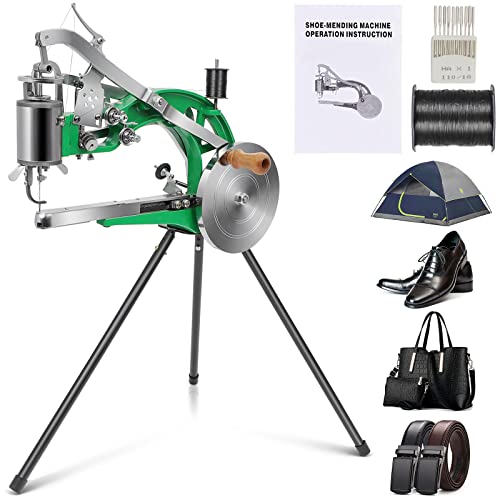
Leather Cobbler Stitching Machine (Shoe Repair) — Zipper-aware listing
This listing earns its slot by naming a job its siblings leave unmentioned: zippers. Anyone who repairs bags and outdoor clothing knows the zipper is where such items go to die — a jacket or rucksack with sound fabric and a failed closure is landfill unless someone restitches the tape. Working along a zipper means sewing in a cramped channel beside teeth and sliders, precisely the sort of confined geometry a cobbler arm was born for. A seller who prints zippers in the title understands the repair bench’s real workload.
Beyond that tell, this is the family design in its dual-line form: a cobbler stitching machine for shoes and clothes, running cotton or nylon line, with tents also named. The dual-line point deserves one more layer of explanation here, because zipper work illustrates it. A zipper tape stitched with cotton line into a washable garment ages gracefully with the clothing; the same repair on a load-bearing rucksack strap wants nylon’s indifference to moisture and abrasion. A single machine fluent in both threads lets a small repair operation quote either job without turning work away.
There is also a quieter virtue to an unadorned listing like this one. It does not claim bearings it may not have, nor bundles it may not include; it describes a shoe repair machine and its thread system and stops. In a category where five storefronts sell one design, the listings that under-promise are often the ones whose parcels match their descriptions. Verify the included accessories on the product page before ordering, since the title is silent about needles and extras — a silence this guide reads as honesty rather than absence, but one you should confirm with your own eyes.
- Thread system: dual cotton and nylon lines, per the listing title
- Jobs named in the title: shoes, clothes, zippers, tents
- Included accessories: the title does not enumerate them — confirm the contents on the product page
- Operation: fully manual, hand-driven stitching
- Cost check: the Amazon page for this cobbler stitcher shows the live figure
Strengths
- Zipper work is named explicitly, matching a huge share of real bag and jacket repairs.
- Dual-line flexibility covers both washable garments and weather-exposed gear.
- Restrained listing claims inspire more confidence than inflated bundle promises.
Trade-offs
- Accessory contents are unstated in the title, so pre-purchase checking is on you.
- No mechanical upgrade is claimed over the family’s shared baseline.
- Zipper repairs still demand care around teeth and sliders; the arm helps, but does not aim for you.
Best for: repairers whose incoming work is heavy on bags, jackets, and failed closures. Not suited for: buyers who want a fully specified, everything-included kit without reading the fine print first.

Janome 712t Treadle Sewing Machine — The household treadle
Everything changes with this pick. The Janome 712t is not a repair fixture but a complete household sewing machine that happens to draw its power from your feet: a treadle drives the mechanism through a belt, your legs rock in an easy rhythm, and both hands stay free to guide fabric — the original hands-free sewing arrangement, a century older than the knee lift. Its title states ten stitches and a four-step buttonhole, with a push-pull bobbin winder, which places it in a different universe from the single-stitch cobblers above.
Who is it for? The off-grid homesteader sewing curtains and clothing where the generator is saved for other loads. The sewer in a region of unreliable power who refuses to let outages idle her work. The traditionalist who simply prefers the meditative pace of treadling and the near-silent room it produces. And, less romantically, anyone equipping a cabin, a mission workshop, or an emergency-capable household where a machine that never needs a socket is a form of insurance. Note the practical requirement the title implies: a treadle machine needs its stand, floor space, and a seated posture you can sustain, so it claims more room than any other pick here.
Ten stitches will not thrill a quilter raised on computerized menus, yet they cover the honest core of household sewing: straight work at varied lengths, zigzag for finishing and appliqué, and the utility stitches mending actually calls for. The four-step buttonhole asks more of the operator than an automatic one — you mark, you turn, you mind your spacing — and produces perfectly respectable results once the sequence is familiar. Measured against the cobblers, the 712t is slower to forgive thick leather but infinitely more capable on everything else a household sews. Readers who later add a powered machine for decorative work often keep a treadle in service for decades; the mechanism has almost nothing in it that time can ruin.
- Power source: treadle and belt, foot-driven
- Stitch count from the listing title: 10 stitches
- Buttonhole: one four-step buttonhole, per the title
- Bobbin winding: push-pull bobbin winder, per the title
- Price route: the Janome 712t’s Amazon page carries the current details
Strengths
- A genuine all-purpose household machine that never touches electricity.
- Both hands remain free for fabric control while the feet supply power.
- Ten stitches and a buttonhole cover real garment sewing and mending alike.
Trade-offs
- Needs a treadle stand and the floor space that comes with it.
- Four-step buttonholes demand operator technique an automatic system would hide.
- Heavy leather and multi-layer canvas remain cobbler territory, not treadle strengths.
Best for: off-grid households and patient home sewers who want full garment capability without a motor. Not suited for: thick-leather repair work, tiny apartments, or anyone who sews in short impatient bursts.

Leather Sewing Machine, Cobbler Sewing Machine (Manual) — Belt-and-bag breadth
The final cobbler listing distinguishes itself with a single telling word in its material list: belts. Alongside the family’s usual shoes, bags, tents, clothes, and coats, this seller names the humble belt — and belts are a diagnostic repair. A belt is a narrow, thick, layered strap that must be stitched along its edge without wandering, often to rescue a buckle end or reattach a keeper. It is too thick for domestic electrics, too narrow to sit comfortably under many presser arrangements, and ideally shaped for a hand-fed cobbler needle you can walk along the edge at walking pace. A listing that thinks of belts thinks like a repairer.
The title also carries the family’s signature dual cotton and nylon line arrangement, misspellings and all — the listing’s own text renders upholstery imperfectly, a small reminder that these storefronts are factories’ outlets rather than polished brands, and that you are buying a mechanism, not a marketing department. Judge the hardware claims, hold the prose lightly, and the value proposition stays clear: the shared design, aimed at strap, bag, and footwear work, at whatever this storefront’s current terms happen to be.
Choosing among the five cobblers, then, comes down to micro-preferences this guide has tried to make legible. Bearings if you sew all day. Included needles if you want to start on delivery day. Zippers if closures dominate your bench. Belts and straps if tack and luggage fill your Saturdays. Or the plain DODOQ statement of the design if you distrust decoration on principle. What you should not do is pay a large premium for any one of them under the illusion of a different machine; the honest spread between these listings is in bundles, claims, and seller behavior, and your money should follow those, not badges.
- Thread arrangement: dual cotton and nylon line, per the listing title
- Materials and jobs named: upholstery, bags, tents, clothes, belts, coats
- Format: manual shoe and leather stitching machine, hand-driven
- Any claim of upgraded bearings: none appears in the title — treat the drive as the family’s standard build
- Checking the figure: this listing’s Amazon page is the place to look
Strengths
- Belts and straps are named, signaling real understanding of repair-bench work.
- Dual-line system keeps both garment mending and rugged gear repair in reach.
- The shared design’s long arm suits narrow, thick work that defeats flat beds.
Trade-offs
- Listing polish is rough, so verify contents and terms carefully before ordering.
- No stated upgrades distinguish the hardware from the family’s baseline.
- Coats and upholstery sit at the edge of what the arm handles gracefully.
Best for: strap, belt, and luggage repairs alongside the usual footwear work. Not suited for: buyers who equate a polished listing with a better machine, or anyone needing stitch variety.
Side-by-Side: The Six Manual Machines at a Glance
| Machine | Power | Defining trait | Natural habitat |
|---|---|---|---|
| DODOQ Manual Leather Sewing Machine (Hand Cobbler) | Hand crank | Plainest statement of the shared cobbler design | General repair bench |
| ColouredPeas Shoe Repair Hand Sewing Machine (10-Bearings) | Hand crank | Ten-bearing upgraded drive claim | High-volume repair work |
| IRONWALLS Leather Cobbler Manual Sewing Machine | Hand crank | Needles included; canvas and tents named | Outdoor-gear repair |
| Leather Cobbler Stitching Machine (Shoe Repair) | Hand crank | Zippers named among its jobs | Bags and jacket closures |
| Janome 712t Treadle Sewing Machine | Treadle | Ten stitches, four-step buttonhole | Off-grid household sewing |
| Leather Sewing Machine, Cobbler Sewing Machine (Manual) | Hand crank | Belts listed among its materials | Straps, tack, luggage |
What Should You Understand Before Sewing Without a Motor?
Hand and foot power change the ergonomics of sewing completely. On an electric machine, speed control lives in a pedal and your attention lives in your hands. On a cobbler, one hand is the motor, which means your guiding hand works alone and your body supplies a rhythm the machine merely obeys. Uneven cranking prints itself directly into uneven stitch spacing; there is no flywheel governor smoothing your mistakes, though the wheel’s own momentum helps once you find the tempo. Plan to spend your first sessions sewing scrap — old belts, dead shoes, canvas offcuts — until the rhythm becomes something your arm does without supervision.
Thread and needle discipline matter more, not less, on simple machines. The dual-line cobbler system rewards owners who match line to job: nylon where weather, load, and abrasion rule; cotton where the work is washed, worn against skin, or historically delicate. Needles for these machines are consumables with a hard life — a needle that has struck a buckle or a sole staple is finished, and forcing on with it tears more than it sews. Keep spares, change them without sentimentality, and your stitch quality will stay ahead of the machine’s reputation.
Mounting is the third reality. A cobbler head bolted or clamped to a solid bench behaves like a precision tool; the same head wobbling on a card table behaves like a punishment. Treadle owners face the parallel truth that the stand is half the machine. Budget your setup effort accordingly, and remember that none of these tools asks anything of your home’s wiring — a virtue that compounds quietly over years of sheds, cabins, stalls, and spare rooms. The habit underneath all of this — matching a tool’s power source to the work actually in front of it — is the same judgment that separates satisfying purchases from expensive regrets in every equipment category we cover, a point our colleagues’ testing of Best Coffee Machines for Iced Coffee makes from the kitchen side: capability you will not use is not capability, it is clutter with a cord.
How Do You Get a Clean First Seam on a Hand Cobbler?
Begin unthreaded. Mount the machine firmly, sit or stand at a height where your cranking arm can circle without shoulder lift, and turn the wheel through fifty slow revolutions doing nothing but watching the needle bar’s travel. You are teaching your arm the machine’s tempo before thread and leather complicate the lesson. Then thread the line your first real job needs — nylon for most leather — following the path slowly, because these simple machines forgive many things but not a missed tension disc.
For the first seam, choose a forgiving victim: a worn belt, a canvas tote with a torn handle anchor. Mark your stitch line with chalk; the guiding hand’s whole job is keeping that line under the needle while the cranking hand refuses to hurry. Sew shorter than you think you should — six inches of straight, even stitching teaches more than a yard of wandering. At the end of the seam, resist the electric habit of a quick reverse; secure the line the way the machine’s documentation directs, by hand-tying or back-cranking a stitch or two, and inspect the underside. Even tension top and bottom means your rhythm is honest. Loops underneath mean your cranking faltered mid-seam, and the cure is tempo, not adjustment.
Treadle owners follow a cousin of this drill: rock the treadle until the machine will start from a dead stop without a hand on the wheel, practice stopping with the needle up and then needle down on command, and only then introduce fabric. In both families, the first hour belongs to the motor — you — and every later hour repays it.
Which Buying Mistakes Catch Manual-Machine Shoppers?
The commonest mistake is the one this guide opened with: believing five cobbler listings are five machines, and paying a premium for a badge. The second is buying a cobbler to do a treadle’s job — attempting garment construction on a repair arm — or the reverse, expecting a treadle to punch through boot leather. The third is ignoring the bundle: needles, lines, and mounting hardware differ between storefronts, and a bare machine that cannot sew on arrival day is no bargain. Fourth comes thread neglect, running the included line for every job regardless of material, then blaming the machine for repairs that rot or snap. Finally, shoppers underestimate the bench: an unmounted cobbler or a treadle on a warped floor will sour an otherwise sound purchase within a week. A related error is skipping the practice phase entirely and christening the machine on a beloved item — the heirloom bag, the good boots — when an hour on scrap would have taught the hands everything the first real repair assumes they know. Every experienced repairer has a ruined first project in their past; the wise ones arranged for theirs to be something they did not love.
How Does Thread Choice Change a Repair’s Working Life?
Owners new to the dual-line system often treat thread as thread, and their early repairs teach them otherwise at the cost of redoing the work. Consider three benches. A walking boot resewn with cotton line looks perfect on the day and fails by spring, because cotton absorbs water, holds it against the leather, and rots quietly inside the seam channel. The same boot in nylon line shrugs off seasons of wet grass. Now reverse the pairing: a much-washed cotton shirt mended with heavy nylon wears a repair stiffer than the garment around it, and the rigid line saws at the soft fabric with every wash until the tear reopens beside the stitching. Neither failure is the machine’s fault; both are line choices.
Weight matters alongside fiber. These cobbler machines are built around substantial line because their clientele — leather, canvas, webbing — needs stitches that behave like rivets. Running the heaviest nylon through a lightweight repair, though, can pucker thin material and overwhelm the very fabric you are saving. Keep at least two lines mounted-ready: a heavy nylon for structural work and a lighter cotton for the washable, the worn-soft, and the historically fragile. Changing lines takes minutes; redoing a failed repair takes the whole job over again, plus the humility.
Color deserves one sentence of respect. Repair benches that stock only black and white line turn away invisible-mending work they could otherwise take, and a modest palette of browns earns its drawer space on leather benches within a month.
What Does a Sensible Manual Sewing Bench Look Like?
The machine is perhaps half the purchase. A cobbler head wants a rigid mount at a height that lets your cranking forearm stay roughly level; too high and your shoulder tires, too low and you hunch into backache by the third boot. Bolt it, do not merely clamp it, if the bench allows — vibration works clamps loose mid-seam, always at the worst stitch. Leave clear space on the arm’s side for the work to swing: shoes and bags rotate constantly during a repair, and a bench crowded with obstacles turns every rotation into a negotiation.
Light is the unglamorous essential. Hand machines are often bought for places without power, yet their work — dark thread on dark leather, inside a darker shoe — demands the best light you can arrange, whether that is a window seat, a battery lamp, or a head torch. Add a small kit that experienced repairers treat as part of the machine: spare needles in the sizes your work uses, a awl for persuading old holes to reopen, beeswax for line that frays, and a seam ripper dedicated to undoing other people’s failed repairs, which will arrive regularly once word spreads that your bench exists.
Treadle owners arrange a different geometry: floor space for the stand, a chair at a height that lets the feet rock without the knees lifting, and a rug or mat under the treadle in rooms where its rhythm would otherwise drum through the floorboards. Both setups share one principle — the human is the motor, so the workstation is engineered around a body, not a power cord, and comfort is a stitch-quality feature rather than a luxury.
When Is Neither a Cobbler nor a Treadle the Right Answer?
Honesty about this category includes naming its borders. If your sewing is production — dozens of identical items against a deadline — human power is a bottleneck no technique removes, and an electric machine will pay for itself in finished work. If your materials are delicate silks, stretch knits, or anything whose feed must be pampered by engineered presser systems, both families here will frustrate you; the cobbler is too coarse and the treadle too plain. And if your interest is decorative stitching, embroidery effects, or buttonholes by the dozen without ceremony, you are shopping in the wrong aisle entirely, and a modern computerized machine is the truthful recommendation.
There is also the question of the operator’s body. A hand cobbler asks real work of one arm and shoulder; a treadle asks it of both legs. Arthritis, injury, or simple fatigue can make the romantic choice the wrong one, and there is no virtue in a machine its owner dreads sitting down to. Try before you commit where you can — a borrowed hour on either mechanism tells you more than any listing — and remember that the secondhand market for both families is lively precisely because owners discover these mismatches honestly and pass sound machines along.
What remains, inside those borders, is a category of tools with an almost unfair longevity. A cobbler head has so few parts that a competent owner can maintain it for life with oil, needles, and attention. A treadle’s belt is its only real consumable. In a century of appliances designed to be replaced, these are machines designed to be inherited, and for the right bench that is not nostalgia — it is arithmetic.
What Work Actually Arrives at a Manual Repair Bench?
Talk to anyone who has owned a cobbler machine for a year and a pattern emerges in the jobs that find them. First come their own boots and bags, the purchases that justified the machine. Then the household’s backlog surfaces: the tent with the torn guy-line tab, the dog lead with the fraying stitch, the school satchel whose strap anchor surrendered in March. By the second season, neighbors begin arriving with the particular hopefulness of people carrying broken things — a leather jacket with a split seam, a beloved handbag whose handle stitching has let go, work boots that a powered repair shop quoted more to mend than seems sane.
This drift from owner to neighborhood repairer is the strongest argument for the family’s better bundles and smoother drives. A machine bought for three jobs a year may do thirty, and the difference between a gritty wheel and a bearing-sweet one is the difference between dreading the knock at the door and enjoying it. It also explains why the dual-line system matters commercially as much as domestically: the bench that can take both the nylon-line boot job and the cotton-line coat job becomes the bench the street actually uses.
Plan, in other words, for the machine’s social life. Mount it somewhere visitors can be received without moving it. Keep both lines in stock. And learn the sentence every repairer eventually needs, the polite boundary between a favor and a workload — because a good manual bench, once known, is never idle for long.
How Do You Keep a Human-Powered Machine Honest for Decades?
Maintenance on these machines is refreshingly legible: everything that moves can be seen moving, and everything that wears can be reached with ordinary tools. The cobbler’s regime is oil, cleanliness, and needle discipline. A drop of machine oil at the moving joints on a schedule your climate dictates — dry workshops forgive longer intervals than damp sheds — keeps the wheel’s feel true. Leather dust and canvas lint are the enemies within; brush out the needle area after heavy work, because compacted debris is what turns a smooth stitcher stubborn. Store the machine dry, and in coastal or humid air give exposed steel a whisper of oil against rust, the one failure mode that genuinely can kill these tools.
The treadle asks for the same cleanliness plus attention to its belt, the single part designed to wear. A belt that slips under load announces itself in faltering stitches on thick seams; dressing or replacing it restores the drive completely, and owners who keep a spare belt never lose a working day to the failure. Check the treadle’s pivot points for developing play once a season, and tighten with the unhurried confidence of someone working on a machine built to be serviced by its owner, because it was.
What neither family needs is equally notable: no firmware, no proprietary cartridges of anything, no authorized-service ransom. The entire maintenance economy of a manual machine fits in a small drawer and a small notebook, and that independence — more than romance, more than the silence — is why these designs have outlived every powered fashion that was supposed to replace them.
How Should You Read a Cobbler Listing Before You Order?
Because five storefronts sell one design, the listing itself becomes the product information you are really buying, and it repays a forensic reading. Start with the bundle inventory: needles, lines, bobbins, mounting hardware, and any stand or board mentioned by name. A listing silent about contents is not necessarily a bare listing, but the burden of proof shifts to you, and a message to the seller before ordering is cheap insurance. Photographs deserve the same scrutiny — images showing the machine mounted and mid-repair tell you more than beauty shots, and a seller whose photos include the needle area and thread path is a seller who has actually used the tool.
Next, weigh the claims against the design’s known physics. Any cobbler listing promising effortless sewing of everything from silk to saddle leather is describing a machine that does not exist; the honest listings in this guide name a plausible band of heavy materials and stop there. Look for the dual-line arrangement stated plainly, since single-line imitations of the design circulate and give up the flexibility that makes the real article versatile. Bearing claims, like the ten-bearing upgrade in this guide, sit in between: unverifiable from your chair, plausible as engineering, and worth a modest premium only when the seller’s wider conduct — clear contents, repair-aware language, responsive answers — supports trusting them.
Finally, read for the after-sale. These machines arrive needing assembly and adjustment, and the difference between a frustrating parcel and a working bench is often a seller who answers the threading question on day two. Reviews that mention setup help, spare parts supplied on request, or a missing needle replaced without argument are worth more than any star-shaped summary. You are not buying a different machine from any of these storefronts; you are buying a different relationship with the same machine, and the listing is where that relationship introduces itself.
Final Recommendation
Decide first which manual world you live in. If your sewing is household sewing — garments, curtains, mending — and you simply want it free of the socket, the Janome 712t is the only honest answer in this guide, and a deeply satisfying one. If your world is repair — shoes, bags, canvas, straps, tents — choose among the cobblers by the micro-differences that match your bench: ColouredPeas for all-day volume and its bearing claim, IRONWALLS for canvas and tent work with needles in the box, the zipper-naming stitcher for closure-heavy work, the belt-naming listing for tack and straps, and the DODOQ as the undecorated baseline that tells you what the design is. Buy the bundle and the seller, not the badge, and the shared design will serve any of those benches well. A hand-crank cobbler will never be the fastest tool in the workshop, but on the day the power is out and the boots still need soles, it is the one that simply keeps turning.
Frequently Asked Questions
Are the five cobbler listings really the same machine underneath?
Essentially, yes — one long-arm hand stitcher design produced and sold through multiple storefronts with differing bundles and claims. Small variations in castings and hardware exist, and one listing claims an upgraded ten-bearing drive, but the mechanism, capability, and limitations are shared. Choose on bundle contents, stated upgrades, and seller reliability.
Can a manual cobbler machine sew regular clothing?
It can mend clothing — patching a coat, restitching a trouser seam — but it is a poor tool for constructing garments, with a single repair stitch and an arm designed for confined spaces. For making clothes without electricity, the treadle pick in this guide is the appropriate machine.
What thread should I use for leather repairs?
Nylon line, which the cobbler listings are built around, is the usual choice for leather because it resists moisture and abrasion. Cotton line suits lighter, washable mending. Match the line to the repair’s working life rather than using whichever spool is mounted.
How hard is the treadle to learn?
Most adults find the rocking rhythm within a single session; the finer skill — starting and stopping with the needle where you want it — takes a few evenings of practice. Generations learned it as children, and the machine’s simplicity means there is very little else to master.
How long does a typical shoe repair take by hand?
Once your rhythm is established, restitching a separated boot upper or a bag strap is usually a matter of minutes at the machine, with marking, positioning, and finishing taking as long as the stitching itself. Your first repairs will run several times slower, and that is the tuition every owner pays; by the fifth or sixth job, the wheel hand stops requiring supervision and the times fall to something a small repair business could honestly charge for.
Can two people share one manual machine for different crafts?
Yes, and cobbler benches often serve a whole household’s worth of unrelated work — one person’s leather projects, another’s canvas and outdoor gear, a third’s heavy mending — because the machine’s skill lives in the operator rather than in settings that need resetting. Keep each user’s preferred line and needles in labeled order near the bench and the handovers stay painless.
Do these machines need any electricity at all?
None of the six picks does. The cobblers are hand-cranked and the Janome is treadle-driven. That independence is their defining virtue for sheds, cabins, stalls, and homes planning around unreliable power. Readers furnishing a fully off-grid workspace sometimes pair them with other socket-free tools; those who later wire the workshop can explore powered options such as Best Integrated Coffee Machines for the break room, but the sewing bench will not miss the outlet.
Is a secondhand manual machine a sensible buy?
Often the most sensible in this whole category, because the mechanisms are simple, inspectable, and built to be serviced by their owners. Turn the wheel or rock the treadle through a full test seam before paying, check for rust in the needle area and play in the pivots, and confirm that needles and lines for the design are still easy to source — on a sound example, wear you can see is honest wear, and these machines wear slowly.
Related Guides
Manual leather stitchers sit beside a powered leather tradition worth knowing before you commit to muscle alone, so our guide to Best Sewing Machines for Leather makes the natural next read for anyone whose repair bench keeps growing.


