What's inside
- Key Takeaways
- Quick Picks
- How Were These Machines Chosen for a Material That Forgives Nothing?
- What Does a Walking Foot Actually Do, and Why Does Leather Demand It?
- Why Is Every Stitch in Leather a Decision You Cannot Unmake?
- How the Six Compare for Leather Work
- Veg-Tan, Chrome-Tan and the Other Hides Your Machine Will Meet
- What Does It Take to Live With an Industrial Machine at Home?
- How Thick a Hide Can You Sew — and How Do You Know Before Buying?
- Where Do First-Time Leather Sewers Most Often Go Wrong?
- The Work Around the Seam: Skiving, Gluing and Finishing
- Final Recommendation
- Frequently Asked Questions
- Related Guides
As an Amazon Associate I earn from qualifying purchases. This post may contain affiliate links at no extra cost to you.
cottageverdict.com is reader-supported. When you buy through links on our site, we may earn an affiliate commission.
Buying route: follow any machine’s name in the quick-picks table — or the same link above its review — and you land on that model’s dedicated Amazon page, where you can check price on Amazon and confirm the configuration; several of these are industrial machines sold as kits with tables and motors, so that page is where the exact package is spelled out. The best sewing machines for leather solve a problem that has almost nothing to do with power. Leather does not behave like cloth. It has no weave to part around a needle, it grips a standard presser foot like a brake pad, and every needle hole it takes is permanent. The machines that sew it well share one mechanism above all others — a walking foot that moves with the material instead of dragging across it — and this guide is organised around that mechanism, from full industrial walking-foot machines on stands down to a hand-cranked cobbler machine that needs no electricity at all.
Picture a wallet blank under an ordinary presser foot. The foot presses down; the feed dogs underneath try to move the leather forward; the leather’s smooth, slightly tacky surface refuses to slide under the foot, so the top layer stalls while the bottom creeps. Stitches shrink, bunch, then suddenly lurch. Quilters met a cousin of this problem decades ago and solved it with a walking foot attachment. Leather workers solved it more thoroughly: they built the walking action into the machine itself, often as compound feed, where feed dogs, needle and inner foot all travel together with the material clamped between them. That is the technology ladder this guide climbs, and it is why the word “industrial” appears here without apology — for leather, the industrial designs are not overkill theatre, they are the native tools of the trade, and where a pick is an industrial machine this guide calls it one, table, servo motor and all.
Scale still matters, and the six picks are not six versions of the same commitment. At one end sit complete workshop installations for people making bags, belts and upholstered goods to sell. In the middle are portable walking-foot machines that bring the key mechanism to a home table. At the far end is a manual cobbler machine, slow as handwriting, that will stitch a shoe in a power cut and asks only patience in return. Readers whose leather ambitions are really about re-covering furniture should also read the companion guide to Best Sewing Machines for Upholstery, where several of the same feed mechanisms are judged on fabric panels and foam instead of hides.
Key Takeaways
- Leather sewing is a feeding problem before it is a power problem: the walking foot, which travels with the material, is the mechanism that defines this category.
- Compound feed — drop feed, needle feed and walking foot moving together — is stated outright in the Consew listing and is the gold standard for layered leather work.
- Three of the six picks are industrial machines sold with tables and servo motors; this guide labels them as such rather than dressing them as home machines.
- A cylinder arm, as on the FY335A, exists for tubular goods — bags, boots and cases — that a flat bed forces you to crush and wrestle.
- Every needle hole in leather is forever, so stitch length, practice scraps and slow starts matter more here than in any fabric category.
- The hand-cranked cobbler machine is the outlier with a real case: total control, zero electricity, and a pace suited to repair work rather than production.
Quick Picks
| Machine | Badge | The case for it |
|---|---|---|
| Weaver Leathercraft 303 Leather Sewing Machine | The leather specialist | A dedicated leather machine from a leathercraft supplier, complete with stand and servo motor, aimed at bags and personal accessories. |
| FY335A Cylinder Arm Walking Foot Industrial Sewing Machine | Tubular-goods industrial | An industrial walking-foot machine on a cylinder arm, sold as a knockdown kit with servo motor and table for leather and bag work. |
| Consew Walking Foot Industrial Sewing Machine | Compound-feed benchmark | Its title spells out the full feed system — drop feed, needle feed, walking foot — on an industrial lockstitch machine with table and servo motor. |
| REX 607Z Portable Walking-Foot Zigzag Sewing Machine | The portable mechanism | The walking foot in a portable body, with zigzag — the sailmaker-style format adapted here for leather repair at a home table. |
| YQ-516 Portable Walking Foot Sewing Machine | Thick-material traveller | A portable walking-foot machine presented for sewing and repairing thick materials, without a table or stand to house. |
| Fbshicung Hand Cobbler Shoe Repair Sewing Machine | The hand-powered original | A manual cobbler machine for shoes and leather repairs that trades speed for absolute, stitch-by-stitch control. |
How Were These Machines Chosen for a Material That Forgives Nothing?
Leather exposes vague buying advice faster than any other sewing material, because its demands are mechanical and specific. So the first screening question for every candidate was about feed: does the listing describe a walking foot, or a feed system built around one? Machines that offered only a standard presser foot and a hopeful “heavy duty” label were set aside for this guide, however strong their motors, because a powerful motor pushing leather under a dragging foot produces powerful frustration. The second question concerned form: flat bed or cylinder arm, portable or installed, electric or manual — because leather projects divide sharply by shape, and a machine that cannot physically receive the work is useless however well it feeds.
The third question was honesty about class. Leather sewing genuinely spans two worlds that marketing loves to blur: domestic machines that can visit leather, and industrial machines that live there. This guide keeps the border visible. When a pick is an industrial machine — built for a table, driven by a servo motor, sold as a kit or a set — it is described as one, with the space, assembly and learning commitments that status carries. Readers deserve to know whether they are buying an appliance or installing equipment.
One further filter ran quietly underneath: repairability. Leather machines are long-lived capital, not seasonal gadgets, and preference went to designs — industrial heads, established portable formats, the century-old cobbler pattern — whose parts, feet and needles circulate in a living trade ecosystem. A machine that can be serviced is a machine that can be kept, and in a craft where hides are bought by the square foot and projects run for weeks, keeping power matters.
Finally, a note on what the listings do not say. Several titles in this class are terse: they name the mechanism and the material and stop. Where a specification a leather worker would want — stitch length range, needle system, presser-foot lift — is absent from the title, the spec boxes below say so and send you to the manufacturer documentation. In a category where a wrong assumption can mean a machine that cannot take the needle system your thread weight needs, that restraint is deliberate.
What Does a Walking Foot Actually Do, and Why Does Leather Demand It?
Watch a walking foot sew in slow motion and the name explains itself. The foot is in two parts. An inner foot clamps the material and, together with the feed dogs below and — on compound-feed machines — the needle itself, carries the work backward by one stitch length. Then the outer foot comes down to hold everything still while the inner foot lifts and walks back to its starting position, ready to take the next step. The material is never dragged across a stationary surface; it is escorted. On cloth this is a refinement. On leather it is the difference between sewing and fighting, because leather’s surface grips. A conventional foot on leather acts like a hand pressed on a tablecloth you are trying to pull: the harder the machine pulls from below, the more the top surface resists, and the layers of a bag seam — outer hide, lining, sometimes a stiffener — each travel at their own reluctant speeds.
Compound feed adds the needle to the travelling party. On the Consew in this guide the listing names all three elements: drop feed, needle feed, walking foot. With the needle moving in step with the material while it is still in the leather, the needle never levers against the hole it has just made — a subtle violence that on plain drop-feed machines elongates holes and weakens the seam line on thicker hides. For a belt or a bag strap that will spend its life under tension, that difference is structural, not cosmetic.
There is also the matter of the marks. A standard foot, and especially feed dogs working alone, can emboss tracks into soft leather that never come out. Walking feet spread the clamping work between two feet and keep the material moving, which reduces — though on the softest garment leathers does not eliminate — the footprints a machine leaves behind. Test on an offcut from the same hide, always: leather varies by animal, tannage and finish, and a mechanism that glides on firm veg-tan may still bruise a buttery chrome-tanned lambskin. The machine is half the system; the hide is the other half, and it does not read manuals.
Why Is Every Stitch in Leather a Decision You Cannot Unmake?
Sew cloth wrong and you reach for the seam ripper. Sew leather wrong and you reach for a new piece of leather. The needle hole in hide does not close up when the thread comes out; a row of wrongly placed stitches leaves a perforated dotted line that weakens the material exactly where the seam was meant to strengthen it, like the tear line on a postage stamp. This single fact reorganises the whole craft. Stitch length runs longer than on fabric, partly for strength — too many holes too close together cut the strip between them — and partly for looks, since leather seams are usually visible and their rhythm is part of the design. Pins are banished; they leave holes too. Clips, double-sided tape made for leatherwork, and careful basting with glue take their place.
It also reorganises how you should shop. A machine for leather is not judged by how it handles your best day but by how controllable it is on your worst: whether it will sew slowly, stitch by single stitch, without lurching when the motor starts. This is why servo motors recur in the industrial picks below. A servo only turns when you ask it to, draws power in proportion to demand, and lets a beginner creep along a bag seam at a meditative pace with full punching force available at crawling speed. The older clutch-motor style of industrial machine, by contrast, runs constantly and engages with a surge that has startled generations of first-time leather sewers into a ruined first project. Where a listing states a servo motor, read it as a controllability claim, and value it accordingly.
Thread and needle choices harden under the same logic. Leather needles have a chisel or wedge point that cuts a small slit for the thread rather than punching a round hole — using a standard sharp needle invites torn holes and skipped stitches. Bonded nylon or heavy polyester threads are the trade’s default because the seam is structural and often visible. None of the listings below bundle the full needle-and-thread story in their titles, so treat consumables as a separate, deliberate purchase, and practise the exact sandwich — hide, lining, stiffener — on scraps before the real piece goes under the foot. In leather, the scrap is not a warm-up. It is the rehearsal that saves the performance.
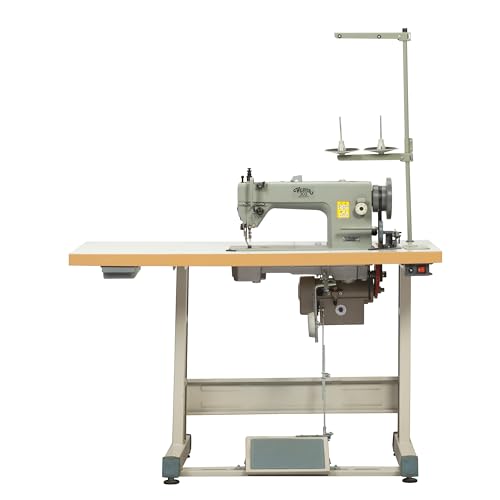
Weaver Leathercraft 303 Leather Sewing Machine — The leather specialist
Weaver is a name leatherworkers already know from the tool and hide side of the trade, and the 303 arrives as a complete workstation rather than a bare machine head: its title promises the machine complete with stand and servo motor, and names its territory as bags, personal accessories and a variety of other leather working projects. That framing matters. This is not a general sewing machine that tolerates leather; it is a leather machine from a leather supplier, sold to people whose projects are wallets, belts, bags, journal covers, holsters and the small-goods economy of craft fairs and online shops.
The stand-and-servo completeness deserves emphasis because first-time industrial buyers routinely underestimate the ecosystem a machine head needs. A head without a table is a paperweight with a needle. Here the workstation arrives as one purchase, which suits a home workshop converting a garage corner into a small leather studio. The servo motor brings the slow-speed control discussed above — the ability to place stitches one at a time around a wallet’s corner, which is where leather projects are won and lost visually. For the crafter stepping up from hand-stitching with two needles and an awl — the saddle-stitch apprenticeship most leatherworkers serve — this class of machine is the traditional graduation, keeping the work recognisable while multiplying output.
- Configuration: machine complete with stand and servo motor, as stated in the listing title
- Intended work: bags, personal accessories and other leather projects, per the listing title
- Feed system detail: the listing title does not spell out the feed arrangement — confirm in the manufacturer documentation
- Stitch type and length range: not printed in the listing title — see the manufacturer documentation
- Needle system: not stated in the listing title — verify before ordering consumables
- Where to buy: the Weaver Leathercraft 303 Leather Sewing Machine listing on Amazon — check price on Amazon
Strengths
- Sold as a complete workstation — stand and servo included — so the setup has no missing half.
- Comes from a leathercraft supplier, with project framing that matches real small-goods work.
- Servo control suits the slow, placed stitching that visible leather seams demand.
Trade-offs
- A stand-based machine claims permanent floor space in a way no portable can be accused of.
- The title leaves feed and stitch specifications to the documentation, so due diligence is required.
- It is a specialist: dress fabrics and quilting cotton are outside its intended parish.
Best for: leather crafters moving from hand-stitching to machine production of bags and small goods. Not suited for: anyone needing a machine that also handles the household’s general sewing, or who lacks a permanent corner for a stand.

FY335A Cylinder Arm Walking Foot Industrial Sewing Machine — Tubular-goods industrial
Some leather goods are flat, and some are tubes. A tote bag at the moment its side seams are already joined, a boot shaft, a cylindrical case, a dog collar being closed — these cannot lie flat on a bed, and forcing them flat is how seams end up twisted. The FY335A answers with the shape its title leads with: an industrial walking-foot machine built on a cylinder arm, sold as a complete knockdown kit with servo motor and table, assembly required, and described plainly as a leather and bag sewing machine. The cylinder arm is a narrow horizontal arm the work slides over, so a tubular piece rotates around it while the walking foot escorts the seam — the same architecture that sews shoes and hats in factories.
The knockdown-kit wording is the honest fine print, and this guide will not soften it: the machine arrives in pieces and you build your workstation, table and all. For a mechanically comfortable buyer that is an afternoon’s satisfying work and a lower delivered cost than an assembled equivalent. For anyone else it is the central fact of the purchase, to be weighed before the walking foot’s virtues seduce. Once built, though, the combination is formidable for its niche — industrial walking-foot feeding, a servo for controlled starts, and an arm that receives the shapes flat beds refuse. Bag makers in particular live on this format: gussets, bases and closed bodies all pass through the cylinder-arm stage of construction.
- Machine class: industrial sewing machine, stated in the listing title
- Arm style: cylinder arm, as the title states it — the feature for tubular leather goods
- Feed: walking foot, in the listing’s own wording
- Package: complete knockdown kit with servo motor and table; assembly required, listed in the title
- Intended work: leather and bag sewing, from the listing title
- Stitch length range and needle system: not given in the listing title — check the manufacturer documentation
- Where to buy: the FY335A Cylinder Arm Walking Foot Industrial Sewing Machine listing on Amazon — check price on Amazon
Strengths
- The cylinder arm receives bags, boots and cases that defeat flat-bed machines.
- Walking-foot feeding and servo drive arrive together in one kit.
- Kit pricing rewards buyers willing to assemble their own workstation.
Trade-offs
- Assembly is a real project; the listing says so and buyers should believe it.
- A cylinder arm is a narrower working platform for large flat panels.
- Industrial ownership means industrial manuals — thorough, but written for technicians.
Choose it for: bag making and three-dimensional leather goods as a serious, ongoing practice. Pass if: your leather work is flat wallets and belts, where the arm’s advantage never comes into play.
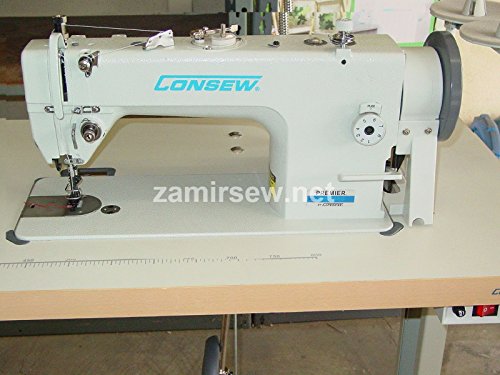
Consew Walking Foot Industrial Sewing Machine — Compound-feed benchmark
If one listing in this guide reads like a specification sheet for the whole category, it is this one. The Consew title names an upholstery walking-foot industrial machine with table and servo motor, and then lists the feed system in full: drop feed, needle feed, walking foot — a compound-feed lockstitch machine. That trio is the complete answer to the leather feeding problem as the industry settled it over a century: the material is clamped, carried by dogs and foot together, and the needle travels with the work while it pierces, so holes stay round, layers stay registered, and thick assemblies feed without the top hide lagging behind the bottom one.
Consew’s framing of the machine toward upholstery is worth a sentence of interpretation. Upholstery leather and furniture hides are this machine’s home crowd, which makes it the natural bridge pick for readers whose leather work includes chair seats, cushions and automotive panels as well as bags. The lockstitch it sews is the strong, identical-both-sides stitch that structural leather seams are built from. As with the Weaver, the table-and-servo completeness means the purchase is a workstation, and the industrial label is worn openly in the title — this guide treats that candour as a feature. Buyers stepping up from domestic machines should expect a different ownership culture: oiling points, needle systems, and feet are all specified like engineering, because they are.
- Machine class: industrial sewing machine with table and servo motor, the title confirms
- Feed system: drop feed, needle feed and walking foot — compound feed, spelled out in the listing title
- Stitch: lockstitch machine, in the seller’s title
- Maker’s framing: upholstery walking foot machine, per the listing
- Maximum sewing thickness: the listing title gives no figure — verify in the manufacturer documentation against your hide weights
- Where to buy: the Consew Walking Foot Industrial Sewing Machine listing on Amazon — check price on Amazon
Strengths
- The only title here that enumerates the complete compound-feed system.
- Needle feed protects thick, layered seams from elongated needle holes.
- Table and servo included — a working station, not a head awaiting furniture.
Trade-offs
- Industrial scale and weight end any thought of putting it away between projects.
- The upholstery orientation means garment-weight leathers are at the gentle end of its range.
- Setup and adjustment follow industrial conventions that reward patience and the manual.
Right for: serious leather and upholstery-leather work where layered seams must stay registered. Wrong for: occasional leather visitors who need a machine to store in a closet.

REX 607Z Portable Walking-Foot Zigzag Sewing Machine — The portable mechanism
The REX 607Z carries an interesting passport. Its format — portable walking foot with zigzag — descends from sailmaking machines built to repair sails in boatyards and on decks, and that heritage turns out to suit leather repair remarkably well: the walking foot grips material that slides, the zigzag handles the wide, forgiving seams of repair work, and the whole machine travels to the job instead of demanding the job be carried to a workshop. The title is brief — portable walking-foot, zigzag, LED light — and this review respects that brevity by not inventing specifications the listing does not state.
Who is this for? The person repairing leather and heavy goods at home or in a small workshop without industrial floor space: horse tack with a torn strap keeper, a leather jacket seam let go, canvas-and-leather bags, upholstery patches. The zigzag is a genuine differentiator in this company — every other pick here is a straight-stitch story — and for repair work, where a zigzag can straddle a tear or bar a stress point, that versatility earns its keep. The LED light is the only other stated feature, a small mercy when the work is a dark hide at a kitchen table in the evening. What the REX asks in return is realism: portable walking-foot machines bring the mechanism to the material, but they do not bring industrial mass, and very thick assemblies will still belong to the stand-mounted picks above.
- Feed: portable walking-foot design, per the seller’s title
- Stitch: zigzag capability, as printed in the title
- Lighting: LED light, per the title
- Motor type and power: not described in the listing title — consult the manufacturer documentation
- Maximum leather thickness: no figure appears in the listing title — verify against the manufacturer documentation for your hide weights
- Where to buy: the REX 607Z Portable Walking-Foot Zigzag Sewing Machine listing on Amazon — check price on Amazon
Strengths
- The walking foot in a body that moves from shelf to table to job site.
- Zigzag adds repair options the straight-stitch industrials do not offer.
- A realistic entry into leather-capable feeding without installing a workstation.
Trade-offs
- The title’s brevity leaves motor and capacity questions for the documentation.
- Portable mass means very thick stacks remain industrial territory.
- Its sail-repair lineage favours utility seams over fine, decorative leatherwork.
Suits: repairers and small-workshop owners who need the mechanism more than the monument. Skip it if: your production is daily and thick, where a stand-mounted compound-feed machine repays its footprint.

YQ-516 Portable Walking Foot Sewing Machine — Thick-material traveller
The YQ-516’s title is the shortest in this guide: a portable walking foot sewing machine for sewing and repairing thick materials. No motor figures, no stitch menus, no bundle theatre. Read generously, that plainness describes a tool aimed at a job list rather than a hobby identity — the household or smallholding list where leather sits alongside other thick troublemakers: webbing straps, tarpaulin corners, heavy canvas, the vinyl of a torn equipment cover. A portable walking foot is the mechanism all of those materials ask for, for the same surface-grip reasons leather asks for it, and a machine that travels to a barn, a boat or a market stall earns its place differently from a workshop installation.
Because the listing commits to so little on paper, this pick carries the guide’s strongest documentation advice: before purchase, take the manufacturer documentation seriously on needle system, stitch length and rated thickness, and match them against the thickest sandwich you actually sew — hide plus lining plus webbing, measured honestly. What can be said from the title is the essential thing: the walking foot is present, which puts this machine in a different feeding class from the ordinary portables that dominate the low shelves, and its stated purpose is thick-material sewing and repair rather than garment construction. Buyers who understand that bargain — mechanism first, specifications to be verified — will find the YQ-516 a rational tool. Buyers who want a leather machine whose every number is published in advance should look at the Consew’s candour instead.
- Feed: portable walking foot, as the listing title has it
- Stated purpose: sewing and repairing thick materials, listed in the title
- Motor, speed and stitch data: absent from the listing title — the manufacturer documentation is the source to consult
- Needle system: not named in the listing title — confirm compatibility with leather needles before buying
- Where to buy: the YQ-516 Portable Walking Foot Sewing Machine listing on Amazon — check price on Amazon
Strengths
- Walking-foot feeding in a genuinely portable format for thick materials generally.
- Repair orientation matches the odd-job reality of farms, boats and workshops.
- No stand or table to accommodate — it works where the broken thing is.
Trade-offs
- The sparest title in the guide; homework is part of the purchase.
- Thick-material generality means leather is one parish among several, not the whole mission.
- Fine leather goods with cosmetic seams deserve a trial on scraps before commitment.
Best for: practical repairers whose thick-material list spans leather, webbing and canvas. Not suited for: production leatherworkers who need published capacities and compound feed.

Fbshicung Hand Cobbler Shoe Repair Sewing Machine — The hand-powered original
Every other machine in this guide plugs in. This one is turned by hand, and it descends from the cobbler’s stitching machines that have repaired shoes for well over a century: you crank, the needle bar moves, and a shuttle lays the stitch while you guide the work with your other hand. The Fbshicung title describes a hand cobbler shoe repair machine running dual cotton or nylon lines, a manual leather machine for shoes, upholstery and DIY items. There is no motor to state a wattage for, no speed ceiling to quote — the specifications that matter are your patience and the strength of the thread you load.
It would be easy to treat the cobbler as a novelty, and that would miss its genuine virtues. Control is total: one crank turn, one stitch, placed exactly where your eye wants it, which around a shoe’s curves — where the work is a three-dimensional puzzle no flat bed welcomes — is a real capability rather than a compromise. It works in a power cut, at a market stall, in a village workshop at the end of a dirt road; cobblers across the world earn their living on this pattern of machine. Its repairs are also famously strong, because the operator feels every stitch’s resistance through the crank. The honest debits are pace and finish: production is measured in stitches per minute of human effort, long straight seams are a meditation, and the stitch appearance is workmanlike rather than boutique. As a second machine for shoe and heavy repair, or a first machine for someone who values mechanical simplicity above all, it is not a compromise at all. It is the original.
- Drive: manual hand operation — no motor, from the listing title
- Thread: dual cotton or nylon line, in the seller’s title
- Intended work: shoes, upholstery and DIY leather items, per the listing
- Stitch length and needle data: not set out in the listing title — refer to the manufacturer documentation
- Power requirement: none — it works wherever the operator does
- Where to buy: the Fbshicung Hand Cobbler Shoe Repair Sewing Machine listing on Amazon — check price on Amazon
Strengths
- Absolute stitch-by-stitch control on curved, awkward shoe and repair work.
- Independent of electricity entirely — off-grid, market stall, anywhere.
- A mechanical simplicity that can be understood, maintained and repaired by its owner.
Trade-offs
- Speed is human; production work would be an act of endurance.
- Long seams demand sustained rhythm to keep stitch spacing even.
- Cosmetic finesse on fine goods lags the powered machines’ consistency.
Choose it for: shoe repair, off-grid workshops, and leatherworkers who want a tool that answers to the hand alone. Pass if: you sew leather to sell in quantity, where hours are money.
How the Six Compare for Leather Work
| Machine | Class | Feed, per title | Shaped for |
|---|---|---|---|
| Weaver Leathercraft 303 | Workshop machine with stand | Feed detail left to documentation | Bags and personal accessories |
| FY335A Cylinder Arm | Industrial, knockdown kit | Walking foot | Tubular leather and bag work |
| Consew Walking Foot | Industrial, with table | Drop feed + needle feed + walking foot | Upholstery leather and layered seams |
| REX 607Z | Portable | Walking foot, zigzag | Repairs on leather and heavy goods |
| YQ-516 | Portable | Walking foot | Thick-material sewing and repair |
| Fbshicung Hand Cobbler | Manual | Hand-cranked cobbler mechanism | Shoes, upholstery, DIY leather |
Veg-Tan, Chrome-Tan and the Other Hides Your Machine Will Meet
Not all leather is one material wearing different colours. Vegetable-tanned leather — veg-tan — is the firm, pale, toolable hide of belts, saddlery and structured bags. It is dense, it holds a crease, it can be wetted and moulded, and it asks a machine for punching authority and a feed system that will not skate on its smooth grain side. Chrome-tanned leather, the majority of the world’s production, comes softer and more pliable, in garment weights that drape almost like heavy cloth and upholstery weights that fill the furniture trade. It asks less brute force and more surface kindness, because its finishes mark more easily and its softness lets it stretch subtly under a dragging foot — one more argument for the walking mechanisms in this guide.
Then come the specialists. Suede and nubuck present a napped surface that feed dogs can roughen if the machine’s underside is aggressive. Exotics and embossed leathers carry patterns that must match across a seam, which turns feeding accuracy into a design requirement: a machine that lets layers creep by two millimetres per seam will misalign a crocodile emboss visibly. Bonded leather and leather laminates behave like neither and punish heat and pressure. The practical consequence for buying is that “leather machine” is a family name, not a single tool. The industrial compound-feed picks here cover the broadest territory — firm veg-tan through upholstery chrome-tan — while garment-weight softness is where a trial on your actual hide matters most, and where the portables can be perfectly sufficient for a small, soft project list.
Thickness interacts with tannage, too. Four ounces of veg-tan is a stiffer, harder plate than four ounces of chrome-tan garment leather, and machines experience them differently even at identical measured thickness. This is why experienced leatherworkers describe their machine’s capacity in terms of a specific hide — “it sews eight-ounce veg-tan all day” — rather than a bare number, and why your test sandwich, introduced below, should be built from the hide you actually bought rather than whatever scrap the shop hands you.
What Does It Take to Live With an Industrial Machine at Home?
Three of this guide’s picks are industrial machines, and their ownership rhythm differs from domestic sewing in ways worth picturing before the crate arrives. Space comes first: a table-mounted machine with a servo motor underneath is a piece of furniture with a permanent address, roughly the footprint of a small desk, and it will be oiled, adjusted and used in that spot for years. Plan the address — near light, with room behind for large hides to pass through, and floor that tolerates the odd dropped oil spot. Assembly is the second rhythm: the FY335A states its knockdown nature in its title, and even assembled industrial sets expect the owner to fit feet, thread stands and belts with a technician’s patience.
Maintenance is the third rhythm, and it is more hands-on than the domestic world of sealed units. Industrial machines are built to be serviced by their operators: oil reservoirs to keep filled, hook assemblies to clear of thread debris, needles and feet swapped with tools rather than clicks. Many home leatherworkers come to love this — the machine is comprehensible, and a comprehensible machine can be kept sewing for decades. The learning curve is the fourth rhythm. Threading paths, tension discipline and foot changes follow factory conventions, documented thoroughly but without the hand-holding of consumer manuals. Budget your first month as an apprenticeship to the machine, sewing scraps and sample seams, and the investment returns itself in every subsequent year. Readers who picture that apprenticeship with pleasure are industrial buyers; readers who picture it with dread should take the portables seriously, because the best machine is the one whose ownership style matches its owner’s temperament.
How Thick a Hide Can You Sew — and How Do You Know Before Buying?
Leather thickness is measured in ounces, each ounce being roughly four-tenths of a millimetre, and the range in ordinary craft use runs from two-ounce garment leather to ten-ounce strap and saddle weights. The question that decides a purchase is never the single layer, though; it is the seam stack. A bag side seam might be two layers of five-ounce hide plus a lining and a piping cord. A belt billet fold triples the strap. Honest buying means adding up your worst stack in ounces or millimetres and matching it against the machine’s rated capacity — and here the discipline of this guide bites, because several titles in this class do not print a capacity figure. Where the title is silent, the manufacturer documentation is the only respectable source, and a seller’s chat answer is not a substitute for the printed specification.
There is a home test worth knowing for machines you can trial or for calibrating expectations: build the exact sandwich you intend to sew from offcuts — same hide, same lining, same stiffener — and sew its hardest corner, not its easiest straight. If the machine places ten slow stitches around that corner without skipped stitches, elongated holes or a strained note, the stack is within its working envelope. If it falters on the sample, it will falter worse on the real piece, where the leather is larger, heavier and harder to manoeuvre. Leatherworkers keep a box of such test sandwiches the way cooks keep tasting spoons; start yours with the first hide you buy.
A neighbouring discipline deserves a footnote here for readers whose leather interest is really about embellishment — stamped initials, monogrammed tags, decorated panels. Stitching construction and stitching decoration are different crafts; if your imagination runs to motifs worked into the surface, the machines surveyed in Best Computerized Embroidery Machines belong to that other conversation, and leather for embroidery hoops is its own specialism with its own rules about stabilising a material that, once again, keeps every hole you make in it.
Where Do First-Time Leather Sewers Most Often Go Wrong?
The classic debut error is practising on the good hide. Leather forgives nothing, so the first hour with a new machine belongs to scraps — ideally offcuts of the very hide destined for the project — where stitch length, thread tension and foot behaviour can be calibrated without consequence. The second error is pinning. Every pin hole is a permanent puncture in a visible place; clips and leather tape exist precisely because this material rewrote the fastenings rulebook. Third comes stitch length set by fabric habit: short, dense stitching that would be prudent on cotton perforates leather into a tear strip, and the seam fails along its own dotted line weeks later, in the customer’s hands.
A workshop-housekeeping error belongs on the list too, because leather dust is not like fabric lint: the fine grit from skived edges and trimmed straps works its way into any carpet near the bench and resists a broom, which is why compact extraction cleaning has its own following among home workshops — the guide to Best Small Carpet Cleaning Machines covers the machines sized for a single room or studio corner. Fourth, beginners underestimate thread. A leather seam is frequently the structure of the object — there is no weave sharing the load — and thread chosen for colour alone, in a light apparel weight, will saw through or snap under strap tension. Match thread weight to the work, and use the needle system the machine’s documentation specifies for it. Fifth, and most quietly expensive: sewing at domestic-machine pace. Leather rewards the slow hand — placed stitches, eased corners, pauses to reposition a heavy piece rather than dragging it through the needle’s arc. The servo-driven picks in this guide exist to make that pace available with power in reserve; the hand cobbler enforces it by design. Either way, the material sets the tempo, and the wise sewer lets it.
The Work Around the Seam: Skiving, Gluing and Finishing
A leather seam is built in three acts, and the machine only performs the middle one. Before sewing comes preparation that has no fabric equivalent. Edges that will fold or overlap are often skived — shaved at an angle with a beveling knife so the doubled thickness tapers instead of stepping — because a machine that can pierce the stack still leaves a ridge if the stack is built like a cliff. Seams are glued or taped before they are stitched, since pins are forbidden by the permanence of holes; the adhesive is a positioning aid, not the structure, and it lets the walking foot work on an assembly that is already registered. Skipping preparation and asking the machine to overpower a badly built stack is the most common way beginners conclude, wrongly, that their machine is too weak for leather.
After sewing comes the finishing that separates craft from manufacture. Seam allowances in leather are often hammered flat — literally, with a cobbler’s hammer on a hard surface — or glued down and rolled, because hide does not submit to a steam iron the way cotton does. Edges are bevelled, dyed or burnished with gum and friction until they shine. Topstitching, where it appears, is placed with a guide foot or a marked line and sewn at the machine’s most deliberate pace, because a wandering topstitch on a bag front cannot be unpicked without leaving its ghost behind. None of these acts belongs to a machine specification, yet together they decide whether the object reads as handmade in the good sense. Choose the machine for its feed and its control; then honour the material with the preparation and finishing it has demanded of craftspeople for centuries, and the combination will outclass either half alone.
Final Recommendation
Decide first whether you are installing a workstation or buying a tool that travels. If leather is becoming a trade or a serious studio practice, the compound-feed Consew states the fullest specification in this guide and earns the anchor position, with the Weaver 303 the natural alternative for small-goods makers who want a leather specialist’s complete stand-and-servo package, and the FY335A the pick when your goods are tubular and a flat bed simply cannot receive them. If the work is repair and occasional thick sewing at a home table, the REX 607Z brings the essential mechanism with zigzag versatility, the YQ-516 keeps the same promise in its plainest form, and the Fbshicung cobbler waits patiently for the jobs — shoes, off-grid repairs, stitch-by-stitch control — that no powered machine does better. Match the machine to the thickest stack and the strangest shape in your real project list, practise on scraps until the stitches bore you, and only then let the good hide under the foot.
Frequently Asked Questions
Can I sew leather on my ordinary home sewing machine?
Thin, soft garment leather — the two-to-three-ounce kind used for gloves and soft pouches — can pass through a sturdy home machine fitted with a leather needle, a roller or non-stick foot, and a longer stitch, sewing slowly. What the ordinary machine lacks is the walking feed, so layers creep and its foot drags on the hide’s surface. Veg-tan, straps, bags and anything multi-layer belong to the machines in this guide. The honest border is thickness plus layers: one soft layer is a visit; a stack is a relocation.
How does a walking foot attachment differ from a walking foot machine?
An attachment is an accessory foot for a domestic machine that mimics the walking action — the foot lifts and moves in a stepping motion driven by the needle bar. It helps, genuinely, on medium work. A walking foot machine builds the mechanism into the machine’s architecture, usually with compound feed, industrial drive and far greater clamping force and lift. The attachment is a way to visit leather sewing; the dedicated machine is a way to live there, and the price and footprint differences reflect exactly that.
Why do industrial leather machines come with servo motors?
Control at low speed. A servo motor turns only when the pedal asks, delivers strong punching force at a crawl, and stops dead when released — the exact behaviour wanted when every stitch is permanent and corners must be placed one stitch at a time. Servo drive is also quiet and frugal compared with the constantly spinning clutch motors of older industrial practice, which matters in a home workshop sharing walls with a household.
What thread and needles should I budget for alongside the machine?
Plan on leather needles in the system your machine’s documentation specifies — they have a cutting point shaped for hide — and bonded nylon or heavyweight polyester thread matched to the work: finer for wallets and visible detail, heavier for straps and structural seams. Add spare needles in quantity, because leather dulls points quickly and a dull needle in hide tears rather than pierces. None of this is exotic, but it is specific, and sewing leather with apparel consumables is the most common false economy in the craft.
Is a cylinder arm necessary for making bags?
Not for every bag — flat-construction totes and pouches sew happily on a flat bed — but the moment a design closes into a tube or a deep three-dimensional body, the cylinder arm stops being a luxury. It lets the work surround the arm and rotate as you sew, instead of being crushed flat and twisted to fit a bed. Occasional bag makers can improvise around the limitation; anyone whose designs are routinely three-dimensional should treat the arm as the deciding feature, as the FY335A’s design does.
Should a beginner start with an industrial machine or a portable?
Start where your project list points, not where your ambition flatters you. A beginner whose list is wallets, belts and a first tote — flat work, moderate stacks — will learn happily on a portable walking-foot machine and may never need more; a beginner committed to bags with structure, upholstery leather or resale production will outgrow a portable within a season and wish the industrial apprenticeship had started sooner. Either way, spend the first month on scraps and simple goods. Leather punishes skipped steps in learning exactly as it punishes skipped preparation, and no machine in this guide can substitute for the hours.
Can the hand cobbler machine really sew shoes?
Yes — that is its native trade, practised worldwide for generations. It excels at repair: re-stitching soles’ welts, patching uppers, mending straps and heavy goods, with the operator feeling each stitch through the crank. Its limits are pace and polish rather than strength. For a cobbler’s bench, a farm workshop or an off-grid repair kit, it remains a rational machine; for producing new footwear in quantity, powered industrial equipment is the realistic tool.
Related Guides
Leather outlives most materials it is made into, which is why so much of it ends up as furniture: readers furnishing a room around hide will find our guide to Best Oversized Leather Chairs a useful companion on the buying side of the material. And because a workshop floor collects its share of hide dust, thread ends and the grit of a working craft space, the small-space cleanup machines in the carpet section of this site — linked from the body of this guide — are worth a look for keeping the sewing corner civilised.


