What's inside
- Key Takeaways
- Quick Picks
- How Did We Judge Machines That All Do One Job?
- Six Specialists, One Function, Compared Plainly
- How Does a Coverstitch Hem Actually Work, Stitch by Stitch?
- What Should You Practise Before Your First Real Hem?
- What Mistakes Send Coverstitch Machines Back Into Their Boxes?
- Which Knit Fabrics Make Coverstitch Sing, and Which Argue Back?
- How Does a Coverstitch Machine Fit Into a Small Sewing Room?
- What Maintenance Does a Looper Machine Need to Stay Skip-Free?
- When Is the Right Time in a Sewing Life to Add a Coverstitch Machine?
- Final Recommendation
- Frequently Asked Questions
- Related Guides
As an Amazon Associate I earn from qualifying purchases. This post may contain affiliate links at no extra cost to you.
cottageverdict.com is reader-supported. When you buy through links on our site, we may earn an affiliate commission.
Where to buy: The six machines below are sold on Amazon and linked from the Quick Picks table and from each detailed review. Coverstitch machines are sometimes bundled with feet or accessory kits that vary by listing, so confirm the contents on the listing you open, and take current pricing from the “check price on Amazon” line in each spec box.
A coverstitch machine does one job, and it is the job that separates homemade knitwear from shop-bought knitwear: the hem. Look inside any commercial T-shirt and you will find it — two or three parallel rows of straight stitching on the outside, and a looper’s web covering the raw edge on the inside, stretching with the fabric instead of cracking when the garment moves. The best coverstitch sewing machines exist to put that finish on home sewing tables, and they are specialists in the strictest sense: they do not cut fabric, they do not construct garments, and despite the word serger appearing in one model’s name below, they are not overlockers and must never be bought as if they were. This guide reviews six dedicated coverstitch machines — three generations of Janome’s CoverPro line, Brother’s long-running 2340CV, Juki’s cover-and-chain model, and Bernette’s Funlock entry — for sewists whose knit garments deserve hems that stretch, lie flat, and survive the wash.
Who needs one? The honest answer is narrower than the marketing: a sewist who regularly makes or alters knit clothing — T-shirts, leggings, activewear, children’s clothes that flex all day — and who has felt the specific disappointment of a twin-needle hem that tunnels, pops, or waves. If your sewing is woven fabric and quilts, a coverstitch machine will sit idle and this guide will happily talk you out of the purchase in its final sections. If knits are your weekly fabric, the coverstitch is not an indulgence; it is the missing third of a knit wardrobe’s construction, alongside the sewing machine that seams and the overlocker, if you own one, that finishes edges.
Key Takeaways
- Coverstitch is a hemming and topstitching system for stretch fabrics — parallel needles above, a looper below — and it is not a serger function.
- None of these six machines trims fabric or constructs seams; they finish hems and add stretch-proof topstitching to garments built elsewhere.
- Janome’s CoverPro line supplies three of the six picks — 900CPX, 1000CPX, and 2000CPX — forming the category’s reference range.
- The Juki MCS-1500 is the only pick whose title states both cover stitch and chain stitch, the two stitch families this category uses.
- The Brother 2340CV carries the word serger in its model name, but it is a dedicated coverstitch machine and should be bought as one.
- Specifications such as needle counts and stitch widths are not stated in these listing titles, so this guide flags them for documentation checks instead of inventing them.
Quick Picks
| Machine | Badge | Its place in the coverstitch room |
|---|---|---|
| Brother 2340CV Coverstitch Serger | Brother Coverstitch Pick | Brother’s dedicated coverstitch machine — a long-running entry point for knit hemming at home. |
| Janome CoverPro 2000CPX Coverstitch Machine | CoverPro Flagship-Style Pick | The highest-numbered CoverPro in this guide, for sewists who want the line’s most developed form. |
| Janome CoverPro 1000CPX Coverstitch Machine | Bundle CoverPro Pick | The CoverPro mid-point, sold here with an exclusive bonus bundle attached to the listing. |
| Janome CoverPro 900CPX Coverstitch Machine | Entry CoverPro Pick | The line’s starting rung — coverstitch capability in its most focused CoverPro form. |
| Juki MCS-1500 Cover Stitch and Chain Stitch Machine | Cover-and-Chain Pick | Juki’s entry, whose title names both stitch families — cover stitch and chain stitch — outright. |
| Bernette b42 Funlock Coverstitch Machine | Bernette Coverstitch Pick | The Bernette Funlock line’s coverstitch machine, from the Bernina family’s value brand. |
How Did We Judge Machines That All Do One Job?
When every candidate performs the same single function, comparison shifts to the questions that surround the function. First, lineage: coverstitch machines reward makers who have iterated on the looper mechanism across generations, because the difference between a coverstitch that never skips and one that skips on every third hem lives in that mechanism’s maturity. Second, clarity of scope: we favored listings and model lines that present the machine as what it is, and we flag the one naming confusion in this guide — Brother’s use of the word serger — rather than letting it mislead a single reader into expecting an overlocker. Third, the ownership path: which machine suits a first coverstitch purchase, which suits a sewist upgrading within a beloved line, and what each listing’s bundle does or does not add.
The honesty rule binds this category tightly. Coverstitch specifications that sewists legitimately care about — how many needles, which stitch configurations, what widths — appear in none of these listing titles, Juki’s stitch-family naming excepted. So the spec boxes below record that silence in varied words and send you to the manufacturer documentation for the configuration table of any model you shortlist. That is not a dodge; stitch configurations are exactly the kind of detail that differs between production runs and regional variants, and a hem’s success depends on getting them right for the machine in front of you, not for a stranger’s review unit.
Finally, we kept the category’s boundary bright against its neighbors. A coverstitch machine does not trim, so it cannot replace an overlocker for edge finishing during construction; an overlocker without a coverstitch function cannot produce the parallel-row hem, no matter how it is threaded. Combo machines that claim both exist elsewhere in the market and are not in this pool. Readers building a knit-sewing setup from zero should also note that construction still belongs to a regular machine — the denim-strong end of which is surveyed in Best Sewing Machines for Denim — while the coverstitch waits, patiently, for the final five minutes of every garment: the hem.

Brother 2340CV Coverstitch Serger — Brother Coverstitch Pick
Begin with the name, because the name is the trap. Brother calls this machine the 2340CV Coverstitch Serger, and a hurried buyer could reasonably expect a serger — an overlocker that trims and finishes edges. The 2340CV is not that machine. It is Brother’s dedicated coverstitch model: it hems knits with the parallel-needle, looper-below stitch formation this whole guide is about, and it does not carry the overlocker’s cutting and edge-finishing brief. Bought with that understanding, it is a well-placed pick — Brother’s presence in the category gives knit sewists in Brother-equipped sewing rooms a coverstitch machine whose design language, manuals, and accessory logic will feel familiar from the first threading.
Longevity of the model line is its quiet credential. Coverstitch mechanisms punish makers who treat them as novelties, and a model that remains in a major maker’s range earns the inference that its looper timing and feeding have survived contact with thousands of home hems. For the sewist whose knit output is steady rather than industrial — family T-shirts, leggings, dance and sports kit, the endless hemming of growing children’s clothes — the 2340CV’s proposition is the category’s core promise in Brother’s dialect: hems that stretch with the garment, lie flat against the body, and stop announcing themselves as homemade at a glance.
Set the expectations this guide sets for every pick: confirm the stitch configurations, needle arrangement, and included feet in the manufacturer documentation, since the title states none of them. Owners of Brother sewing machines will find the transition kindest here; owners of other brands should compare the threading path’s reputation for patience, because coverstitch threading — looper especially — is the skill this category demands of everyone, whatever the badge.
- Function stated in the title: coverstitch machine
- Naming caution: the title includes the word serger, but this is a dedicated coverstitch model, not an overlocker
- Needle configuration: the listing title does not state a needle count — the manufacturer documentation holds the configuration table
- Stitch widths and types: not enumerated in its title, so verify them in the documentation for this model
- Included feet and accessories: not listed in the title; confirm the bundle on the listing itself
- Where to buy: the Brother 2340CV listing on Amazon — check price on Amazon
Strengths
- Brother’s dedicated coverstitch entry, familiar in feel to Brother households.
- A long-running model position suggests a mature looper mechanism.
- It delivers the category’s core promise: stretch hems that read as shop-bought.
Trade-offs
- The serger word in its name invites a misunderstanding buyers must consciously avoid.
- Stitch configuration details require a documentation check before ordering.
- Like every pick here, it neither trims fabric nor constructs garments.
Best for: Brother-loyal knit sewists adding hemming capability to an existing setup. Not suited for: anyone shopping for an overlocker or a first and only sewing machine.
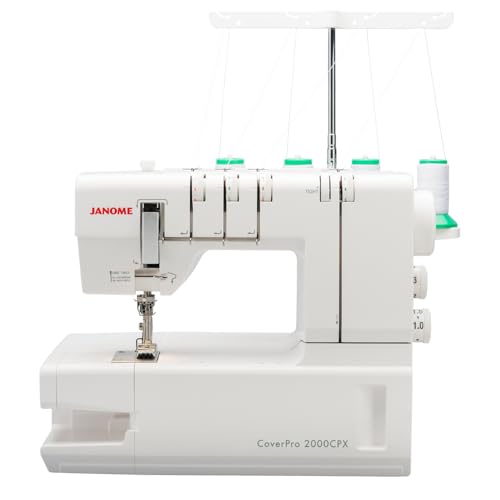
Janome CoverPro 2000CPX Coverstitch Machine — CoverPro Flagship-Style Pick
Janome’s CoverPro line is the closest thing the home coverstitch category has to a reference standard, and the 2000CPX is its highest-numbered representative in this guide. CoverPro machines are dedicated coverstitch units from a maker whose overlock and coverstitch engineering is a core business rather than a sideline, and the line’s generations — two of which appear below as the 1000CPX and 900CPX — let a buyer choose their rung on a ladder whose top this machine occupies. For the sewist who already knows coverstitch is central to their sewing — the activewear maker, the children’s-clothing producer, the knitwear enthusiast whose output is weekly — buying the line’s most developed form is a rational end to the search.
What “most developed” means must be handled with this guide’s usual discipline: the listing title states the model and the function and nothing further, so the specific configuration advantages of the 2000CPX over its siblings belong to the manufacturer documentation, where they should be compared line by line before ordering. What can be said here is structural. In a specialist category, the flagship of a specialist line concentrates the maker’s accumulated fixes — looper behavior, feeding manners, threading sanity — and coverstitch is a function where accumulated fixes are the product. A hem that never skips at a seam crossing is not a feature on a box; it is a decade of small engineering decisions, and flagships are where those decisions live.
The buyer profile follows: this is the pick for the sewist who has already decided, with evidence from their own output, that knit hemming is a permanent department of their sewing room. First-time coverstitch buyers unsure whether the function earns its footprint should start one rung down and let their hems argue for the upgrade; the CoverPro ladder is built to be climbed.
- Function stated in the maker’s title: coverstitch machine, CoverPro line
- Position in line: the highest-numbered CoverPro model in this guide
- Needle and stitch configuration: not stated in the product title — pull the configuration table from the manufacturer documentation
- Differential feed or seam-crossing detail: the title makes no claim, so treat any such feature as documentation territory
- Bundled accessories: none are enumerated in the Amazon listing title
- Where to buy: the Janome CoverPro 2000CPX listing on Amazon — check price on Amazon
Strengths
- The flagship rung of the category’s reference line concentrates Janome’s coverstitch engineering.
- It suits high-output knit sewists for whom hemming is a weekly department.
- The CoverPro ladder below it makes the upgrade path legible and low-risk.
Trade-offs
- Its advantages over sibling models must be verified in documentation, not assumed from the number.
- Flagship positioning is wasted on occasional knit sewers.
- It remains a single-function machine: construction and edge finishing live elsewhere.
Best for: committed knit sewists who hem weekly and want the CoverPro line’s top rung. Not suited for: first-time coverstitch buyers still testing whether the function earns its space.

Janome CoverPro 1000CPX Coverstitch Machine — Bundle CoverPro Pick
The 1000CPX is the CoverPro line’s middle rung, and this listing sweetens it in the way listings do: the title names an exclusive bonus bundle alongside the machine. Bundles in the coverstitch category deserve more respect than bundles usually get, because the function’s daily life runs through its accessories — the feet that guide a hem’s folded edge, the needles the looper system prefers, the tools that make threading a looper a two-minute job instead of a ten-minute meditation. A bundle assembled for this model can therefore be genuinely useful, provided its contents match your hemming habits, which is why the standing instruction applies with force: read the bundle’s contents on the listing itself before valuing it.
As the middle rung, the 1000CPX inherits the line’s core proposition — Janome’s dedicated coverstitch engineering — at the ladder’s most balanced point. The sewist who hems regularly but not relentlessly, whose knit garments are a department rather than the whole store, is this machine’s natural owner. The step between the 900CPX below and the 2000CPX above is, in documentation terms, a matter of configurations and refinements; in ownership terms it is a matter of how central the function is to your sewing identity, and the middle is where most honest answers land.
One practical note on bundle listings generally: exclusive bundles are seller-specific, so the same model name elsewhere may arrive with different contents. That variability is a reason to buy the listing you have actually read — this one, with its bundle enumerated in front of you — rather than a cheaper twin whose box holds a surprise. In a category bought for a decade of hems, the right accessories on day one are worth more than a small saving followed by a month of separate orders.
- Function stated in the stated title: coverstitch machine, CoverPro line
- Bundled extras stated in the model title: exclusive bonus bundle — contents to confirm on the listing
- Position in line: the middle CoverPro rung in this guide
- Stitch configurations: the listing title does not enumerate them; the manufacturer documentation is the reference
- Needle count: not stated in the retailer title and to be verified in the documentation
- Where to buy: the Janome CoverPro 1000CPX listing on Amazon — check price on Amazon
Strengths
- The CoverPro line’s balanced rung, with a bundle that can equip the function fully.
- Janome’s specialist coverstitch engineering at the ladder’s middle.
- A natural upgrade or entry point for regular knit hemmers.
Trade-offs
- Bundle value depends entirely on contents the buyer must verify.
- Configuration differences versus its siblings live in documentation, not in the title.
- Occasional hemmers may find the entry rung sufficient for years.
Best for: regular knit sewists who want the CoverPro middle with its accessories settled at purchase. Not suited for: bargain hunters comparing model names without reading bundle contents.

Janome CoverPro 900CPX Coverstitch Machine — Entry CoverPro Pick
The 900CPX is where the CoverPro ladder touches the ground, and its role in this guide is to be the honest first coverstitch machine: Janome’s dedicated mechanism without the flagship’s price of admission or the middle rung’s bundle considerations. Its listing title is the plainest in the guide — CoverPro 900CPX Coverstitch Machine, full stop — and the review matches that plainness with a plain claim: if your knit hems have outgrown the twin needle and you want the real stitch from the category’s reference maker, this is the lowest-risk way to find out whether the function transforms your sewing the way its devotees promise.
Entry rungs in specialist lines are sometimes secretly hobbled, and the documentation check this guide keeps prescribing is how a buyer confirms that is not the case here: compare the 900CPX’s configuration table against its siblings’, and let the stated differences — not the model numbers’ vibes — decide whether the step up is worth its money for your hemming volume. Many home sewists discover the entry rung is, in fact, the whole ladder for their needs: a household’s worth of T-shirts and leggings hemmed beautifully for years, with the flagship’s refinements remaining a pleasure they never required.
There is also a resale-and-regret logic to starting here. A first coverstitch machine is partly an experiment — will I really hem enough knits to justify a single-function machine’s footprint? — and experiments should be run at the lowest cost that still tests the real function. The 900CPX tests the real function, in the reference line, without bundle noise. If the experiment succeeds beyond expectation, the ladder is standing right there; if it fails, it fails cheaply and the machine remains a competent hemmer for the knits that do come.
- Function stated in the title: coverstitch machine, CoverPro line
- Position in line: the entry CoverPro rung in this guide
- Stitch and needle configurations: not stated in its title — compare them in the manufacturer documentation before deciding between rungs
- Bundled accessories: none are claimed in the maker’s title
- Speed or feed claims: the listing title offers none to quote
- Where to buy: the Janome CoverPro 900CPX listing on Amazon — check price on Amazon
Strengths
- The reference line’s mechanism at its most accessible rung.
- A clean, bundle-free purchase that tests the function honestly.
- Sufficient for years of ordinary household knit hemming.
Trade-offs
- Refinements and configurations of higher rungs are forgone, pending documentation comparison.
- No bundle means feet or accessories may be separate early purchases.
- High-output hemmers may climb the ladder sooner than they expect.
Best for: first-time coverstitch buyers who want the real stitch at the lowest-risk rung. Not suited for: production-level knit sewists who already know their volume.

Juki MCS-1500 Cover Stitch and Chain Stitch Machine — Cover-and-Chain Pick
Juki’s MCS-1500 earns a distinction no other pick here can claim: its title actually tells you what the machine sews. The cover stitch and the chain stitch are the two stitch families of this category — the cover stitch that hems with parallel rows and a looper’s web beneath, and the chain stitch that serves for basting-like seams, decorative topstitching, and utility stitching that must stretch or be removed cleanly. A maker willing to name both in the title is speaking the category’s technical language plainly, and Juki’s broader reputation — built on machines that sew all day without drama — gives the plain speaking weight.
The chain stitch deserves its paragraph, because coverstitch shoppers sometimes buy for the hem alone and discover the second family later. A chain stitch, formed with a looper instead of a bobbin, has a give that suits knit construction details, and its famous party trick — pull the looper thread and the whole line unravels — makes it the professional’s basting and temporary-seaming stitch as well. On the MCS-1500, the two families together widen the machine’s working week beyond hemming into the decorative and utility topstitching that knit garments constantly request: neckline reinforcement, flat decorative seams on activewear, stitched-down elastic channels’ visible rows.
Juki buyers typically arrive with a temperament: they value mechanism over menu, and they maintain their machines like the tools they are. The MCS-1500 fits that temperament in a specialist category where mechanism is nearly everything. Verify its configuration details in the documentation as with every pick here — but note that alone among these six, its title has already answered the first question a coverstitch buyer asks.
- Stitch families stated in the product title: cover stitch and chain stitch
- Function: dedicated coverstitch-class machine
- Needle configuration: the listing title does not publish a count, so consult the manufacturer documentation for the arrangement
- Stitch widths: not stated in the Amazon listing title and to be confirmed in the documentation
- Included accessories: not enumerated in the stated title — check the listing for the box contents
- Where to buy: the Juki MCS-1500 listing on Amazon — check price on Amazon
Strengths
- Both stitch families are named in the title — the clearest scope statement in this guide.
- Chain stitch utility extends the machine beyond hemming into topstitching and temporary seams.
- Juki’s mechanism-first reputation suits a function where mechanism is decisive.
Trade-offs
- Configuration specifics still require the documentation step.
- Juki’s utilitarian presentation offers less hand-holding for nervous first-timers.
- It shares the category limit: no trimming, no garment construction.
Best for: technically minded knit sewists who want cover and chain stitches in one specialist. Not suited for: buyers who want a guided, bundle-complete first coverstitch experience.

Bernette b42 Funlock Coverstitch Machine — Bernette Coverstitch Pick
Bernette is the Bernina family’s value line, and the b42 Funlock is its coverstitch machine — a fact pattern that defines this pick’s appeal. Bernina’s name carries weight in sewing rooms for precision engineering at premium prices; Bernette exists to deliver the family’s design approach at prices a home sewist can reach without a ceremony. The Funlock branding, which Bernette uses across its overlock and coverstitch range, signals machines aimed at sewists who want the function to feel approachable — a friendlier face on a category whose threading diagrams have ended friendships.
Position the b42 honestly among its five rivals. It is the alternative-lineage pick: for a sewist whose other machines are Bernina or Bernette, whose dealer relationships and accessory habits run in that direction, the b42 keeps the coverstitch department inside the family. For a sewist building a knit setup from zero, it competes on the same terms as the others — mechanism, configurations as documented, bundle as listed — with the Funlock line’s accessibility as its character note. Its title, like most here, states function and model only, so the configuration table in the manufacturer documentation is where a shortlist comparison must be finished.
The b42 also serves as this guide’s reminder that coverstitch, for all its specialist aura, has become a normal department of a serious home sewing room — normal enough that a value line bothers to field a dedicated model. A generation ago the function lived in industrial rooms and combination machines; that a Bernette, a Brother, three Janomes, and a Juki now contest the home version of it is the category’s maturity speaking, and the home knit sewist is the beneficiary of every one of those engineering budgets.
- Function stated in the model title: coverstitch machine, Funlock line
- Maker line: Bernette, the Bernina family’s value brand
- Needle and stitch configurations: not stated in the retailer title — the manufacturer documentation carries the table to compare
- Bundled accessories: none are enumerated in the title
- Threading aids or feed claims: the listing title makes none, so verify any such detail in the documentation
- Where to buy: the Bernette b42 Funlock listing on Amazon — check price on Amazon
Strengths
- Bernina-family design lineage at a value line’s positioning.
- The Funlock brief emphasizes approachability in an intimidating category.
- It keeps Bernette and Bernina households inside one accessory and service world.
Trade-offs
- Configuration and accessory details require the documentation check.
- Its community of owners is smaller than the CoverPro’s, so peer advice is thinner.
- Single-function limits apply exactly as they do to every pick here.
Best for: Bernina-family households and value-conscious knit sewists wanting a dedicated hemmer. Not suited for: buyers who lean heavily on large owner communities for guidance.
Six Specialists, One Function, Compared Plainly
| Machine | Line | Stated in the title | Start here if… |
|---|---|---|---|
| Brother 2340CV Coverstitch Serger | Brother | Coverstitch function (with the serger naming caution) | Your sewing room already speaks Brother |
| Janome CoverPro 2000CPX Coverstitch Machine | CoverPro | Coverstitch function, top rung | Hemming is a weekly, high-output department |
| Janome CoverPro 1000CPX Coverstitch Machine | CoverPro | Coverstitch function plus bonus bundle | You want the middle rung equipped at purchase |
| Janome CoverPro 900CPX Coverstitch Machine | CoverPro | Coverstitch function, entry rung | This is your first coverstitch machine |
| Juki MCS-1500 | Juki MCS | Cover stitch and chain stitch, both named | You value the chain stitch’s utility too |
| Bernette b42 Funlock Coverstitch Machine | Funlock | Coverstitch function | Your machines are Bernina-family already |
How Does a Coverstitch Hem Actually Work, Stitch by Stitch?
Understanding the mechanism explains every buying rule in this guide. A coverstitch machine carries its needles in a row — the configuration varies by model and is documented, not titled — and beneath the fabric a looper travels side to side, laying a thread that interlocks with every needle thread on the underside. Sewn from the top with the garment inside-out in your hands, the result is the familiar retail finish: parallel straight rows visible outside, and underneath, a soft web that covers the hem’s raw edge and stretches as the fabric stretches. No knife is involved, which is why the fabric must be folded and prepared before it reaches the machine, and why the function complements rather than replaces an overlocker’s trimmed edge.
Turn a retail garment inside out once more and look at where the coverstitch appears besides hems: down the outside of activewear seams as flat decorative rows, around necklines where a band must be stitched down without losing its give, along the edges of elastic channels in waistbands and cuffs. The function is a small vocabulary rather than a single sentence, and home sewists who learn it find uses accumulating — a swimsuit’s leg elastic, a dance costume’s neckline, the decorative twin rows that make a plain jersey top look designed rather than assembled. That accumulation is the real return on the machine: not one hem saved, but a finish that starts appearing everywhere your sewing needed stretch to survive contact with a body in motion.
The stretch is the point. A straight stitch from a regular machine locks thread between two points; pull the fabric and the thread, having nowhere to go, snaps. The coverstitch’s looper web is a reservoir of thread that extends with the knit and recovers with it, which is why leggings hemmed this way survive a year of school runs while twin-needle hems — the home workaround, two straight rows with a bobbin zigzag beneath — eventually pop their bobbin thread at the stretch points. The twin needle remains a fine improvisation for an occasional knit; the coverstitch is what replaces improvisation when knits become a wardrobe. Decorative uses follow naturally: the same formation sewn on the garment’s right side becomes flat, sporty topstitching, and the chain stitch family member serves seams and details that need give or easy removal.
What Should You Practise Before Your First Real Hem?
Threading, until it is boring. A coverstitch machine’s looper path is the most intricate threading in home sewing, and the sewist who has threaded their machine six times on a quiet afternoon will hem calmly; the one who threads it first with a garment waiting will not. Practise on the actual fabric family you intend to hem — jersey behaves differently from ponte, and both differ from ribbing — and make your peace with the two classic coverstitch moments: the start, where the first stitches need the fabric positioned so the needles bite cloth rather than air, and the finish, where the threads are drawn to the underside and secured so the hem cannot unravel back along its own web.
Keep the practice fabric honest. Sewists love to rehearse on whatever scrap is nearest, but a coverstitch tuned on a stable woven offcut has learned nothing about the jersey it will meet on garment day. Maintain a small stash of your real fabrics’ remnants — a sleeve’s worth of the T-shirt jersey, a strip of the legging ponte — labeled and kept with the machine, and run the first thirty centimetres of every new fabric across a remnant before the garment goes under the needles. That habit, borrowed from quilters and their practice sandwiches, is the cheapest insurance in this entire category, and it converts the first hem on a new fabric from an experiment into a repetition.
Seam crossings deserve their own rehearsal. Where a hem crosses a side seam, the fabric stack thickens abruptly, and skipped stitches love to happen exactly there; the practised responses are to slow down, to help the fabric over the step by hand, and to keep the needle choice fresh and appropriate for knits. Keep a notebook of what worked per fabric — needle, settings as documented for your model, any stabilizer that helped — because coverstitch mastery is a collection of fabric-specific truces, and the notebook is how a home sewist accumulates them without re-fighting the same hem twice. None of this is difficult; all of it is specific, which is why this category rewards owners who treat the first month as an apprenticeship rather than a verdict on the machine.
What Mistakes Send Coverstitch Machines Back Into Their Boxes?
The first is the category error this guide opened with: buying a coverstitch machine expecting an overlocker, discovering it does not trim or finish construction edges, and concluding it is broken rather than specialized. The second is the mirror error — buying an overlocker advertised with coverstitch-adjacent language and discovering the hems are not the real formation. Both errors are prevented by the same discipline: name the stitch you need, in its technical terms, and buy the machine whose title states it. The third mistake is feeding the machine woven-fabric expectations: coverstitch on a woven hem is possible topstitching, but the function’s soul is stretch, and a sewist who rarely touches knits has bought a monument.
The fourth mistake is skipping the apprenticeship above and judging the machine by its first hem. Coverstitch is the most technique-sensitive function in the home sewing room; first hems tunnel, skip, and wander on every brand in this guide when the operator is new, and the same machine hems beautifully in month two. Give the function its month, keep the notebook, and let the evidence accumulate before the verdict. Sewists who do, rarely go back — the sight of a hem that could pass in a shop window, on a garment you made, is one of home sewing’s purest satisfactions, and it is available from every machine on this page once hands and mechanism have been properly introduced. Readers whose sewing expands from knitwear into decorated garments will find the embellishment side of the room mapped in Best Embroidery Machines for Home Use, a natural next department after hems are mastered.
Which Knit Fabrics Make Coverstitch Sing, and Which Argue Back?
Cotton jersey is the function’s home fabric — the T-shirt material the stitch was born on — and it hems with a compliance that makes beginners believe they are naturals. Ponte and double knits, being stable and substantial, are nearly as kind, and their hems lie with a tailored flatness that shows the coverstitch at its most expensive-looking. Ribbing, the cuff and neckband fabric, asks for a slower pace and a gentle hand because its ridges feed unevenly, but it rewards the patience with the exact finish retail activewear displays. Swim and performance fabrics sit at the demanding end: slippery, highly elastic, and unforgiving of a dull needle, they are month-three fabrics on any machine in this guide, to be met with fresh needles, practised settings, and a sacrificial test hem every single time.
Elastic deserves a sentence of its own in this fabric survey, because stitching elastic down — waistbands, leg openings, cuff channels — is coverstitch work that even woven-fabric sewists eventually meet through swimwear, underwear, and children’s clothes. The formation’s give lets elastic be secured in parallel rows that stretch with the band rather than cracking at the first wear, and the visible result is the flat, retail finish that a zigzag only approximates. If your sewing includes any elasticated garments at all, count those hems in your annual tally when judging this purchase; they are the quiet workload that turns a coverstitch machine from a knit luxury into a household utility.
The fabric lesson underneath the list is that coverstitch quality is a three-way negotiation between fabric, needle, and the operator’s preparation. Because these machines do not trim, the hem allowance must be folded accurately before sewing — measured, pressed, and pinned or fused in place — and most “machine problems” on a first hem are actually folding problems arriving at the needle. Sewists migrating from overlocker habits, where the knife forgives a wandering edge, must slow down and prepare like a tailor. Once that discipline clicks, the same preparation makes every brand in this guide look competent, which is the category’s open secret: at the hemming stage, the operator is half the mechanism.
How Does a Coverstitch Machine Fit Into a Small Sewing Room?
As a resident specialist with a defined shift. The practical arrangement most knit sewists settle into is a triangle: the regular machine constructs, the overlocker — if owned — finishes construction edges, and the coverstitch waits for hemming day, when several garments are hemmed in one session because threading the machine once for five hems is wiser than threading it five times for one. Batching hems is the habit that makes a single-function machine feel efficient rather than indulgent, and it quietly changes how you sew: garments are constructed to the hem stage and set aside in a small, satisfying queue.
Threading stations deserve design attention in a small room. Keep the machine’s manual, a pair of long tweezers, and the thread colors you hem with most within the machine’s own footprint, so a rethread is a seated, two-minute event rather than a scavenger hunt conducted while a garment waits. Some owners thread the looper in a contrasting color during the learning month — a deliberate, visible thread that shows exactly where the web forms and where a skip begins — and the trick teaches more in an afternoon than a manual’s diagrams manage in a week. Small kindnesses to your future self, arranged in advance, are what separate a specialist that gets used from one that gets admired.
Storage and threading realities shape the rest. A coverstitch machine that must be dragged from a high shelf and threaded from scratch for a single T-shirt will be avoided; one that lives threaded, covered, within reach of the sewing table will be used weekly. If your room forces a choice between the coverstitch living out and another tool living out, let your fabric output decide — knit-heavy households give the coverstitch the permanent place and store the occasional tools, woven-heavy households do the reverse and should perhaps not buy the coverstitch yet at all. The machine’s value is realized in use frequency, and use frequency is mostly a furniture decision made in advance.
What Maintenance Does a Looper Machine Need to Stay Skip-Free?
Skipped stitches are the coverstitch’s signature complaint, and most of them are maintenance wearing a disguise. Lint gathers around the looper mechanism from knit fabrics’ fuzzy edges, and a small brush applied after hemming sessions keeps the looper’s path clean enough to form its web reliably. Needles matter even more than on a regular machine: a coverstitch asks two or more needles to stay in perfect cooperation with the looper’s timing, and one slightly bent or dulled needle expresses itself immediately as a skipped stitch at a seam crossing. Change needles as a set, on schedule and on suspicion, using the type your documentation specifies for knits.
Thread quality is the third leg. The looper consumes thread generously, and a thread that fuzzes or varies in thickness will break the web’s rhythm in ways that imitate mechanical faults. Standardize on threads your machine demonstrably likes — discovered during the practice month, recorded in the notebook — and resist mid-project experiments. Finally, treat the machine’s timing with respect: never force fabric through a resistance, and if a genuine timing problem ever does develop, it is a technician’s job rather than a forum’s. Owners who keep the lint out, the needles fresh, and the thread honest find that coverstitch machines are not temperamental at all; they are precise, which is a different and much more manageable thing.
When Is the Right Time in a Sewing Life to Add a Coverstitch Machine?
The evidence-based answer is: after your third knit garment, not before your first. The first knit garment teaches construction; the second teaches that hemming is where home knitwear goes to look homemade; the third confirms the pattern is permanent rather than a phase. A sewist who buys at that point buys with a queue of real garments waiting, practises on fabrics they actually wear, and discovers the function’s value within a week. A sewist who buys speculatively, ahead of any knit output, owns an elegant answer to a question their sewing has not asked, and the machine’s box becomes a reproach on a shelf.
There is a second right time, later and quieter: when alterations become the household’s knit story. Children’s clothes are let down and re-hemmed, bought activewear is shortened, a partner’s T-shirts are tailored at the hem — alteration hemming is coverstitch work in its purest domestic form, and a household that alters monthly will use the machine as faithfully as one that constructs. Judge your own candidacy by the hems in your last year, counted honestly, rather than by the wardrobe in your imagination. Twenty hems a year is a working machine; two is a souvenir. The six picks here span the ladder from first experiment to weekly production, so the only wrong purchase is the one whose rung does not match the count.
Final Recommendation
Buy by lineage and ladder position, and let your knit output set the rung. First-time coverstitch buyers should start at the CoverPro 900CPX or the Brother 2340CV — the reference line’s entry, or the familiar badge’s dedicated model — and discover, at the lowest risk the category allows, whether the function earns its footprint in their sewing life. Regular hemmers belong on the middle rung, the 1000CPX with its bundle read carefully, while weekly, high-output knit sewists should climb straight to the 2000CPX and be done. The Juki MCS-1500 is the connoisseur’s alternative, the only machine here that names both its stitch families, and the Bernette b42 keeps the function inside the Bernina family’s world at a value line’s reach. Whichever you choose, learn its threading until your hands are bored, practise on your real fabrics, and your knit garments will stop confessing that they were made at home.
Frequently Asked Questions
Can a coverstitch machine replace a serger?
No, and the distinction is the most important sentence in this guide. A serger — an overlocker — trims fabric and finishes edges during construction, usually with a knife and an overlock stitch. A coverstitch machine does not trim; it hems and topstitches with parallel needles and a looper, producing the stretch finish inside retail knitwear. Many knit sewists own both because the functions are partners, not rivals: the overlocker builds and finishes, the coverstitch hems. One pick here carries the word serger in its name, but it is a coverstitch machine and must be bought as one.
Can I hem knits without a coverstitch machine?
Yes, with compromises you will feel in proportion to how much knit you sew. A twin needle on a regular machine imitates the look — two parallel rows above, a zigzag beneath — and survives gentle wear, though its bobbin thread can pop under real stretch. A stretch stitch or narrow zigzag is the other serviceable workaround. These are honest solutions for occasional knits; the coverstitch machine becomes worthwhile when knit hemming is a weekly event and the workarounds’ failure rate starts costing garments.
What is a chain stitch, and why does one pick here name it?
A chain stitch is formed with a looper rather than a bobbin, producing a line of stitching with useful stretch — and the endearing property that pulling the looper thread unravels the whole line cleanly, which makes it ideal for temporary seams and basting as well as for knit details. The Juki MCS-1500 names both stitch families in its title, telling buyers both families are its brief. On other models, chain stitch capability is a configuration question to settle in the manufacturer documentation.
Do coverstitch machines sew woven fabrics?
They can topstitch wovens, and some sewists use the parallel rows decoratively on denim and shirting. But the formation’s reason to exist is stretch: the looper web that lets a hem move with knit fabric. On wovens, a regular machine’s straight stitch does the same visual job with less machinery. Buy a coverstitch machine for a knit-heavy sewing life; a woven-heavy one will leave it idle, and idle specialists are the sewing room’s saddest furniture. Heavy woven work, incidentally, has its own machine categories entirely, separate from this page’s stretch specialists — and floor care for the sewing room’s other half is another department again, as Best Carpet Cleaning Machines covers for the rooms where sewing actually happens.
How hard is it to learn coverstitch threading?
It is the most intricate threading in home sewing, and it is learnable by anyone willing to practise it a handful of times before a deadline exists. The looper path is the part that demands patience; the needles are ordinary work. Makers’ manuals and diagrams exist precisely because the path is not intuitive, and following them step by step, in order, without improvisation, gets every model in this guide threaded correctly. Budget an afternoon of practice hems on scrap jersey, and the skill is yours permanently.
Should I buy a combination serger and coverstitch machine instead?
Combination machines exist and suit some rooms: one footprint, one purchase, both functions — at the cost of conversion time between modes and, usually, a threading routine that must be partly rebuilt at every changeover. Sewists who hem in batches and finish edges in batches often find the conversion tolerable; sewists who alternate functions within a single garment’s session usually do not, and drift toward dedicated machines like the six here. The honest test is your own workflow across a week, not the showroom demonstration. This guide’s pool contains only dedicated coverstitch machines, and their reviews assume the dedicated route has already won that test in your room.
What accessories should a new coverstitch owner expect to add?
Expect the hem-guiding foot or attachment appropriate to your model to be the first addition if it is not in the box, because accurate folding is the function’s daily craft and a guide turns it into procedure. A supply of the correct knit needles in the sizes your fabrics demand is the second, bought before the first real garment rather than after the first skipped stitch. Beyond those, let the notebook decide: the accessory your practice hems keep asking for, by name, is the one to buy, and the discipline of waiting a month before accessorizing will save every new owner a drawer of speculative tools.
Related Guides
A parting calibration for the undecided: run your hand along the hems of the last five knit garments you bought, and count how many carry this stitch. If the answer is most of them — and it will be — then the finish you admire every time you dress is a machine’s work, and the only question this guide has really been asking is whether your own sewing deserves the same finish. For knit sewists, it does, and the ladder above is standing by at whatever rung your output justifies.
One more small truth from the hemming queue: the first garment you finish on a new coverstitch machine will teach you more than this entire guide, because your hands will learn the feeding, the folding, and the finish in the only order that matters — yours. Read the documentation, thread slowly, and let that first hem be a lesson rather than a test.
Coverstitch sewists tend to live in stretch fabrics and soft garments, and the quilts that suit that life are the easy, draping kind. For quilts designed to be used hard and loved soft — including versions sized for travel and camp — see Best Camping Quilts for Women for a change of needle pace.


