What's inside
- Where to Buy a Top-Control Dishwasher, and Why Hidden Controls Changed Kitchen Design
- Key Takeaways
- Quick Picks
- How Did We Assemble a Fair Top-Control Field?
- The Hidden-Control Field, Compared
- What Do You Give Up When the Controls Hide?
- How Should You Read a Decibel Figure Before Trusting It?
- Can a Panel-Ready Door and a Family Kitchen Really Coexist?
- How Does Living With Hidden Controls Change the Daily Ritual?
- Which Households Should Still Choose Front Control Instead?
- What Should the Installer Check That Front-Control Owners Never Think About?
- How Do Third Racks Change What a Top-Control Machine Can Swallow?
- What Happens to Resale, Rentals and Second Homes in This Layout?
- How Should You Maintain a Door With No Visible Controls?
- Errors That Follow Top-Control Buyers Home
- How Do You Choose Between Quiet, Steam and Capacity When You Cannot Have All Three Cheaply?
- What Should Arrive, Be Kept and Be Filed on Delivery Day?
- A Buyer’s Walk Through the Five Linked Machines, in One Evening
- How Does the Hidden Panel Age Across a Decade of Kitchens?
- What Does the Next Decade Hold for the Hidden Panel?
- One Last Distinction: Top Control Is Not the Same as a Handle-less Door
- Final Recommendation
- Frequently Asked Questions
- Related Guides
As an Amazon Associate I earn from qualifying purchases. This post may contain affiliate links at no extra cost to you.
cottageverdict.com is reader-supported. When you buy through links on our site, we may earn an affiliate commission.
Where to Buy a Top-Control Dishwasher, and Why Hidden Controls Changed Kitchen Design
The best top-control dishwashers begin with an absence: no buttons on the door. Moving the controls to the door’s upper edge — visible when the door opens, invisible when it closes — gave kitchens the slab-front calm that designers wanted and gave households a control panel children cannot redecorate mid-cycle. What began as a premium styling gesture became the default grammar of the modern built-in, and this guide compares the machines that speak it best: five verified models you can buy through the links below, plus one premium line discussed at class level because its listings sit outside this guide’s verified pool.
Top control is not a wash technology, and this guide will not pretend otherwise. The machines here differ where it matters — in steam, in decibels, in racks and capacity — while sharing the hidden-control layout. An LG with steam and a third rack, a Bosch Benchmark quiet enough to need a light to prove it is running, a Sharp carrying sixteen place settings, a panel-ready ZLINE that disappears into cabinetry, and a Midea holding the straightforward centre: five different answers wearing the same clean face. A sixth name, the ZLINE Autograph Edition line, appears as a prose discussion — a distinct, design-led branch of the ZLINE family, mentioned at class level only, with no link and no borrowed specifications.
Linked names lead to Amazon listings, where you can check price on Amazon and confirm the full dimensions. This guide prints no prices and no fixed ratings; it quotes decibels and place settings only where a listing title states them, and says so where a title is silent.
Key Takeaways
- Top control hides the panel on the door’s edge: clean face, no child-height buttons, status checked with the door ajar.
- The Bosch Benchmark’s titled 39 dBA is the quiet benchmark of this set by a wide margin.
- LG’s entry is the feature maximalist: QuadWash, TrueSteam, Dynamic Dry and a third rack in one title.
- The Sharp carries the set’s largest titled capacity at 16 place settings and 44 dBA.
- Panel-ready design reaches its logical end in the ZLINE, whose door wears your cabinetry.
- Capacity for real households is a subject of its own in Best Dishwashers for Families.
Quick Picks
| Pick | Badge | Why it stands out |
|---|---|---|
| LG LDTS5552S Top Control Dishwasher | Steam and Spray Maximalist | QuadWash arms, TrueSteam, Dynamic Dry and a third rack at a titled 46 dBA. |
| Bosch Benchmark SHX9PCM5N Dishwasher | The Quiet Benchmark | A titled 39 dBA over a stainless tall tub — the set’s hush, quantified. |
| Sharp SDY6768SMS Top Control Dishwasher | Sixteen Settings, Handled | The largest titled capacity here, a third rack and a handle-led door at 44 dBA. |
| ZLINE 24-Inch Panel-Ready Dishwasher | Cabinetry’s Chameleon | Custom panel ready over a stainless steel tub — the dishwasher that vanishes. |
| Midea MDT24P3CST Dishwasher | Straightforward Centre | A stainless 24-inch top-control built-in with a title that promises nothing it cannot cash. |
| ZLINE Autograph Edition line (class discussion) | Design-Led Premium Branch | The same brand’s statement line, covered at class level with no linked listing. |
How Did We Assemble a Fair Top-Control Field?
Every linked machine here states its top-control layout or belongs to a line whose defining fact it is, and every specification quoted — decibels, place settings, named wash systems — is copied from the manufacturer’s own listing title. That discipline matters doubly in this category, because top-control line-ups are where brands stack their flagship technologies, and flagship language inflates faster than any other kind. When the LG title says TrueSteam, steam may be discussed; when the Midea title says almost nothing beyond the format, this guide discusses the format and declines to furnish the machine with borrowed features.
The field was balanced across the four reasons households actually shop this layout. Quiet first: the Bosch at a titled 39 dBA and the Sharp at 44 bracket the LG’s 46, giving open-plan homes a genuine spread. Features second: steam and multi-arm washing live at the LG end. Capacity third: the Sharp’s sixteen settings answer the big household. Design fourth: the panel-ready ZLINE serves kitchens where the dishwasher must disappear, and the Autograph discussion that follows it serves readers whose design ambitions run past a standard door. The Midea anchors the centre, where most purchases actually happen.
One honest limitation: top-control machines ask you to open the door to read their minds. Every pick here shares that trait by definition, and the body of the guide weighs what it costs in daily life — mid-cycle checks, remaining-time glances — against the clean face it buys.

LG LDTS5552S Top Control Dishwasher — Steam and Spray Maximalist
LG’s title reads like a technology manifesto: QuadWash, TrueSteam, Dynamic Dry, a third rack, 46 dBA and a PrintProof stainless finish. Take the systems in the order a load meets them. QuadWash multiplies the spray arms’ coverage with multi-motion arms, attacking the tub’s corners — historically the postcode where bowls come out wearing yesterday’s soup. TrueSteam brings steam to the cycle, loosening baked residues before the wash and softening the water-spot problem at the dry end; readers who want steam as the whole subject will find it treated at length in our guide to Best Steam Dishwashers. Dynamic Dry is LG’s name for its drying approach, closing the sequence the steam opened.
The third rack continues the theme of removing excuses: cutlery and long utensils lie flat and separate, freeing the lower racks for the cookware QuadWash was built to reach. At 46 dBA the machine is respectably quiet rather than record-chasing — a figure the household will hear as a murmur in the next room, not a presence at the table. PrintProof, the finish claim, addresses the top-control door’s one vanity problem: a slab of stainless at exactly hand height, in a kitchen full of wet fingers.
There is also the matter of the wash arms’ audience: QuadWash’s coverage claims are aimed at the corners, but corners are where households load their most awkward citizens — the mixing bowl, the colander, the vase. A system that reaches them changes loading behaviour itself, because loaders stop pre-assigning the awkward pieces to the sink. Over a year, that behavioural shift — more of the kitchen actually washed by the machine — may be the LG’s largest real dividend, larger than any single cycle’s brilliance.
Who should pay the maximalist’s premium in features? Households whose cooking soils heavily and variously, whose loads mix delicate glass with roasting pans, and who will actually use a steam cycle rather than admire it on the panel. The LG rewards the engaged loader with a system for every soil; the disengaged loader, who presses one button for a decade, is paying for range they will never visit — a distinction the Midea below exists to honour.
- Format: top control built-in, PrintProof stainless steel
- Wash systems: QuadWash, TrueSteam, per the listing title
- Drying: Dynamic Dry
- Racks: 3rd rack included
- Noise: 46 dBA, per the listing title
- Where to buy: the LG LDTS5552S listing on Amazon — check price on Amazon
Strengths
- The deepest feature set in this guide, each item titled.
- Steam loosens soil before the wash and helps the dry after it.
- Fingerprint-resistant finish suits a handle-height slab door.
Trade-offs
- Feature depth is wasted on one-button households.
- 46 dBA trails the Bosch and Sharp on quiet.
- Systems multiply the manual’s length along with the wash’s power.
Best for: keen cooks who will genuinely use steam, spray coverage and the third rack.
Not suited for: anyone whose ideal control panel has exactly one button labelled go.

Bosch Benchmark SHX9PCM5N Dishwasher — The Quiet Benchmark
Thirty-nine. The Bosch Benchmark’s title leads a stainless top-control tall tub with a number that reorganises the whole category: 39 dBA, a level at which a running dishwasher becomes a rumour confirmed by a floor light rather than a sound. Benchmark is Bosch’s flagship line, and this machine’s proposition is the oldest luxury in appliances — power you cannot hear. Open-plan homes, night-running households, anyone whose kitchen table doubles as a desk: the audience for 39 dBA knows itself immediately.
The tall tub beneath that quiet is stainless steel, pairing this guide’s layout with the cavity material our stainless-tub companion article examines in depth. Tall means vertical generosity — platters and tall cookware without the tilt-and-pray loading of standard tubs. The top-control layout completes the flagship grammar: nothing on the door, everything on the edge, a kitchen face as quiet visually as the machine is acoustically.
Silence at this level changes behaviour in a way worth describing: households stop scheduling around the dishwasher. The machine runs through dinner, through the film, through the baby’s nap in the next room, and the kitchen’s timetable reverts to the family’s own. That freedom is what 39 dBA actually purchases — not a number for a brochure but the removal of a small daily negotiation. Owners of merely quiet machines describe their dishwasher as unobtrusive; owners at this level describe forgetting it exists, which is the appliance ideal entire.
What the title does not state is a place-setting count, and this guide leaves the blank unfilled; Benchmark buyers are choosing on the decibel and the tub, and Bosch’s own listing elsewhere carries the dimensions a serious buyer will verify before ordering. Judge this pick as the set’s specialist: where the LG maximises systems, the Bosch maximises silence, and households should be honest about which currency their kitchen is short of. Most kitchens, most evenings, are short of silence.
- Format: 24-inch top control tall tub built-in, stainless steel
- Tub: stainless steel, per the listing title
- Noise: 39 dBA, per the listing title
- Line: Bosch Benchmark Series
- Capacity: not stated in the title
- Where to buy: the Bosch Benchmark SHX9PCM5N listing on Amazon — check price on Amazon
Strengths
- A titled 39 dBA — the quietest claim in this guide by seven points.
- Stainless tall tub pairs height with the premium cavity material.
- Flagship line backing for a long-horizon purchase.
Trade-offs
- Quiet this deep usually leads the set’s pricing tier, stated qualitatively.
- No titled capacity figure for spreadsheet shoppers.
- Its talents are wasted in a closed-door kitchen that runs loads at noon.
Suits best: open-plan and night-washing households for whom noise is the first specification.
A poor fit for: buyers who rank a long feature list above a short decibel figure.

Sharp SDY6768SMS Top Control Dishwasher — Sixteen Settings, Handled
Sharp’s entry carries the biggest number in the guide: sixteen place settings, stated in the title alongside a third rack, a top-control layout with a handle, and 44 dBA quiet operation. Sixteen is family-and-entertaining territory — the load after a holiday meal, the weekend’s accumulation cleared in one run — and the third rack is what makes sixteen honest, because capacity in cutlery is where big loads usually fail first. A machine that seats sixteen settings of plates but drowns their knives and forks in a basket has promised more than it washes.
The handle deserves its own sentence in a top-control guide, because it marks a design fork: most hidden-control doors are handle-less slabs opened by a recessed grip, while this Sharp keeps a proud handle on the door. Households with towel-on-handle habits, cooks with floury hands, and anyone who has fought a recessed grip with wet fingers will recognise the handle not as styling but as ergonomics. It also gives the closed door a deliberate, appliance-forward look that suits kitchens not chasing the invisible ideal.
Sixteen settings also reframes the machine’s week: instead of the daily medium load, the Sharp’s household can bank dishes across a day and a half of ordinary eating and clear them in one deep run — fewer cycles, fuller loads, water and heat spent on china rather than on heating a half-empty tub. The habit requires a household unbothered by a filling dishwasher’s patience, and a kitchen with enough plates to let sixteen settings accumulate. Both conditions describe exactly the large families and entertainers this machine was titled for.
At 44 dBA the Sharp runs two points quieter than the LG and five louder than the Bosch — the middle of this set’s acoustic spread, matched to the middle-high capacity. The combination defines its buyer precisely: the large household that washes at family hours, wants the load gone in one cycle, and hears the machine as background rather than intrusion. For that buyer, the Sharp is not a compromise between the maximalist and the silent flagship; it is the point of the triangle they actually live at.
- Format: 24-inch top control built-in, handle door
- Capacity: 16 place settings, per the listing title
- Racks: 3rd rack included
- Noise: 44 dBA quiet operation
- Controls: top control, per the listing title
- Where to buy: the Sharp SDY6768SMS listing on Amazon — check price on Amazon
Strengths
- The set’s largest titled capacity, backed by a third rack.
- A real handle on a hidden-control door — rare ergonomic honesty.
- Quieter than the feature-maximalist LG by a titled margin.
Trade-offs
- Sixteen settings is surplus iron for a couple’s daily load.
- The handle’s profile will not suit slab-front minimalists.
- Big tubs reward full loads; half-load households wash air.
Ideal for: big households and entertainers who clear a feast in one cycle.
Not the right match for: minimalists who want the door to disappear entirely.
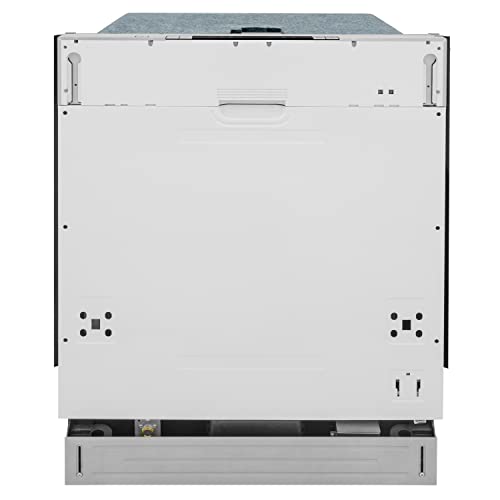
ZLINE 24-Inch Panel-Ready Dishwasher — Cabinetry’s Chameleon
The ZLINE takes top control’s founding idea — the dishwasher should not look like one — to its conclusion: a custom panel ready door that wears a panel matching your cabinetry, over a stainless steel tub. Closed, there is no appliance in the kitchen at all, only a run of cabinets; the controls wait on the door’s edge, and the wash happens behind wood. For kitchens designed as furniture rather than as laboratories, this is the only pick in the guide that fully answers the brief.
Panel-ready ownership has its own practicalities, and this guide will state them rather than glide past. A panel must be made or ordered to the manufacturer’s specification, its weight within the door’s rated range, and installed so the door’s balance survives it — work usually shared between the cabinetmaker and the appliance installer. The reward is proportionate: a kitchen whose dishwasher is discoverable only by the faint sound of water, in a home where that discretion was the design’s whole point.
Cabinetmakers, it should be said, have opinions about panel-ready dishwashers, and listening to yours early is the cheapest step in this entire guide. The panel’s grain direction, its weight in the chosen timber, the handle’s placement so the door reads as a drawer line or a cupboard — these decisions belong to the kitchen’s design conversation, not to installation day. Households that hold that conversation early describe the finished kitchen with a particular pride: the appliance nobody can find is the one everybody asks about.
The stainless tub matters more, not less, behind a hidden door, because the cavity is the part of the machine you will actually see for a decade. ZLINE’s standard line — this linked model — should not be confused with the brand’s Autograph Edition branch, discussed at class level at the end of these reviews: the standard panel-ready machine is the working chameleon, while Autograph is the statement line, and buyers should know which conversation they are in before they start pricing panels.
- Format: 24-inch top control built-in, custom panel ready
- Tub: stainless steel, per the listing title
- Door: accepts a custom cabinetry panel
- Controls: top control, per the listing title
- Line: ZLINE standard panel-ready line (distinct from Autograph Edition)
- Where to buy: the ZLINE 24-Inch Panel-Ready Dishwasher listing on Amazon — check price on Amazon
Strengths
- Total visual disappearance into a designed kitchen.
- Steel tub behind the disguise, where it will be seen daily.
- Top control is native to the concept, not an afterthought.
Trade-offs
- The panel is an extra project with its own cost in effort.
- Guests will open three cabinets looking for the dishwasher.
- Door weight limits must be respected at installation.
Pick it for: designed kitchens where the appliance must vanish into the cabinetry.
Poorly suited to: rentals and quick replacements, where a panel project makes no sense.

Midea MDT24P3CST Dishwasher — Straightforward Centre
The Midea’s title is the shortest in this guide — a 24-inch stainless top-control built-in dishwasher, full stop — and this review honours that brevity by discussing what a buyer can actually know from it. The format is the mainstream ideal: full width, hidden controls, a stainless door face. Midea, a manufacturing giant whose appliances wear many badges worldwide, sells this machine on the format’s merits rather than on named systems, and there is a real market for exactly that: households replacing a failed unit who want the modern layout without funding a flagship’s research programme.
Midea’s scale is the quiet argument underneath the sparse title: a manufacturer producing appliances at global volume tends to produce mature pumps, seals and boards, the unglamorous organs that decide whether a dishwasher is still washing in year eight. Buyers who weight longevity over theatre often reason exactly this way — that the mainstream centre of a category is where reliability concentrates, because the designs have been built often enough for their weaknesses to have been found and fixed by other people’s ownership.
What can be said responsibly beyond the title? That top control at this level buys the same daily goods it buys anywhere — the clean door, the child-proof panel, the status check by cracked door — and that a mainstream machine’s ownership experience is decided by installation quality, local service and the household’s own habits more than by trademarked cycles. Readers should verify the full specification on the listing itself, where the manufacturer publishes the numbers this guide refuses to guess: capacity, noise, programmes. A guide that invents those for a quiet title would be lying to you in the voice of thoroughness.
Positioned honestly, the Midea is the control group of this experiment — the machine that tells you what top control itself is worth, stripped of steam, sprayers and silence records. If its listing’s full specification meets your household’s needs, the money it does not spend on badges remains yours for the kitchen’s other battles. If it does not, the four machines above it in this guide each sell a specific, titled reason to climb.
- Format: 24-inch built-in, stainless
- Controls: top control, per the listing title
- Systems: none named in the title — verify the full specification on the listing
- Capacity: not stated in the title
- Noise: not stated in the title
- Where to buy: the Midea MDT24P3CST listing on Amazon — check price on Amazon
Strengths
- The modern layout in its purest, least decorated form.
- A mainstream maker’s footprint behind the badge.
- Lets the format, not the features, carry the decision.
Trade-offs
- The title gives shoppers few numbers to compare.
- No titled steam, third rack or silence claim to lean on.
- Research burden shifts to the buyer at the listing.
Made for: replacement buyers who want top control without a flagship’s tariff of features.
A weak match for: shoppers who decide by specification table and want it all in the title.
The ZLINE Autograph Edition Line — Design-Led Premium Branch
The final slot belongs to a name readers will meet while researching the linked ZLINE above, and it is handled here at class level, in prose only: the ZLINE Autograph Edition line. Autograph is the same manufacturer’s design-led branch — the line where the brand dresses its appliances as kitchen jewellery, with statement finishes and accent hardware intended to be seen rather than hidden. It is a genuinely different proposition from the standard panel-ready machine: that one disappears, this one performs.
Statement appliances also reorganise a renovation’s budget conversations, and naming that early helps Autograph-curious readers. Money spent on a design line is money visibly spent — guests see it, the household enjoys it daily, and it anchors the room’s other choices the way a range with accent hardware anchors a colour scheme. That is a legitimate way to spend a renovation budget, arguably more honest than hiding the same sum in invisible specifications nobody will ever perceive. The class deserves respect as a choice, even in a guide that links its plainer sibling.
Why does it appear without a link, a listing or specifications? Because this guide’s verified pool contains the standard panel-ready model, not an Autograph dishwasher listing, and the rule of the house is that unverified products are discussed as classes or not at all. What can be said at class level is the shopping guidance: Autograph buyers are paying for design authorship, should compare the line against other statement appliances rather than against mainstream top-control machines, and should confirm any specific model’s tub, capacity and noise from its own listing before letting a finish decide for them. A beautiful door is a reason to look closer, never a substitute for the specification behind it.
Readers torn between the two ZLINE directions are really choosing a kitchen philosophy. Panel-ready says the best appliance is an invisible one; Autograph says the best appliance is a piece of the room’s jewellery. Both are defensible, neither is a wash programme, and the dishes — indifferent to philosophy — will judge only the water.
- Format: premium design line, discussed at class level
- Character: statement finishes and accent hardware, by class design
- Relationship: the design-led branch distinct from the standard panel-ready line
- Verification path: confirm any model’s full specification on its own listing
- Availability: through the brand’s retail channels
- Where to buy: no listing is linked for this line in this guide — research it at the brand’s own channels
Strengths
- Design authorship for kitchens built around statement appliances.
- A clear alternative philosophy to the disappearing panel-ready route.
- Keeps a single brand’s range coherent for suite buyers.
Trade-offs
- Premium design lines price the design as surely as the machine.
- Statement finishes date faster than cabinetry-matching panels.
- Specifications vary by model and must be checked individually.
Strongest for: design-first renovators building a kitchen around visible, authored appliances.
Weakest fit: buyers who want the dishwasher to vanish — that is the other ZLINE’s whole talent.
The Hidden-Control Field, Compared
| Machine | Noise as titled | Capacity as titled | Defining claim |
|---|---|---|---|
| LG LDTS5552S Top Control Dishwasher | 46 dBA | Not stated (3rd rack) | QuadWash and TrueSteam |
| Bosch Benchmark SHX9PCM5N Dishwasher | 39 dBA | Not stated (tall tub) | Benchmark quiet, steel tub |
| Sharp SDY6768SMS Top Control Dishwasher | 44 dBA | 16 place settings | Capacity with a handle |
| ZLINE 24-Inch Panel-Ready Dishwasher | Not stated | Not stated | Custom panel ready, steel tub |
| Midea MDT24P3CST Dishwasher | Not stated | Not stated | The format, undecorated |
| ZLINE Autograph Edition line | Check per model | Check per model | Design-led statement line |
What Do You Give Up When the Controls Hide?
Three small taxes, honestly itemised. First, the glance: a front-control machine announces its remaining time across the room, while a top-control machine keeps the secret until you crack the door — which pauses some cycles and always breaks the seal’s steam. Second, the lean: front panels can be started by a hip or an elbow brushing past, a flaw, but also occasionally a convenience that top control removes along with the accidents. Third, the guest problem: visitors cannot operate a machine whose controls they cannot find, which households count as either a tax or a benefit depending on their guests.
Against those taxes, the dividends: a door that wipes clean in one pass, a panel safe from toddler experimentation and from the cleaning-spray corrosion that eats front displays, and the design calm that motivated the layout in the first place. Most households pay the taxes for a week and then stop noticing them, which is the market’s verdict written in habit. The layout won because its costs are small, daily and forgettable, while its benefit — the kitchen’s face — is visible every hour.
How Should You Read a Decibel Figure Before Trusting It?
Decibels are logarithmic, which makes small gaps larger than they look: the seven points between the Bosch’s titled 39 and the LG’s 46 represent a clearly audible difference, roughly the distance between a library’s hush and a quiet conversation’s murmur, while the two points between the LG and the Sharp’s 44 will register as a shade, not a step. Figures are also measured under standardised conditions that your kitchen will not reproduce — cabinetry, flooring and room size all re-voice a machine — so treat titled decibels as a ranking instrument rather than a promise of the exact sound in your home.
The practical method: rank by the numbers, then discount by your room. A closed galley kitchen forgives five points; an open-plan space where the sofa sits four metres from the dishwasher forgives none. Night-running households should weight the figure almost above capacity, because a machine that wakes the house will be run less, and a dishwasher run less is capacity already lost.
Can a Panel-Ready Door and a Family Kitchen Really Coexist?
They coexist in thousands of kitchens, with two understandings. The panel must be specified honestly — weight and dimensions inside the maker’s limits — because a door hung with an overweight panel strains hinges and sags its seal over years. And the household must accept the discovery ritual: children learn the invisible dishwasher’s location in a day, guests never do, and hosts become practiced at the graceful intercept before a visitor opens the dishwasher hunting for a mug cupboard.
Beyond those, the panel-ready family kitchen gains what the ZLINE section promised: a room that reads as furniture at the hours it is a living space, and as a kitchen only when the work starts. In open-plan homes where the dishwasher’s door is also the living room’s wall, that transformation is not vanity; it is the room’s second job done properly. Households whose kitchens freeze as well as wash — preserving a garden’s output in bulk — will recognise the same furniture-first instinct in our guide to Best Frost-Free Freezers, where the appliance count is high and the visual calm is prized.
How Does Living With Hidden Controls Change the Daily Ritual?
The ritual changes in small, compounding ways. Loading ends with a deliberate act — choose the cycle with the door open, close, and trust — rather than the front-control habit of starting the machine with a knee while carrying the last glass. Households report an unexpected benefit within weeks: cycles get chosen more thoughtfully, because the choosing happens facing the load rather than facing the room. The eco programme’s usage rises; the intensive programme stops being the default for loads of breakfast plates.
Unloading changes too. The top-control door, opened fully, presents its panel as a kind of dashboard of the finished cycle — and the household’s eye learns to read it the way a driver reads a parked car’s dials. None of this is worth money on a specification sheet, and all of it is what ownership actually consists of: thousands of small interactions, each made slightly calmer by a layout that puts the machine’s face away while it works.
Which Households Should Still Choose Front Control Instead?
This guide’s honesty requires naming them. Households with a member whose mobility or height makes the door’s edge an awkward reach — controls there are operated standing over an open door — may find a front panel kinder. Hosts who run multiple partial loads through an evening of entertaining use the at-a-glance countdown as a genuine tool. And some kitchens, particularly period ones, wear their appliances proudly and would lose character to a slab door’s discretion.
For everyone else the market’s direction is the answer: top control became the default because its taxes are small and its dividend — the calm door — is collected at every glance across the kitchen. But defaults are statistics, not commandments, and the three households above should buy their exception knowingly, with this guide’s blessing and their own requirements ranked above fashion.
What Should the Installer Check That Front-Control Owners Never Think About?
The door’s swing becomes an electrical question in this layout: the panel lives on the edge that travels furthest, so the installer confirms the door opens fully without the edge meeting a handle, a bin pull-out or an island’s corner — an obstruction that a front-control door would merely have decorated. Clearance above matters too in kitchens with deep worktops, where an overhanging stone edge can shadow the panel’s display from a standing user’s view.
Levelling carries an extra consequence: a door fractionally out of true shows it in this layout as a visible seam line against the cabinetry, the one aesthetic flaw the whole design exists to avoid. A patient installer adjusts until the closed door reads as a cabinet front, because in a top-control kitchen the closed door is the product. The wash, after all, is hidden twice — once by the door, once by the design.
How Do Third Racks Change What a Top-Control Machine Can Swallow?
Two of the linked machines here — the LG and the Sharp — carry third racks, and the feature deserves a section because it interacts with capacity in a way place-setting counts hide. A third rack is a shallow tray at the tub’s crown, sized for cutlery laid flat, utensils, lids and the long thin citizens of the kitchen drawer. Its gift is subtraction: every fork that sleeps up there is a fork not nesting in a basket below, and nested cutlery is the commonest cause of the one dirty spoon in a clean load.
The tray also taxes: a few centimetres of tub height surrendered at the top, which tall stemware in the rack below occasionally misses. Households should weigh their glassware’s height against their cutlery volume — wine-heavy kitchens and cutlery-heavy kitchens are different countries, and the third rack is a citizen of the second. Loaders who adapt to the tray describe a conversion experience; loaders who keep reaching for a basket that is no longer there describe a fortnight of mild annoyance first. Both reports are true, in that order.
What Happens to Resale, Rentals and Second Homes in This Layout?
Top control has become the expected face in a renovated kitchen, which gives it a quiet role in property: estate agents describe slab-front dishwashers as updated without needing to name the layout, and a front-control machine in a new kitchen reads, fairly or not, as a leftover. Landlords equipping better rentals reach for the layout for a practical reason beyond fashion — a panel children cannot play with and tenants cannot corrode with spray cleaner survives tenancies better.
Second homes invert the logic slightly: a machine used six weekends a year gains little from silence or steam, and the Midea’s undecorated centre — or even a front-control exception — can be the rational allocation. The layout’s virtues are daily-use virtues; multiply them by your actual days before paying for them.
How Should You Maintain a Door With No Visible Controls?
The slab door’s maintenance is a single wipe, which is the point, but two details reward attention. The door’s upper edge, where the panel lives, collects the kitchen’s rising steam and grease in a thin line; a weekly pass with a soft cloth keeps the display legible and the touch points responsive. And the door’s seal, as on any machine, wants its fold wiped monthly — hidden controls hide the machine’s face, not its hygiene.
Panel-ready doors add one line to the routine: treat the panel as cabinetry, because it is — the timber or painted finish gets the care the kitchen’s other fronts get, and harsh appliance cleaners stay on the steel and glass where they belong. Owners who keep those two habits find the invisible dishwasher ages at the speed of the kitchen around it, which is precisely the illusion the layout was bought to sustain.
Errors That Follow Top-Control Buyers Home
The first error is shopping the door and forgetting the opening: a top-control machine still needs its 24 inches, its water, its drain and its power, and a surprising number of replacements fail on a cabinet that shrank a centimetre behind new flooring. Measure the cavity, not the old machine. The second error is the opposite vanity — paying for silence in a kitchen with a door that closes, where a mid-forties machine would have been inaudible through the wall, and starving the budget that installation needed.
Third, buyers of panel-ready machines sometimes order the panel from a photograph rather than the specification, and meet the weight limit for the first time on installation day. Fourth, households fall for feature lists they will never operate: steam for a family that eats from the grill, sixteen settings for a couple. The guide above was arranged by those four honesties — room, noise, design, habit — precisely so the errors have somewhere to be caught before the checkout.
How Do You Choose Between Quiet, Steam and Capacity When You Cannot Have All Three Cheaply?
Every buyer in this category eventually faces the triangle, so here is a method for it. List your household’s last twenty dishwasher complaints — actually list them, from memory, at the table. Complaints about noise point at the Bosch’s corner. Complaints about rewashing, soaking and scrubbing point at the LG’s systems. Complaints about a second load waiting on the counter point at the Sharp’s sixteen settings. The triangle resolves itself the moment the complaints are counted, because households reliably discover their grievances cluster in one corner and merely visit the others.
The method’s virtue is that it prices features in the buyer’s own currency — annoyance — rather than in brochure order. A household with two noise complaints and eleven capacity complaints that buys the quiet machine has purchased five years of the wrong relief. Let the grievances vote; they have seniority.
What Should Arrive, Be Kept and Be Filed on Delivery Day?
Keep the specification sheet from the listing, printed or saved, because it is the document this guide kept pointing at — the manufacturer’s own numbers, against which the delivered machine can be checked while a return is still easy. Photograph the model plate inside the door’s edge before the first wash; that photograph is the key to every future part, manual and warranty conversation. File the panel specification separately if your machine is panel-ready, since a damaged panel years later will be remade from that page or not at all.
Then run the empty hot cycle, check the floor beneath for the installer’s honesty, and load the first real wash with the household’s most honest load — not a ceremonial easy one. A machine judged on its true Tuesday in week one will not surprise you in year two.
A Buyer’s Walk Through the Five Linked Machines, in One Evening
Imagine the shortlist as an evening’s errands. You begin at the Bosch, where the salesman starts the machine and then has to point at the floor light to prove anything is happening; if that demonstration moves you, the evening is over and the guide’s work is done. If it leaves you cold — if your kitchen has a door and your evenings are loud anyway — walk to the LG and ask what the steam does to a lasagne dish; the feature household finds its answer there, in the soil it cooks.
Then load the Sharp with your imaginary feast and feel the handle; check the ZLINE’s panel specification against your cabinetmaker’s patience; and stand finally in front of the Midea and ask the evening’s most clarifying question — what, exactly, would the extra money above this machine buy me, in my kitchen, on my Tuesdays? Buyers who can answer that question in one sentence buy well in this category. Buyers who cannot should buy the Midea’s honesty or the Bosch’s silence, the two poles where regret is rarest.
How Does the Hidden Panel Age Across a Decade of Kitchens?
Front-control panels age in public: displays fade, printed labels polish away under thumbs, and a machine can look tired while washing perfectly. The top-control panel ages in private, on an edge that faces up rather than out, touched deliberately rather than brushed past. A decade on, the difference shows in photographs of kitchens more than in performance — the slab door still reads as current because it never carried a dateable interface on its face. Interfaces are fashion; a blank door is not, and fashion is what dates a kitchen fastest.
There is a second ageing story in the electronics themselves: a panel on the edge lives further from the door’s daily slamming face and from the cleaning sprays that mist front displays. None of this guarantees a longer life — boards fail by their own lottery — but the layout removes two of the commonest cosmetic deaths, and cosmetic death, in a kitchen renovation economy, is usually the one that triggers replacement.
What Does the Next Decade Hold for the Hidden Panel?
The layout’s trajectory is visible in this very line-up: controls migrating from the door’s face to its edge are now migrating again, into touch surfaces that appear only when a hand approaches and into applications that move the panel off the machine entirely. The slab door will likely complete its journey to pure furniture, with the machine’s state reported by light, sound or phone rather than by any surface of its own. Readers buying today are buying mid-journey, which is a comfortable place: the layout is mature, its parts are standard, and its successor technologies have not yet made it obsolete.
What will not change is the underlying negotiation this guide has circled throughout — between the machine as appliance and the machine as furniture. Every generation re-answers it. The five linked machines here are this generation’s five best answers, and the prose line at the end is its most theatrical one.
One Last Distinction: Top Control Is Not the Same as a Handle-less Door
Shoppers conflate two design choices that this guide has kept separate, and separating them at the till prevents the commonest disappointment in the category. Top control describes where the panel sits — the door’s edge. Handle-less describes how the door opens — a recessed grip instead of a bar. The Sharp in this guide proves the two are independent: hidden controls, proud handle. A buyer who wants the handle’s ergonomics need not surrender the clean panel, and a buyer who wants the full slab can have it — but they are choosing two things, and should know the price and pleasure of each.
Test both choices with wet hands in the showroom if you can. The recessed grip that feels elegant dry can feel argumentative with soapy fingers, and the handle that looks old-fashioned in a photograph can feel like the best engineering in the building at midnight with a sleeping house. Ergonomics is the part of the specification no title can state for you.
Final Recommendation
Choose by the currency your kitchen lacks. Silence: the Bosch Benchmark, and it is not close. Systems: the LG, whose steam and spray arms earn their panel space. Capacity with a handle your hands will thank: the Sharp. Invisibility: the standard ZLINE and a good cabinetmaker. The format alone, honestly priced in effort: the Midea — and if your heart is set on an appliance as jewellery, research the Autograph line at its own channels with a specification checklist in hand. Whichever you choose, the door will close on a clean face and a hidden panel, and the kitchen will keep the secret beautifully — a top-control machine’s whole promise, kept nightly, is that the hardest-working appliance in the house can also be the one nobody has to look at.
Frequently Asked Questions
Can children start a top-control dishwasher by accident?
Far less easily than a front-control one: the panel sits on the door’s edge, out of the reach and sight of small children, and most machines add a control lock for the determined. The realistic child risk in this layout is not starting the machine but opening it mid-cycle, which every layout shares.
How do I know a top-control machine is running?
Many project a small light onto the floor or glow at the door’s edge; all of them tell you when the door is cracked open. Households that run machines overnight usually stop checking within a month — the morning’s clean load becomes the only status report that matters.
Is top control harder to repair than front control?
The control board’s location changes, the repair economy does not, in any way a buyer should weight. What matters is the brand’s service network where you live, a question worth one phone call before any built-in purchase, whatever its layout.
Does a panel-ready machine cost more to own?
It costs more to begin — the panel itself and the cabinetmaker’s hour — and roughly the same to run. Buyers should budget the panel as part of the appliance, not discover it as an accessory, and confirm its weight against the door’s specification before it is made.
Should I match my dishwasher’s control style to my other appliances?
Only the door’s finish needs to match the suite; the control layout is invisible in the comparison that matters, because the panel hides when the door closes. A top-control dishwasher sits happily beside a front-control range, and the kitchen reads as one family through finish and handle language rather than through where the buttons live. Buy the layout your hands prefer and let the finishes do the matching.
Do top-control dishwashers cost more to run than front-control ones?
No — the layout is about where the panel sits, not how the machine washes. Running costs follow the wash systems, the tub and the household’s cycle habits. A steam-equipped machine spends differently from a basic one, but that difference belongs to the systems, and it exists identically behind either door style.
Can a top-control panel be damaged by steam from the wash?
The panel is sealed for the environment it lives in — the door’s edge meets the tub’s steam at every opening on every machine of this type, and manufacturers engineer for it. The owner’s contribution is the weekly wipe of the edge described in this guide, which keeps cooking grease, rather than steam, from dulling the display.
What is the difference between the two ZLINE directions in this guide?
The linked machine is the standard panel-ready line: it hides the dishwasher behind your cabinetry. The Autograph Edition is the brand’s design-led branch, discussed here in prose only, which does the opposite and dresses the appliance to be seen. Same brand, opposite philosophies, and only the standard line is linked in this guide.
Related Guides
Hidden controls pair naturally with a quiet kitchen’s other half, ventilation, and readers speccing both may enjoy Best Ultra-Quiet Range Hoods as a companion read. For the family-capacity angle this guide touched through the Sharp, the families companion linked in the Key Takeaways goes deeper.


