What's inside
- Where to Buy a Stainless-Tub Dishwasher, and Why the Tub Material Earns Its Own Guide
- Key Takeaways
- Quick Picks
- What Did We Require Before a Machine Could Join This List?
- Six Steel Cavities, Side by Side
- Why Does Steel Dry Dishes Better Than Plastic?
- What Does a Steel Tub Do to Kitchen Noise?
- How Long Should a Stainless Cavity Outlast a Plastic One?
- Steel, Hybrid or Plastic: Sorting the Tub Vocabulary Before You Shop
- How Can You Verify a Showroom Machine’s Cavity in Thirty Seconds?
- What Does the Tub Material Change About Hot Cycles and Baby Bottles?
- Slips That Shorten a Steel Tub’s Advantages
- Does the Tub Material Interact With Your Water, Your Detergent and Your Habits?
- How Should You Clean and Descale a Steel Cavity Without Harming It?
- What Does Installation Day Ask of a Steel-Tub Buyer?
- When Is a Plastic Tub Actually the Right Answer?
- How Does a Steel Tub Change the Second Decade of a Kitchen?
- Which Rack Layout Suits the Way Your Household Actually Eats?
- What Should You Check in the First Week of Owning a Steel-Tub Machine?
- A Note on Finishes: When the Door Is Steel but the Story Is Not
- Final Recommendation
- Frequently Asked Questions
- Related Guides
As an Amazon Associate I earn from qualifying purchases. This post may contain affiliate links at no extra cost to you.
cottageverdict.com is reader-supported. When you buy through links on our site, we may earn an affiliate commission.
Where to Buy a Stainless-Tub Dishwasher, and Why the Tub Material Earns Its Own Guide
The best dishwashers with stainless steel tubs share one structural decision that reaches into almost everything else a machine does: the wash cavity is steel rather than plastic. A steel tub holds heat differently, resists the staining and odour absorption that age a plastic interior, runs quieter because the material damps spray noise instead of drumming it, and tolerates the high wash temperatures that sanitise cycles and hard-water households demand. Shoppers usually meet the stainless tub as a premium checkbox; in practice it behaves more like a foundation, quietly improving drying, acoustics and longevity all at once.
This guide gathers six machines whose own listing titles state the steel tub — or, in the countertop case, a stainless steel interior — so the claim under every pick is the manufacturer’s own wording rather than a reviewer’s inference. The set spans the shapes a steel tub comes in: full-size 24-inch built-ins with third racks, an 18-inch compact for narrow kitchens, and one countertop model for households with no cabinet slot at all. Finishes, capacities and noise figures below come only from those titles; where a title gives no decibel figure, none is invented for it.
Each linked name leads to its Amazon listing, where you can check price on Amazon and confirm dimensions against your cabinet opening. No prices or fixed ratings appear in this guide. The tub question is a decades-long one — you are choosing the material your dishes will wash inside for the machine’s whole life — and it deserves a decision made on structure rather than on this week’s discount.
Key Takeaways
- Every pick here states a stainless steel tub or interior in its own listing title.
- Steel tubs damp noise, resist odour and staining, and help condensation drying work harder.
- The set covers 24-inch built-ins, an 18-inch compact and a countertop machine — steel is not only a big-kitchen material.
- Third racks appear on the Kenmore and the Sharp, the two family-leaning picks in the line-up.
- Heated drying shows up on the SPT; the steel-tub condensation route is explained in the body of the guide.
- Control placement is a separate axis entirely, explored in our guide to Best Top-Control Dishwashers.
Quick Picks
| Pick | Badge | Why it stands out |
|---|---|---|
| Kenmore 24-Inch Dishwasher With 3rd Rack | Three Racks, Family Steel | Stainless tub, three racks, top control and a titled 49 dBA in a high-capacity frame. |
| Sharp SDW6726MS 24-Inch Dishwasher | Power Wash Sprayer | Third rack plus a dedicated power wash sprayer, at a titled 47 dB. |
| Honeywell 18-Inch Built-In Dishwasher | Compact Steel Tub | An 18-inch built-in with a stainless tub, eight place settings and six programs. |
| BLACK+DECKER BDW100MS 24-Inch Dishwasher | Smart Wash Value Frame | Twelve place settings, stainless tub and a Smart Wash cycle in a stainless-look door. |
| BLACK+DECKER BCD6SD Countertop Dishwasher | Countertop Steel Interior | Six place settings and six programs with a stainless steel interior, no cabinet required. |
| SPT SD-6505SS 24-Inch Built-In Dishwasher | Tall Tub, Heated Drying | A stainless tall tub with Smart Wash and heated drying under an ENERGY STAR title. |
What Did We Require Before a Machine Could Join This List?
The entry ticket was the title itself: the words for a stainless tub had to appear in the manufacturer’s own listing, because tub material is exactly the sort of specification that gets blurred in marketing summaries — “stainless” describing a door finish while the cavity behind it is grey plastic. Readers will meet that blur in the wild, and this guide’s first service is refusing to repeat it. The BLACK+DECKER BDW100MS is the instructive case: its title carries both a stainless-look exterior and a stainless steel tub, stated as two separate facts, which is how an honest listing writes it.
Beyond the ticket, the set was balanced deliberately across kitchen shapes. A guide that listed six near-identical 24-inch built-ins would answer only the easiest version of the question. So the compact Honeywell holds the narrow-kitchen seat, the BCD6SD holds the no-cabinet seat, and the remaining four divide the mainstream: two with third racks for households that wash cutlery and utensils in volume, one value-framed Smart Wash machine, and the tall-tub SPT with heated drying for readers whose plastics come out wet from condensation machines. Noise figures are quoted only where titles state them — the Kenmore at 49 dBA, the Sharp at 47 dB — and the absence of a figure elsewhere is reported as absence, not filled with a plausible guess.
A note on what a steel tub does not do: it does not soften water, descale an element or rescue a load from bad detergent. It resists the consequences of hard water better than plastic does, and it cleans up more completely afterwards, but households on very hard supplies should read this guide alongside the hard-water discussion elsewhere on the site rather than expecting the tub to fight that battle alone.

Kenmore 24-Inch Dishwasher With 3rd Rack — Three Racks, Family Steel
The Kenmore stacks the mainstream wish list into one title: three racks, a stainless steel tub, top control, an energy-efficient designation and an ultra-quiet claim quantified at 49 dBA. Start with the racks, because they shape daily life more than any other line. A third rack converts the cutlery problem — the basket that crowds the lower rack and nests spoons together — into a flat tray where each piece washes separately, and it swallows the long utensils that otherwise duel with the upper spray arm. Families notice this within a week; the basket’s departure frees lower-rack territory that plates and pans immediately colonise.
The tub underneath that choreography is the point of this guide: stainless steel, in a machine its title calls high-capacity. Steel and capacity belong together in family service because the tub will see two or three loads a day for years — heat, detergent, mineral-bearing water, the occasional dropped knife — and steel shrugs at treatment that gradually stains, roughens and perfumes a plastic cavity. Top control keeps the door face clean-lined, with the cycle display hidden on the door’s upper edge until the door opens.
Loading geometry deserves a final word, because three racks rearrange more than cutlery. With flatware lifted out of the lower basket’s territory, the bottom rack becomes a pan-and-plate floor in a way two-rack machines only promise; the middle rack takes bowls and glasses without negotiating around a basket’s handle. Households upgrading from a two-rack machine typically report the same surprise: the new machine’s loads look smaller in count and larger in substance, because the awkward pieces — ladles, spatulas, the potato masher — have a flat home at last.
At 49 dBA the Kenmore sits in the conversational range: audible as a presence in an open-plan room, not an interruption. Households that run the machine during dinner parties may chase quieter still; households that run it overnight will never think about the number again. What the title does not give is a place-setting count, and this guide will not supply one — “high-capacity” is the manufacturer’s chosen word, and readers comparing raw capacity should weigh the three-rack layout, which in practice raises usable room more than a nominal setting or two.
- Format: 24-inch built-in, stainless steel finish
- Tub: stainless steel, per the listing title
- Racks: 3 racks, including a third rack
- Controls: top control
- Noise: ultra-quiet 49 dBA, per the listing title
- Where to buy: the Kenmore 24-Inch Dishwasher listing on Amazon — check price on Amazon
Strengths
- Third rack plus steel tub is the family combination that ages best.
- Top control keeps a stainless door visually uninterrupted.
- A titled decibel figure lets buyers compare noise honestly.
Trade-offs
- No place-setting count in the title to settle capacity arguments.
- Three racks ask loaders to learn a new packing habit.
- 49 dBA is quiet, not the quietest territory in this guide’s wider family.
Best for: families who want the steel tub and the cutlery tray in one mainstream machine.
Not suited for: cooks who load by instinct and resent any rack that asks them to think.

Sharp SDW6726MS 24-Inch Dishwasher — Power Wash Sprayer
Sharp’s entry distinguishes itself with a phrase none of the other titles carry: Power Wash Sprayer. Where most dishwashers distribute one wash pressure across the whole tub, a dedicated power sprayer concentrates force where baked-on soil lives — the casserole corner, the roasting pan’s rim. For households whose cooking leans on ovens and sheet pans, that targeted violence is worth more than an extra delicate cycle they will never select. The title pairs it with a third rack, twelve place settings, and a noise figure of 47 dB described in the listing’s own words as library quiet.
Twelve place settings is the honest middle of the built-in market: not the largest tub here, not a compact, but the size that suits a household of three or four washing once a day. The third rack stretches that capacity in the dimension families actually overflow — flatware and utensils — so the nominal twelve behaves larger at the table-clearing moment that matters. Stainless steel is the title’s material word for the machine, and the guide’s pool verification ties the model to the steel-tub set this article covers.
There is a quieter virtue in the Sharp’s numbers worth naming: balance. Nothing in its title reaches for a superlative it cannot cash — a mid-size capacity honestly stated, a noise figure given as a number rather than an adjective (the library phrase rides along, but the 47 stands on its own), a rack count that matches the capacity. In a category where titles often shout, a specification that reads like a measurement rather than a poster tends to predict an ownership experience of the same character.
Think of the Sharp as the cook’s pick in this line-up. The Kenmore courts the big family; the Sharp courts the person who sears, roasts and bakes, then faces the pan. Its sprayer will not rescue a pan left to fossilise for three days — no sprayer will — but against same-evening soil it changes the soak-or-scrub calculation that decides whether the good pan gets used on a weeknight at all. Kitchens are full of equipment rationed by washing dread; a machine that lowers the dread raises the cooking.
- Format: 24-inch built-in, stainless steel
- Capacity: 12 place settings, per the listing title
- Racks: third rack included
- Wash feature: Power Wash Sprayer
- Noise: 47 dB, described in the title as library quiet
- Where to buy: the Sharp SDW6726MS listing on Amazon — check price on Amazon
Strengths
- A dedicated power sprayer aimed at baked-on cookware soil.
- Quieter on paper than the Kenmore, with a stated figure.
- Third rack included despite the mid-size capacity.
Trade-offs
- Twelve settings will strain a five-person household’s biggest days.
- The sprayer’s benefit fades for households that rarely cook in pans.
- Delicate-cycle devotees get less headline attention here.
Suits best: home cooks whose pans, not their plates, decide whether a dishwasher is good.
A poor fit for: large families who need every cubic inch of tub before any feature.

Honeywell 18-Inch Built-In Dishwasher — Compact Steel Tub
The Honeywell answers the narrow kitchen’s oldest grievance: compact machines are usually where manufacturers economise on the tub, so small kitchens get plastic cavities while wide ones get steel. This 18-inch built-in keeps the material — its title states a stainless steel tub outright — and fits eight place settings and six washing programs behind a black door. For a galley kitchen, a butler’s pantry run, an in-law suite or a small apartment whose cabinetry was framed before dishwashers were standard, that combination is not a compromise pick; it is the pick the space was waiting for.
Measure before you fall for it, because 18-inch machines live or die by the opening. The compact class exists for cabinets framed at that width — common in older flats, cottages and galley refits — and a household with a standard 24-inch opening should not volunteer for a smaller tub out of misplaced modesty. Conversely, a true 18-inch opening cannot stretch, and owners there should be suspicious of any advice that treats their kitchen as a problem rather than a dimension. The Honeywell is written for the second group, in full knowledge that the first group has the whole rest of this guide.
Eight place settings describes a household rhythm rather than a limitation: couples and singles who cook, small families who run the machine daily instead of warehousing dishes for a marathon load. Six programs is a sensible repertoire at this size — enough to separate the glassware evening from the casserole evening without a dial of novelties. The title also carries UL and Energy Star marks, pairing a compact footprint with a recognised efficiency designation, which matters in small homes where the dishwasher may be the hardest-working appliance in the building.
Steel earns its keep doubly in a compact. A small tub washes hotter relative to its volume and cycles more often per place setting than a big one, so its interior ages faster; steel’s resistance to staining and odour is worth more per square inch here. Owners graduating from a countertop machine will also notice the acoustic difference a built-in steel cavity makes behind a closed cabinet door — the kitchen stays a room you can sit in while the wash runs.
- Format: 18-inch built-in, black
- Tub: stainless steel, per the listing title
- Capacity: 8 place settings
- Programs: 6 washing programs
- Designations in title: UL, Energy Star
- Where to buy: the Honeywell 18-Inch Dishwasher listing on Amazon — check price on Amazon
Strengths
- A genuine steel tub in the 18-inch class, where plastic is common.
- Built-in installation keeps counters clear in small kitchens.
- Energy Star designation stated in the title itself.
Trade-offs
- Eight settings cap the household size it can serve alone.
- Sheet pans and stockpots will still meet the sink.
- Black finish narrows the kitchens it blends into.
Ideal for: narrow kitchens that refuse to accept a plastic tub as the price of their width.
Not the right match for: entertainers whose dinner parties seat ten and wash accordingly.

BLACK+DECKER BDW100MS 24-Inch Dishwasher — Smart Wash Value Frame
BLACK+DECKER’s full-size entry leads with clarity about its own construction, and in this guide that clarity is a feature. The title separates the two stainless facts — a stainless look on the door, a stainless steel tub inside — rather than letting one adjective smear across both. Behind the door: twelve-place-setting capacity, five wash programs and a Smart Wash cycle, under an Energy Star designation. It is a specification written for a buyer who wants the steel tub’s substance without paying for theatre.
Consider who else this machine quietly serves: the landlord equipping a quality rental, the seller staging a kitchen, the household replacing a failed unit under time pressure. In each case the checklist is the same — recognised brand, mainstream capacity, an efficiency designation, a tub that will still look fresh at inspection — and the BDW100MS ticks them without requiring its buyer to become a dishwasher scholar. Appliances bought under pressure are usually regretted; this one is specced to survive a hurried decision.
Smart Wash is the working heart here: a sensor-driven cycle that reads the load’s soil and adjusts rather than running a fixed programme against unknown dirt. For households whose loads alternate between breakfast plates and Sunday roasts, sensor washing removes the nightly guess about which cycle the day deserves, and it spends water and heat in proportion to the mess. Five programs around it cover the deliberate choices — the heavy pot load, the quick turnaround — without menu sprawl.
Position this machine as the line-up’s straightforward value frame: the tub material of the premium set, the capacity of the mainstream, a sensor cycle doing quiet work, and a brand whose service footprint is broad. What it does not claim is a third rack or a headline noise figure, and readers for whom those matter have the Kenmore and Sharp above. Readers for whom the tub, the capacity and the designation matter most may find the BDW100MS is the guide’s most efficient allocation of their budget — stated qualitatively, as this guide states all such things.
- Format: 24-inch built-in, stainless look
- Tub: stainless steel, per the listing title
- Capacity: 12-place setting capacity
- Programs: 5 wash programs, Smart Wash cycle
- Designation in title: Energy Star
- Where to buy: the BLACK+DECKER BDW100MS listing on Amazon — check price on Amazon
Strengths
- Honest title separates door finish from tub material.
- Sensor washing suits households with wildly variable loads.
- Full mainstream capacity with the steel tub included.
Trade-offs
- No third rack for the cutlery-heavy household.
- No decibel figure in the title for noise comparisons.
- Five programs is a working set, not an enthusiast’s menu.
Pick it for: a steel tub and sensor washing at the sensible centre of the market.
Poorly suited to: buyers who rank a cutlery tray above all other features.
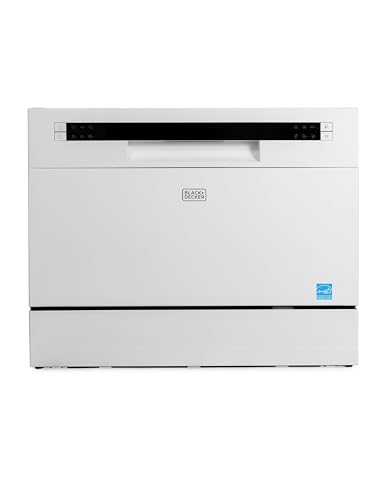
BLACK+DECKER BCD6SD Countertop Dishwasher — Countertop Steel Interior
The countertop seat in a steel-tub guide needs defending, so here is the defence: the BCD6SD’s title states a stainless steel interior, and interior is the countertop word for the same cavity this article exists to discuss. Six place settings, six wash programs and an Energy Star Certified designation complete a specification that treats the countertop buyer as an adult — no toy appliance condescension, just a small machine built around the same material as its built-in cousins.
Placement craft matters more with a countertop than with any built-in, because the machine shares air with the cook. Set it where the drain hose falls naturally to the sink without a kink, where the door’s swing does not duel a cupboard, and where its modest hum sits furthest from the table or the bed in a studio. Owners who treat placement as a one-time puzzle solved well report the machine disappearing into the kitchen’s furniture; owners who wedge it anywhere spend a year being reminded of it daily.
Who washes here? The studio tenant, the office kitchen, the RV-adjacent household, the couple in a rental whose lease forbids cabinet surgery, the owner of a period home whose kitchen they refuse to modernise by force. For all of them the countertop format’s bargain is identical: surrender a rectangle of work surface, receive a real wash with a steel cavity, a proper programme set and no plumber. Six programs at this size is generous — enough to give glassware its own gentler evening and pots their hotter one.
Steel matters in a countertop for a reason specific to the format: these machines often sit closed between washes in warm kitchens, sometimes with a damp load inside, and interiors that absorb odour announce it at the next opening. A stainless interior wipes clean, resists the tea-and-curry perfume that plastic keeps, and tolerates the high-temperature cycles a small machine uses to sanitise baby bottles and jars. In a tiny kitchen, where the dishwasher is also a presence, that neutrality is a daily mercy.
- Format: countertop, white
- Interior: stainless steel, per the listing title
- Capacity: 6-place setting capacity
- Programs: 6 wash programs
- Designation in title: Energy Star Certified
- Where to buy: the BLACK+DECKER BCD6SD listing on Amazon — check price on Amazon
Strengths
- Steel interior in a format where all-plastic rivals are common.
- No installation beyond placement and a sink for drainage.
- A full six-programme repertoire despite the small footprint.
Trade-offs
- Six settings is a small household’s ceiling, firmly.
- Counter space is spent every day, not only on wash days.
- Large pans and oven trays remain sink work.
Made for: renters and small-space households who want the material without the renovation.
A weak match for: anyone whose counter is already a negotiated peace between appliances.

SPT SD-6505SS 24-Inch Built-In Dishwasher — Tall Tub, Heated Drying
SPT’s entry is the guide’s tall tub: a 24-inch built-in whose title promises a stainless steel tall tub, a Smart Wash system, heated drying and ENERGY STAR standing. Tall tub is a capacity philosophy — vertical room for the platter, the stockpot, the tall vase — bought without widening the cabinet opening, and in steel the extra height comes with the material’s usual dividends. Households that host, preserve, brew or bake in batches tend to discover their old tub’s ceiling before its floor; this is the pick aimed at that discovery.
Heated drying deserves its sentence because it divides the steel-tub world. Much of the class dries by condensation against the steel wall — effective on plates and glass, weaker on plastics. A heated dry spends energy to finish the job actively, and readers whose loads run heavy with storage containers and children’s cups often rank it first among features. Our companion guide to Best Dishwashers With Heated Drying takes that single feature as its whole subject; here it is enough to note the SPT carries it in its title while several rivals in this list do not claim it at all.
Tall tubs change loading posture as much as capacity: the upper rack rides higher, the lower rack swallows what used to be pre-soaked in the sink, and the machine rewards households that load in layers — heavy and tall below, fragile above. Shorter loaders should test the reach on any tall-tub model in a showroom, because a rack you cannot comfortably load is capacity you do not own. That single ergonomic check separates delighted tall-tub owners from the ones who quietly return to washing platters by hand.
Smart Wash completes a trio of practicalities: sense the soil, wash accordingly, dry with heat, in a tall steel cavity. The title gives no decibel figure and no place-setting count, so this guide reports the shape of the offer rather than inventing its dimensions. Buyers cross-shopping raw numbers should set the SPT’s verified features — tall tub, heated dry, sensor wash, designation — against rivals’ verified numbers and decide which currency they trust.
- Format: 24-inch built-in, stainless steel
- Tub: stainless steel tall tub, per the listing title
- Wash system: Smart Wash System
- Drying: heated drying
- Designation in title: ENERGY STAR
- Where to buy: the SPT SD-6505SS listing on Amazon — check price on Amazon
Strengths
- Tall-tub height swallows the platters standard tubs refuse.
- Heated drying answers the plastics problem directly.
- Sensor washing adapts instead of repeating a fixed programme.
Trade-offs
- Title omits capacity and noise figures some buyers want.
- Heated drying spends more energy than condensation drying.
- Tall tubs can make the top rack a reach for shorter loaders.
Strongest for: hosts and batch cooks whose loads are tall before they are numerous.
Weakest fit: households devoted to the lowest-energy drying route above dry plastics.
Six Steel Cavities, Side by Side
| Machine | Shape | Capacity as titled | Signature feature |
|---|---|---|---|
| Kenmore 24-Inch Dishwasher With 3rd Rack | 24-inch built-in | High-capacity (no count titled) | Third rack, 49 dBA |
| Sharp SDW6726MS 24-Inch Dishwasher | 24-inch built-in | 12 place settings | Power Wash Sprayer, 47 dB |
| Honeywell 18-Inch Built-In Dishwasher | 18-inch built-in | 8 place settings | Steel tub at compact width |
| BLACK+DECKER BDW100MS 24-Inch Dishwasher | 24-inch built-in | 12-place setting capacity | Smart Wash cycle |
| BLACK+DECKER BCD6SD Countertop Dishwasher | Countertop | 6-place setting capacity | Stainless steel interior |
| SPT SD-6505SS 24-Inch Built-In Dishwasher | 24-inch built-in, tall tub | Not stated in title | Heated drying, Smart Wash |
Why Does Steel Dry Dishes Better Than Plastic?
Condensation drying is a small piece of physics the steel tub performs beautifully. At the rinse’s end the tub’s contents are hot; the steel wall, thinner and more conductive than plastic, cools faster than the dishes as the machine rests, so moisture in the cavity air preferentially condenses on the wall and runs to the drain, leaving plates and glass progressively drier. Plastic insulates its own surface, staying closer to the dishes’ temperature, and the moisture has nowhere preferential to go — it settles back where it started. This is why the steel-tub class so often dries without a heating element, and why the SPT’s heated drying, where fitted, is a belt added to braces rather than a rescue.
Plastics — the dishes, not the tub — remain the exception in any system, because they store little heat and shed water poorly. Every technology in this guide, heated or condensation, leaves a few droplets on a storage box. The steel advantage shows on the ceramic and glass majority of a load, which is where a household judges dryness at unloading time.
What Does a Steel Tub Do to Kitchen Noise?
A dishwasher’s soundtrack is spray striking surfaces, water moving through plumbing, and the pump’s low industry. The tub material conducts that concert to the room: plastic, light and resonant, behaves a little like a drum skin, while steel’s mass and the insulation usually packed behind it absorb and deaden. Manufacturers quote whole-machine figures rather than tub contributions — the Kenmore’s titled 49 dBA and the Sharp’s 47 dB are system numbers — but the class pattern is consistent enough that quiet-seeking buyers treat the steel tub as a down payment on silence before they read a single decibel.
Installation completes what material begins: a machine levelled properly, its insulation blanket seated, its hoses not drumming against cabinet walls. Readers chasing the quietest possible kitchen should pair the steel choice with that installation care, and with realistic expectations — a dishwasher is a machine washing with pressurised water, and library silence belongs to the Sharp’s marketing poetry more than to any plumbed appliance.
How Long Should a Stainless Cavity Outlast a Plastic One?
Longevity claims deserve care, so frame it as resistance rather than prophecy. Steel does not absorb the pigments of a thousand tomato sauces, does not hold the ghost of last month’s fish curry, does not roughen into the micro-texture where biofilm anchors, and does not soften or craze under repeated high-temperature cycles. Plastic tubs, especially in hard-water districts, gradually chalk and stain in ways no cleaning fully reverses. The rest of the machine — pumps, seals, electronics — ages on its own schedule in either material, which is why this guide speaks of the cavity outlasting, not the appliance living forever.
The practical consequence lands at resale and at year ten alike: a steel tub that wipes to a shine makes a machine feel maintained, while a stained plastic cavity makes the same machine feel tired. Households that keep appliances long, or that may sell a home with the kitchen included, are buying that decade-later impression along with the wash performance. It is also why bulk-storage households — the kind who freeze a season’s produce and wash canning jars by the dozen, the audience of our guide to Best Freezers for Breast Milk Storage at the small end — so often insist on steel: the jar-washing years are hard on interiors.
Steel, Hybrid or Plastic: Sorting the Tub Vocabulary Before You Shop
Three cavity materials circulate in listings, and the words matter. A full stainless tub is steel on every interior surface. A hybrid tub marries a plastic floor or lower section to steel door and walls in some designs — a genuine middle construction with middle properties, neither the fraud some purists claim nor the equal of full steel at the sump, where heat and grit concentrate. A plastic tub is polymer throughout, lightest and cheapest to form, and the class this guide positions as the baseline the others improve on. None of the six picks here is a hybrid, and this guide calls none of them one; the word appears only so readers can place it when rival listings use it.
Why does the floor deserve emphasis? Because the cavity’s hardest life happens at the bottom: the hottest water pools there, the filter and sump live there, dropped cutlery lands there point-first. A hybrid that saves its steel for the walls spends it where life is easy. When comparing a hybrid against a full steel tub at similar money, that geography — not the badge — is the honest difference, and it is the difference a decade of daily washes will vote on.
How Can You Verify a Showroom Machine’s Cavity in Thirty Seconds?
Open the door and look down, not at the door. The door’s inner panel is steel on a great many machines regardless of tub, precisely because it photographs well; the cavity floor and walls are the testimony. Run a fingertip along the tub’s rear wall: steel is cool, smooth and unyielding, plastic warmer to the touch with a faint moulded texture. Then find the specification plate or the manual’s materials line and make the listing’s claim match the maker’s own document. Thirty seconds, and the blur this guide warned about in its opening cannot survive.
The same visit tests the racks, which spec sheets describe poorly. Roll each rack its full travel; a steel-tub machine aimed at families should glide loaded, not merely empty. Tilt a mental casserole into the lower rack and a tray of cutlery into the third if fitted. Machines reveal their real capacity in the showroom to anyone who loads them imaginatively — place settings are a standardised fiction, but a roasting pan either fits or it does not.
What Does the Tub Material Change About Hot Cycles and Baby Bottles?
Households with infants, preserving jars or a family member whose health makes them careful — stated plainly, without medical promises — tend to run the hottest cycles a machine offers, often. Steel’s tolerance for repeated high temperatures is structural: no softening, no crazing, no gradual surface breakdown for residues to cling to, cycle after cycle, year after year. A plastic cavity endures those cycles too, but it ages visibly under them, and a surface that has roughened is a surface that rinses less completely.
The tub also decides how the machine smells between those hot cycles, which matters in the nursery-adjacent kitchen more than anywhere. Steel’s refusal to absorb odour means yesterday’s fish and today’s bottles do not share a perfume. Pair that with a clean filter and an occasionally empty hot run, and the cavity stays the neutral room those careful loads deserve.
Slips That Shorten a Steel Tub’s Advantages
The commonest slip is scouring: steel wool and abrasive powders scratch the cavity’s finish, and scratched steel holds soil the way the plastic you avoided once did. A soft cloth and ordinary detergent are the whole maintenance kit. Second comes the neglected filter, whose backlog perfumes even a steel tub — the material resists odour absorption, but it cannot refuse to host a dirty filter. Third, owners in hard-water areas sometimes assume steel is immune to scale; it is resistant, not immune, and an occasional citric descale keeps the shine honest.
A fourth slip is subtler: slamming the racks. Steel tubs dent where plastic flexes, and a dented tub floor can pool water in a machine that drained perfectly before. Load with the care the material rewards and the cavity will repay it for the machine’s whole working life.
Does the Tub Material Interact With Your Water, Your Detergent and Your Habits?
Steel does not exist in isolation; it negotiates with everything else in the wash. In hard-water homes its smooth surface gives scale less purchase than a chalking plastic wall, so deposits wipe away at descale time instead of bonding into the surface — one reason this guide’s readers so often arrive from the hard-water article. With detergent, steel’s heat retention keeps wash water nearer its target temperature through the cycle, which is the condition detergents are dosed for; a cavity that bleeds heat asks chemistry to work colder than its label assumed. And with habits, steel forgives the forgotten load — the wash left closed overnight — because the cavity has not absorbed the dinner’s smell to hand back at breakfast.
None of these interactions is dramatic alone. Together they describe why owners describe steel-tub machines with a word they rarely use for appliances: settled. The machine stops being a topic. In a kitchen, where the dishwasher runs more cycles than every other appliance combined, settled is the highest available praise.
How Should You Clean and Descale a Steel Cavity Without Harming It?
The routine is short enough to write on the inside of a cupboard door. Weekly: pull the filter, rinse it under the tap, and return it before the next load — the filter, not the tub, is where odour is born. Monthly: wipe the door seal’s fold, where a grey line of residue gathers in every material, and run the machine empty on its hottest cycle if the household’s loads rarely use it. Seasonally, or when glasses hint at film: an empty citric-acid descale, the same chemistry the hard-water guide recommends, which strips mineral before it can dull the steel’s finish.
What to keep away from the cavity is equally short: scouring powders, steel wool, and bleach-heavy cleaners that pit the surface they claim to brighten. Steel’s shine is a finish, not a coating, so it cannot peel — but it can be scratched into dullness by kindness of the wrong kind. Owners who follow the short routine find the tub at year five looks close to the tub at month one, which is the entire promise of the material kept in miniature.
What Does Installation Day Ask of a Steel-Tub Buyer?
Built-in steel machines install like any built-in — water in, drain out, power connected, level feet adjusted until the door hangs true — with two steel-specific footnotes. The first is levelling’s effect on the door seal: a heavy steel door hung out of level will find the tub’s edge unevenly, and a patient installer checks the seal’s contact all round rather than trusting the bubble alone. The second is the insulation blanket, which on steel-tub models does much of the acoustic work this guide credits to the material; it must be seated fully, not bunched, before the machine slides home.
Countertop and compact buyers have their own versions: the BCD6SD wants a level counter and an unstressed drain hose, the Honeywell wants its narrow opening measured at three heights because old cabinetry is rarely square. In every format, the first empty hot cycle before the inaugural load is worth the wait — it flushes the factory’s residues and proves the plumbing while the kitchen is still in installation mode, not yet back to cooking.
When Is a Plastic Tub Actually the Right Answer?
Honesty requires the counter-case, briefly. A plastic tub in a lightly used second home, a workshop sink run or a first flat with a two-year horizon can be perfectly rational: the material’s weaknesses are time-based, and short horizons never collect them. Budget released there may matter more spent on installation quality or a better range. This guide’s six picks exist for the opposite situation — a primary kitchen, a long horizon, a household that will wash thousands of loads in the same cavity — and readers in the short-horizon case should take the vocabulary lesson above, buy knowingly, and spend the difference on something they will enjoy sooner.
How Does a Steel Tub Change the Second Decade of a Kitchen?
Kitchens are renovated in waves, and the dishwasher’s tub is usually chosen in the first wave and judged in the third. Cabinets get refaced, counters replaced, ranges upgraded — and through it all the dishwasher installed years earlier keeps opening its door. A steel cavity is the version of that door a household still enjoys opening in year nine: no stain map of every sauce the decade contained, no permanent smell of the machine’s own history. Owners planning to age in place, or to sell into a market where kitchens close deals, are really choosing between two decade-later impressions when they choose a tub material today.
There is a maintenance dividend in that second decade too. Plastic cavities eventually demand cosmetic rescue — whitening cycles, odour treatments, the little rituals of a surface fighting its own ageing. Steel asks for a wipe and a filter rinse. Households differ in how much appliance housekeeping they tolerate, but nobody’s tolerance grows with the years; the material that asks least at year ten is the one still being thanked then.
Which Rack Layout Suits the Way Your Household Actually Eats?
Capacity arguments go wrong when they count settings instead of meals. A household that eats cereal, sandwiches and one cooked dinner produces a load of bowls, mugs and a pan; a household that cooks twice daily produces cookware with a side of plates; a baking household produces a third shape entirely, wide and floury. The third rack in the Kenmore and Sharp serves the first two shapes by removing cutlery from contention. The SPT’s tall tub serves the third. The compact Honeywell and the countertop BCD6SD serve the household whose meals are real but whose kitchen is not, and the BDW100MS serves the unclassifiable middle with a sensor and a honest twelve.
Before choosing, spend one evening watching your own sink. Count what actually accumulates, note the single most awkward object — there is always one, a grill pan or a vase or a blender jar that has never once fit — and let that census, not a showroom’s styling, rank the six layouts above. Dishwashers are bought for a decade of evenings exactly like that one.
What Should You Check in the First Week of Owning a Steel-Tub Machine?
Run one deliberately mixed load and inspect like an auditor: glasses against the light, the pan that usually keeps a shadow of soil, a plastic box for the drying verdict. Note which rack positions washed cleanest, because every tub has a geography and learning yours in week one beats a year of vague dissatisfaction. Check the filter after that first load — packing materials and installation debris make their way there — and set the rinse-aid dial to the middle of its range as a starting hypothesis rather than a conclusion.
Then register the mundane things while the paperwork is findable: the model and serial from the door edge, the manual’s tub-care page, the hardness of your water if you have never tested it. None of this is exciting, and all of it is the difference between a machine that is owned and a machine that merely occupies a cabinet. Steel rewards the owned kind.
A Note on Finishes: When the Door Is Steel but the Story Is Not
Kitchen suites are sold as families — range, refrigerator and dishwasher wearing one finish — and the dishwasher’s door is designed to match, in stainless, black stainless or panel-ready disguise. That cosmetic steel is real steel, but it is not the steel this guide is about, and the confusion between the two has sold many plastic tubs to buyers who believed they had purchased the material’s benefits. Panel-ready machines deepen the disguise: the door vanishes into cabinetry entirely, and only opening it reveals the cavity you actually bought.
So let the suite-matching happen at the door, where it belongs, and let the tub decision be made by opening every candidate — in the showroom or in the listing’s specification lines — and reading the cavity on its own merits. The six machines above passed that reading in their titles. A kitchen can wear any finish it likes; what washes the dishes is the room behind the door.
Final Recommendation
Match the shape first and the badge second. Families should start with the Kenmore’s third rack and titled quiet, cooks with the Sharp’s power sprayer, narrow kitchens with the Honeywell’s compact steel, and straightforward mainstream buyers with the BDW100MS’s sensor-washed honesty. The BCD6SD carries the material onto the countertop for households without a cabinet to give, and the SPT’s tall heated cavity waits for hosts whose platters defeat standard tubs. Choose the steel that fits your kitchen’s geometry, and the material will do its quiet, stain-free work for years after the badge is forgotten — because a tub is not a feature you use, it is the room your dishes live in, one hot hour at a time.
Frequently Asked Questions
Is a stainless tub worth it if my current plastic-tub machine works?
If the current machine washes well and owes you nothing, run it until it does not; the steel case is strongest at replacement time, when the material upgrade rides along with a purchase already happening. At that moment the difference buys drying, quiet and a cavity that stays fresh — benefits collected daily for the machine’s whole life.
Does a steel tub make a dishwasher heavier to install?
Marginally, but installation is a two-person, level-and-connect job in either material, and the weight difference disappears the moment the machine is seated. What matters more is the delivery route: measure stair turns and doorways, as with any 24-inch appliance.
Can I tell a steel tub from a stainless-look door in a listing?
Read for the word tub or interior attached to stainless, as the BDW100MS title does when it lists both facts separately. A title that says only “stainless steel dishwasher” with a photo of a steel door may be describing the finish alone; the specification section’s tub-material line settles it.
Do steel tubs need special detergent?
No. Ordinary dishwasher detergent, dosed to load and water, is the whole requirement. The material’s contribution is what happens around the detergent — heat retention, condensation, a surface that releases soil and rinses clean — not any chemistry of its own.
Does a steel tub help in a home with hard water?
It helps at the margins that matter over years: scale finds less purchase on a smooth steel surface, descale cycles restore the finish more completely, and the cavity does not chalk the way plastic gradually does under mineral load. It does not soften the water or protect the heating element by itself, so hard-water households should still consider the treatment routes covered elsewhere on the site — the tub is a resilient room, not a water plant.
Are fingerprints on stainless doors a reason to choose another finish?
They are a reason to choose a finish variant, not another tub. Several lines in this guide’s wider family offer fingerprint-resistant stainless treatments on the door while the cavity stays the same steel. Decide the door with your eyes and the tub with your head; the listing separates the two facts, as the BDW100MS title demonstrates, and so should the buyer.
Why do some steel-tub machines still leave plastics wet?
Because plastic dishes store almost no heat and water beads on them, every drying system struggles there; condensation systems struggle most visibly. Heated drying, like the SPT’s, narrows the gap. A shake and a tilted rack at loading close most of what remains.
Related Guides
Steel-tub shopping usually happens inside a wider kitchen refresh, and readers speccing the cooking side of the same project may enjoy Best 30-Inch Electric Ranges as a companion. For the control-placement question this guide deliberately set aside, the top-control companion linked in the Key Takeaways is the next read.


