What's inside
- Where to Buy a 30-Inch Electric Range Without Guessing at the Fuel
- Key Takeaways
- Quick Picks
- How Did We Screen Out the Gas Ranges Hiding in Electric Searches?
- What Should You Measure Before a 30-Inch Range Arrives?
- Freestanding, Slide-In, or Front Control: Which Layout Fits Your Cooking?
- How Do You Keep an Electric Range Cooking Evenly for Years?
- Which Cleaning Method Matches the Way You Actually Cook?
- How Do Element Sizes and Pan Fit Change What Five Burners Can Do?
- What Does Oven Capacity in Cubic Feet Actually Predict?
- Why Does the Control Panel Decide More Arguments Than the Cooktop?
- How Should You Plan the Electrical Side of the Swap?
- What Separates a Range That Ages Gracefully From One That Dates Quickly?
- How Do You Cook a Whole Week on One of These Ranges?
- What Should Renters and Landlords Agree Before a Range Is Ordered?
- How Do You Read a Range Title the Way an Installer Would?
- Which Pick Suits Which Kitchen? A Household-by-Household Walk-Through
- Common Mistakes When Replacing a Range
- Final Recommendation
- What Happens on Delivery Day, Step by Step?
- Frequently Asked Questions
- Related Guides
As an Amazon Associate I earn from qualifying purchases. This post may contain affiliate links at no extra cost to you.
cottageverdict.com is reader-supported. When you buy through links on our site, we may earn an affiliate commission.
Where to Buy a 30-Inch Electric Range Without Guessing at the Fuel
The best 30-inch electric ranges fill the most common opening in American kitchens, and that ordinariness is exactly why this guide is strict about one thing: every pick below runs on electricity, verified from its own listing title, because searches for this size cheerfully surface gas models wearing similar names. A 30-inch electric range gives you a full cooktop and a family-sized oven in the slot your cabinets already provide, and the six models here divide along lines that actually change daily cooking — convection style, air fry, steam cleaning, front versus rear controls, and oven capacity from 4.8 to 5.6 cubic feet.
Start with the honest shape of the category. Five elements is the modern expectation at this width, though one pick here makes do with four and says so in its title. True convection appears on some listings and plainer convection language on others, and those phrases are not interchangeable, so each review below repeats the wording its own title uses rather than upgrading it in paraphrase. Steam cleaning shows up repeatedly as the low-effort answer to oven spills, while air fry has moved from novelty to a stated feature on both Frigidaire entries.
One more framing note before the picks. Thirty inches is a nominal width, and the work that matters happens before delivery: measure the opening at counter height and at the floor, confirm a proper range receptacle sits behind the unit, and check whether your cooking style leans toward a slide-in profile with front controls or a freestanding body with a rear panel. Readers planning a wider, two-oven layout as part of a remodel may also want our guide to Best 40-Inch Electric Ranges With a Double Oven, which treats that much rarer format with the caution it deserves.
Key Takeaways
- All six picks are electric, confirmed title by title; gas ranges that surfaced during research were excluded rather than quietly included.
- Oven capacity spans 4.8 to 5.6 cu. ft., with the Kenmore front-control model holding the largest cavity in this guide.
- Air fry is a stated feature on both Frigidaire picks, while steam cleaning appears on four of the six listings.
- The Empava is the only four-element cooktop here; the other five picks each state five elements.
- Front controls appear on the Kenmore, and slide-in styling on the Empava and the Frigidaire Professional, which changes how each range meets your counters.
- One pick, the Empava, states plainly that its power cord is not included — budget the cord and the receptacle check into the order.
Quick Picks
| Model | Our badge | The short case for it |
|---|---|---|
| Frigidaire Electric Convection Range with Air Fry 5.3 | Best all-round family pick | A 5.3 cu. ft. freestanding oven pairing convection with air fry and steam cleaning in stainless steel. |
| Midea MER30S2AST 30 Electric Range with Steam Clean | Best understated steam-clean choice | A named-model 30-inch range whose title keeps its promise narrow: electric cooking with steam clean. |
| Forno Paolo 30 Freestanding Electric Range True Convection | Best for committed bakers | The words true convection sit in the title itself, on a freestanding stainless-steel body. |
| Kenmore 5.6 Front Control Electric Range | Best big-oven front-control pick | The largest oven here at 5.6 cu. ft., with true convection, five elements, and precision set controls. |
| Empava 30 Electric Range 4.8 Radiant Ceramic | Best radiant ceramic cooktop | A 4.8 cu. ft. oven under a radiant ceramic surface, freestanding or slide-in, with the cord sold separately. |
| Frigidaire Professional 30 Slide-in Electric Range with Air Fry | Best polished slide-in finish | A five-element slide-in pairing air fry with total convection under the Professional badge. |
How Did We Screen Out the Gas Ranges Hiding in Electric Searches?
We began with the fuel question and refused to move past it until each listing answered it in its own words. Every pick below carries the word electric in its verified title, and where a title also names the format — freestanding, slide-in, front control — we kept that language attached to the pick rather than smoothing it away. Gas models from familiar brands appeared in the same searches and were set aside, not because they are poor appliances, but because a reader shopping for an electric range who receives a gas one faces a return, a reconnection, and possibly a missing gas line where none exists.
After fuel, we ranked by stated substance: oven capacity where the title gives it, element count, convection wording, cleaning method, and control placement. We treated silence honestly. The Midea title, for instance, promises steam clean and very little else, so its review discusses what that narrow promise means instead of inventing a feature list around it. Where a listing states a limitation outright — a power cord that is not included — we treated that candour as useful information and repeated it in the review rather than burying it.
Finally, we kept the six picks distinct in role. Two Frigidaire models could easily blur together, so their reviews separate the freestanding all-rounder from the Professional slide-in by format, convection wording, and the kitchens each suits. The result is a short list where every pick answers a slightly different household question, which is what a six-pick guide owes its readers.

Frigidaire Electric Convection Range with Air Fry 5.3 — Best all-round family pick
Frigidaire’s freestanding entry is the range most households in this guide will picture when they close their eyes: a stainless-steel body, a 5.3 cu. ft. oven, convection cooking, and air fry named in the title rather than implied by a badge on a retailer’s page. That combination covers the ordinary week remarkably well. Convection evens out tray bakes and roast vegetables, air fry handles the frozen foods that pass through family kitchens in volume, and the capacity swallows a large roasting pan without the sideways negotiation smaller ovens demand.
Steam cleaning is the third leg of its appeal, and it suits this pick’s audience precisely. A household cooking daily will soil an oven steadily rather than catastrophically, and a steam cycle aimed at light, regular soil matches that pattern better than a rare, scorching deep clean. The freestanding format also matters: finished sides and a rear control panel mean it sits comfortably in an open-ended run of cabinets where a slide-in’s unfinished flanks would show.
- Oven capacity: 5.3 cu. ft. as stated in the listing title
- Cooking modes named: convection and air fry
- Cleaning method named: steam cleaning
- Format: freestanding, stainless steel finish
- Where to buy: the Frigidaire Electric Convection Range with Air Fry 5.3 listing on Amazon — check price on Amazon
Strengths
- Air fry and convection together cover both weeknight frozen food and proper baking without a second appliance on the counter.
- Steam cleaning matches the light, frequent soiling of a family oven better than occasional heavy-duty cycles.
- Freestanding finished sides forgive cabinet runs that do not close neatly around the range.
Trade-offs
- Rear controls mean reaching across hot cookware to adjust the oven, which some cooks dislike on principle.
- It is not the largest oven here; households roasting for a crowd may prefer the Kenmore’s extra room.
- Stainless steel shows fingerprints readily in a kitchen where small hands open the oven often.
Best for: families wanting one range that bakes, roasts, and air-fries without fuss. Not suited for: cooks who insist on front controls for safety or reach reasons.

Midea MER30S2AST 30 Electric Range with Steam Clean — Best understated steam-clean choice
The Midea MER30S2AST arrives with the shortest title in this guide, and there is something refreshing in that restraint. It names the size, the fuel, and one cleaning feature — steam clean — and leaves the rest to the product page. We include it because a named model number, a stated 30-inch electric format, and a practical cleaning method form a coherent promise for a buyer who wants a straightforward range and intends to confirm finer details on the listing itself before ordering.
Steam cleaning deserves its moment here because it shapes ownership more than shoppers expect. An oven that cleans with water and moderate heat encourages small, frequent cleans after roasts and bakes, which keeps the cavity from ever reaching the baked-on state that makes cleaning a weekend project. For a rental property, a first home, or a cottage kitchen where the range works hard during visits and rests between them, that low-effort routine is a genuine quality-of-life feature rather than a spec-sheet ornament.
- Model named in title: MER30S2AST
- Width and fuel: 30-inch electric, as titled
- Cleaning method named: steam clean
- Details beyond the title: confirm element count and oven capacity on the listing page
- Where to buy: the Midea MER30S2AST 30 Electric Range with Steam Clean listing on Amazon — check price on Amazon
Strengths
- A specific model number makes cross-checking parts, manuals, and the listing itself straightforward.
- Steam clean supports the little-and-often cleaning habit that keeps an oven pleasant to open.
- An unadorned feature set suits buyers who cook simply and maintain appliances themselves.
Trade-offs
- The brief title leaves oven capacity and element count to be confirmed on the product page.
- No convection or air fry is claimed in the title, so keen bakers should look at the Forno or Kenmore first.
- Buyers who want every specification up front in the headline will find this listing comparatively quiet.
Best for: straightforward households and landlords wanting a named model with easy cleaning. A poor fit for: bakers who need convection confirmed in the headline before they shortlist.

Forno Paolo 30 Freestanding Electric Range True Convection — Best for committed bakers
The Forno Paolo puts its strongest claim where a careful shopper looks first: the words true convection are in the title, attached to a 30-inch freestanding electric range in stainless steel. That phrasing matters to bakers because true convection describes a fan working with its own heating element, circulating air that is already hot rather than merely stirring the oven’s ambient heat. Multi-rack baking — two trays of biscuits, a batch of scones beside a tray bake — is where the difference stops being vocabulary and becomes even browning.
Forno’s Paolo line speaks to the home cook who likes a professional visual register without stepping up to a 36-inch pro-style range or a dual-fuel installation. The freestanding body keeps installation simple: slide it into a standard opening, connect the range cord, and the finished sides take care of appearances. Readers whose kitchens run narrower should note that this same thinking applies at smaller widths too, where features shrink but the fuel check matters just as much.
- Convection: true convection, stated in the title
- Format: freestanding, stainless-steel finish
- Width and fuel: 30-inch electric, as titled
- Oven capacity: not stated in the title — confirm on the listing page
- Where to buy: the Forno Paolo 30 Freestanding Electric Range True Convection listing on Amazon — check price on Amazon
Strengths
- True convection wording in the title gives multi-rack bakers a claim they can hold the listing to.
- Freestanding format installs into a standard opening without slide-in trim considerations.
- Stainless-steel presentation suits kitchens styled toward a professional look.
Trade-offs
- The title states no oven capacity, so large-pan households must verify dimensions on the page.
- No air fry or steam clean is named, so those conveniences belong to other picks in this guide.
- A less familiar brand badge means checking warranty and service details on the listing matters more.
Best for: bakers who bake on two racks and read convection claims literally. Not the right match for: shoppers who want air fry named among the headline features.
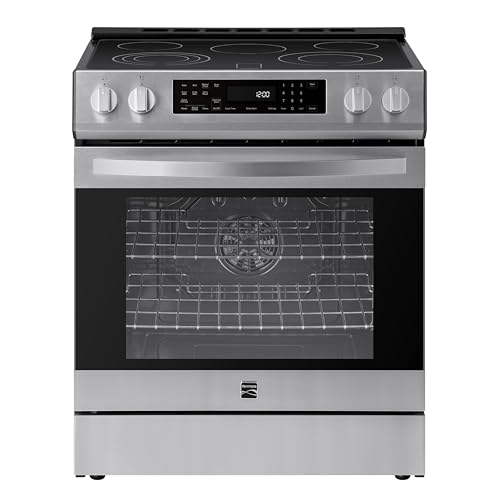
Kenmore 5.6 Front Control Electric Range — Best big-oven front-control pick
Kenmore’s entry is the capacity leader of this guide at 5.6 cu. ft., and it pairs that room with the control layout many cooks actively prefer: front controls, reached without leaning across burners. The title is unusually informative — true convection, five elements, steam clean, a broil function, chrome racks, precision set controls, and a large window all appear in it — which makes this the easiest pick here to evaluate from the headline alone, and the review can therefore spend its words on what those features mean in a working kitchen.
Front controls change small daily behaviours. Adjusting oven temperature mid-roast no longer involves reaching over a stockpot, and households with shorter cooks or seated cooks gain a layout that respects their reach. The large window and chrome racks belong to the same practical story: watching a bake without opening the door preserves the very heat true convection works to distribute, and sturdy racks matter when the oven’s extra capacity is filled with the heavy casseroles that capacity invites.
- Oven capacity: 5.6 cu. ft., the largest in this guide
- Controls: front control with precision set controls, as titled
- Cooktop: five elements; oven offers true convection and broil
- Cleaning and fittings: steam clean oven, chrome racks, large window
- Where to buy: the Kenmore 5.6 Front Control Electric Range listing on Amazon — check price on Amazon
Strengths
- The biggest cavity here, ready for holiday birds and double casseroles without juggling.
- Front controls remove the reach-across-the-burners problem entirely.
- A detailed title lets buyers verify the feature set before they ever open the product page.
Trade-offs
- Front controls sit within reach of curious small children unless a lock habit is formed.
- No air fry is named, despite the generous oven, so frozen-food fans should weigh the Frigidaire picks.
- A large cavity heats more air for a single small bake than a compact oven would.
Best for: households cooking big and often, especially where front controls suit the cook’s reach. Poorly suited to: solo cooks heating one small tray at a time.

Empava 30 Electric Range 4.8 Radiant Ceramic — Best radiant ceramic cooktop
The Empava takes a different route across the cooktop: a radiant ceramic surface with four elements over a 4.8 cu. ft. oven, in a body the title describes as both freestanding and slide-in capable. A smooth ceramic top changes the cleaning rhythm of a kitchen — spills wipe from a flat plane rather than pooling around coil rings — and it doubles as visual calm in a small kitchen where the range top often serves as extra landing space once cool.
Its title also contains this guide’s most useful piece of candour: 240V, power cord not included. That single parenthesis saves real frustration. A range arriving without its cord, in a home whose old cord is the wrong configuration, loses a day to a hardware run; a buyer warned in the headline orders the correct cord alongside and installs once. Steam clean in the oven rounds out a pick aimed at tidy, smaller households — including the many cottage and condo kitchens where a range shares duty with the laundry decisions we cover in Best Washer Dryers for Condos, since compact homes tend to choose every appliance by the same space-and-simplicity logic.
- Oven capacity: 4.8 cu. ft. as stated in the title
- Cooktop: radiant ceramic with four elements
- Format: freestanding and slide-in, stainless steel, 240V supply
- Cleaning named: steam clean; note the power cord is not included
- Where to buy: the Empava 30 Electric Range 4.8 Radiant Ceramic listing on Amazon — check price on Amazon
Strengths
- A flat ceramic surface wipes clean in seconds and calms the look of a small kitchen.
- Dual freestanding and slide-in positioning widens the openings this range can serve.
- The cord warning in the title prevents the classic delivery-day installation stall.
Trade-offs
- Four elements rather than five limits simultaneous pans on a busy evening.
- The smallest oven here asks large households to plan roasts more carefully.
- Ceramic glass rewards prompt spill cleanup, since burnt-on sugar needs attention, not neglect.
Best for: tidy cooks in smaller kitchens who prize a wipe-flat cooktop. A weak match for: five-pan cooks feeding a crowd from one cooktop.

Frigidaire Professional 30 Slide-in Electric Range with Air Fry — Best polished slide-in finish
The second Frigidaire in this guide earns its separate place through format and finish. This is a 30-inch slide-in with five elements, air fry, and what the title calls total convection, wearing the Professional badge that signals the brand’s more tailored styling. A slide-in sits flush among counters, controls move to the front, and the whole run of cabinetry reads as one fitted line — the look most kitchen renovations are actually chasing when they replace a range.
Total convection is Frigidaire’s own wording, and we repeat it as written rather than translating it into a rival’s vocabulary; paired with air fry, it gives this pick the broadest cooking-mode story of the six for a cook who roasts, bakes, and crisps in rotation. Households furnishing a whole cottage kitchen at once will recognise the pattern from other rooms: the reading corner gets the same deliberate treatment in our companion guide to Best Reading Chairs for Bedrooms, where fit and finish are weighed as carefully as they are here.
- Format: 30-inch slide-in, stainless steel, Professional series
- Cooktop: five elements, as titled
- Cooking modes named: air fry and total convection
- Oven capacity: not stated in the title — confirm on the listing page
- Where to buy: the Frigidaire Professional 30 Slide-in Electric Range with Air Fry listing on Amazon — check price on Amazon
Strengths
- Slide-in format delivers the fitted, front-control look renovations aim for.
- Air fry plus total convection covers crisping and even baking in one cavity.
- Five elements keep multi-pan evenings realistic.
Trade-offs
- Slide-in styling assumes counters and cabinets that meet it cleanly; rough openings suit freestanding picks better.
- The title omits oven capacity, so capacity-led buyers must check the product page.
- Polished finishes ask for a wipe-down habit to keep their tailored look.
Best for: renovators wanting a fitted front-control range with air fry. Not suited for: openings with uneven cabinet edges that a freestanding body would hide.
What Should You Measure Before a 30-Inch Range Arrives?
Measure the opening three ways: width at counter height, width at floor level, and depth from the wall to the front of your cabinets. Nominal 30-inch ranges are built slightly under the number so they can slide into a standard opening, but older cabinetry bows, flooring changes steal fractions, and a range that binds halfway in is a delivery problem, not a cooking one. Note the position of the receptacle as well; a box placed high on the wall can hold a range proud of the counters by an inch that shows in every photograph of your finished kitchen.
Then measure the route, not just the destination. Door widths, hallway turns, and the swing of the range’s own oven door all belong in the plan, as does the electrical check: a proper 240V range receptacle of the configuration your chosen model expects, and a cord ordered in advance if the listing — like the Empava’s — tells you none is in the box. Five minutes with a tape and a torch behind the old range prevents the most common range-buying regret, which is never about cooking at all.
Freestanding, Slide-In, or Front Control: Which Layout Fits Your Cooking?
Freestanding ranges carry finished sides and usually rear controls, tolerating imperfect openings and standing alone at the end of a cabinet run. Slide-ins trade that forgiveness for integration: front controls, an overlap onto the counter edges, and a built-in look that needs cabinetry ready to receive it. Front-control freestanding models, like the Kenmore here, split the difference — finished sides with controls you never reach across a burner to use.
Choose by behaviour rather than fashion. Cooks who simmer large pots while the oven runs will feel rear controls as a daily tax. Households with small children may prefer rear controls precisely because little hands cannot reach them. Renovations with stone counters cut for a slide-in should honour that cut. The layout question has no universal winner, which is why this guide deliberately keeps all three formats in play.
How Do You Keep an Electric Range Cooking Evenly for Years?
Level the range at installation and check it again after the first month; a range that rocks on one foot heats pans unevenly and rattles racks. Keep ceramic tops clean with prompt wiping once cool, lift rather than slide heavy cast iron across glass, and let steam-clean cycles do their light, regular work instead of waiting for a season of spills. Convection fans reward space: leave gaps between trays, avoid lining racks in ways that block airflow, and rotate pans only when a recipe truly needs it, since every door opening dumps the heat the fan worked to even out.
Once a season, pull the range forward if your installation allows, vacuum the dust that gathers behind it, and inspect the cord and receptacle for heat discolouration. Check the oven door seal by closing it on a strip of paper at several points; a seal that grips everywhere keeps temperatures honest. These are unglamorous habits, but a range is a fifteen-year appliance, and small maintenance is what separates the ones that cook evenly for all fifteen from the ones that drift.
Which Cleaning Method Matches the Way You Actually Cook?
Steam cleaning, named on four of these six listings, uses water and moderate heat to loosen light soil, and it shines under a little-and-often routine. It will not resurrect an oven neglected for a year, and no honest guide should pretend otherwise. What it does is lower the activation energy of cleaning until wiping the oven becomes a monthly ten-minute task rather than a dreaded event — and ovens that get cleaned monthly never need rescuing.
Match the method to your soil. Frequent roasters who catch drips early will live happily with steam alone. Households whose ovens see cheese-topped bakes and fruit pies bubbling over should read each listing’s full cleaning description on the product page before deciding, and should treat a removable oven floor or easy-wipe enamel as a feature worth weighing beside headline modes. The best cleaning system is the one whose effort profile matches your habits, because that is the one that will actually be used.
How Do Element Sizes and Pan Fit Change What Five Burners Can Do?
A cooktop’s usefulness hides in its geometry. Five elements crowded across thirty inches means at least two of them are small, intended for saucepans and simmering rather than for the wide skillet that anchors a family dinner. Before choosing, lay your own pans on the question: the largest skillet or griddle you own, the stockpot you reach for in soup season, and the small saucepan that heats sauce while everything else cooks. If those three cannot coexist on the diagram of a given cooktop, the element count is decoration.
Bridge and warming elements, where a listing names them, change the geometry again by letting long griddles or keeping zones join the working set. None of the six titles here leans on such claims, which keeps expectations honest: these are conventional layouts, and their strength is predictability. A cook who fries in a very wide pan most nights should favour the layout whose largest element sits at the front, because a big pan centred at the back pushes its handle and its steam into the wall and the cook alike.
Radiant ceramic tops add a different fit consideration. The printed rings on the glass describe where heat concentrates, and a pan much smaller than its ring wastes energy while a pan much larger heats unevenly at its edges. Coil elements forgive mismatched pans more readily but rock under warped bases. Either way, flat-bottomed cookware is the quiet requirement: a pan that spins on the surface will cook like it, whatever the element count promised.
What Does Oven Capacity in Cubic Feet Actually Predict?
Cubic feet sounds precise and behaves loosely. Manufacturers measure oven volume by conventions that can include space behind racks and below the floor, so two ovens with the same stated capacity can accept different pans. Treat the figures in this guide — 4.8, 5.3, and 5.6 cu. ft. among the picks that state them — as a ranking rather than a promise: the Kenmore will swallow more than the Empava, and both statements are safer than any claim about a specific bird.
The measurements that predict your cooking are the rack width, the height between rack positions, and the distance from the lowest rack to the broiler. A tall Dutch oven with its lid knob, a sheet pan with raised sides, a roasting rack sitting in a deep pan — these are the real tests. Where a title names a large window, as the Kenmore’s does, that is a practical feature rather than a styling one, because judging a bake through glass keeps the door shut and the temperature where you set it.
Households that bake in batches should also think about rack count and spacing under convection. Moving air helps only where air can move, and trays stacked tightly in a large oven can bake less evenly than trays given room in a smaller one. Capacity buys options; it does not bake the biscuits. The cook who understands that will get more from 4.8 honest cubic feet than a careless cook gets from the largest cavity in this guide.
Why Does the Control Panel Decide More Arguments Than the Cooktop?
Ask a household six months after a range purchase what they would change, and the answer is rarely about burners. It is about controls: a panel that collects steam and grease above the busiest pots, knobs a toddler can reach, a touch surface that beeps at a hip brushing past, or markings that fade into the stainless in low light. The three layouts in this guide — rear panels on the freestanding picks, front controls on the Kenmore and the slide-in Frigidaire Professional — distribute those annoyances differently, and your household’s habits decide which distribution you can live with.
Rear controls keep the panel away from small hands and give the cooktop a clean front edge, at the cost of reaching across heat. Front controls remove the reach and put settings where a seated cook or a shorter cook can work comfortably, at the cost of accessibility to children and the occasional accidental nudge. Neither is safer in the abstract; each is safer for a particular kitchen. What matters is choosing deliberately rather than discovering your preference after installation, when changing it means changing the range.
Legibility deserves a sentence of its own. Precision set controls, named in the Kenmore’s title, promise deliberate adjustment rather than vague dial sweeps, and any shopper comparing in a showroom should set a temperature and a timer on each candidate. The panel you can operate while holding a hot tray, with wet hands, in evening light, is the panel that belongs in your kitchen — a test no specification table can run for you.
How Should You Plan the Electrical Side of the Swap?
An electric range is among the largest loads in a house, and its swap deserves the same respect as any electrical work. Begin by identifying what already exists: the receptacle’s configuration behind the current range, the breaker that feeds it, and whether the existing cord matches the new model’s expectations. Listings state their voltage — the Empava’s title, for example, names 240V plainly — and a mismatch discovered on delivery day turns an exciting installation into a reschedule.
If your home’s wiring predates modern range circuits, or the receptacle shows heat damage, looseness, or scorching, bring in an electrician before the new range arrives rather than after. The same visit can confirm the breaker sizing and the cord choice, and it is far cheaper than an emergency call with a new appliance sitting in the middle of the kitchen. Renters should loop in the landlord at this stage too, since the receptacle and circuit belong to the property even when the range belongs to you.
Finally, plan the old range’s exit with the same care as the new one’s entrance. Measure the route for both, arrange removal or recycling through the retailer where offered, and keep the old unit cooking until the swap day is confirmed. A household that sequences these steps eats dinner at home every night of the project; a household that improvises them eats takeaway beside a range standing in the hallway, learning patience the expensive way.
What Separates a Range That Ages Gracefully From One That Dates Quickly?
Finishes and badges date; fundamentals do not. A range ages well when its oven heats evenly, its controls remain legible, its door seal keeps gripping, and its surfaces clean without special rituals. Stainless steel, shared by every pick in this guide, endures because it tolerates heat, resists staining, and matches appliances bought years apart — but it asks for a wipe along the grain and forgiveness for fingerprints in exchange.
Features age at different speeds too. Air fry and steam cleaning, named across these listings, describe durable cooking and cleaning methods rather than connected novelties, which bodes well for their usefulness in year ten. Modes tied to apps and accounts, by contrast, depend on software support lasting as long as the hardware. None of the six titles here leans on connectivity claims, and for an appliance bought to cook for fifteen years, that restraint reads as a virtue rather than a gap.
The last ageing factor is serviceability: a named model number, like the Midea’s MER30S2AST, and established badges make manuals, racks, and elements findable long after purchase. When two ranges cook alike on paper, the one whose parts you can still order in a decade is the one that will still be cooking in a decade. Longevity is a feature; it simply never gets its own line in the title.
How Do You Cook a Whole Week on One of These Ranges?
Walk a week through any pick in this guide and the differences sharpen. Monday’s sheet-pan dinner wants convection and a rack layout that lets a tray of vegetables sit beside a tray of chicken without crowding; the Forno’s true convection and both Frigidaire models answer that directly. Tuesday’s frozen pizza and nuggets are air fry territory, where the two Frigidaire picks turn the oven into the appliance a countertop basket usually plays, freeing worktop space in kitchens that have none to spare.
Wednesday’s soup lives on the cooktop, and here element placement takes over from oven modes: a stockpot simmering at the back while a small pan toasts spices at the front is the everyday choreography every layout here supports, though front-control owners will adjust the oven for the bread baking beneath without reaching across the pot. Thursday’s bake — bread, a tray of scones, a casserole for Friday — rewards the Kenmore’s large window, because watching through glass is how a cook learns an oven’s temperament without dumping its heat every ten minutes.
The weekend is where capacity speaks. A roast with two vegetable trays, a pie beneath, and rolls proofing in the residual warmth afterwards: that is the meal the Kenmore’s 5.6 cu. ft. was built for and the meal the Empava’s 4.8 cu. ft. asks you to sequence rather than stack. Neither answer is wrong. The household that cooks that feast monthly should buy for it; the household that cooks it twice a year should buy for the other fifty weeks and borrow a neighbour’s oven at Christmas.
Cleaning closes the week. Sunday’s wipe-down, done while the oven runs a steam cycle after the roast, is the habit the steam-clean picks are designed around, and it is worth stating plainly that the feature’s value compounds: an oven steamed monthly stays an oven you can steam, while an oven left for a year needs a different and harsher conversation. Choose the pick whose weekly rhythm matches yours, and the range will feel less like an appliance and more like a routine that runs itself.
What Should Renters and Landlords Agree Before a Range Is Ordered?
A surprising share of 30-inch electric ranges are bought for properties the buyer does not cook in: rentals, in-law suites, staff cottages, and first flats furnished by parents. Those purchases succeed on agreements rather than features. Who owns the range, who pays for the cord and any receptacle work, who holds the manual and the model number, and what happens to the old unit — four questions that take one phone call before ordering and one difficult conversation after delivery if skipped.
For the property itself, the virtues in this guide reorder. A named model with findable parts, like the Midea, and a cleaning method a tenant will actually use, like steam, outrank a degree of convection refinement no tenant will ever report. Durability of finish matters more than delicacy of styling, and a freestanding format that tolerates imperfect cabinetry suits older rental kitchens better than a slide-in that demands a fitted opening.
Tenants choosing their own range for a landlord’s kitchen should document the existing appliance’s condition, keep the old cord question in writing, and confirm the receptacle configuration with a photograph before ordering anything. The Empava’s title warning about its cord applies with double force here, because a rental’s receptacle is whatever the last renovation left behind. Get the photograph, match the cord, and the installation becomes the non-event everyone wants it to be.
How Do You Read a Range Title the Way an Installer Would?
Installers read titles backwards, starting from the constraints: fuel, width, voltage, cord, format. Shoppers read them forwards, starting from the pleasures: air fry, convection, finish. This guide has tried to teach the installer’s order without losing the shopper’s joy, and the six titles here repay the discipline. Each one, read backwards, confirms electric fuel at thirty inches; read forwards, each promises a different pleasure, from the Kenmore’s precision controls to the Empava’s ceramic calm.
Practise the backward read on any range you consider beyond this list. Find the fuel word and refuse substitutes. Find the width and compare it with your tape, not your memory of the old range’s width. Find the voltage and the cord note. Only then read the modes, and when you do, hold each mode to the title’s exact wording, because convection, true convection, and total convection are three claims, not one claim in three fonts.
That habit — constraints first, pleasures second, wording always — is the whole method of this guide compressed into a paragraph. It excluded the gas ranges hiding in electric searches, it surfaced the one pick that ships without a cord, and it kept six genuinely different ranges distinct on the page. Carry it to every appliance purchase and the delivery day will keep being the boring, successful day it ought to be.
Which Pick Suits Which Kitchen? A Household-by-Household Walk-Through
Consider the family of five in a house whose kitchen has not been remodelled since the children arrived. Their range works every day, hosts a Sunday roast, and absorbs the spills of cooks still learning. For them the freestanding Frigidaire’s combination of a 5.3 cu. ft. oven, air fry for the week’s frozen staples, and steam cleaning matched to steady soiling is not a compromise but a portrait of their kitchen. Finished sides forgive their cabinetry, and the rear panel keeps settings out of the reach of the youngest cook in the house.
Now consider the keen baker in a small city flat, cooking for one or two but baking for a whole friendship circle. Her limiting factor is not capacity but evenness: two trays at once, browning alike. The Forno Paolo’s titled true convection speaks directly to her, and the Empava runs second in her affections for different reasons — a ceramic top that wipes clean after candied spills and a footprint of features sized to a flat where every appliance must justify its presence daily.
The renovator finishing a cottage kitchen, counters newly cut and a reading chair waiting in the next room, is the Frigidaire Professional’s natural owner: slide-in lines, front controls, and air fry under a polished badge. The landlord equipping a tidy rental reaches instead for the Midea’s named model and steam-clean simplicity, valuing the manual he can file and the parts he can order. And the multigenerational household, where a grandparent cooks seated and a holiday bird anchors the year, belongs to the Kenmore — front controls at a reachable height, the largest oven here, and a window that lets everyone watch the feast without opening the door on it.
None of these households bought the wrong range by choosing differently from the others. Each read the same six titles through a different life, which is precisely what a guide should enable. If your household resembles two of these portraits at once, weigh the feature you will use weekly over the one you will use at holidays, because weekly features compound into satisfaction while holiday features mostly compound into stories.
Common Mistakes When Replacing a Range
The costliest mistake is assuming the new range matches the old one’s fuel and cord. Kitchens get remodelled in stages; a home may hold a gas line capped behind an electric range, or a receptacle configured for a cord the new listing does not supply. Verify both before the delivery truck is booked. The second mistake is measuring only the opening and forgetting the route — a range that cannot turn the hallway corner is a range going back on the truck.
Third, shoppers chase element counts while ignoring element sizes; five elements help only if one of them fits your largest pan. Fourth, convection wording gets skimmed: plain convection, true convection, and branded variants describe different hardware, and the title’s exact phrase is the claim you can rely on. Finally, many buyers never check how the oven door and storage drawer interact with nearby cabinet handles — open every door and drawer in the showroom of your mind before the range is in the room.
Final Recommendation
For most households, the freestanding Frigidaire with air fry and steam cleaning is the balanced answer: a 5.3 cu. ft. oven, the modes a family week actually uses, and a format that forgives ordinary cabinetry. Bakers should step to the Forno Paolo for its titled true convection, capacity hunters to the Kenmore’s 5.6 cu. ft. and front controls, and renovators to the Frigidaire Professional slide-in. The Midea suits a named-model, steam-clean simplicity, and the Empava serves tidy smaller kitchens that value a ceramic top. Measure honestly, verify the cord, and the range you choose will disappear into your cooking — which is where a good range belongs, noticed only on the evenings it helps you feed people well.
What Happens on Delivery Day, Step by Step?
Delivery day goes well when it has been rehearsed. The old range is disconnected and moved along the route you measured, the receptacle is inspected while the opening stands empty — the one moment in fifteen years when cleaning behind the range costs nothing — and the new range comes in on the same path, levelled on all four feet before its first pan is heated. Keep the manual, the model number, and a photograph of the rating plate in one folder, physical or digital, because every future question about parts begins with those three items.
Run the new oven empty through a first heating cycle as its manual directs, since manufacturing residues burn off with an odour that should not season your first dinner. Boil a kettle of water on each element, open and close every drawer and door, and set the clock and a timer while the delivery crew is still within call-back distance. Small faults — a rack that binds, a knob that sits crooked — are trivially fixed in that first hour and oddly easy to live with unreported for years if the moment passes.
Keep the packaging’s corner protectors and the delivery paperwork until the first full cooking day has passed without a fault, since returns and warranty conversations both begin with documents nobody expects to need. Photograph the installed range from the front and from each side while the light is good; those images record clearances, finish, and the way the body meets your counters, and they settle questions with retailers far faster than descriptions do. Small paperwork habits like these feel fussy on delivery day and priceless in month nine.
Then cook something forgiving. A tray of roast vegetables tells you where the hot corners live; a batch of biscuits maps the evenness better than any thermometer reading. Every oven has a temperament, and the first week is when you learn yours — after that, the range stops being new equipment and becomes the kitchen’s quiet centre, which is the entire point of choosing it carefully.
Frequently Asked Questions
Does a 30-inch electric range need a special outlet?
Yes. These ranges run on a 240V range receptacle, not a standard wall socket, and the cord configuration must match your receptacle. One pick in this guide, the Empava, states that its power cord is not included, so check each listing and order the correct cord with the range rather than after it.
What is the difference between convection and true convection?
Plain convection circulates oven air with a fan. True convection adds a heating element around that fan, so the moving air is itself heated, which generally evens out multi-rack baking further. Brands also use their own terms, such as total convection, and we repeat each title’s wording rather than treating the phrases as interchangeable.
Can a slide-in range replace a freestanding one in the same opening?
Usually, provided the opening width matches and your counters can meet the slide-in’s edges cleanly. Slide-ins have unfinished sides designed to sit between cabinets, so an opening at the end of a run may show gaps a freestanding body would have covered. Measure, and look at the ends of your cabinet run before deciding.
Do I need to remove the old range before the new one arrives?
Having the opening empty and clean when the crew arrives keeps the swap short and lets you inspect the receptacle and floor that the old range hid for years. If removal is part of your delivery arrangement, confirm it in advance rather than assuming it, and confirm where the old unit goes. Photograph the empty opening and the receptacle before the new range slides in; those pictures answer questions that arise months later about cords, clearances, and what the floor looked like before.
Is steam cleaning enough for a heavily used oven?
Steam cleaning handles light, regular soil very well and encourages the frequent cleaning that prevents heavy build-up. An oven with long-neglected, baked-on soil may need more than steam at first. Read the full cleaning description on the listing page and match the method to your habits honestly.
Should I keep my old range’s cord for the new range?
Only if its configuration matches the new model’s requirements and it shows no heat damage, fraying, or loose blades. Cords age with the appliance, and a new range on a tired cord saves a small sum at the exact point where the circuit works hardest. When a listing states the cord is not included, treat a fresh, correctly rated cord as part of the purchase and order it at the same time.
How many elements do I really need?
Five elements give flexibility for multi-pan meals, but element size and placement matter as much as count. A four-element ceramic top, like the Empava’s, serves smaller households comfortably. Think about your largest pan and your busiest evening, and let those two facts choose.
Related Guides
Range widths change what a kitchen can do, and our library covers the neighbouring sizes with the same fuel-checking discipline. Readers working with a compact opening should start with Best 20-Inch Electric Ranges, where four burners and a real oven fit a footprint ten inches narrower than the standard slot.


