What's inside
- Key Takeaways
- Quick Picks
- How We Chose These Picks
- The Best Electric Pressure Cookers, Reviewed in Detail
- How Do the Six Electric Pressure Cookers Compare Side by Side?
- What Does Ten-in-One Actually Mean, Function by Function?
- How Do Modern Lids and Steam Release Systems Keep You Safe?
- How Should You Choose Between Six, Six-and-a-Half and Eight Quarts?
- What Is Sous Vide Doing on a Pressure Cooker, and Is It Worth Using?
- How Do You Maintain Pressure, Seals and Valves Across Years of Use?
- High Pressure, Low Pressure — What Is the Difference in the Food?
- How Do Sensors and Smart Programmes Actually Help?
- Which Cooker Suits Which Kind of Cook?
- How Does an Electric Pressure Cooker Change Batch Cooking and Freezing?
- How Do You Cook Two Dishes at Once With Pot-in-Pot?
- Does Altitude Change How These Cookers Behave?
- What Should You Know About Warranties, Support and Longevity at Each Rung?
- What Are the Most Common Mistakes When Shopping the Full Range?
- Final Recommendation
- Frequently Asked Questions
- Related Guides
As an Amazon Associate I earn from qualifying purchases. This post may contain affiliate links at no extra cost to you.
cottageverdict.com is reader-supported. When you buy through links on our site, we may earn an affiliate commission.
Where to buy: the six cookers below are all sold on Amazon, and the names throughout the Quick Picks table and the detailed reviews link to their listings so you can check price on Amazon as you compare. This guide to the best electric pressure cookers takes the whole category in view — not just the entry models, but the full ladder from the proven six-quart classics up to the ten-function flagships with stay-cool lids, whisper-quiet steam release and pots that move from cooker base to stovetop. The electric pressure cooker has quietly become the hardest-working appliance in the modern kitchen, and the interesting question is no longer whether the format works, but how far up its range your cooking actually needs to climb.
The best electric pressure cookers divide by ambition. At one end sit the benchmark machines that defined the category and still cook superbly with a minimum of ceremony. In the middle, the nine-function models add sous vide, clearer displays and calmer steam handling. At the top, the Pro-class cookers rethink the hardware itself: lids that diffuse steam instead of jetting it, inner pots with handles that can sear on a gas hob, and pressure systems tuned for quieter, faster, more precise work. This guide walks that ladder rung by rung, with an honest account of which upgrades change dinner and which merely change the brochure.
Key Takeaways
- Six quarts remains the centre of the category, but eight-quart flagships now serve large households without a performance penalty.
- The flagship upgrades that matter are hardware: diffuser lids, stovetop-safe handled pots and gentler steam release, not extra presets.
- Ten-in-one means the core pressure functions plus sous vide, yoghurt, sterilise and their neighbours — useful breadth, honestly labelled.
- Safety is a system, not a feature: lid interlocks, pressure sensors and controlled venting should all be present and boringly reliable.
- Every cooker here rewards correct fill discipline — two-thirds maximum, half for foaming foods — whatever its price.
Quick Picks
| Pick | Badge | Why it earns its place |
|---|---|---|
| Instant Pot Pro 6 Qt 10-in-1 | Best Overall Flagship | Handled stovetop-safe pot, gentle steam diffusion and the fullest function set in six quarts |
| Instant Pot Pro 8 Qt 10-in-1 | Best for Large Households | The complete Pro package scaled to eight quarts for crowds and serious batch work |
| Ninja HyperHeat 9-in-1 Pressure Cooker 6.5 Qt | Best Fast Searing Performer | Ninja’s power-led take on the format, built around rapid cooking and a strong sauté game |
| Instant Pot Duo Plus 6 Qt 9-in-1 | Best Mid-Range All-Rounder | The classic platform matured, with a clear display and calmer steam release |
| Cosori Pressure Cooker 6 Qt 9-in-1 | Best for Easy Cleaning | Ceramic-coated pot and a thorough safety roster in a modern stainless design |
| Instant Pot Duo 6 Qt 7-in-1 | Best Proven Classic | The category’s benchmark, still the reference for recipes, spares and reliability |
How We Chose These Picks
An overview of electric pressure cookers has to judge two different things at once: the cooking, which is remarkably consistent across the serious end of this market, and the ownership, which is where the models genuinely separate. On cooking, we looked for even pressure, a sauté function with enough power to brown rather than stew, and rice and grain programmes that respect the difference between the two. On ownership, we weighed the lid as a daily object — how it opens, where it rests, how its steam behaves — the inner pot as a piece of cookware in its own right, and the control system as something a person must read at a glance while dinner is underway.
Safety received its own audit rather than a line in a checklist. A modern electric pressure cooker should make its dangerous state impossible to ignore and impossible to open: the lid interlock, the float valve’s visible position, the pressure and temperature sensors behind the programmes, and a release path that directs steam away from the hand performing it. All six cookers here satisfy that standard; where they differ is in refinement, with the flagship lids venting steam as a soft diffusion rather than a startling jet — a difference you feel in your shoulders every single time you cook.
We also insisted on range honesty. A guide to the whole category that pretended the flagship’s price bought three times the cooking would be lying, and one that pretended the classic’s age made it obsolete would be lying in the other direction. The truth this guide is organised around: pressure cooking itself plateaued early and brilliantly, so money spent climbing the range buys control, quiet, capacity and cookware quality. Whether those are worth buying depends on how often the machine will run — which is why each review below names its natural owner rather than a universal winner.
The Best Electric Pressure Cookers, Reviewed in Detail

Instant Pot Pro 6 Qt 10-in-1 — Best Overall Flagship
The Pro is Instant Pot rebuilding its flagship around the pot itself, and the redesign is more radical than the familiar black silhouette suggests. The inner pot gains stay-cool silicone handles and a flat, tri-ply base that is safe on stovetop burners, which quietly changes the cooking workflow: you can sear on the hob with real heat, carry the pot to the base by its handles, and pressure cook in the same vessel, then carry it to the table without a mitt-and-prayer manoeuvre. It sounds like a detail. Across a hundred dinners it is the difference between an appliance you use and a piece of cookware you happen to plug in.
The lid receives the same seriousness. Its steam release is engineered to be gentle and diffused, with an extra muffling cover that turns the dramatic hiss of older models into something closer to a sigh — a change that matters in open-plan kitchens and sleeping-baby households. The control panel offers twenty-eight customisable settings across its ten functions, including sous vide, and remembers the adjustments a household actually makes, so the machine gradually becomes tuned to its owners rather than to a factory’s guesses. Pressure cooking itself is marginally quicker to temperature than the classic line, helped by a higher-powered element.
Who should pay the flagship price? The cook who will use the machine several times a week, who sears before stewing as a matter of doctrine, and who values a quiet kitchen. Who should not: the occasional user, for whom the same money buys a classic cooker plus a year of good ingredients. The Pro does not cook a better bean than its ancestors; it cooks every bean with less friction, less noise and better tools, and at the top of this category that is exactly what flagship money is for.
- Capacity: 6 quarts with a handled, stovetop-safe inner pot
- Functions: 10-in-1 with sous vide and customisable settings
- Steam release: gentle, diffused and muffled design
- Controls: dial-led interface with programme memory
- Best role: the high-frequency cook’s main cooker
Strengths
- Handled pot transforms searing and serving
- Quietest, calmest steam release in the range
- Deep customisation rewards regular users
Trade-offs
- Flagship pricing for refinements, not miracles
- More settings than casual cooks will explore
- Handled pot costs more to replace than plain ones
Best for: frequent pressure cooks who sear, stew and serve from one pot.
Not suited for: occasional users better served by the classic models.
Instant Pot Pro 8 Qt 10-in-1 — Best for Large Households
Scaling a pressure cooker up is not just a matter of a bigger pot, and the eight-quart Pro shows the engineering that honest scaling requires. The heating element is more powerful, because eight quarts of cold stew is a serious thermal load; the lid and its diffuser system are sized for the larger steam volume; and the whole machine keeps the Pro line’s handled, stovetop-safe inner pot, which at this capacity stops being a convenience and becomes close to a necessity — an eight-quart pot of braise is a heavy, hot object, and handles that stay cool are a safety feature wearing a convenience costume.
The working numbers define its owner. Filled to the responsible two-thirds line, this cooker holds roughly five quarts of finished food: a double batch of chilli, a whole large chicken with room for the vegetables to matter, stock from two carcasses, or the pulled pork for a gathering without a second session. Large families, batch cooks and anyone who hosts in double digits will recognise their kitchen in that list. The ten-function breadth — pressure, slow, rice and grains, steam, sauté, sous vide, yoghurt, sterilise, warm and the rest — scales with it, so the big machine is not a narrower tool but the full flagship, enlarged.
The costs of size are physical rather than culinary. This cooker claims a wide patch of counter and a deep cupboard, it is slower to pressurise a small meal than a six-quart machine would be, and its pot fills a domestic sink with intent. Households of two should admire it and buy its smaller sibling. Households whose Sunday cooking feeds the week, or whose table regularly seats eight, will find it the most capable electric pressure cooker in this guide — the flagship experience without the batch compromise.
- Capacity: 8 quarts, about five quarts of working volume
- Functions: the full 10-in-1 Pro programme set
- Inner pot: handled and stovetop-safe, as the six-quart Pro
- Steam release: diffused, scaled for the larger pot
- Best role: large families and batch cooking
Strengths
- Flagship features at genuine gathering scale
- Handled pot is near-essential at this weight
- One session replaces two in smaller cookers
Trade-offs
- Demands serious counter and cupboard space
- Overkill and slower for small daily meals
- Heavy pot when full, even with good handles
Best for: big households, hosts and freezer-filling batch cooks.
Not suited for: couples or anyone storing appliances in shallow cupboards.

Ninja HyperHeat 9-in-1 Pressure Cooker 6.5 Qt — Best Fast Searing Performer
Ninja approaches the pressure cooker the way it approaches every category: as a power problem. The HyperHeat is a 6.5-quart, 1200-watt machine whose marketing claim of cooking up to twice as fast rests on aggressive heating and a sear-and-sauté function with genuine authority — the stage where lesser cookers merely warm ingredients in their own juices while calling it browning. In a pressure cooker, that stage is not decoration: the fond built during a proper sear is the flavour foundation of every stew that follows, and a machine that browns convincingly in its own pot removes the hob pan from the workflow entirely.
The nine functions cover the modern spread — pressure, sear and sauté, slow cook, steam, sous vide and companions — arranged in Ninja’s assertive, legible control style. The pot is PFAS-free with a removable design that cleans easily, and the 6.5-quart capacity is a shrewd in-between size: a little more working room than the six-quart standard for family stews, without the eight-quart machine’s storage appetite. The Blue Macaron finish will divide opinion; it is either a welcome refusal of appliance black or a colour commitment, depending on the kitchen it lands in.
Ninja’s ecosystem is the consideration a buyer should weigh alongside the hardware. The brand’s recipes and accessories orbit its own machines, and while the fundamental techniques transfer freely from the wider pressure-cooking world, the deepest bench of community knowledge in this category still wears Instant Pot colours. Choose the Ninja for its heat and its sear — legitimate, dinner-changing strengths — and accept that you are joining the smaller of the two great tribes.
- Capacity: 6.5 quarts, a useful step above standard
- Power: 1200W with an emphatic sear and sauté stage
- Functions: 9-in-1 including steam and sous vide
- Inner pot: PFAS-free and removable for cleaning
- Finish: Blue Macaron, distinctly non-standard
Strengths
- The strongest browning performance in this guide
- Fast heating suits impatient weeknight cooking
- Capacity sweet spot between six and eight quarts
Trade-offs
- Smaller recipe and accessory ecosystem
- Colour finish will not suit every kitchen
- Power-led style is less gentle with delicate dishes
Best for: cooks who sear hard and value speed above ecosystem.
Not suited for: buyers who want the largest community recipe library.

Instant Pot Duo Plus 6 Qt 9-in-1 — Best Mid-Range All-Rounder
Viewed across the whole category, the Duo Plus occupies the rung where refinement and restraint balance. It keeps the classic platform’s virtues — the six-quart stainless pot, the unmatched spares network, the recipe universe written in its image — and directs its extra money at the two interfaces a cook touches constantly: the display and the steam release. The large blue readout shows the cooking stage plainly enough to read across a kitchen, which sounds trivial until you have squinted at a lesser panel with wet hands and a sauce underway. Information, in a pressure kitchen, is a safety feature and a confidence feature at once.
The nine functions broaden the classic set in directions households genuinely use. The egg programme removes guesswork from a weekly staple, the cake setting turns the pot into a steamer-oven for dense, moist bakes, and sterilise handles jars, bottles and utensils with a thoroughness a dishwasher cycle approximates but does not equal. Sous vide is absent — that is Pro and Cosori territory — and its absence is the honest price of this rung; buyers who know they want water-bath cooking should climb, while buyers who merely like the sound of it should note how rarely the sound becomes a habit.
As an all-rounder the Plus makes its case through accumulation rather than a single headline: a lid that parks in its own handles, a release control placed away from the steam’s first rush, a pot that every accessory maker supports. In a category overview it is the cooker against which both directions must justify themselves — the flagships must prove their refinements are worth doubling down for, and the classic must argue that its savings outweigh this machine’s daily calm. Many households, reading both arguments, will land exactly here.
- Capacity: 6 quarts, the category’s standard size
- Functions: 9-in-1 including cake, egg and sterilise
- Display: large, legible cooking-stage readout
- Steam release: repositioned for a cooler hand
- Inner pot: stainless, fully accessory-compatible
Strengths
- The balanced midpoint of features and price
- Display clarity improves everyday confidence
- Full access to the deepest spares ecosystem
Trade-offs
- No sous vide at this rung of the ladder
- Plain pot without the Pro’s handles
- Steam release calmer than classic, louder than Pro
Best for: households wanting one mature, versatile family cooker.
Not suited for: sous vide enthusiasts or bargain-first buyers.
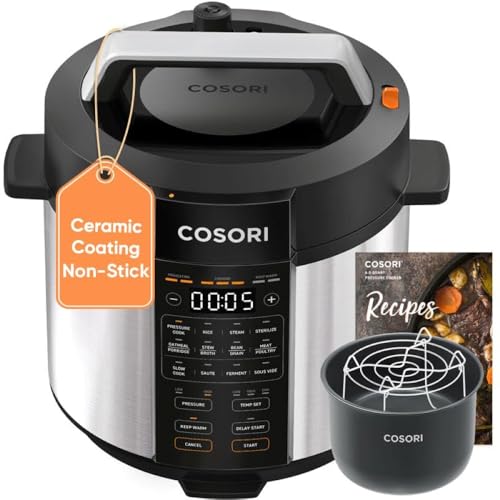
Cosori Pressure Cooker 6 Qt 9-in-1 — Best for Easy Cleaning
In a full-range overview, Cosori’s six-quart cooker earns attention for treating cleanup and safety as headline engineering rather than fine print. Its ceramic-coated inner pot changes the daily texture of ownership: rice releases without the crunchy welded layer, bean dishes rinse away instead of soaking overnight, and the pot can be trusted to nonstick habits that bare stainless never quite permits. For households whose pressure cooking happens three or four nights a week, that difference compounds into the feature they would surrender last — a useful corrective to the assumption that flagship money is the only money that buys quality of life.
The safety architecture deserves the same emphasis here as in any flagship discussion. Cosori lists a dozen protective features, and behind the count sits a coherent system: the lid must be correctly seated before pressure can build, sensors govern temperature and pressure continuously, and the steam release is shaped to direct the jet away from the operating hand. In a category where trust is the product, that roster places this cooker in the first rank regardless of its price rung. Its 1100 watts and stainless body complete a specification that reads modern in every line.
Its nine functions include sous vide, which makes the Cosori the least expensive route in this guide to water-bath cooking — a genuine rung-skipping trick for the curious. The counterweights are ecosystem depth and coating mortality: Cosori’s spares and community recipes are growing rather than grown, and a ceramic surface, however good, is a surface with a lifespan that stainless does not share. Buy it as the thinking household’s value flagship, maintain the coating with soft tools, and it will hold this position in the range for years.
- Capacity: 6 quarts in a stainless housing
- Functions: 9-in-1 with sous vide included
- Inner pot: ceramic-coated for release and rinsing
- Safety: a dozen listed protective systems
- Power: 1100W heating element
Strengths
- Easiest cleanup of any cooker in this guide
- Sous vide without climbing to flagship prices
- Safety engineering presented and built seriously
Trade-offs
- Coating requires gentler care than bare steel
- Community and spares still maturing
- No handled or stovetop-safe pot option
Best for: frequent cooks who prize easy washing and modern safety design.
Not suited for: buyers wanting the largest accessory marketplace.

Instant Pot Duo 6 Qt 7-in-1 — Best Proven Classic
Any honest survey of this category ends by genuflecting to the machine that created it, and the six-quart Duo’s presence in a 2026 overview is not nostalgia — it is measurement. Strip away every advance the newer models advertise and ask what remains: pressure cooking that is fast, even and repeatable; a sauté function adequate to build a stew’s foundation; rice, steam, slow cook and yoghurt programmes that cover the weekly repertoire; and a stainless pot that will outlast the electronics around it. What remains, in other words, is roughly ninety percent of what any electric pressure cooker ever does for any household, delivered by the most documented and repairable design in the field.
The Duo’s role in the range has clarified with age. It is the control group: the cooker whose performance defines the baseline that flagships must beat in experience rather than in cooking, because in cooking they mostly match it. Its membrane buttons and modest display are the visible price of that position, and its steam release — a bare valve and a confident hand — is the one place where newer lids genuinely improve on it in daily feel. Owners adapt within a week; the design’s defenders note, fairly, that a simpler interface has fewer ambitions to fail.
For the overview buyer, the Duo poses the category’s essential question in its purest form: is your money buying dinners, or buying the experience of making them? Both are legitimate purchases. But a household equipping a first serious kitchen, or a second home, or a student flat with ambitions, will find no cooker in this guide that converts money into pressure-cooked dinners more efficiently — and the flagships above it on the ladder are best understood as refinements of the standard this machine set.
- Capacity: 6 quarts, the size recipes assume
- Functions: 7-in-1 covering the weekly core
- Inner pot: stainless steel with tri-ply base
- Legacy: the deepest documentation of any model
- Best role: baseline excellence and second kitchens
Strengths
- The reference standard for recipes and timing
- Simplest, most repairable design in the range
- Stainless pot built for a decade of service
Trade-offs
- Basic display compared with newer panels
- Steam release is the least refined here
- No sous vide or diffuser-lid refinements
Best for: purists, first kitchens and anyone buying the proven baseline.
Not suited for: cooks seeking flagship quiet and customisation.
How Do the Six Electric Pressure Cookers Compare Side by Side?
| Pick | Capacity | Functions | Defining strength |
|---|---|---|---|
| Pro 6 Qt | 6 Qt | Ten functions | Handled stovetop-safe pot, quiet release |
| Pro 8 Qt | 8 Qt | Ten functions | Flagship features at gathering scale |
| Ninja HyperHeat | 6.5 Qt | Nine functions | Searing power and heating speed |
| Duo Plus | 6 Qt | Nine functions | Display clarity and balanced refinement |
| Cosori | 6 Qt | Nine functions | Ceramic pot and safety roster |
| Duo Classic | 6 Qt | Seven functions | Proven baseline, deepest ecosystem |
The comparison clarifies what climbing this range actually purchases. Capacity changes who the cooker serves. The pot’s construction changes how cooking feels — searing on a hob, rinsing a ceramic surface, scrubbing immortal stainless. The lid’s steam behaviour changes the emotional temperature of every single use. What barely changes is the stew. A buyer who understands that sentence can shop the table in any direction with confidence, because the right rung is the one whose refinements match the frequency and style of their own cooking, not the one with the longest function list.
What Does Ten-in-One Actually Mean, Function by Function?
The arithmetic of multi-cookers invites scepticism, so it is worth unpacking honestly. The genuine, mechanically distinct functions in a modern ten-function machine are these: pressure cooking, which is the engine; sautéing, which is the same heating element used with the lid off; slow cooking, which is low, unpressurised heat over hours; steaming, which is pressure or near-pressure heat applied briefly; and sous vide, which is precise low-temperature water circulation by careful element control. Around that honest core orbit the programme presets — rice, grains, yoghurt, sterilise, cake, egg, keep warm — which are real conveniences built from the core functions plus tuned timings and temperatures. Yoghurt, for instance, is a low, steady incubation heat; sterilise is a full-pressure cycle held for cleaning rather than cooking.
Judged that way, a ten-function flagship is not ten appliances, but neither is it a fraud: it is five genuine methods and a library of well-tested automation, in one vessel that also stores itself. The practical question for a buyer is which of the five methods their household will truly use monthly. Pressure and sauté are universal. Slow cooking suits the plan-ahead cook. Sous vide suits the experimenter and the steak perfectionist. A household that will use three methods weekly is buying well at any rung; a household buying ten methods for one fantasy dinner party is subsidising the brochure.
How Do Modern Lids and Steam Release Systems Keep You Safe?
Safety in this category is best understood as layers that assume each other’s failure. The first layer is mechanical: the lid cannot be opened while pressure remains, because the float valve physically blocks rotation until it drops, and the lid cannot build pressure at all unless it is fully locked — the machine checks, and refuses politely, rather than hoping the user noticed. The second layer is sensory: temperature and pressure are monitored continuously, and the element is governed to hold the programme’s target rather than simply heating until a timer complains. The third layer is venting: steam leaves by a designed path, at a designed rate, in a designed direction.
The newest lids add refinement to that third layer. Diffuser caps break the release jet into a softer, wider flow, and sealed release switches let the user trigger venting from a control positioned away from the steam’s exit. The result is not merely quieter — it is calmer, and calm users make fewer mistakes around hot equipment. When comparing models, the safety questions worth asking are therefore behavioural: Can I tell at a glance whether the pot is pressurised? Does the release keep my hand out of the jet? Does the lid announce a bad seal before pressure builds? Every cooker in this guide answers those well; the flagships simply answer them with better manners.
How Should You Choose Between Six, Six-and-a-Half and Eight Quarts?
Start from the working volume, not the headline. Pressure cookers fill to two-thirds for ordinary foods and to one-half for beans, grains and anything that foams, so the honest capacities in this guide are roughly four quarts for the six-quart machines, a little more for the Ninja’s six-and-a-half, and about five and a third for the eight-quart Pro. Map those numbers against the largest meal you cook monthly — not annually — and the choice usually makes itself. A family of four with leftovers ambition fits the six-quart class exactly, which is why the entire industry is built around it.
The edge cases argue upward or sideways. Households that cook for gatherings, meal-prep in freezer batches, or braise very large joints will feel the six-quart ceiling weekly and should take the eight. Households drawn to the Ninja’s searing power gain a small capacity bonus as a side effect. What should not drive the decision is the fantasy of the one enormous annual cook: renting, borrowing or splitting that single event across two sessions is cheaper than storing an oversized machine for the other fifty-one weeks. Capacity is the one specification you cannot upgrade later, so choose it for your real calendar, generously but honestly.
What Is Sous Vide Doing on a Pressure Cooker, and Is It Worth Using?
Sous vide migrated onto multi-cookers because the hardware overlaps: a vessel, a heating element and a temperature sensor are most of a water bath already. In practice, the better implementations in this guide — the Pro models and the Cosori — hold water at a set temperature accurately enough to cook the foods where the technique shines: steaks taken to an exact doneness edge to edge, chicken breast that stays juicy because it never overshoots, eggs at precise textures, and vegetables that keep their character. The pot’s own lid and insulation help stability, and there is no separate circulator to store, which for the curious cook is the entire argument.
The limitations deserve equal clarity. A static bath without a circulator has gentle hot and cool spots, so very long cooks and very full pots are less even than a dedicated device delivers, and the bath size is the pot size — no holiday brisket baths here. Treat cooker-based sous vide as an excellent apprenticeship: if it becomes a weekly passion, a dedicated circulator is a future purchase you will make with knowledge; if it remains a monthly pleasure, the built-in version was all you ever needed. Either way, its presence on the flagship and mid-range models is a genuine capability, not a sticker.
How Do You Maintain Pressure, Seals and Valves Across Years of Use?
Long-term performance in this category is a story of small rubber and metal parts. The silicone sealing ring does the hardest work — flexing, heating, absorbing the aromas of every stew — and it is a consumable by design: expect to replace it every year or two, sooner if steam starts escaping at the rim or if yesterday’s curry haunts today’s rice. The float valve and its cap need rinsing after starchy cooks, because dried foam in the valve channel is the quiet enemy of both sealing and safety. The anti-block shield under the lid should be removed and washed on the same schedule, and the rim’s sealing channel wiped before it builds a crust that mimics a failing ring.
The inner pot rewards the care appropriate to its material: stainless tolerates nearly anything, ceramic coatings ask for soft tools and no thermal shock, and the Pro’s handled pot adds the rule that its stovetop talents do not extend to induction abuse or empty preheating. Store any of these machines with the lid resting ajar or inverted, so seals air and odours leave, and keep the condensation cup emptied. None of this is burdensome; all of it is the difference between a cooker that performs like its first year and one that slowly becomes a cautionary tale at no fault of its engineering.
High Pressure, Low Pressure — What Is the Difference in the Food?
Most cooking in these machines happens at high pressure, where the sealed environment lifts the boiling point of water well beyond its open-pot limit and drives heat into dense foods at a pace no simmer can match. That is the setting for braises, beans, stocks and grains — foods whose transformation is about time and penetration. Low pressure is the gentler register, suited to foods that high pressure would bully: delicate vegetables that should stay distinct, fish that needs minutes rather than force, eggs in their shells, and custards or cheesecakes that set best without violent agitation in the pot. The better machines in this guide make the distinction a first-class control rather than a hidden programme, which is one of the quieter ways the modern range outclasses its ancestors.
Understanding the two registers changes how recipes read. When a recipe specifies low pressure, it is usually protecting texture, not saving time; substituting high pressure for half the minutes rarely produces the same plate, because the food experiences a different temperature, not merely a shorter one. Conversely, timid cooks who run everything on low out of caution discover that beans stay stubborn and braises stay stringy — the method’s magic lives at the top of the dial. The flagship customisation in the Pro models exists largely to let experienced users tune exactly this variable per dish and save the result, turning a two-register instrument into a personal one.
How Do Sensors and Smart Programmes Actually Help?
It is easy to dismiss smart programmes as marketing, but the sensing underneath them does real work. A modern electric cooker watches temperature at the pot’s base and infers pressure behaviour from it, adjusting the element in small corrections rather than crude on-off bursts. That governance is why the same programme produces consistent rice across seasons and kitchens: the machine is steering, not merely heating. Programmes for rice and grains encode different steering — absorption curves, rest periods, pressure profiles — which is why a grains programme outperforms a generic timer on the same food even though both, in the end, apply heat in a sealed pot.
The burn protection that frustrates beginners is the same system thinking defensively: a base temperature rising too fast signals liquid starvation, and the machine intervenes before food welds itself to the pot. Owners who understand that the warning is a sensor’s opinion, usually a correct one, learn faster than owners who treat it as a defect. Where the flagships extend the idea is memory — settings that persist, favourites that recall a household’s tuned timings — so the intelligence accumulates around your cooking instead of resetting to factory assumptions every time the lid closes.
Which Cooker Suits Which Kind of Cook?
Consider four kitchens. The weeknight pragmatist cooks three dinners a week under time pressure, values a display readable at a glance and a release that does not startle, and belongs in the Duo Plus or the Cosori depending on whether scrubbing or sous vide tempts them more. The technique cook sears on principle, tweaks timings, keeps notes, and will use the Pro’s handled pot and saved settings weekly — the flagship premium is, for this kitchen, simply the price of the right tool. The gathering cook measures success in portions and freezer containers, and the eight-quart Pro is the only machine here that respects that arithmetic. The power cook, impatient and fond of deep browning, is the Ninja’s natural citizen.
Notice that none of these portraits is about wealth; they are about frequency and style, which is why this guide resists crowning a single winner for all kitchens. A cooker matched to its cook gets used five hundred times. A cooker bought as a trophy gets used at Christmas. The range’s breadth is a virtue precisely because kitchens differ, and the most expensive mistake in the category is not overspending or underspending — it is buying the portrait of a cook you are not, and then cooking like yourself in it, unhappily, for years.
How Does an Electric Pressure Cooker Change Batch Cooking and Freezing?
Pressure cooking and the freezer are natural allies, because the foods the method does best — braises, beans, soups, stocks, pulled meats — are precisely the foods that freeze without resentment. A batch session in a six-quart machine yields a dinner plus two freezer portions as a matter of routine; in the eight-quart Pro it yields a dinner plus a fortnight of building blocks. The technique that makes this work is cooking components rather than finished dishes: beans without their final seasoning, meats shredded and stored in their liquor, stocks concentrated and frozen flat in bags that stack like books. Future dinners then assemble in minutes, with the cooker returning for a fast reheat-and-finish role.
Two disciplines keep the system honest. Cool food promptly and freeze it in portion sizes you will actually use, because a two-litre block of chilli is a commitment device, not a convenience. And label with the date and the dish’s intended finish — the herbs, acid and dairy that fresh cooking adds at the end should be added after reheating, not frozen into the base, both for food safety rhythm and because the revived dish will taste cooked rather than stored. Households that adopt this pattern find the pressure cooker quietly reorganises their food spending: the freezer becomes a pantry of their own cooking, and the takeaway menu loses its best argument.
How Do You Cook Two Dishes at Once With Pot-in-Pot?
The technique that separates competent owners from fluent ones is pot-in-pot cooking: a heatproof bowl or pan, set on a trivet above the main dish, cooks a second food in the same pressure cycle. Rice above a curry is the canonical pairing, because the grains steam in the environment the stew creates while drinking none of its sauce. The method suits the six-quart machines comfortably and becomes generous in the eight-quart Pro, where a family stew and its accompaniment finish together, timed to the longer of the two and rested as one meal. Containers matter: stainless and oven-glass vessels with a little headroom, covered loosely if the upper dish must stay distinct, and always enough water in the base pot to make the steam both dishes depend on.
Stacking inserts extend the idea to vegetables over grains over a sauce, though each added layer narrows the margin for error. The governing principle is compatibility of timing — pair foods whose pressure minutes are neighbours, and let the more delicate dish ride in the protected upper position where the heat arrives gentler. Mastered, pot-in-pot is the strongest argument against the claim that a pressure cooker is a one-dish appliance, and it is available at every rung of this range; the flagships merely give it more room to breathe.
Does Altitude Change How These Cookers Behave?
Yes, and mountain kitchens feel it in a specific way. Pressure cookers work by adding a fixed pressure above the surrounding atmosphere, so at altitude — where the atmosphere presses less — the absolute pressure inside the pot, and therefore the cooking temperature, sits lower than the same machine achieves at sea level. The food still cooks far faster than in an open pot, which at altitude is itself handicapped, but dried beans and dense braises may need their times extended modestly, and bakers using the cake programmes should expect to experiment. Some advanced models allow an altitude adjustment in their settings; on the rest, the correction is a few added minutes and a notebook.
The practical advice is reassuring: buy the cooker you would buy at sea level, then calibrate it to your kitchen with forgiving foods first — beans, stocks, a familiar stew — noting the adjustments your altitude demands. Within a month the corrections become instinct. Altitude is a reason to choose a machine with clear manual controls, since you will be steering rather than trusting presets, and on that criterion the dial-led flagships and the honest classic alike serve mountain cooks well.
What Should You Know About Warranties, Support and Longevity at Each Rung?
The unglamorous truth of this category is that the electronics, not the pressure vessel, set the lifespan — control boards, sensors and displays live in a hot, steamy neighbourhood and age accordingly. That reframes what the rungs buy. The classic Duo’s longevity case rests on simplicity and an enormous installed base: parts, knowledge and replacement pots are everywhere, and a ten-year-old machine is a common sight. The flagships answer with build quality and manufacturer support, betting that better components and a current product line keep them serviceable longest. The newer challengers — Cosori and Ninja — sit between: substantial companies with real support operations, but product lines still young enough that their decade-from-now spares picture is a reasoned hope rather than a track record.
Practical buyers can tilt the odds regardless of rung. Register the product, keep the manual, buy the spare ring while the model is current, and site the cooker so its steam vents into open air rather than into the underside of a cabinet, which slowly damages both cabinet and machine. Treat support as part of the specification when comparing two close prices: a responsive maker and a findable parts page are worth real money across a ten-year ownership, and they are among the few specifications no amount of home testing can reveal in the first month.
What Are the Most Common Mistakes When Shopping the Full Range?
The flagship trap is the first: assuming the most expensive cooker cooks the best food, when the range’s own evidence says it cooks the same food with better tools and quieter manners. Buy those refinements for frequency of use, not for imagined flavour. The opposite trap is reflexive minimalism — saving a modest sum against a decade of daily friction in display, release and pot, which is economy measured in the wrong unit. Third is capacity vanity in both directions: the eight-quart bought for status by a household of two, and the six-quart defended by a family of seven out of habit.
Shoppers also misread function counts as capability, comparing ten against nine against seven as though the numbers were scores, when the honest comparison is which specific methods — sous vide above all — a household will actually practise. And many buyers ignore the pot as cookware: its material, its handles, whether it can meet a stovetop, whether a replacement is findable in five years. The pot is the part of the machine that touches food and sink every day of its life. In a full-range decision, it deserves at least as much attention as the display it sits under.
Final Recommendation
Across the whole range, the Instant Pot Pro is the cooker we would place in a busy, serious kitchen: its handled stovetop-safe pot and diffused steam release are the two refinements that survive contact with daily life, and its six-quart size fits the way most households actually cook. Scale that recommendation up to the eight-quart Pro for large families rather than sideways to anything lesser, and consider the Ninja the right flagship alternative when searing power is your personal headline. Below the flagships, the Duo Plus remains the balanced midpoint, the Cosori the cleaning-conscious alternative, and the classic Duo the unbeatable baseline — proof that in this category, climbing the range buys grace rather than dinner, and grace, bought knowingly, is money well spent.
Frequently Asked Questions
Is an electric pressure cooker the same as an Instant Pot?
Instant Pot is a brand — the dominant one — while electric pressure cooker is the category, which also includes Cosori, Ninja and others in this guide. The cooking principles are identical across brands: a sealed vessel, electric heat, regulated pressure. What differs is hardware design, controls, pots and ecosystems. Recipes written for one brand’s six-quart machine generally transfer to another’s with timing intact, because the physics does not check the logo.
How long do electric pressure cookers take to reach pressure?
It depends on the load: a pot of soup from cold ingredients may need ten to fifteen minutes before the cooking countdown begins, while a small load of warm ingredients can pressurise in five. Larger capacities and frozen contents sit at the long end. Recipes’ total times usually assume this climb, and experienced cooks use the sauté function to pre-warm ingredients when the evening is short. The countdown is only the middle act of the performance.
Can these cookers really replace a slow cooker and a rice cooker?
For most households, yes. The slow-cook programme replicates the low, long method in the same pot, and the rice and grain programmes on the better models produce results that retire a basic rice cooker without regret. The honest exceptions are devotees: a household that slow-cooks daily while also pressure cooking will want two vessels, and a rice perfectionist household may keep a dedicated cooker for its texture. For the shared-counter majority, one machine genuinely does the work of three.
What foods should never go in a pressure cooker?
Anything that needs a dry, crisp finish — the vessel is a steam chamber and steam softens. Very delicate fish fillets and quick green vegetables are poor candidates because their perfect moment is shorter than the pressurising cycle. Thickening agents such as flour and cornflour belong in after cooking, since they can scorch on the base and interfere with the liquid the pressure needs. And foaming foods must respect the half-fill rule, because foam reaching the valves is the one mess this category genuinely punishes.
Do I need to add liquid even when the food contains water?
Yes — the cooker builds pressure from steam, and steam requires free liquid beyond what the ingredients will eventually release. Every model specifies a minimum, commonly around a cup for six-quart machines, and sauces, tomatoes and vegetables count toward it once cooking starts but not at the moment the lid closes. Recipes written for pressure cooking build this in; adapting a stovetop recipe means adding the minimum and subtracting elsewhere, because the sealed pot will return nearly all of it to the dish.
Can I open the lid to check on food mid-cook?
Not casually — releasing pressure, opening, and re-pressurising costs several minutes each way and disturbs dishes that rely on a single continuous cycle. The machines reward trust: set the programme, let the physics run, and judge the result at the end. If a dish genuinely needs a mid-cook addition, such as vegetables joining a stew for its final minutes, plan it as a deliberate two-stage programme rather than an interruption, which is how experienced owners write their own recipes anyway.
How do I know when the sealing ring needs replacing?
The signs are steam leaking from the rim during cooking, longer and longer climbs to pressure, a ring that stays loose or stretched after washing, and flavours migrating between dishes despite cleaning. A vinegar steam cycle cures odour; nothing cures a tired seal except replacement. Rings are inexpensive and model-specific, so buy the exact fit for your cooker and keep the old one as an emergency spare rather than a daily driver.
Related Guides
Continue the tour of the range with Best BBQ Smokers for the outdoor end of slow cooking, Best Cleaner for Kitchen Counters and Sinks for keeping the counters these machines live on in good order, and Best Bluetooth Digital Meat Thermometers (Waterproof Class) for the instrument that verifies every roast the cooker produces.



[…] out the budget kitchen with Best Electric Pressure Cookers when you are ready to see what the wider price range adds, Best Kitchen Sinks for the basin that […]