What's inside
- Key Takeaways
- Quick Picks
- How Did We Divide the Cleaning Jobs?
- Which Cleaner Should Handle Which Surface?
- What Is the Difference Between Cleaning, Polishing and Disinfecting?
- Which Cleaners Are Unsafe on Marble and Natural Stone?
- How Should You Clean a Stainless Steel Sink Without Scratching It?
- What Is the Right Weekly Cleaning Rhythm for Counters?
- How Do You Remove Hard Water Film From a Sink?
- Are Plant-Derived Cleaners Strong Enough for a Real Kitchen?
- How Should You Store and Organise the Cleaning Cupboard?
- What Should You Do About Stains on Quartz and Composite Counters?
- How Can You Tell When a Cleaner Is Damaging a Surface?
- Do Disinfecting Sprays Belong on Food Preparation Surfaces?
- How Much Cleaner Should a Household Actually Own?
- What Is the Safest Way to Clean Around Children and Pets?
- How Do You Clean the Splashback and Faucet Base?
- What Is the Best Way to Clean a Composite Sink Daily?
- How Should Grease on Cabinet Fronts Be Handled?
- When Should a Cleaner Be Replaced Rather Than Finished?
- How Do You Keep Microfibre Cloths Working?
- What Should a Guest-Ready Ten-Minute Clean Include?
- How Do You Clean Around a Gas Hob Without Spreading Grease?
- What Labels Should You Photograph When You Buy a Cleaner?
- What Mistakes Do People Make With Kitchen Cleaners?
- Final Recommendation
- Frequently Asked Questions
- Related Guides
As an Amazon Associate I earn from qualifying purchases. This post may contain affiliate links at no extra cost to you.
cottageverdict.com is reader-supported. When you buy through links on our site, we may earn an affiliate commission.
Where to buy: All six cleaners below are stocked on Amazon, where you can check price on Amazon and confirm the surface list on each label against the counters and sink materials in your own kitchen before a bottle joins the cupboard under the sink.
The best cleaner for kitchen counters and sinks is not one bottle, whatever the cupboard under the sink would prefer. Counters in a single kitchen can span sealed granite, quartz, laminate and a butcher-block island, while the sink might be stainless, composite or enamelled cast iron, and each surface keeps its own list of friends and enemies. This guide therefore ranks six cleaners as a small, deliberate arsenal: three specialists from one maker covering kitchen, sink and countertop separately, a plant-derived everyday spray, and two stone-focused formulas for households whose counters are the expensive kind.
That structure teaches the real lesson of the category. A degreasing spray that rescues a stovetop will streak a polished counter; a sink polish that restores steel will do nothing for the grease film on the splashback; a stone cleaner protects an investment that an all-purpose bottle might quietly etch. Matching cleaner to surface is not fussiness but arithmetic, since counters and sinks cost thousands and bottles cost very little by comparison.
Read the picks by the job you actually face each week. Grease management, sink restoration, streak-free counter finishing and stone-safe daily cleaning are four different assignments, and the six below divide them cleanly, with honest notes about scent, residue and the surfaces each label forbids.
Key Takeaways
- Counters and sinks need different chemistry; one miracle bottle is a marketing story, not a routine.
- Degreasers belong on stovetops and splashbacks, while polishes belong on the sink basin itself.
- Stone counters deserve pH-considerate formulas, because acid damage on marble and granite is permanent.
- A no-residue daily spray is the bottle a household actually finishes, so scent and feel matter.
- Sink polishes restore water behaviour, making droplets bead and sheet off instead of drying into spots.
- Always read the forbidden-surface list on the label before the marketing list on the front.
Quick Picks
| Pick | Badge | Why it earns a place |
|---|---|---|
| HOPE’S Perfect Kitchen Cleaner Spray | Best Whole-Kitchen Degreaser | A thirty-two ounce no-residue degreasing spray built for counters, stoves and microwaves, and described by its maker as pet and home safe. |
| HOPE’S Perfect Sink Cleaner and Polish | Best Sink Basin Restorer | A restorative polish that removes stains and is labelled for cast iron, Corian, composite and acrylic sinks in a compact 8.5 ounce bottle. |
| HOPE’S Perfect Countertop Cleaner and Polish | Best Streak-Free Counter Finish | A streak-free spray for granite, quartz, marble, stone, laminate and Corian, sold with the microfibre cloth its finish depends on. |
| ATTITUDE Kitchen Cleaner Spray | Best Plant-Derived Everyday Spray | EWG Verified and ninety-nine percent naturally derived, a citrus zest degreaser for stovetops, counters and appliances with no sticky residue. |
| Weiman Granite & Stone Daily Clean & Shine | Best Stone Daily Disinfecting Spray | A daily stone spray that cleans, shines and disinfects across granite, marble, limestone, tile and slate, with a streak-free citrus finish. |
| Bar Keepers Friend Granite & Stone Cleaner | Best Stone Polish and Protection | A cleaner and polish in a two pack, made to clean, shine and protect natural and manufactured quartz, Silestone, soapstone and marble. |
How Did We Divide the Cleaning Jobs?
The selection began by mapping a real kitchen’s weekly soil. Cooking grease migrates further than cooks believe, settling on counters feet from the hob; sinks collect a different burden of mineral film, soap scum and staining from food; stone counters add a third problem, looking clean while slowly losing their finish to the wrong chemistry. Six products were chosen to cover those three territories with a specialist each, plus crossover bottles for households that prefer a shorter shelf.
Residue behaviour was judged as seriously as cleaning power. A countertop cleaner that leaves a film has merely replaced visible soil with invisible soil, which then prints under glasses and dulls the stone’s reflection. The picks below were favoured for labels promising, and formats supporting, a clean rinse or buff: sprays that wipe to nothing, polishes that finish dry, and daily stone formulas designed to leave shine rather than coating.
Safety language mattered in both directions. Products stating their surface range plainly, granite yes, marble caution, composite suitable, earned trust over products claiming to clean everything, because universal claims in cleaning usually mean the testing was as thin as the promise. Where a pick carries a disinfecting claim, that claim is reported as the maker’s, tied to the organisms and dwell times on its own label.
Finally, format decided ties. A thirty-two ounce degreaser suits a household that cooks with oil nightly; an eight-and-a-half ounce polish suits the sink’s occasional restoration; a spray with an included microfibre cloth suits the counter’s daily finish. Bottles sized to their job get finished, and finished bottles are the only ones that ever truly worked.

HOPE’S Perfect Kitchen Cleaner Spray — Best Whole-Kitchen Degreaser
Grease is the kitchen’s travelling soil, and this is the bottle aimed at its whole itinerary. The HOPE’S kitchen spray degreases across counters, stovetops and microwave interiors, the three stops on grease’s daily route, and its defining promise is the finish: no residue. That phrase matters because degreasers that leave their own film behind create the sticky counter that collects tomorrow’s dust and convinces owners the room is never quite clean.
The thirty-two ounce size suits the role honestly. A whole-kitchen spray gets used in long bursts after frying, roasting and holiday cooking, and a small bottle in that job teaches owners to ration, which teaches grease to stay. The maker’s pet and home safe positioning will matter to households where animals patrol the floor beneath the counters and children graze along them, though every cleaner should still be wiped and rinsed from food surfaces as its label directs.
Use it as the arsenal’s infantry rather than its specialist: counters after cooking, the hob’s surround, the microwave’s ceiling where soup goes to retire. For the sink basin’s mineral film and the stone counter’s final polish, the dedicated bottles further down this list take over, and the division of labour is the point of owning more than one cleaner.
Cupboard audits usually reveal this bottle’s job being attempted by three weaker sprays at once; consolidating onto one honest degreaser simplifies the whole weekly routine.
- Role: all-purpose kitchen degreasing spray
- Size: 32 fluid ounces, single pack
- Finish promise: no residue after wiping
- Surfaces named: counters, stoves, microwaves and more
- Household note: maker positions it as pet and home safe
Strengths
- Covers grease across the whole cooking zone
- No-residue finish avoids sticky counter syndrome
- Generous size matches whole-kitchen usage
Trade-offs
- Not a sink polish or a stone specialist
- Food-contact surfaces still need a rinse wipe
- Scent and feel are utilitarian rather than luxurious
Best for: households that cook with oil often and want one honest degreaser for the whole zone.
Not suited for: owners of delicate stone seeking a dedicated, protective daily formula.
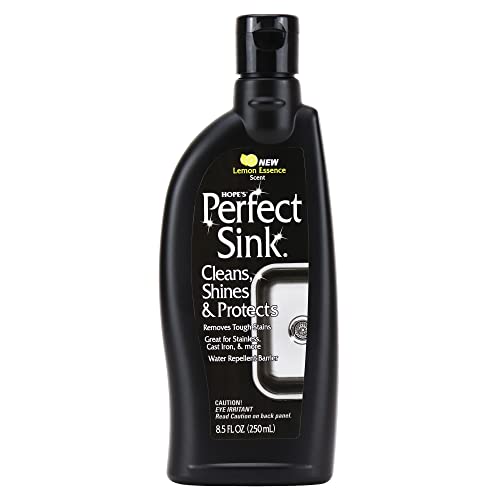
HOPE’S Perfect Sink Cleaner and Polish — Best Sink Basin Restorer
Sinks fail cosmetically long before they fail structurally, gathering a grey mineral bloom, tea and coffee shadows, and the faint rust freckles that appear where a tin stood wet overnight. This HOPE’S polish is the restorative answer in the line-up, made to lift that accumulated evidence and leave the basin shedding water more cleanly, which slows the bloom’s return. Its labelled range is usefully specific: cast iron, Corian, composite and acrylic, the four sink materials that most often defeat generic sprays.
The small bottle is correct sizing rather than stinginess. A polish is worked over the basin in modest amounts on an occasional rhythm, monthly for most households, and a giant bottle would oxidise in the cupboard before its level dropped. Concentrated, occasional products should be bought in the size their rhythm consumes, a principle this guide applies across the whole cleaning cupboard.
Technique decides the result. Work the polish over a damp basin in sections, give stains dwell time rather than elbow violence, and rinse thoroughly so the restored surface meets water evenly. Stainless owners should confirm suitability on the label for their exact finish, and everyone should keep this bottle for the basin alone, because a restorative polish on a countertop is the right chemistry in the wrong room.
Its restorative role makes it the bottle most likely to produce a visible before-and-after in a single session, which is a deeply satisfying return on eight and a half ounces.
- Role: restorative sink cleaner and polish
- Size: 8.5 fluid ounces, concentrated use
- Labelled for: cast iron, Corian, composite, acrylic
- Action: removes stains, restores water behaviour
- Rhythm: occasional treatment, not a daily spray
Strengths
- Surface list names the awkward sink materials plainly
- Restorative action revives tired basins visibly
- Small bottle matches an occasional-use rhythm
Trade-offs
- Not intended as an everyday counter spray
- Stainless suitability needs a label check per finish
- Results depend on dwell time and patient technique
Best for: owners of composite, Corian, acrylic or cast iron sinks with visible staining and bloom.
Not suited for: shoppers wanting a single daily spray for every surface in the kitchen.

HOPE’S Perfect Countertop Cleaner and Polish — Best Streak-Free Counter Finish
Countertops are judged in raking light, the low morning sun that turns every streak into a headline. This HOPE’S countertop spray is built for that judgement, cleaning and polishing in one pass across granite, quartz, marble, stone, laminate and Corian, and arriving with a microfibre cloth because the maker understands the finish is a two-part system: chemistry to lift the soil, textile to leave the surface dry and even.
The surface list is the review. A counter in a real kitchen is rarely one material from wall to island, and a spray cleared for the whole family of common surfaces removes the hesitation that leaves counters half-cleaned. Marble’s presence on the list deserves respect rather than assumption, since marble is the diva of stones; follow the label’s directions precisely there and test any new cleaner in a hidden corner first, as this guide advises for every stone product.
Keep this bottle for the finishing pass rather than the frying aftermath. Heavy grease belongs to the degreaser above; this spray’s gift is the final, streakless state that makes a cleaned kitchen look cleaned. Households that adopt that two-stage habit, degrease then finish, stop chasing smears around the counter with a wet cloth and calling the chase cleaning.
Keep the included cloth with the bottle rather than letting it migrate to general duty, because a cloth carrying old grease will undo this spray’s finishing work on contact.
- Role: countertop cleaner and polish spray
- Size: 22 fluid ounces with microfibre cloth
- Surfaces named: granite, quartz, marble, stone, laminate, Corian
- Finish promise: streak-free when buffed dry
- Method: spray, wipe, finish with the cloth
Strengths
- One spray cleared across the common counter family
- Included cloth completes the streak-free system
- Polishing finish elevates cleaned stone visibly
Trade-offs
- Heavy grease should be degreased before it
- Marble still demands a cautious patch test
- Cloth needs laundering to keep performing
Best for: mixed-material kitchens wanting one finishing spray for every counter they own.
Not suited for: households seeking a heavy-duty degreaser as their only bottle.

ATTITUDE Kitchen Cleaner Spray — Best Plant-Derived Everyday Spray
Some households choose cleaners the way they choose food, reading ingredient philosophy before performance claims. The ATTITUDE spray is this guide’s answer for them: EWG Verified, described as ninety-nine percent naturally derived, scented with citrus zest, and still tasked as a genuine degreaser for stovetops, counters and appliances rather than a perfumed water for already-clean rooms. That combination, credentials plus a real job, is rarer than it should be.
Everyday positioning is its strength. The formula promises no sticky residue, the scent reads as kitchen-appropriate rather than medicinal, and the twenty-seven ounce bottle sits comfortably in the daily rhythm of wiping counters after breakfast and the hob after dinner. A cleaner used daily at moderate soil outperforms a fearsome cleaner used monthly at catastrophic soil, in hygiene, in surface preservation and in the household’s general morale.
Set expectations at the label’s own level. Plant-derived degreasers handle fresh grease and grime admirably and ask for dwell time on baked deposits that a caustic specialist would strip rudely and fast. Households that cook gently and clean promptly will never notice the difference; households reheating a week’s roast pans should keep the HOPE’S degreaser beside it for the heavy evenings.
Ingredient-led buyers should still judge it by the hob after a week of dinners, because credentials earn the trial while performance earns the reorder.
- Credentials: EWG Verified kitchen spray
- Composition: 99 percent naturally derived per maker
- Scent: citrus zest, everyday kitchen character
- Size: 27 fluid ounces, degreasing action
- Surfaces: stovetops, counters and appliances
Strengths
- Verified credentials for ingredient-conscious homes
- No sticky residue suits daily counter rhythm
- Pleasant scent encourages the frequent use it suits
Trade-offs
- Baked-on grease needs dwell time or a stronger ally
- Purist formulas cost more per ounce typically
- Citrus scent, while mild, is still a scent
Best for: ingredient-conscious households that wipe down daily and cook moderately.
Not suited for: heavy frying households needing maximum degreasing force nightly.

Weiman Granite & Stone Daily Clean & Shine — Best Stone Daily Disinfecting Spray
Stone owners face a pincer: ordinary disinfecting sprays can be too harsh for marble and limestone, while gentle stone cleaners rarely claim any disinfecting action at all. This Weiman formula occupies the narrow middle, a daily spray for granite, marble, limestone, tile and slate that cleans, shines and disinfects, with the maker stating it kills ninety-nine point nine percent of germs and bacteria when used as directed on its label. In a kitchen where raw chicken meets the counter weekly, that combination has obvious practical weight.
Daily is the operative word in its design. The formula is made to be used constantly without dulling the stone or leaving the streaks that punish rushed wiping, and its citrus scent keeps the ritual pleasant. Disinfecting claims live and die by dwell time, the wet contact period the label specifies, so the honest routine is spray, attend to another small task, then wipe, rather than the spray-and-instantly-buff habit that defeats the product’s second job.
Respect the boundaries the category imposes. A daily stone spray is not a sealant, not a stain remover for the turmeric incident of last month, and not for the sink basin’s mineral scale. It is the stone counter’s everyday guardian, and households with serious stone should pair it with periodic sealing and the restorative products elsewhere in this guide rather than asking one bottle to be a quarry, a chemist and a janitor simultaneously.
Stone owners who entertain often will value the disinfecting pass most on the evenings when the counter has served as both butcher’s block and buffet.
- Role: daily stone cleaner, shine and disinfectant
- Size: 24 ounce spray, citrus scent
- Maker claim: kills 99.9 percent of germs and bacteria
- Surfaces: granite, marble, limestone, tile, slate
- Finish: streak-free when used as directed
Strengths
- Disinfecting action cleared for delicate stones
- Daily formula preserves shine without dulling
- Wide stone and tile surface range
Trade-offs
- Disinfection requires the label’s dwell time
- Not a sealant or a deep stain treatment
- Citrus scent may not suit fragrance-free homes
Best for: stone counter owners who want daily cleaning and disinfecting in one safe bottle.
Not suited for: households needing heavy degreasing or sink restoration first.

Bar Keepers Friend Granite & Stone Cleaner — Best Stone Polish and Protection
Bar Keepers Friend built its name on a famously assertive powder, which makes this stone-specific formula the interesting branch of the family: a cleaner and polish tuned for natural and manufactured stone, including quartz, Silestone, soapstone and marble, where the assertive original would be entirely out of place. The lesson generalises beyond one brand: within any maker’s range, the surface named on the bottle is the instruction, and the famous bottle is not automatically the right bottle.
The polish element distinguishes it from the daily Weiman. Where a daily spray maintains, a cleaner-polish restores lustre and leaves a measure of protection that helps stone shrug off the next week’s fingerprints and glass rings. The two pack format suits that rhythm across a whole kitchen, one bottle in service and one in reserve, and suits larger stone installations whose weekly polish consumes more than a single bottle a season.
Apply it as a finishing ritual rather than a rescue service. Counters should be cleaned of grease and soil first, then polished in sections and buffed to the shine the stone remembers from installation day. Households that keep that rhythm find their stone ageing like furniture instead of like a workbench, which, at stone prices, is the entire economic argument for owning a polish at all.
A polish kept in reserve is only useful if its rhythm is calendared, so tie it to a monthly event the household already observes and the two-pack will pace itself.
- Role: stone cleaner and protective polish
- Pack: two bottles of 25.4 ounces
- Surfaces: natural and manufactured quartz, Silestone
- Also named: soapstone and marble countertops
- Action: cleans, shines and helps protect
Strengths
- Polish restores lustre daily cleaners only maintain
- Two pack suits large stone installations
- Named for manufactured stone brands explicitly
Trade-offs
- A finishing step, not a first-response degreaser
- Buffing time is part of the bargain
- Keep separate from the brand’s stronger powders
Best for: owners of quartz, Silestone, soapstone or marble who will polish on a rhythm.
Not suited for: shoppers wanting one spray to degrease, disinfect and polish at once.
Which Cleaner Should Handle Which Surface?
| Pick | Primary territory | Format and size cues | Standout trait |
|---|---|---|---|
| HOPE’S Perfect Kitchen Cleaner Spray | Whole kitchen degreasing | 32 oz spray, multi-surface | No-residue finish across counters and stoves |
| HOPE’S Perfect Sink Cleaner and Polish | Sink basin restoration | 8.5 oz polish, restorative | Lifts stains from cast iron, Corian, composite, acrylic |
| HOPE’S Perfect Countertop Cleaner and Polish | Countertop finishing | 22 oz spray with microfibre cloth | Streak-free polish for granite, quartz, marble, laminate |
| ATTITUDE Kitchen Cleaner Spray | Everyday plant-derived cleaning | 27 oz spray, citrus zest | EWG Verified, 99 percent naturally derived |
| Weiman Granite & Stone Daily Clean & Shine | Stone daily care and disinfecting | 24 oz spray, citrus scent | Cleans, shines and disinfects stone and tile |
| Bar Keepers Friend Granite & Stone Cleaner | Stone cleaning and polishing | 25.4 oz, two pack | Protective polish for natural and manufactured stone |
What Is the Difference Between Cleaning, Polishing and Disinfecting?
Cleaning removes soil, polishing changes how a surface reflects light and sheds water, and disinfecting kills organisms under stated conditions. A bottle can honestly do one, two or all three, yet the verbs are not interchangeable, and most cleaning disappointment comes from expecting the wrong verb: polishing a greasy counter seals the grease under a shine, while disinfecting a visibly soiled counter wastes the active ingredients on dirt instead of germs.
The order of operations follows from the definitions. Clean first, so the surface is bare; disinfect where the label offers it, respecting dwell time; polish last, as the finish. The six picks in this guide map onto that sequence almost tidily, with the degreasers and daily sprays cleaning, the Weiman adding disinfection, and the sink and stone polishes closing the routine.
Which Cleaners Are Unsafe on Marble and Natural Stone?
Acids are stone’s enemy, and they hide in friendly bottles: vinegar-based sprays, lemon descalers and many bathroom cleaners will etch marble and limestone on contact, leaving dull spots that are not dirt but dissolved surface. Abrasive powders commit the slower crime, micro-scratching polished stone until its reflection clouds. Neither injury can be wiped away, because the damage is the surface itself departing.
The defence is label literacy. Stone-safe products say so and name their stones, as the Weiman and Bar Keepers Friend entries above do, while general cleaners that omit stone from a long surface list are telling you something by omission. When a bottle’s promises and your counter’s price disagree, believe the counter and patch-test in a corner the toaster usually hides.
How Should You Clean a Stainless Steel Sink Without Scratching It?
Steel has a grain, and the grain is the rule: wipe and polish along it, never across it and never in circles with anything firmer than a soft cloth or sponge. Cross-grain scrubbing engraves a visible crosshatch that catches light and soil together, ageing a sink years in a single enthusiastic afternoon. Bicarbonate paste on a soft cloth handles most sink film safely within that discipline.
Dry the basin after the evening wash whenever you can. Standing water is the delivery system for nearly every sink blemish, from mineral rings to the rust freckles left by a wet tin’s footprint, and a thirty-second dry pass prevents more marks than a monthly restoration removes. The HOPE’S sink polish above then becomes an occasional revival rather than a recurring rescue.
What Is the Right Weekly Cleaning Rhythm for Counters?
Anchor the rhythm to cooking rather than the calendar. After any session involving raw protein or serious oil, counters get the degreasing or disinfecting pass the surface allows; after gentle days, a wipe with the daily spray suffices. Stone receives its polish weekly in most homes, the sink its restorative treatment monthly, and the whole cupboard an honest audit each season, when the dried, the duplicated and the never-quite-right bottles are retired.
Rhythm beats intensity because soil ages. Fresh grease lifts with a whisper of chemistry, while week-old grease polymerises into a varnish that demands force, and force is what surfaces cannot forgive. Households that clean little and often keep both their counters and their cleaners gentle, which is the cheapest preservation strategy ever devised for expensive stone.
How Do You Remove Hard Water Film From a Sink?
Mineral film is a deposit, not a stain, so it yields to time and mild chemistry rather than scrubbing violence. Lay a cloth dampened with the sink polish or a suitable descaling solution across the filmed area, let chemistry work for several minutes, then lift and rinse, repeating rather than escalating. Escalation is where sinks get scratched, and a scratch holds the next film more tightly than the smooth surface ever did.
Prevention returns to drying and water behaviour. A polished basin sheets water off instead of letting it pool and evaporate into rings, which is the unglamorous superpower of the sink polish in this guide. In very hard water districts, a wipe after the last use of the night is the difference between a monthly polish and a weekly battle, regardless of which bottle wins.
Are Plant-Derived Cleaners Strong Enough for a Real Kitchen?
For the soil of ordinary days, yes, and the ATTITUDE entry above is built exactly to that standard: fresh grease, fingerprints, splash marks and the general film of a working kitchen. Surfactants derived from plants still lower water’s surface tension and lift oil; the chemistry differs in origin more than in kind. Where plant-derived formulas ask for help is aged, baked or polymerised grease, where dwell time and a second application substitute for caustic force.
The honest framing is a division of labour rather than a contest. Keep the plant-derived spray as the daily driver its credentials suit, and keep one conventional heavy bottle for the roast-pan evenings. Households that demand a single bottle be simultaneously purest and strongest are asking chemistry for a contradiction, and manufacturers who promise it are selling the contradiction, not the cleaner.
How Should You Store and Organise the Cleaning Cupboard?
The cupboard under the sink rewards the same discipline as the surfaces above it. Group bottles by territory, counter, sink, stone, floor, so the right chemistry is found by job rather than by memory; keep polishes and restoratives toward the back, where their occasional rhythm belongs; and decant nothing into unlabelled bottles, because the label carries the surface warnings that protect the most expensive objects in the room.
Child and pet safety governs the geography too: caps secured, sprays locked or latched where small hands explore, and no cleaner stored in a food container ever, under any deadline pressure. An organised cupboard also reveals duplication, the three half-used degreasers most kitchens own, and finishing one bottle at a time is a small economy that funds the correct specialist when it is genuinely needed.
What Should You Do About Stains on Quartz and Composite Counters?
Quartz and manufactured stone resist staining impressively yet keep a short list of genuine threats: strong pigments left to dry, solvents, and heat-shocked resins near a pan’s landing zone. Fresh spills lift with the daily spray; dried pigment usually yields to a non-abrasive pad and patience. The Bar Keepers Friend stone polish above is formulated with manufactured brands in its sights, which is why it names them rather than gesturing at stone in general.
Composite sink basins follow similar rules with one addition: avoid leaving metal tins and tools standing wet on the surface, because rust transfers eagerly and photographs like a stain. The restorative sink polish earns its shelf space in composite homes precisely for those incidents, lifting the evidence before it settles into the surface’s story.
How Can You Tell When a Cleaner Is Damaging a Surface?
Damage announces itself as change that cleaning cannot reverse: a marble patch that stays dull after rinsing, a steel area that catches light differently along a scrub line, a composite basin whose water behaviour worsens instead of improving after treatment. The moment a surface looks worse in the cleaned area than in the untouched one, stop, rinse thoroughly and retire that bottle from that surface permanently.
Patch testing prevents most of these discoveries. Any new cleaner, however trusted its brand, should meet any new surface in a hidden square first, with a full dry-down and a look in morning light before it graduates to the whole counter. Two minutes of caution per pairing is the cheapest insurance in this entire guide, and it is the habit that separates households whose stone ages gracefully from those with a map of dull spots.
Do Disinfecting Sprays Belong on Food Preparation Surfaces?
They belong there when used as their labels direct, which typically means applying to a cleaned surface, respecting the stated wet dwell time, and, on food-contact areas, following any rinse instruction the label carries. The Weiman stone spray’s value is that it brings that capability to surfaces where harsher disinfectants fear to tread, letting a stone counter be both protected and properly treated after raw poultry has visited.
Households that dislike the whole category have a respectable alternative: rigorous cleaning with hot water and detergent, physical removal being the underappreciated half of kitchen hygiene. What does not work is the worst middle path, a disinfectant sprayed and instantly wiped, which delivers neither the chemistry’s full effect nor the cleaner’s, while smelling reassuringly medicinal about the failure.
How Much Cleaner Should a Household Actually Own?
The arsenal in this guide, six bottles across four jobs, is close to the practical ceiling for most kitchens. Below it, surfaces get the wrong chemistry; above it, bottles multiply into half-used confusion and the right one is never the one in hand. Audit by job rather than by bottle: degreasing, daily wiping, sink restoration and stone care either have a named owner in your cupboard or they do not.
When a job lacks an owner, buy the specialist for that job alone, as the HOPE’S trio above demonstrates by splitting one brand’s range into three honest assignments. When a job has three owners, finish two before replacing any. A cleaning cupboard run on those two rules stays small, current and matched to the actual counters and sink it serves.
What Is the Safest Way to Clean Around Children and Pets?
Choose the mildest chemistry that performs the job, store every bottle behind a latch or lock, and return food-contact surfaces to a rinsed, dry state before small hands and paws resume their patrols. The HOPE’S kitchen spray’s pet and home safe positioning and the ATTITUDE spray’s verified credentials exist for exactly these households, though positioning never replaces the rinse and the latched cupboard.
Timing helps as much as selection. Deep cleaning, polishing and disinfecting dwell times fit naturally into the hour after children are in bed and animals are settled, letting surfaces dry completely before the morning’s barefoot inspection. A routine built around the household’s actual traffic protects both the surfaces and the small residents, which is the whole point of choosing cleaners deliberately.
How Do You Clean the Splashback and Faucet Base?
The splashback collects a fine, even grease lacquer that owners stop seeing precisely because it is even, and the faucet base grows a mineral collar in the puddle zone behind the spout. Both yield to the degreaser in this guide applied with patience: spray, let the chemistry soften the film for a few minutes, then wipe with a cloth rinsed frequently so you are lifting soil rather than relocating it in decorative arcs.
Around the faucet base, an old soft toothbrush reaches the collar that cloths bridge over, and drying the zone afterwards slows its return. Treat these borders as part of the counter for cleaning purposes, because visually they are: a gleaming counter behind a grubby faucet base reads as a half-cleaned room to every guest who waits there for tea.
What Is the Best Way to Clean a Composite Sink Daily?
Composite basins want a soft sponge, mild detergent and a rinse that ends with a wipe dry, a routine gentle enough to repeat daily for decades. The daily enemy is not dirt but standing water carrying pigment: coffee dregs, tea leaves and curry sauces should be rinsed away the same evening rather than left to introduce themselves to the surface overnight.
Weekly, inspect the basin in raking light for the first signs of film or a transferred rust mark, and answer with the restorative polish while the mark is still a rumour. Composite rewards early, gentle attention and resents late, violent attention, which is a fair summary of most materials in this guide and most objects in a house generally.
How Should Grease on Cabinet Fronts Be Handled?
Cabinet fronts near the hob wear the same grease film as the counters, thinned by distance, and they meet it with weaker defences: painted and lacquered finishes that strong degreasers can soften or dull. Use the mildest spray that lifts the film, the ATTITUDE or a diluted pass of the kitchen degreaser, on a cloth rather than sprayed directly, and dry the fronts so moisture never lingers in the joints and edges.
Handles and knobs deserve their own minute with the cloth, since they collect the concentrated evidence of every cooking hand in the house. It is unglamorous work with an outsized visual return, because fronts and hardware occupy more of the kitchen’s sightline than the counters everyone remembers to clean.
When Should a Cleaner Be Replaced Rather Than Finished?
Replace a cleaner when it separates and will not re-mix, when its sprayer dies beyond a rinse’s repair, when its scent has turned, or when you realise it has been failing its surface for months while you blamed the surface. Cleaning chemistry is inexpensive and surfaces are not, so loyalty to a failing bottle is the most expensive thrift in the cupboard.
Also replace on evidence of mismatch: a bottle bought for a previous home’s laminate may have no honest work in a marble kitchen, and passing it on or retiring it beats improvising with the wrong chemistry. The audit question is always the same: which job, on which surface, does this bottle own here, and a bottle without an answer is clutter with a trigger.
How Do You Keep Microfibre Cloths Working?
Microfibre fails by contamination rather than age: fabric softener coats its fibres, old grease loads its split ends, and a cloth washed with fluffy towels emerges wearing lint that it then donates to your polished counters. Wash microfibre separately in warm water without softener, dry it away from high heat, and retire cloths that smell after washing or smear a clean counter on a test wipe.
Colour-coding cloths by territory, counters, sink, floor, costs nothing and prevents the day’s worst cross-contamination error, which is also the day’s most common one. The cloth included with the HOPE’S countertop spray should live with the finishing kit, because a finishing cloth that has served the floor will never finish anything again.
What Should a Guest-Ready Ten-Minute Clean Include?
Ten minutes, spent in the right order, transforms a working kitchen: clear and degrease the counters, wipe the hob, polish the sink basin dry, empty the visible bin, and finish with the countertop spray and its cloth for the streak-free pass. The sequence matters because each stage removes the soil the next stage would otherwise spread, and the sink’s dry polish is the flourish guests actually notice while filling a glass.
Skip the cupboards, the oven interior and the floor’s corners in a ten-minute clean; they are not where a guest’s eye or hand goes. The lesson generalises to the weekly rhythm in this guide: clean by contact and sightline first, and the room will feel kept even before it is, in the exhaustive sense, clean.
How Do You Clean Around a Gas Hob Without Spreading Grease?
Work from the outside inward and from the cleanest area toward the dirtiest, so the cloth arrives at the hob already used rather than arriving at the counters afterwards loaded with the hob’s worst. Lift grates and caps to soak while the surrounding surface gets its degreasing pass, and let chemistry dwell on the hob’s enamel rather than scrubbing at burner ports with anything that could bend or block them.
Finish by drying and polishing the enamel and steel around the burners, because a wet hob surround re-collects dust into a fresh film within hours. The degreaser in this guide earns its size on exactly this job, and the countertop finish spray should stay out of it until the grease is genuinely gone rather than merely rearranged.
What Labels Should You Photograph When You Buy a Cleaner?
Photograph the back label, where the surface list, the warnings and the directions live, and keep the photograph with the household’s appliance records. Front labels are advertisements; back labels are contracts, and the contract is what you need at the moment a bottle meets a new surface or a stain refuses the first attempt.
The habit pays off when a bottle’s printed text wears away in a damp cupboard, when a partner or housemate needs the warning you remember reading, and when you are standing in a shop deciding whether the replacement in your hand is truly the same formula as the one that worked. Two photographs per bottle is the whole system, and it takes less time than one etched marble repair consultation.
What Mistakes Do People Make With Kitchen Cleaners?
Reaching for the strongest bottle first is the classic error, because strength in cleaning usually means chemistry that some surface in the room cannot forgive. Marble etched by a bathroom spray and steel crosshatched by a scouring powder are both permanent souvenirs of that reflex. Start mild, escalate only on the soil, and let dwell time do the work muscles want to do.
A second mistake is mixing products in pursuit of extra power, particularly anything involving bleach meeting anything acidic, a combination that creates genuinely dangerous gas. One product, used as directed, then rinsed away before another is considered: that sequence is not timidity but chemistry. The arsenal approach in this guide assigns each bottle its own job precisely so mixing never becomes tempting.
Third, owners clean the counters and neglect the sink’s waterline, the faucet’s base and the splashback’s lower edge, where film builds undisturbed for months. A room reads as clean at the level of its dirtiest visible detail, and those neglected borders are exactly where a guest’s eye lands while waiting for the kettle.
Finally, many households keep using a cleaner that visibly fails, a spray that streaks, a polish that smears, because the bottle is not empty yet. The sunk cost of a few ounces of chemistry is trivial beside the surfaces it disappoints weekly. Retire failures without ceremony and let the cupboard hold only bottles that earn their shelf.
Final Recommendation
Build the cupboard by job and the six sort themselves. The HOPE’S Perfect Kitchen Cleaner Spray owns degreasing, the HOPE’S Perfect Sink Cleaner and Polish owns the basin, and the HOPE’S Perfect Countertop Cleaner and Polish owns the counter’s final finish, a tidy trio for mixed kitchens.
The stone route anchors on the Weiman Granite & Stone Daily Clean & Shine for daily care and disinfection, with the Bar Keepers Friend polish in reserve, while ingredient-first households start with the ATTITUDE spray and add force only where their cooking proves they need it. Every route through this list beats the single miracle bottle it replaces.
Counters and sinks are the two surfaces your hands and eyes audit a dozen times a day, so give each the chemistry it actually asked for and the whole kitchen will start passing that audit without effort.
Frequently Asked Questions
Can I use one cleaner for both counters and the sink?
A gentle daily spray can wipe both in a pinch, and the HOPE’S kitchen spray above is designed broadly enough for routine duty across the zone. The limitation is restoration: sink mineral film and staining need the polish’s chemistry, and stone counters need their own protective formulas. One bottle can maintain; it cannot specialise, and the difference shows within a season.
What cleaner is safest for marble counters?
A spray that names marble on its surface list and avoids acids, like the Weiman daily stone spray or the HOPE’S countertop spray in this guide. Marble’s enemies are vinegar, lemon and most bathroom descalers, which etch it on contact. Whatever you choose, patch-test behind an appliance first and wipe spills, especially wine and tomato, promptly rather than relying on any cleaner afterwards.
How do I stop my sink looking dull after cleaning?
Dullness after cleaning usually means residue or mineral film rather than dirt. Rinse more thoroughly, dry the basin with a soft cloth, and use a restorative polish periodically to reset the surface’s water behaviour, as the HOPE’S sink polish does. A basin that sheets water dry will look brighter between cleans than one where droplets sit and evaporate into rings.
Are disinfecting stone cleaners necessary in a kitchen?
They are valuable after raw meat and poultry preparation on stone, where gentler stone cleaners may not claim disinfecting action. The Weiman spray in this guide exists for that gap, provided its label’s dwell time is respected. On non-stone counters, ordinary disinfecting products cleared for the surface serve the same role; the stone-safe part is the specialism, not the disinfection alone.
Can Bar Keepers Friend be used on any counter?
Only the stone-specific formula belongs on stone, and only on the surfaces its label names, which include natural and manufactured quartz, Silestone, soapstone and marble. The brand’s famous powder is a different product for different jobs and should not be substituted onto polished stone. Brand loyalty is no substitute for reading which bottle in the range you are holding.
How often should a sink be polished rather than just cleaned?
Monthly suits most households, with hard water and heavy cooking arguing for a shorter interval and gentle use allowing a longer one. Judge by water behaviour: when droplets stop sheeting off and start clinging in rings, the surface is asking. Polishing on that signal rather than a rigid calendar keeps the chore proportional to the need.
What is the quickest way to make a tired kitchen feel clean before guests arrive?
Dry-polish the sink, degrease and finish the counters, and wipe the cabinet handles, in that order. Those three surfaces carry the room’s first impression because they catch light and hands, and together they take under ten minutes with the bottles in this guide. Floors and windows matter on a longer horizon; the sink and counters are tonight’s verdict.
Can I make my own counter cleaner from vinegar and water?
On laminate and some sealed surfaces a mild homemade spray can handle light soil, yet vinegar is an acid and acids are precisely what marble, limestone and many natural stones cannot tolerate, which is why this guide steers stone owners to named, stone-cleared formulas. If you mix your own for safe surfaces, label the bottle with its contents and its forbidden list, and never let it migrate to the stone counter in a helpful moment.
Why does my counter still feel sticky after I clean it?
Stickiness after cleaning is usually the cleaner’s own residue, a film of product that was sprayed generously and wiped briefly, then left to dry into a tacky layer that collects fresh dust. The cure is a second wipe with a cloth dampened in plain water, followed by a dry buff, and a lighter hand with the spray next time. No-residue formulas like the degreaser in this guide reduce the problem, though technique still decides the finish.
Should renters use the same cleaners as owners?
Renters should be more conservative, not less, because the surfaces belong to someone else and the deposit remembers every etch and scratch. Stick to the mildest named-surface products in this guide, photograph the counters and sink at move-in, and keep the landlord’s own instructions where they exist. A gentle daily spray and a soft cloth will carry a tenancy without a single cleaning-related deduction.
Related Guides
Cleaning choices connect directly to the sinks and composite surfaces covered elsewhere in this series, so keep these guides open while you build your cupboard. Best Cleaners for Blanco Diamond Composite Kitchen Sinks Best Dual Probe Meat Thermometers Best KitchenAid Mixers.


