What's inside
- Where to Buy, and How to Read This Guide
- Key Takeaways
- Quick Picks
- How Did We Choose Within a Range This Famous?
- Why Has One Brand Defined This Category for So Long?
- How Do the KitchenAid Core Models and Their Rivals Compare?
- Tilt-Head or Bowl-Lift: Which Architecture Fits Your Baking?
- What Can the Attachment Hub Actually Do for a Home Kitchen?
- How Should You Match Bowl Size to Your Real Batches?
- What Do Speeds and Touchpoints Mean Beyond the Brochure?
- How Do You Set Up and Care for a Stand Mixer for the Long Term?
- How Much Counter Space Does a Stand Mixer Really Claim?
- What Should a First-Time Stand Mixer Owner Bake in the First Month?
- How Do Second Bowls and Extra Accessories Extend a Mixer’s Life?
- Is a Refurbished or Second-Hand KitchenAid a Sensible Buy?
- How Has the Stand Mixer Earned Its Place as a Household Heirloom?
- What Should You Know About Using the Dough Hook Well?
- What Is the Simplest Test of Whether You Bought the Right Mixer?
- What Mistakes Do Mixer Buyers Most Often Regret?
- Final Recommendation
- Frequently Asked Questions
- Related Guides
As an Amazon Associate I earn from qualifying purchases. This post may contain affiliate links at no extra cost to you.
cottageverdict.com is reader-supported. When you buy through links on our site, we may earn an affiliate commission.
Where to Buy, and How to Read This Guide
Ask a room of bakers to name a mixer and one brand answers first, not because of advertising, but because its machines have sat on family counters long enough to be inherited. The best KitchenAid mixers span two families that solve different problems: tilt-head and bowl-lift stand mixers that knead, whip and grind through an ecosystem of attachments, and a hand mixer for the jobs too small to deserve the big bowl. This guide covers the core of that range and explains where each machine’s loyalty is earned.
KitchenAid is the axis of this guide, deliberately. The stand mixers below, the Classic, the Artisan and the 5.5-quart bowl-lift, represent the three decisions most buyers actually face, capacity, head style and ambition. Two rivals stand beside them, from Cuisinart and Martha Stewart, not as co-winners but as measuring instruments: placing a competitor next to each KitchenAid shows precisely what the ecosystem, the touchpoints and the attachment hub are worth, and where a rival’s specification genuinely competes.
Every pick links to its listing so you can check price on Amazon and confirm the current bundle, because included beaters, shields and bowls vary and matter. No prices are printed here, for the usual reason that they move; the value judgements below are built on design and capability, which do not.
A word about how to use the comparisons in this guide, because they are the heart of it. Each rival appears immediately after the KitchenAid models it challenges, and the reviews argue in the open: where the rival’s specification wins, it is recorded as winning; where the KitchenAid’s system, action or support answers back, that is recorded too. A buyer who finishes the guide should be able to state, in one sentence, what the KitchenAid premium buys in the tier they are shopping, and whether their own kitchen will ever collect on it.
Key Takeaways
- Tilt-head models suit most homes: easier bowl access, lighter bodies, and capacity for family baking up to moderate dough batches.
- Bowl-lift machines are the heavy-dough answer, with a sturdier frame that stays planted when kneading dense bread.
- The attachment hub is KitchenAid’s deepest advantage: pasta rollers, grinders and grain mills turn one motor into a system.
- Bowl size should follow your largest regular batch, not your largest imaginable one; oversized bowls mix small quantities poorly.
- Cuisinart’s rival competes on speeds and price positioning, while the Martha Stewart model competes on looks and simplicity.
- A KitchenAid hand mixer remains the right tool for small, fast jobs even in a house that owns a stand mixer.
Quick Picks
| Pick | Badge | Why it earned a place |
|---|---|---|
| KitchenAid Classic 4.5-Qt Stand Mixer K45SS | Best Entry Into the Range | The traditional tilt-head in Onyx Black, with ten speeds, metal construction and full attachment compatibility. |
| KitchenAid Artisan 5-Qt Stand Mixer Empire Red | Best Mainstream Icon | The five-quart tilt-head in the famous red, with a pouring shield and the broadest colour range in the business. |
| KitchenAid 5.5-Qt Bowl-Lift Stand Mixer | Best for Serious Bread Bakers | Eleven speeds and a bowl-lift frame that stays planted under heavy dough, with beater, hook and whip included. |
| Cuisinart 5.5-Qt Stand Mixer 12 Speed | Comparison Pick: Specification Rival | Placed beside the KitchenAids to test the premium: 5.5 quarts, twelve speeds and a full accessory set in Onyx. |
| Martha Stewart 5.3QT Tilt Head Stand Mixer | Comparison Pick: Design-Led Rival | A lifestyle-brand challenger with twelve speeds, a 5.3-quart bowl and a removable splash shield, testing the looks-versus-system question. |
| KitchenAid 9-Speed Hand Mixer KHM926 Contour Silver | Best Hand Mixer in the Range | The stand mixers’ smaller sibling, for the daily jobs too quick for the big bowl: whipping, folding and small batters at the hob or table. |
How Did We Choose Within a Range This Famous?
By refusing to list the whole catalogue. KitchenAid sells many variants, colours and special editions, but the buying decision collapses into a few real questions: tilt-head or bowl-lift, four-and-a-half quarts or five and a half, stand mixer only or a hand mixer alongside. The three stand mixers chosen answer those questions at their clearest points, the Classic as the traditional entry, the Artisan as the mainstream icon, and the bowl-lift as the serious baker’s step up.
We judged the machines on mixing fundamentals first: how thoroughly the beater sweeps the bowl, how the lowest speed treats a sponge, how the frame behaves under a stiff dough, and how the controls feel with floury hands. KitchenAid’s planetary mixing, with its many touchpoints around the bowl, is not marketing poetry; it is the reason owners rarely scrape mid-mix, and it weighed heavily against rivals whose specifications look similar on paper.
The rivals earned their places by being the comparisons shoppers genuinely make. Cuisinart’s 5.5-quart machine matches KitchenAid on capacity and beats it on speed count, so it tests whether the ecosystem premium is justified. The Martha Stewart mixer tests the design-led end of the market. And the KitchenAid hand mixer closes the guide because a complete KitchenAid kitchen usually includes one, for reasons the final review explains.
Why Has One Brand Defined This Category for So Long?
Longevity is the unfashionable answer. KitchenAid stand mixers are built around metal gearing and a design that has evolved rather than been reinvented for decades, so parts, attachments and knowledge accumulate around them. A recipe written in another country assumes the paddle fits; a charity-shop attachment from years ago mounts on a new machine; a repairer in any town has seen the mechanism before. That surrounding infrastructure is a real product feature, and it is the one rivals find hardest to copy quickly.
The second answer is the hub. The powered attachment port on the head turns a mixer into a pasta maker, a meat grinder, an ice cream maker, a grain mill and more, each driven by the same motor you already own. Households that use even two attachments stop describing the machine as a mixer at all; it becomes the kitchen’s power unit. Keep that system in mind through every comparison below, because a rival can match a specification sheet while offering nothing behind it.
There is a counter-argument fairness requires airing: not every kitchen wants a system. A household that bakes six times a year, owns no other powered attachments and feels no pull towards pasta rollers is buying a decade of hub it will never open, and for that household a rival’s lower price is not a compromise but a correct allocation. The guide’s KitchenAid axis is a default, not a doctrine, and the comparison reviews exist precisely to identify the buyers for whom the default should be overruled.

KitchenAid Classic 4.5-Qt Stand Mixer K45SS — Best Entry Into the Range
The Classic is where the KitchenAid story starts for most households, and its restraint is the point. A 4.5-quart bowl covers family cake and cookie batches, ten speeds run from a gentle stir to a fast whip, and the tilt-head gives the easy bowl access that makes stand mixing feel effortless rather than ceremonial. The metal construction gives it the reassuring heft of a machine built to be repaired rather than replaced.
Crucially, nothing about the Classic is a lesser ecosystem citizen. The hub accepts the same attachments as the flagship models, the planetary action sweeps the bowl with the same thoroughness, and the machine you buy for birthday cakes in year one can be rolling pasta in year five without an upgrade. What it lacks against the Artisan is the pouring shield, a little capacity and the colour wardrobe. Households baking weekly rather than daily will rarely feel those gaps, and the Classic’s simplicity has its own daily pleasure: everything about it is exactly where decades of owners expect it to be.
The Classic also functions as the range’s gift and second-home machine in a way its bigger siblings cannot. Its price band, its single-colour decisiveness and its total lack of intimidation make it the stand mixer most often bought for someone else: the daughter’s first flat, the holiday house, the parent downsizing from a beloved but enormous old machine. Recipients actually use it, which is the highest compliment a gifted appliance can earn, and its ecosystem compatibility means the gift can grow with attachments on future birthdays rather than being replaced by them.
The Classic’s Onyx Black finish has a practical politics in shared and family kitchens: it shows flour honestly, which sounds like a flaw and behaves like a prompt, because a machine that displays its dusting gets wiped, and a wiped machine’s seals, hub and vents live longer. Shiny pale finishes hide neglect until it compounds. Owners who clean by eye rather than by schedule, which is most owners, may find the dark machine quietly outlives its prettier siblings.
- Capacity: 4.5-quart stainless bowl
- Design: tilt-head, Onyx Black
- Speeds: 10 settings
- Mixing: 59 touchpoints around the bowl
- Compatibility: full KitchenAid attachment range
Strengths
- Full ecosystem access at the entry point
- Tilt-head access suits everyday baking
- Metal build promises a long service life
Trade-offs
- No pouring shield in the standard bundle
- Smaller bowl limits the largest dough batches
- Colour choice is narrower than the Artisan
Best for: weekly bakers buying into the system for the first time.
Not suited for: production bread bakers working at maximum capacity daily.
Confirm the included beaters in the current bundle and Check price on Amazon.
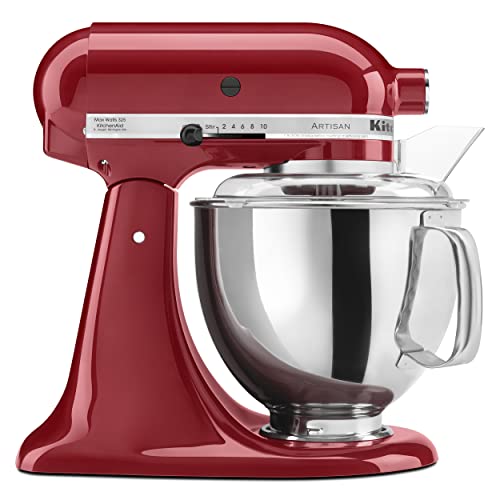
KitchenAid Artisan 5-Qt Stand Mixer Empire Red — Best Mainstream Icon
The Artisan is the mixer in the wedding photographs, and unusually for a design icon, the fame is functional. The five-quart bowl handles bigger batches than the Classic without crossing into unwieldy, the tilt-head keeps access easy for cooks who add ingredients mid-mix, and the included pouring shield genuinely reduces the flour cloud that greets every new baker’s first sponge. Ten speeds cover the whole repertoire with the same planetary thoroughness as its siblings.
Empire Red is the signature, but the Artisan’s colour range is the widest in the category, which matters more than snobbery admits: a machine that lives permanently on the counter should please the eye of the person who cleans around it. Against the bowl-lift model below, the Artisan concedes ultimate dough stability; against everything else here, it is the balanced centre of the range, the model against which the phrase KitchenAid mixer is mentally pictured, and the one most households should start their deliberations from, even if they end elsewhere.
Colour deserves its paragraph in the Artisan’s case because this machine pioneered the idea that a mixer is furniture. The range runs from the signature red through creams, blacks and seasonal shades, and owners genuinely choose by kitchen palette, knowing the machine will be seen ten thousand times for every thousand times it mixes. That is not frivolity; it is the correct economics of attention for a permanent counter resident. Underneath whichever shade, the same planetary action and hub wait, which is why the Artisan can be both the design choice and the serious one without contradiction.
Artisan ownership often expands a household’s baking in a specific direction: laminated and enriched doughs, celebration cakes, the projects that were previously bakery purchases. The machine’s capacity and composure make those projects feel domestic rather than heroic, and families report the mixer paying its way in birthday cakes alone across a childhood. That is the context in which its premium should be judged, not against the price of a cake mixer, but against the price of every cake it will ever make unnecessary to buy.
- Capacity: 5-quart stainless bowl
- Design: tilt-head, Empire Red
- Speeds: 10 settings
- Included: pouring shield for cleaner adding
- Compatibility: full KitchenAid attachment range
Strengths
- The balanced capacity most families need
- Pouring shield reduces flour mess
- Widest colour choice in the category
Trade-offs
- Tilt-head flexes slightly under the stiffest doughs
- Lives on the counter; storage is not an option
- Premium over the Classic buys refinement, not power class
Best for: families wanting the definitive, do-everything model.
Not suited for: dense-dough specialists who should look at bowl-lift.
Browse the colour range on the listing before choosing and Check price on Amazon.

KitchenAid 5.5-Qt Bowl-Lift Stand Mixer — Best for Serious Bread Bakers
Bowl-lift is the architecture of commitment. Instead of tilting, the head stays fixed and the bowl rises to meet it on a lever, which produces a frame that does not rock, walk or flex when a stiff dough starts climbing the hook. For bakers who knead dense loaves, bagel dough or double batches several times a week, that stability is not a luxury; it is the difference between a machine that supervises itself and one that must be held down and watched like a toddler near a pond.
The 5.5-quart bowl is the largest in this guide, eleven speeds give fine control at both the folding and whipping ends, and the included set, flat beater, dough hook and wire whip in stainless, covers the serious repertoire from the first day. The trade-offs are ergonomic: bowl removal takes a little more technique, and the machine is taller, which matters under low cabinets where a tilt-head needs clearance to open anyway. Measure your counter-to-cabinet gap either way; then, if bread is your religion, this is your mixer.
Bowl-lift ownership has a learning curve worth warning about honestly. The bowl snaps onto its arms and lifts on a lever, and the first three removals feel awkward to hands trained on tilt-heads; by the tenth, the motion is muscle memory and the stability that caused it feels non-negotiable. Bakers stepping up should budget that fortnight of mild clumsiness rather than mistaking it for a design flaw. The reward arrives with the first triple batch of bagel dough, kneaded in a silence of frame and motor that no tilt-head in this guide can quite match.
The bowl-lift’s eleven speeds find their purpose at the extremes its architecture serves: the lowest for starting a stiff dough without shocking the motor or the flour into the air, the highest for whipping the large volumes of egg white a 5.5-quart bowl can hold. Middle speeds are plentiful in every machine; it is the ends of the dial that separate designs, and this machine’s ends were engineered by people who clearly bake at scale and intend their customers to do the same.
- Capacity: 5.5-quart stainless steel bowl
- Design: bowl-lift for stability
- Speeds: 11 mixing settings
- Included: flat beater, dough hook, wire whip
- Finish: Porcelain White
Strengths
- Stays planted under heavy, dense doughs
- Largest capacity in this guide
- Complete stainless accessory set included
Trade-offs
- Taller body needs cabinet clearance checks
- Bowl handling takes practice
- More machine than cake-only bakers need
Best for: bread bakers and double-batch households.
Not suited for: small kitchens with low-hanging cabinets.
Measure your cabinet clearance carefully, then Check price on Amazon.
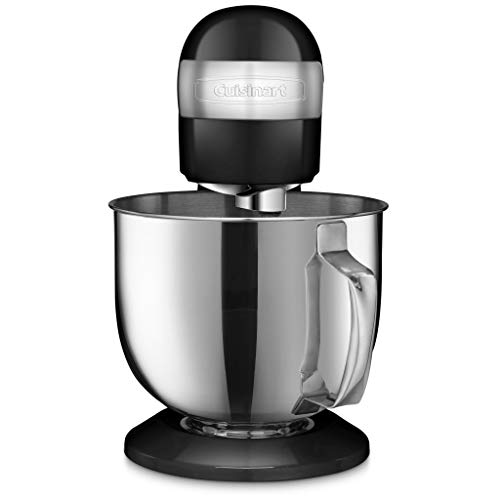
Cuisinart 5.5-Qt Stand Mixer 12 Speed — Comparison Pick: Specification Rival
Cuisinart’s stand mixer is the comparison that keeps KitchenAid honest, so it sits here in the open rather than in a footnote. The specification is pointed: a 5.5-quart stainless bowl matching the bowl-lift’s capacity, twelve speeds exceeding every KitchenAid in this guide, and a chef’s whisk, mixing paddle, dough hook and splash guard with pour spout all in the box. A shopper reading spec sheets alone could reasonably ask what, exactly, the famous name adds.
The honest answer is everything around the sheet. The Cuisinart mixes well, and its splash guard is genuinely useful, but it offers no attachment universe behind the bowl, no decades of accumulated parts and know-how, and its mixing action, while competent, asks for a scrape-down more often in our judgement of the design. If your baking begins and ends at the bowl, this rival competes hard and may win on the day’s pricing. If pasta rollers and grain mills live in your future, the comparison resolves the other way, and that distinction, not the speed count, is the real decision.
One more angle on the Cuisinart: its twelve speeds slice the low end finely, which gentle bakers may genuinely prefer for folding and starting sponges, and its splash guard’s pour spout is a small design pleasure the KitchenAid shield matches but does not exceed. If a household’s baking is entirely bowl-bound, cakes, batters, frostings, whipped work, the honest spreadsheet can favour this machine, especially on a day when its pricing undercuts the Artisan’s. The guide’s verdict stands on the system, but systems only pay rent to households that use rooms beyond the first one.
Cuisinart’s splash guard with its pour spout deserves the final word in its review, because it represents the rival’s design philosophy at its best: solve the visible annoyances thoroughly. Flour clouds and dribbled additions are the daily frictions of stand mixing, and this machine attacks them in the box rather than in an accessory catalogue. A KitchenAid buyer pays for a system that extends; a Cuisinart buyer pays for a session that behaves. Both are coherent purchases, and the guide’s honesty consists in refusing to pretend otherwise.
- Capacity: 5.5-quart stainless steel bowl
- Speeds: 12 settings
- Included: whisk, paddle, dough hook, splash guard
- Finish: Onyx, model SM-50BK
- Design: tilt-head stand mixer
Strengths
- Twelve speeds top this guide’s chart
- Generous accessory set in the box
- Capacity matches the largest KitchenAid
Trade-offs
- No attachment ecosystem behind the bowl
- Mixing action benefits from mid-mix scraping
- Shallower pool of parts and know-how
Best for: bowl-only bakers comparing purely on specification and price.
Not suited for: cooks planning to expand into powered attachments.
Compare its live bundle against the Artisan’s and Check price on Amazon.
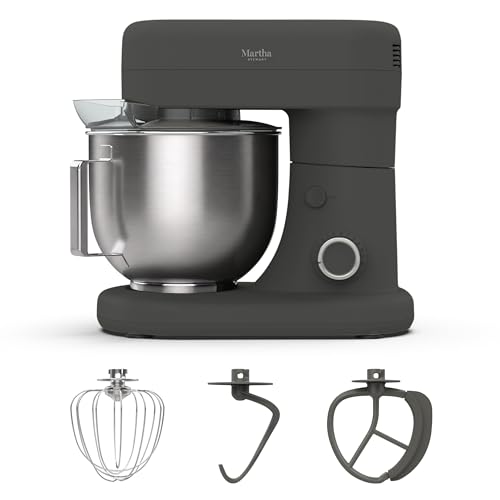
Martha Stewart 5.3QT Tilt Head Stand Mixer — Comparison Pick: Design-Led Rival
The Martha Stewart mixer competes on a different axis: the counter as a styled surface. Its Caviar Gray finish and tidy lines are aimed at kitchens photographed as carefully as they are cooked in, and the specification is no embarrassment, twelve speeds, a 5.3-quart stainless bowl, dough hook, whisk and beater, plus a removable splash shield. As a mixing appliance for cakes, batters and whipped work, it covers the mainstream repertoire without apology.
Its role in this guide is to sharpen the KitchenAid question rather than to win it. There is no powered hub ecosystem behind this machine, and the brand’s appliance line is a licensing story rather than a generations-deep engineering one, so the buyer is purchasing a mixer, full stop. For some kitchens that is the correct purchase: the baking is occasional, the look matters daily, and the system future is imaginary. Naming that trade clearly is what a comparison pick is for, and households should choose it, if they choose it, with eyes open rather than by drifting.
The Martha Stewart machine also raises a fair question about who mixers are for. Its styling, its straightforward twelve speeds and its complete basic kit speak to the baker who cooks from magazines, photographs the result and values a counter that looks composed in the background of a life. There is no shame in that brief, and this machine serves it coherently. What it cannot do is grow: no hub, no attachments, no second act. Buy it as a finished object and it satisfies; buy it as the start of a system and it will quietly disappoint, which is why the distinction is drawn so plainly here.
The Martha Stewart mixer’s twelve speeds, like the Cuisinart’s, slice finer than KitchenAid’s ten, and for the gentle end of baking that granularity is a genuine if modest pleasure. Its removable splash shield likewise shows a designer thinking about washing-up, the least glamorous and most frequent interaction any mixer has with its owner. The machine’s limits are strategic, not tactical: it does its listed jobs respectably, and simply promises nothing beyond them, which some buyers will correctly read as a promise kept in advance.
- Capacity: 5.3-quart stainless steel bowl
- Speeds: 12 settings
- Included: dough hook, whisk, beater, splash shield
- Design: tilt-head, Caviar Gray
- Jobs: bread, cake and whipping
Strengths
- Styled finish suits design-led kitchens
- Full basic accessory set included
- Capacity close to the largest here
Trade-offs
- No attachment hub or ecosystem
- Appliance heritage is licensing, not engineering lineage
- Support depth trails the category leaders
Best for: occasional bakers who style their counters deliberately.
Not suited for: system builders planning attachments over years.
Weigh the look against the system question and Check price on Amazon.

KitchenAid 9-Speed Hand Mixer KHM926 Contour Silver — Best Hand Mixer in the Range
A guide to KitchenAid mixers that omitted the hand mixer would misunderstand how these kitchens actually run. The big stand mixer owns the weekend; the KHM926 owns Tuesday. Whipping cream for a pudding, beating eggs for an omelette at the hob, folding a small batter in the bowl it will bake in: these jobs take ninety seconds, and dragging out a stand mixer for them is friction that changes what people bother to cook. The hand mixer removes the friction, and the 9-speed is the range’s fullest expression of that idea.
Within the KitchenAid family its virtues are continuity rather than capacity. The speed control shares the stand mixers’ philosophy, a genuinely gentle bottom end for folding, rising to a purposeful whip, and the accessory set, beaters, whisk and hooks, mirrors the big machines’ repertoire at hand scale. It stores in a drawer, travels to holiday kitchens, and rescues dinner parties when the stand mixer is occupied. Owners of both machines describe the same division of labour, and it is why this smaller sibling closes a guide otherwise devoted to its larger family: the range is a system at two scales, not a single product.
The hand mixer’s place in the ecosystem is worth one more thought, because it explains a common buying pattern: households often acquire the KHM926 first, years before any stand mixer, and its manners teach them what the brand’s low speeds should feel like. When the stand mixer eventually arrives, it is usually the same badge, bought with the confidence of a small machine that never misbehaved. As an ambassador the hand mixer is unmatched in the range, and as a tool it keeps its drawer long after the flagship lands, which is more than most ambassadors manage.
Notice what the KHM926’s presence at the end of this guide implies about the range’s shape: KitchenAid does not treat the hand mixer as a toy version of the stand mixer but as the same philosophy at hand scale, gentle starts, honest speeds, accessories that wash and last. Households that own both describe a single mixing culture across two machines, and that coherence, recipes behaving the same way in either pair of hands, is a quiet luxury no rival in this guide currently offers at any price.
- Speeds: 9 settings, hand-held format
- Attachments: Turbo Beater II, pro whisk, dough hooks
- Care: dishwasher-safe accessories
- Storage: drawer-sized, no counter footprint
- Role: quick and small-batch mixing
Strengths
- Zero setup for ninety-second jobs
- Gentle low speeds for folding work
- Stores in a drawer, travels easily
Trade-offs
- Batch size limited by your own bowl
- You provide the arm and the patience
- Not a kneading machine for large doughs
Best for: stand mixer owners and small households alike, for daily quick work.
Not suited for: anyone kneading family bread batches by hand mixer alone.
Consider it as the stand mixer’s partner and Check price on Amazon.
How Do the KitchenAid Core Models and Their Rivals Compare?
| Pick | Key specification | Standout trait |
|---|---|---|
| KitchenAid Classic 4.5-Qt Stand Mixer K45SS | 4.5-qt tilt-head, 10 speeds | Traditional entry point |
| KitchenAid Artisan 5-Qt Stand Mixer Empire Red | 5-qt tilt-head, pouring shield | The iconic all-rounder |
| KitchenAid 5.5-Qt Bowl-Lift Stand Mixer | 5.5-qt bowl-lift, 11 speeds | Heavy-dough stability |
| Cuisinart 5.5-Qt Stand Mixer 12 Speed | 5.5-qt, 12 speeds, splash guard | Spec-sheet challenger |
| Martha Stewart 5.3QT Tilt Head Stand Mixer | 5.3-qt tilt-head, 12 speeds | Design-led challenger |
| KitchenAid 9-Speed Hand Mixer KHM926 Contour Silver | 9 speeds, hand format, full attachments | The daily quick-job tool |
The table exposes the guide’s argument in miniature. Capacities cluster tightly, speeds cluster tighter, and on paper the rivals look like equals, which is precisely why the decision must be made on what surrounds the numbers: the hub and its attachments, the mixing action’s thoroughness, the parts and knowledge infrastructure, and the head style that suits your dough. KitchenAid’s premium, where it exists, buys that surrounding system.
Head style deserves its own sentence in any comparison. Tilt-heads, the Classic, Artisan and both rivals here, win on access and familiarity; the bowl-lift wins on stability and capacity. Neither is better in the abstract. The right question is what your heaviest regular dough does to a machine, and the answer to that question, honestly given, selects the architecture for you.
Tilt-Head or Bowl-Lift: Which Architecture Fits Your Baking?
The tilt-head is the domestic classic for good reasons. The head swings back, the bowl is fully exposed, ingredients go in without contortion, and the bowl lifts off its base with a twist that anyone can learn in one attempt. For cakes, cookies, batters and moderate doughs, which is to say the overwhelming majority of home baking, that ease is the daily experience of the machine, and daily experience is what ownership actually consists of.
The bowl-lift trades a little of that ease for composure under load. With the head fixed and the bowl cranked up into it, the frame forms a single rigid structure, and heavy doughs that make a tilt-head nod and wander simply get kneaded. The costs are height, a slightly fussier bowl removal, and a price step. Bakers should choose by their stiffest regular recipe: below that threshold, tilt-head joy; above it, bowl-lift calm. Occasional ambitions do not count; the weekly loaf does.
What Can the Attachment Hub Actually Do for a Home Kitchen?
The hub is a standardised power take-off on the mixer’s head, and the catalogue behind it is where a KitchenAid stops being a mixer. Pasta rollers and cutters turn the machine into a fresh-pasta station that produces sheets of a quality dedicated hand-crank machines envy. The food grinder handles mince, sausages and falafel mixtures. Grain mills, ice cream makers, spiralizers, juicers and slicers extend the list further than most households will ever explore.
The economic logic compounds over years. Each attachment costs a fraction of the standalone appliance it replaces, stores in a fraction of the space, and runs off a motor you already maintain. This is why the rival comparisons in this guide keep returning to the hub: a competing mixer can equal the bowl work and still leave its owner buying separate machines for everything the hub would have covered. Buyers should ask not whether they want attachments today, but whether they can imagine wanting none of them for a decade.
How Should You Match Bowl Size to Your Real Batches?
Bigger is not automatically better in mixing bowls, because planetary beaters are tuned to a bowl’s geometry and small quantities in a large bowl can smear around the edges under the beater’s sweep. A cup of cream whips reluctantly in a 5.5-quart bowl and eagerly in a smaller one, which is why keen bakers sometimes keep a second, smaller bowl for the machine they already own rather than downsizing the machine itself.
Size from your largest regular batch, then check the small end. A household whose peak is a double cookie batch lives happily at 4.5 quarts; bread bakers doubling loaves need the 5.5; and everyone should confirm the machine handles their smallest frequent job, whipped egg whites for two, a single cake batter, without sulking. The models in this guide were chosen so that each size point is represented by a machine that also behaves at the opposite end of its range.
What Do Speeds and Touchpoints Mean Beyond the Brochure?
Speed counts are the most gamed number in this category, so translate them into behaviour. What matters is the bottom and the top: a lowest speed gentle enough to fold flour without a dust cloud or to start a sponge without splashing, and a top speed that whips cream and meringue to peaks in reasonable time. The middle speeds are variations; ten, eleven or twelve divisions of the same journey matter far less than the quality of its ends, which is why this guide’s reviews keep returning to low-speed manners.
Touchpoints describe how many times per revolution the beater contacts the bowl’s inner surface in planetary action, and they proxy for scraping: more touchpoints, more thoroughly the mixture is folded back into the beater’s path. High-touchpoint machines leave less unmixed residue at the bowl’s base and walls. No number replaces watching a batter come together, but when comparing across brands, touchpoints and low-speed behaviour tell you more truth than the speed dial’s highest digit ever will.
How Do You Set Up and Care for a Stand Mixer for the Long Term?
Placement is the first act of care. A stand mixer is heavy enough that it should live where it works, on the counter with clearance for the head to tilt or the bowl to lift, near the socket it will use, because a machine that must be hauled from a cupboard will be used half as often as one standing ready. Check the beater-to-bowl clearance when the machine is new; most designs allow a small adjustment, and a beater set correctly neither clangs the bowl nor leaves a layer of unmixed flour beneath it.
Ongoing care is mostly respect. Add flour at low speed or in stages to spare the motor the shock of a stiff start, let heavy doughs rest the machine between batches on marathon days, and wash bowls and beaters promptly, keeping water away from the head’s internals. Wipe the hub cap area where attachment grease can migrate. Machines treated this way measure their service in decades, and the second-hand market in old KitchenAids, still working, still supported, is the evidence.
How Much Counter Space Does a Stand Mixer Really Claim?
Measure the claim in three dimensions and in behaviour. The footprint is modest, roughly a large loaf tin’s worth of counter, but the working claim is larger: tilt-heads need vertical room to open, bowl-lifts need their full height permanently, and both need a landing zone beside them for bowls, scales and ingredient tubs during a bake. A mixer parked in a corner with no working room around it will be used reluctantly, however fine the machine.
The deeper truth is that a stand mixer is a permanent resident and should be budgeted as one. Households that accept this, clearing a proper station with the flour and sugar within reach, use their machines several times a week; households that treat the mixer as a visitor, cupboarded between uses, watch it become an heirloom before its time. Choose the spot before the model, because the spot decides the usage, and the usage decides whether any of the machines in this guide were worth buying at all.
What Should a First-Time Stand Mixer Owner Bake in the First Month?
Choose a curriculum rather than a celebration. Week one, a simple cake and a batch of cookies, to learn the speeds, the scrape points and the sound of a batter coming together. Week two, whipped cream and a meringue, to meet the top end and the whisk. Week three, a single loaf of bread on the dough hook, modest and forgiving, to learn what kneading looks like when a machine does the work your arms used to do.
By week four the machine’s character is known: where its beater misses, how its lowest speed behaves with flour, whether the bowl’s handle suits your grip when it is full of batter. That knowledge is the real manual, and it arrives only through use. Owners who run this curriculum inside the first month also surface any fault while returns are painless, which is the practical dividend of enthusiasm, and they enter month two as operators rather than owners, which is the entire point of the purchase.
How Do Second Bowls and Extra Accessories Extend a Mixer’s Life?
The most useful accessory is not glamorous: a second bowl. Baking days stall at the washing-up, a buttercream bowl waiting while a sponge needs mixing, and a spare bowl abolishes the queue for the price of a bag of flour’s bigger cousins. Smaller bowls, where the range offers them, solve the small-batch problem described earlier in this guide, letting a big machine whip two egg whites without embarrassment.
Beyond the bowl, buy accessories against recipes rather than against the catalogue. The flat beater with a flexible edge, where available for your model, ends mid-mix scraping for many batters; a spare whisk rescues meringue day when the first is in the wash. Attachments for the hub should follow the same discipline, purchased when a household’s cooking actually arrives at pasta, grinding or milling, not in anticipation of a personality the kitchen may never develop. Systems reward patience: the hub will still be there when the recipe is.
Is a Refurbished or Second-Hand KitchenAid a Sensible Buy?
This is one of the few appliance categories where the used market deserves a serious hearing, because the machines are durable, repairable and supported with parts across decades. A second-hand KitchenAid with a smooth motor note, a tight head and a hub cap intact can deliver years of service, and the savings against new are real. The checks are tactile: listen for grinding, watch for head wobble under a stiff dough, confirm every speed engages, and inspect the beater shaft and bowl for the wear that tells the machine’s true mileage.
Buy new when the price gap narrows, when the machine is a gift, or when the specific current model’s refinements matter to you; buy used when the individual machine in front of you passes its examination and the seller’s story matches its condition. Either way, the category’s longevity is the point: a product line whose twenty-year-old examples are still bought with confidence is a product line whose new machines carry a certain promise, and that promise is a large part of what the badge has always sold.
How Has the Stand Mixer Earned Its Place as a Household Heirloom?
Few appliances are inherited with gratitude; most are inherited with a trip to the recycling centre. The stand mixer is the exception because its value is mechanical and cumulative rather than electronic and expiring. A thirty-year-old machine still mixes, still accepts current attachments, still finds parts and repairers, and carries its family’s baking history in a way that makes replacing it feel like a small betrayal. Manufacturers of disposable appliances study this category with envy, because loyalty of this depth cannot be advertised into existence; it can only be compounded, one working decade at a time.
The heirloom quality has a practical corollary for today’s buyer: the second-hand and hand-me-down market acts as a quality guarantee on the new purchase. A machine whose predecessors demonstrably survive is a machine whose own survival is a reasonable expectation rather than a hope, and expectations of that kind are exactly what a premium is supposed to buy. When the comparison sections of this guide weigh KitchenAid’s premium, this is the heaviest item on the scale, heavier than speeds, heavier than colours, because it is measured in decades.
What Should You Know About Using the Dough Hook Well?
The dough hook is the attachment most often misused, because it invites ambition. Respect three rules and it will reward you for years. First, knead at the low speeds the manual specifies for dough, never higher, because the hook is designed to fold and stretch at a pace that develops gluten without tearing it or straining the drive. Second, respect the flour capacity for your bowl size; an overloaded dough climbs, stalls and heats the machine, and the fix is two batches, not more force.
Third, learn the windowpane test and the feel of a finished dough, smooth, elastic, pulling away from the bowl’s sides, because the hook’s job ends at a texture, not at a timer. Bakers who internalise those three rules find the machine transforms bread from a weekend project into a weekly habit, which is the single largest lifestyle change any appliance in this guide can honestly claim to cause. The hook, used well, is the argument for the whole category.
What Is the Simplest Test of Whether You Bought the Right Mixer?
Live with it for one ordinary month and watch where your hands go. The right mixer is reached for without thought, its bowl the one your recipes now assume, its speeds a language your fingers speak while your mind is on the cake. The wrong mixer announces itself in small avoidances, the recipe not attempted, the attachment never mounted, the hand mixer chosen for jobs the big machine should have owned. That monthly audit, honest and unforced, tells you more than any review, including this one, because it measures the machine against the only laboratory that matters: your kitchen, your recipes, your hands.
What Mistakes Do Mixer Buyers Most Often Regret?
Buying by colour first and architecture second is the photogenic mistake. A tilt-head in the perfect shade still flexes under the bagel dough its owner bakes weekly, and a bowl-lift bought for its looks still crowds the low cabinets it lives under. Choose the frame for your baking and the size for your batches; then, and only then, enjoy the colour chart.
Ignoring the small-batch end runs a close second. Buyers size up for the Christmas batch and spend the year fighting a huge bowl over two egg whites. If your daily jobs are small and your peaks are rare, the Classic’s bowl, or a second smaller bowl for a larger machine, serves your actual life better than maximum capacity does.
Skipping the ecosystem question wastes the category’s main advantage. A shopper who saves a little on a rival and then buys standalone pasta and grinding appliances over the following years has not saved; they have merely deferred and multiplied the spending. Equally, a shopper who pays for hub dreams they will never use has bought a story. Both errors come from not imagining the decade honestly.
Finally, flour discipline: tipping the whole flour measure into a running bowl at speed is how counters get dusted and motors get shocked. Add in stages, start low, use the pouring shield where one is provided. The machines in this guide are strong, but every veteran baker’s technique exists because some beginner, once, did it the other way.
A fifth regret completes the list: never adjusting the beater clearance. Owners live for years with a beater that either clangs the bowl or floats above an unmixed layer, assuming the machine was simply made that way, when the adjustment exists precisely to tune that gap and takes minutes with the manual open. A mixer set up correctly on day one mixes like a different, better machine.
Final Recommendation
Start the decision where most households should: the KitchenAid Classic 4.5-Qt Stand Mixer K45SS if your baking is weekly and varied, the KitchenAid Artisan 5-Qt Stand Mixer Empire Red if you want the definitive family machine with its shield and colours, and the KitchenAid 5.5-Qt Bowl-Lift Stand Mixer the moment heavy dough becomes a weekly habit rather than an annual experiment. The rivals earn respect, the Cuisinart on specification, the Martha Stewart on style, but neither brings the system that makes a KitchenAid compound in value year after year.
Choose the frame for your stiffest dough, the bowl for your truest batch, and the brand for the decade you intend to keep it, and the mixer will stop being an appliance purchase and become what owners quietly call it, the machine, as if there were only ever one candidate for the title.
Frequently Asked Questions
Is the Artisan worth the step up from the Classic?
For most families, yes, if the budget allows: the larger bowl, the pouring shield and the colour range are used and appreciated constantly, while the Classic remains the rational buy for smaller households and tighter budgets. The mixing quality itself is comparable, so the decision is about capacity and convenience rather than capability.
Can a bowl-lift mixer fit under standard kitchen cabinets?
It depends on the cabinet height, because bowl-lift models are taller and need their full height available permanently, while tilt-heads need clearance only when opened. Measure from counter to cabinet underside and compare with the listing’s dimensions for the exact model, allowing a margin for the bowl’s travel.
Do all KitchenAid attachments fit all KitchenAid stand mixers?
The hub standard is famously consistent across the stand mixer range, which is the foundation of the ecosystem argument: attachments made for the hub fit the Classic, Artisan and bowl-lift models alike. Hand mixers are a separate family and do not take hub attachments, which is why they carry their own beaters, whisk and hooks.
How many speeds do I actually need on a stand mixer?
Fewer than the dials advertise. A gentle stir, a few working speeds for batters and doughs, and a vigorous whip cover real baking; ten to twelve divisions simply slice that journey more finely. Judge a machine by its lowest speed’s manners and its top speed’s enthusiasm rather than by the count between them.
Can these mixers knead bread dough without burning out?
Yes, within their design briefs: use the dough hook, keep to the recommended speeds for kneading, respect batch sizes for the bowl, and let the bowl-lift take the heaviest work if dense loaves are your routine. Motors suffer when oversized, stiff batches are forced at high speed, which is technique failure rather than machine failure.
Why keep a hand mixer if I own a stand mixer?
Because of the ninety-second jobs. Whipping a little cream, beating eggs in the pan’s bowl, mixing a small glaze: the hand mixer does these with no setup and washes up in seconds. Most two-machine households report the hand mixer earns its drawer weekly, which is why the range’s flagship hand model closes this guide.
What is the difference between the Classic and Artisan bowls in practice?
Half a quart of working room, which shows up as headroom when a batter rises during mixing and as capacity for larger cookie and cake batches. The Artisan’s bowl also arrives with the pouring shield in its standard bundle. For small households the Classic’s bowl is never the limiting factor; for double-batch bakers the Artisan’s extra room is felt weekly.
Can I leave a stand mixer plugged in permanently?
Most owners do, and the machines are designed to live on counters, but the tidy habit is to switch off at the socket where the outlet allows it, both for standby economy and as general electrical hygiene. What matters more is that the cord is not trapped under the machine’s own weight or run across a hot hob, the two fates cords actually die of.
Related Guides
The mixer is the anchor; these guides cover what it works beside. Best Descaler for Nespresso Machines, Best Briquettes for Smokers, Best Composite Kitchen Sinks.


