What's inside
- Where to Buy, and How to Read This Guide
- Key Takeaways
- Quick Picks
- How Did We Choose Appliances for a Job List Instead of a Category?
- Which Cooking Jobs Does a Microwave Actually Do Badly?
- How Do These Alternatives Divide the Microwave’s Failures Between Them?
- Reheating Pizza and Leftovers: Which Appliance Actually Fixes Them?
- Can a Countertop Oven Really Replace a Main Oven?
- What About Defrosting, the Microwave’s Other Party Trick?
- How Much Counter Space and Clearance Do These Ovens Need?
- How Do You Clean an Air Fryer Oven Without Hating It?
- Which Is Better for Toast and Sandwiches: Oven, Grill or Microwave?
- How Do You Reheat Fried Food Without Losing the Crunch?
- What Size Alternative Suits a Household of One or Two?
- How Does a Countertop Oven Handle Baking Compared With a Main Oven?
- How Do You Decide Between Keeping Both Appliances and Going Microwave-Free?
- What Learning Curve Should a First-Time Countertop Oven Owner Expect?
- How Should You Plan a Week of Cooking Around a Countertop Oven?
- Where Should a New Countertop Oven Live While It Earns Its Place?
- What Mistakes Do People Make When Replacing a Microwave?
- Final Recommendation
- Frequently Asked Questions
- Related Guides
As an Amazon Associate I earn from qualifying purchases. This post may contain affiliate links at no extra cost to you.
cottageverdict.com is reader-supported. When you buy through links on our site, we may earn an affiliate commission.
Where to Buy, and How to Read This Guide
Nobody misses a microwave until the leftovers come out rubbery for the third night running. The honest truth is that microwaves are brilliant at a narrow set of jobs, heating liquids, steaming vegetables, defrosting in a hurry, and quietly terrible at the rest: crisping, browning, roasting and reheating anything whose texture matters. The best alternatives to microwaves are the appliances that take over exactly those failing jobs, and this guide is organised around that idea rather than around any single gadget.
So this is not a toaster oven roundup wearing a disguise. Each pick below earned its place by answering a specific complaint: pizza that comes back floppy, roast potatoes that steam instead of crackling, chicken skin that turns to rubber, frozen food that thaws unevenly. Some households will replace the microwave entirely with one versatile countertop oven; more will keep a small microwave for drinks and let a second appliance handle everything texture-related. Both strategies are legitimate, and the sections below help you choose between them.
Every model here is a countertop oven with convection or air frying ability, because hot moving air is what microwaves fundamentally cannot offer. Each pick links to its Amazon listing so you can check price on Amazon and verify the footprint, since these machines are larger than the microwaves they complement and counter space is the first negotiation.
A note on method before the metal: every machine below was assessed against the microwave it would sit beside or replace, not against an abstract ideal. A countertop oven that crisps beautifully but takes twenty minutes to preheat for a two-minute job has failed the actual assignment, because the microwave’s one true superpower is immediacy. Speed to useful heat, honesty of capacity and the texture of the finished food carried the most weight in the judgements that follow.
Key Takeaways
- Microwaves fail at browning and crisping because they heat water molecules, not surfaces; hot-air ovens fix exactly that weakness.
- Reheated pizza, roast potatoes and pastry belong in an air fryer oven, where they come back crisp instead of soggy.
- A countertop convection oven can genuinely replace a main oven for households of one to four, which a microwave never could.
- Defrosting still favours the microwave or patient fridge thawing; alternatives win on cooking quality, not thawing speed.
- Measure your counter and cabinet clearance carefully: these ovens run hot externally and need air space on all sides.
- Most households end up with a partnership, small microwave for liquids and steaming, air oven for everything with texture.
Quick Picks
| Pick | Badge | Why it earned a place |
|---|---|---|
| Breville Smart Oven Air Fryer Pro | Best Full Microwave Replacement | Thirteen functions with precise convection control make it the one machine that can retire both microwave reheating and a main oven for small households. |
| Cuisinart 8-in-1 Air Fryer Oven | Best Everyday All-Rounder | Eight functions and 1800 watts in a 0.6 cubic foot body that crisps weeknight food without dominating the counter. |
| Cuisinart TOA-55 Air Fryer Oven | Best for Pizza Nights | A 0.6 cu ft cavity that fits a twelve-inch pizza, heats to 450 degrees and keeps a removable crumb tray for easy cleaning. |
| Ninja Flip Toaster Oven & Air Fryer SP151 | Best for Tiny Counters | Flips up to store against the backsplash, reclaiming counter space, yet still cooks family meals for four. |
| Emeril Lagasse 26QT French Door Air Fryer Oven | Best for Big Families | A 26-quart interior, French doors and 24 presets give the largest households a genuine main-oven understudy. |
| Hamilton Beach Easy Reach Air Fryer Toaster Oven | Best Easy-Access Design | A roll-top door that lifts out of the way, six-slice capacity and a wide 150 to 450 degree range for arthritic hands and busy counters. |
How Did We Choose Appliances for a Job List Instead of a Category?
We started by writing down the complaints, not the products. Soggy reheated pizza, leathery chicken, pastry that steams, roast vegetables that never caramelise, frozen snacks with icy centres and molten edges: each failure of microwave physics became a test an alternative had to pass. Any appliance that could not demonstrably beat a microwave at one of those jobs was excluded, however good it might be at unrelated tricks.
Convection and air frying capability became the entry ticket, because circulating hot air is the mechanism that crisps and browns. Beyond that we weighed capacity honestly, since a machine replacing an oven must fit a chicken or a twelve-inch pizza, control quality, because browning rewards precision, and cleaning, because an alternative that is miserable to wipe out will be abandoned by February however beautifully it roasts.
We also insisted on range. The six survivors span compact flip-up designs for tiny counters through a family-size French door model, so that the recommendation can follow your kitchen rather than the other way round. None of them thaws food as quickly as a microwave, and this guide says so wherever it matters, because an alternatives guide that hides the original appliance’s strengths is just advertising.
Which Cooking Jobs Does a Microwave Actually Do Badly?
Microwave energy excites water inside food, which is why it heats quickly and why it can never dry a surface enough to crisp it. Skin, crusts and edges emerge steamed: chicken skin goes flabby, bread softens, pastry slumps, and cheese turns greasy rather than golden. Reheating amplifies the problem because the food was crisp once and the contrast is unmistakable. Anything whose pleasure lives in its surface, fries, roast potatoes, pizza, pies, grilled sandwiches, is fighting the appliance’s basic physics.
Evenness is the second weakness. Microwaves deposit energy in patches, so dense or irregular foods thaw and cook unevenly, with scorched rims around cold centres. And browning chemistry, the Maillard reactions that make roasted food taste roasted, needs dry surface heat well above boiling point, which a microwave cavity never reaches. The alternatives below attack these three failures, surface texture, evenness and browning, with fan-driven dry heat, which is why they succeed where the microwave cannot.
There is a third, quieter failure worth naming: reheating in a microwave degrades gradually, so households lower their expectations without noticing. The first soggy pizza is an event; the fiftieth is simply what pizza tastes like now. Owners who add a hot-air oven often describe the first reheated slice as a small shock, not because the oven is miraculous, but because their baseline had sunk. Restoring the baseline is the real product being bought in this category.
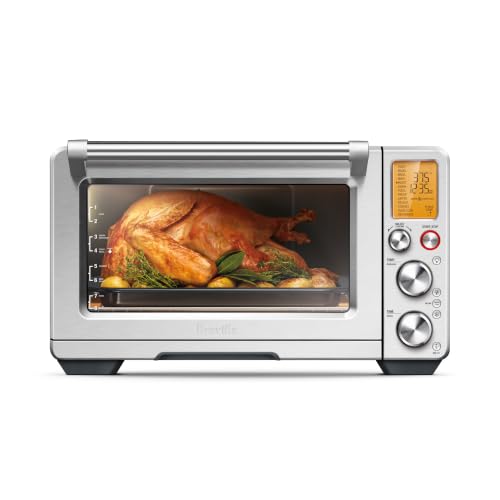
Breville Smart Oven Air Fryer Pro — Best Full Microwave Replacement
The Breville is what happens when a countertop oven is engineered like a serious appliance rather than a compromise. Thirteen functions span toast, bake, roast, broil, pizza, air fry and dehydrate among others, and its convection system trims cooking times noticeably while evening out hot spots. Reheated pizza emerges with a crisp base and bubbling top, roast vegetables caramelise at the edges, and a whole chicken roasts with genuinely crackling skin, all the things your microwave has been apologising for.
Precision is the deeper virtue. The temperature control holds steady rather than swinging, the interior fits a twelve-inch pizza and a decent roasting pan, and the controls reward cooks who actually cook rather than merely reheat. It is the largest and most committed purchase in this guide, and its dehydrate and slow settings mean it keeps finding jobs after the novelty fades. If one machine must carry a small household’s entire oven workload while the microwave handles drinks, this is the strongest candidate here.
Consider also what the Breville does to a baker’s week. Proofing, baking and slow cooking in one cavity means the machine can take a loaf from dough to crust without troubling the main oven, and its air fry mode handles the Friday chips with the same authority. That breadth is why owners describe it as infrastructure rather than appliance. The investment case rests on use: a household that cooks daily in it amortises the machine across hundreds of meals, while a household that reheats twice a week should honestly choose smaller, and this guide’s next pick exists for them.
Breville ownership has a learning dividend: because the machine exposes real temperatures and real functions rather than hiding them behind novelty presets, cooks using it become better oven cooks generally, learning what 180 degrees does to a potato and what a fan does to a pastry. That education transfers to every other oven the household will ever own. Few appliances teach while they work; this one does, and keen cooks should count the tuition in the price.
- Functions: 13 including air fry, roast and dehydrate
- Convection: reduces cooking time versus still air
- Capacity: fits a 12-inch pizza and roasting pans
- Finish: brushed stainless steel
- Controls: precise electronic temperature management
Strengths
- Browns and crisps like a real oven, because it is one
- Wide function range replaces several appliances
- Accurate temperatures suit baking as well as roasting
Trade-offs
- Large footprint demands a permanent counter home
- Premium positioning within this group
- Overkill for households that only reheat snacks
Best for: small households wanting one oven to do nearly everything.
Not suited for: tiny kitchens with no spare counter depth.
Measure your counter depth and cabinet clearance, then Check price on Amazon.

Cuisinart Air Fryer Toaster Oven 8-in-1 1800W — Best Everyday All-Rounder
Cuisinart’s 8-in-1 hits the practical centre of this category. At 1800 watts it heats fast, the air fry mode resurrects chips, wings and yesterday’s roast potatoes with real crunch, and the convection bake handles traybakes and gratins the microwave would only steam. A 60-minute timer and a 0.6 cubic foot cavity sized for family side dishes make it a weeknight tool rather than a weekend toy.
Daily manners are good: the stainless body wipes down, the controls are dial-and-go simple, and warm mode holds food at serving temperature while the rest of dinner catches up, a quiet superpower microwaves cannot copy without ruining texture. It will not swallow a huge turkey or replace a range cooker at Christmas, and it does not pretend to. For the reheating and crisping jobs that drive people to seek a microwave alternative in the first place, this is the balanced answer most kitchens will use daily.
The Cuisinart’s timer and warm mode deserve a household story. A parent reheating three different dinners across an evening of staggered arrivals can hold the first at serving temperature without it drying into leather, a trick no microwave performs without ruining the food it holds. Multiply that small mercy by every training night and late meeting in a family year and the 8-in-1 stops looking like a compromise purchase. It is the machine for kitchens whose problem is logistics as much as texture, and logistics is most kitchens’ actual problem.
The Cuisinart 8-in-1 also handles the breakfast shift with unusual competence, a shift many countertop ovens fumble. Toast emerges evenly, bacon crisps on a tray without filling the kitchen with hob smoke, and eggs can bake in ramekins while the coffee brews, all in one cavity that a microwave could only have steamed into sadness. Households whose mornings are a relay of staggered departures will find the machine quietly reorganising breakfast from a queue into a system.
- Power: 1800 watts
- Functions: 8-in-1 including air fry and convection
- Capacity: 0.6 cu ft interior
- Timer: 60-minute with warm setting
- Finish: stainless steel, model TOA-70NAS
Strengths
- Air fry mode restores crunch to leftovers
- Warm mode holds food without overcooking it
- Heats quickly and cooks evenly for its size
Trade-offs
- Too small for large celebration roasts
- Exterior gets hot in long sessions
- Crumb management needs regular attention
Best for: families wanting crisp reheats and weeknight roasting in one box.
Not suited for: households cooking for six or more at once.
Check the interior dimensions against your favourite tray and Check price on Amazon.

Cuisinart Air Fryer Toaster Oven TOA-55 — Best for Pizza Nights
The TOA-55 is the pizza argument made metal. Its cavity accepts a twelve-inch pizza whole, the element reaches 450 degrees so bases crisp rather than sag, and convection circulation keeps the top bubbling evenly to the edges. Frozen pizza, the food microwaves mistreat most theatrically, comes out tasting like an intention rather than an apology, and reheated slices recover their structure instead of curling into sadness.
Seven functions cover the rest of the alternative brief: air frying for wings and wedges, baking for small cakes and traybakes, toasting that actually browns both sides. The removable crumb tray is a small mercy that matters weekly, because pizza and toast generate crumbs industriously and a tray that slides out beats shaking an oven over the sink. Households whose microwave complaints begin and end with pizza and snacks will find this the most targeted machine in the group.
One caution belongs with the TOA-55’s praise: a pizza cavity invites pizza frequency, and households report the machine quietly reorganising their Fridays around it. That is a lifestyle observation rather than a criticism. The oven also toasts more evenly than a slot toaster for thick artisan slices, because the heat surrounds rather than attacks from two sides, and its broil setting finishes cheese-topped anything with a proper gratin. Buy it for pizza, by all means; just know it will audition for the rest of the menu within the month.
TOA-55 owners should exploit its broil with confidence, because a compact cavity puts food close to the element and gratins finish fast and fiercely. Cheese on toast, the top of a shepherd’s pie portion, a crumble’s final minute: these small browning jobs are where a big oven feels absurd and a microwave feels helpless, and they are this machine’s home turf. Watch the first few attempts closely, because proximity cuts both ways, and then enjoy a capability most kitchens simply do not possess at this scale.
- Power: 1800 watts, heats to 450°F
- Functions: 7-in-1 with convection
- Capacity: 0.6 cu ft, fits a 12-inch pizza
- Cleaning: removable crumb tray
- Finish: stainless steel
Strengths
- Twelve-inch pizza capacity with real base crisping
- High top temperature for proper browning
- Crumb tray simplifies weekly cleaning
Trade-offs
- Shares counter demands with its larger sibling
- Seven functions, so fewer speciality modes
- Not the choice for dehydrating or slow cooking
Best for: pizza lovers and snack-driven households.
Not suited for: cooks wanting dehydrate or proofing functions.
Confirm your pizza stone or tray fits the cavity and Check price on Amazon.

Ninja Flip Toaster Oven & Air Fryer SP151 — Best for Tiny Counters
Counter space is the objection that kills most microwave alternatives, and the Ninja Flip is designed entirely around defeating it. After cooking, the whole oven rotates up to stand vertically against the backsplash, freeing the worktop it just used. For galley kitchens and studio flats, that single trick converts an impossible purchase into a practical one, and it deserves to headline the review.
The cooking itself does not feel like a compromise for the storage gimmick. It air fries, bakes and toasts for around four people, with family meals ready in roughly twenty minutes according to the maker, and it sips less power than a full-size oven doing the same job. Sheet-pan dinners are its home ground: salmon, vegetables and wedges in one pass, crisped by moving hot air in a way no microwave can imitate. Tall items are the limit, since the cavity is wide and shallow rather than deep, so whole chickens belong to other picks in this guide.
The Flip’s storage trick changes household politics as well as geometry. An appliance that puts itself away is an appliance nobody campaigns to remove from the counter, and in shared kitchens that peace treaty has real value. Its shallow cavity also heats fast, because there is less air to bring to temperature, so weeknight sheet-pan dinners genuinely start sooner than in a deep oven. The shape disciplines the cooking in a healthy direction too: flat, spread-out food crisps, and this machine makes flat, spread-out food the path of least resistance.
The Flip’s shallow format has one more talent: it reheats flatbreads, wraps and quesadillas better than any deep cavity, because both faces sit near heat and the filling warms before the outside can dry. Lunch, in households that work from home, is disproportionately made of exactly those foods, and a machine that perfects the working lunch while disappearing against the wall afterwards has understood its assignment at a level its rivals should study.
- Design: flips upright for storage
- Capacity: family meals for four
- Efficiency: uses less power than a standard oven
- Functions: toaster oven and air fryer combined
- Footprint: wide, shallow sheet-pan format
Strengths
- Stores vertically, solving the counter-space problem
- Fast sheet-pan meals with real crisping
- Lower energy use than a full oven
Trade-offs
- Shallow cavity excludes tall roasts
- Wide footprint while in use
- Not ideal for large batch baking
Best for: small kitchens that need the counter back after dinner.
Not suited for: cooks who roast whole birds regularly.
Check the flip clearance under your cabinets and Check price on Amazon.
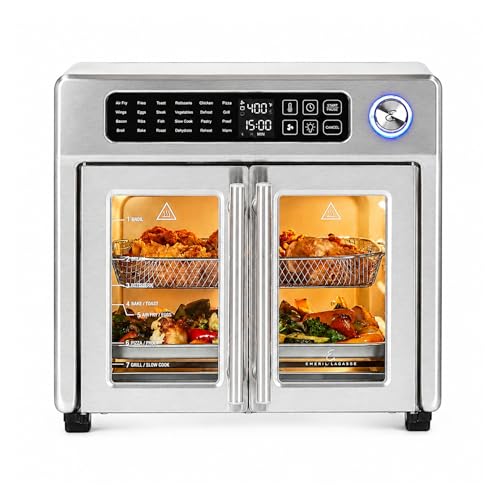
Emeril Lagasse 26QT French Door Air Fryer Oven — Best for Big Families
When the complaint is that a microwave cannot feed a crowd properly, capacity becomes the answer and this Emeril Lagasse model is the capacity pick. Twenty-six quarts of interior swallows large casseroles, big batches of wings and family-size roasts, while the French doors open with a single pull and give the oven a permanence that suits kitchens where it will work daily as a second, or even primary, oven.
Twenty-four one-touch presets cover the common jobs, and six included accessories mean the machine arrives ready rather than demanding a shopping list. Convection circulation keeps big loads cooking evenly, which is where large countertop ovens sometimes falter. It is unapologetically the biggest footprint here, and households must honestly have the counter for it. Given that space, it replaces more microwave failures than any rival in this guide simply because almost nothing you cook is too large for it.
French doors sound like a flourish until you open them with an elbow while holding a casserole, at which point they become the most practical feature in the category. The Emeril also suits the household that hosts: a second oven of this size absorbs the overflow of a holiday meal, warming sides while the main oven guards the roast, and for two weekends a year that capacity justifies the counter it occupies the rest of the time. Between those weekends it earns its keep on batch cooking, tray after tray of wings and wedges moving through a cavity that never feels full.
For the Emeril, consider the holiday rehearsal: run it through one full festive side-dish service before the real day, potatoes parboiled and roasted, vegetables glazed, rolls refreshed, and learn its timing against your main oven’s. Big countertop ovens earn their counter most gloriously under load, and a rehearsed load is a calm one. Owners who do this once describe the machine thereafter not as an air fryer but as the second oven, which is the promotion this model was always campaigning for.
- Capacity: 26 quarts, extra-large interior
- Presets: 24 one-touch options
- Doors: French door design
- Accessories: six cooking accessories included
- Style: countertop convection cooker
Strengths
- Largest capacity in this guide by a distance
- French doors are easy with full hands
- Preset range covers family cooking routines
Trade-offs
- Needs a generous, permanent counter space
- Heavier to move for cleaning underneath
- Small households will rarely fill it
Best for: large families and keen batch cooks.
Not suited for: compact kitchens or occasional users.
Measure twice, this is the big one, and Check price on Amazon.

Hamilton Beach Easy Reach Air Fryer Toaster Oven — Best Easy-Access Design
Doors are the unglamorous detail that decides whether an oven gets used by everyone in the house. Hamilton Beach’s roll-top door slides up and out of the way instead of swinging down onto the counter, so reaching food at the back does not mean leaning over a hot door or clearing a landing zone in front of the machine. For older cooks, anyone with limited mobility, and counters crowded with the debris of family life, that access changes the appliance from theirs to everyone’s.
The cooking specification is honest and broad: six-slice capacity, bake, broil and toast functions, air frying for the crisping jobs, and a temperature range from 150 to 450 degrees that covers gentle warming through serious browning. Auto shutoff adds peace of mind in busy households. It lacks the Breville’s precision and the Emeril’s volume, but as an accessible, fairly priced route out of soggy microwave reheats, it makes a case none of the others quite replicate.
Accessibility cuts deeper than convenience with the Hamilton Beach. A roll-top door means no hot door panel swinging towards a seated cook, no reaching across a lowered door’s heat, and no counter space sacrificed to a door’s landing zone, which in a wheelchair-using household or a grandparent’s kitchen is the difference between independence and assistance at dinner. Appliances are rarely reviewed through that lens, and this one deserves to be, because its designers clearly thought about hands, wrists and reach as carefully as about wattage.
The Hamilton Beach’s temperature floor of 150 degrees opens a job the others neglect: gentle holding and slow warming. Proofing dough in a drafty kitchen, keeping plates warm, holding a sauce at serving temperature without splitting it, these low-heat tasks are where a wide range quietly outperforms a hotter headline. A machine that can be gentle as well as fierce fits more of a household’s actual day, and the Easy Reach’s range is the widest argument in this guide for versatility over spectacle.
- Door: roll-top for easy access
- Capacity: 6-slice toaster oven size
- Temperature: 150 to 450°F adjustable
- Functions: air fry, bake, broil and toast
- Safety: auto shutoff fitted
Strengths
- Roll-top door suits limited mobility and tight counters
- Wide temperature range covers warming to browning
- Auto shutoff reassures busy households
Trade-offs
- Less precise than premium rivals
- Capacity suits sides and snacks more than roasts
- Styling is functional rather than sleek
Best for: multigenerational households and anyone valuing easy access.
Not suited for: precision bakers needing exact temperature holds.
Check the door clearance above your counter and Check price on Amazon.
How Do These Alternatives Divide the Microwave’s Failures Between Them?
| Pick | Key specification | Standout trait |
|---|---|---|
| Breville Smart Oven Air Fryer Pro | 13 functions, convection, large cavity | True oven replacement |
| Cuisinart 8-in-1 Air Fryer Oven | 1800W, 8-in-1, 0.6 cu ft | Crisping all-rounder |
| Cuisinart TOA-55 Air Fryer Oven | 1800W, 450°F max, 12-inch pizza | Pizza and snack specialist |
| Ninja Flip Toaster Oven & Air Fryer SP151 | Flip-up storage, serves four | Counter-space solution |
| Emeril Lagasse 26QT French Door Air Fryer Oven | 26QT, 24 presets, French doors | Family-size capacity |
| Hamilton Beach Easy Reach Air Fryer Toaster Oven | 6-slice, roll-top door, 150–450°F | Accessible design |
Notice what the table is really mapping: not brands, but jobs. Crisping snacks points to the Cuisinart pair, full oven replacement to the Breville, feeding a crowd to the Emeril, counter poverty to the Ninja, and accessibility to the Hamilton Beach. Choosing by the job you resent most about your microwave produces a better match than choosing by headline wattage or function count.
One honest line under the whole table: none of these thaws a chicken breast in eight minutes or boils a mug of water as lazily as a microwave. The partnership model, compact microwave for liquids and defrosting, air oven for texture, remains the configuration most households settle into, and there is no failure in keeping both.
Reheating Pizza and Leftovers: Which Appliance Actually Fixes Them?
Pizza is the benchmark because everyone knows what it should taste like. In an air fryer oven, a slice reheats in a few minutes at moderate-high heat: the base crisps from below, the cheese re-melts and bubbles at the edges, and the crust’s chew returns. The same slice in a microwave emerges hot, limp and somehow both soggy and tough. Roast potatoes, fried chicken and pastry follow the same script, because dry circulating heat re-dries surfaces that steaming reheats can only soften further.
The technique is simple: single layer, space between pieces, a few minutes less than you first think, and a check before the cheese crosses from bubbling to browning. Saucy leftovers like curries and stews are the exception that proves the rule; those reheat beautifully in a microwave or a saucepan, and no air oven improves them. Sort your leftovers by texture, crisp things to the air oven, wet things to the microwave or hob, and the leftovers problem largely solves itself.
Can a Countertop Oven Really Replace a Main Oven?
For one to four people, mostly yes. A good convection countertop oven roasts a chicken, bakes a tray of brownies, gratins a casserole and handles weeknight sheet-pan dinners with less preheat time and less energy than heating a full-size cavity for a small load. Households report their main oven falling silent for weeks at a stretch once a capable countertop model arrives, which is the strongest evidence that replacement is practical rather than theoretical.
The limits arrive at scale and at height. Christmas turkeys, three-tier baking projects and the largest roasting pans still belong to the main oven, and some countertop models restrict which bakeware fits. Think of the countertop oven as the default and the main oven as the reserve for feasts, and the arrangement satisfies nearly every week of the year while cutting energy use on the ordinary ones.
What About Defrosting, the Microwave’s Other Party Trick?
Here the alternatives must be honest: nothing in this guide thaws food quickly. An oven can hold a low temperature for gentle defrosting of bread and baked goods, and an air fryer can cook some foods from frozen remarkably well, sausages, chips, breaded items and many vegetables among them, because manufacturers have tuned those programmes around frozen starting points. Cooking from frozen is the modern workaround, and for the right foods it beats thaw-then-cook on both time and texture.
For raw meat and fish, though, the safe routes remain the fridge overnight, cold water for sealed packages, or a microwave’s defrost cycle used carefully. If your household defrosts meat several times a week, that is a genuine argument for keeping a compact microwave alongside your new oven rather than banishing it entirely. Alternatives thinking is about assigning each job to the appliance that does it best, not about loyalty to a single box.
How Much Counter Space and Clearance Do These Ovens Need?
More than the product photographs suggest. Countertop ovens vent heat from their sides, top and rear, and manufacturers specify clearances, often several centimetres on each side and more above, before the machine is considered safely installed. Under-cabinet placement deserves special suspicion: a hot oven parked beneath wooden cabinets for a long roast can damage finishes and, in the worst cases, create a fire risk, so measure the vertical gap and respect it.
Depth is the other silent constraint, since doors, handles and rear vents push the true footprint beyond the headline figure. The Ninja Flip exists precisely because this negotiation fails in so many kitchens. Before ordering anything in this guide, clear the intended spot, measure it in three dimensions, and compare with the listing’s full dimensions including clearance, not just the body of the machine.
How Do You Clean an Air Fryer Oven Without Hating It?
Fat is the price of crisping, and it settles on interior walls, elements and trays. The routine that keeps it pleasant is boring and effective: wipe the cooled interior after messy cooks rather than weekly, soak trays and baskets while you eat, and use the crumb tray, where fitted, instead of letting debris bake onto the floor of the cavity. A paste of bicarbonate of soda handles stubborn films without harsh chemicals near cooking surfaces.
Avoid the two extremes of neglect and aggression. Neglect builds a polymerised layer that smokes at high temperatures and flavours food; aggression, scouring pads on non-stick coatings and water sprayed at elements, shortens the machine’s life. Ten calm minutes after a roast is the whole secret, and households that adopt it find these ovens no harder to live with than the microwave whose interior, if we are honest, also needed wiping more often than it got.
Which Is Better for Toast and Sandwiches: Oven, Grill or Microwave?
Toast is the microwave’s most embarrassing failure, because bread in a microwave does not toast at all; it steams, toughens and then, as it cools, achieves a texture somewhere between sponge and shoe leather. Any hot-air oven in this guide produces real toast, browned by dry heat, and a countertop oven’s advantage over a slot toaster is thickness: doorstep slices, bagels, panini and open sandwiches all fit where slots refuse them.
Grilled sandwiches are where the category quietly shines. A panini-style melt in an air fryer oven emerges with a crisped exterior and a properly molten centre, without the pan-watching a hob demands or the sogginess a microwave guarantees. Give the sandwich a few minutes, turn it once if the model’s heat is one-sided, and the result explains why so many owners report their sandwich press and their microwave both gathering dust after an oven like these arrives.
How Do You Reheat Fried Food Without Losing the Crunch?
Fried food reheating is a moisture-management problem. In the fridge, the coating absorbs water from the food’s interior; the reheat must drive that moisture back out through the crust without overcooking the centre. Hot moving air does exactly this, which is why a few minutes in an air fryer oven returns fried chicken, pakoras and spring rolls to something recognisably crisp, while a microwave drives the same moisture in the wrong direction and delivers a wrapper of regret.
Technique completes the rescue: bring the food out of the fridge a little before reheating so the centre is not icy, arrange pieces in a single layer with air gaps, and stop the moment the coating crackles rather than cooking to a timer’s habit. Sauced fried foods are the honest exception, since their coating was designed to soften, and those belong in a pan or a gentle oven rather than an air blast. Sort by coating, as with all leftovers, and the results follow.
What Size Alternative Suits a Household of One or Two?
Small households face a seductive error: buying the biggest oven because capacity feels like value, then heating a cavern for a single portion every night. A compact model in the 0.6 cubic foot region, or the flip design, preheats faster, uses less energy per meal and crisps small batches more effectively, because the fan’s air actually circulates around a modest load instead of wandering a large empty box.
The counter-argument is the weekly rhythm rather than the nightly one. If Sunday means a roast chicken and tray of vegetables for two days of lunches, capacity earns its place even in a small household, and the Breville-sized machines justify themselves on that single day. Audit your largest regular cook, not your largest imaginable one, and buy for the regular; the imaginable can borrow the main oven, which is what it is for.
How Does a Countertop Oven Handle Baking Compared With a Main Oven?
Baking exposes temperature honesty, and this is where the category divides. Better countertop ovens hold a set temperature within a narrow band, so sponges rise evenly and biscuits bake in the time the recipe promises; cheaper ones swing, and the cook learns to rotate trays and forgive edges. Convection generally helps baking by erasing hot spots, though delicate items prefer a gentler fan or a still-air mode where offered.
Practical adjustments become second nature: drop the recipe temperature slightly for strong convection, choose light-coloured tins to avoid over-browning bases in a small cavity where elements sit close, and accept that two-tray projects may run sequentially rather than together. None of this is hardship, and the energy saved by not heating a full oven for a dozen muffins is real. Serious bakers with weekly layered cakes should still audition the Breville class first, because precision is the feature their hobby actually consumes.
How Do You Decide Between Keeping Both Appliances and Going Microwave-Free?
Audit a fortnight of your own cooking before deciding, because the answer lives in your habits rather than in any review. Count the microwave’s actual jobs across two ordinary weeks: if the tally is drinks, porridge, steaming and defrosting, with everything else already migrating to the hob, a countertop oven can absorb the steaming and the rest can be rehomed to a kettle and a saucepan, and the microwave can leave with honour. If the tally includes daily ready meals and midnight reheats, the partnership model is your honest answer.
Space arbitrates what preference cannot. A kitchen that cannot hold both machines must choose by the audit’s majority, and the audit usually surprises: many households discover their microwave performs three jobs, two of which another appliance does better. The discovery is the value of counting. Sentiment keeps appliances on counters long after their work has left, and two honest weeks of tally marks are the cheapest consultant a kitchen renovation ever hired.
What Learning Curve Should a First-Time Countertop Oven Owner Expect?
A shorter one than feared, with three lessons in it. Lesson one is that hot air cooks faster than the still-air timings printed in older recipes, so first attempts should be checked early and often until your eye calibrates. Lesson two is spacing: the single-layer discipline feels fussy for exactly one meal, the meal whose lower layer steamed, and then it becomes religion. Lesson three is that the machine’s own presets are starting points for your food in your kitchen, not commandments, and a pencil note on the manual’s margin is worth a month of repetition.
By the end of the first month most owners report the oven has reorganised their defaults: leftovers are planned with reheating in mind, the main oven rests on weeknights, and the microwave’s role has clarified into the narrow, honourable list of jobs it does best. That reorganisation, not any single meal, is the purchase paying off, and it arrives faster than almost any other kitchen change a household can make.
How Should You Plan a Week of Cooking Around a Countertop Oven?
The households that get the most from these machines plan backwards from the oven’s strengths. One roast or sheet-pan dinner early in the week generates the leftovers the oven reheats best, chicken, potatoes, roasted vegetables, so Monday’s cooking is deliberately sized for Wednesday’s crisp revival. A pizza night anchors the social end of the week, and a baking session, muffins, a traybake, a loaf in the Breville class, fills the house and the freezer in one warm hour on a weekend morning.
Notice what that rhythm does to the microwave: it shrinks to drinks, porridge, steaming and the occasional defrost, the honourable narrow brief this guide began with, and it does so without a single argument about replacement. The countertop oven has not defeated the microwave; it has relieved it of the jobs it was failing, and the kitchen runs better with each machine doing what its physics suits. Plan the week around that division of labour once, and it repeats itself without further thought, which is the definition of a system that works.
Keep one more habit in the plan: a five-minute clean while the oven is still warm from Sunday’s baking, trays soaking during lunch, interior wiped before the fat sets. Weekly rhythm again, the same trick the descaling calendar uses and the same trick every durable kitchen routine uses, attaching the small chore to the large pleasure so the chore never becomes a project. The oven that is wiped weekly is the oven that still crisps like new in its third year.
Where Should a New Countertop Oven Live While It Earns Its Place?
Give the new oven a probation month in a temporary spot before committing it to a permanent home, because the right place reveals itself through use, near the prep zone for weeknight trays, near the table for serving, or wherever the household’s traffic actually flows at dinner time, and a machine in the right place gets used twice as often as the same machine in the theoretically correct one.
What Mistakes Do People Make When Replacing a Microwave?
The first mistake is expecting one alternative to inherit every microwave job, then declaring the experiment a failure when defrosting takes longer. These ovens replace the cooking and crisping jobs magnificently and the thawing job barely at all. Buyers who frame the purchase around texture jobs stay delighted; buyers who frame it around total replacement sometimes do not.
Overfilling the basket or tray runs second. Air frying and convection depend on moving air reaching every surface, and a heaped tray steams its lower layer exactly like the microwave you were escaping. Single layers with gaps look slower and cook faster, because crisping everything once beats rescuing a soggy batch with a second pass.
Ignoring clearance is the dangerous mistake. An oven shoved flush under cabinets or against a wall runs hotter than designed, cooks unevenly and can damage its surroundings over time. The manual’s clearance figures are part of the appliance, as surely as its element, and they are the cheapest specification to honour.
Finally, many new owners never explore beyond air fry mode, leaving bake, broil, warm and dehydrate untouched for the machine’s whole life. A countertop oven earns its counter space through range; spending one weekend deliberately cooking a roast, a cake and a batch of toast in it teaches more than a month of reheating chips.
One more mistake deserves naming: judging the new oven by microwave timings. Owners transfer the three-minute habit to a machine that works in eight-to-twelve-minute arcs, declare it slow, and miss that the food emerging is from a different category of good. Compare the result on the plate, not the number on the clock, or the comparison is rigged from the start.
Final Recommendation
If the budget stretches to one definitive machine, the Breville Smart Oven Air Fryer Pro replaces the widest share of microwave failures and most of a main oven besides. Most households, though, will be happiest with the Cuisinart Air Fryer Toaster Oven 8-in-1 1800W as the daily crisping workhorse, or the Cuisinart Air Fryer Toaster Oven TOA-55 if pizza night is the hill your kitchen dies on.
Start from the meal your microwave ruins most reliably, match it to the machine above that fixes exactly that meal, and the purchase will justify itself within a fortnight; that is the quiet secret of this whole category, that the right alternative is never the biggest or the cleverest, only the one aimed at your particular soggy disappointment.
Frequently Asked Questions
Can I get rid of my microwave entirely if I buy one of these?
Many small households do, especially with the larger models here, and manage happily with hob kettles for drinks and fridge planning for defrosting. If you rely on fast defrosting or late-night mug reheats several times a week, keeping a compact microwave alongside remains the more comfortable arrangement.
Do air fryer ovens use less energy than a main oven?
Generally yes for small and medium loads, because the cavity is smaller, preheating is faster and cooking times often shorten with convection. For a single tray of food the saving is real; for a full Sunday roast with all the trimmings, the main oven’s capacity can make it the more efficient tool after all.
Why does food from frozen cook well in an air oven but badly in a microwave?
Hot air cooks from the surface inward at a steady rate and crisps as it goes, so breaded and sturdy foods reach the centre cooked just as the outside turns golden. Microwaves deposit energy unevenly in patches, which is why frozen food emerges with molten edges guarding an icy middle.
Are countertop ovens safe under kitchen cabinets?
Only with the clearance the manufacturer specifies, measured honestly. These ovens radiate serious heat upwards during long cooks, and cabinets need air space to stay safe and undamaged. If your vertical gap is tight, choose a lower-profile model like the flip design or place the oven on an open counter run.
How is an air fryer oven different from a basket air fryer?
The oven format trades the basket’s intensity for space and versatility: trays instead of a drawer, room for pizzas and casseroles, and functions like toast, bake and broil alongside air frying. Basket models crisp small batches faster; ovens feed more people and handle far more shapes of food.
What should I cook first to test a new countertop oven?
Roast a chicken or a tray of vegetables, then reheat a slice of pizza the next day. Between them those two jobs test evenness, browning, capacity and the reheating quality that probably prompted the purchase, and they will tell you more in one weekend than any specification sheet.
Can a countertop oven boil water or heat soup like a microwave?
It can heat soup in an oven-safe vessel, but slowly and without any advantage, and boiling a mug of water in one is a misuse of a good oven. Liquids are the microwave’s home ground, which is why most households keep a small microwave for drinks and soups even after an air oven takes over everything with texture.
Do these ovens need preheating?
Briefly, yes, and far less than a main oven: most reach working temperature in a few minutes because the cavity is small. That short preheat is the price of crisping, and it is why these machines succeed as microwave alternatives where a full-size oven fails the same test on speed alone.
Can these ovens cook a frozen ready meal better than a microwave?
For meals whose pleasure is texture, yes, at the cost of time: a lasagne or a breaded dish emerges browned and structured rather than steamed and slumped, because the oven cooks it the way it was originally cooked. For a soup or a stew the microwave remains faster and just as good. Read the meal before choosing the machine, and the rivalry dissolves into a rota.
Related Guides
For the full picture of a microwave-free counter, these guides round out the story. Best Black Friday Deals on KitchenAid Hand Mixers, Best BBQ Smokers, Best Cleaner for Kitchen Counters and Sinks.


