What's inside
- Where to Buy, and How to Read This Guide
- Key Takeaways
- Quick Picks
- How Did We Narrow Down the Portable Field?
- What Does 700 Watts Actually Mean at Mealtimes?
- How Do the Six Portable Picks Stack Up Side by Side?
- Where Will a 0.7 Cu Ft Microwave Actually Fit in Your Life?
- How Should You Measure Your Space Before Ordering?
- What Can You Cook Well at 700 Watts, and What Should You Avoid?
- How Do You Get Even Results From a Small, Low-Power Cavity?
- Is a Portable Microwave a Sensible Buy for an RV or Boat?
- How Should You Pack and Move a Portable Microwave Safely?
- What Accessories Genuinely Help a Small Microwave Owner?
- How Do You Clean a Portable Microwave Without Damaging It?
- Should Students Buy New, or Hunt for a Used Portable?
- How Does a Portable Microwave Change Eating in a Small Space?
- What Should You Do on the First Day With a New Portable?
- How Should You Store a Portable Microwave Between Terms or Seasons?
- What Mistakes Do Portable Microwave Buyers Keep Making?
- Final Recommendation
- Frequently Asked Questions
- Related Guides
As an Amazon Associate I earn from qualifying purchases. This post may contain affiliate links at no extra cost to you.
cottageverdict.com is reader-supported. When you buy through links on our site, we may earn an affiliate commission.
Where to Buy, and How to Read This Guide
A dorm room desk, an RV galley counter and a cramped office kitchenette share one problem: full-size appliances simply do not fit, yet reheating leftovers in a shared hallway machine gets old within a week. That is the gap the best portable microwaves fill. Every model in this 0.7 cubic foot class runs at roughly 700 watts, stands under a foot tall and lifts with one hand, so it can ride in a car boot on move-in day and perch on a bookcase shelf without drama.
Portable here does not mean battery powered, and it is worth saying that plainly before any money moves. These are corded countertop machines shrunk to the smallest useful footprint, designed for reheating drinks, soup, noodles and single portions rather than cooking family dinners. Judge them on that job and several of them do it genuinely well. Judge them against a 1,200-watt family microwave and they will all feel slow, because the physics of 700 watts cannot be negotiated away.
All six picks below come from the same tight class, so the differences that matter are controls, door design, noise options and small quality-of-life touches. Each one links to its Amazon listing so you can check price on Amazon and confirm the current dimensions before ordering, because in this class a centimetre of height can decide whether the machine slides under your cabinets or not.
One more framing before the reviews: portability in this class is about relocation, not wilderness cooking. These machines move between term-time addresses, get carried to a holiday let, live on a boat for a season and return to a cupboard when guests arrive. Everything in the reviews below, door design, weight of controls, standby behaviour, was judged through that moving life rather than through the static life of a family kitchen, because a portable appliance earns its name in transit as much as at the socket.
Key Takeaways
- Every 0.7 cu ft model here runs near 700 watts, so expect reheating times roughly half again as long as a full-power kitchen microwave.
- A standard dinner plate fits in most of these cavities, but tall mugs and large mixing bowls usually do not, so check the interior height against your favourite mug.
- Mute or sound on/off modes matter far more in a dorm or RV than raw power, because a beeping machine at midnight wakes the whole room.
- Push-button doors beat pull handles in tight spaces, since there is no handle swing to clear against a wall or cupboard.
- Measure your shelf depth before ordering: the machine needs a few centimetres of breathing room behind it for the vents.
- For one person reheating single portions, this class is genuinely sufficient; for households cooking raw food from scratch, it is not.
Quick Picks
| Pick | Badge | Why it earned a place |
|---|---|---|
| BLACK+DECKER 0.7 Stainless | Best All-Round Portable | The safest default for a first dorm or office machine, with ten power levels and a push-button door. |
| COMFEE’ 0.7 (Black) | Best for Quiet Rooms | Sound on/off control and an eco mode make it the considerate pick for shared walls and RV hookups. |
| Farberware 0.7 (Stainless) | Best Preset Selection | Six presets plus multi-stage cooking give the keenest small-space cook the most programming to play with. |
| TOSHIBA 0.7 (Black) | Best Defrost Manners | ChefDefrost, eleven power levels and a mute option make it the most polished-feeling compact here. |
| Frigidaire 0.7 Retro | Best Retro Looks | Black-and-gold retro styling with eight auto menus, for counters where appearance genuinely matters. |
| Frigidaire 0.7 Compact | Best Simple Classic | A long-running, straightforward compact with ten power levels and one-touch cooking for no-fuss reheating. |
How Did We Narrow Down the Portable Field?
We restricted the field to true 0.7 cubic foot machines with verified listings, because plenty of products marketed as portable turn out to be ordinary compact models with larger footprints once the specifications are read closely. Anything above this size class belongs in a different guide, and anything much smaller stops fitting a normal plate, which defeats the purpose.
Within the class we weighted the controls a tired student or a travelling couple actually touches daily: one-touch reheating, a sensible defrost mode, a turntable that stays on its ring, and a door that opens without dragging the whole lightweight body across the counter. A small microwave that slides backwards every time the door opens becomes irritating within days, so base grip and door effort counted heavily.
Finally we looked for ownership details that listings confirm, such as child safety locks for shared housing, eco modes that cut standby draw in an RV running on a limited electrical hookup, and sound controls for thin-walled rooms. None of those features headlines a box, yet together they decide whether a portable microwave is a pleasure or a regret by the second month.
What Does 700 Watts Actually Mean at Mealtimes?
Wattage is the honest headline of this whole category. A 700-watt machine heats food noticeably more slowly than the 1,000 to 1,200 watts most home cooks are used to, and it heats less evenly, so stirring halfway through and letting food stand for a minute afterwards stops being optional advice and becomes part of the routine. A mug of soup that takes ninety seconds in a big microwave may need two and a half minutes here, plus a stir in the middle.
The flip side is electrical friendliness. Seven hundred watts is gentle enough for older dorm wiring, small RV inverters and office circuits shared with kettles and printers, where a hungrier appliance might trip breakers. The cavity still handles the core portable jobs beautifully: reheating a plate of pasta, softening butter, warming baby food, defrosting a single chicken breast or bringing yesterday’s takeaway back to life. Raw cooking of dense foods is where patience runs out, and this guide treats that limit honestly rather than dressing it up.
There is also a noise and neighbour dimension to low power that rarely makes the box. A 700-watt machine hums rather than roars, its fan is modest, and in a studio flat at six in the morning that restraint is a social feature. Pair it with one of the mute-equipped models below and the whole reheating ritual can happen inside a sleeping household without waking it, which for shift workers and new parents is not a footnote but the purchase itself.
BLACK+DECKER 0.7 Cu Ft Microwave Stainless — Best All-Round Portable
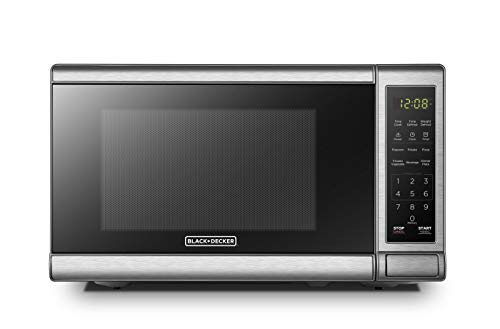
This stainless BLACK+DECKER is the machine we would hand to someone who asked for a portable microwave without any further questions. The control layout is the familiar full-size pattern shrunk down, with ten power levels, a digital display and express keys that behave exactly as a new owner expects, so there is no learning curve on a hungry evening. The push-button door release deserves specific praise: on a lightweight body, a pull handle tends to drag the whole oven towards you, while a button lets the door pop with the machine staying planted.
Daily reheating is its home ground. Coffee, soup and a plate of rice all come back evenly enough once you accept the 700-watt pace and stir once midway. The removable turntable lifts out for wiping, which matters in shared spaces where someone always overheats tomato sauce eventually. The child safety lock is a thoughtful inclusion for family RVs and houses with curious toddlers visiting grandparents. It will not thrill anyone, but it also gives nobody a reason to complain, and for a first small microwave that balance is exactly right.
Ownership details round out the picture. The interior wipes clean without awkward corners, the cord is long enough for the shallow counters these machines inhabit, and the feet grip laminate and wood better than most in the class, which works with the push-button door to keep the whole unit composed. Students who have carried one between three addresses report the same verdict: nothing has broken, nothing has confused a housemate, and the machine has never once been the reason a meal failed. In this category, boring reliability is the highest available praise.
Noise, finally, is where this model behaves in company. The fan note is low and the turntable motor silent enough that a video call from the same desk survives a reheat happening two feet away, a scenario its designers may not have imagined and its owners now live daily. Home workers in studio flats ask about exactly this, and the answer here is reassuring.
- Capacity: 0.7 cu ft in a compact countertop body
- Output: 700 watts with 10 power levels
- Door: push-button release, stainless finish
- Turntable: removable glass plate
- Safety: child safety lock fitted
Strengths
- Controls mirror full-size machines, so nothing needs relearning
- Push-button door keeps the light body from sliding on the counter
- Stainless front wipes clean and suits office kitchens
Trade-offs
- 700 watts means reheats run long compared with home units
- Interior height limits tall travel mugs
- Stainless shows fingerprints in bright light
Best for: first-time buyers in dorms, offices and spare rooms who want the familiar option.
Not suited for: households hoping to cook raw family meals quickly.
Confirm the current footprint against your shelf space and Check price on Amazon.

COMFEE’ 0.7 Cu Ft Countertop Microwave — Best for Quiet Rooms
The COMFEE’ model earns its place through two features that sound minor on a box and turn out to be the whole ballgame in real portable settings. The first is sound control: the beeper can be switched off, so a midnight hot chocolate in a dorm room or a partner sleeping three feet away in an RV does not end with a chorus of electronic chirps. The second is an eco mode that trims standby consumption, a small mercy when the machine lives on a campsite hookup or an inverter budget.
Around those headline touches sits a competent little oven. One-touch buttons cover the reheats people actually repeat, the black finish hides the scuffs that portable life inflicts, and the child lock suits shared student houses. Heating character matches the class norm, which means patience plus one stir. What lifts this model above generic rivals is that its designer clearly imagined where it would live: small rooms, close neighbours, limited power. If that description sounds like your situation, this is the thoughtful end of the category.
A word about the black finish in shared houses: it hides the evidence. Portable microwaves in communal kitchens live hard lives of spilled noodles and borrowed reheats, and a dark exterior with a wipe-clean panel forgives that life in a way bright steel does not. The eco mode also earns unexpected gratitude from whoever pays the electricity bill in a house-share, because a machine that sips nothing while idle is a machine nobody argues about at the meter reading. Small virtues, compounding weekly, are this model’s real specification.
The COMFEE’ also travels well between kitchens because nothing about it is precious. The panel tolerates being wiped by whoever is nearest, the door has no chrome to polish, and the whole machine reads as equipment rather than ornament, so it can serve a term in a student house and a summer in a caravan without looking diminished by either. Appliances that accept their working life gracefully are rarer than appliances that perform well in a review week.
- Capacity: 0.7 cu ft, black countertop body
- Output: 700 watts
- Sound: on/off control for the beeper
- Power saving: eco mode for standby
- Safety: child safety lock fitted
Strengths
- Mutable beeper is gold in dorms and RVs at night
- Eco mode trims standby draw on limited hookups
- One-touch keys cover everyday reheats without menus
Trade-offs
- Black finish shows dust quickly
- Same 700-watt pace as every rival here
- Control panel lettering is small in dim light
Best for: night owls, RV travellers and anyone sharing thin walls.
Not suited for: buyers who want a bright stainless showpiece for a main kitchen.
Check the latest listing details and Check price on Amazon.
Farberware 0.7 Cu Ft Countertop Microwave — Best Preset Selection
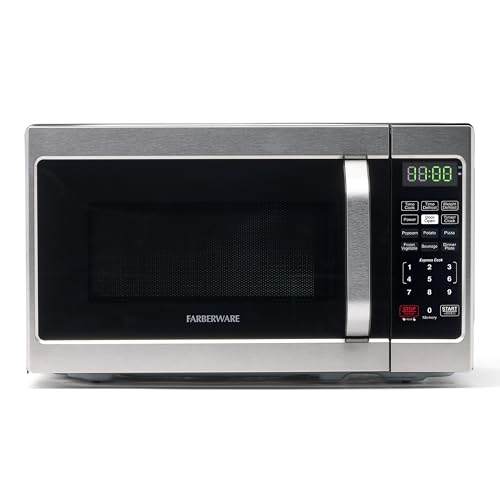
Farberware packs the richest control set in this group into its 0.7 cubic foot box. Six preset options handle the usual suspects, defrost works by weight or by time, and multi-stage cooking lets the machine run a defrost stage and then roll straight into a cooking stage without you standing over it. For a student who batch-preps on Sunday and reheats components through the week, that sequencing genuinely saves fiddling.
The LED display is clear, the stainless styling is tidy, and ten power levels give finer control than most rivals when you are softening chocolate or warming something delicate at low output. None of this changes the 700-watt ceiling, and preset times still assume portions sized for this cavity, so a brimming bowl will need an extra minute and a stir. Treat the presets as good starting points rather than promises and the Farberware rewards you with the most flexible brain in the smallest class of microwave.
Programme the Farberware thoughtfully and it repays you in a specific way: the multi-stage feature shines on frozen leftovers, the exact food portable owners eat most. Set a defrost stage followed by a reheat stage and a tub of Sunday’s chilli walks itself from frozen to steaming while you shower, arriving with its centre hot rather than merely its edges. Rivals can do the same job in two visits; this one does it in none, and on a weekday morning that difference is the difference between a cooked breakfast and a skipped one.
One small Farberware habit worth copying: label your own presets. The machine’s six programmes are starting points, and owners who keep a notebook of what worked for their regular portions, the big mug, the meal-prep tub, the frozen peas, convert a generic panel into a personal one within a fortnight. No rival in this guide rewards that homework more, because none offers the same combination of stages and levels to tune.
- Capacity: 0.7 cu ft, stainless steel finish
- Output: 700 watts with 10 power levels
- Programs: 6 preset options
- Cooking: multi-stage sequences supported
- Defrost: by weight or by time
Strengths
- Multi-stage cooking chains defrost into reheating automatically
- Weight-based defrost suits batch-prep households
- Clear LED display and logical keypad
Trade-offs
- Preset times still need adjusting for full bowls
- Feature-rich panel is overkill for tea-and-soup users
- Stainless front needs regular wiping
Best for: small-space cooks who prep ahead and like programmable help.
Not suited for: anyone who only ever presses one reheating button.
Look over the preset list on the listing and Check price on Amazon.

TOSHIBA 0.7 Cu Ft Countertop Microwave — Best Defrost Manners
Toshiba’s compact entry feels a notch more considered than the class average. Its ChefDefrost system is tuned to thaw without cooking the edges of a chicken breast into rubber, which is the single hardest trick at 700 watts, and eleven power levels give unusually fine steps for gentle jobs like melting butter or proofing a small batch of dough in a warm kitchen. Six auto menus cover routine reheats, and the sound can be switched off for quiet hours.
The black body is deliberately plain, which suits apartments and dorm desks where an appliance should disappear rather than perform. Eco mode trims standby use between sessions. In daily service the Toshiba does the portable basics with a calm competence: the door action feels solid, the turntable tracks properly, and the controls respond without the lag that plagues the cheapest small ovens. Buyers who notice fit and finish will notice this one, and defrost-heavy cooks get the most from its tuning.
The Toshiba also handles the social side of small-space cooking with unusual grace. Its muted, unhurried beeps, when sound is on at all, are pitched lower than the class’s usual electronic chirp, and the panel’s response to each press feels deliberate rather than frantic. Cooks who share a kitchen with a baby’s nap schedule or a partner’s night shifts will understand immediately why those details were engineered in. It is the portable we would buy for a household where consideration is a specification.
Battery-free simplicity is the Toshiba’s hidden touring virtue. In an RV, every appliance that asks nothing of the inverter while idle and behaves identically at every site is one less variable in the evening’s power budget, and the eco mode plus the honest 700-watt ceiling make this the easiest machine here to plan a leisure battery around. Touring couples who count amp-hours the way others count calories will feel the difference by the third night off-grid.
- Capacity: 0.7 cu ft, black compact body
- Output: 700 watts with 11 power levels
- Defrost: ChefDefrost system
- Programs: 6 auto menus
- Extras: sound on/off and eco mode
Strengths
- Defrost tuning protects edges better than class rivals
- Eleven power levels allow gentle, precise heating
- Mute and eco modes suit shared and off-grid spaces
Trade-offs
- Plain styling will not dress up a counter
- 700 watts still slows family-size portions
- Black surfaces show splashes under bright light
Best for: cooks who defrost ingredients often and value quiet operation.
Not suited for: shoppers wanting a retro or colourful statement piece.
Verify the menu list matches your habits and Check price on Amazon.

Frigidaire 0.7 Cu Ft Retro Countertop Microwave — Best Retro Looks
Some portable microwaves are bought for a bedsit desk and hidden; this Frigidaire retro model is bought to be looked at. The black body with gold detailing borrows its lines from mid-century appliances, and on a styled studio counter or a vintage-themed RV renovation it earns its keep as decor before it heats a single mug. Eight auto cook menus and auto defrost cover the functional side without embarrassing the brief.
Honesty requires noting the compromises that come with the costume. Five power levels is fewer than rivals offer, so fine control for delicate melting is coarser, and the retro controls favour charm over speed of input. The glass turntable and LED display are thoroughly modern underneath. None of that matters if the machine’s main jobs are reheating coffee, warming pastries and looking handsome in photographs of your tiny kitchen, and for design-led small spaces this is the only pick in the group even attempting that double duty.
Treat the retro Frigidaire as a piece of kitchen theatre that also heats food and it will never disappoint you. Guests comment on it, photographs of the counter improve, and the morning coffee ritual gains a small ceremony from its styling. The honest test is whether your cooking actually needs more than five power levels; for reheating, defrosting and the occasional mug cake, it does not, and the machine’s eight auto menus quietly cover the repertoire its owners actually use. Charm, here, is not the opposite of competence but a different distribution of it.
The retro Frigidaire also photographs its owner’s life better than its rivals in a way that has practical consequences: machines people enjoy looking at get wiped, dusted and cared for, while ugly appliances get neglected until they fail. Its gold trim rewards that attention by staying handsome under it. If the choice between this and a plainer rival feels purely aesthetic, remember that maintenance follows affection, and affection follows looks more often than engineers like to admit.
- Capacity: 0.7 cu ft retro body, black with gold trim
- Output: 700 watts with 5 power levels
- Programs: 8 auto cook menus
- Defrost: automatic defrost fitted
- Display: LED with glass turntable
Strengths
- Distinctive retro styling suits styled small spaces
- Eight auto menus cover daily reheating
- Compact footprint fits studio counters
Trade-offs
- Only five power levels for gentle jobs
- Style-first controls are slower to use
- Trim needs gentle cleaning to stay smart
Best for: studio dwellers and renovators who care how the counter looks.
Not suited for: precision cooks who want many power steps.
Confirm the colourway in the current listing and Check price on Amazon.

Frigidaire 0.7 Cu Ft Compact Countertop Microwave — Best Simple Classic
This older Frigidaire compact has survived in catalogues while flashier rivals came and went, and the reason is plain competence. Ten power levels, one-touch cooking buttons and auto defrost handle the whole portable repertoire without a single clever feature demanding your attention. The LED display is legible from across a small room, and the black finish tolerates the knocks of being moved between counters, cupboards and accommodation at term time.
It lacks the mute controls and eco modes of the newest designs, so the beeper announces itself in the traditional way and standby draw is what it is. For a workshop break room, a rental property or a grandparent’s spare counter, those omissions barely register next to the machine’s virtues: it heats, it defrosts, it fits, and replacement familiarity means anyone can use it without instructions. In a category full of near-identical boxes, a proven one with no surprises is a perfectly rational purchase.
Longevity is this Frigidaire’s quiet argument. A design that has remained in production while rivals churned has had its weak points found and fixed by the market itself, and spare turntables and plates for long-running compacts are easier to source than for a model launched last spring. For a landlord furnishing a rental or a parent equipping a student flat they will not visit often, that proven-ness is worth more than any feature launched this year, because the machine’s job is to be forgotten while it works.
For the classic Frigidaire, consider the housemate test, the true examination of any shared appliance. A stranger at midnight, hungry and half asleep, can operate this machine correctly without instructions, wake nobody with a confusing panel, and leave it clean enough for the next person. Machines that pass that test become part of a house’s furniture; machines that fail it become part of its folklore, and not in a kind way.
- Capacity: 0.7 cu ft compact body, black
- Output: 700 watts with 10 power levels
- Cooking: one-touch programs fitted
- Defrost: automatic defrost by setting
- Display: LED with glass turntable
Strengths
- Proven design with no learning curve
- Ten power levels cover gentle and full reheats
- Tough, plain finish suits rentals and break rooms
Trade-offs
- No mute option for night-time use
- No eco standby mode
- Styling is purely functional
Best for: landlords, break rooms and buyers who want the proven option.
Not suited for: light sleepers sharing a room with the machine.
Compare the current specification before ordering and Check price on Amazon.
How Do the Six Portable Picks Stack Up Side by Side?
| Pick | Key specification | Standout trait |
|---|---|---|
| BLACK+DECKER 0.7 Stainless | 0.7 cu ft, 700W, 10 power levels | Push-button door on a light body |
| COMFEE’ 0.7 (Black) | 0.7 cu ft, 700W, eco mode | Sound on/off for quiet reheating |
| Farberware 0.7 (Stainless) | 0.7 cu ft, 700W, 6 presets | Multi-stage cooking in a tiny box |
| TOSHIBA 0.7 (Black) | 0.7 cu ft, 700W, 11 power levels | ChefDefrost with mute option |
| Frigidaire 0.7 Retro | 0.7 cu ft, 700W, 5 power levels | Retro black-and-gold styling |
| Frigidaire 0.7 Compact | 0.7 cu ft, 700W, 10 power levels | Long-running no-fuss design |
Read across the table and a pattern emerges: the cavity and wattage barely move, so your decision rides on controls and courtesy features. Frequent defrosters should lean towards the Toshiba tuning, night-time users towards anything with a mute, and the style-conscious towards the retro Frigidaire, accepting its shorter power-level list as the price of the costume.
One more comparison hides in the listings rather than the table: exact exterior dimensions. Portable models vary by a couple of centimetres in height and depth despite sharing a capacity class, and that variance decides under-cabinet fit. Note your shelf measurements on paper, then match them against the listing for the specific model you choose, not against the class in general.
Where Will a 0.7 Cu Ft Microwave Actually Fit in Your Life?
The natural homes for this class are spaces where a microwave is a personal appliance rather than a household one. A student heating soup at a desk, a nurse on a night shift warming lunch in a small staff kitchen, a truck driver or RV couple travelling with a hookup, a grandparent in a granny annexe who wants tea and porridge without crossing the house at dawn. In each case the machine serves one or two people, a handful of times a day, and counter space is worth more than cooking speed.
It also works as a second microwave. Families with teenagers discover that a small unit in a den or games room ends the queue for the main kitchen machine during homework hours, and home bakers use one purely for melting butter and chocolate so the big oven stays free. Framed as a specialist rather than a compromise, the 0.7 class stops looking like a lesser appliance and starts looking like a deliberate tool, sized to a job it performs perfectly adequately.
How Should You Measure Your Space Before Ordering?
Grab a tape measure before you fall for any listing photograph, because product images in this class are notoriously scale-free. Measure the width of the shelf or counter run, the height up to the underside of the cabinet above, and the depth from wall to front edge. Then subtract a margin: these machines vent from the sides and rear, and a unit wedged flush against walls on every side will run hot and age early. A few centimetres of air behind and above is the difference between a five-year appliance and a two-year one.
Do not forget the door swing and the plug. The door opens towards you and needs its arc clear, the cord needs to reach a socket without crossing a sink, and the whole machine will be lifted occasionally for cleaning underneath, so a spot you can slide it out of beats a spot it must be threaded into. Finally, test your biggest everyday container against the listed interior dimensions; a favourite tall mug that cannot stand upright inside will annoy you every single morning.
What Can You Cook Well at 700 Watts, and What Should You Avoid?
Reheating is the glory job: soups, stews, curries, pasta, rice dishes and yesterday’s pizza all return happily, especially with a stir or a flip halfway. Drinks, porridge, instant noodles, frozen peas and single portions of frozen ready meals behave well too. Defrosting works in small quantities, a chicken breast or a couple of sausages, with rests between bursts so the cold centre can catch up with the warming edges.
Avoid dense raw cooking. A thick jacket potato takes an age and cooks unevenly, raw chicken pieces are a food-safety headache at low power, and anything relying on browning will disappoint because microwaves do not brown at any wattage. Large volumes are the other trap: doubling the food more than doubles the time, and the middle stays cold while the rim scorches. Keep portions single, keep expectations honest, and a 700-watt portable will feel capable rather than feeble.
How Do You Get Even Results From a Small, Low-Power Cavity?
Technique matters more at 700 watts than raw settings. Spread food in a shallow, even layer rather than a tall mound, arrange thicker pieces towards the outside of the plate where microwave energy concentrates, and cover the dish with a vented lid or plate to trap steam and speed the centre along. Stirring or turning halfway is not fussiness; in a small cavity with modest power it is the main tool you have against cold spots.
Standing time finishes the job the magnetron started. Leaving a covered dish for a minute or two after the timer ends lets temperatures equalise through the food, which both improves texture and makes reheating safer. Use the lower power levels for delicate work: butter softens instead of exploding at half power, and chocolate melts without seizing if you stop and stir between short bursts. Master those three habits and the gap between this class and a bigger machine shrinks to patience alone.
Is a Portable Microwave a Sensible Buy for an RV or Boat?
For touring vehicles the electrical maths is the attraction. A 700-watt draw is within reach of modest inverters and typical campsite hookups that would protest at a full-size oven plus a kettle running together, and the light body can be stowed in a locker while driving rather than bolted down. Secure it for travel, though: an unsecured microwave becomes a heavy projectile on the first sharp roundabout, so a non-slip mat and a strap or a snug locker are part of the purchase, not accessories.
Ventilation and power discipline still apply on the road. Run the machine with locker doors open so heat escapes, avoid pairing it with other heavy loads on the same circuit, and remember that heating a meal from a leisure battery costs real charge, so hookup cooking is kinder to your reserves. Owners who respect those limits report these little ovens as among the most used items in the van, precisely because hot soup after a wet walk needs no ceremony.
How Should You Pack and Move a Portable Microwave Safely?
Portable owners move their machines more in a year than family owners move theirs in a decade, so the technique is worth learning. Remove the glass turntable and its ring and pack them separately in a towel or their original foam, because the plate is the most fragile component and the one most often sacrificed to a car boot. Tape the door shut, coil the cord without kinking it at the plug, and carry the machine level, vents unobstructed, rather than by its door handle.
On arrival, let the machine rest on its new counter for a short while before the first use if it has travelled tilted, and check the turntable seats properly on its ring before heating anything precious. Inspect the cord for travel damage, confirm the door still latches with its usual click, and run a mug of water as a commissioning test. Five unglamorous minutes, and the machine resumes its life as if the journey never happened, which is precisely what portability is supposed to mean.
What Accessories Genuinely Help a Small Microwave Owner?
Three cheap companions transform life with a small cavity. A microwave-safe cover with a vent is the first, trapping steam for even reheating while keeping the interior clean enough that weekly wiping stays a thirty-second job. The second is a small microwave-safe rack or trivet where the model allows it, lifting food into the cavity’s stronger energy zone and letting two small items share a session without touching.
The third is a dedicated mug-and-bowl set sized to the machine: containers chosen because they fit, with headroom to spare, end the daily geometry puzzle of the too-tall bowl. Beyond those, most accessories marketed at microwave owners are solutions in search of problems. A food thermometer, however, earns its place in any kitchen that defrosts meat at low power, because it converts the food-safety question from hope into measurement, and that conversion is worth more than every gadget in the catalogue combined.
How Do You Clean a Portable Microwave Without Damaging It?
Steam does the work. A bowl of water with a slice of lemon, heated until the window fogs, loosens everything a week of reheats deposited, and a soft cloth then lifts it away without scouring the interior paint that protects the metal beneath. The turntable and ring go in the sink like any plate. Stubborn spots yield to a second steam rather than to abrasives, which scratch the finish and give future grime a foothold.
Two cautions preserve the machine. Never spray cleaner directly at the vents or the control panel, where liquid migrates into places it is unwelcome; apply it to the cloth instead. And keep the door seal and latch area clean and dry, because that seal is both a safety component and the first place neglect shows. Five minutes weekly is the whole regime, and a portable machine cleaned that way still smells of nothing after years of other people’s lunches, which in a shared kitchen is a minor miracle.
Should Students Buy New, or Hunt for a Used Portable?
The second-hand market in this class is lively at the end of every academic year, and the savings can be real, so the question deserves a fair hearing. A used portable is a reasonable buy when the door latches cleanly, the interior paint is unchipped, the turntable is present and the machine heats a mug of water at the expected pace during a test in the seller’s kitchen. Those four checks take three minutes and filter out most of the trouble.
Buy new when any check fails, when the machine will serve a baby or an elderly relative whose food safety margins matter most, or when the price gap has narrowed to the point where a warranty is worth more than the saving. Students should also remember the end of their own tenancy: a machine bought new with its box kept is a machine that resells in an afternoon in May, which quietly refunds part of the purchase to the organised.
How Does a Portable Microwave Change Eating in a Small Space?
Something quietly significant happens when a person gains private reheating: meals decouple from the household’s schedule. The student eats when the essay breaks, not when the kitchen frees; the nurse eats at three in the morning without ceremony; the grandparent in the annexe keeps their own hours with dignity. Nutritionists note that people eat better when hot food is easy at the moment of hunger, because the alternative at that moment is crisps. A portable microwave is, in that sense, less an appliance than a small grant of independence.
It also changes what people buy. Single portions, batch-cooked tubs in the freezer, the second half of a takeaway saved without guilt: all become practical when reheating is private and immediate. Households report less food waste from small machines than from large ones, counterintuitively, because the small machine makes leftovers feel like ingredients rather than obligations. Judge the category by that ledger and the 0.7 class stops looking like a compromise and starts looking like a philosophy of eating alone well.
What Should You Do on the First Day With a New Portable?
Commission it like you mean it. Wash the turntable, wipe the cavity, run a bowl of water to steaming to clear factory smells, and set the clock, because a machine whose clock is wrong will be forgiven nothing else. Then cook three known quantities: your usual mug of water for tea, your usual portion of leftovers, and one defrost of something small. Note the times that worked on a card kept inside the nearest cupboard door.
That card becomes the machine’s real manual within a month, written in your portions rather than the manufacturer’s laboratory ones. Check the door latch’s feel, learn where the vents breathe so nothing gets stacked against them, and decide the machine’s permanent home before the counter reorganises itself around a temporary position. First days set patterns that last years, and ten deliberate minutes at the start are the cheapest ownership upgrade in this entire guide.
How Should You Store a Portable Microwave Between Terms or Seasons?
Storage is the portable’s fourth season, and it deserves the same care as the move itself. Clean the cavity before the machine goes away, because a crumb left in May is a smell discovered in September, and leave the door ajar for the first day of storage so the interior dries completely rather than sealing its own moisture inside. Coil the cord loosely, keep the turntable packed with the machine rather than in a separate box that will inevitably be opened in a different house, and store the whole unit somewhere dry and level, off a garage floor where damp and knocks conspire.
On retrieval, reverse the ritual with the same commissioning test used after any move: inspect the cord, seat the plate, run water to steaming, and wipe the cavity once more before food goes in. Machines stored and revived this way start their second term as if the holiday never happened, while machines thrown into cupboards return with odours, mysteries and occasionally tenants. Ten minutes at each end of the season is the entire cost of the difference, and it is the last ownership habit this guide will ask of you.
What Mistakes Do Portable Microwave Buyers Keep Making?
The classic error is buying this class to do a family microwave’s job, then blaming the machine. A 0.7 cubic foot, 700-watt oven reheating four big portions in sequence will feel painfully slow, because that workload belongs two sizes up. Match the class to single servings and it shines; ask it to cater and it cannot win.
Skipping the tape measure runs a close second. Buyers assume all small microwaves share one footprint, discover the chosen model is a centimetre too tall for the shelf, and end up with it living awkwardly on the floor or blocking a cupboard door. Five minutes with measurements, compared against the listing, prevents the whole saga.
A third mistake is sealing food in airtight containers for reheating. Steam needs an escape route; a vented cover or a cracked lid prevents sauce eruptions and soggy results, and it also stops containers warping in the heat. Relatedly, metal trim on fancy mugs and foil seals on ready meals must stay out, however small the machine looks.
Finally, many owners never use the lower power levels they paid for, blasting everything at full output and concluding the oven cooks unevenly. Gentle power plus patience transforms defrosting and melting, and it costs nothing but a few seconds of button pressing to learn which level suits your regular jobs.
One more belongs on the list: placing the machine where its vents breathe against a wall or inside a closed cupboard and then running it with the cupboard door shut for tidiness. A portable microwave in a sealed box is an oven heating itself, and the shortened life that follows is entirely self-inflicted. Air is part of the appliance’s design, wherever it lives.
Final Recommendation
If you want one recommendation to act on, start with the BLACK+DECKER 0.7 Cu Ft Microwave Stainless for its familiar controls and stay-put push-button door, unless your life specifically involves sleeping neighbours, in which case the COMFEE’ 0.7 Cu Ft Countertop Microwave and its mute earn the nod. The Farberware 0.7 Cu Ft Countertop Microwave suits anyone who will actually use multi-stage programming rather than admiring it on the box.
Whichever of the six lands on your counter, buy it for the reheating life you actually live: single portions, modest power, small footprint, honest limits. A portable microwave chosen on those terms stops being the cheap option and becomes the right-sized one, and right-sized appliances are the ones still earning their space years later.
Frequently Asked Questions
Can a 0.7 cu ft microwave fit a full-size dinner plate?
Usually yes, provided the plate is a standard flat dinner plate rather than a wide-rimmed charger. Most models in this class accept plates around ten inches across on the turntable, but deep bowls and tall mugs are the tighter squeeze, so compare your favourite pieces with the listed interior height before ordering.
How much slower is 700 watts than a normal microwave?
As a rough rule, add about half as much time again compared with a 1,000-watt machine, then stir and check. A drink that takes a minute at full household power may need ninety seconds here, and dense foods benefit from a standing minute afterwards so the heat evens out.
Can I run one of these in a dorm room without tripping the power?
In most cases yes, because 700 watts is a modest draw that older wiring tolerates well, which is a large part of this class’s appeal. Still check your residence rules, since some dormitories restrict which appliances may be used in bedrooms regardless of wattage.
Is it safe to use a portable microwave on an RV inverter?
It can be, provided the inverter is rated comfortably above the microwave’s running draw and the battery bank behind it is healthy. Many owners prefer campsite hookups for longer cooking and keep inverter use for short reheats, which is gentler on stored charge.
Why does my food heat unevenly in a small microwave?
Small cavities concentrate energy in patches, and low power gives heat less time to spread by conduction. Shallower layers, arranging thick pieces at the edges, stirring halfway and letting the dish stand covered afterwards will fix most cold-centre complaints without any change of machine.
Do I need to leave space around a portable microwave?
Yes. The vents need air, so leave a few centimetres behind and above the unit and avoid pushing it flush into a corner. A machine that can shed heat easily cooks more consistently and tends to last longer than one stewing in its own warmth.
How heavy is a 0.7 cu ft microwave to carry?
Light enough for one person to carry comfortably under one arm or in both hands for a short distance, which is the practical definition of portable in this class. Exact weights vary by model, so check the listing if you will be carrying it up several flights of stairs regularly, and always remove the glass plate before a move.
Can I put a portable microwave on a shelf or bookcase?
Yes, provided the shelf is level, load-rated for the machine’s weight and deep enough to leave ventilation space behind and above the unit. Keep it away from the shelf edge, route the cord safely to a socket without trailing it across a walkway, and never stack items on top of the machine while it is in use.
Can a portable microwave run from a car’s power outlet?
Not directly from a standard car socket, which is designed for small electronics rather than a 700-watt appliance. With a suitably rated inverter wired to handle the load it is technically possible, but the practical touring solutions remain campsite hookups and leisure batteries with inverters sized for the job, which is how the RV owners in this guide actually use their machines.
Related Guides
If your kitchen plans are growing beyond a single small oven, our companion guides cover the next size up and the wider counter. Best 0.9 Cubic Foot Microwaves, Best Cheap Pressure Cookers, Best Kitchen and Bath Faucets, Judged by Lab-Test Standards.


