What's inside
- Key Takeaways
- Quick Picks
- How We Chose These Picks
- What Does Each Extra Function Actually Ask of the Machine?
- Which Size of Multifunctional Microwave Fits Which Household?
- How Should You Test a Combination Machine in Its First Fortnight?
- Combination Machines, Function by Function
- How Do You Get Real Crisping Out of a Combination Cavity?
- What Does the Second-Oven Role Mean on the Year’s Biggest Cooking Days?
- Where Do Multifunctional Microwaves Sit in a Whole Kitchen?
- What Mistakes Do Combination-Microwave Buyers Keep Making?
- Final Recommendation
- Frequently Asked Questions
- Related Guides
As an Amazon Associate I earn from qualifying purchases. This post may contain affiliate links at no extra cost to you.
**cottageverdict.com is reader-supported. When you buy through links on our site, we may earn an affiliate commission.**
Where to buy: the six combination machines reviewed here are sold through their Amazon listings, linked from the Quick Picks table and from each review heading, where the current bundle, finish and delivery terms can be confirmed before you clear counter space for one.
A multifunctional microwave is a wager against counter clutter: one box that microwaves, air-fries, bakes with convection heat and broils, instead of three appliances competing for the same stretch of worktop. The best multifunctional microwaves earn that wager honestly — each function strong enough that the household actually retires the single-purpose machine it replaces. The weak versions, and every category has them, microwave adequately and air-fry apologetically, leaving the old air fryer on the counter and the new machine’s extra modes as menu decoration. This guide exists to separate those two outcomes, using the only evidence a listing can be held to: the functions its title actually claims.
That discipline matters more here than in any plain microwave roundup, because “multifunctional” is the most elastic word in the category. One maker’s count includes defrosting as a function; another’s counts a mute button. So the rule of this guide is strict: a model is credited with air-frying only when its title says air fry, with convection only when its title says convection, with broiling only when broil is printed. By that rule the six picks below are genuinely multifunctional — every one of them claims an air-fry or convection capability in its headline, and most claim both — while their differences in size, wattage and secondary functions are mapped in their own titles’ words.
The field divides by appetite. Two compact 0.9 cubic foot machines serve small households and small counters. A 1.0 and a 1.2 sit in the middle, and a 1.5 cubic foot TOSHIBA tops the size range for families who want combination cooking at volume. A Ninja entry plays by its own rules, promising to replace two countertop appliances outright with a named crisping technology and a function count of fourteen. Between them, they answer the question every buyer of this category is really asking: how many appliances can one box honestly be?
Key Takeaways
- Every pick claims air-fry or convection capability in its title; no function is credited to any model that its headline does not state.
- Sizes run from 0.9 cu ft compacts to a 1.5 cu ft family machine, so the multifunctional idea scales from studio counters to full kitchens.
- The TOSHIBA 1.0 is the most explicit about its modes: 8-in-1 with convection and broil both named in its title.
- Ninja’s Crispi MW101 claims fourteen functions and positions itself as a replacement for a microwave and an air fryer together.
- Stated wattage appears on three titles — 900W on the BLACK+DECKER and Sharp, 1000W on the TOSHIBA 1.5 and the Ninja — and is claimed nowhere else.
- Combination cooking rewards counter space and punishes wishful thinking: the buying sections below test each function claim against the cooking it implies.
Quick Picks
| Pick | Badge | Why it is here |
|---|---|---|
| TOSHIBA 1.0 Cu Ft Air Fryer Combo Microwave | The explicit eight | An 8-in-1 whose title names convection and broil outright, with Pro Defrost and a 12.4-inch turntable. |
| BLACK+DECKER 0.9 Cu Ft 5-in-1 Microwave Air Fryer | The compact five | Five functions in 0.9 cu ft at 900W, with convection bake and roast and a child lock for small kitchens. |
| Frigidaire 1.2 Cu Ft Air Fry Convection Microwave | The middleweight fryer | Air fry and convection at 1.2 cu ft with a named Combo-Fry mode and XL capacity positioning. |
| TOSHIBA 1.5 Cu Ft 4-in-1 Microwave With Air Fryer (Silver) | The family combo | The biggest cavity here at 1000W, with smart sensor, convection and a position-memory turntable. |
| Ninja Crispi MW101 Microwave & Air Fryer | The replacement bid | FusionCrisp technology and fourteen functions, pitched as one box instead of a microwave plus an air fryer. |
| Sharp SMC0985KS 3-in-1 Convection Air Fry Microwave | The tidy three | Microwave, convection and air fry in a 0.9 cu ft, 900-watt stainless package from a microwave specialist. |
How We Chose These Picks
The first filter was the honesty rule stated above: a candidate needed an air-fry or convection claim in its verified title, because a multifunctional guide built on product-page archaeology would be grading marketing departments rather than machines. That filter produced a field with a satisfying spread — three brands with deep microwave heritage, one air-fryer-native challenger, and sizes from dorm-compact to family-large — and it let every subsequent judgement be made from printed claims a reader can verify in seconds.
The second filter was functional spread. A useful roundup should not present six identical answers, so the final six divide the territory: the most explicit mode list, the smallest full-featured footprint, the mid-size fryer, the family-size combo, the two-appliances-in-one bid, and the restrained three-function specialist. Households that batch-cook with machines like these tend to shop the storage side of the same habit alongside, in our guide to Best Backup Freezers, where the food these combinations crisp and bake is kept between sessions. This guide keeps its feet on the worktop, where most multifunctional buying actually happens.
Finally, we read each title for the small print that predicts daily life: a defrost system with a name, a turntable with a memory, a mute function for early mornings, a child lock for family counters. Multifunctional machines are operated more often and in more modes than plain microwaves, so the details of operation compound faster — a truth the reviews below keep returning to as they weigh each model’s stated character.
What Does Each Extra Function Actually Ask of the Machine?
Start with the physics, because combination appliances live or die by it. Microwaving heats food from the inside out with no browning; air-frying is small-scale convection — a fan driving hot air hard around food in a tight space — and it browns, crisps and roasts. Convection baking is the same fan-and-element arrangement run for evenness rather than intensity, while broiling is direct radiant heat from above. A multifunctional microwave contains a microwave generator plus a heating element and fan, and the engineering tension is permanent: the cavity must be a good microwave box and a good little oven at once, and accessories — a crisping rack, a fry basket — mediate between the two personalities.
That tension explains the honest expectations a buyer should carry. A combination machine’s air-fry mode will crisp fries, wings and vegetables convincingly in family portions, and its convection mode will bake a tray of biscuits or roast a small chicken with real evenness. What it will not do is match a large dedicated oven for volume, or a big basket air fryer for a party-size batch — the cavity that microwaves your soup is simply smaller than either. The wager pays when the household’s actual cooking fits the cavity: weeknight portions, sides, reheats that deserve crisping, small bakes. Buyers who picture holiday-scale loads should size up within this guide or keep a dedicated oven as the main instrument and let the combo handle the supporting roles.
Energy and time argue quietly for the category as well. Heating a one-to-one-and-a-half cubic foot cavity to baking temperature takes a fraction of the energy and minutes that a full-size oven demands for the same tray of food, and on the small loads that dominate weeknight cooking the saving repeats daily. No title in this guide prints consumption figures, and this guide invents none — the argument is geometric rather than numerical. A small box, heated for a small meal, is thriftier than a large box heated for the same meal, and households that cook small most nights will feel that thrift in both the bill and the clock.
There is a workflow dividend that pure specification lists miss. A combination machine can sequence its personalities — defrost by microwave, crisp by air fry, hold warm by gentle convection — in one cavity, with one dish, without the cook ferrying food between appliances. Several titles in this guide gesture at exactly that choreography, and households that cook in sequences will feel the dividend nightly. It is the strongest argument for the category, stronger than the counter space it saves.
Which Size of Multifunctional Microwave Fits Which Household?
The 0.9 cubic foot pair — the BLACK+DECKER and the Sharp — are the small-kitchen answer, and their compactness is a genuine feature rather than an apology. In a studio flat, a small rental or a counter already crowded with a kettle and a coffee machine, a full-function machine that fits is worth more than a larger one that exiles something else. Their air-fry portions suit one or two people; their convection modes handle the small bakes small households actually make. The discipline is to buy them for the household you have, not the dinner party you host twice a year — the twice-a-year load can borrow the main oven, which every small kitchen still has.
The middle pair, at 1.0 and 1.2 cubic feet, is where most households should start their thinking. A 1.0 with a stated 12.4-inch turntable takes standard dinner plates and modest casseroles; the 1.2 stretches to the wider dishes and the family-size fry loads. The 1.5 cubic foot TOSHIBA at the top serves the household that batch-cooks and reheats in volume, and its size begins to compete with a small oven’s role in daily life. The Ninja stands outside the size ladder’s logic, asking to be judged as a system — microwave plus air fryer in one footprint — against the combined counter cost of the two machines it replaces.
Depth is the dimension buyers forget in this category, because combination machines run deeper than the plain microwaves they replace — the fan and element housing has to live somewhere — and a machine that fits its width can still overhang a shallow counter or crowd the splashback with its vents. Every size judgement in this section should be made in three dimensions against the actual counter, with the door’s swing and the cook’s standing room included. The tape measure is the cheapest accessory in the entire purchase and the one whose absence is most regretted.
One measurement discipline applies across all sizes: the accessories must fit too. A crisping rack or fry basket that only just fits the cavity will be used reluctantly, and a mode used reluctantly is a mode not bought. Where a title prints a turntable diameter, test your favourite oven dish against it; where it does not, the product page owes you the interior dimensions, and a careful buyer collects them before the order rather than after the delivery.
How Should You Test a Combination Machine in Its First Fortnight?
The first two weeks decide whether a multifunctional microwave becomes the kitchen’s workhorse or an expensive reheating box, so give it a deliberate curriculum. In week one, run the honest comparisons: the same fries in air-fry mode that you used to make in the old appliance, the same casserole reheated by sensor, a defrost of the exact cut your household buys most. Note what matches, what beats and what disappoints, while returning the machine is still a live option and while the old appliance is still in the house to compare against. Most households find the pattern quickly — the combo wins on sequences and small loads, the dedicated machine keeps an edge on sheer volume — and knowing that pattern is the whole point of the exercise.
In week two, learn the choreography the category exists for. Cook one meal entirely in the box: defrost in it, microwave the grains in it, crisp the protein in it, hold the vegetables warm in it while the table is set. Time the evening against a normal night. The households that convert fully to combination cooking are the ones who discover, in that experiment, that the ferrying between appliances was costing them more attention than they realised. The households that do not convert learn something equally valuable — which two modes they actually live in — and can stop feeling guilty about the other twelve.
Invite the household into the experiment, because a combination machine serves more cooks than its buyer. The teenager who reheats pizza deserves to learn the air-fry revival rather than the microwave sog; the partner who bakes deserves the convection timings written on a card inside the cupboard door. Machines become multifunctional in a household only when the knowledge is shared, and a fortnight of deliberate testing is the natural moment to spread it.
Keep the accessories out where they can be reached during this fortnight, on the counter or in the nearest drawer, because a rack that starts its life buried will stay buried. By the end of the second week the machine will have found its real job description in your kitchen, which is the moment — not the unboxing — when the purchase can honestly be judged.

TOSHIBA 1.0 Cu Ft Air Fryer Combo Microwave — The explicit eight
TOSHIBA’s compact combo writes the most accountable title in this guide: an air fryer combo microwave of 1.0 cubic feet in black stainless steel, described as 8-in-1 with convection and broil both named, a Pro Defrost system, and a 12.4-inch turntable. In a category addicted to vague multiplicity, naming the modes is a form of respect for the buyer — convection and broil are checkable promises, and a broil function in particular separates machines that can finish a dish with radiant heat from machines that merely circulate hot air and call the result grilled. The 8-in-1 count will include the microwave’s own sub-modes, as such counts always do, but the headline functions are printed where they can be held to account.
The 12.4-inch turntable is the right size for the cavity’s ambition: standard plates ride it comfortably, and the air-fry and convection accessories that serve a 1.0 cavity are proportioned to it. Pro Defrost, the named defrost system, matters in a combination machine more than in a plain one, because the combo’s whole choreography — thaw, then crisp, then finish — begins with a defrost that does not cook the edges it will later be asked to brown. A household that plans sequences will read that pairing of features as a coherent design rather than a list.
Broil deserves one more sentence of respect, because it is the mode most often promised vaguely and delivered weakly across this category. A real broil function finishes a cheese-topped dish with actual browning, crisps the top of a gratin, and gives skin a final blast that circulating air alone rounds off. A title that prints the word has accepted judgement on exactly that performance, and buyers who finish dishes — gratins, nachos, garlic bread, the top of a shepherd’s pie — should weight this model’s explicit claim heavily. It is the difference between a machine that can only cook a dish and a machine that can complete one.
Black stainless is the finish, and it suits the machine’s positioning: a compact, serious, multi-mode instrument for a kitchen that wants its one box to look deliberate. For a household of one to three, cooking weeknight portions and expecting every claimed mode to be real, this is the most completely argued specification in the guide — the pick whose title does the most of the review’s work before the review begins.
- Cavity as listed: 1.0 cu ft
- Functions as listed: 8-in-1, with convection and broil named
- Defrost as listed: Pro Defrost
- Turntable as listed: 12.4 inch
- Finish as listed: black stainless steel
- Where to buy: the TOSHIBA 1.0 air fryer combo listing on Amazon — check price on Amazon
Strengths
- The only title here that names broil alongside convection and air fry.
- A named defrost system feeding the sequence cooking combos exist for.
- Full multifunctionality in a one-metre-of-counter footprint class.
Trade-offs
- At 1.0 cu ft, air-fry portions are sized for small households, not gatherings.
- Wattage is not stated in the title; confirm it on the product page.
- The 8-in-1 count includes microwave sub-modes, as all such counts do.
Tailored to: small households that cook in sequences and read mode lists literally. Less tailored to: families whose fry loads arrive by the kilo.

BLACK+DECKER 0.9 Cu Ft 5-in-1 Microwave Air Fryer — The compact five
BLACK+DECKER compresses the multifunctional idea into 0.9 cubic feet: a 5-in-1 microwave air fryer combo at a stated 900 watts, with convection bake and roast named in the title, a child lock, and ten power levels, aimed in the listing’s words at small kitchens. The phrase “convection bake & roast” is doing honest work — it tells the buyer the hot-air personality is meant for baking and roasting, the two jobs a small household most wants from a second oven — and the 900-watt microwave output is the sensible pairing for a cavity this size, where higher wattage would bully small portions.
Ten power levels in a compact combo is a considered inclusion. Small portions are where power granularity matters most: a single serving of sauce, a small bowl of vegetables, a child’s portion reheated gently. The child lock belongs to the same thought — a compact machine in a small kitchen sits within a child’s reach more often than a built-in does, and the lock acknowledges the machine’s real environment. Read together, the title describes a machine designed from the small kitchen outward, rather than a big machine shrunk.
Small-kitchen ownership has a rhythm this machine fits precisely: the counter is cleared by cooking, not before it. A compact combo can sit permanently in the corner where a plain microwave lived, while absorbing the jobs that used to require hauling a separate fryer out of a cupboard and putting it away again — a hauling tax that, in small kitchens, quietly decides whether crispy food happens on a Tuesday at all. The measure of a compact multifunctional machine is not what it does on its best day but how many ordinary days it improves, and a five-function box that never needs storing improves nearly all of them.
The honest limit is throughput. Five functions in 0.9 cubic feet serve one or two people beautifully and a family gathering not at all; the air-fry basket’s world is the weeknight portion, the side dish, the reheated slice that deserves its crisp back. Buyers who understand that bargain get one of the most space-efficient full-function machines in this guide. Buyers who need volume should walk down the page to the 1.5, where the same idea wears a bigger cavity.
- Cavity as listed: 0.9 cu ft
- Functions as listed: 5-in-1 microwave air fryer combo
- Hot-air modes as listed: convection bake and roast
- Cooking power as listed: 900W
- Controls as listed: 10 power levels, child lock
- Ordering route: the BLACK+DECKER 5-in-1 listing on Amazon is where to check price on Amazon
Strengths
- Full five-function range in the guide’s joint-smallest footprint.
- Convection bake and roast are named, not implied.
- Ten power levels and a child lock suit its small-kitchen brief precisely.
Trade-offs
- Portions are one-to-two-person scale in every hot-air mode.
- 900W is right-sized for the cavity but slower on big reheats.
- Broil is not among the functions its title names.
Built for: studios, small rentals and couples who cook compactly. Built too small for: households whose air-fryer loads feed a table.

Frigidaire 1.2 Cu Ft Air Fry Convection Microwave — The middleweight fryer
Frigidaire’s combination entry states its case in a single breath: a 1.2 cubic foot microwave that is also a digital air fryer and a convection oven, with a Combo-Fry mode and XL capacity in a stainless steel finish. The Combo-Fry name is the interesting claim — a mode that presumably sequences or blends microwave energy with frying heat to speed the crisping of foods that a pure air fryer handles slowly — and its presence signals a maker thinking about the actual friction in combination cooking, which is time. Foods that air-fry from raw in twenty minutes can frustrate a weeknight; a mode that starts the inside cooking while the outside crisps attacks exactly that wait.
At 1.2 cubic feet, this is the middleweight of the guide — the size that takes a family-of-three’s fry load and a standard casserole, without the counter commitment of the 1.5. The XL capacity phrasing is the maker’s own positioning within its line, and this guide repeats it as positioning rather than as a measurement; the measurement is the 1.2, and it is a useful one. Digital controls and a stainless finish complete a title that reads as a mainstream brand’s confident entry into the category: no exotic claims, the three core personalities named, one proprietary mode to investigate on the product page.
One under-discussed virtue of the middle size deserves air: accessory ecology. A 1.2 cavity is large enough that its fry basket takes a family portion in one layer — the single-layer rule from this guide’s technique section — yet small enough that the basket itself washes in a standard sink and stores in a standard drawer. The compact machines ask for batch discipline; the 1.5 asks for storage planning. The middleweight’s accessories simply fit the kitchen’s existing furniture, and that mundane compatibility is a real reason this size class quietly outsells its neighbours year after year.
Wattage is not stated in the title, and the careful buyer will confirm it alongside the accessory set — what rack or basket ships for the fry modes — before ordering. With those two page-checks done, this is the balanced pick of the guide: big enough for family portions, functional across all three hot personalities, and wearing a badge whose service network needs no introduction. Households upgrading from a plain microwave and unwilling to give the air fryer its own postcode will find the argument lands here.
- Cavity as listed: 1.2 cu ft
- Functions as listed: microwave, digital air fryer, convection oven
- Signature mode as listed: Combo-Fry with XL capacity
- Finish as listed: stainless steel
- Not stated in the title: wattage — confirm on the product page
- Where to buy: the Frigidaire 1.2 air fry listing on Amazon — check price on Amazon
Strengths
- All three core personalities named in the title, at the versatile middle size.
- Combo-Fry mode targets the real friction of combination cooking: time.
- A mainstream badge with the service footprint that implies.
Trade-offs
- Wattage goes unstated in the title and must be verified before purchase.
- Accessory details for the fry modes are a product-page question.
- Its XL phrasing is line positioning; the honest measure is the 1.2 cu ft.
Right-sized for: families of three or four retiring a separate air fryer. Oversized for: a single cook whose loads never filled a compact.
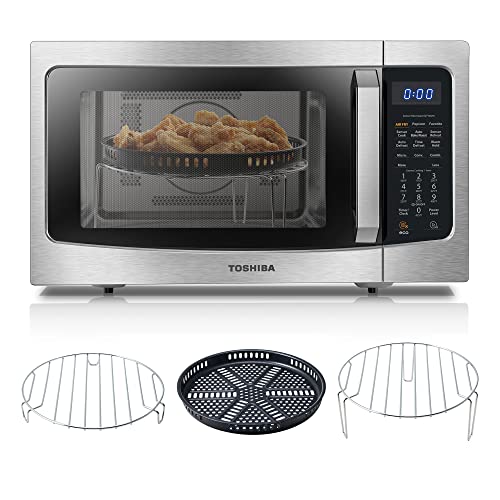
TOSHIBA 1.5 Cu Ft 4-in-1 Microwave With Air Fryer (Silver) — The family combo
The second TOSHIBA in this guide plays a different position from its 1.0 sibling: a 4-in-1 microwave with air fryer at 1.5 cubic feet and a stated 1000 watts, with a smart sensor, convection, a mute function and a position-memory turntable, in silver, for countertop use. The 4-in-1 count is the most conservative in the guide and the cavity is the largest — an inverse relationship that says something good about the maker’s priorities. Where the compact model enumerates modes, this one enumerates living-with-it details, and for a family machine that is the correct emphasis.
Position-memory turntable deserves its explanation, because it solves an annoyance nobody lists until they have lived without the solution. A normal turntable stops wherever the timer ends, leaving a mug’s handle facing away; a position-memory plate returns to its starting orientation, so the handle you placed toward you is the handle you retrieve. Across a family’s hundreds of weekly uses, that small courtesy compounds. The mute function belongs to the same philosophy — a family machine that can silence its beeps for the early riser reheating porridge at dawn, or the parent warming a bottle-adjacent midnight snack, respects the household’s sleep as a feature.
Families should also picture the queue this machine will manage. At 1.5 cubic feet it is the only pick here that can reheat two plates’ worth in a single load without stacking, crisp a family portion of wings in one layer, and still have the cavity free for the sauce — not simultaneously, but in a sequence short enough to feel simultaneous at the table. That throughput, more than any single mode, is what a family is buying at this size, and it is why the guide’s largest machine is also its most family-argued despite carrying the shortest function count of the branded field.
The smart sensor and convection complete the working set: sensor judgement for the variable family reheat, convection for the bakes and roasts a 1.5 cavity can genuinely host, air fry for the portions a family actually fries. At 1000 stated watts the microwave side is full-strength. This is the guide’s family recommendation in the combination category — the machine whose title reads like it was written by someone who has operated a microwave in a sleeping house, at family scale, for years.
- Cavity as listed: 1.5 cu ft — the largest here
- Functions as listed: 4-in-1 with air fryer and convection
- Cooking power as listed: 1000W
- Controls as listed: smart sensor, mute function
- Turntable as listed: position memory
- Finish as listed: silver
- Purchase path: the TOSHIBA 1.5 silver listing on Amazon carries the current price — check price on Amazon
Strengths
- The family-size cavity with full-strength stated wattage.
- Position-memory turntable and mute function are rare, lived-in courtesies.
- Sensor cooking handles the variable loads family life generates.
Trade-offs
- Broil is not named among its functions, unlike its smaller sibling.
- The counter footprint is the largest commitment in this guide.
- Its 4-in-1 count looks modest beside rivals’ numbers while covering the core jobs.
Household fit: families who want one box to absorb the air fryer’s and half the oven’s work. Household misfit: counters where 1.5 cubic feet of machine would exile everything else.

Ninja Crispi MW101 Microwave & Air Fryer — The replacement bid
Ninja’s Crispi MW101 makes the boldest framing claim in this guide: a microwave and air fryer with FusionCrisp technology that, in its title’s words, replaces a countertop microwave and an air fryer, offering fourteen functions and a fast 1000-watt microwave side. Most combination machines describe themselves as microwaves with extras; Ninja describes its machine as two appliances consolidated, which is the correct description of what buyers are actually shopping for. FusionCrisp is the maker’s named crisping system — the hot-air personality given a brand and, by implication, the engineering attention of a company whose reputation was built on air fryers before it ever microwaved anything.
That heritage inverts the usual combination question. With the heritage brands, the buyer asks whether a microwave maker can air-fry; with Ninja, the question is whether an air-fryer maker can microwave — and the title answers with the number that matters, a stated fast 1000W on the microwave side, which is full class-standard power rather than a token. Fourteen functions is the largest count in the guide, and as with all counts it will include sub-modes; the load-bearing claims are the two appliances replaced and the wattage printed beside them.
The consolidation argument deserves a fair stress test, because it is easy to state and harder to live. Replacing two appliances with one means the one box is occupied when both jobs arrive together — the evening when the fries need crisping at the exact moment the sauce needs microwaving. Households that cook in parallel will feel that queue; households that cook in sequence will not notice it exists. Ninja’s wager is that most weeknight cooking is sequential, and for most households that wager is sound — but the couple who habitually run the air fryer and the microwave simultaneously at 6 p.m. should count their parallel evenings before they consolidate them away.
Cavity size is not stated in the title, which is this pick’s one act of reticence, and the buyer should collect it from the product page and test it against the dishes the machine is meant to absorb. If the size suits, the proposition is compelling for the counter-poor household that currently owns both appliances and resents both footprints: one box, one cord, one control language, from the maker whose crisping technology is the reason for the purchase. Households loyal to a single suite brand will look elsewhere; households loyal to counter space will look here first.
- Proposition as listed: replaces a countertop microwave and an air fryer
- Crisping system as listed: FusionCrisp
- Functions as listed: 14
- Microwave power as listed: fast 1000W
- Finish as listed: silver
- Model as listed: MW101
- Not stated in the title: cavity size — confirm on the product page
- Where to buy: the Ninja Crispi MW101 listing on Amazon — check price on Amazon
Strengths
- The only pick designed from the air-fryer side of the category inward.
- Full 1000W microwave power stated, so consolidation costs no pace.
- One footprint and one control language replacing two appliances.
Trade-offs
- Cavity size is unstated in the title and must be checked before ordering.
- Fourteen functions includes sub-modes; the core claim is the two-in-one replacement.
- Its control language is Ninja’s own, a small relearning for heritage-brand households.
Compelling if: you own both appliances it replaces and want the counter back. Less compelling if: your air fryer is huge and beloved, and only the microwave needs replacing.

Sharp SMC0985KS 3-in-1 Convection Air Fry Microwave — The tidy three
Sharp’s entry is the minimalist’s combination machine: a 3-in-1 convection air fry microwave in stainless steel, 0.9 cubic feet and a stated 900 watts, model SMC0985KS. Three-in-one is the most honest arithmetic in the guide — microwave, convection, air fry, counted once each, with no sub-modes inflating the tally — and it comes from a maker with one of the deepest microwave pedigrees in the industry, a company that has built little else but microwave ovens for decades and whose drawer and countertop machines anchor the category’s serious end. The restraint of the title reads like confidence: the three personalities a combination buyer actually uses, in a compact body, at a wattage matched to the size.
The 0.9 cubic foot cavity ties the BLACK+DECKER for smallest here, and the comparison between the two compacts is instructive. The BLACK+DECKER counts five functions and names bake and roast; the Sharp counts three and names the technologies. Neither is fibbing; they are describing the same class of machine in different dialects, and the buyer’s choice between them can honestly rest on control feel, finish and which title’s language matches their own mental model. What the Sharp adds is the specialist’s pedigree — a microwave-first maker whose convection and air-fry modes were engineered by people who think in cavities.
There is a counter-argument the Sharp’s restraint invites, and fairness requires airing it: mode counts are not pure vanity. A household that proofs dough, dehydrates herbs, slow-cooks a stew or keeps plates warm through a long dinner is using functions that a tidy three does not claim, and for that household the longer lists elsewhere in this guide are a genuine shopping list rather than decoration. The Sharp’s bet is on the statistical household, whose week is microwaving, crisping and the occasional bake. Know which household you are before deciding whether restraint reads as focus or as absence.
For the small household that wants combination cooking without a carnival of modes — the couple who will air-fry salmon on Tuesday, bake a small loaf on Saturday and microwave everything else — the tidy three is a grown-up specification. It asks the buyer to value depth in three functions over breadth across eight or fourteen, and a great many experienced cooks will recognise their own habits in that trade immediately.
- Cavity as listed: 0.9 cu ft
- Functions as listed: 3-in-1 — microwave, convection, air fry
- Cooking power as listed: 900 watts
- Finish as listed: stainless steel
- Model as listed: SMC0985KS
- Ordering route: find the Sharp SMC0985KS through its Amazon listing to check price on Amazon
Strengths
- The most conservative function count in the guide, from a microwave specialist.
- All three core personalities present in the joint-smallest footprint.
- Stated 900 watts matched sensibly to the compact cavity.
Trade-offs
- No broil is claimed, and no sensor system is named in the title.
- Compact portions apply in every hot-air mode, as with its 0.9 sibling.
- Buyers who enjoy deep preset libraries will find the offer deliberately spare.
Speaks to: experienced cooks who use three functions deeply. Speaks less to: mode collectors who equate a long function list with capability.
Combination Machines, Function by Function
| Model | Size | Stated microwave power | Hot-air personalities in title |
|---|---|---|---|
| TOSHIBA 1.0 Combo | 1.0 cu ft | Not stated | Air fry, convection, broil |
| BLACK+DECKER 5-in-1 | 0.9 cu ft | 900W | Air fry, convection bake and roast |
| Frigidaire 1.2 | 1.2 cu ft | Not stated | Air fry, convection, Combo-Fry |
| TOSHIBA 1.5 4-in-1 | 1.5 cu ft | 1000W | Air fry, convection |
| Ninja Crispi MW101 | Not stated | 1000W | Air fry via FusionCrisp |
| Sharp SMC0985KS | 0.9 cu ft | 900 watts | Convection, air fry |
The table is this guide’s honesty rule made visible: every cell is a claim the model’s own title prints, and the gaps are printed as gaps. Two titles leave wattage unstated, one leaves size unstated, and only one names broil. A buyer who reads the table row by row can shortlist in a minute — and can also see why the reviews insist on product-page checks for the unstated cells rather than filling them from neighbouring models.
How Do You Get Real Crisping Out of a Combination Cavity?
Technique matters more in a shared cavity than in a dedicated fryer, and four habits separate crisp results from steamed disappointments. Dry the food’s surface — moisture is crisping’s enemy in any appliance, and doubly so in a cavity that also generates steam as it microwaves. Use the rack or basket the mode expects, because hot air must reach the food’s underside; a solid plate turns air-frying into top-side roasting. Do not crowd: a single layer with air gaps crisps, a piled layer steams itself, and two honest batches beat one soggy one every time. And let the machine preheat when the mode offers it, since a cold cavity’s first five minutes are spent warming steel rather than food.
Sequencing is the combination machine’s home advantage, so build meals around it. Defrost in the same dish you will crisp in, where the dish allows; start dense vegetables with a short microwave phase and finish them under the hot air; reheat yesterday’s fried food with air alone and be quietly amazed at what returns. Households that think in sequences will find these machines genuinely expand what a weeknight can include. Households that think in single modes will still be served — every pick here microwaves properly — but they will be paying for choreography they never use, and the honest advice for them is a simpler machine.
One more habit protects the investment: clean the cavity’s ceiling and the area around the element as the maker directs, because air-fry modes deposit a fine grease film exactly where a microwave-only machine stays clean. Five minutes monthly keeps the hot-air modes tasting like food rather than like last month’s fries — a small tax on a machine doing two jobs, and worth paying on schedule.
What Does the Second-Oven Role Mean on the Year’s Biggest Cooking Days?
Every kitchen has four or five days a year when the main oven is a contested resource — the holiday roast holding the cavity for hours while three side dishes queue, the baking day when trays rotate through a single box, the gathering where reheating alone could occupy an oven. A multifunctional microwave is the pressure valve on exactly those days. Its convection mode takes the tray of rolls or the dish of gratin; its air-fry mode revives the appetisers; its microwave side handles the sauces and the gravy-adjacent emergencies. None of the six picks here will cook the centrepiece — that is not their claim — but a household that has run one holiday with a competent second oven rarely goes back to running one without.
The rest of the year, the same machine handles the inverse problem: the day too hot, too small or too rushed for the main oven at all. A two-person bake in high summer, a single portion of salmon, a tray of roasted vegetables for one — loads that make a full-size oven feel like heating a hall to warm a chair. Small cavities heat fast and cool the kitchen less, and the combination machine’s owner discovers that the second oven quietly becomes the first one for most of the calendar. That inversion is the deepest reason the category keeps growing: it is not really about functions counted on a box, but about having the right size of oven for the meal actually being cooked.
Where Do Multifunctional Microwaves Sit in a Whole Kitchen?
Think of the combination machine as the kitchen’s utility player: it covers the second-oven jobs — the side dish while the main oven holds the roast, the small bake on a hot day when heating a full oven feels absurd, the reheated leftovers that deserve better than microwaving alone. In homes without a second oven, it becomes that oven for everything except the largest occasions. In homes with one, it still earns its counter by speed: preheating a small cavity is a fraction of heating a large one, and weeknight cooking is mostly small loads.
The category also points beyond the counter for households planning a whole kitchen. A combination machine is often the renter’s or the small kitchen’s version of an idea that fitted kitchens express in cabinetry: two cooking personalities in one footprint. Readers speccing that built-in expression will find it surveyed in our guide to Best Combo Wall Ovens, where the microwave leaves the worktop and joins a full oven in a single column. The countertop machines in this guide and the built-in columns in that one are the same wager at different scales — that one well-chosen box should cook in more than one honest way.
What Mistakes Do Combination-Microwave Buyers Keep Making?
The first is counting functions instead of testing them against their own cooking: a fourteen-function machine whose owner uses three is a three-function machine with a confusing menu. List the jobs you actually need done — crisp, bake, defrost, reheat — and match titles to that list. The second is ignoring the accessories: a combination machine without its rack or basket in the box, or with accessories that fit awkwardly, will be used as a plain microwave within a month, so confirm what ships and how it stores. The third is expecting dedicated-appliance volume from a shared cavity, then blaming the machine for a physics problem the buyer created.
Two quieter errors follow. Buyers place a combination machine where its hot-air modes cannot breathe — hard against a wall or under a low cabinet that resents the heat — when these machines vent more warmth than a plain microwave and want clearance respected. And buyers never learn the sequence modes, leaving the category’s best trick unexplored; the household that reads its manual for one evening in the first week uses a different appliance for years afterwards than the household that does not. Shoppers who enjoy value arithmetic will recognise the same trap in our colleagues’ guide to Best Economy Dishwashers, where the cheapest path to a function is not always the machine with the longest feature list, but the one whose features match the household’s actual week.
Final Recommendation
Match the machine to the household’s true centre of gravity. Small households that cook in sequences should start with the TOSHIBA 1.0, whose title names convection, broil and a proper defrost system in one accountable breath; the BLACK+DECKER and the Sharp divide the compact vote between feature breadth and specialist restraint. The Frigidaire 1.2 is the balanced middleweight, the TOSHIBA 1.5 is the family machine whose mute button and memory turntable show a maker thinking about real mornings, and the Ninja MW101 is the consolidation play for counters currently hosting both appliances it replaces. Buy the functions your week will actually call, in the size your dishes actually need, and the one box on the counter will keep proving — crisp, baked, reheated, night after night — that it deserved the space it took.
Frequently Asked Questions
Can a multifunctional microwave really replace an air fryer?
For weeknight portions, yes — every pick in this guide claims air-fry capability in its title, and the Ninja is explicitly positioned as a replacement for a separate air fryer. The limits are volume and batch size: a dedicated large basket fryer still wins a party-size load. Households whose frying is measured in family portions will not miss the separate machine; households frying for crowds should keep both or size their expectations honestly.
What is the difference between the air-fry and convection modes?
Intensity and intent. Convection circulates heated air for even baking and roasting; air-frying drives that air harder and faster around food in a basket or on a rack to crisp surfaces. In these combination machines the same fan-and-element hardware serves both, with different settings — which is why titles that name both are describing two behaviours of one system, not two separate appliances inside the box.
Why do the function counts vary so much, from 3-in-1 to fourteen?
Because makers count differently. Sharp’s 3-in-1 counts the three core technologies; larger counts fold in sub-modes such as defrost variants, keep-warm and reheating programmes. This guide therefore compares named functions — air fry, convection, broil — rather than headline counts, and you should too: write down the jobs you need, then find the titles that name those jobs.
Does combination cooking slow down the microwave side?
The microwave function itself runs at the machine’s stated power — 1000W on the TOSHIBA 1.5 and the Ninja, 900W on the two compacts — regardless of the extra modes on board. What changes is only the menu’s depth. Where a title leaves wattage unstated, as the TOSHIBA 1.0 and Frigidaire do, confirm it on the product page, since microwave pace is a daily experience and worth one check.
Do combination microwaves need more clearance than ordinary ones?
Generally yes, and the product page’s installation notes are the authority for your model. Hot-air modes push more heat out of the vents than microwaving alone, so the clearances above and behind the machine deserve respect rather than the squeeze a plain microwave might tolerate. Measure the intended spot with the maker’s stated clearances in hand, especially under low cabinets, before the machine arrives rather than while it sits in its box.
Are the accessories for frying and baking included?
Combination machines typically ship with the rack or basket their hot-air modes require, but the exact set varies by model and is a product-page detail rather than a title claim. Confirm what is in the box before ordering, and picture where the accessories will live when not in use — a rack without a home becomes a rack in a drawer under everything, and modes whose tools are buried are modes that quietly retire.
Related Guides
Readers drawn to one-box cooking versatility may also enjoy our guide to Best Home Steam Ovens, where the extra function under the microscope is steam rather than hot air — a different route to the same ambition of making one appliance cook in several honest ways. Between steam and crisping, a counter can cover a remarkable share of a household’s cooking without ever troubling the main oven.


