What's inside
- Key Takeaways
- Quick Picks
- What Did a Microwave Have to Prove to Belong in an RV Guide?
- The Six Picks at a Glance
- How Do You Measure an RV Cabinet Opening Without Getting It Wrong?
- What Does 900 Watts Mean for a Coach’s Power Budget?
- Road Manners: What Should You Check After the First Thousand Miles?
- Which Buying Mistakes Do RV Owners Make With Microwaves?
- 0.9, 1.0 or 1.1 Cubic Feet: What Actually Fits Inside Each?
- What Does a 900-Watt Machine Cook Well on the Road?
- Repair the Factory Unit or Replace It? The RV Owner’s Recurring Question
- Heat and Venting Inside a Wooden Cabinet: The Quiet Engineering
- Black or Stainless in a Coach Interior?
- Buying for a Used RV: The Second-Owner’s Version of This Guide
- The Microwave’s Place in the Whole Galley System
- Presets, Levels and Instant Start: Reading the Control Claims Like a Driver
- Final Recommendation
- Frequently Asked Questions
- Related Guides
As an Amazon Associate I earn from qualifying purchases. This post may contain affiliate links at no extra cost to you.
cottageverdict.com is reader-supported. When you buy through links on our site, we may earn an affiliate commission.
All six machines in this guide are sold on Amazon, and each pick links to its own listing so you can check price on Amazon and confirm the trim and cavity details against your RV’s cabinet before ordering. There are no prose-only picks in this roundup — the verified field of true built-in RV microwaves was deep enough to fill all six slots with real, linkable machines.
The best RV microwaves are built-ins, and that word is the guide’s whole discipline. An RV microwave lives in a cabinet opening, framed by a trim kit, powered by the coach’s electrical system, and shaken by every mile of road — it is a different appliance from the countertop dorm microwave that merely happens to be small, and this guide excludes the countertop class plainly and early. Every pick below is a built-in RV unit with a stated capacity between 0.9 and 1.1 cubic feet and, where the title gives it, a stated 900 watts of cooking power. RecPro, the RV aftermarket’s most familiar name, supplies three of the six, including the range’s only air-fry and convection variants; InVision, CONTOURE and ProCamp complete a field that covers black and stainless, trim included and trim separate, express-cook minimalism and multi-stage cooking.
Why does the built-in distinction matter so much on the road? Because the countertop unit in a moving vehicle is a projectile with a power cord, because RV cabinet openings are cut to a small family of standard sizes that built-ins are designed to fill, and because the trim kit is not decoration — it is the finished, ventilated frame that lets a microwave breathe inside a wooden cabinet. The sections below take each machine on its stated merits, then walk through the measuring, the power arithmetic and the road-worthiness checks that decide whether a given unit belongs in your coach.
Key Takeaways
- All six picks are true built-in RV microwaves — cabinet-mounted with trim solutions — and countertop dorm models are excluded by design, not by oversight.
- Stated capacities cluster tightly: 0.9, 1.0 and 1.1 cubic feet, with 900W the stated cooking power on five of the six titles.
- Trim kits are included in the RecPro 1.0, InVision and ProCamp titles, and stated as sold separately for the CONTOURE — a real cost-and-effort difference at installation.
- Two picks cook beyond microwaving: the RecPro Air Fry model, and the RecPro 1.1 convection unit, the largest cavity in the guide.
- Measure the cabinet opening and check the coach’s inverter or shore-power budget before choosing; in an RV, fit and power outrank features.
Quick Picks
| Pick | Badge | Why it earned its place |
|---|---|---|
| RecPro 1.0 Cu Ft Microwave With Trim Kit (Black) | The reference point | The class’s standard-bearer: 1.0 cu ft, a stated 900W, trim kit in the box, 8 express cook presets and 10 power levels. |
| InVision 0.9 Cu Ft Built-In RV Microwave | Stainless compact | A 0.9 cu ft built-in in stainless with the trim kit included — the smaller opening’s finished-looking answer. |
| RecPro 1.0 Cu Ft Air Fry Microwave (Black) | Air-fry traveller | Microwave plus air fry in one 1.0 cu ft, 900W cabinet unit, with 11 power levels and multi-stage cooking. |
| CONTOURE 1.0 Cu Ft Built-In RV Microwave | Turntable noted | 1.0 cu ft and 900W with a stated 10.5-inch glass turntable and time-and-weight defrost; trim kit sold separately. |
| RecPro 1.1 Cu Ft RV Convection Microwave | Biggest cavity | The guide’s largest at 1.1 cu ft, adding convection cooking to 900W microwaving, with touchpad controls and an LED display. |
| ProCamp 0.9 Cu Ft RV Microwave With Trim Kit | Stainless value | 0.9 cu ft, a stated 900W and 10 power levels in stainless, trim kit included, aimed at motorhomes and campers by name. |
What Did a Microwave Have to Prove to Belong in an RV Guide?
Three things, all checkable in the title. It had to be a built-in — designed for a cabinet opening, not a countertop. It had to address the trim question, the frame that finishes the installation, whether by including the kit or by stating honestly that it is sold separately. And it had to state its capacity, because RV cabinet openings are unforgiving and a buyer matching a cutout needs the number in writing. Wattage was recorded exactly where titles state it and nowhere else; five of the six state 900W, and the InVision’s title leaves wattage unstated, so this guide leaves it unstated too, however safe a guess might feel.
The excluded class deserves its sentence of respect: countertop microwaves serve dorms, offices and kitchen counters honourably, and many RV owners do carry one, strapped down, in a cabinet. But they are not built-ins, their vents expect open air, and a guide that listed them here would be answering a question its reader did not ask. The reader’s question is which machine belongs in the opening above the RV’s counter — and these six are the verified answers.

RecPro 1.0 Cu Ft RV Microwave With Trim Kit (Black) — The reference point
If the built-in RV microwave has a default setting, this is it: RecPro’s 1.0 cubic foot unit in black, with the trim kit in the box, a stated 900 watts of cooking power, 8 express cook presets, 10 power levels and instant start. RecPro built its name supplying the RV industry’s replacement market — the furniture, appliances and fittings owners buy when the original equipment tires — and this model is the one against which the class is usually measured, because it was designed for the standard opening and the standard electrical system rather than adapted from a household product. The trim kit’s inclusion is not a small thing: it means the purchase is complete on arrival, frame and all, and the installation ends with a finished cabinet face rather than a second order.
The control story suits road life. Express cook presets and instant start are the features a driver actually uses at a rest stop — one touch, hot food, no menu archaeology — and 10 power levels give the defrosting and reheating gradations that 900 watts of honest power needs to avoid scorching small portions. One point of title discipline: this model also exists in a stainless listing, and it is the same model — the guide counts it once, in black, and shoppers who prefer stainless should know they are choosing a finish, not a different machine. For the owner replacing a tired factory microwave in a standard opening, this is the lowest-risk purchase in the guide, and the benchmark every other pick is compared against.
- Format: built-in RV microwave, trim kit included
- Capacity: 1.0 cu. ft., stated in the title
- Power: 900W cooking power, as titled
- Controls: 8 express cook presets; 10 power levels; instant start
- Finish: black (also listed in stainless — same model)
- Where to buy: the RecPro 1.0 Cu Ft RV Microwave With Trim Kit listing on Amazon — check price on Amazon
Strengths
- The complete purchase: trim kit in the box, standard size, the class’s reference specification.
- Express presets and instant start are exactly the controls road stops reward.
- An RV-specialist maker’s model, designed for the cabinet rather than adapted to it.
Trade-offs
- Microwave only — no air fry or convection for owners who want one appliance to do both jobs.
- Black is the finish counted here; stainless hunters must find the sibling listing themselves.
- Its very standardness means no headline feature — it wins on fit and completeness.
Best for: the straightforward replacement — a standard opening, a tired factory unit, a wish for the job done in one order. Skip it if: you want convection or air-fry cooking from the same cavity.

InVision 0.9 Cu Ft Built-In RV Microwave — Stainless compact
The InVision serves the smaller opening and the stainless kitchen: a 0.9 cubic foot built-in whose title states the built-in design, the included trim kit, the stainless steel finish and the compact RV sizing, with the model number 300-4200 printed for exact matching. Smaller RVs and older coaches often carry the tighter cutout, and their owners face a thin choice of machines that finish properly; a stainless unit with its trim included, from a maker addressing the RV market by name, is a genuinely useful find for that reader. The stated compact sizing is the pick’s headline — this is the machine for the opening the 1.0 cu ft class will not enter.
Title discipline matters most on this pick: its wattage is not stated, and this guide will not assign it one, however strong the class pattern of 900 watts might be. A buyer for whom the wattage figure is decision-critical should read it in the listing itself before ordering; a buyer whose decision is fit, finish and trim — the usual RV decision, in that order — has everything needed in the title. The 0.9 cavity reheats, defrosts and cooks for one or two travellers without complaint, and its smaller appetite suits the electrical budgets of smaller coaches. In a guide where every other pick leads with a number, the InVision leads with a fit, and for its intended opening that is the right priority.
- Format: built-in RV microwave, trim kit included
- Capacity: 0.9 cu. ft., stated in the title
- Power: not stated in the title
- Finish: stainless steel
- Model: 300-4200, as titled
- Where to buy: the InVision 0.9 Cu Ft Built-In RV Microwave listing on Amazon — check price on Amazon
Strengths
- The compact opening’s finished answer — stainless, trim included, sized for smaller cutouts.
- A printed model number makes exact-fit verification against the listing straightforward.
- Stainless finish suits the growing number of RVs fitted out like small apartments.
Trade-offs
- Wattage is unstated in the title — power shoppers must confirm it in the listing.
- The 0.9 cavity is the joint-smallest here; family-sized dishes will not fit.
- No express-preset or specialty cooking claims are made in the title.
Ideal for: smaller coaches and stainless galleys where the opening, not the feature list, is the constraint. Not the one if: you need a stated wattage or a full cubic foot of cavity.

RecPro 1.0 Cu Ft RV Air Fry Microwave (Black) — Air-fry traveller
Space in an RV is a zero-sum negotiation, and this RecPro’s argument is that one cavity can hold two appliances’ jobs. The title states a 1.0 cu ft RV air fry microwave at 900 watts in black, with a quick start button, 11 power levels, a child lock and multi-stage cooking. The air fry function is the headline: crisped food without a separate air fryer occupying a cabinet, which in a coach kitchen is not a convenience but a genuine reallocation of the scarcest resource on board. Travellers who have given up fried textures on the road — or who carry a countertop air fryer and resent its footprint daily — are this machine’s constituency.
The supporting details show road thinking. Eleven power levels is one more than the class standard and gives finer control at the gentle end where reheating without rubberising happens. Multi-stage cooking lets a defrost flow into a cook without the cook returning to the panel — the set-and-walk-away pattern that suits a driver making a short stop. The child lock, mundane in a house, earns its place in a vehicle where the kitchen is also the hallway, the lounge and the children’s entire world on a rainy day. What the title does not state is a trim kit, and this guide notes the silence: buyers should confirm the trim arrangements in the listing, because the finished installation depends on it. The cavity and power match the reference RecPro exactly, so the decision between them is purely the air fry question — worth it if the second appliance’s space is worth more than the simplicity of the standard model.
- Format: built-in RV microwave with air fry
- Capacity: 1.0 cu ft, stated in the title
- Power: 900W, as titled
- Controls: quick start; 11 power levels; multi-stage cooking; child lock
- Trim kit: not stated in the title — confirm in the listing
- Finish: black
- Where to buy: the RecPro 1.0 Cu Ft RV Air Fry Microwave listing on Amazon — check price on Amazon
Strengths
- Air fry in the microwave’s footprint returns a whole cabinet to other duty.
- Multi-stage cooking fits the short-stop rhythm of travel days.
- Eleven power levels give the finest low-end control stated in this guide.
Trade-offs
- Trim arrangements are not stated in the title and must be confirmed before ordering.
- Combination cooking adds modes to learn; pure reheaters will use a fraction of it.
- Air fry results in a 1.0 cavity suit small batches — this replaces a small air fryer, not a family one.
Choose it if: your coach kitchen is one appliance deep and crisped food is the thing you miss. A weak match for: travellers who only ever reheat and defrost, who should take the simpler reference model.
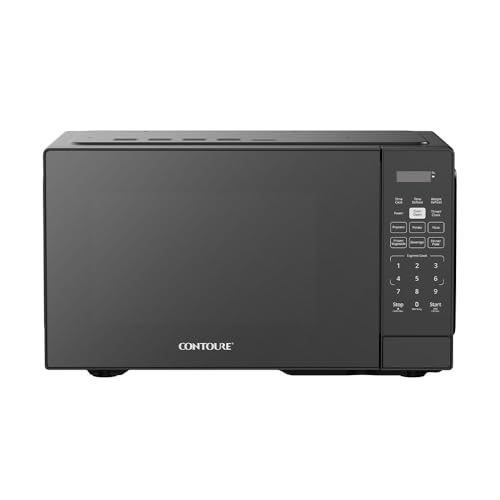
CONTOURE 1.0 Cu Ft Built-In RV Microwave — Turntable noted
CONTOURE is an RV-and-marine appliance name, and its built-in states the class specification with unusual completeness: 1.0 cu ft, 900 watts, black onyx finish, express cook presets, auto menus, time and weight defrost, and a 10.5-inch glass turntable whose diameter is printed in the title — a small act of honesty this guide appreciates, because turntable size is the practical limit on which plates and dishes the cavity can actually serve, and most titles leave it to be discovered. A 10.5-inch turntable takes a full dinner plate, which is the real-world capacity test a cubic-foot figure only approximates.
The pick’s defining caveat is printed just as plainly: the trim kit is sold separately, under its own model reference in the title. Read generously, this is flexibility — the buyer whose coach already carries a compatible frame, or who prefers a different trim, is not forced to pay for a duplicate. Read practically, it is a second purchase and a compatibility check that the included-kit picks spare you, and the total cost of the installation is not known until both items are priced. This guide counts the transparency as a virtue and the errand as a cost, and places the CONTOURE accordingly: a well-specified machine for the buyer who reads titles — which, by this point in the guide, is the only kind of buyer still reading.
- Format: built-in RV microwave; trim kit sold separately
- Capacity: 1.0 cu ft, stated in the title
- Power: 900W, as titled
- Turntable: 10.5 in glass, stated in the title
- Controls: express cook presets; auto menus; time and weight defrost
- Finish: black onyx
- Where to buy: the CONTOURE 1.0 Cu Ft Built-In RV Microwave listing on Amazon — check price on Amazon
Strengths
- The stated turntable diameter lets a buyer verify their dinner plates will fit — rare, useful honesty.
- A complete control set: presets, auto menus and both defrost modes in the title.
- An RV-and-marine specialist’s model, sized for the standard opening.
Trade-offs
- The trim kit is a separate purchase — the installation’s full cost needs both listings.
- Trim compatibility must be confirmed, adding a step the included-kit picks avoid.
- Black onyx is the only finish this listing presents.
Best for: the methodical buyer who wants the turntable in writing and does not mind sourcing the trim as its own line item. Not suited for: anyone who wants the installation complete in a single box.

RecPro 1.1 Cu Ft RV Convection Microwave — Biggest cavity
The largest cavity in this guide belongs to RecPro’s convection model: 1.1 cubic feet, stated 120 volts and 900 watts, with touchpad controls, an LED digital display, a child safety lock, and weight and time defrost, in black. Convection is the significant word. A convection microwave circulates hot air and genuinely bakes and roasts — the difference between reheating a casserole and cooking one — and in an RV whose oven may be small, temperamental or absent, a convection cavity above the counter can become the kitchen’s real oven. Full-time RVers and long-season travellers are this machine’s people: the ones for whom the microwave is not a reheating station but a primary cooking appliance.
The 120V statement in the title matters more than it looks, because it confirms the machine expects the coach’s ordinary AC supply — the shore-power and inverter world the reader actually lives in — and asks for nothing exotic. The extra tenth of a cubic foot over the class standard sounds marginal and is not: it is the difference at the margin where a casserole dish either clears the cavity or does not, and convection cooking, which needs air space around the food, spends capacity faster than microwaving does. Touchpad controls and the LED display suit the combination cooking workflow, where stages and temperatures are programmed rather than guessed. No trim kit is mentioned in the title — the recurring note applies, and the buyer should confirm the frame arrangements in the listing before the installation weekend is planned around their absence.
- Format: built-in RV convection microwave
- Capacity: 1.1 cu. ft. — the largest stated here
- Power: 900W; 120V supply, both as titled
- Controls: touchpad; LED digital display; child safety lock
- Defrost: weight and time defrost, per title
- Trim kit: not stated in the title — confirm in the listing
- Where to buy: the RecPro 1.1 Cu Ft RV Convection Microwave listing on Amazon — check price on Amazon
Strengths
- True convection baking in the RV’s microwave opening — a second oven where no oven fits.
- The biggest stated cavity in the guide, which convection cooking genuinely needs.
- The title’s plain 120V statement confirms ordinary coach power compatibility.
Trade-offs
- Combination cooking is the most complex control story here — a learning curve is included.
- Trim arrangements are unstated in the title and need confirming.
- Convection cycles draw sustained power, which off-grid inverter budgets must respect.
Strongest case: full-timers and long-season travellers who cook, rather than merely reheat, and whose RV oven is inadequate or absent. Pass if: your road cooking is coffee, soup and leftovers — the reference model does all three with less to learn.

ProCamp 0.9 Cu Ft RV Microwave With Trim Kit — Stainless value
ProCamp’s entry matches the InVision’s compact brief and answers it point for point: 0.9 cu ft, stainless, trim kit included — and then adds the number the InVision’s title withholds, a stated 900 watts with 10 power levels, aimed by name at motorhomes and campers, with the model reference MCG992ARB printed in the title. For the smaller-opening buyer who wants the whole specification in writing before ordering, this is the most completely stated compact pick in the guide. The comparison between the two 0.9 machines is the guide’s neatest illustration of its own method: same capacity, same finish family, same trim inclusion — separated by one title’s decision to print its wattage and the other’s silence.
In service, the ProCamp’s case is the small coach’s daily reality. Nine-tenths of a cubic foot reheats two travellers’ meals, defrosts modestly and cooks the simple end of the menu, while the stainless cabinet wipes clean in the galley where every surface is within arm’s reach of a splash. Ten power levels give the control gradation that 900 watts needs for small portions, which overheat faster than family-sized ones. Owners of camper vans and compact motorhomes — the vehicles where the microwave opening is smallest and the electrical system most modest — are the natural audience, and the pick’s title speaks to them so directly that the review’s remaining job is simply to confirm that nothing in it contradicts the brief. Nothing does.
- Format: built-in RV microwave, trim kit included
- Capacity: 0.9 cu ft, stated in the title
- Power: 900W; 10 power levels, as titled
- Finish: stainless
- Audience: motorhomes and campers, per title; model MCG992ARB
- Where to buy: the ProCamp 0.9 Cu Ft RV Microwave With Trim Kit listing on Amazon — check price on Amazon
Strengths
- The most fully stated compact specification here — capacity, wattage, levels and trim all in the title.
- Stainless with the kit included makes the purchase complete on arrival.
- Explicitly aimed at motorhomes and campers — the small-coach brief in so many words.
Trade-offs
- The 0.9 cavity limits dish size, as with its InVision rival.
- No specialty cooking — this is a microwave, honestly and only.
- Less of a track record to research than the RecPro name carries in this class.
Best for: compact motorhome and camper owners who want every number in writing and the trim in the box. Not suited for: anyone feeding a crew or replacing a 1.0 cu ft opening’s machine.
The Six Picks at a Glance
| Pick | Capacity, as titled | Power, as titled | Trim | Beyond microwaving |
|---|---|---|---|---|
| RecPro 1.0 With Trim Kit | 1.0 cu ft | 900W | Included | No |
| InVision 0.9 Built-In | 0.9 cu ft | Not stated | Included | No |
| RecPro 1.0 Air Fry | 1.0 cu ft | 900W | Not stated | Air fry |
| CONTOURE 1.0 Built-In | 1.0 cu ft | 900W | Sold separately | No |
| RecPro 1.1 Convection | 1.1 cu ft | 900W, 120V | Not stated | Convection |
| ProCamp 0.9 With Trim Kit | 0.9 cu ft | 900W | Included | No |
How Do You Measure an RV Cabinet Opening Without Getting It Wrong?
Remove the old machine first — measurements taken around an installed unit are wishes, not numbers. With the opening empty, record its width, height and depth at several points, because RV cabinetry is carpentry, not machining, and the opening’s smallest dimension is the one that governs. Note the electrical outlet’s position inside or behind the cabinet, and the venting arrangement the old machine used; built-in microwaves breathe in designed directions, and the trim frame is part of that breathing, which is why the frame is a functional component and not a picture border. Photograph everything. Then match against the listing’s stated cutout requirements for the specific model — the titles in this guide give capacities, and the listings give cutouts, and the buyer who checks the second against the tape measure’s verdict will not be returning a microwave from a campsite.
Owners replacing a factory unit hold one advantage: the old machine’s make and model, usually labelled inside the door, identify the opening’s intended size, and cross-referencing that model against the new pick’s requirements is the fastest verification in RV appliance work. Owners fitting a microwave where none existed face carpentry as well as shopping, and for them the trim-included picks — the reference RecPro, the InVision, the ProCamp — simplify the project by making the finished face a solved problem. The same measure-twice discipline governs the rest of a small-space kitchen refit, incidentally, including the machines in Best Under-Cabinet Microwaves, where the cabinet is in a house but the geometry is just as unforgiving.
What Does 900 Watts Mean for a Coach’s Power Budget?
A microwave’s cooking wattage is its output; its draw from the coach’s system is higher, and the inverter or shore connection feels the draw, not the output. The practical consequences are the ones experienced travellers already know: on shore power or a generator, any pick in this guide runs without thought. On an inverter fed by the house batteries, a 900W-class machine is a heavy but manageable load for short runs — reheating and defrosting are brief — while long convection cycles, the RecPro 1.1’s speciality, are a battery budget item to plan rather than an impulse. The child locks and express presets in these titles are conveniences; the real off-grid feature is the cook’s own scheduling, running the heavy electrical loads when the sun or the shoreline is providing.
None of the titles here states an input wattage or an amperage, so this guide prints none — the listing and the machine’s rating plate are the authorities, and the buyer running a small inverter should read them before ordering rather than after the first low-voltage alarm. That caution is the RV version of this site’s standing rule, and it scales to every appliance in a self-contained vehicle: the stated numbers govern, the unstated ones get checked, and the road forgives preparation more readily than optimism.
Road Manners: What Should You Check After the First Thousand Miles?
A built-in microwave in a vehicle lives a life no household appliance imagines — vibration as a daily condition, temperature swings in a parked coach, and the slow loosening that roads apply to every fastener. The installation deserves a settling check after the first trips: confirm the mounting screws are snug, the trim sits flush, the door latch engages with its original click, and the turntable rides its ring as it did on day one. Listen on the next use for new rattles, which are the machine’s way of reporting a loose panel or a shifted mounting point while the fix is still a screwdriver’s minute.
The interior habits of road life are equally simple. Travel with the cavity empty and the turntable secured — many owners keep the glass plate in a drawer lined with a cloth, because a turntable that survives the highway is one that did not spend it bouncing. Wipe the cavity after messy uses rather than weekly; in a small coach, yesterday’s soup is this morning’s ambient aroma. Machines maintained this way routinely outlast the RV’s original fittings around them, which is the replacement market’s whole history — RecPro exists because coaches outlive their first appliances, and the second ones, chosen well, are usually better than the first.
Which Buying Mistakes Do RV Owners Make With Microwaves?
The classic is buying a countertop model for a built-in opening — it fits the hole, roughly, and then vents wrong, rattles loose and looks unfinished, because it was designed for open air and a stationary life. The second is ignoring the trim question until installation day, discovering that the frame is a separate purchase, as the CONTOURE states honestly, or an unstated arrangement to confirm, as with the two combination RecPros. The third is matching by capacity alone: a 1.0 cu ft label describes the cavity, not the cutout, and two machines of equal capacity can demand different openings. The fourth is forgetting the electrical budget — ordering a convection machine for an off-grid coach whose inverter sulks at the sight of it.
The fifth mistake belongs to the whole small-space refit rather than the microwave alone: replacing appliances one at a time without a plan for the vehicle’s total electrical and storage picture. The owners who fare best treat the coach as a system — cooking, cold storage and power in one budget — which is why the thinking in Best Glass Door Freezers, a guide about an entirely different appliance class for shops and garages, still rhymes: state the requirement, verify the claim, respect the installation’s real constraints. And the refit planner who reaches the wall-oven question in a park-model or a converted coach will find the value end of that field mapped in Best Economical Double Wall Ovens, where the same title-first scepticism applies to much larger iron.
0.9, 1.0 or 1.1 Cubic Feet: What Actually Fits Inside Each?
Cubic feet are abstract; dinner plates are not. The 0.9 cu ft machines — InVision and ProCamp — are reheating and simple-cooking cavities: two travellers’ plates in sequence rather than together, mugs, bowls, a bag of popcorn, a frozen meal in its tray. Their turntable diameters are not stated in their titles, so the plate test belongs to the listing check, but the class expectation is a standard plate handled one at a time and larger serving dishes left to other methods. The 1.0 cu ft class is the RV standard because it crosses the threshold where a full dinner plate rotates comfortably — the CONTOURE’s stated 10.5-inch turntable makes that concrete — and where a modest casserole joins the menu. The RecPro convection model’s 1.1 is the only cavity here that invites a baking dish with headroom, and convection needs that headroom, because air must circulate around the food for the mode to earn its name.
The buyer’s translation exercise is simple and worth doing literally: take the three dishes you microwave most — the plate, the bowl, the storage container you reheat leftovers in — and measure them. Compare against the turntable and cavity figures the listings state. Ten minutes with a tape measure at the kitchen table predicts satisfaction better than any review paragraph, including the six above, because capacity satisfaction is personal geometry. The guide’s part is to ensure the numbers you compare are the stated ones; the dishes are yours.
What Does a 900-Watt Machine Cook Well on the Road?
Expect honest mid-power cooking. Nine hundred watts reheats leftovers thoroughly in a few minutes, cooks fresh vegetables and rice-based convenience meals well, defrosts evenly when the power levels are used rather than blasted — the reason these titles bother to state 10 or 11 levels — and handles the frozen-meal repertoire without the rubberised edges that underpowered machines produce. Where it asks patience is in sheer mass: a large, dense casserole heats through more slowly than in a high-wattage household machine, and the experienced RV cook compensates with the rest-and-stir rhythm, letting standing time equalise the temperature instead of adding brute minutes.
The combination models redraw this map at the edges. Air fry mode crisps the foods microwaves are worst at — anything whose pleasure is a crust — in small, quick batches. Convection mode bakes the foods microwaves cannot attempt at all: a tray of biscuits, a small roast, a baked casserole with a browned top. Owners stepping from a household kitchen should calibrate once, with a familiar dish, rather than relearning by disappointment; the first meal in a new machine is tuition, and it is cheaper paid deliberately.
Repair the Factory Unit or Replace It? The RV Owner’s Recurring Question
Coaches outlive their microwaves, and the replacement decision usually arrives as a failure — a dead control board, a door latch, a magnetron grown weak and slow. Repair is worth pricing when the failure is a single component and the cavity is sound, but the RV case tilts toward replacement more often than the household case, for three reasons. The machine is a standard size, so replacement is a known quantity rather than a remodel. The labour of extracting and refitting dominates any repair bill, and it is paid once either way. And the new machine arrives with the current feature set — the express presets, locks and, in the combination models, cooking modes the original never had — for a vehicle whose remaining life is measured in years of trips.
The countervailing case is the vintage or custom coach whose opening matches nothing current without carpentry; there, repair buys the preservation of the cabinetry, and the calculus reverses. Either way, the failed machine’s model number and the opening’s measurements are the two facts to gather before any money moves — the same two facts this guide has been asking for since its first section, because in RV appliances they are, nearly always, the whole decision.
Heat and Venting Inside a Wooden Cabinet: The Quiet Engineering
A household microwave sits in open air; an RV built-in cooks inside a wooden box, in a vehicle that may itself be sitting in desert sun. The built-in design answers with venting paths engineered into the unit and its trim, which is the deeper reason the trim is functional and the countertop substitution is unwise: a countertop machine’s vents expect a room, and a cabinet is not a room. Owners can help the engineering honestly — keep the cabinet’s surrounding clutter away from the trim’s vent paths, avoid running long convection cycles with the coach closed and unventilated in extreme heat, and treat a machine that begins cutting out on thermal protection as reporting a venting problem, not suffering a character flaw.
This is also where the combination models ask their one real question. Convection and air fry modes sustain oven-like temperatures, and they do so in the same cabinet; their designs account for it, but the owner’s part is to respect the clearances the listing states and to give the machine air on the long bakes. The reward for that respect is the thing itself: a small wooden cabinet in a vehicle, safely producing a baked dinner at a lakeside stop, which remains — for all its ordinariness to the people who live it — a minor marvel of the RV idea.
Black or Stainless in a Coach Interior?
The finish question, trivial in a house, has texture in a vehicle. Black — the reference RecPro, the air fry model, the convection model and the CONTOURE’s black onyx — disappears into the shadowed cabinetry of most RV interiors, shows cooking splatter less between wipes, and matches the black glass of the other appliances coaches are usually fitted with. Stainless — the InVision and the ProCamp — brightens a small galley, coordinates with the apartment-style fit-outs of newer and larger coaches, and shows every fingerprint in a space where the microwave door is also, unavoidably, a handhold as the vehicle moves and its occupants steady themselves. Neither is a wrong answer; the tiebreaker is which appliance family already lives in the coach, because a matched galley looks deliberate and a mixed one looks accumulated. Note, from the reference pick’s own note, that finishes can be listings rather than models — the RecPro 1.0 exists in stainless as the same machine — so a finish preference should send the buyer looking for the sibling listing before it sends them to a different model.
Buying for a Used RV: The Second-Owner’s Version of This Guide
Most RV microwaves are bought by second, third or fifth owners, for coaches whose original documentation is a rumour. That buyer’s workflow differs from the new-coach owner’s in one respect: everything must be discovered rather than looked up. The opening’s measurements, the outlet’s position, the old unit’s model number from its door label, the inverter’s capacity from its own plate — the used-RV buyer assembles the file personally, and this guide’s measurement section is written for them. They should also expect the discovery that the previous owner’s microwave was itself a replacement, possibly a countertop substitution in a built-in’s clothing, and should budget the trim question accordingly: an opening that has been adapted once may need the full trim solution the included-kit picks provide.
The compensating pleasure of the used coach is that the standard sizes are genuinely standard. A twenty-year-old opening very often accepts a current pick from this page without a saw ever being lifted, because the industry converged on its dimensions long ago and the replacement market — RecPro above all — exists to serve exactly that convergence. The second owner’s diligence is therefore rewarded at a rate the custom-kitchen owner never sees: measure carefully, order confidently, and the machine that arrives is, with high probability, the machine that fits.
The Microwave’s Place in the Whole Galley System
No RV appliance cooks alone, and the microwave’s value depends on what stands around it. In a coach with a good propane range and oven, the microwave is the reheating and convenience station, and the reference RecPro’s express presets are the whole requirement — the oven does the baking, the burners do the searing, and the microwave’s job is speed. In a coach whose oven is a storage drawer with ambitions, the convection model’s claim strengthens enormously, because it imports the missing capability into the opening that already exists. In the all-electric coach, the power budget binds everything together, and the microwave’s short, intense draws must be choreographed against the air conditioning and the water heater — a scheduling art that experienced all-electric travellers perform without thinking and newcomers learn in one tripped evening.
Cold storage completes the system, because the microwave’s menu is written by the fridge and freezer’s capacity: a coach that can carry a week of food uses its microwave as a true cooking appliance, reheating and finishing real meals, while a coach shopping every second day uses it for the convenience repertoire. The traveller planning a refit should therefore spec the galley as one drawing — cooking power, cold volume, electrical supply — rather than as a row of independent purchases, and should let the microwave decision come after the power decision, since the power decision constrains it absolutely. The six picks in this guide span the realistic outcomes of that process: three straightforward microwaves for the reheating role at two sizes, and three answers — CONTOURE’s completeness, air fry, convection — for the coaches that ask more of the opening.
Presets, Levels and Instant Start: Reading the Control Claims Like a Driver
The control vocabulary in these titles translates directly into travel behaviour. Express cook presets — stated on the reference RecPro and the CONTOURE — are the one-touch minute buttons that dominate real RV use, because the modal RV microwave event is not a recipe but a reheat at a stop with the engine’s heat still in the cab. Instant start, stated on the reference model, removes the last keypress from that event. Power levels, stated everywhere from 10 to 11, are the defrosting and gentle-reheating controls, and their count matters less than their existence — a machine with levels can thaw without cooking the edges, which is half of all RV microwave work in the fishing and hunting seasons. Auto menus and multi-stage cooking, where titles state them, serve the parked-and-settled hours rather than the road, and the buyer should weight them by the kind of traveller they are: the driver who cooks at destinations will use them; the driver who cooks at fuel stops will not, and should pay for presets instead. Controls, like capacities, are personal geometry — the panel you will actually touch, chosen for the stops you actually make.
Final Recommendation
For most RV owners, the RecPro 1.0 with its trim kit is the recommendation: the standard size, the stated 900 watts, the complete box, the specialist maker — it is the replacement that asks the fewest questions and answers the most. Owners of smaller openings should choose between the two 0.9 cu ft stainless picks on a single fact — the ProCamp states its 900 watts, the InVision does not — and on which listing’s details better match the cutout on the tape. Travellers who cook seriously on the road should look past both to the combination machines: air fry for the space-starved, convection for the full-timer, each in the same RecPro line. Measure the opening, respect the power budget, and confirm the trim before the box is opened. Do those three things, and the microwave above your RV’s counter will do the least RV thing imaginable: it will simply work, at every stop, until the road itself is the only part of the trip you still have to think about.
Frequently Asked Questions
Can I put a regular countertop microwave in my RV instead?
You can carry one, and many owners do, secured in a cabinet — but it is not a built-in, and this guide does not recommend it as one. Countertop units vent for open air, lack a trim solution for the opening, and travel as loose cargo. The six picks here are designed for the cabinet, the road and the coach’s wiring, which is the requirement the question usually hides.
Why do five of the six picks state exactly 900 watts?
Because 900 watts is the class’s settled compromise: strong enough to cook real food in reasonable time, modest enough for the electrical systems of the vehicles these machines serve. Household countertop models often run hotter, but they answer to a house’s panel, not an inverter. The InVision’s title leaves its wattage unstated, and this guide leaves it that way rather than assuming the class figure.
Is a trim kit really necessary?
For a finished and correctly ventilated installation, yes — the trim is the frame that closes the gap between machine and cabinet, presents the finished face, and respects the unit’s venting design. Picks differ honestly on supply: included with the reference RecPro, InVision and ProCamp; sold separately for the CONTOURE; unstated for the two combination RecPros, where the listing must be checked before ordering.
Convection or air fry — which suits RV life better?
They answer different hungers. Air fry, in the RecPro 1.0 combination model, crisps small batches and replaces a countertop appliance, saving the scarcest thing in a coach: space. Convection, in the 1.1 model, bakes and roasts like a small oven and suits travellers who cook full meals. The full-timer with an inadequate oven should take convection; the weekender who misses crisped food should take the air fry.
How do I know which size fits my opening?
Measure the empty cutout — width, height and depth, at its smallest points — and compare against the specific model’s stated installation requirements in its listing. Capacity labels describe the cavity, not the cutout, so a 1.0 cu ft machine is not automatically a fit for another 1.0’s opening. The old unit’s model number, usually inside its door, is the fastest cross-reference of all.
Can these microwaves run on an inverter?
They run on the coach’s 120V AC supply, however that supply is produced — shore power, generator or inverter. The honest caveat is budget: a 900W-class machine draws more than its cooking wattage, and sustained convection cooking is a significant battery load. Short reheats are routine on a healthy inverter system; long bakes belong on shore power or a running generator. Confirm your system’s capacity against the machine’s rating in its listing.
How long should an RV microwave last?
Long enough that the replacement market is built around coaches outliving their first units. Lifespan on the road is governed less by the electronics than by the installation’s kindness — secure mounting, respected venting, a turntable that travels stored rather than bouncing — and by the owner’s settling checks after the first trips. A well-fitted built-in, maintained as this guide describes, should serve through years of seasons; a loose, badly vented substitution can age in a single hard summer.
Are RV microwaves repairable by a normal appliance technician?
Generally yes — the cooking technology is the household technology, and any competent appliance technician can diagnose the microwave side of the machine. The RV-specific parts of a job are the extraction from the cabinet, the trim, and the vehicle’s power supply, which is why many owners use RV service centres for the removal and refit while the bench work itself is ordinary. Keep the model number and this guide’s measurement notes with the coach’s papers, and a future technician starts the job already knowing the machine.
Do I need to remove the microwave for winter storage?
Ordinarily, no. The built-in stays installed; the winterising that matters is the vehicle’s own — power disconnected or maintained according to the coach’s storage regime, the cavity cleaned and left dry, the door left slightly ajar if the coach will sit sealed for months, so the interior stays fresh. The turntable, as always, travels and stores best out of the cavity. Come spring, the settling check from this guide — screws, trim, latch, turntable — is the recommissioning, and it takes ten minutes.
Related Guides
Readers refitting a small kitchen beyond the RV — a cabin, a studio, a compact house — will find the nearest household cousin of this guide in Best Small Countertop Microwave Ovens, where the countertop class that was excluded here receives its own fair hearing. The built-in discipline, though, starts on this page: measure first, and let the trim question be asked before the box is opened, not after.
One last word for the owner mid-refit, standing in a gutted galley with a tape measure and six browser tabs: the order of operations that never regrets itself is opening first, power second, trim third, features last. Every pick in this guide can be located on that sequence, and the machine that survives all four questions in order is, with a probability no review can improve, the machine that will still be earning its cabinet on the far side of the next hundred thousand miles.


