What's inside
- Key Takeaways
- Quick Picks
- How We Chose These Picks
- Why Does a Shop Freeze Behind Glass at All?
- Which Specifications Actually Decide a Merchandiser Purchase?
- How Does the Garage and Farm-Stand Buyer Fit Into This Class?
- What Does It Cost a Shop to Run Glass Instead of Steel?
- The Merchandiser Ladder, Compared
- How Should a Merchandiser Be Sited, Powered and Stocked?
- What Mistakes Do Glass-Door Freezer Buyers Keep Making?
- Final Recommendation
- Frequently Asked Questions
- Related Guides
As an Amazon Associate I earn from qualifying purchases. This post may contain affiliate links at no extra cost to you.
**cottageverdict.com is reader-supported. When you buy through links on our site, we may earn an affiliate commission.**
Where to buy: the six display freezers reviewed below are sold through their Amazon listings, linked from the Quick Picks table and from each review heading, where freight, configuration and current specification can be confirmed before a commercial cabinet is committed to your floor.
Honesty first, because this category needs it more than most: the best glass door freezers sold through marketplaces are not kitchen appliances wearing a window. They are commercial merchandisers — the upright display cabinets that keep ice cream, frozen novelties and bagged ice at selling temperature in shops, cafés, bakeries, farm stands and petrol stations, built to be looked through a hundred times a day and opened nearly as often. This guide reviews them as what they are. It is written for the shopkeeper choosing a display cabinet, the garage seller running a side business in frozen goods, the home producer whose farm stand has outgrown a chest, and the buyer who simply wants frozen stock visible at a glance in a workshop or games room. It is not written for anyone seeking a prettier kitchen freezer, because that product, at honest scale, is not what these listings sell.
That framing is a feature, not a warning label. A merchandiser is engineered for a harder life than a domestic freezer ever faces: doors opened by customers, warm rooms, stock that must look frozen and inviting through glass under lights. Its virtues — visibility, reach-in access, signage space, locks, certifications — are a shop’s virtues, and its costs — commercial scale, commercial presence, commercial running character — are the honest price of them. The six verified models below span the class from a 2.1 cubic foot countertop display to a 23 cubic foot flagship with a lighted canopy, and every figure used in their reviews comes from their titles: temperature ranges, certifications and defrost types appear only where a title prints them.
Read the class as a ladder of retail ambition. The countertop miniature puts a frozen display beside a till. The twelve-foot class is the small shop’s standard reach-in. The sixteen-to-eighteen-foot models are the serious single-door merchandisers, and the twenty-three-foot cabinet is a wall of frozen retail in one door. Somewhere on that ladder is the exact size of somebody’s business growing — and the discipline of this guide is to match each cabinet to the trade it was built for, in the titles’ own stated terms.
Key Takeaways
- Glass-door freezers in this market are commercial merchandisers; this guide reviews them for shops, garages and display use, not as kitchen freezers.
- Sizes run from a 2.1 cu ft countertop display to a 23 cu ft single-door flagship with a lighted canopy.
- The KOOLOTS 12.1 is the only title printing a certification set — ETL, NSF and DOE — alongside its lock and manual defrost.
- Two titles print temperature ranges: the 16.6 cu ft display at -8 to -1 degrees Fahrenheit, and the BODEGACOOLER 18 at -15 to 5 degrees.
- Defrost splits the class: manual on the KOOLOTS and KoolMore, automatic on the 16.6 display and the BODEGACOOLER.
- Glass is the product here — visibility that sells — and every review weighs the display virtues alongside the freezing ones.
Quick Picks
| Pick | Badge | Why it is here |
|---|---|---|
| ADT 2.1 Cu Ft Glass Door Countertop Freezer | The till-side display | A 2.1 cu ft countertop upright with a glass door — frozen impulse buys at the point of sale. |
| KOOLOTS 12.1 Cu Ft Glass Door Merchandiser Freezer | The certified reach-in | A 24-inch single-door merchandiser with lock, manual defrost and ETL, NSF and DOE certifications stated. |
| KoolMore KM-MFD-12GSG Glass Door Freezer | The stainless standard | Twelve cubic feet of glass-door merchandising in stainless steel with manual defrost, from a commercial maker. |
| 27-Inch 16.6 Cu Ft Display Freezer With Glass Door | The triple-pane performer | Triple-pane glass, a stated -8 to -1 degree range, auto defrost and an LED sensor light at 27 inches wide. |
| BODEGACOOLER 18 Cu Ft Glass Door Display Freezer | The wide-range worker | Eighteen cubic feet with the guide’s widest stated range, -15 to 5 degrees, and auto defrost. |
| ECEVT 23 Cu Ft Display Freezer With Glass Door | The canopy flagship | Twenty-three cubic feet behind one 27-inch door, with LED lighting, adjustable shelves and a lighted canopy for signage. |
How We Chose These Picks
We began by accepting the category as it is. Candidates were verified as genuine glass-door freezing merchandisers — upright cabinets with display doors, built for commercial duty — and anything that was a domestic freezer with a cosmetic window, or a refrigerator that could not hold freezing temperatures, was set aside. Titles were then read for the facts a commercial buyer can act on: capacity, door count and width, temperature range where printed, defrost type where printed, and certifications where printed. The unevenness of those titles is itself reported in the reviews: some makers print their ranges and credentials proudly, others state size and little else, and a buyer deserves to see that difference rather than have it smoothed over.
The six were chosen to ladder the class by retail scale, from countertop to flagship, with the two twelve-foot models kept side by side because they argue the standard size in different dialects — one by certification, one by maker’s commercial lineage. Readers whose display ambitions run to fresh rather than frozen goods, or whose frozen stock travels rather than sits, will find a neighbouring problem examined in our guide to Best Portable Fridge Freezers, where the cabinets roll on wheels and run from vehicles. This guide stays with the fixed, lit, look-through cabinet that anchors a shop’s frozen offer.
One method note matters commercially: freight. Cabinets of this size ship as freight, arrive on pallets and enter buildings through doors that must be measured — a discipline the placement section returns to. A merchandiser is a piece of shopfitting that happens to freeze, and it was chosen, for this guide, with a shopfitter’s respect for dimensions and duty cycles.
Why Does a Shop Freeze Behind Glass at All?
Because frozen food sells with the eyes first. A chest freezer in a shop is a lid that must be lifted on faith; a glass door is a shelf that advertises itself — the colours of the packaging, the frost on the tubs, the visible abundance that tells a customer the shop is serious about its frozen range. Retailers learned long ago that visibility moves frozen stock faster than signage does, and the merchandiser format exists to industrialise that lesson: anti-condensation glass, interior lighting that makes product glow rather than lurk, shelving that presents labels at reading height. Every engineering choice in the six cabinets below serves that commercial logic before it serves any other.
The format’s costs are the mirror of its virtues. Glass insulates less willingly than a solid insulated door, so a merchandiser works harder than a chest to hold its cold, and its compressor expects a commercial rhythm of openings rather than a domestic one. Its shelves ration stock by height and label rather than by the chest’s forgiving well. And it occupies a shop’s most valuable territory — vertical, visible, at customer height — which is precisely the point, and precisely why a household without goods to display should admire these machines and then buy something else. The reviews below never pretend otherwise: each model is graded as a selling instrument that freezes, in that order.
There is a middle territory where the domestic and commercial honestly meet, and this guide serves it without embarrassment: the garage business, the farm stand, the home producer selling from a workshop, the large household whose games room hosts a visible frozen store for a crowd. In those places a merchandiser’s virtues — see the stock, count the stock, lock the stock — are domestic virtues too, and its scale is an asset rather than an excess. The buyer in that territory should read on with confidence; the buyer furnishing a kitchen should read on with interest and order a kitchen freezer.
Which Specifications Actually Decide a Merchandiser Purchase?
Temperature range first, where a title prints it — and notice that only two of the six print one. A range tells the buyer what the cabinet can hold: the 16.6 display’s stated -8 to -1 degrees Fahrenheit is a classic ice-cream-and-frozen-food band, while the BODEGACOOLER’s stated -15 to 5 reaches colder at the bottom and up toward fresh territory at the top, a flexibility that suits mixed stock. Where no range is printed, the product page owes the buyer the figure, and a commercial purchase should never be signed without it, because a cabinet that cannot reach a stock’s required temperature is furniture.
Defrost type is the second decider, and the class splits cleanly. Manual defrost, stated by the KOOLOTS and the KoolMore, means a planned emptying and ice removal on the shop’s schedule — simpler machinery, a maintenance day in the calendar. Auto defrost, stated by the 16.6 display and the BODEGACOOLER, removes that day at the cost of the temperature cycling the process involves. Neither is superior in the abstract; a low-traffic cabinet tolerates manual defrost easily, while a busy shop’s cabinet earns its auto defrost weekly. Certifications form the third decider for buyers selling to the public: the KOOLOTS prints ETL, NSF and DOE credentials in its title, the kind of letters that health inspectors, landlords and insurers ask about, and their presence or absence in a title is a legitimate shortlisting criterion for a trading business.
Door traffic is the decider nobody prints and every shopkeeper knows. A merchandiser’s compressor and seals live a life measured in openings — dozens on a quiet day, hundreds on a Saturday — and the cabinet’s real durability is its ability to recover temperature between customers without drama. No title can state that quality, which is why commercial buyers lean on the proxies this guide keeps returning to: certifications that imply tested duty, makers whose trade is commercial equipment, glass built in panes rather than promises. The proxies are imperfect and they are what the market offers; a careful buyer weighs them instead of pretending the question away.
The fourth decider is the display hardware itself — glass construction, lighting, shelving, signage. Triple-pane glass is printed by the 16.6 model; a lighted canopy by the ECEVT; a lock by the KOOLOTS; LED lighting by several. These are not garnishes on a commercial cabinet. They are the difference between stock that is seen, lit, priced and sold, and stock that merely stays cold. A buyer should spec the display as seriously as the refrigeration, because in this class the display is the revenue and the refrigeration is the cost of earning it.
How Does the Garage and Farm-Stand Buyer Fit Into This Class?
Between the shopkeeper and the dreamer stands the buyer this class increasingly serves: the home-based seller. The farm stand that has added frozen berries, meat and ready meals to its table; the home baker whose celebration cakes and bake-at-home lines now need visible storage customers can browse; the garage business reselling ice and frozen novelties to a neighbourhood. For these buyers a merchandiser is not an affectation but the moment a hobby becomes a premises — the cabinet that lets stock be seen, counted, locked and, where the local rules require it, held in equipment whose credentials can be produced. The twelve-foot class is their natural home, and the KOOLOTS’s printed certifications speak directly to the day an inspector or a market organiser first asks questions.
The same territory includes the purely domestic display buyer, honestly defined: the large household whose utility room or games room hosts gatherings weekly, whose frozen store is genuinely browsed by guests and family, and who values the inventory visibility of glass for the same reason a shop does — because unseen frozen food is forgotten food. For that buyer the class’s commercial character is a manageable trade rather than a disqualification, provided the cabinet’s scale is chosen soberly. A 12-foot merchandiser in a utility room is a working appliance; a 23-foot flagship in the same room is a statement that needs a household’s whole social life to justify it.
What unites both territories is that the buying questions are the shopkeeper’s questions in miniature: What temperature does my stock need? Must the cabinet lock? Will anyone official ever ask what it is certified to? How will it enter the building? The reviews below were written so that those questions can be answered from titles where titles permit, and flagged for the product page where they do not.
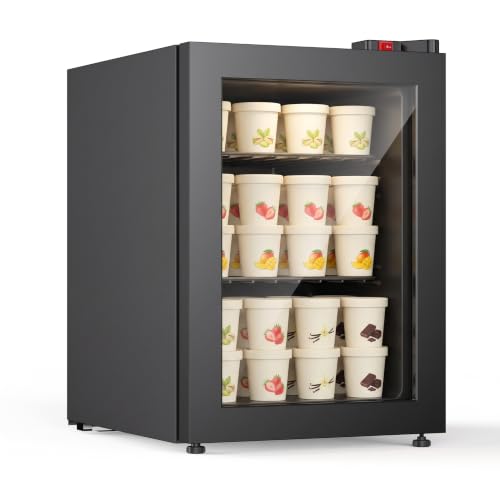
ADT 2.1 Cu Ft Glass Door Countertop Freezer — The till-side display
The ADT is the class in miniature: a 2.1 cubic foot glass door display mini freezer, a countertop upright that puts a small frozen offer at eye level exactly where buying decisions happen — beside the till, at the end of the counter, in the café’s last metre before the door. Its title is the tersest in the guide, stating format and size and nothing else, and this review follows it: no temperature range is claimed here, no certification is implied, and the buyer should collect both from the product page before trading from it. What the format itself guarantees is the merchandiser idea at its purest — frozen stock visible through glass, at arm’s reach, in a footprint a counter can spare.
Countertop placement has its own small disciplines, and a buyer should rehearse them before the little cabinet arrives. The counter must carry it level and uncomplaining, the vents must breathe rather than face a wall at an inch’s distance, and the door’s swing must clear the till, the card reader and the queue’s elbows. A 2.1 cabinet asks little, but it asks it in the most contested square metre of the entire shop, so the rehearsal is worth the ten minutes it takes. Shops that place it well report the same small miracle: a product category that did not exist in the business last month, paying for its counter space in frozen impulse sales.
The use case writes itself. A coffee shop sells a dozen tubs of ice cream a day it never sold before, because the tubs can be seen. A bakery freezes its own ready-bake stock where customers can point at it. A farm stand keeps its frozen berries beside the till instead of in a back room. In each case the cabinet’s smallness is the strategy: the display is an impulse instrument, and impulse needs a dozen facings at the decision point, not a warehouse behind a wall. Buyers should judge this pick by the metre of counter it will occupy and the products that will glow inside it.
As the entry point to the class, the little ADT also serves the cautious: a first display freezer, bought to test whether visible frozen stock sells in a particular shop, at a scale whose failure would be a lesson rather than a liability. If the test succeeds, the ladder below awaits; if the shop’s frozen future is genuinely countertop-sized, this may be the whole answer, honestly sized.
- Capacity as listed: 2.1 cu ft
- Format as listed: countertop upright display freezer
- Door as listed: glass door
- Not stated in the title: temperature range and certifications — confirm on the product page
- Where to buy: the ADT 2.1 countertop listing on Amazon — check price on Amazon
Strengths
- The merchandiser idea at countertop scale — visibility exactly at the point of sale.
- A low-commitment first display for testing a shop’s frozen offer.
- Fits the counters and cafés that floor models cannot enter.
Trade-offs
- Its title states no temperature range; trading buyers must verify it.
- Two cubic feet of display is an impulse range, not a frozen department.
- No lock or certification is claimed for stock that may need either.
Point-of-sale perfect: for cafés, bakeries and stands selling frozen by the glance. Pointless for: any buyer whose frozen stock is measured in trolley-loads.

KOOLOTS 12.1 Cu Ft Glass Door Merchandiser Freezer — The certified reach-in
The KOOLOTS 12.1 writes the most credentialled title in this guide: a commercial upright freezer of 12.1 cubic feet, a 24-inch reach-in display with a single glass door, a lock, energy-efficient positioning, manual defrost, and ETL, NSF and DOE certifications printed in the headline. Those three letter-groups are the review’s headline because they are a trading business’s shortlist in miniature. ETL speaks to electrical safety testing; NSF to the sanitation standards food premises are judged by; DOE to energy compliance. A buyer opening a shop, fitting a rental unit or answering to an insurer will be asked for exactly these assurances, and this is the only title here that answers before being asked.
The 24-inch width deserves a planner’s note, because it is the dimension around which small retail refrigeration is standardised. A cabinet of this width slips into the runs and alcoves that shops, market stalls and concessions are actually built with, shares its planning module with the undercounter and reach-in equipment around it, and can be replaced years later by any maker’s standard model without carpentry. Buying into a standard footprint is a quiet form of future-proofing that lifestyle appliances rarely offer, and it is one more reason the twelve-foot class is where serious small-shop buying concentrates.
The lock belongs to the same seriousness. A merchandiser stands in public space, and its stock is money behind glass; a lock converts the cabinet from a display anyone can open after hours into a secured store, which matters in shared premises, market halls and garage businesses alike. Manual defrost is the specification’s honest cost — the cabinet will want a planned defrost rhythm — and at 24 inches wide the whole package occupies the standard single-door merchandiser footprint that small shops are plumbed and powered around.
Energy-efficient positioning, claimed in the title, matters commercially because a merchandiser runs around the clock in a warm room; the DOE credential gives that claim a framework rather than leaving it as an adjective. Taken together, this is the guide’s most completely argued trading cabinet: certified, lockable, standard-footprinted, and honest about its defrost discipline. Shops buying their first serious reach-in should start their comparison here and make rivals argue against it.
- Capacity as listed: 12.1 cu ft
- Format as listed: 24-inch reach-in, single glass door merchandiser
- Security as listed: lock
- Defrost as listed: manual
- Certifications as listed: ETL, NSF and DOE
- Ordering route: the KOOLOTS 12.1 listing on Amazon is where to check price on Amazon
Strengths
- The only stated certification set in the guide — a trading buyer’s checklist in the title.
- A lock secures stock in public and shared premises.
- The standard 24-inch single-door footprint fits small-shop planning.
Trade-offs
- Manual defrost imposes a maintenance rhythm the auto-defrost rivals avoid.
- No temperature range is printed in the title; verify it on the product page.
- Its commercial specification is wasted on purely domestic daydreaming.
Trading-ready: for shops and sellers who must answer for their cabinet’s credentials. Over-credentialed for: a garage buyer who needs cold and glass and nothing else.

KoolMore KM-MFD-12GSG Glass Door Freezer — The stainless standard
KoolMore’s entry states its case with a commercial maker’s economy: a 12 cubic foot commercial freezer with a glass door in stainless steel, manual defrost, model KM-MFD-12GSG. Where its 12.1 rival argues by credentials, this model argues by material and maker. Stainless steel is the commercial kitchen’s native finish for reasons that compound over years — it shrugs off the knocks of a working premises, cleans to an inspector’s standard, and presents a front-of-house face that can stand in customer view without apology. A glass-door cabinet lives in customer view by definition, so its cabinet finish is part of its display, and stainless is the finish that ages most gracefully in that role.
KoolMore’s commercial focus is the context: this is a maker whose catalogue serves restaurants and food retail, and the model-code formality of the listing — KM-MFD-12GSG — is the dialect of equipment bought by specification rather than by lifestyle. Manual defrost matches the KOOLOTS, imposing the same planned rhythm, and the 12 cubic foot size sits in the same standard class, so the two models invite a direct comparison in which the buyer weighs stated certifications against stated material and maker’s trade lineage. This guide declines to invent a winner between them; it notes that the questions are different, and that a buyer should know which question their premises is asking.
Stainless deserves one more commercial observation, because a display cabinet’s exterior is worked harder than a storage cabinet’s. It is leaned on, wiped down between customers, scuffed by crates and cleaned with whatever the premises uses at closing time. A finish chosen for that life is not vanity; it is the difference between a cabinet that looks like an asset in year four and one that looks like a survivor. Front-of-house equipment is judged by customers who never consciously judge it, and the KoolMore’s material is the quiet answer to that unconscious audit.
Temperature range and certifications are not printed in this title, and the commercial buyer should collect both from the product page with the same rigour applied to the ADT. What the title does establish — size class, glass door, stainless construction, defrost type, a commercial maker’s model — is a coherent, professional specification for the small shop or serious garage business that wants its display cabinet to look like equipment and last like it.
- Capacity as listed: 12 cu ft
- Format as listed: commercial freezer with glass door
- Finish as listed: stainless steel
- Defrost as listed: manual
- Model as listed: KM-MFD-12GSG
- Where to buy: the KoolMore KM-MFD-12GSG listing on Amazon — check price on Amazon
Strengths
- Stainless construction suits front-of-house commercial duty and hard cleaning.
- A commercial equipment maker’s model, specified in trade dialect.
- The standard twelve-foot class, directly comparable with its certified rival.
Trade-offs
- No certifications are printed in the title, unlike the KOOLOTS.
- Manual defrost, with the same planned rhythm its rival imposes.
- Temperature range is a product-page verification, not a headline fact.
Equipment-minded: for premises where the cabinet must look and last like trade kit. Credential-first buyers: the KOOLOTS above prints its letters in the title.
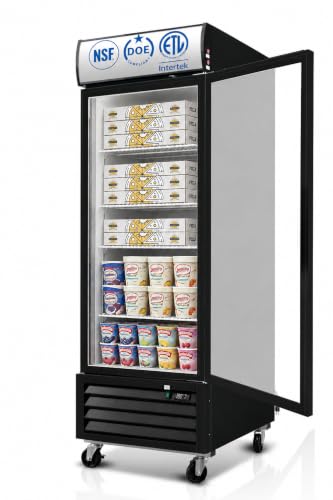
27-Inch 16.6 Cu Ft Display Freezer With Glass Door — The triple-pane performer
This unbranded 27-inch display freezer writes the most technically detailed title in the guide: a commercial upright merchandiser of 16.6 cubic feet with a triple-pane glass door, a stated temperature range of -8 to -1 degrees Fahrenheit, auto defrost, and an LED sensor light. Each element answers a known merchandiser weakness. Triple-pane glass attacks the format’s insulation problem at its weakest surface — three layers between the warm shop and the frozen interior, reducing both the compressor’s labour and the condensation that fogs lesser doors. The stated range is a proper frozen band, printed where a buyer can hold the seller to it. Auto defrost removes the manual rhythm the twelve-foot pair impose. And a sensor light — illumination that responds rather than burning constantly — treats the display’s running costs as a design problem rather than an inevitability.
The 27-inch width and 16.6 capacity move the class up a tier: this is a frozen department in one door, for the shop whose frozen range has outgrown a standard reach-in but whose floor cannot take a two-door cabinet. The title’s own positioning — offered as a good choice for commercial premises — is stated without a maker’s name, so the buyer’s verification burden is the familiar unbranded one: the product page and seller carry the warranty story. What the title itself establishes is a specification of unusual completeness, and completeness in a headline is a form of confidence a buyer can weigh.
The sensor light, easily skimmed past in the title, deserves its own commercial logic. A display light that responds — brightening for the customer at the glass, resting when the shop is empty — spends its electricity only when the display is being read, and it spares the stock the constant radiant warmth of an always-on lamp at close quarters. Multiplied across a cabinet’s years of trading hours, that restraint is a real operating saving wearing a small feature’s clothes, and it signals a maker who has thought about the merchandiser as a cost centre as well as a sales tool. Buyers comparing running costs across this guide will find few other titles that address the question at all.
For the growing shop, this is the step-up pick: more display, better glass, automatic defrost discipline and a printed temperature promise, in a single-door footprint only three inches wider than standard. Its claims are the most checkable in the guide after the KOOLOTS’s certifications, and a buyer comparing the two is really comparing philosophies — credentials versus engineering detail — both of which are respectable ways to buy equipment.
- Capacity as listed: 16.6 cu ft
- Width as listed: 27 inches
- Glass as listed: triple-pane door
- Temperature as listed: -8 to -1 degrees Fahrenheit
- Defrost as listed: auto
- Lighting as listed: LED sensor light
- Purchase path: this 27-inch display model’s Amazon listing is where to check price on Amazon
Strengths
- Triple-pane glass addresses the merchandiser format’s weakest surface.
- A printed temperature range and auto defrost — the complete working specification.
- Sensor lighting trims the display’s constant running cost.
Trade-offs
- Unbranded: the warranty and service story is a product-page investigation.
- No certifications are printed in its detailed title.
- At 27 inches and 16.6 cu ft it needs a measured door route and floor plan.
Growth-stage shops: a department’s worth of display with its engineering stated. Micro-shops: the twelve-foot class above is your honest scale.

BODEGACOOLER 18 Cu Ft Glass Door Display Freezer — The wide-range worker
BODEGACOOLER’s upright states the widest temperature span in this guide: a commercial display freezer of 18 cubic feet with a single glass door, a stated range of -15 to 5 degrees Fahrenheit, and auto defrost, built for standing display duty. The bottom of that range is the coldest figure printed anywhere here — colder than standard frozen duty, suited to stock that rewards deep cold and to ice cream held at a firm, scoop-resisting set — while the top of the range reaches toward fresh temperatures, giving the cabinet a flexibility the narrower-band models do not claim. A shop whose stock changes with the seasons, or whose frozen offer mixes deep-cold staples with softer serve-adjacent products, is the natural reader of that span.
At 18 cubic feet behind one door, this is a large single merchandiser, and auto defrost is the correct companion at that scale: a cabinet holding this much trading stock cannot be emptied casually for a manual defrost day, so the machine takes the discipline onto itself. BODEGACOOLER’s name will be familiar to readers of this site’s portable refrigeration coverage, where the maker works the vehicle-and-camping end of cold; here the same badge stands still at shop scale, which is a reminder that display freezing and portable freezing are neighbouring trades with different flagship products.
Temperature flexibility has a planning consequence worth spelling out for the mixed-stock shop. A cabinet that can hold -15 at the bottom of its range and rise toward fresh temperatures at the top can follow a business through its own evolution — deep-frozen staples this year, a chilled-adjacent line next year, a seasonal swing between them — without the cabinet itself becoming the constraint. Equipment that outlives the business plan it was bought under is rare enough to be worth naming as a virtue, and the stated span in this title is the only claim in the guide that makes that promise in numbers.
The title prints no certifications and no lock, and a trading buyer should verify both needs on the product page. What it prints — size, door, the widest stated range, automatic defrost — is the specification of a working shop cabinet whose argument is temperature flexibility at volume. Shops that have been running two narrower cabinets for two temperature jobs should look at this one hardest: consolidation behind a single glass door is exactly the purchase its range describes.
- Capacity as listed: 18 cu ft
- Format as listed: upright, one door, standing display
- Temperature as listed: -15 to 5 degrees Fahrenheit — the widest span here
- Defrost as listed: auto
- Where to buy: the BODEGACOOLER 18 display listing on Amazon — check price on Amazon
Strengths
- The widest and coldest stated temperature range in the guide.
- Auto defrost suits a cabinet too fully stocked to empty casually.
- Eighteen cubic feet of single-door display for a serious frozen range.
Trade-offs
- No lock or certifications are printed in the title.
- Its range’s flexibility is wasted on a single-temperature stock.
- A large cabinet’s freight and placement need planning, not improvisation.
Mixed-stock shops: two temperature jobs behind one door. Single-product sellers: a narrower cabinet will hold your one temperature with less machinery.

ECEVT 23 Cu Ft Display Freezer With Glass Door — The canopy flagship
The ECEVT closes the ladder at flagship scale: a commercial display freezer of 23 cubic feet behind a single 27-inch door, an upright merchandiser with LED lighting, adjustable shelves and a lighted canopy. The canopy is the detail that declares the cabinet’s intent. A lighted canopy is signage real estate — the illuminated panel above the door where a shop puts its name, its brand or its frozen offer’s promise — and its presence marks this as a machine designed to anchor a retail space rather than merely to stand in one. Twenty-three cubic feet behind it is a wall of stock: the largest single-door display in this guide, for the shop whose frozen range is a department and a destination.
The canopy deserves its own commercial footnote, because signage is where a flagship stops being equipment and becomes architecture. A lighted canopy can carry the shop’s name into the street-facing sightline, brand a concession inside a larger premises, or simply mark the frozen department across a big floor so customers navigate by it. Premises that rent their frozen space to brands, or that trade on a name worth lighting, will read the canopy as the model’s headline rather than its garnish. Premises that do not need signage should still weigh it honestly — an unlit canopy is wasted height, and the twelve and sixteen-foot models spend that height on stock instead.
Adjustable shelves at this scale are the merchandising system itself. Frozen stock arrives in heights that change with every supplier and season, and a cabinet whose shelves move lets the shopkeeper re-plan the display as the range evolves — tall tubs this month, bagged goods the next — without wasting the vertical inches that are a merchandiser’s whole economy. LED lighting, stated plainly in the title, is the flagship’s expected illumination: bright, cool-running and kind to the stock it shows.
Defrost type and temperature range are not printed in this title, and at this size those omissions are the buyer’s first product-page questions, alongside freight terms — a 23 cubic foot cabinet travels as serious freight and enters through a measured door or not at all. What the title establishes is the flagship proposition in full: maximum single-door display, signage above it, shelving that adapts, light that sells. For the premises that can fill it, nothing else in this guide is playing the same game.
- Capacity as listed: 23 cu ft — the largest here
- Format as listed: 27-inch single-door upright merchandiser
- Signage as listed: lighted canopy
- Interior as listed: LED lighting, adjustable shelves
- Not stated in the title: temperature range and defrost type — confirm on the product page
- Ordering route: find the ECEVT 23 flagship through its Amazon listing to check price on Amazon
Strengths
- The biggest single-door display in the guide, with signage built in.
- Adjustable shelves let the display follow the stock’s changing shapes.
- A flagship presence that anchors a shop’s frozen department visually.
Trade-offs
- Its headline omits temperature range and defrost type — verify both.
- Freight, doorways and floor loading are genuine projects at this scale.
- A half-filled flagship advertises the wrong thing; buy it to fill it.
Department-scale sellers: the wall of frozen retail, canopy lit. Department-dreamers: a half-empty flagship is worse than a full twelve-footer.
What Does It Cost a Shop to Run Glass Instead of Steel?
The honest answer is structural rather than numerical, because no title in this guide prints a consumption figure and this guide invents none. Glass gives up heat more readily than an insulated solid door, a display cabinet is opened by customers rather than by one disciplined owner, and interior lighting — however efficient its technology — is a load a storage freezer never carries. A merchandiser therefore works harder than a same-size storage cabinet, and its buyer should budget for that character in the running costs and in the compressor’s working life. The DOE credential printed in the KOOLOTS’s title exists precisely because this class’s efficiency is regulated and comparable; buyers for whom running cost is a first-order concern should make that credential, and the product pages’ energy figures, part of the shortlist arithmetic.
Against the cost stands the revenue logic that justifies the entire class: frozen stock that can be seen sells faster and at better margins than stock that must be asked for, and a cabinet that moves a shop’s frozen range from the back room to the customer’s eyeline is earning its electricity in the most literal sense. The correct comparison for a trader is never merchandiser versus chest on running cost alone; it is merchandiser versus the sales the chest never makes. Shops that run that arithmetic honestly usually find the glass pays for its appetite — and shops whose frozen range is a courtesy rather than a business line usually find the opposite, which is equally useful knowledge before the freight is booked.
The Merchandiser Ladder, Compared
| Model | Capacity | Stated range | Defrost | Signature |
|---|---|---|---|---|
| ADT Countertop | 2.1 cu ft | Not stated | Not stated | Point-of-sale miniature |
| KOOLOTS Merchandiser | 12.1 cu ft | Not stated | Manual | ETL, NSF, DOE; lock |
| KoolMore KM-MFD-12GSG | 12 cu ft | Not stated | Manual | Stainless steel, trade maker |
| 27-Inch Display Freezer | 16.6 cu ft | -8 to -1 degrees | Auto | Triple-pane glass, sensor light |
| BODEGACOOLER Display | 18 cu ft | -15 to 5 degrees | Auto | Widest stated range |
| ECEVT Merchandiser | 23 cu ft | Not stated | Not stated | Lighted canopy, adjustable shelves |
The table’s gaps are information, printed as gaps on this guide’s standing rule: three titles state no temperature range, and a commercial buyer should treat collecting those figures as the first act of shortlisting. What the table does show cleanly is the class’s shape — a ladder from countertop to flagship, a defrost divide at the middle, and two different philosophies of proof, certification and engineering detail, competing at the standard size.
How Should a Merchandiser Be Sited, Powered and Stocked?
Siting begins with the route, not the destination: measure every doorway, turn and threshold between the street and the cabinet’s final metre, because a merchandiser that cannot enter the building is an expensive pavement ornament. At the destination it wants level floor, clearance at its vents, and a position where the glass works — facing the customer’s natural path, lit by its own interior rather than fighting the shop’s glare. Power wants the same foresight as any commercial appliance: a suitable circuit, a cord that lives unchafed, and a socket position that does not ask the cabinet to stand off the wall. Kitchens at domestic scale face a smaller version of the same permanence problem, a kinship our colleagues explore in the guide to Best Small Dishwashers, where an appliance is likewise chosen once and then lived with daily for years.
Stocking is merchandising, and it has rules of its own. Face the labels, group by the customer’s logic rather than the supplier’s, keep the eye-level shelves for the lines that must move, and never let the display run visibly thin — a merchandiser’s abundance is its advertisement, and a sparse cabinet tells the room the frozen offer is an afterthought. Rotate stock with the same first-in-first-out discipline the freezer guides in this series preach, because visible stock is auditable stock, and the glass that sells the food also dates it in public.
Temperature verification is the siting habit that separates professional premises from hopeful ones. A merchandiser’s own display or dial is a claim; an independent thermometer resting among the stock is evidence, and the two should be compared in the first week and whenever the season turns. Stock held for sale carries obligations that a household freezer never faces, and the shop that can show its temperatures were known, not assumed, is the shop that survives the awkward questions. The habit costs almost nothing and belongs in the same closing-time routine as the glass cleaning and the seal check.
Finally, plan the cabinet’s care as a shop rhythm: glass cleaned to a sparkle on a schedule, since fingerprints are the tax visibility pays; door seals checked; the defrost discipline — manual or automatic — understood by whoever closes the shop. A merchandiser is the hardest-working piece of furniture in a retail premises, and it repays being managed like the revenue asset it is.
What Mistakes Do Glass-Door Freezer Buyers Keep Making?
The first and largest is category confusion: buying a merchandiser as a domestic freezer and discovering that a commercial cabinet’s scale, sound and running character belong to a shop floor. This guide’s opening frame exists to prevent exactly that purchase. The second is shortlisting on capacity while leaving temperature range unverified — three of these six titles print no range, and a cabinet that cannot hold a stock’s required temperature fails at its only job. The third is forgetting the freight and the doorway, and meeting the cabinet’s dimensions for the first time on the pavement outside the shop.
The quieter mistakes are commercial rather than mechanical. Buyers under-fill a flagship, turning its abundance advertising into an apology; they place the glass where the shop’s light fights it; they skip the lock on a cabinet standing in shared premises; they ignore certification questions until an inspector or an insurer asks them, at which point the answers cost far more than the KOOLOTS’s title charges. And they treat the display as storage that happens to be visible, rather than as selling that happens to be cold — the inversion that separates the shops whose freezers earn from the shops whose freezers merely run. The same inversion, in a domestic dialect, runs through our guide to Best Dishwashers for Pots, where an appliance likewise succeeds only when it is chosen for the work it will actually be given.
Final Recommendation
Buy the rung of the ladder your trade actually stands on. The ADT is the honest first display — a countertop test of whether visible frozen stock sells in your shop. At the standard size, choose the KOOLOTS when credentials and a lock lead your checklist, and the KoolMore when stainless construction and a trade maker’s lineage matter more. Growing shops should step up to the 27-inch display for its triple-pane glass, stated range and automatic defrost; mixed-stock sellers should weigh the BODEGACOOLER’s wide temperature span; and the ECEVT is the flagship for premises ready to fill twenty-three cubic feet and light the canopy above them. Verify every unstated range on the product page, measure the route before the freight, and the glass door will do the rest — because a freezer that shows its stock honestly, at the right temperature, in the right shop, is not merely storing the business; it is quietly, visibly, selling it.
Frequently Asked Questions
Can I use a glass door freezer as my home kitchen freezer?
You can stand one in a home, but you should not mistake it for a kitchen appliance. These are commercial merchandisers: shop-scale cabinets built for display duty, customer traffic and commercial running rhythms. In a garage, workshop or home-business setting those traits are virtues, and several picks here serve exactly that territory. In a fitted kitchen, a domestic freezer’s insulation, scale and manners will serve better, and this guide’s honesty about the class exists to steer that buyer correctly.
Why do some titles print a temperature range and others not?
Because makers choose their headlines differently — some lead with engineering, some with size, some with credentials. This guide claims a range only where a title prints one: -8 to -1 degrees on the 16.6 display, -15 to 5 on the BODEGACOOLER. For every other model the range is a product-page fact, and a commercial buyer should collect it before shortlisting, since a cabinet’s range decides which stocks it may legally and safely hold.
Manual or auto defrost: which suits a small shop?
It depends on the shop’s rhythm. Manual defrost, on the KOOLOTS and KoolMore, means a planned emptying on the shop’s schedule — acceptable where stock turns over and a quiet morning exists for the job. Auto defrost, on the 16.6 display and the BODEGACOOLER, removes that appointment and suits cabinets too full or too busy to empty. Busy, fully stocked shops generally earn back auto defrost; quieter premises may never miss it.
What do the KOOLOTS certifications actually cover?
Its title prints ETL, NSF and DOE. In brief: ETL marks tested electrical safety, NSF speaks to sanitation standards for food premises, and DOE to energy compliance. Together they are the credentials a trading business is most often asked to produce — to inspectors, landlords and insurers — which is why this guide treats their presence in a title as a first-order buying fact rather than fine print.
How does a merchandiser arrive, and what should be ready for it?
As freight, on a pallet, at a weight and width that deserve respect. Before ordering, measure the full route from street to final position — doors, turns, steps, the shop’s own counters — and confirm the delivery terms on the product page, including whether the service is kerbside or in-position. Have the floor space cleared, the socket ready and a second pair of hands arranged. Cabinets in this class reward the prepared premises and punish the improvised one, and the preparation costs an hour while the improvisation can cost a doorway.
How much stock should a merchandiser hold to look right?
Full enough that the display reads as abundance, organised enough that every line can be found and rotated. A merchandiser is an advertisement that freezes; a half-empty flagship like the 23 cubic foot ECEVT advertises hesitation, while a well-filled twelve-foot cabinet advertises a business. Match the cabinet to the stock you genuinely carry — the ladder in this guide exists so that no shop has to choose between a cabinet it cannot fill and one it cannot fit.
Related Guides
Readers furnishing commercial cold storage beyond the display case may pair this guide with our coverage of Best Commercial Upright Freezers, where the same premises-class cabinets are reviewed with solid doors and storage rather than selling in mind. Between the glass and the steel, a shop can plan its whole frozen operation: what the customer sees, and what the business keeps behind it.


